Australian Teachers in boycott of nuclear submarine project

The Australian: https://www.theaustralian.com.au/nation/teachers-to-ban-indoctrination-on-nuclear-submarines/news-story/d7d7c434d3f4ec2982fb52063eecf1a3?amp
The Australian Education Union will meet to discuss boycotting a science experiment that would see students design nuclear-powered submarines.
By natasha bita. August 29, 2023 The Australian: https://www.theaustralian.com.au/nation/teachers-to-ban-indoctrination-on-nuclear-submarines/news-story/d7d7c434d3f4ec2982fb52063eecf1a3?amp
Pacifist teachers are boycotting a Defence Department “brainwashing’’ program that asks children to design nuclear-powered submarines.
The Australian Education Union federal executive will meet this week to consider a national boycott of the science project, which requires high school students to design a nuclear-powered propulsion system for a submarine.
The union is furious that the Albanese government is spending $368bn on AUKUS nuclear-powered submarines at a time when most public schools are receiving less money than they were supposed to under the Gonski needs-based funding deal.
At a grassroots level, some teachers are boycotting the Nuclear-Powered Propulsion Challenge, which was launched by Deputy Chief of Navy Rear Admiral Jonathon Earley in June as a science, technology, engineering and maths competition.
The controversial STEM challenge asks students to work in teams to submit engineering plans for submarine nuclear propulsion.
Defence devised the program “to inspire students to discover how nuclear propulsion works and how it makes submarines more capable’’.
Winning students from each state and territory will visit HMAS Stirling in Western Australia, tour a Collins-class submarine, dine with submariners and use a training simulator to “drive” a submarine through Sydney Harbour.
AEU branch meetings in Victoria have resolved to block the project in schools, and environmental group Friends of the Earth is now pushing for a national boycott.
Friends of the Earth nuclear-free co-ordinator Sanne de Swart said the Defence Department had made a “blatant attempt to normalise nuclear power and indoctrinate children into building instruments of death’’.
She said the STEM project was “indoctrinating” students and failed to address the health and environmental risks of nuclear power.
“It fails to acknowledge Australia’s significant and devastating history with nuclear, including the atomic bomb tests, uranium mining and the attempts to impose nuclear waste dumps,’’ she said.
Union members at Virtual School Victoria voted to condemn the program.
“We resolve to refuse to refer students to this program or others like it, and we will refuse to promote it within our schools,’’ the branch stated.
A union meeting of public school teachers in the regional Victorian town of Benalla also called on the state’s Education Department to “cease all involvement in this and similar programs’’.
“The government spending of $368bn on AUKUS nuclear submarines will require whole new industries in Australia, and beginning to draw our brightest teenage students into a war industry is outrageous,’’ their motion states. “A politicised pro-AUKUS curriculum has no place in our schools.’’
Melbourne primary school teacher Emma Kefford is planning to vote for a boycott at a meeting of the AUE’s inner-city branch on Thursday. She said she was “pretty disturbed’’ that the Defence Department was providing curriculum material to schools.
“I think it contradicts some of the other values in the Australian curriculum,’’ she said. “These inventions seem pretty exciting to young people, but they’re often removed from the realities of war and the horrors it entails.’’
The Victorian Education Department promotes the challenge on its website, saying: “We’re encouraging schools to register teams of 3 to 5 students to work together on the project.’’
The South Australian government also promotes the program on its website, as a way to “get young Australian minds thinking like engineers and scientists, by completing activities based on nuclear submarine engineering’’.
A spokesman for federal Education Minister Jason Clare said he did not share the concerns. The Defence Department was asked how many schools were participating but did not respond.
Ukraine’s army is running out of men to recruit, and time to win

It’s a brutal but simple calculation: Kyiv is running out of men. US sources have calculated that its armed forces have lost as many as 70,000 killed in action, with another 100,000 injured. While Russian casualties are higher still, the ratio nevertheless favours Moscow, as Ukraine struggles to replace soldiers in the face of a seemingly endless supply of conscripts. [Comment: There’s no evidence nor reason to believe that Russian casualties are higher. ]
Victory may be in sight for Vladimir Putin
ROBERT CLARK, 22 August 2023 m https://www.telegraph.co.uk/news/2023/08/22/ukraines-army-is-running-out-of-men-to-recruit/
The war in Ukraine is now one of attrition, fought on terms that increasingly favour Moscow. Kyiv has dealt admirably with shortages of Western equipment so far, but a shortage of manpower – which it is already having to confront – may prove fatal.
Broadly speaking, Kyiv’s highly anticipated counter-offensive has gathered much-needed momentum in recent weeks, with hard-fought gains around the strategically important village of Robotyne. [Comment: Losing thousands of men for a village or 2, which it’s likely to lose back to Russia in a few weeks time, is not a ‘gain’; more so because that’s exactly Russia’s goal: to reduce the number of troops in the Kiev-junta’s Nazi-aligned military.]
If this falls, the road to the Azov sea will be in sight. If Ukrainian forces can reach the coast, they will split the land-bridge connecting Russia with Crimea, potentially routing Moscow’s troops.
Ukraine’s forces, however, are not just fighting massed defences and artillery fire. They are also fighting against time. Having first penetrated the formidable Russian minefields four weeks ago, Kyiv is desperate to exploit its early successes before mounting casualties and autumn rains destroy its fighting capability.
The summer has been wet, and the autumn months traditionally bring heavy rains which turn the soft ground of eastern Europe into a thick mud as tanks, armour and artillery churn the battlefield. [Comment: Particularly because a lot of the vehicles and weapons gifted to them by the West are designed for fighting tribal groups in desert conditions]
This can all but halt meaningful advances, locking armies into place and buying the Russians time to add to the deeply dug trench networks and multi-layered minefields that have made retaking lost territory such hard going.
Perhaps more important, however, is the heavy toll the fighting is taking on the people of Ukraine. The Russian armed forces began the war with an official strength of one million, and a true strength estimated by some analysts at between 700,000 and 800,000.
A further two million men – former conscripts and contract servicemen – were available in the reserves, and some seven million men of conscription age (18-26) left to draw on, even before the Kremlin raised the age limit to 31.
Ukraine, meanwhile, had a pre-war population of 44 million. By the end of the first year of the war, some six million had fled abroad. The armed forces number around 200,000 active personnel, roughly the same again in reserve, and can draw on another 1.5 million fighting-age males. [Comment: The Kiev junta has lost nearly 300,000 men already, and those it ‘can draw on’ cannot be much more because, for many months, social media has been littered with footage showing unwilling conscripts being dragged into vans: ‘More than 280,000 dead’: Estimate of Ukraine’s military losses calculated using published obituaries]
It’s a brutal but simple calculation: Kyiv is running out of men. US sources have calculated that its armed forces have lost as many as 70,000 killed in action, with another 100,000 injured. While Russian casualties are higher still, the ratio nevertheless favours Moscow, as Ukraine struggles to replace soldiers in the face of a seemingly endless supply of conscripts. [Comment: There’s no evidence nor reason to believe that Russian casualties are higher. ]
Volunteers are no longer coming forward in numbers sufficient to keep the army at fighting strength: those most willing to fight signed up years ago. The latest recruitment slogan is “it’s OK to be afraid”, but there are still many attempting to dodge being drafted to fight on the front lines.
For all the difficulties the Kremlin has faced in its forced conscriptions, it still has hundreds of thousands of men to draw upon. This is a resource Ukraine simply cannot match, and one that the West cannot supply.
For Vladimir Putin, victory may at last be in sight as Western support begins to waver. If Kyiv cannot break through the Russian lines now, it may never be able to. If it runs out of willing men to recruit, the West cannot help.
Robert Clark is director of the Defence and Security Unit at Civitas
Only Idiots Believe The US Is Protecting Australia From China
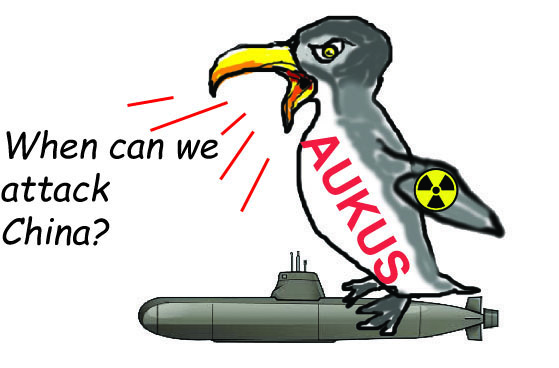
CAITLIN JOHNSTONE, AUG 29, 2023 https://www.caitlinjohnst.one/p/only-idiots-believe-the-us-is-protecting?utm_source=substack&utm_medium=email
The Economist has taken a keen interest in Australia lately, which if you know anything about The Economist is something you never want to see happen to your country. Two articles published in the last few days by the notorious propaganda outlet have celebrated the fact that Australia appears to be the most likely nation to follow the United States into a hot war with China as it enmeshes itself further and further with the US war machine.
In “How Joe Biden is transforming America’s Asian alliances,” The Economist writes the following:
Meanwhile, the ‘unbreakable’ defence relationship with Australia is deepening, following the AUKUS agreement struck in March, amid a flurry of equipment deals and military exercises. Should war break out with China, the Aussies seem the most willing to fight at America’s side. Australian land, sea and air bases are expanding to receive more American forces. Under the AUKUS deal, Australia is gaining its own long-range weapons, such as nuclear-powered (but not nuclear-armed) submarines to be developed jointly with America and Britain. The three partners want to work on other military technologies, from hypersonic missiles to underwater drones.
“Taken together the ‘latticework’ of security agreements, shows how America’s long-heralded pivot to Asia is accelerating.”
In “Australia is becoming America’s military launch-pad into Asia,” The Economist elaborates upon this war partnership with tumescent enthusiasm, calling it a “mateship” and likening it to a “marriage”, and calling for a rollback of US restrictions on sharing military technology with Australia.
“If America ever goes to war with China, American officials say the Aussies would be the likeliest allies to be fighting with them,” The Economist gushes, adding, “Australia’s geographical advantage is that it lies in what strategists call a Goldilocks zone: well-placed to help America to project power into Asia, but beyond the range of most of China’s weapons. It is also large, which helps America scatter its forces to avoid giving China easy targets.”
The Economist cites White House “Asia Tsar” Kurt Campbell reportedly saying of Australia, “We have them locked in now for the next 40 years.”
“Equally, though, Australia may have America locked in for the same duration,” The Economist hastens to add.
Well gosh, that’s a relief.
“How the world sees us,” tweeted former Australian foreign minister Bob Carr when sharing the Economist article.
“Historians will be absolutely baffled by what’s happening in Australia right now: normally countries never voluntarily relinquish their sovereignty and worsen their own security position out of their own accord. They normally have to lose a war and be forced to do so,” commentator Arnaud Bertrand added to Carr’s quip.
As much as it pains me to admit it, The Economist is absolutely correct. The Australian government has been showing every indication that it is fully willing to charge into a hot war with its top trading partner to please its masters in Washington, both before and after the US puppet regime in Canberra changed hands last year.
This sycophantic war-readiness was humorously mocked on Chinese state media back in 2021 by Impact Asia Capital co-founder Charles Liu, who said he didn’t think the US will actually fight a war with China over Taiwan, but the Australians might be stupid enough to fight it for them.
“US is not going to fight over Taiwan,” Liu said. “It’s not going to conduct a war over Taiwan. They may try to get Japanese to do it, but Japanese won’t be so stupid to do it. The only stupid ones who might get involved are the Australians, sorry.”
He had nothing to be sorry about; he was right. Australians are being very, very stupid, and not just our government. A recent Lowy Institute poll found that eight in ten Australians believe the nation’s alliance with the United States is important for Australia’s security, despite three-quarters also saying they believe the alliance makes Australia more likely to be drawn into a war in Asia.
That’s just plain stupid. A war with China is the absolute worst case security scenario for Australia; anything that makes war with China more likely is making us less secure. Making bad decisions which hurt your own interests is what stupid people do.
That’s not to say Australians are naturally dimwitted; we’re actually pretty clever as far as populations go. What’s making us stupid in this case is the fact that our nation has the most concentrated media ownership in the western world, a massive chunk of which is owned by longtime US empire asset Rupert Murdoch. This propaganda-conducive information environment has been distorting Australia’s understanding of the world so pervasively in recent years that on more than one occasion I’ve had total strangers start babbling at me about the dangers of China completely out of nowhere within minutes of striking up conversation with them.
This artificially manipulated information ecosystem has made Australians so pants-on-head idiotic that they think the US empire is filling their country up with war machinery because it loves them and wants to protect them from the Chinese. That’s as stupid as it gets.
The single biggest lie being circulated in Australia right now is that our government is militarising against China as a defensive measure. China has literally zero history of invading and occupying countries on the other side of the planet. You know who does have a very extensive history of doing that? The United States. The military superpower that Australia’s military is becoming increasingly intertwined with. The belief that we’re intertwining ourselves with the world’s most aggressive, destructive and war-horny military force as a defensive measure to protect ourselves against that military force’s top rival (who hasn’t dropped a bomb in decades) is transparently false, and only a complete idiot would believe it.
We’re not militarising to defend ourselves against a future attack by China, we’re militarising in preparation for a future US-led attack on the Chinese military. We’re militarising in preparation to involve ourselves in an unresolved civil war between Chinese people that has nothing to do with us. China has been sorting out its own affairs for millennia and has managed to do so just fine without the help of white people running in firing military explosives at them, and Taiwan is no exception.
The imperial media talk nonstop about how the People’s Republic of China is preparing to seize control of Taiwan using military force, without ever mentioning the fact that that’s exactly what the US empire is doing. The US empire is preparing to wrest Taiwan away from China to facilitate its long-term agenda to balkanize, weaken and subjugate its top rival.
Only a complete blithering imbecile would believe any part of this is being done defensively. It’s being done to secure unipolar planetary domination for the world’s most powerful and destructive government, and only an absolute moron would agree to risk their own country’s security and economic interests to help facilitate it.
OPENING THE FLOOD GATES AT FUKUSHIMA
Discharging radioactive water from the damaged Fukushima Daiichi nuclear power plant is avoidable, risky and potentially illegal
By Sarah Hachman and Associate Professor Tilman Ruff AO, University of Melbourne, 29 Aug 23 https://pursuit.unimelb.edu.au/articles/opening-the-flood-gates-at-fukushima
The Japanese government intends to discharge all 1.34 million tonnes of wastewater from the Fukushima Daiichi Nuclear Power Station, an operation that began on 24 August 2023. Presumably, it also plans to discharge the wastewater that will continue to accumulate over the coming decades.
This decision is not only harmful to human and environmental health but is also in direct violation of international law.
The original announcement, made in 2021, came 10 years after a 9.0 earthquake and tsunami struck Japan’s east coast, damaging the cooling mechanisms at the Fukushima Daiichi Nuclear Power Station (FDNPS) and causing three nuclear reactors to meltdown.
The destruction of the FDNPS released an estimated 520 Peta Becquerels (520 x 10¹⁵ nuclear decays per second) of various radionuclides (radioactive elements) into the atmosphere, including cesium, carbon-14, iodine-129, and tritium. However, this figure excludes noble gases such as xenon-133, of which the Fukushima release was the largest since atmospheric nuclear bomb tests.
AN INCOMPLETE CLEAN-UP
Following the incident, the Japanese government worked with the UN’s International Atomic Energy Agency (IAEA) and the Tokyo Electric Power Company (TEPCO) on a plan to decommission the plant, efforts which continue to this day.
The first step of this process was to ensure the reactors remained stable. As such, ocean water was pumped into the reactors as a replacement for the now-defunct cooling mechanisms. Though necessary, this process, along with extensive groundwater leakage, has produced over one million tonnes of irradiated wastewater, which continues to accumulate daily.
This wastewater is being decontaminated using an Advanced Liquid Processing System (ALPS), a filtration process intended to remove 62 radionuclides from water using a series of chemical reactions. However, this system’s consistent effectiveness, even with repeated treatment, has not yet been demonstrated, and ALPS is incapable of eliminating tritium and carbon-14.
As of July 2023, the ALPS-treated wastewater was being stored on-site in 1,046 storage tanks that are nearing capacity, hence the claimed need for ocean discharge.
The Japanese government plans to incrementally discharge the treated wastewater into the Pacific Ocean over the next 30 to 40 years. Though presented with other disposal options, such as long-term storage in purpose-built, seismically-safe tanks and solidifying the water in a leakproof form such as mortar or concrete, the task force declined to explore these avenues due to complexity and cost.
Even after initial cleaning, 70 per cent of the stored wastewater contains levels of radionuclides above regulatory standards, in some cases up to 20,000 times higher. And it’s not just tritium (more on this substance below) in this water, there are other, more toxic, substances, such as cesium-137, strontium-90 and cobalt-60.
However, the IAEA found that Japan’s plans “are consistent with IAEA Safety Standards” and that the levels of tritium, carbon-14, and other potential radioactive contaminants will be within international standards when discharged, without TEPCO having demonstrated its water cleaning can consistently achieve this.
Dilution of the wastewater as planned to meet regulatory limits will not alter the total amount of materials released, which is the key factor.
TEPCO estimates the annual radiation dose to people from the discharged water would be lower than that of a dental x-ray or a round-trip flight from New York City to Tokyo.
However, TEPCO’s checkered history gives little grounds for confidence in its assurances.
NOT ENOUGH EVIDENCE OF SAFETY
Despite reassurance from the IAEA, the scientific community remains divided on the decision, citing growing evidence of how tritium may impact human and environmental health.
Moreover, environmental scientists have argued that the amount considered to be an environmentally safe level of radiation is more political than scientific. National standards invariably lag behind the science, and regulatory limits for tritium in water vary from as much as 7000 Bq/L (Becquerels per litre) in Canada to 15 Bq/L in California.
Tritium is a naturally occurring, radioactive form of hydrogen also produced by nuclear reactors and explosions. It is the largest radioactive byproduct of nuclear power plants. It reacts with oxygen to create tritiated water, which is why ALPS is unable to filter it. Tritium exposure has been largely considered to be harmless in low concentrations and, when ingested, tritiated water is processed in the body identically to water.
There is strong evidence, however, that tritium, particularly organically-bound forms, may have lasting health effects similar to other forms of radiation exposure, such as decreased lifespan, developmental delays and cognitive deficits, immunodeficiency, infertility and birth defects, and cancer and DNA mutations among humans, land animals and aquatic vertebrates and invertebrates who experienced high or prolonged exposure.
The International Commission on Radiological Protection considers tritium’s beta radiation overall to be twice as biologically damaging as X-rays, and organically-bound tritium three times as damaging as tritium incorporated into water.
Though the task force has committed to monitoring tritium exposure in aquatic animals, TEPCO noted that “fish tritium measurement is very difficult and there are only a few analysis agencies that are capable of performing this measurement,” and that reports from these agencies are often conflicting, making this an insufficient risk mitigation strategy.
ILLEGAL UNDER INTERNATIONAL LAW
Japan joined both the 1972 London Convention to prevent marine pollution by waste dumping, and also the 1996 Protocol which specifically prohibits the marine dumping of radioactive waste. In 1996, Japan ratified the United Nations Convention on the Law of the Sea (UNCLOS), an international agreement that established a framework for maritime activities.
By ratifying UNCLOS, Japan committed itself to “protect and preserve the marine environment” and abstain from polluting waterways from “land-based sources”.
Additionally, in 1992 Japan committed to the Rio Declaration, a collection of goals created by the UN targeting sustainable development and environmental protection that heavily emphasises the precautionary principle. Article 15 states: “where there are threats of serious or irreversible damage, lack of full scientific certainty shall not be used as a reason for postponing cost-effective measures to prevent environmental degradation.”
Though there is still debate within the scientific community surrounding the effects of tritium and what constitutes an acceptable level of radiation exposure, two truths remain. One, Japan has committed itself to environmental protection, and two, the contaminated wastewater is a land-based source of pollution.
Furthermore, the very existence of the debate on tritium’s safety and the knowledge that the discharged water will contain other, more harmful radioactive pollutants, requires Japan to employ the precautionary principle just as they agreed to in 1992.
The Japanese government moving forward with the discharge plan, disregarding its commitments to the global community and international efforts for environmental protection sets a precedent for how the global community responds to modern nuclear crises.
Approving this plan means approving a compromise on human and environmental health, inflicting a transboundary and transgenerational problem on peoples around the Pacific with no offsetting benefit or say in the decision, and a failure to engage state and non-state actors with stakes in the nuclear industry to question what’s acceptable.
As such, the Japanese government must follow through on its commitments to the international community and critically consider alternatives for wastewater disposal. The discharge is planned to go on for 30-40 years and radioactive wastewater will continue to accumulate.
Even though it has already started, it can still be stopped and a better alternative implemented.
Kazakhstan’s 40-Year History of Nuclear Testing: Call to Action for Nonproliferation Education

Nuclear tests were carried out there in complete secrecy and absolute denial of harmful effects of the radiation fallout.”
Nearly 1.5 million Kazakh people have suffered as a result of the 456 nuclear tests (340 underground and 116 aboveground) conducted for more than four decades at the Semipalatinsk polygon.
BY ASSEM ASSANIYAZ 28 AUGUST 2023
LONDON – Fourteen years ago, the United Nations General Assembly (UNGA) declared Aug. 29 the International Day against Nuclear Tests. Initiated by Kazakhstan, its increasing relevance for the entire world community is fueled by sprawling geopolitical instability. In an interview with The Astana Times, Margarita Kalinina-Pohl, a U.S.-based expert in nuclear and radiological security, addressed ongoing challenges in nuclear disarmament and raised an importance of nonproliferation education.
Kalinina-Pohl is the director of the CBRN (Chemical, Biological, Radiological and Nuclear) Security Program at the James Martin Center for Nonproliferation Studies (CNS) with a 25-year work experience in education. The center is part of the Middlebury Institute of International Studies (MIIS) at Monterey, California. For this story, she shared intriguing insights of her research on nuclear and radiological security in Central Asia.
The legacy of nuclear testing
Christopher Nolan’s recently released film “Oppenheimer” about the creation of the atomic bomb during World War II remains a topic of heated discussions. However, the Hollywood movie, in her opinion, was “focused on the Trinity Test [the first detonation of the U.S. nuclear weapon] and its successful outcome, but it was silent about the human cost of local communities, known as the New Mexico ‘downwinders’.”
The Trinity nuclear test was part of the U.S.-led Manhattan Project, the code name for the scientific and military undertaking for the development of the first atomic bombs.
“Manhattan Project leaders did not inform people living nearby or downwind about the test, nor were Marshallese informed why they had to move from their land when nuclear atmospheric tests were conducted in the Pacific Ocean,” she said.
“The Soviets did the same to the Kazakh people living in the vicinity of the Semipalatinsk Test Site (STS),” she noted. “Nuclear tests were carried out there in complete secrecy and absolute denial of harmful effects of the radiation fallout.”
Nearly 1.5 million Kazakh people have suffered as a result of the 456 nuclear tests (340 underground and 116 aboveground) conducted for more than four decades at the Semipalatinsk polygon.
In the early 1990s, Kazakhstan faced an urgent need to secure dangerous materials, prevent brain drain, and start remediation and cleanup activities of the weapons of mass destruction (WMD). After the collapse of the Soviet Union, the country transferred nearly 1,400 Soviet nuclear warheads to Russia and joined the nonproliferation regime.
Kalinina-Pohl visited the Semipalatinsk polygon twice during her management activities at the CNS regional office in Kazakhstan. On her first private visit in 1999, she and her colleague from Switzerland had a tour to the experimental field (the former site for atmospheric nuclear tests) and to Degelen mountain (the tunnels for underground tests).
As for the second visit in 2001, she participated in a range of events commemorating the 10th anniversary of the STS closure organized by veterans of the Nevada-Semipalatinsk antinuclear movement, the first major anti-nuclear protest movement in the former Soviet Union. The official ceremony was held in the Kazakh city of Kurchatov and the program included another trip to the site.
“The encounters in Kurchatov and Semipalatinsk had a profound effect on me personally and professionally. It was an eye-opening experience that helped me realize the colossal efforts put into the tests and their large-scale impact on people and environment,” she said.
Another memory she shared from her visits was the impression from the Stronger Than Death monument, a memorial to the victims of nuclear tests. A mother under the nuclear mushroom shielding her child “depicts a powerful image.”
“In addition to dangerous nuclear materials at this site, the Soviet legacy left radioactive sources for military, research, and industrial purposes. On top of that, biological weapons were also produced in Kazakhstan. They were tested at Vozrozhdeniye Island in the Aral Sea,” she noted.
“The voices of the victims were silent for so long,” said Kalinina-Pohl. She emphasized that their true stories are being uncovered today, citing the example of works of a Kazakh artist and a nuclear disarmament activist Karipbek Kuyukov, who experienced firsthand consequences of nuclear tests at STS.
The book “Atomic Steppe: How Kazakhstan Gave Up the Bomb” written by a Kazakh prominent nuclear non-proliferation expert Togzhan Kassenova allowed Kalinina-Pohl to learn more about the plight of victims of nuclear tests in Kazakhstan. She recommended reading it, as “a full understanding of the complexity and soreness of the decision to close the test site came after this story.”
Nuclear and radiological security in Central Asia
This September marks another milestone in the history of nuclear disarmament – the 30th anniversary of the initiative to establish the Central Asian Nuclear-Weapon-Free Zone (CANWFZ). It led to the signing of the Treaty on a Nuclear-Weapon-Free Zone in Central Asia (Kazakhstan, Kyrgyzstan, Tajikistan, Turkmenistan, and Uzbekistan) in 2006 in the Kazakh city of Semei, also referred as the Treaty of Semipalatinsk.
Kalinina-Pohl herself was born near one of the former uranium mine sites in Kyrgyzstan.
“Central Asian states – Kyrgyzstan and Tajikistan in particular – are still coping with the Soviet uranium mining legacy in the form of impoundments containing radioactive waste, known as tailings. They cause harm to people and the environment, representing a safety concern,” she said.
Along with other countries in the world, Central Asian states are also embarking on civilian nuclear energy programs…………………………………………………………………………………………………………………….
Kazakhstan’s longstanding commitment to nuclear disarmament resulted in its active participation in drafting and adoption of the Treaty on the Prohibition of Nuclear Weapons (TPNW). It was entered into force in an expedited manner in January 2021. The country’s chairmanship in TPNW by the end of this year will be mainly focused on victim assistance and environmental remediation. https://astanatimes.com/2023/08/kazakhstans-40-year-history-of-nuclear-testing-call-to-action-for-nonproliferation-education/
Vivek Ramaswamy: Cut funding for Ukraine or face ‘post-Zelensky warlord’
Tony Diver, Telegraph, Fri, 25 Aug 2023
The war in Ukraine will end with the country under the control of a “post-Zelensky warlord” if America does not cut its military funding, Vivek Ramaswamy has said.
The entrepreneur and presidential candidate, who was considered the breakout star of Wednesday’s Republican primary debate, has pledged to stop US support for Mr Zelensky if he wins control of the White House next year.
He said Ukraine would end up “just like what happened after the Soviets invaded Afghanistan” if America does not “step in” to end Western military aid.
The war in Ukraine has become controversial among some on the political Right, who argue its cost has become unjustifiable.
Polls show that the proportion of GOP voters who believe America is doing too much for Ukraine have tripled since last spring, to 44 per cent, while a significant majority of Democrats support more spending.
Some Republicans in the House of Representatives have indicated they will be less willing to support funding increases in future, although few take as hardline a stance as Mr Ramaswamy.
In the debate in Milwaukee, the 38-year-old entrepreneur said more military aid for Ukrainian forces would be “disastrous” and amount to “protecting against an invasion across somebody else’s border”.
And in comments published later by Voice of America, he went on to suggest the continuation of the war would be worse for Ukraine’s long-term interests and stability.
“My plan to end the Ukraine war will actually be probably better for Ukraine, at least it comes out with sovereignty intact. You mark my words, the way this war ends right now without the US actually stepping in and saying we’re not going to fund any more of it is going to be some post-Zelensky warlord takes over, with a couple 100 billion dollars of American military equipment. Just like what happened after the Soviets invaded Afghanistan, and you see how far that got us.”
Mr Ramaswamy has said he would prioritise a trip to Moscow in his first year as president and give Russia a guarantee that NATO will never admit Ukraine. He has said his foreign affairs policy would be based on the “America First” strategy pursued by Donald Trump between 2016 and 2020, when he withdrew from international organisations and treaties, including the Paris Agreement on climate change.
Ron DeSantis, the second-placed Republican candidate after Mr Trump, has also pledged to cut funding to Kyiv.…………….. https://www.telegraph.co.uk/world-news/2023/08/25/vivek-ramaswamy-ukraine-post-zelensky-warlord-russia/
Ukraine conflict may be lengthy – Canadian PM
Rt.com 29 Aug 23,
Justin Trudeau has pledged that Ottawa, along with the other G7 members, will support Kiev for as long as it takes.
It may still be a long time before the military conflict between Ukraine and Russia ends, Canadian Prime Minister Justin Trudeau has said. He added that his country as well as the other G7 nations are prepared to support Kiev for the long haul.
Speaking to reporters on the sidelines of the Seventh Global Environment Facility Assembly in Vancouver on Saturday, Trudeau said that the Group of Seven leaders have always known that Ukraine’s counteroffensive “was going to be a long process.”
Certainly from the conversations we’ve had at the G7 and NATO, we are ready for a war that will take as long as it needs to, because we cannot and must not let Russia win,” he added.
Ukraine launched its much-hyped counteroffensive in early June in the east and south of the country, but has yet to make any significant gains. Senior officials in Kiev, including President Vladimir Zelensky, have acknowledged that it is going more slowly than anticipated.
Western media outlets have reported heavy losses among Ukrainian forces as they try to breach Russian defenses.
The Russian Defense Ministry claimed earlier this month that Kiev had lost over 43,000 military personnel and nearly 5,000 pieces of military equipment since the start of the counteroffensive.
The Wall Street Journal, citing anonymous officials in Washington, reported on Thursday that the US is unlikely to give Ukraine “anywhere near the same level” of military aid in 2024 compared to this year.
On Friday, Bloomberg claimed that European officials are growing increasingly concerned that US President Joe Biden could “nudge” Ukraine toward peace talks next year.
Earlier this month, former Russian President Dmitry Medvedev, who currently serves as deputy chairman of the Russian Security Council, said on Telegram that hostilities between Russia and Ukraine could drag on for years or even decades………………. https://www.rt.com/news/581911-canadian-pm-ukraine-conflict-lengthy/
Young Vietnamese Diplomat Envisions Nuclear-Free World
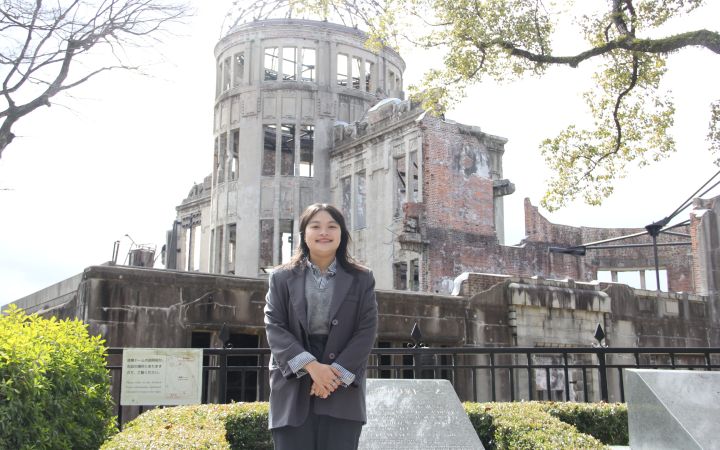
She is proud that Viet Nam has ratified the Treaty on the Prohibition of Nuclear Weapons and is currently at accession level with the NPT.
- Lê Nguyen An Khanh is a young diplomat with the Ministry of Foreign Affairs, Viet Nam. She is passionate about the non-proliferation of nuclear weapons and world peace.
- UNITAR Division for Prosperity trains government officials in Asia to learn about international nuclear disarmament processes and build their communication and negotiation skills.
28 August 2023, Hiroshima, Japan – Lê Nguyen An Khanh is a young official from Viet Nam, working at the Department of International Organisations at the Ministry of Foreign Affairs. She believes that diplomats like her have the responsibility to advocate for nuclear disarmament. But it’s not always easy to keep abreast of the intricacies of the field. “We are constantly having [to] research all the issues, of which nuclear disarmament and non-proliferation is a huge part”, she says………………………………………………………………………………….
Lê has had to learn how to take the uncertainties of global politics and turn them into something surmountable. She is proud that Viet Nam has ratified the Treaty on the Prohibition of Nuclear Weapons and is currently at accession level with the NPT. She wants to make sure her country’s voice is heard on the international stage, that it is seen as a world player. (Plus, she enjoys meeting, learning and working with like-minded people from different backgrounds and cultures.)
Being a young diplomat can come with its challenges: her views and opinions may not be granted the same weight as her older, perhaps more experienced, colleagues. But Lê challenges other young diplomats to be passionate and work hard.
“If you work hard enough, stick to your ideals and you are passionate about what you do and want to do in the future, people will recognize you – especially the seasoned diplomats who have already been there. You have to demonstrate that you are willing and have the capability to deliver. [If] you have a passion, you will be able to overcome challenges”. -Lê Nguyen An Khanh, Vietnamese diplomat and 2023 alumna, UNITAR Nuclear Disarmament and Non-Proliferation Training Programme
Looking to the Future
Lê will incorporate into her work all that she learned in the UNITAR training and expects to share her knowledge with colleagues in other departments and ministries as well. She applauds the UNITAR Hiroshima Office for putting together a well-organized and resourced training programme that she calls “an epitome of a good training programme”.
In the next 20 years, Lê says she wants to see more UNITAR offices around the world and for more people to learn about nuclear disarmament and non-proliferation. “I want to see UNITAR bring people from different regions with different cultures, race, genres to show the similar yet different experiences of their lives.”
Her personal goal is to make sure that she contributes to global peace.
Peace is a universal value. Everybody wants peace. I think peace is the motivation for every country to move towards development and stability. It is only when we have peace that we can move forward and make ourselves stronger.” -Lê Nguyen An Khanh, Vietnamese diplomat and 2023 alumna, UNITAR Nuclear Disarmament and Non-Proliferation Training Programme
About UNITAR
The United Nations Institute for Training and Research (UNITAR) is a dedicated training arm of the United Nations. In 2022, UNITAR trained 396,046 learners around the world to support their actions for a better future. In addition to our headquarters in Geneva, we have offices in Hiroshima, New York and Bonn and networks around the world.
The Division for Prosperity is based in the Hiroshima Office and Geneva. We seek to shape an inclusive, sustainable and prosperous world through world-class learning and knowledge-sharing services on entrepreneurship, leadership, finance and trade, digital technologies, and nuclear disarmament and non-proliferation. We empower individuals from least-developed countries, countries emerging from conflict, and small-island developing states – especially women and young people – to bring about positive change.
United Nations Volunteer Ruhiya Yousuf contributed to this article.
China’s summer of climate destruction
China’s summer this year has seen both extreme heat and devastating floods.
And the flooding this time around has struck areas where such weather has
been unheard of, with scientists – blaming climate change – warning that
the worst is yet to come.
“I’ve never seen a flood here in my whole life,”
says 38-year-old Zhang Junhua, standing next to a vast patch of rice, now
completely useless. “We just didn’t expect it.” His family and friends are
safe, he says, because they were given plenty of warning to get to higher
ground, but everyone in his village now has some tough months ahead. What’s
more, the devastation in north-east China’s Heilongjiang Province has had a
major impact on food supplies for the whole country.
BBC 28th Aug 2023
Sizewell C project descends into farce
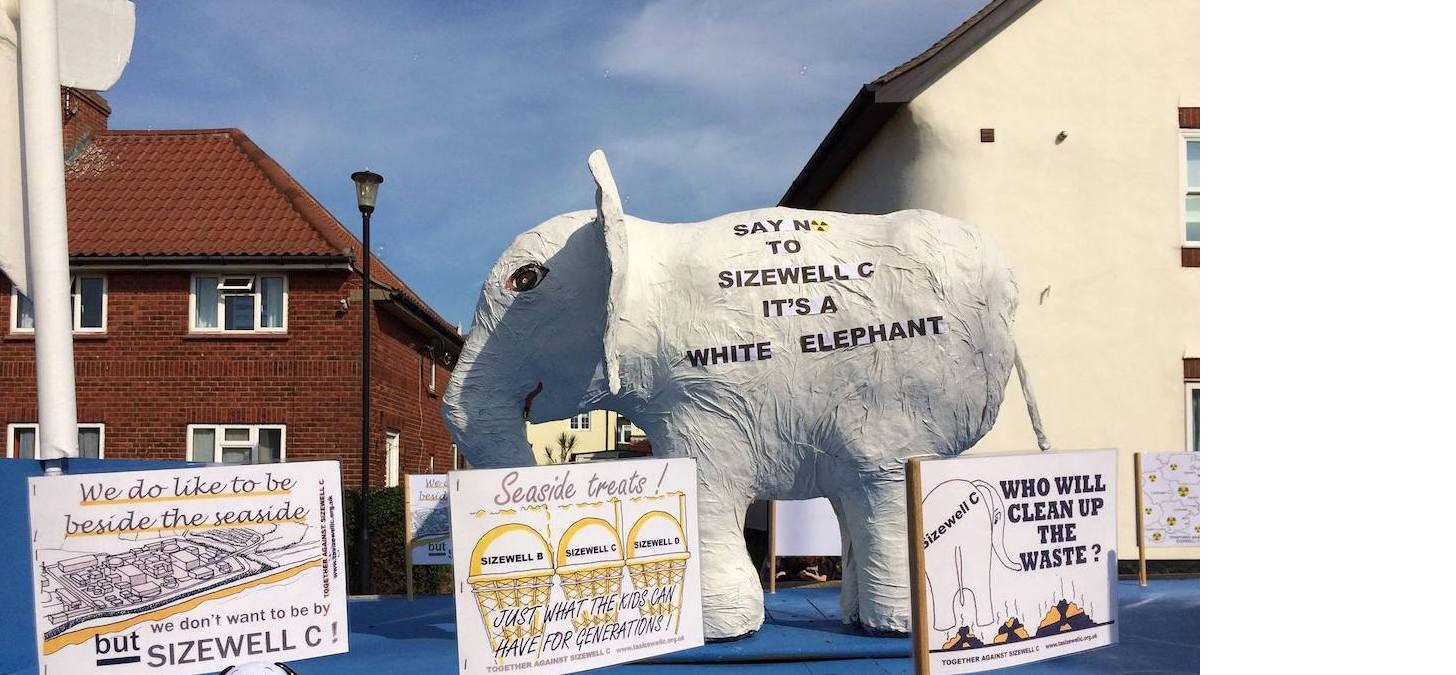
The Sizewell C development has offered observers an opportunity to monitor in great detail how a modern project costing at least Euros 30bn can and often does fall foul of environmental, financial, operational and political collapse.
By Essex Mag. August 26, 2023 https://www.essexmagazine.co.uk/2023/08/sizewell-c-project-descends-into-farce/
While the German government announces its flagship climate and transformation fund of Euros 212bn to accelerate its green transition programme of building renovation and decarbonising its energy sector between 2024 and 2027, the UK is reduced to scrabbling around the City vainly seeking investors in the increasingly farcical soap opera that is Sizewell C.
The ‘grand project’ – French nuclear incursion into a beleaguered and wilting UK energy sector – has mesmerised government officials and MPs of both major parties for the best part of a decade yet it is no closer today to realisation than it was in 2012.
With announcements on further delays to Hinkley Point C and an embarrassing silence in response to invitations to invest in Sizewell C, the hopes that nuclear power will lead the UK on its ‘world beating’ programme towards net zero carbon by 2050 look more unlikely than ever: even an optimistic start date of 2035 for Sizewell C would only afford the plant a marginal – and hugely expensive – contribution to reducing carbon emissions and only for a few years, barely time to off-set the carbon debt created by its construction.
Compared to the visionary German programme, the UK’s response to the existential climate crisis is weak, lacking in leadership and entirely inconsequential in the face of accelerating climate change impacts which are already leaving some parts of the world uninhabitable.
The Sizewell C development has offered observers an opportunity to monitor in great detail how a modern project costing at least Euros 30bn can and often does fall foul of environmental, financial, operational and political collapse.
Government has been beguiled by nuclear power to the exclusion of all else, removing subsidies for green sources of electricity generation while finding hundreds of millions of pounds to incentivise nuclear power. The regulators, constrained by the antiquated and redundant regulators’ code of practice, have turned blind eyes to the obvious – eroding coastlines, storm surges, floods and the future inaccessibility of lethal nuclear waste for transporting to a (currently mythical) geological disposal facility, the huge loss of life sea-water-cooled plants have on the marine environment and fish stocks and the idiocy and irresponsibility of discharging huge amounts of radioactivity to the environment when their health costs are unknown – in their attempts show their eagerness to do the government’s bidding on shoe-string budgets.
Pete Wilkinson, TASC’s Deputy Chairperson and co-founder of Greenpeace UK and Friends of the Earth, said today, ‘HMG is besotted by a Boris Johnson-inspired nuclear fantasy, the regulators are ignoring their obligations, EDF is out of control, respecting nothing but their own agenda, bullying local people, ignoring the absence of a Sizewell C contracted water supply, threatening the imposition of a desalination plant to cover their own inadequacies, and local authorities have been desperate to show their central government overlords that they are shoring up a broken and discredited policy. The Labour Party are no better as it cowers before trades union demands for Labour to secure a small number of well-paid jobs at over £30millon a pop and support an unworkable, dangerous and hugely costly distraction to the climate change crisis which threatens to engulf us.’
German officials believe Ukraine destroyed Nord Stream – media
Rt.com 27 Aug 23
Nothing ties Russia to the explosions, two major German news outlets have reported
German investigators probing the attacks on the Nord Stream pipelines are increasingly convinced that the perpetrators in question are linked to Ukraine, Der Spiegel and state broadcaster ZDF reported on Friday.
Those familiar with the probe “consider the clues [pointing to] Ukraine to be particularly convincing,” the ZDF broadcaster said, adding that “there is no reliable evidence” that would suggest Russia was responsible………………………………………………………………………………………
The Nord Stream 1 and 2 pipelines, built to deliver Russian natural gas to Germany, were destroyed by underwater explosions off the Danish island of Bornholm in September 2022. Western outlets have since repeatedly reported that evidence found in the case points to Ukraine. Kiev has denied any involvement in the incident. https://www.rt.com/news/581849-nord-stream-evidence-ukraine-german/
Nuclear discharge leading tourists to rethink travel plans
By Wang Xiaoyu | China Daily 2023-08-28
Japan’s move to discharge nuclear-contaminated water from the Fukushima Daiichi Nuclear Power Plant into the ocean from Thursday has prompted some Chinese tourists and tourism agencies to reconsider their travel plans to the country.
Japan is among the third batch of countries that are allowed group tourism from China following the easing of COVID-19 restrictions as announced by Chinese authorities on Aug 8. But growing enthusiasm for visiting Japan could be dampened by the wastewater release.
“I have received quite a number of inquiries on trips to Japan in recent weeks, but news of the nuclear-contaminated water will definitely affect tourism to the country,” Di Mingyang, an employee at a travel agency in Beijing, said on Sunday.
…………………………………………. In 2019, 9.59 million Chinese tourists visited Japan, accounting for 30 percent of its foreign travelers, according to Japanese newspaper Asahi Shimbun…………………………… more https://www.chinadaily.com.cn/a/202308/28/WS64ebe54ea31035260b81e760.html
Chinese government acknowledges problems for nuclear power due to climate change
Govt orders new nuclear power plants to carefully consider water intake safety
By Global Times Aug 28, 2023
The National Nuclear Safety Administration (NNSA) has urged China’s newly-built and projected nuclear power plants to fully consider water intake issues, in a bid to ensure the safe operation of nuclear power facilities.
During a recent meeting, the administration emphasized that relevant departments should improve water intake procedures due to changes in climate and sea environment over the years, to further ensure the smooth operation of nuclear power plants. This was stated by NNSA’s official social media account on Monday…………………………………………. https://www.globaltimes.cn/page/202308/1297149.shtml
1 This Month


Tell the Ukrainian Government to Drop Prosecution of Peace Activist Yurii Sheliazhenko

Petition to revoke the licensing of the Near Surface Nuclear Disposal Facility (NSDF) at Chalk River. https://www.ourcommons.ca/petitions/en/Petition/Details?Petition=e-7247


of the week – STOP SMALL MODULAR REACTORS IN CANADA
To see nuclear-related stories in greater depth and intensity – go to https://nuclearinformation.wordpress.com
-
Archives
- March 2026 (204)
- February 2026 (268)
- January 2026 (308)
- December 2025 (358)
- November 2025 (359)
- October 2025 (376)
- September 2025 (258)
- August 2025 (319)
- July 2025 (230)
- June 2025 (348)
- May 2025 (261)
- April 2025 (305)
-
Categories
- 1
- 1 NUCLEAR ISSUES
- business and costs
- climate change
- culture and arts
- ENERGY
- environment
- health
- history
- indigenous issues
- Legal
- marketing of nuclear
- media
- opposition to nuclear
- PERSONAL STORIES
- politics
- politics international
- Religion and ethics
- safety
- secrets,lies and civil liberties
- spinbuster
- technology
- Uranium
- wastes
- weapons and war
- Women
- 2 WORLD
- ACTION
- AFRICA
- Atrocities
- AUSTRALIA
- Christina's notes
- Christina's themes
- culture and arts
- Events
- Fuk 2022
- Fuk 2023
- Fukushima 2017
- Fukushima 2018
- fukushima 2019
- Fukushima 2020
- Fukushima 2021
- general
- global warming
- Humour (God we need it)
- Nuclear
- RARE EARTHS
- Reference
- resources – print
- Resources -audiovicual
- Weekly Newsletter
- World
- World Nuclear
- YouTube
-
RSS
Entries RSS
Comments RSS
 nuclear-news