The film Oppenheimer has shone a global spotlight on the dawn of US nuclear weapons tests. In the Marshall Islands, where 23 of those earth-shattering blasts happened, people have never been able to forget
t first glance, the aquamarine waters that surround the Marshall Islands seem like paradise. But this idyllic Pacific scene hides a dark secret: it was thelocation of 67 nuclear detonations as part of US military tests during the cold war between 1946 and 1958.
The bombs were exploded above ground and underwater on Bikini and Enewetak Atolls, including one device 1,100 times larger than the Hiroshima atom bomb. Chernobyl-like levels of radiation forced hundreds from their homes. Bikini Atoll remains deserted. At the US government’s urging, residents have begun returning slowly to Enewetak.
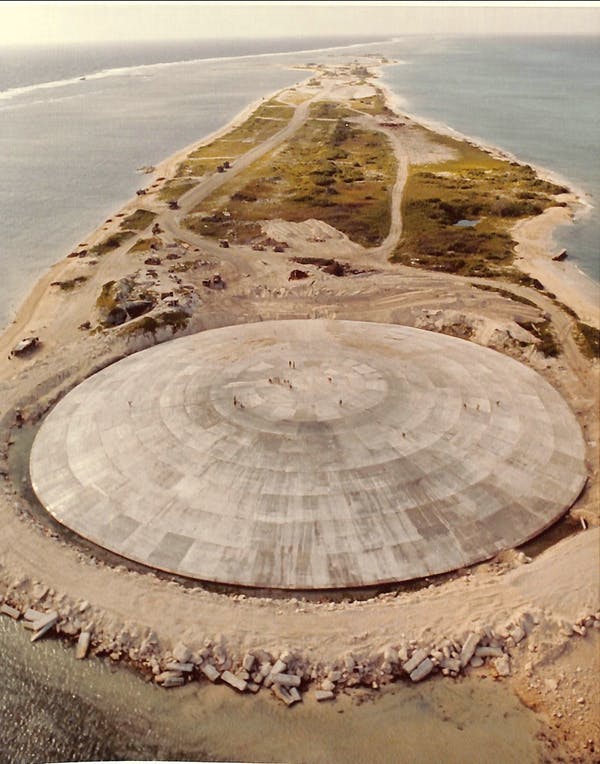
Today, there is little visible evidence of the tests on the islands except for a 115-metre (377ft)-wide cement dome that locals nickname the Tomb – for good reason.
Built in the late 1970s and now aged and cracking, the huge concrete lid on Runit Island covers more than 90,000 cubic metres (3.1m cubic ft) – or roughly 35 Olympic-sized swimming pools – of radioactive soil and nuclear waste. Unbeknown to the Marshallese people, the US shipped the waste from Nevada, where it was testing nuclear weapons on Native American land.
The legacy of America’s nuclear testing on Indigenous communities both on the US mainland and its territories has come under renewed scrutiny with the release of Oppenheimer, the blockbuster film about the physicist who led development of the atomic bomb.
Although his team tested the nuclear weapons on Native American land – there were 928 large-scale nuclear weapons tests in Nevada, Utah and Arizona during the cold war, dispersing huge clouds of radioactive material – the film never mentions the impact of the testing on the local Native Americans.
The legacy of America’s nuclear testing on Indigenous communities both on the US mainland and its territories has come under renewed scrutiny with the release of Oppenheimer, the blockbuster film about the physicist who led development of the atomic bomb.
Although his team tested the nuclear weapons on Native American land – there were 928 large-scale nuclear weapons tests in Nevada, Utah and Arizona during the cold war, dispersing huge clouds of radioactive material – the film never mentions the impact of the testing on the local Native Americans.
“The film completely ignores the experiences of our people,” says Ian Zabarte, principal man of the Western Bands of the Shoshone Nation – who have been described as “the most bombed nation on earth”
Zabarte is attempting to forge connections with those Pacific Islanders who were similarly affected by nuclear testing. Earlier this year, he met representatives from the Marshall Islands when they visited Nevada to discuss the effects on their health from nuclear weapons testing.
“The health impacts on our people have never been investigated,” Zabarte says. “We have never received an apology, let alone any kind of compensation.”
Separately, a band of Marshallese activists are now sailing around the country’s 29 atolls, along with artists and climate scientists, on a 12-day tour that aims to raise awareness of nuclear testing on the archipelago.
The 520-mile ocean voyage is being operated by Cape Farewell, a cultural programme founded by the British artist David Buckland and funded by the Waverley Street Foundation, Laurene Powell Jobs’s climate charity.
“Cancers continue from generation to generation,” says Alson Kelen, a master navigator and community elder who grew up on Bikini Atoll and is joining the expedition.
“If you ask anyone here if there’s a legacy of nuclear impact on their health, the answer would be yes. The Marshall Islands Nuclear Claim Tribunal has a list of cancers that are related to nuclear throughout our people. These cancers are hereditary.”
The US maintains that the Marshall Islands are safe. It seized them from Japan in 1944, and eventually granted the islands independence in 1979, but the fledgling nation remained in “free association” with the US. Under this system, along with Micronesia and Palau, the Marshall Islands are self-governing but economically remain largely dependent on Washington, which also retains a military presence. Today it continues to use the US dollar, and American aid still represents a large percentage of its GDP.
In 1988, an independent international tribunal was established to adjudicate between the two countries, and it later ordered the US to pay $2.3bn (£1.8bn) to the Marshall Islands in healthcare and resettlement costs.
The US government has refused, arguing that its liabilities ended when it paid $600m in the 1990s. In 1998, the US stopped providing medical care for cancer-stricken islanders, leaving many in financial hardship.
The agreement is up for renegotiation this year, and the Marshallese hope they will have stronger negotiating power with the US now that China is showing an interest in the islands due to their strategic location. The islanders are pushing for the $2.3bn they feel they are owed, and a cleanup of the Runit Dome, which is at risk of collapsing due to rising sea levels and the natural ageing of concrete structures.
“Of course it’s going to break,” says Stephen Palumbi, a Stanford University marine scientist who led a research trip to the islands in 2016. “What else can you expect? You can’t just build something like that and walk away from it and expect it to stay there. You wouldn’t do that with your patio.”
According to a 2019 investigation by the LA Times, many US military personnel present at the construction of Runit Dome realised that radioactive material was leaking from it, and would continue to do so – yet did not alert the Marshallese government.
The threat to the Tomb is particularly acute because the islands, which lie just 2 metres above sea level on average, are very vulnerable to rising sea levels. The country’s capital, Majuro, is highly likely to be at risk of frequent flooding, according to a World Bank study.
It is not clear what will happen to the environment when the Tomb crumbles, and has also been hard to track how the ecosystem has behaved over time as “there’s just not many people” on Bikini Atoll to even casually monitor changes, Palumbi says.
But a 2012 United Nations report said the effects of radiation on the Marshall Islands are long-lasting and have caused “near-irreversible environmental contamination”.
On Palumbi’s visit, locals warned his team not to eat the coconuts – which are radioactive due to the contaminated groundwater – or the coconut crabs that feed on them. “You do not grow crops, you do not eat coconut, you do not drink the water,” Palumbi says.
In general, it has been shown that nuclear blasts represent an extreme threat to local biodiversity. A 1973 US government-funded study on nuclear testing in Alaska found both immediate harm and long-term damage to marine species: fish exploded when their gas-filled swim bladders reacted to the change in pressure underwater, and hundreds of sea otters were also killed instantly.
Researchers have recently found that sea turtle shells can be used to study nuclear contamination, with traces of uranium found in animals not born when testing in the Pacific Islands ended. The turtles are thought to accumulate human-made radionuclides in their bony outer shell, which is usually made of keratin, through the food chain by eating uranium-contaminated algae.
Japan recently announced it would start dumping waste from the Fukushima nuclear power plant, which had meltdowns in 2011, into the ocean. Although the UN’s nuclear watchdog says it is safe to do so, there are fears that there is still not enough understanding of how radioactive nuclear waste affects the ecosystem to be sure of this.
Palumbi notes that the resilience of the ocean is impressive, with corals regrowing on the Marshall Islands as soon as 10 years after the bombs were exploded. “This is the most destructive thing we have ever done to the ocean, dropping 23 atomic bombs on it, yet the ocean is really striving to come back to life.”
There are, however, eerie reminders of what happened decades ago, including a fine talcum powder-like sediment covering the reefs – and still-visible damage to the reef itself. “On the inside of the lagoon, where the actual bombs were, it’s still an amazing mess,” Palumbi says. “The reef has cracked in half, and you realise that it was the bomb.”
Kelen says he would not trust anyone who says releasing nuclear material into the water is safe. “Everybody who has talked to me about nuclear has been lying,” he says. This, he says, includes the US “who promised our islands were safe to live in. This continues. I do not trust politicians who say this will be OK.”
Zabarte, who has numerous family members who have died of cancer, is similarly concerned about the long-term impacts of radiation. “My people have nowhere to go,” he says. “We have to stay there, exposing ourselves on a daily basis. We have no choice.”
“We have to keep repeating this story,” says Kelen. “We have forever been moved around by people who make decisions over us, telling us our lives will be safe and how to live. But no matter what life has thrown at us, from nuclear testing to rising sea levels, our home and life are very much still here.
“We live this story, and it informs us culturally, but we do not let it define who we are.”
As a crowning irony, the Nuclear Alliance is led by France, whose own national law … excludes atomic energy from being classified as a green investment.
In March 2021, seven nuclear member states sent a letter to the European Commission demanding the inclusion of nuclear energy in the taxonomy. When a team of independent journalists took the letter’s statements apart it found that of the 25 factual claims in the letter, 20 were either fictitious or misleading
The European Commission, under the presidency of Ursula von der Leyen, has officially declared climate policy as its number one priority.
But the end of August, in the European General Court in Luxembourg, marks the conclusion of the first phase of one of three lawsuits against the European Commission targeting a key piece of European Green Deal legislation.
These lawsuits were brought not by opponents of climate mitigation policy, but by those, including Austria and a number of environmental groups, who wish to rescue the legislation from what they see as its being fatally compromised.
The pleading in the cases is aimed at revoking the Complementary Climate Delegated Act (CCDA), in force since this January.
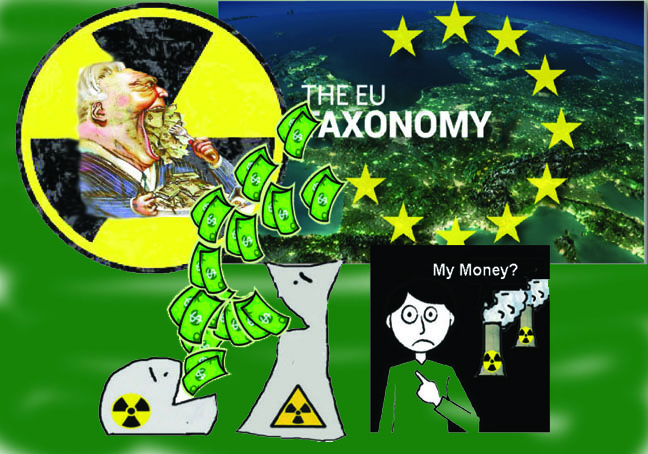
This supplements the Taxonomy Regulation, a list of economic activities considered sustainable and thus eligible for green investment, to include, astonishingly, natural gas and nuclear power.
What has led to this situation, in which the EU executive, ostensibly dedicated to achieving its “Fit by 55” plan to substantially reduce greenhouse emissions by 2030, finds itself challenged on its showpiece Green Legislation by one of its own member states?
The answer readily supplied by critics is that it is an appropriate response to one of the most conspicuous triumphs of greenwashing foisted on the public.
The inclusion of gas and nuclear, they say, violates the entire purpose of the Taxonomy Regulation.
The media dropped the ball
This hijacking of the EU’s key instrument of green policy has been openly accomplished through a campaign of misinformation conducted by the nuclear lobby.
In March 2021, seven nuclear member states sent a letter to the European Commission demanding the inclusion of nuclear energy in the taxonomy.
The intervention got some attention from news media at the time, but it was not of a critical kind.
When a team of independent journalists took the letter’s statements apart it found that of the 25 factual claims in the letter, 20 were either fictitious or misleading
Workaday mainstream journalists with tight deadlines to meet certainly haven’t always been keen to delve into all the nooks and crannies of a complicated story or take the responsibility to come down trenchantly on one side of an issue.
But something more insidious has emerged in recent decades: a paralysis in the face of debate, a willingness to report the scientific controversy and to present both sides in a “fair and balanced” way which gives equal time to the consensus of experts and the hype of hucksters.
Like retired journalist Jay Rosen said, “You don’t get a lot of complaints if you just write down what everyone says and leave it at that.”
But this serves the purposes of disinformation, which is not to convince, but to confuse and demoralise. Ultimately, it disables any organised effort to change things.
The Nuclear Seven’s claims are, in fact, dubious
When a team of independent journalists took the letter’s statements apart it found that of the 25 factual claims in the letter, 20 were either fictitious or misleading, including the usual dubious assertions about nuclear’s “valuable contribution” to climate neutrality.
However, the conclusions of the crowd-sourced investigation did not find a publisher among the European outlets and went largely unnoticed.
The letter by the Nuclear Seven — France, Poland, Hungary, Czechia, Romania, Slovakia and Slovenia — was bolstered ten days later by the release of a draft report by the European Commission’s Joint Research Centre (JRC).
The extent of the influence of the Nuclear Seven and the JRC report on the ultimate decision to formally label nuclear as sustainable is unclear, but likely decisive.
It had been assigned to determine whether nuclear power met the criteria for inclusion in the taxonomy, specifically, the Do No Significant Harm principle. This, in spite of the trifling fact that the JRC was established under the Euratom Treaty and is still tasked with conducting nuclear research under the aegis, and with the funding, of Euratom.
The report concluded that there was no “science-based evidence” that nuclear could do more harm to the environment than other activities in the taxonomy.
o no one’s surprise; but to considerable criticism from experts, including one of Germany’s nuclear regulatory authorities, and from the European Commission’s own Scientific Committee on Health, Environment and Emerging Risks, both of whom pointed out that the report’s conclusions were not supported by the report’s own findings.
Others noted that the JRC mandate neglected many critical taxonomy elements. In spite of these severe strictures, when the final JRC report was published a few months later it contained no revisions.
Nuclear lobby’s swagger
The extent of the influence of the Nuclear Seven and the JRC report on the ultimate decision to formally label nuclear as sustainable is unclear, but likely decisive.
And buoyed up by this, the EU’s successful nuclear lobby has been conducting itself with noticeable swagger.
From the seven signatories of the 2021 letter, the Nuclear Alliance, as it is now known, has expanded to 14 EU countries with the addition, in February, of Bulgaria, Croatia, Finland and the Netherlands, followed by Belgium, Estonia and Sweden, with Italy as an observer.
As a crowning irony, the Nuclear Alliance is led by France, whose own national law … excludes atomic energy from being classified as a green investment.
Now representing a majority in the EU, the Alliance has been emboldened to demand, at their fourth meeting in Spain on 11 July, that nuclear energy should be treated equally with renewables when it comes to EU funding and the promotion of joint projects.
Under their banner of “tech neutrality” — an echo from the 2021 letter — the Alliance has already successfully lobbied for the acceptance of nuclear-produced “pink hydrogen” as “green hydrogen” and managed to wring important concessions in the revision of the Renewable Energy Directive, which would almost double the share renewable in the EU’s overall energy consumption by 2030.
These concessions allow for a greater role of nuclear power in meeting these targets.
Everything goes as sustainability loses its essence
As a crowning irony, the Nuclear Alliance is led by France, whose own national law — a 2015 decree on the “Energy and Ecological Transition for Climate” label — excludes atomic energy from being classified as a green investment.
In “Diversion from urgent climate action”, WISE’s nuclear expert Jan Haverkamp makes the case that vigorous nuclear industry lobbying in Brussels has had a “direct influence on the speed with which urgent climate action is taken”, slowing down the adoption of renewable energy sources, which is a boon for the fossil fuel industry.
Sustainability having lost its meaning, everything is allowed. And so, living in the Upside Down, we are witness to the triumph of the nuclear lobby.
Sustainability having lost its meaning, everything is allowed.
And so, living in the Upside Down, we are witness to the triumph of the nuclear lobby.
In the post-CCDA landscape, the nuclear zombies have acquired a new green sheen as they shamble and shuffle pointlessly, consuming all the oxygen in the climate policy conversation until they ultimately expire in obscene cost overruns and non-delivery of their boastfully promised but illusory results.
THE FILM “OPPENHEIMER,” which tells the story of the Manhattan Project’s development of the atomic bomb, has made quite a splash this summer, with audiences and critics alike hailing it as a riveting slice of scientific history. But it also has some viewers asking: Where are the women? In the film, Lilli Hornig is the only woman scientist named and portrayed working on the project, though she was not the only one involved. Charlotte Serber, shown as project leader J. Robert Oppenheimer’s secretary, actually did far more. Some scholars argue that physicist Lise Meitner, co-discoverer of nuclear fission, should have been included. As a biographer of historical women scientists, I should be the first in line to decry the erasure or minimization of women’s contributions. But should women be written into stories merely for the sake of representation, without first considering the context and the person? Is this what they would have wanted?
In Meitner’s case, the answer is “no.” Her discovery may have been crucial to creating the atomic bomb, but she wanted nothing to do with it nor wanted to be depicted in films about it. And I believe Meitner’s refusal to participate in the weaponization of her work on moral grounds makes her more worthy of commemoration than Oppenheimer. She chose humanity over notoriety.
According to Ruth Lewin Sime’s detailed biography, “Lise Meitner: A Life in Physics,” Meitner was likely the first female professor in Germany and the head of physics at the Kaiser Wilhelm Institute for Chemistry in Berlin. In 1934, she became so intrigued by Italian physicist Enrico Fermi bombarding elements with newly discovered particles called neutrons that she decided to do some tests of her own. After performing a few experiments, Meitner could tell that something exciting lay on the other side of her digging. She also knew she’d need an interdisciplinary team to properly conduct the research and interpret the results, so she recruited her chemist colleague Otto Hahn and later his assistant Fritz Strassmann. Little did she comprehend that they were on the cusp of upending the principles of nuclear physics.
Over the next four years, Meitner and her team spent their days irradiating various elements with neutrons and identifying the decay products. Meitner would use physics to explain the nuclear processes, and Hahn would conduct chemical analyses. In late 1938, Hahn and Strassmann discovered that neutron-bombarded uranium-235 samples seemed to contain barium — a much lighter element than expected, which the pair could not explain.
Meitner was headed toward the zenith of her career. But she had Jewish ancestry, so while making scientific history, she was also desperately searching for a way to make it out of Nazi Germany alive. With the help of a vast network of colleagues, she fled to Sweden in the summer of 1938. Meitner continued collaborating with colleagues via telephone, letters, and secret meetings for several months after her covert escape, but she would never move back to Germany.
In December 1938, Hahn wrote to Meitner about the puzzling barium results. This led Meitner and her nephew, nuclear physicist Otto Robert Frisch, into a discussion in which they calculated that bombarding uranium with neutrons could split the uranium atom’s nucleus in half, releasing 200 million electron volts of energy. Meitner and Frisch published their results in the scientific journal Nature on Feb. 11, 1939, proposing the process should be called “fission,” named after the biological term used to describe cell division. But Hahn and Strassmann published their own analysis in the journal Naturwissenschaften on Jan. 6. (And Hahn alone was awarded the 1944 Nobel Prize in Chemistry for the discovery of nuclear fission.)
Within a few short months of the papers, dozens of physicists had confirmed the process: uranium-235 atoms absorbed loose neutrons, causing them to become unstable and split. The process, some thought, might prompt a chain reaction. If so, the fission of just one pound of uranium-235 would release the same amount of explosive energy as roughly 8,000 tons of TNT.
The potential practical applications were many, but Meitner refused to be a part of the weaponization of her work. She’d experienced the horrors of war up close during her stint as a nurse at a military hospital near the Russian front in World War I and didn’t want to be involved in the creation of something that would bring pain, suffering, and death. Few scientists refused to help their side create weapons during the war, yet when Meitner was invited to work on the Manhattan Project, she responded, “I will have nothing to do with a bomb.”
When Meitner heard the news of the bombing of Hiroshima, she went for a five-hour walk. What had her science wrought? Rumors flew about her role in the project, despite her clear lack of participation. The Stockholm Expressen newspaper surmised that the bomb had been invented because a Jewish scientist escaped Germany and passed her secrets along to the Allies. Time magazine proclaimed Meitner a “pioneer contributor to the atomic bomb.” But she knew nothing of its creation and deplored this sensationalized, largely false publicity.
In January 1946, Meitner traveled to the U.S. to present lectures and teach classes at several universities across the country, as well as visit old friends and family who had immigrated there when fleeing the Nazis. At the airport in New York, she was met with a horde of photographers and reporters. At a Women’s National Press Club banquet where she was awarded “Woman of the Year,” Meitner sat next to President Harry Truman. When discussing the bomb, both agreed they wished for it never to be used again.
And yes, there were movie offers. Metro-Goldwyn-Mayer asked Meitner to approve of her depiction in the script for “The Beginning or the End,” a film about the development and use of the atomic bomb. Meitner wrote to Frisch that the script was “nonsense from the first word to the last” and that she “answered that it was against my innermost convictions to be shown in a film, and pointed out the errors in their story.” Oppenheimer, on the other hand, approved of the use of his likeness in the movie, apparently welcoming of the media attention.
MGM hoped a bigger payday might persuade Meitner to reconsider. In response, she gave three friends power of attorney and advised them to sue MGM on her behalf if any woman scientist appeared in the film. Meitner continued to refuse permission to use her name in films and plays.
Despite her work being corrupted to create death, Meitner never lost sight of the good that could come of the pursuit of scientific knowledge. “Science makes people reach selflessly for truth and objectivity,” she asserted in 1953. “It teaches people to accept reality, with wonder and admiration, not to mention the deep joy and awe that the natural order of things brings to the true scientist.”
History loves to laud the Oppenheimers: the ones who push the envelope, who puzzle through conundrums in the face of challenges, and who say “yes.” Saying “no” — choosing not to participate — is much less cinematic. But in this case, I think a moral objection is much more worth celebrating. #nuclear #antinuclear #nuclearfree #NoNukes
Weapons Straight Out of a Science Fiction Novel Have Not Been Able to Turn the Tide on the Battlefield
In his 1988 book War Stars: The Superweapon in the American Imagination, H. Bruce Franklin traces a deep-rooted cultural belief in the magic of futuristic weapon systems that would enable the U.S. to defeat any foreign adversary.
Franklin dates the infatuation to the era of the revolutionary war with the development of the combat submarine by Robert H. Fulton to pulverize the British Navy.
He in turn shows a direct line through World War I and World War II and the development of air power and the atomic bomb, through the Vietnam War where sophisticated U.S. war machines could not defeat the guerrilla warfare tactics of the Vietcong.
Franklin could easily include a new chapter on Ukraine, whose summer counteroffensive has fizzled despite the country’s function as a testing ground for new American weapon systems.
These include space-based satellites and sensors that have been used by the Ukrainians to track Russian troop movements and assist in navigation, mapping and electronic warfare, and positioning systems that guide precision weapons and drones.
A webinar in mid-July hosted by the War Industry Resistance Network placed the U.S. strategy in Ukraine in the context of a broader attempt by the U.S. to militarize space and use it to destroy its leading geopolitical rivals—Russia and China.
The first speaker, Dave Webb, a retired engineering and peace studies professor from England, emphasized that the 1991 Operation Desert Storm set the groundwork for Ukraine as the first space war in which the U.S. showed off new satellite and precision guided missiles that wound up devastating Iraq.
In 1997, the U.S. Space Command outlined its goal of obtaining full-spectrum military dominance over land, sea, air and space by the year 2020—which achieved partial fulfillment with the Trump administration’s creation in 2019 of a new Space Force as a branch of the U.S. military.
By 2024, the budget of the Space Force reached $30.3 billion, a 15% increase over 2023 and a doubling of the budget from 2020.
Congress has in a not so veiled way tried to legitimate these budget increases by holding hearings raising alarm about the threat of Unidentified Flying Objects (UFO’s).
One in late July featured a former intelligence officer, David Grusch, who claimed that he faced retaliation at the Pentagon for his confidential disclosure that “non-human beings” had been retrieved from spacecraft.[1]
On August 11, the 75th Intelligence, Surveillance and Reconnaissance Squadron (ISRS) was activated at Peterson Space Force Base in Colorado. It has been tasked with identifying and destroying or disrupting adversary satellites and ground-based lasers aimed at preventing the U.S. from using its own satellites during a conflict.
Space.com reported that the U.S. Space Force has conducted multiple training exercises to practice “live fire” satellite jamming [of Russian and Chinese space based satellites] and “simulated on-orbit combat training” as part of a growing commitment to space-based war.
The Space Force’s operations have been made possible by a $1.5 billion space surveillance radar center built by Lockheed Martin in an atoll in the Marshall Islands, which became operational in March 2020. The center now tracks more than 26,000 objects in space, some the size of a marble.
Additional surveillance centers have recently been built in Texas, Australia and Great Britain while Boeing is building a secret military space plane, the X-37B, which can carry out orbital space flight missions.
Webb ended his talk by noting that the spirit of a 1967 Outer Space Treaty that was designed to prevent the militarization of Outer Space is not being followed.
Space exploration is giving way to space exploitation and growing competition with Russia, which has developed its own space-based weapon systems in response to what the U.S. is doing.
The second speaker at the webinar, Bruce Gagnon, coordinator of the Global Network Against Weapons & Nuclear Power in Space, pointed out that, for the last quarter century, Russia has presented its demand for a new cooperative space treaty before the United Nations but has been blocked by the U.S., Israel and a few of their allies.
The Russians have stated unequivocally, as have the Chinese, that they do not want to devote their countries’ resources to a destructive and fruitless arms race in space, though the U.S. believes it can be master in space and has been taken over totally by the military-industrial complex.
When the creation of the new Space Force came up for a vote in 2019, the Democratic-controlled House of Representatives supported it, though it had wanted to call it Space Corps.
………………………………………….Gagnon’s concern about the militarization of Outer Space began when he read a book by Linda Hunt called Secret Agenda, which detailed the CIA’s recruitment of Nazi scientists under Operation Paperclip who helped found the U.S. space program.
Chief among them was Wernher von Braun, who had helped develop the V-2 rocket in Germany using slave labor.
Gagnon said he finds it chilling that the U.S. Space Force carries out yearly war-game exercises where they simulate fighting using space-based weapons right out of science fiction novels. Among these is the “Rod from God,” a weapon in which tungsten steel rods are fired from orbiting satellites, smacking the Earth from the sky as if sent by God.
Right now, Gagnon says, we are living through a Cuban Missile Crisis in reverse as the U.S. has pointed nuclear weapons directly at Russia from a U.S. military base in Deveselu, Romania, and another in Redzikowo, Poland off the Baltic Sea.
The U.S. goal is to break up Russia as it did Yugoslavia in the 1990s because Russia is the world’s largest resource base and threatens the ability of the U.S. to extract resources from the Arctic unencumbered.
Along with World War III, the current U.S. space strategy is threatening to unleash a major environmental catastrophe as space-based satellites and weapons are leaving debris that cannot be cleaned up.
August 29 is the United Nations International Day Against Nuclear Tests. The day was established in 2009 to increase awareness “about the effects of nuclear weapon test explosions or any other nuclear explosions and the need for their cessation as one of the means of achieving the goal of a nuclear-weapon-free world.” The day was proposed by the Republic of Kazakhstan, which continues to suffer from the 456 nuclear test explosions conducted by the Soviet government at the Semipalatinsk Nuclear Test site in Eastern Kazakhstan. 29 August is the day when Kazakhstan closed down the test site in1991.
Youth (and young at heart) are encouraged to complete a distance of 8.29 km (symbolising August 29) by running, walking, biking, wheelchair, skateboard or an equivalent human-powered means. Youth who register can receive a certificate recognising the effort. Everyone participating is encouraged to take photos and use the hashtag #StepUp4Disarmament when posting on social media. You can also download the design for a bib to wear.
Right to Life without Nuclear Threats August 29 Commemoration event at the UN in Geneva
The chief problem with the Price-Anderson Act is the difference in how the law affects the public and the nuclear firms. In view of federal preemption of nuclear licensing, the public has essentially no say in the siting of a nuclear power plant and so must accept the associated accident risk. Nuclear vendors, however, are freed from all liability for offsite consequences of a nuclear accident, and so have nothing to worry about, either financially or legally.
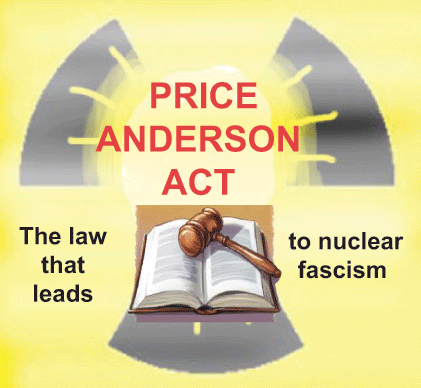
On the night of July 27, the US Senate passed the National Defense Authorization Act for fiscal year 2024. The Senate-approved bill included a 20-year extension of the Price-Anderson Nuclear Industries Indemnity Act, which provides that if there are any offsite lives and property lost in a severe reactor accident, nuclear industry manufacturers and builders cannot be held liable. The extension of the act also includes another controversial provision—the adequacy of funds provided by the act for compensating victims of a nuclear accident.
The approval last month of this extension came without any public hearings and was introduced in Congress in a rather troubling manner. The extension’s backers, knowing it would face rough sledding in an open hearing, first attached it to the Accelerating Deployment of Versatile, Advanced Nuclear for Clean Energy (ADVANCE) Act of 2023, which was then placed on the Senate legislative calendar on July 10 and added to the “must-pass” National Defense Authorization Act. While it has yet to pass the House, the act bears powerfully on the country’s commitment to nuclear energy, and especially on safety standards for nuclear power plants and therefore should not escape public scrutiny.
The Price-Anderson Act was first approved in 1957, soon after the Atomic Energy Act of 1954 permitted private nuclear energy activity. Firms like General Electric and Westinghouse, among others, told Congress they would not build commercial nuclear power plants—a technology with which there was essentially no experience—if they faced vast liability for possible accidents. To promote rapid investment in nuclear power plants, the government gave the builders and vendors freedom from liability for offsite accidents. It added provisions for public compensation after a catastrophic accident. But both provisions need updating in view of what we have learned in the last 60-odd years.
The act currently provides about $13 billion for post-accident public compensation, with the funds coming over time from a self-insurance scheme funded by the owners of nuclear power plants. But the estimated cost of the 2011 Fukushima accident—several hundred billion dollars—dwarfs the Price-Anderson amount. Yet, there is more. If an accident was to lead to widespread and long-term nuclear plant shutdowns, as occurred in Japan, it isn’t clear the owners would be able to meet their financial obligations. What’s clear is that after a severe nuclear accident, the issue of compensation would land in the lap of Congress.
At a 2014 Nuclear Regulatory Commission hearing on a safety upgrade for the 19 US plants essentially identical to the ones at Fukushima, the staff of the US Nuclear Regulatory Commission (NRC) told the commissioners that a fire in only one of the pools in which nuclear plants store highly radioactive used fuel could release much more radioactivity, conceivably 20 times more, than in the 2011 Fukushima accident. The commissioners at the time dismissed the concern on grounds that such an event was so improbable it failed the NRC’s cost-benefit analysis. But, however remote, the possibility remains.
The chief problem with the Price-Anderson Act is the difference in how the law affects the public and the nuclear firms. In view of federal preemption of nuclear licensing, the public has essentially no say in the siting of a nuclear power plant and so must accept the associated accident risk. Nuclear vendors, however, are freed from all liability for offsite consequences of a nuclear accident, and so have nothing to worry about, either financially or legally.
According to the NRC, calculations using “probabilistic risk assessment” serve as proof that the probability of severe nuclear accidents at US nuclear plants is extremely remote. But large nuclear vendors like General Electric and Westinghouse evidently don’t believe these numbers; otherwise, they would accept liability and would not fear risking their stockholders’ investment. If reactor builders won’t accept paying for the consequences of a possible nuclear accident, why then should members of the public, whose health and communities would be affected?……………………………………………………….
The current exuberance over “advanced” reactors” has some of the same boosterish markings as the earlier AEC episode, with the advocates so sure they are right that they think cutting corners is okay—like dispensing with public hearings on Price-Anderson Act extension.
The Price-Anderson Act extension is part of a larger program that would pull out the stops on granting generous subsidies to private nuclear firms, speeding approvals of nuclear license applications and promoting nuclear reactor exports—all supposedly in the interest of “reestablishing America’s preeminence as the global leader in nuclear energy in the 21st century.”
On September 11 & 12, the NZ government is hosting the 2nd Aerospace Summit in Ōtautahi/Christchurch. We will be there to oppose this conference.
Why? 1. The “aerospace industry” is just another name for the world’s biggest weapons dealers. Lockheed Martin (world’s largest arms dealer) is one of the key sponsors of the Summit. The top 6 “aerospace companies” are all arms dealers.
2. The aerospace industry already has a massive climate impact. While an estimated 80% of the world’s population have never set foot on a plane, per-capita NZ has the 6th highest global emissions at 1 tonne CO₂
3. The night sky will be destroyed by rich billionaires who want to relocate to Mars. People like Elon Musk, Jeff Bezos and Richard Branson are billionaire space investors who screw over their workers and foment class war on earth, while launching garbage into space like Musk’s starlink satellite web that will pollute the sky to the point that doing actual astronomy where we learn really amazing stuff about the universe will be difficult.
4. This whole industry is based around Peter Beck and his company Rocket Lab. Beck told the people of Mahia that weapons wouldn’t be launched from his site on their land, but has been very happy to send up dozens of secret US military satellites. Meanwhile, you and I, ordinary wage earners, have paid $6 million to pave an exclusive road out to Beck’s launch pad.
There are so many reasons to oppose the development of a home-grown “aerospace” industry.
Join us for our webinar on Thursday, 31 August at 12 noon to find out more, and book your leave to join us in Ōtautahi/Christchurch to say #KeepSpaceForPeace and #StopTheSpaceWaste
We hope to see you there, or continue your support in ways relevant to you and your community.
Ngā mihi, Keep Space For Peace campaigners
Auckland Peace Action started this petition on the OurActionStation community campaign platform. If there’s an issue close to your heart that you’d like to campaign on, you can start your campaign here.
At the start of the latest stage in the war in Ukraine, in February 2022, Ukrainian President Volodymyr Zelenskyy urged supporters of his cause and the cause of Ukrainians throughout the West to stop cheering for the war and make themselves feel strong and powerful and Churchillian by doing so on social media and instead go to Ukraine and pick up arms to help them fight against the Russian army, based on the argument, among many, that Ukraine has far fewer people to fight against the much more populous country of Russia. Unsurprisingly, very few of our pack of Western world cheerleaders in the media or political and punditry classes heeded Zelensky’s pleas.
Very few of them actually went to Ukraine to help them fight and expel the Russians. And as a result, Ukraine, which already faces a massive disadvantage in population size as compared to Russia, has really been struggling from the start, especially now that the most trained and most aggressive fighters, a lot of them, have been removed from the battlefield, killed or wounded, they’re really struggling with an inability to match the sheer number of Russian men who are either willing or required to fight in this war.
Lately, as a result, however, President Zelenskyy has become increasingly more repressive, both in terms of banning all dissent from being expressed. He has imposed martial law, making it clear that there will be no elections until this war is over, which means he will remain in power for the foreseeable future into the indefinite future and he has really had to crack down on the attempt by Ukrainian men, increasingly, either to bribe their way out of the country or to just risk their lives fleeing the country because they don’t want to be used as cannon fodder in what they obviously regard as an increasingly futile war.
We will look at the latest events in Ukraine, including on the part of President Zelenskyy, that are increasingly anti-democratic in nature, that signifies the futility of this war effort, as well as the U.S. role, and remind you of some of the worst offenses of media propaganda that have been designed to sell this war to the West, something that plainly is eroding as a majority of Americans have decided they no longer favor any further aid.
Japan started dumping more than 1.3 million tons of radioactive water into the Pacific Ocean Thursday – and an expert has warned it ‘has the potential to cause mutations as seen in Chernobyl.
‘The wastewater is currently being held in the nation’s Fukushima nuclear plant, which is set to be decommissioned and must be cleaned to prevent accidental leaks. The contaminated water has been filtered to remove isotopes, leaving only tritium and carbon-14, which are radioactive isotopes of hydrogen and carbon that cannot be easily removed from water.
Timothy Mousseau, a researcher at the University of South Carolina, told DailyMai.com: Tritium and carbon-14, along with the other radionuclides [that cause cancer] to be released, all have the potential to cause mutations, cancers and developmental deformities, as seen in Chernobyl.’
The UK has announced a £192m ($242m) loan guarantee to support Ukraine’s nuclear energy industry, following the visit of the Energy Security and Net Zero Secretary, Grant Shapps, to Kyiv this week. Nuclear is Ukraine’s main energy source, making up around 60% of the country’s power generation in 2022…………………………
The loan will enable UK-based company, Urenco, to supply uranium enrichment services to Ukraine’s national nuclear company, Energoatom………………………………….
Zaporizhzhia is not the only nuclear energy site to be affected by the invasion, with the South Ukraine nuclear plant also facing serious issues. Drones have reportedly been recorded flying low over the site and, in November, the plant lost connection to one of its three 750kV power lines, leading to a 50% reduction in power to one of its three operating reactors. The Khmelnitsky and Rivne power plants have also faced difficulties due to blackouts caused by missile strikes, which cause them to automatically disconnect from the grid.
The impact on nuclear power in Ukraine has, unsurprisingly, been significant, killing the industry’s growth and limiting opportunities in the nation’s biggest energy sector.
Trends identified by GlobalData indicate that the invasion marked the curtailing of patent filings in Ukraine’s nuclear energy industry, with no filings identified since January 2022. With priorities elsewhere and plants under Russian control, Ukraine nuclear future has become unclear.
Benjamin Netanyahu has long warned of the perils of a nuclear Middle East. Now he seems willing to allow Saudi nukes in exchange for normalization.
FP, By Azriel Bermant, a senior researcher at the Institute of International Relations Prague. 25 Aug 23
Three years ago, the tormented Israeli Prime Minister Benjamin Netanyahu found refuge from his domestic troubles with the announcement of peace agreements with the United Arab Emirates (UAE) and Bahrain which became known as the Abraham Accords. Three years on, speculation has grown in Israel over the possibility of the most significant breakthrough in regional diplomacy in 40 years: the signing of a normalization deal with Saudi Arabia.
……………………………………………………………………………. the Saudi government in Riyadh is also insisting it should be permitted to enrich uranium as part of a civil nuclear program.
This flies in the face of Israel’s long-standing attempts to prevent other countries in the region from acquiring any nuclear capability. This policy became known as the Begin Doctrine, named after then-Israeli Prime Minister Menachem Begin, who famously authorized the bombing of Iraq’s Osirak nuclear reactor in June 1981……. https://foreignpolicy.com/2023/08/24/netanyahu-saudi-mbs-nuclear-enrichment-arms-race/
Japan started releasing treated radioactive water from the wrecked Fukushima nuclear power plant into the Pacific Ocean yesterday, a polarising move that prompted China to announce an immediate blanket ban on all aquatic products from Japan.








 nuclear-news