Why we cannot trust the International Atomic Energy Agency
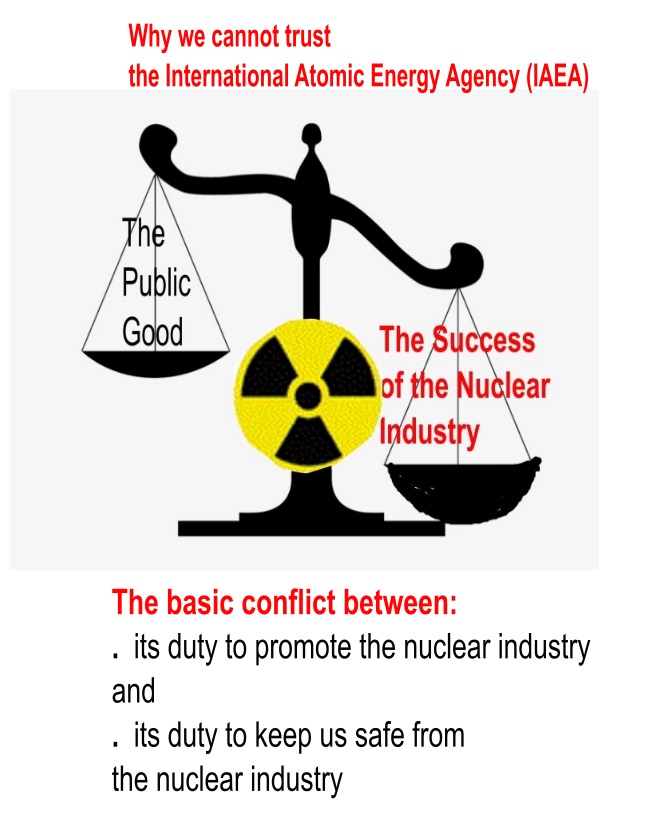
Well, it’s just so simple. Would you have faith in a doctor who advised a medication, when you knew that his main job was to promote and sell that medication?
Today, as Japan starts to pour the tainted water from the Fukushima nuclear catastrophe into the Pacific Ocean, we should take note of Rafael Grossi’s recent statement:
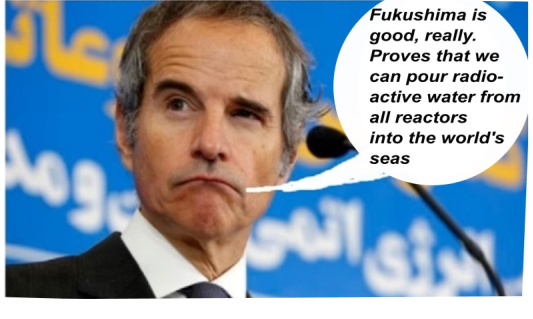
“the future of nuclear as an alternative energy source relies on the success of the Fukushima release,” – Rafael Grossi, Director General of the International Atomic Energy Agency.
You see, whether or not Japan’s release of Fukushima nuclear wastewater is dangerous, is not the main point. Nuclear authorities around the world have been releasing radioactively tainted water into the seas for yonks. They used to just dump barrels of nuclear wastes. Then in 1993, ocean disposal was banned by international treaties. (London Convention (1972), Basel Convention, MARPOL 73/78). But that applies only to containers of wastes, not to liquids emptied via pipelines. The industry, and its promoter, the IAEA, wants this situation to be complacently accepted world-wide. The Fukushima decision is a key milestone in that process of acceptance.
It all really goes back to 1956, when the IAEA was created, in order to create a more friendly face to nuclear science, rather than being just for nuclear weapons. Its role was to promote the peaceful use of nuclear power, and also to regulate the industry – a conflict of interest from the start.
This became problematic for another United Nations Agency – the World Health Organisation (WHO.) On May 28, 1959, an agreement was signed between the IAEA and WHO , an agreement which began the uneasy situation in which the IAEA took over the prime role in radiation research. Article I (3) states that “whenever either organization proposes to initiate a programme or activity on a subject in which the other organization has or may have a substantial interest, the first party shall consult the other with a view to adjusting the matter by mutual consent”.
This has resulted in the IAEA taking the lead role as watchdog over the information about radiation health effects which is distributed to the public, while the WHO has become confined to contributing to medical care and public health assistance.
The result of this agreement was especially obvious after the Chernobyl disaster, where IAEA (not WHO) took the lead in reporting radiation health effects. IAEA, enforcing the philosophy of the International Commission for Radiation Protection (ICRP), denied that any of the catastrophic health problems in the exposed population were related to radiation.
Grossi has been adept at downplaying the dangers of nuclear reactors. For instance, regarding the Russian-occupied Zaporizhzhia plant in Ukraine – “the problem there is war, the problem is not nuclear energy,” Grossi said. In this way, he quietly glosses over the reality that any nuclear reactor could become a military target, at a time of conflict.
This is all getting pretty serious now. It really is time for the world to ask questions about this conflict of interest. Should the control of information about health and environmental effects of the nuclear industry be transferred to some agency that is NOT committed to promoting that industry ?
Fukushima waste-water decision disregards scientific evidence, violates the human rights of Pacific region communities

Japan announces date for Fukushima radioactive water release
Greenpeace International, 22 August 2023 https://www.greenpeace.org/international/press-release/61364/japan-announces-date-for-fukushima-radioactive-water-release/
Tokyo – Greenpeace Japan criticises the Japanese government’s announcement of the start date for radioactive water discharges from the Fukushima Daiichi nuclear station into the Pacific Ocean.
The decision disregards scientific evidence, violates the human rights of communities in Japan and the Pacific region, and is non-compliant with international maritime law. More importantly it ignores its people’s concerns, including fishermen. The Japanese government and Tokyo Electric Power Company (TEPCO) – the nuclear power plants’ operators – falsely assert that there is no alternative to the decision to discharge and that it is necessary to move towards final decommissioning. This further highlights the failure of the decommissioning plan for the nuclear plants destroyed in the 2011 earthquake, stating that tens of thousands of tons of contaminated water will continue to increase with no effective solution.
“We are deeply disappointed and outraged by the Japanese Government’s announcement to release water containing radioactive substances into the ocean. Despite concerns raised by fishermen, citizens, Fukushima residents, and the international community, especially in the Pacific region and neighboring countries, this decision has been made,” said Hisayo Takada, Project Manager at Greenpeace Japan.
The increasing volumes of and the pending release of the radioactive water demonstrate the failure of the decommissioning plan for the Fukushima Daiichi. The contaminated water will continue to accumulate for many years without effective measures to stop it. The Japanese Government and TEPCO falsely claim that discharge is the only viable option necessary for eventual decommissioning. Nuclear power generation, which experiences shutdowns due to accidents and natural disasters, and perpetually requires thermal power as a backup, cannot serve as a solution to global warming.
“The deliberate pollution of the Pacific Ocean through these radioactive waste discharges is a consequence of the 2011 nuclear disaster and Japan’s decades long nuclear power program. Instead of acknowledging the flaws in the current decommissioning plan, the ongoing nuclear crisis, and the massive amount of public funds required, the Japanese government intends to restart more nuclear reactors despite evidence of major earthquakes and safety risks. The current government energy plan fails to deliver secure and sustainable renewables such as wind and solar energy that the climate emergency demands,” said Takada.
As of 8 June 2023, there were 1,335,381 cubic meters of radioactive wastewater stored in tanks[1], but due to the failure of the ALPS (Advanced Liquid Processing System) processing technology, approximately 70% of this water will have to be processed again. Scientists have warned that the radiological risks from the discharges have not been fully assessed, and the biological impacts of tritium, carbon-14, strontium-90 and iodine-129, which will be released in the discharges, have been ignored.[2]
The International Atomic Energy Agency (IAEA) endorsed Japan’s plans for discharge. However, the IAEA has failed to investigate the operation of the ALPS, has completely ignored the highly radioactive fuel debris that melted down which continues every day to contaminate ground water – nearly 1000 cubic meters every ten days. Furthermore, the discharge plan has failed to conduct a comprehensive Environmental Impact Assessment, as required by its international legal obligations, given that there is a risk of significant transboundary harm to neighboring countries. The IAEA is not tasked with protecting the global marine environment but it should not encourage a state to violate it.
“The myth is being perpetuated that discharges are necessary for decommissioning. But the Japanese government itself admits that there is sufficient water storage space in Fukushima Daiichi.[3] Long-term storage would expose the current government decommissioning roadmap as flawed, but that is exactly what needs to happen. The Fukushima Daiichi nuclear station is still in crisis, posing unique and severe hazards, and there is no credible plan for its decommissioning,” emphasized Shaun Burnie, Senior Nuclear Specialist at Greenpeace East Asia.
Member states at the United Nations Human Rights Council in Geneva, as well as UN Special Rapporteurs, have opposed and criticized Japan’s discharge plans.[4] Japan’s discharge plans also disregard the groundbreaking Human Rights Council resolution 48/13, which in 2021 determined that it is a human right to have a clean, healthy and sustainable environment.[5] Furthermore, Japan has failed to comply with its legal obligations under the United Nations Convention for the Law of the Sea (UNCLOS), to protect the marine environment including its legal requirement to conduct a comprehensive Environmental Impact Assessment into the discharges into the Pacific Ocean, given the risk of significant transboundary harm to neighboring countries.[6]
“Instead of engaging in an honest debate about this reality, the Japanese government has opted for a false solution – decades of deliberate radioactive pollution of the marine environment – during a time when the world’s oceans are already facing immense stress and pressures. This is an outrage that violates the human rights of the people and communities of Fukushima, and other neighboring prefectures and the wider Asia-Pacific region,” said Burnie.
Fukushima Daiichi Nuclear Power Station is still continuing to release radioactive materials

A new argument for considering the issue of contaminated ALPS water release .
This brief examines the amount of radioactive material that has been
leaking from the Fukushima Daiichi Nuclear Power Station ever since the
meltdowns occurred more than 12 years ago.
It is huge. Both TEPCO and the
government are undoubtedly aware of this reality. Despite this, they are
now attempting to release even the radioactive materials they have been
able to manage in tanks to the outside world. While attention focuses on
this release, this brief attempts to highlight the even larger problems of
Fukushima Daiichi and the irresponsible way the authorities are dealing
with them.
CNIC 23rd Aug 2023
The nuclear lobby is gearing up for a takeover of COP 28

The various nuclear front groups are organising to have a prominent role in promoting nuclear as the cure for global heating. What a lie! Surrounded by packs of lies – the most glaring being their pretense of being “not for profit” organisations.
By all possible means – academic lectures, art and culture, displays – whatever – they will be allout to control the propaganda emanating from the 2023 United Nations Climate Change Conference.
Of course, the nuclear industry might be expected to get strong competition from the oil industry, seeing that COP28 will be held in the United Arab Emirates, (Thu, 30 Nov 2023 – Tue, 12 Dec 2023)
Still, these two unrelenting propagandising, and polluting industries, will probably work together.
The one voice that’s sure to be excluded is the voice of degrowth, conserving energy, cutting down on consumerism.
Fukushima: What are the concerns over waste water release?
By Tessa Wong, Asia Digital Reporter, BBC News, 23 Aug 23,
Japan’s controversial plan to release treated waste water from the Fukushima nuclear plant into the Pacific Ocean has sparked anxiety and anger at home and abroad.
Since the 2011 tsunami which severely damaged the plant, more than a million tonnes of treated waste water has accumulated there. Japan has said it will start discharging it from 24 August.
Despite an endorsement from the UN nuclear watchdog, the International Atomic Energy Agency (IAEA), the plan has been deeply controversial in Japan with local communities expressing concerns about contamination.
Fishing industry groups in Japan and the wider region are also worried about their livelihoods, as they fear consumers will avoid buying seafood.
China has accused Japan of treating the ocean as its “private sewer”, and criticised the IAEA of being “one-sided”. While South Korea’s government has said it has no objections to the plan, many of its citizens are opposed to it.
So what is Japan’s plan and how exactly has it churned the waters?
What is Japan doing with the nuclear waste water?
Since the disaster, power plant company Tepco has been pumping in water to cool down the Fukushima nuclear reactors’ fuel rods. This means every day the plant produces contaminated water, which is stored in massive tanks.
More than 1,000 tanks have been filled, and Japan says that it needs the land occupied by the tanks to build new facilities to safely decommission the plant. It has also pointed out concerns that the tanks could collapse in a natural disaster.
Releasing treated waste water into the ocean is a routine practice for nuclear plants – though critics have pointed out that the amount from Fukushima is on an unprecedented, far vaster scale.
Tepco filters the Fukushima water through its Advanced Liquid Processing System (ALPS), which reduces most radioactive substances to acceptable safety standards, apart from tritium and carbon-14…………………………………………….
What do critics say?
Despite years of government assurances, the plan remains deeply controversial to the Japanese public. Only 53% said they support it, while 41% said they did not, in a survey conducted in August by the newspaper Asahi Shimbun.
UN-appointed human rights experts have opposed the plan, as have environmental activists. Greenpeace has released reports casting doubt on Tepco’s treatment process, alleging it does not go far enough in removing radioactive substances.
Critics say Japan should, for the time being, keep the treated water in the tanks. They argue this buys time to develop new processing technologies, and allow any remaining radioactivity to naturally reduce.
There are also some scientists who are uncomfortable with the plan. They say it requires more studies on how it would affect the ocean bed and marine life.
“We’ve seen an inadequate radiological, ecological impact assessment that makes us very concerned that Japan would not only be unable to detect what’s getting into the water, sediment and organisms, but if it does, there is no recourse to remove it… there’s no way to get the genie back in the bottle,” marine biologist Robert Richmond, a professor with the University of Hawaii, told the BBC’s Newsday programme.
Tatsujiro Suzuki, a nuclear engineering professor from Nagasaki University’s Research Center for Nuclear Weapons Abolition, told the BBC the plan would “not necessarily lead to serious pollution or readily harm the public – if everything goes well”.
But given that Tepco failed to prevent the 2011 disaster, he remains concerned about a potential accidental release of contaminated water, he said.
What have Japan’s neighbours said?
China has been the most vocal, accusing Japan of violating “international moral and legal obligations” and “putting its selfish interests above the long-term wellbeing of the entire humanity”.
It has also warned that Tokyo “must bear all consequences”, and has already banned seafood from Fukushima and surrounding prefectures…………….
n contrast to China, Seoul – which has been keen to build ties with Japan – has soft-pedalled its concerns. It says it “respects” the IAEA’s findings and has endorsed the plan.
But this approach has angered the South Korean public, 80% of whom are worried about the water release according to a recent poll.
“The government enforces a strong no-littering policy at sea… But now the government is not saying a word (to Japan) about the wastewater flowing into the ocean,” Park Hee-jun, a South Korean fisherman told BBC Korean………….
Thousands have attended protests in Seoul calling for government action, as some shoppers fearing food supply disruptions have stockpiled salt and other necessities.
In response, South Korea’s parliament passed a resolution in late June opposing the water release plan – though it is unclear what impact this would have on Japan’s decision. Officials are also launching “intense inspections” of seafood, and are sticking to an existing ban of Japanese seafood imports from regions around the Fukushima plant……………………………
the biggest vindication may lie with the IAEA report, released by the agency’s chief Rafael Grossi while visiting Japan in July.
The report, which came after a two year investigation, found that Tepco and Japanese authorities were meeting international safety standards on several aspects including facilities, inspections and enforcement, environmental monitoring, and radioactivity assessments.
Mr Grossi said the plan would have a “negligible radiological impact on people and the environment”.
Yet, Japan’s decision to start discharging the Fukushima water has set the stage for an intensified showdown with its critics.
Additional reporting by Yuna Ku and Chika Nakayama. https://www.bbc.com/news/world-asia-66106162
France heatwave curbs cooling water supply to St Alban nuclear plant
PARIS, Aug 23 (Reuters) – A heatwave curbing the availability of cooling water has prompted a production warning from operator EDF for the Saint Alban nuclear power plant on the Rhone river in eastern France for Aug. 26-27.
Similar warnings have been issued this summer at plants including those at Bugey and Tricastin, which are also on the Rhone……………………….more https://www.reuters.com/world/europe/france-heatwave-curbs-cooling-water-supply-st-alban-nuclear-plant-2023-08-23/
Neocon Dark Money Front Launches Desperate Ad Blitz, as Support for Ukraine Forever War Craters
By Alexander Rubinstein / The Grayzone 23 Aug 23
Defending Democracy Together, a neoconservative outfit led by career chickenhawk scribe Bill Kristol, has launched a new initiative called “Republicans for Ukraine” to transform the 2024 presidential election into a referendum on US funding for the NATO proxy war.
Urging Republicans in Congress to support more funding for Ukraine in the upcoming appropriations bill is also a key item on the agenda…………………………………………………….
Now, as the Ukrainian counteroffensive fails and a majority of Americans declare opposition for the first time to sending more military aid to Ukraine, Kristol is launching a multimillion dollar ad blitz to keep the tanks slogging through the Donbas mud and the dark money flowing into his bank accounts. https://scheerpost.com/2023/08/23/neocon-dark-money-front-launches-desperate-ad-blitz-as-support-for-ukraine-forever-war-craters/
China bans Japanese seafood after Fukushima wastewater release
Water containing radioactive tritium being pumped into Pacific via tunnel from Tepco plant, amid protests from China, South Korea and fishing communities
Guardian, Justin McCurry, 24 Aug 23
Japan has begun discharging more than 1m tonnes of tainted water into the Pacific Ocean from the wrecked Fukushima Daiichi nuclear power plant in a move that has move that prompted China to announce an immediate blanket ban on all seafood imports from Japan and sparked anger in nearby fishing communities.
The plant’s operator, Tokyo Electric Power (Tepco), pumped a small quantity of water from the plant on Thursday, two days after the plan was approved by Japan’s government.
Tepco said the release began at 1:03pm local time (0403 GMT) and it had not identified any abnormalities with the seawater pump or surrounding facilities. Live video showed engineers behind computer screens and an official saying – after a countdown – that the “valves near the seawater transport pumps are opening.”
Monitors from the UN atomic watchdog, which has endorsed the plan, were due to be on site for the procedure, while Tepco workers were scheduled to take water samples later on Thursday.
The discharge, which is expected to take 30 to 40 years, has caused anger in neighbouring countries and concern among fishers that it will destroy their industry as consumers steer clear of seafood caught in and around Fukushima.
On Thursday, China criticised the release, branding it “extremely selfish and irresponsible”.
“The ocean is the common property of all humanity, and forcibly starting the discharge of Fukushima’s nuclear wastewater into the ocean is an extremely selfish and irresponsible act that ignores international public interests,” Beijing’s foreign ministry said in a statement…………………
How to dispose of wastewater that has built up at the site on Japan’s north-east coast has proved a diplomatic headache for the government, despite support for its approach from the UN’s nuclear watchdog, the International Atomic Energy Agency (IAEA)…………………………
Critics of the discharge say a lack of long-term data means it is impossible to say with certainty that tritium poses no threat to human health or the marine environment. Greenpeace said the radiological risks had not been fully assessed, and that the biological impacts of tritium, carbon-14, strontium-90 and iodine-129 – which will be released as part of the discharge – “have been ignored”…………………………
Hong Kong’s chief executive, John Lee, said releasing the water into the ocean was “irresponsible”, adding that the city would activate import controls on Japanese seafood from regions including Fukushima and Tokyo from Thursday. The ban will cover live, frozen, refrigerated, and dried seafood, as well as sea salt and seaweed.
South Korea, once an outspoken critic of the plans, has said that it accepts the science behind the discharge, but has stopped short of publicly supporting Japan’s approach amid concerns over food safety among the South Korean public……………………
Japanese students urge end to nuclear weapons in 1st visit to U.N. Geneva in 4 years
Japan Today 23 Aug 23
A group of Japanese high school students called for the abolition of nuclear weapons on Tuesday as they visited the U.N. office in Geneva as peace messengers for the first time in four years after the COVID-19 pandemic halted any trips.
The 22 female students from 16 prefectures, aged 15 to 18, submitted some 625,000 signatures that they had collected since 2020 to push for the abolition of nuclear weapons and attended the U.N. conference on disarmament, dedicated to a discussion on the elimination of nuclear weapons.
The members are selected each year to convey the messages of the two Japanese cities of Hiroshima and Nagasaki, which were devastated by U.S. atomic bombs in the final days of World War II.
“The peace maintained by the presence of nuclear weapons is not sustainable,” said Koharu Osawa, a 16-year-old student from Nagasaki during a meeting with Carolyne-Melanie Regimbal, chief of service of the U.N. Office for Disarmament Affairs’ Geneva Office.
Noting that “Nuclear weapons continue to be tremendous risks to our society,” Regimbal said that “Japan has a long-standing commitment to peace, disarmament but also youth leadership,” adding, “The U.N. remains determined to find solutions” with the peace messenger initiative………………………………….
The Peace Messenger initiative dates back to 1998, when India and Pakistan conducted nuclear tests, and since then more than 2,620,000 signatures have been collected and delivered to the United Nations https://japantoday.com/category/national/japan-students-urge-end-to-nukes-in-1st-visit-to-u.n.-geneva-in-4-yrs
1 This Month


Tell the Ukrainian Government to Drop Prosecution of Peace Activist Yurii Sheliazhenko

Petition to revoke the licensing of the Near Surface Nuclear Disposal Facility (NSDF) at Chalk River. https://www.ourcommons.ca/petitions/en/Petition/Details?Petition=e-7247


of the week – STOP SMALL MODULAR REACTORS IN CANADA
To see nuclear-related stories in greater depth and intensity – go to https://nuclearinformation.wordpress.com
-
Archives
- March 2026 (176)
- February 2026 (268)
- January 2026 (308)
- December 2025 (358)
- November 2025 (359)
- October 2025 (376)
- September 2025 (258)
- August 2025 (319)
- July 2025 (230)
- June 2025 (348)
- May 2025 (261)
- April 2025 (305)
-
Categories
- 1
- 1 NUCLEAR ISSUES
- business and costs
- climate change
- culture and arts
- ENERGY
- environment
- health
- history
- indigenous issues
- Legal
- marketing of nuclear
- media
- opposition to nuclear
- PERSONAL STORIES
- politics
- politics international
- Religion and ethics
- safety
- secrets,lies and civil liberties
- spinbuster
- technology
- Uranium
- wastes
- weapons and war
- Women
- 2 WORLD
- ACTION
- AFRICA
- Atrocities
- AUSTRALIA
- Christina's notes
- Christina's themes
- culture and arts
- Events
- Fuk 2022
- Fuk 2023
- Fukushima 2017
- Fukushima 2018
- fukushima 2019
- Fukushima 2020
- Fukushima 2021
- general
- global warming
- Humour (God we need it)
- Nuclear
- RARE EARTHS
- Reference
- resources – print
- Resources -audiovicual
- Weekly Newsletter
- World
- World Nuclear
- YouTube
-
RSS
Entries RSS
Comments RSS
 nuclear-news