Ukraine likely to fail in key counteroffensive aim, says US intelligence

Roland Oliphant, Telegraph, Fri, 18 Aug 2023, https://www.sott.net/article/483699-Ukraine-likely-to-fail-in-key-counteroffensive-aim-says-US-intelligence
Ukraine’s counter-offensive will likely fail in its key objective to cut Russia’s land bridge to Crimea this year, according to a US intelligence assessment briefed to members of Congress.
Instead, Ukraine’s attack is expected to stop some way short of the key city of Melitopol, the Washington Post reported, citing anonymous officials familiar with the assessment.
The reported assessment, which The Telegraph could not immediately verify, could foreshadow mutual recriminations between members of the pro-Ukraine alliance over the offensive’s slow progress.
Ukraine launched a long-planned counter-offensive in June. Its main objective was to reach the sea of Azov and sever Russia’s land bridge to the annexed Black Sea Crimean peninsula.
Ukraine and its allies hoped newly supplied Western equipment such as Leopard tanks and Bradley fighting vehicles would help achieve a breakthrough. But the assault immediately ran into stronger than anticipated Russian resistance and has struggled to make progress.
In an effort to reduce losses, analysts said Ukraine has now switched back to the strategy of smaller assaults and strikes on supply lines that eventually led to success in the southern Kherson region last year.
Melitopol, about 50 miles south of the current front line, is often called the “gateway” to Crimea and sits astride two roads and a railway controlling access to the peninsula. To reach it, the Ukrainians would have to puncture three layers of reinforced defensive lines and minefields, and bypass or capture several heavily fortified towns and villages en route.
Playing down tensions
In public, Ukrainian and Western officials generally seek to play down tensions over the slow progress of the fighting.
Dmytro Kuleba, the Ukrainian foreign minister, said on Thursday that Ukraine does not feel under pressure from Western allies to deliver quicker results.
But mutual recriminations have begun.
Volodymyr Zelensky, the president of Ukraine, said in July that the operation was originally planned for spring but delayed for months because of insufficient weapons systems and munitions. That delay in turn gave the Russians time to dig in and sow minefields, he said.
Other critics have accused Western governments of hypocrisy for expecting Ukraine to achieve a combined-arms-style breakthrough without air superiority or long-range precision missiles to hit supply lines, minimum requirements for any similar Nato operation.
No ‘panaceas’
US and other Western officials have denied decisions on arms supplies have hampered the offensive.
A senior official in Joe Biden’s administration told the Washington Post the main issue remains piercing the Russian defensive lines and that there was “no evidence” F-16 fighters or longer-range missile systems such as ATACMS would have been a “panacea” to that problem.
Late last month, a German military intelligence report blamed slow progress on Ukraine’s generals splitting Western-trained brigades into small units to assault objectives, which it said negated advantages in force and firepower.
It said an “operational doctrine” particularly entrenched in senior officers with combat experience meant Nato training was not being put into practice.
The Biden administration gave the green light to European countries to provide F16 fighters and associated training to Ukrainian pilots and crews in May, following months of Ukrainian lobbying.
The United States on Friday formally assured Denmark and the Netherlands that it would give permission for F-16s to be exported to Ukraine when training is complete, but that is not expected to be until early next year.
It has so far rebuffed Ukrainian requests for ATACMS precision missiles.
Fukushima: wastewater from ruined nuclear plant to be released from Thursday, Japan says
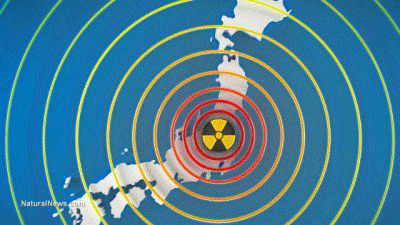
Release plans approved by UN nuclear authority have caused outcry in China and concern for the reputation of Japan’s seafood
Guardian Justin McCurry in Tokyo 22 Aug 23
Japan is to begin releasing wastewater from the wrecked Fukushima Daiichi nuclear power plant from Thursday, in defiance of opposition from fishing communities, China and some scientists.
The prime minister, Fumio Kishida, has said that disposing of more than 1m tonnes of water being stored at the site is an essential part of the long and complex process to decommission the plant.
But the plan, announced by Kishida on Tuesday, has caused controversy because the water contains tritium, a radioactive substance that can’t be removed by the facility’s water filtration technology.
The decision comes weeks after the UN’s nuclear watchdog, the International Atomic Energy Agency (IAEA), approved the discharge, saying that the radiological impact on people and the environment would be “negligible”.
South Korea and China banned seafood imports from some areas of Japan after Fukushima Daiichi suffered a triple meltdown in the March 2011 triple disaster along the country’s north-east coast.
The South Korean government recently dropped its objections to the discharge, but opposition parties and many South Koreans are concerned about the impact the discharge will have on food safety. China remains strongly opposed, while Hong Kong, an important market for Japanese seafood exports, has also threatened restrictions.
Some experts point out that nuclear plants around the world use a similar process to dispose of wastewater containing low-level concentrations of tritium and other radionuclides.
“Tritium has been released [by nuclear power plants] for decades with no evidential detrimental environmental or health effects,” said Tony Hooker, a nuclear expert from the University of Adelaide.
Greenpeace, however, has described the filtration process as flawed, and warned that an “immense” quantity of radioactive material will be dispersed into the sea over the coming decades.
The government and the plant’s operator, Tokyo Electric Power (Tepco), also face opposition from local fishers, who say pumping water into the Pacific Ocean will destroy their industry.
In a meeting on Monday with Masanobu Sakamoto, the head of the National Federation of Fisheries Cooperative Associations, Kishida attempted to reassure fishing communities that the discharge was safe………………………………… https://www.theguardian.com/environment/2023/aug/22/fukushima-wastewater-from-ruined-nuclear-plant-to-be-released-from-thursday-japan-says
Much hype, enthusiasm, tax-payers’ largesse, for Britain’s “new nuclear”. (What could possibly go wrong?)

There would be up to £20 billion in subsidies, if needed, to get between five and eight SMRs up and running by early next decade, and about £160 million in grants to keep R&D ticking over into AMRs and nuclear fuels.
Britain fires starter’s gun on race to nuclear
In the second instalment of the Nuclear Option series, Prime Minister Rishi Sunak’s government is suddenly ready to shower billions of pounds on getting modular nuclear reactors up and running by the early 2030s.
Australian Financial Review Hans van Leeuwen, Europe correspondentAug 22, 2023 – London
The British government is ready to trowel more than £20 billion ($38 billion) of taxpayers’ money into turbocharging the country’s nuclear industry, as the daunting task of decarbonising the UK’s energy sector looms ever larger.
With offshore wind and solar unlikely to ensure Britain has uninterrupted baseload power, the official goal is to get 24 gigawatts of nuclear energy onstream by 2050 – up to a quarter of British power demand, up from 15 per cent now.
But hefty new gigawatt-scale nuclear power stations are struggling to get off the ground, so the government’s hopes are increasingly pinned on an early lift-off for small modular reactors (SMRs)
…………… …. Tom Greatrex, chief executive of Britain’s Nuclear Industry Association. says that although successive Downing Street administrations have all understood Britain’s flagging nuclear industry needs fresh legs, Prime Minister Rishi Sunak’s government is now gripped with urgency. And it has clocked the key catalysing role of taxpayers and public policy.
“The lesson from anywhere in the world where nuclear power has been deployed is that unless the state is actively involved in encouraging it to happen, it doesn’t happen,” Greatrex says.
“It is public policy that has driven it, basically because the infrastructure is so big and capital-intensive.”
The government recently unfurled a £170 million investment into hurrying up work on the embryonic but enormous Sizewell C, a 3.2-gigawatt nuclear reactor to be built by the mid-2030s. This came on top of £700 million in earlier subsidies.
But the real action must of necessity be elsewhere. Construction of the next big new nuclear reactor, the 3.2-gigawatt Hinkley Point C plant in Somerset, has been subject to seemingly endless delays and cost blowouts. And of the five creaky old mega-reactors now operating, all but one will be shut in the next five years.
So, the focus is squarely on SMRs, which in theory can be rolled out more cheaply and snappily; and also on advanced modular reactors (AMRs), which use exotic new tech or methods that are still either largely on the drawing board or even just a glint in some scientist’s eye.
A week before the Sizewell announcement, the government confirmed it would set up a new agency, revelling in the Tory-boilerplate name of Great British Nuclear, to gee up the industry.
There would be up to £20 billion in subsidies, if needed, to get between five and eight SMRs up and running by early next decade, and about £160 million in grants to keep R&D ticking over into AMRs and nuclear fuels.
“I look forward to seeing the world-class designs submitted from all around the world through the competitive selection process, as the UK takes its place front and centre in the global race to unleash a new generation of nuclear technology,” energy minister Andrew Bowie trumpeted.
Leaders of the pack

At the front of the SMR pack is Rolls-Royce, leading a consortium that has already received £210 million in government grants. It has beefed up its SMR workforce to about 600 people.
……………………………………………. GE Hitachi is Rolls-Royce’s main rival. Media reports say it already has a BWRX-300 under construction and regulatory review in Canada, a.nd its model is under consideration in the US. The company claims to be the only contender with a realistic shot of getting an SMR operational by 2030.
The two are very likely to feature on Great British Nuclear’s short-list, which will be compiled by the end of the year. Other contenders could include Nuscale and Westinghouse.

The lucky winners will get access to the government’s subsidy scheme, which could be worth £20 billion if that’s what it takes.
It’s unclear exactly what form this largesse will assume. It could use the “regulated asset base” model, where investors are given a guaranteed minimum return, funded by a levy on consumer energy bills.
Another model might involve “strike prices”: a guaranteed price per unit, to smooth out the risks and uncertainty involved in committing so much capital upfront.
Whatever the capital cost, it won’t be as much as required for a mega-reactor: perhaps £2 billion to get an SMR up and running, as opposed to the £20 billion-plus for Sizewell C, thanks to the SMR’s modular, factory-based construction method. The catch, of course, is that you get just 50 to 500 megawatts of energy, rather than 3.2 gigawatts.
“It’s the economics of volume versus the economics of scale,” Greatrex says.
The initial batch of SMRs will almost certainly be built on the site of decommissioned larger reactors: communities there are socialised to nuclear; there are good grid connections; and the geography favours PWRs. This could help overcome a raft of potential political, planning or permit obstacles.
Dark horses
While the SMRs bolt towards an early-2030s target, the government hopes to back other horses in slower time. The AMRs might use technologies that ultimately prove more efficient, such as MoltexFlex’s molten-salt reactor. Or they might have different applications, such as local start-up U-Battery………………………….
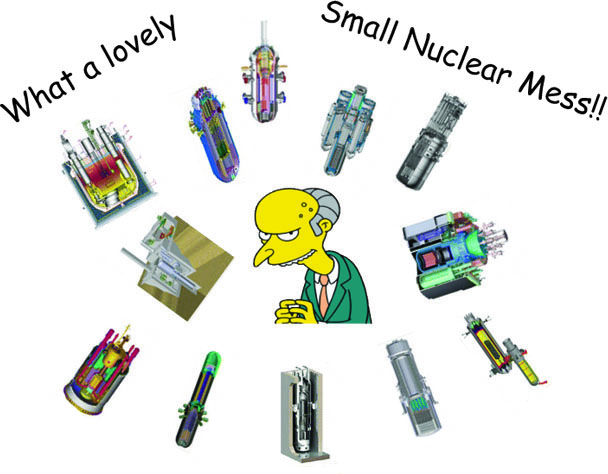
U-Battery ‘s key backer, Urenco, ultimately couldn’t pull in investors, and in March handed the intellectual property to the government-backed National Nuclear Laboratory.
Other AMRs have higher-profile investors: TerraPower has Bill Gates; NewCleo has Italy’s Agnelli family. Most are working across multiple markets. X-Energy, for example, is using US funding to build a pilot of its gas-cooled pebble-bed reactor in Texas, which it says would allow it to roll out quickly in Britain…………………
The government has fired the starter’s gun, and the race in Britain is on. There’s bipartisan political support and investor interest, so Greatrex’s only anxiety is that Westminster might become distracted.
“It’s about maintaining momentum and focus. When something is at the top of the agenda it gets that attention and focus,” he says. “But if that focus is lost, that drive and commitment is lost? Then things could go back to taking a very long time.” https://www.afr.com/companies/energy/britain-fires-starter-s-gun-on-race-to-nuclear-20230726-p5dr9r
Exposure to Low-Dose Ionizing Radiation Linked to Solid Cancer Mortality

Elana Gotkine Aug 21, 2023 https://www.applevalleynewsnow.com/news/health/exposure-to-low-dose-ionizing-radiation-linked-to-solid-cancer-mortality/article_6ed70b06-3ba4-549e-828c-e2892b462550.html
(HealthDay News) — Protracted exposure to low-dose ionizing radiation is associated with an increased risk for solid cancer mortality, according to a study published online Aug. 16 in The BMJ.
David B. Richardson, Ph.D., from the University of California in Irvine, and colleagues examined the effect of protracted low-dose exposure to ionizing radiation on the risk for cancer in a multinational cohort study involving workers in the nuclear industry in France, the United Kingdom, and the United States. Participants included 309,932 workers with individual monitoring data for external exposure to ionizing radiation, with follow-up of 10.7 million person-years.
The researchers identified 103,553 deaths, including 28,089 due to solid cancers. There was a 52 percent increase in the estimated rate of mortality due to solid cancer with cumulative dose per Gy, which lagged by 10 years. The estimate of association was approximately doubled on restriction of the analysis to the low cumulative dose range (0 to 100 mGy) and with restricting the analysis to workers hired in more recent years, when estimates of occupational external radiation were more accurate. The estimated magnitude of the association was modestly affected by exclusion of deaths from lung cancer and pleural cancer, indirectly indicating that the association was not substantially confounded by smoking or asbestos exposure.
“The study provides evidence in support of a linear association between protracted low-dose external exposure to ionizing radiation and solid cancer mortality,” the authors write.
EDF Warns of French Nuclear Output Cuts in Weekend Heat Wave

Bloomberg, By Francois De Beaupuy, August 22, 2023
Electricite de France SA will probably have to reduce nuclear output over the coming weekend as a heat wave affecting a large part of the country warms rivers used for cooling some of its reactors.
Due to the high temperatures forecast on Rhone river, production restrictions are likely to affect production at its Tricastin power plant — where two of its four 900-megawatt reactors are already………….(Subscribers only) more https://www.bloomberg.com/news/articles/2023-08-21/edf-warns-of-french-nuclear-output-cuts-in-weekend-heat-wave#xj4y7vzkg
Japan’s nuclear wastewater – should we be worried?
August 22, 2023 https://www.nst.com.my/opinion/leaders/2023/08/945792/nst-leader-japans-nuclear-wastewater
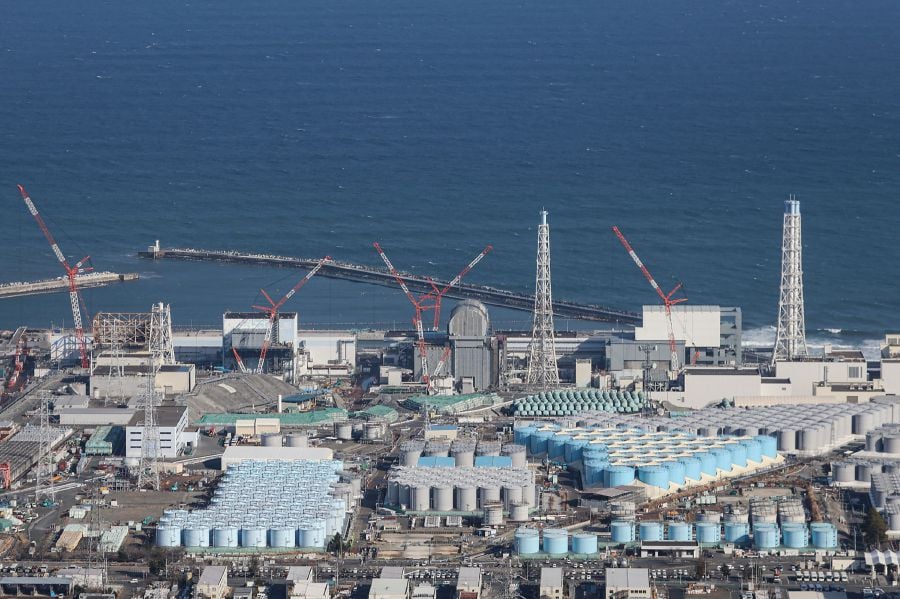
FUKUSHIMA is a dreaded word in the region because what happens there doesn’t stay there. There in Japan on March 11, 2011, an earthquake and tsunami, in that order, knocked out the Fukushima Daiichi nuclear-power plant, releasing untreated radioactive water into the sea.
Given the state of the nuclear plant technology then — or even now — there wasn’t the time for the radioactive elements to self-destruct. The human mind, including the Japanese ones, for some reason didn’t perceive that calamities can happen all at once.
The Fukushima disaster is such a tale of instantaneous conjunction of calamities. On a visit to the disaster zone on Sunday, Japanese Prime Minister Fumio Kishida was quoted by news agency AFP as saying that he was refraining from “commenting on a concrete timing of the release into the ocean at this point in time”, leaving ample room for a prime ministerial hint that it will be soon.
Some 500 Olympic-size swimming pools of wastewater, accumulated over 12 years after the disaster, are expected to be released into the Pacific Ocean. The fact that it would be a slow release over 10 years registered no effect in the region’s dread meter.
The region is on dread-watch, but much of it is coated with diplomatic niceties. China has been the most vociferous in opposing the release of the wastewater into the ocean. In China, dread comes mixed with geopolitical anger, given that Tokyo is a tango partner of Washington.
If a taste of Chinese animus is needed, here is one quote from a Beijing official, gleefully circulated by the Western media: Japan is treating the sea as its sewer. An interesting take, we must say, now that all nations without exception are treating the seas as their sewer.
How many marine lives were destroyed or how many people have ingested radioactive materials through seafood after the accident 12 years ago is hard to tell. Nuclear literature tells us if the water isn’t treated properly, dangerous isotopes can have devastating effects, including DNA-damaging ones. Should we fear? Yes and no. Start with yes.
The Tokyo Electric Power Company (Tepco), the operator of the crippled nuclear plant, and Japanese regulators stand accused of negligence, notwithstanding the earthquake and tsunami. Now that Tepco and the government are saying the 1.34 million tonnes of wastewater planned to be released into the Pacific Ocean is safe, many in Japan don’t believe them. Both are victims of trust deficit.
Kishida, though he wasn’t prime minister when disaster struck in 2011, is in need of reputation management advice. Not just to repair the trust deficit at home, but also abroad.
China has banned seafood from Fukushima and considering a wider ban. Others in the region are beginning to be infected by China’s isotope fear, not because of Beijing’s geopolitics, but because of the nightmarish outcome of radioactive contamination. If the dread grows, it will cripple more than Fukushima.
Now for the no, our second response to Japan’s release of the treated wastewater into the ocean. The world shouldn’t fear because the Japanese guarantee that the dangerous radioactive elements have been filtered out and comes stamped with the approval of the United Nations’ International Atomic Energy Agency
Unless, of course, if the world has reasons to believe that the IAEA, too, comes branded with a trust deficit.
End Nuclear Testing Forever, Says Secretary-General in Message for International Day

Following is UN Secretary-General António Guterres’ message for the International Day against Nuclear Tests, observed on 29 August:
Since 1945, more than 2,000 nuclear tests have inflicted terrifying suffering on people, poisoned the air we breathe and ravaged landscapes around the world.
On the International Day Against Nuclear Tests, the world speaks with one voice to end this destructive legacy.
This year, we face an alarming rise in global mistrust and division. At a time in which nearly 13,000 nuclear weapons are stockpiled around the world — and countries are working to improve their accuracy, reach and destructive power — this is a recipe for annihilation.
A legally binding prohibition on nuclear tests is a fundamental step in our quest for a world free of nuclear weapons. The Comprehensive Nuclear-Test-Ban Treaty, though not yet in force, remains a powerful testament to humanity’s will to lift the shadow of nuclear annihilation from our world, once and for all.
In the name of all victims of nuclear testing, I call on all countries that have not yet ratified the Treaty to do so immediately, without conditions.
Let’s end nuclear testing forever.
Japanese fishing industry leader is “greatly concerned” over the pending disharge of Fukushima radioactive water into the ocean.

The leader of a Japanese fisheries industry group told officials on Monday
he was “greatly concerned” about the discharge of treated radioactive water
set to be released into the sea from the wrecked Fukushima nuclear plant.
The government is expected to decide soon, perhaps within days, when to
start releasing the water, equivalent to the contents of 500 Olympic-size
swimming pools, despite objections at home and abroad to the plan.
Reuters 21st Aug 2023
Biden’s rival, Robert F. Kennedy Junior, labels F-16s for Ukraine ‘a disaster for humanity’

21vAug 23 , https://www.rt.com/news/581543-kennedy-ukraine-f16-delivery/1
Supplying US-made fighter jets to Kiev would only benefit the defense industry, RFK Jr. says
The looming delivery of US-made F-16 fighter jets to Ukraine will not prevent the “collapse” of the country’s military and will only benefit the military-industrial complex, Democrat presidential hopeful Robert F. Kennedy Junior has claimed.
The Ukrainian conflict should be resolved through negotiations, RFK Jr. argued in a thread on social media platform X (formerly Twitter), stating that supplying F-16s to Kiev was a “great decision for the defense industry, but a disaster for Ukraine and humanity.”
“F-16s won’t stop the collapse of the Ukrainian military (which some experts say is imminent). These planes require a lot of training and maintenance. This isn’t the movies,” Kennedy stressed.
The presidential hopeful has long-opposed the enduring Western aid to Ukraine, spearheaded by Washington, arguing that the US should admit its “failure” in the country and focus on domestic issues instead. Kennedy’s criticism of the fighter-jet delivery comes after Washington enabled its European allies to re-export older planes to Ukraine, and hours before the move was officially announced by Denmark and the Netherlands.
The upcoming delivery was heralded by Dutch PM Mark Rutte on Sunday as he hosted Ukrainian President Vladimir Zelensky at a military airbase in Eindhoven.
“Today we can announce that the Netherlands and Denmark commit to the transfer of F-16 aircraft to Ukraine and the Ukrainian Air Force, including cooperation with the United States and other partners once the conditions for such a transfer have been met,” Rutte said at a press conference.
Simultaneously, the Danish Ministry of Defence released a statement confirming its pledge to provide Kiev with F-16s from its inventory, once certain “conditions” are met. The conditions “include, but are not limited to, successfully selected, tested and trained Ukrainian F-16 personnel as well as necessary authorizations, infrastructure and logistics,” it said.
Kiev has long-demanded modern aircraft, as well as other, increasingly sophisticated weaponry, from its Western backers, arguing the planes would help it turn the tide of the conflict with Russia, which has been going on since February 2022. Moscow has repeatedly urged the collective West to stop the military deliveries, arguing they would only prolong the hostilities rather than change their ultimate outcome.
US derides wimpy Ukrainians that have become ‘casualty adverse’
Walt Zlotow, West Suburban Peace Coalition, Glen Ellyn IL 21 Aug 23
The US has come up a clever way of masking their contempt of the Ukrainian military in their failed counteroffensive against Russia.
Dismayed that Ukraine is squandering US weapons by hurling them at Russian forces instead hurling themselves at the well-fortified invaders, armchair US military are calling the Ukrainians ‘casualty adverse’, a nice way of calling them ,cowards. US/UK war games ahead of the June counteroffensive envisioned Ukraine taking large casualties in order to reclaim Donbas so they could start brutalizing Donbas Ukrainians again.
That was OK for the US war party. Hey, didn’t that work for England and France during trench warfare during WWI? Apparently, US strategists forgot those allies lost a few million soldiers to take at best a few hundred yards. The Ukraine general staff shot back: “We simply don’t have the resources to do the frontal attacks that the West is imploring us to do.”
The US knew Ukraine had neither the human nor explosive resources to regain territory, a US precondition for ending the war thru negotiations. That makes the US proxy war against Russia, shedding only Ukrainian blood and only destroying the Ukrainian economy, a grotesque US moral crime that must be resisted by every peace loving American.
President Biden has painted the US into a corner of death and despair he spent the last half century leading up to promoting American empire and exceptionalism. It may be too late for the electorate to inspire an epiphany in Biden to pivot to peace.
But we must try.
1 This Month
Chernobyl: The Lost Tapes – A good documentary on Chernobyl on SBS available On Demand for the next 3 weeks– https://www.sbs.com.au/ondemand/tv-program/chernobyl-the-lost-tapes/2352741955560

of the week–London Campaign for Nuclear Disarmament

Tell the Ukrainian Government to Drop Prosecution of Peace Activist Yurii Sheliazhenko
To see nuclear-related stories in greater depth and intensity – go to https://nuclearinformation.wordpress.com
-
Archives
- April 2026 (126)
- March 2026 (251)
- February 2026 (268)
- January 2026 (308)
- December 2025 (358)
- November 2025 (359)
- October 2025 (376)
- September 2025 (257)
- August 2025 (319)
- July 2025 (230)
- June 2025 (348)
- May 2025 (261)
-
Categories
- 1
- 1 NUCLEAR ISSUES
- business and costs
- climate change
- culture and arts
- ENERGY
- environment
- health
- history
- indigenous issues
- Legal
- marketing of nuclear
- media
- opposition to nuclear
- PERSONAL STORIES
- politics
- politics international
- Religion and ethics
- safety
- secrets,lies and civil liberties
- spinbuster
- technology
- Uranium
- wastes
- weapons and war
- Women
- 2 WORLD
- ACTION
- AFRICA
- Atrocities
- AUSTRALIA
- Christina's notes
- Christina's themes
- culture and arts
- Events
- Fuk 2022
- Fuk 2023
- Fukushima 2017
- Fukushima 2018
- fukushima 2019
- Fukushima 2020
- Fukushima 2021
- general
- global warming
- Humour (God we need it)
- Nuclear
- RARE EARTHS
- Reference
- resources – print
- Resources -audiovicual
- Weekly Newsletter
- World
- World Nuclear
- YouTube
-
RSS
Entries RSS
Comments RSS
 nuclear-news