TODAY. Bribery and Blackmail: these are the tools for continuing success of the nuclear industry
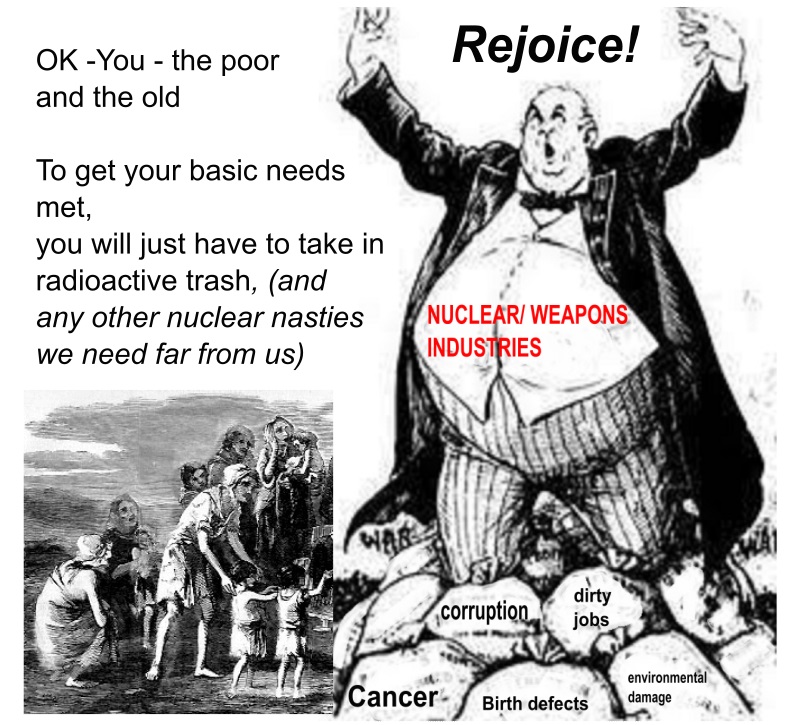
The sociopaths who run this world assure us that disposal sites for radioactive trash wiil be found. And, these sites will be decided upon only with informed consent of the local community.
And they mean this – they sure do. Apart from all the technical blah blah – on safety etc, the really significant part will be the “goodies” that they will charitably bestow on the community.
It’s so simple. You find a poor, aging, struggling community. preferably remote, that is lacking in adequate medical educational, and other human services. They can’t seem to get these. Governments are slow to respond to their needs.
But then – hey presto ! Along comes the nuclear industry, and suddenly – purses open -and this poor community is suddenly grateful to have those essential facilities – that everyone else has got anyway , (without having to accept nuclear trash).
I was prompted to note this today, as one Japanese town [or more correctly, its Mayor], considers hosting a nuclear waste dump. – “The town will only get poorer if we just keep waiting,” Kaminoseki Mayor Tetsuo Nishi – “We should do whatever is available now.”
Earlier this month, Chugoku put forward a proposal to build a storage facility jointly with Kansai Electric, but the plan was met by angry protests from residents, who surrounded the mayor and yelled at him.
Assange Be Weary: The Dangers of a US Plea Deal

August 18, 2023
By Binoy Kampmark / CounterPunch, https://scheerpost.com/2023/08/18/assange-be-weary-the-dangers-of-a-us-plea-deal/
At every stage of its proceedings against Julian Assange, the US Imperium has shown little by way of tempering its vengeful impulses. The WikiLeaks publisher, in uncovering the sordid, operational details of a global military power, would always have to pay. Given the 18 charges he faces, 17 fashioned from that most repressive of instruments, the US Espionage Act of 1917, any sentence is bound to be hefty. Were he to be extradited from the United Kingdom to the US, Assange will disappear into a carceral, life-ending dystopia.
In this saga of relentless mugging and persecution, the country that has featured regularly in commentary, yet done the least, is Australia. Assange may well be an Australian national, but this has generally counted for naught. Successive governments have tended to cower before the bullying disposition of Washington’s power. With the signing of the AUKUS pact and the inexorable surrender of Canberra’s military and diplomatic functions to Washington, any exertion of independent counsel and fair advice will be treated with sneering qualification.
The Albanese government has claimed, at various stages, to be pursuing the matter with its US counterparts with firm insistence. Prime Minister Anthony Albanese has even publicly expressed his frustration at the lack of progress in finding a “diplomatic solution” to Assange’s plight. But such frustrations have been tempered by an acceptance that legal processes must first run their course.
The substance of any such diplomatic solution remains vague. But on August 14, the Sydney Morning Herald, citing US Ambassador to Australia Caroline Kennedy as its chief source, reported that a “resolution” to Assange’s plight might be in the offing. “There is a way to resolve it,” the ambassador told the paper. This could involve a reduction of any charges in favour of a guilty plea, with the details sketched out by the US Department of Justice. In making her remarks, Kennedy clarified that this was more a matter for the DOJ than the State Department or any other department. “So it’s not really a diplomatic issue, but I think there absolutely could be a resolution.”
In May, Kennedy met members of the Parliamentary Friends of Julian Assange Group to hear their concerns. The previous month, 48 Australian MPs and Senators, including 13 from the governing Labor Party, wrote an open letter to the US Attorney General, Merrick Garland, warning that the prosecution “would set a dangerous precedent for all global citizens, journalists, publishers, media organizations and the freedom of the press. It would also be needlessly damaging for the US as a world leader on freedom of expression and the rule of law.”
In a discussion with The Intercept, Gabriel Shipton, Assange’s brother, had his own analysis of the latest developments. “The [Biden] administration appears to be searching for an off-ramp ahead of [Albanese’s] first state visit to DC in October.” In the event one wasn’t found, “we could see a repeat of a very public rebuff delivered by [US Secretary of State] Tony Blinken to the Australian Foreign Minister two weeks ago in Brisbane.”
That rebuff was particularly brutal, taking place on the occasion of the AUSMIN talks between the foreign and defence ministers of both Australia and the United States. On that occasion, Foreign Minister Penny Wong remarked that Australia had made its position clear to their US counterparts “that Mr Assange’s case has dragged for too long, and our desire it be brought to a conclusion, and we’ve said that publicly and you would anticipate that that reflects also the positive we articulate in private.”
In his response, Secretary of State Blinken claimed to “understand” such views and admitted that the matter had been raised with himself and various offices of the US. With such polite formalities acknowledged, Blinken proceeded to tell “our friends” what, exactly, Washington wished to do.
Assange had been “charged with very serious criminal conduct in the United States in connection with his alleged role in one of the largest compromises of classified information in the history of our country. The actions that he has alleged to have committed risked very serious harm to our national security, to the benefit of our adversaries, and put named sources at grave risk – grave risk – of physical harm, and grave risk of detention.”
Such an assessment, lazily assumed, repeatedly rebutted, and persistently disproved, went unchallenged by all the parties present, including the Australian ministers. Nor did any members of the press deem it appropriate to challenge the account. The unstated assumption here is that Assange is already guilty for absurd charges, a man condemned.
At this stage, such deals are the stuff of manipulation and fantasy. The espionage charges have been drafted to inflate, rather than diminish any sentence. Suggestions that the DOJ will somehow go soft must be treated with abundant scepticism. The pursuit of Assange is laced by sentiments of revenge, intended to both inflict harm upon the publisher while deterring those wishing to publish US national security information. As the Australian international law academic Don Rothwell observes, the plea deal may well take into account the four years spent in UK captivity, but is unlikely to either feature a complete scrapping of the charges, or exempt Assange from travelling to the US to admit his guilt. “It’s not possible to strike a plea deal outside the relevant jurisdiction except in the most exceptional circumstances.”
Should any plea deal be successfully reached and implemented, thereby making Assange admit guilt, the terms of his return to Australia, assuming he survives any stint on US soil, will be onerous. In effect, the US would merely be changing the prison warden while adjusting the terms of observation. In place of British prison wardens will be Australian overseers unlikely to ever take kindly to the publication of national security information.
Huge study of nuclear workers in France, the United Kingdom, and the United States confirms low dose radiation as a cause of cancer.

What this study adds
- The results of an updated study of nuclear workers in France, the UK, and the US suggest a linear increase in the relative rate of cancer with increasing exposure to radiation
- Some evidence suggested a steeper slope for the dose-response association at lower doses than over the full dose range
- The risk per unit of radiation dose for solid cancer was larger in analyses restricted to the low dose range (0-100 mGy) and to workers hired in the more recent years of operations
Cancer mortality after low dose exposure to ionising radiation in workers in France, the United Kingdom, and the United States (INWORKS): cohort study
BMJ 2023; 382 doi: https://doi.org/10.1136/bmj-2022-074520 (Published 16 August 2023)Cite this as: BMJ 2023;382:e074520
David B Richardson, professor1, Klervi Leuraud, head of service2, Dominique Laurier, deputy director of health2, Michael Gillies, medical statistician3, Richard Haylock, senior research scientist3, Kaitlin Kelly-Reif, senior research scientist4, Stephen Bertke, research statistician4, Robert D Daniels, senior research scientist4, Isabelle Thierry-Chef, senior research scientist5, Monika Moissonnier, research assistant6, Ausrele Kesminiene, senior visiting scientist6, Mary K Schubauer-Berigan, programme head6
Abstract
Objective To evaluate the effect of protracted low dose, low dose rate exposure to ionising radiation on the risk of cancer.
Design Multinational cohort study.
Setting Cohorts of workers in the nuclear industry in France, the UK, and the US included in a major update to the International Nuclear Workers Study (INWORKS).
Participants 309 932 workers with individual monitoring data for external exposure to ionising radiation and a total follow-up of 10.7 million person years.
Main outcome measures Estimates of excess relative rate per gray (Gy) of radiation dose for mortality from cancer.
Results The study included 103 553 deaths, of which 28 089 were due to solid cancers. The estimated rate of mortality due to solid cancer increased with cumulative dose by 52% (90% confidence interval 27% to 77%) per Gy, lagged by 10 years. Restricting the analysis to the low cumulative dose range (0-100 mGy) approximately doubled the estimate of association (and increased the width of its confidence interval), as did restricting the analysis to workers hired in the more recent years of operations when estimates of occupational external penetrating radiation dose were recorded more accurately. Exclusion of deaths from lung cancer and pleural cancer had a modest effect on the estimated magnitude of association, providing indirect evidence that the association was not substantially confounded by smoking or occupational exposure to asbestos.
Conclusions This major update to INWORKS provides a direct estimate of the association between protracted low dose exposure to ionising radiation and solid cancer mortality based on some of the world’s most informative cohorts of radiation workers. The summary estimate of excess relative rate solid cancer mortality per Gy is larger than estimates currently informing radiation protection, and some evidence suggests a steeper slope for the dose-response association in the low dose range than over the full dose range. These results can help to strengthen radiation protection, especially for low dose exposures that are of primary interest in contemporary medical, occupational, and environmental settings.
Conclusions This major update to INWORKS provides a direct estimate of the association between protracted low dose exposure to ionising radiation and solid cancer mortality based on some of the world’s most informative cohorts of radiation workers. The summary estimate of excess relative rate solid cancer mortality per Gy is larger than estimates currently informing radiation protection, and some evidence suggests a steeper slope for the dose-response association in the low dose range than over the full dose range. These results can help to strengthen radiation protection, especially for low dose exposures that are of primary interest in contemporary medical, occupational, and environmental settings.
…………………………………………………………………………………………………………………………………………………………………………………………………………………………… Discussion
This study, which involved a major update to an international cohort mortality study of radiation dosimeter monitored workers, reports evidence of an increase in the excess relative rate of solid cancer mortality with increasing cumulative exposure to ionising radiation at the low dose rates typically encountered by French, UK, and US nuclear workers. The study provides evidence in support of a linear association between protracted low dose external exposure to ionising radiation and solid cancer mortality.
…………………………………………………
What is already known on this topic
- Ionising radiation is an established cause of cancer
- The primary quantitative basis for radiation protection standards comes from studies of people exposed to acute, high doses of ionising radiation
What this study adds
- The results of an updated study of nuclear workers in France, the UK, and the US suggest a linear increase in the relative rate of cancer with increasing exposure to radiation
- Some evidence suggested a steeper slope for the dose-response association at lower doses than over the full dose range
- The risk per unit of radiation dose for solid cancer was larger in analyses restricted to the low dose range (0-100 mGy) and to workers hired in the more recent years of operations
What Happened When the US Set Off Nuclear Weapons in One of the Most Geologically Active Places on Earth?
the enduring impact on the island remains as the copious radioactive elements made when we try to come up with ways to destroy us all keep seeping from their tomb underground.
Imagine a Bond villain saying they were going to set off three nuclear bombs in one of the most volcanically and seismically active places on Earth. Now imagine that the US already did it.
Rocky Planet. By Erik Klemetti. Aug 16, 2023
“……………. the United States set three nuclear bombs off in one of the most geologically active parts of the world … and nothing happene
These days it is hard to imagine a world with nuclear testing. However, in the 1940s to 1990s, the US and USSR (amongst others) were setting off bombs like they were going out of style. In the air, on land, under the sea and eventually underground, these “experiments” were both means to develop even bigger weapons and displays of force. The consequences of many of these tests are still being felt thanks to the copious radioactive fallout produced.
Bombs in Alaska
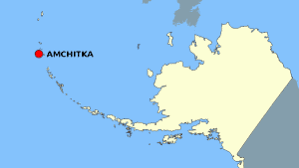
One set of the over 1,000 nuclear explosions run by the US was conducted on Amchitka in the Aleutian Islands. Long Shot, Milrow and Cannikin were the code names given to three blasts performed from 1965 to 1971. This included the largest underground nuclear bomb ever detonated, the 5 megaton weapon as part of Operation Grommet.
The most astonishing thing about these tests is that Amchitka Island is in the middle of the Aleutian subduction zone, where the Pacific Plate is diving underneath the North American Plate. There are six potentially active volcanoes within 100 miles of the island. On top of that, the Rat Islands region has produced numerous and gigantic earthquakes across the 20th and 21st centuries. This area is highly volatile, geologically speaking.
So, why run nuclear tests there? For one, it is remote. Very few people live anywhere near these islands. It’s remoteness also allowed Amchitka to be a proxy for the USSR so that the US could work on methods to detect underground nuclear blasts from afar. The island previously hosted a US Air Force base during World War II that had over 15,000 soldiers stationed in this desolate island. This meant that the infrastructure for tests was there after the armed forces moved out.
The first nuclear test on Amchitka was 1965’s Long Shot. It was an 80-kiloton warhead that was used to test early methods of seismic detection of distant nuclear blasts. After that, nothing happened on the island again until 1969. It was realized that the Cannikin test was way too big to do in Nevada, so off to Alaska it went.
Volcanoes and Earthquakes
Let’s set out stage: the US planned to test a massive nuclear weapon in a shaft last 1 mile (2 kilometers) deep in a location that was volcanically and seismically active. Remember those six volcanoes with 100 miles? They include Semisopochnoi (currently erupting, and prior to test, 1873), Little Sitkin (last erupted 1830), Gareloi (last erupted 1989, and prior to the test, 1952), Davidof (Holocene), Segula (1600s?) and Kiska (last erupted 1990, erupting in 1969!)
On top of that, the M8.7 Rat Islands earthquake that generated a tsunami that swept across the Alaskan coast occurred ~30 miles from Amchitka on February 4, 1965. That was less than 9 months before the Long Shot test! It is hard to imagine how a massive earthquake could happen that close to the test site … and they still went ahead and did it! Combine that with the vivid memories of the 1964 M9.2 earthquake and tsunami in Alaska, and no wonder people were edgy about bomb tests.
Just to show how strange the pre-test ban treaty world was, the US Atomic Energy Commission set off a smaller (1-1.2 megaton, or 12-15 times larger than Long Shot) earlier to calibrate their sensors for the larger blast to come. Later, it was admitted that the Pentagon had run the Milrow explosion to also test if a big blast could, just maybe, cause an earthquake or eruption.
The Big One
Although the tests were performed under the auspices of the US Atomic Energy Commission, they were really being done for the Pentagon. The Cannikin test was meant to investigate the feasibility of using a 5-megaton warhead as part of an anti-ballistic missile program (the Spartan Missile). Although there was a lot of resistance to the test (see below), President Nixon still went ahead and ordered the test to proceed (with support from the Supreme Court).
Cannikin went off on November 6, 1971. It produced a M7 earthquake from the blast. You can see in this video how the land surface jumped as much as 20 feet during the explosion as the shockwave moved across the island. Thousands of birds and otters died in the shockwave. A crater over a mile wide was produced but even with the same energy released as the 2010 earthquake in Haiti, no tsunami was generated. Supposedly, very little radiation was detected either. In the eyes of the US Atomic Energy Commission and the Pentagon, it was a great success.
……………………………………………………… Looking Back 50 Years
The one long-term impact of the tests is the groundwater of Amchitka. Although little radiation was detected directly after the blast, water percolating through the underground remains of the Cannikin blast becomes radioactive. The US Department of Energy doesn’t agree with findings that show elements like plutonium in groundwater at Amchitka, but it does seem that the island still feels the effects of those blasts even today.
The other impact is a human impact. By the late 1960s, environmentalists became increasingly enflamed by the frequency of nuclear weapon tests … and rightly so. The amount of fallout produced by these tests is clearly seen in the deep-sea sediment and ice core records. When word got out about the immense Cannikin test, a group headed out in a rented boat they dubbed “Greenpeace” to try to stop the test, both in fear of fallout and the potential for triggering another earthquake and tsunami like the M8.7 event in 1965. Stormy weather with winds over 120 miles per hour prevented the ship from reaching Amchitka for the test, but the name “Greenpeace” remained as the environmental organization we know today.
Maybe the myth that we can set off eruptions and earthquakes using nuclear weapons can be (partially) put to bed. The only earthquake caused by these explosions were, well, caused by the explosion. Little evidence exists to suggest that the blasts had any trigger effect on faults and volcanoes near Amchitka. However, the enduring impact on the island remains as the copious radioactive elements made when we try to come up with ways to destroy us all keep seeping from their tomb underground. https://www.discovermagazine.com/planet-earth/what-happened-when-the-us-set-off-nuclear-weapons-in-one-of-the-most
Fukushima water release poses test for Japan-South Korea unity
TOKYO/SEOUL – Japan Times , BY TIM KELLY, SAKURA MURAKAMI AND HYONHEE SHIN
REUTERS 18 Aug 23
U.S. President Joe Biden wants to lock in friendly ties between Japan and South Korea at a summit on Friday, but their readiness to shelve grievances will be tested when Tokyo begins pumping water from its wrecked Fukushima nuclear plant into the sea.
Japan already delayed the release to avoid stirring up political opposition in South Korea before President Yoon Suk-yeol joins Prime Minister Fumio Kishida for a meeting with Biden at the Camp David retreat on Friday, four officials in Japan and South Korea said.
The dumping of radioactive water may happen days after the summit, which the United States is billing as a “historical” trilateral meeting that will deliver a “bold counter” to regional rival China.
That puts less domestic political pressure on Yoon, said one of the officials, who asked not to be identified because of the sensitivity of the issue.
Washington needs its Asian allies to work together because they see the military power balance in East Asia, including around Taiwan, shifting in China’s favor.
…………………….. Even if Fukushima fades as an issue, the risk of bad blood remains real. As relations soured in 2019, for example, Moon nearly scrapped a critical intelligence-sharing deal with Japan, reversing the decision at the last minute under U.S. pressure.
By accepting an International Atomic Energy Agency (IAEA) report last month that greenlit Japan’s Fukushima water release, Yoon could encourage fresh dissent that China will try to amplify, analysts say.
“There is certainly some possibility that Yoon will come under pressure over this, particularly if there is data that shows that the water is more dangerous than we otherwise thought,” said Christopher Johnstone, a former East Asia director of Biden’s National Security Council who is now with the Center for Strategic and International Studies.
Japan says it will remove most radioactive elements from the water except for tritium, a hydrogen isotope that must be diluted because it is difficult to filter.

U.S. Secretary of State Antony Blinken on Tuesday expressed satisfaction with Japan’s plans.
………………….a Gallup poll in late June showed that 78% of South Koreans worry about potential contamination of the ocean and seafood…………………………
more https://www.japantimes.co.jp/news/2023/08/18/japan/politics/south-korea-fukushima-radioactive-water/
Japan mothers’ group fears Fukushima water release could revive health concerns
By Kiyoshi Takenaka, Akiko Okamoto and Tom Bateman, August 18, 2023
IWAKI, Japan, Aug 17 (Reuters) – Waves crashing on a Japanese beach lashed a man and a woman wearing waders and hats as they demonstrated the use of a blue bucket to scoop some of the liquid into large plastic containers to be taken away and tested for radiation.
Members of a group that tracks such levels in food and seawater, they fear Japan’s plans to release treated radioactive water into the sea near the Fukushima nuclear plant could stir an anxiety among residents reminiscent of the 2011 disaster.
“The people of Fukushima endured the risks for the last 12 years and have confirmed the radiation level has dropped,” said Ai Kimura, director of non-profit group Mothers’ Radiation Lab Fukushima, also known as Tarachine.
“But if radioactive materials are released into the ocean now, it will again bring back the tragedy of 12 years ago,” she added, speaking at the lab in the city of Iwaki, 50 km (30 miles) south of the power plant.
Japan is preparing this summer to start discharging into the Pacific more than a million tons of water from the tsunami-crippled power plant, but has not yet revealed the date.
Although the government and an international nuclear regulator say the plan is safe, it has alarmed neighbours, particularly China, and the regional fisheries industry.
Tarachine comprises 13 members – mostly mothers – who had no experience in radiology when they started, but were taught by scientists and doctors how to run tests and keep records.
After losing a job cooking school lunches in the wake of the disaster, Kimura joined the group in 2014 and taught herself how to measure radiation, in hopes of protecting her daughters, who were teenagers at the time, as well as others.
Now she says she wants more dialogue between the government and plant operator Tokyo Electric Power (9501.T) on one side, and citizens, fishermen and others on the other, to allay concerns over safety and other fears.
“Since the ocean has no walls … and what’s been released can’t be taken back, this issue is not only for Fukushima or for Japan to give consideration to, but for the whole world,” Kimura added.
…………… Kimura’s group vowed to continue its activities after the release begins.
“We will keep on providing data, so that fathers and mothers can decide for themselves, and children can also decide, when they grow up, whether to eat Fukushima fish or whether to go swimming in the sea,” Kimura said.
Reporting by Kiyoshi Takenaka, Akiko Okamoto and Tom Bateman; Editing by Chang-Ran Kim and Clarence Fernandez https://www.reuters.com/world/asia-pacific/japan-mothers-group-fears-fukushima-water-release-could-revive-health-concerns-2023-08-17/
Over Budget and Delayed—What’s Next for U.S. Nuclear Weapons Research and Production Projects?
August 17, 2023, https://www.gao.gov/blog/over-budget-and-delayed-whats-next-u.s.-nuclear-weapons-research-and-production-projects [Excellent diagrams]
The United States’ nuclear weapon stockpile depends on facilities that are, on average, about 50 years old. In fact, the processing of enriched uranium used in nuclear weapons is still conducted in an Oppenheimer-era facility built in 1945. These aging facilities pose safety and operational risks and cost taxpayers almost a billion dollars to maintain each year.
Over the next two decades, the United States plans to spend tens of billions of dollars to modernize the research and production infrastructure on which the nuclear stockpile depends. Today’s WatchBlog post looks at our new report about the status of these efforts, led by the National Nuclear Security Administration (NNSA), and the challenges that have resulted in them being over budget and delayed.
New infrastructure projects are important, complex, and expensive
NNSA is currently designing or constructing 23 major projects (each costing more than $100 million). Some projects will process nuclear components containing plutonium or enriched uranium, which are critical to the functioning of nuclear weapons. These projects are expensive and include three multi-billion dollar, one-of-a-kind efforts to build new or modify existing uranium and plutonium component production facilities in New Mexico, South Carolina, and Tennessee. Other projects do not involve nuclear materials and are less expensive, such as a $270 million project to build a high explosives laboratory and related facilities in Texas.
New projects will cost more and take longer to build than NNSA planned
As of March, NNSA’s projects that were in the construction phase collectively overran their cost estimates by over $2 billion and their schedules by almost 10 years. Some of the reasons for these increased costs and delays include poor management and planning, as well as COVID-19. Of the projects that are under construction, the multi-billion-dollar Uranium Processing Facility family of projects in Tennessee is responsible for a majority of the cost increases and schedule delays. These cost increases and schedule delays, as well as NNSA’s decision to refocus resources on higher-priority projects, led NNSA to propose placing two other projects (in Texas and South Carolina) currently in the design phase on hold for multiple years.
In addition, six projects in the design phase are implementing significant changes that may increase their cost and schedule beyond NNSA’s preliminary estimates. These include a project to modify existing plutonium processing facilities at Los Alamos National Laboratory in New Mexico.
We’ve made recommendations to help NNSA improve its oversight of these projects
We have previously made recommendations that would help NNSA better manage its projects as well as the programs that will operate the completed projects to achieve agency goals. For example, we recommended that the NNSA complete a lifecycle cost estimate for establishing the agency’s capability for producing plutonium pits (the central core of a nuclear weapon), as this effort involves dozens of programs, projects, and other activities, including two multi-billion dollar projects and multiple other projects that will cost hundreds of millions of dollars. However, NNSA has not taken action on some of these recommendations. We have expressed concerns about the management of nuclear projects and programs since 1990, and NNSA acquisition and program management remains on our most recent High Risk List.
Learn more about NNSA’s projects, their statuses, and challenges by checking out our new report.
US tightens export controls of nuclear power items to China
By Timothy Gardner, August 19, 2023
WASHINGTON, (Reuters) – The Biden administration has tightened controls on the export of materials and components for nuclear power plants to China, saying it would ensure the items were used only for peaceful purposes and not the proliferation of atomic weapons.
The steps are among the latest signs of strained relations between Washington and Beijing, which have clashed over spying allegations, human rights, China’s industrial policies, and U.S. export bans on advanced technologies.
The Bureau of Industry and Security (BIS), an arm of the Commerce Department, now requires exporters to get specific licenses to export certain generators, containers and software intended for use in nuclear plants in China.
The Nuclear Regulatory Commission (NRC), the federal agency responsible for nuclear energy safety, also requires exporters to get specific licenses to export special nuclear material and source material.
That includes different types of uranium as well as deuterium, a hydrogen isotope that, in large amounts, could be used in reactors to make tritium, a nuclear weapons component.
The Biden administration sees the action as “necessary to further the national security interests of the United States and to enhance the common defense and security” the NRC said.
A U.S. official said the changes, made on Monday, were prompted by general policy toward China…………………….
Non-proliferation analyst Edwin Lyman of the Union of Concerned Scientists non-profit group said the changes were “more symbolic than substantive” and doubted China’s nuclear weapons program would be meaningfully impacted.
…………………………….U.S. company Westinghouse has four AP1000 reactors in China. In 2018 Donald Trump’s administration issued restrictions on exports of nuclear reactor technology newer than the AP1000 due to proliferation concerns. Westinghouse did not immediately respond to a request for comment about the U.S. requirements.
Reporting by Timothy Gardner; additional reporting by Michael Martina; editing by Barbara Lewis https://www.reuters.com/world/us/us-tightens-export-controls-nuclear-power-items-china-2023-08-18/
Nuclear Fusion: Energy Breakthrough or Ballyhoo?

Forbes, Ariel Cohen, 18 Aug 23,
After scientists worldwide dispelled the false promises surrounding the purported superconductor LK-99, another scientific breakthrough in nuclear fusion naturally drew scrutiny. Nuclear fusion has been “10 years away” for decades – why should this be any different? This narrative and accompanying headlines mean fusion advances are sometimes lost in technobabble. The latest developments in nuclear fusion may not herald an age of limitless emission-free energy just yet. Still, they represent a concrete step forward for the greenest energy source known to humanity.
In December 2022, a breakthrough for nuclear fusion occurred when more energy was released than used in creating the reaction, finally passing the “break-even point.” This recent innovation was duplicated when the Lawrence Livermore National Laboratory in California recently repeated its success. The response released a higher energy yield than ever before. However, these breakthroughs are limited: they were not energy positive for the entire system, only for the lasers used in the reaction. The power generated was less than what a refrigerator uses to run in one day and had to be created at the National Ignition Facility in an area the size of a football stadium. Nuclear fusion remains more than 10 years away. It is hard for mere humans to replicate a fusion reaction found only in stars.
A fusion reaction does not contradict the known fundamentals of physics. The problems scientists encounter are one of actualization, not conception………………….
Cost efficiency is the most serious challenge…………………………………………….
Supply and logistical issues also hamper nuclear fusion, with almost all the most critical components involved in fusion being in dangerously short supply. ……………………………….
The environmental costs of nuclear fusion should also not be underestimated. ……………………………….
Loose in the environment, tritium is dangerous for approximately 120 years. The Energy Information Administration (EIA) notes that the United States does not currently operate a permanent disposal facility for high-level nuclear waste, significantly complicating nuclear projects. This situation reflects the US Department of Energy’s myopic policy for decades.
………………………… Ironically, the hypothetical possibilities of nuclear fusion also present a problem. Nuclear fusion can theoretically emit so much energy so fast that scientists are still determining how small reactions can be scaled down. Without significant energy grid investment, it is possible that nuclear fusion would remain tragically out of reach because it could push too much energy too fast onto a grid that couldn’t distribute excess supply……….. https://www.forbes.com/sites/arielcohen/2023/08/16/nuclear-fusion-energy-breakthrough-or-ballyhoo/?sh=4a3691442ad4
Zelensky holds court with Ukraine’s most notorious neo-Nazi
ALEXANDER RUBINSTEIN·AUGUST 16, 2023, https://thegrayzone.com/2023/08/16/zelensky-ukraines-notorious-neo-nazi/—
Western media has dismissed evidence of neo-Nazi influence in Ukraine by citing President Zelensky’s Jewish heritage. But new footage published by Zelensky shows the leader openly collaborating with a fascist ideologue who once pledged to “lead the white races of the world in a final crusade…against Semite-led Untermenschen.”
Ukrainian President Vlodymyr Zelensky has uploaded a video to his Telegram channel showing him holding court with one of the most notorious neo-Nazis in modern Ukrainian history: Azov Battalion founder Andriy Biletsky.
On August 14, just over an hour after Secretary of State Anthony Blinken announced another $200 million in military aid to Kiev, Ukrainian President Vlodomyr Zelensky published the video depicting what he called an “open conversation” with Ukraine’s 3rd Separate Assault Brigade.
“I am grateful to everyone who defends our country and people, who brings our victory closer,” Zelensky wrote, following his encounter with the unit on the outskirts of Bakhmut.
While casual Western observers might not have realized it, the brigade Zelensky was addressing is actually the newest iteration of Ukraine’s neo-Nazi Azov Battalion.
“The 3rd separate assault brigade, excellent fighters,” Zelensky wrote days after the consultation, in a Twitter post which also alluded to a separate meeting with the Aidar Battalion, another neo-fascist outfit that has been accused of war crimes by Amnesty International. “They have stopped the enemy from advancing towards Kostiantynivka and pushed the occupiers back up to 8 kilometers.”
But the group’s origins are no secret. Describing their most recent rebrand in a YouTube video released in January, the unit explained: “Today we officially announce that the SSO AZOV is expanding to a brigade. From now on, we are the 3rd separate assault brigade of the Ground Forces of the Armed Forces of Ukraine.”
Like its predecessor, the unit is led by Andriy Biletsky, who founded the Azov Battalion and has long served as a figurehead for the closely-aligned National Corps political movement.
But in spite of Biletsky’s rich Nazi pedigree, the video Zelensky published shows him sharing a moment of bonhomie with a white nationalist militant who has described Jews as “our enemy,” or as the “real masters” of the oligarchs and craven politicians that have corrupted Ukraine.
“How could I be a Nazi?” Zelensky asked on the eve of Russia’s invasion, pointing to his Jewish heritage. “How could a people who lost eight million lives fighting Nazis support Nazism?”
Perhaps the question needs to be asked again of the Ukrainian president following the tribute he paid to his country’s top neo-Nazi ideologue.
Ukraine’s Jewish leader meets “The White Leader”
Since Russia’s military operations in Ukraine kicked off in 2022, Biletsky had taken pains to distance himself from his fascist past. He now claims that an infamous promise he made to rid the world of “Semite-led untermenschen” was actually fabricated by Russian Foreign Minister Sergei Lavrov.
But Biletsky’s most notorious screed against Jews was not an isolated outburst. Indeed, his record of Nazi-inspired tirades is extensive, and has been a matter of public record for decades.
Biletsky’s college thesis was a defense of the Ukrainian Insurgent Army, a group of paramilitary Nazi collaborators founded by Stepan Bandera’s Organization of Ukrainian Nationalists that carried out ethnic cleansings of more than 100,000 Jews and Poles. After leaving university, Biletsky quickly embedded with multiple fascist outfits, including the “Stepan Bandera All-Ukrainian Organization ‘Tryzub’” and the Social-National Party — not to be confused with the National Socialist Party of 1940’s Germany.
Biletsky left the Social-National Party in protest in 2004 as the group began to rebrand and move away from overt neo-Nazi symbolism. Two years later, he led an organization called Patriots of Ukraine, which has been linked to numerous mob assaults. One Patriot of Ukraine member has claimed the group was behind the seizure and torching of the headquarters of a political party during the US-backed “Maidan” coup in 2014.
According to Ukraine’s Kharkiv Human Rights Protection Group, Patriots of Ukraine “espoused xenophobic and neo-Nazi ideas, and was engaged in violent attacks against migrants, foreign students in Kharkiv and those opposing its views.” What’s more, “Biletsky and some other members were suspected of violent seizures of newspaper kiosks and similar criminal activities.”
“For three years running, the organization has gained notoriety for its torch processions around student campuses in Kharkiv, Kyiv and Chernivtsi which fill foreign students studying in Ukraine with terror,” the human rights group noted in 2008.
During a Patriots of Ukraine general meeting in 2009, Biletsky raved: “How can we describe our enemy? The authorities and the oligarchs. Do they have anything in common? Yes, they have one thing in common: they are Jews, or behind them are their real masters — Jews.”
In 2011, Biletsky was arrested for allegedly ordering Patriot of Ukraine members to kill a fellow ultranationalist inside the group’s office following a dispute, and spent the following years in pre-trial detention. Thanks to a resolution passed by the Ukrainian parliament after the Western-backed overthrow of President Viktor Yanukovych, he would ultimately be released in 2014. But during his three years in custody, Biletsky managed to have a number of his fascist screeds published in a collection titled “The Word of the White Leader.”
One essay in the collection, dated to 2007, rails against Jews and Black migrants, casually dropping the n- word in the process. “Ukraine is the light of Europe! Our Nation still has enough strength to withstand this influx of foreigners, to cleanse our land and light the fire of purification throughout Europe!” the essay concludes.
In another essay outlining the ideology of “Social-Nationalism,” Biletsky praised National Socialism as a “great idea,” but criticized the Nazis as having been insufficiently eugenicist in their family welfare programs. He complained they supported parents with multiple children “without considering the biological quality of each individual family.”
“The result,” he continued, was “a significant increase in the birth rate, [but] a significant decrease in the percentage of the Nordic type in the population.” Because “these social benefits are aimed at the masses, they encouraged the worst human material to give birth to a child in the first place,” the self-proclaimed “White Leader” lamented.
A subsequent Biletsky manifesto entitled “Language and Race – Primary Issues” expanded on the “social-nationalist” concept: “Ukrainian social-nationalism considers the Ukrainian Nation to be a blood-racial community… Race is everything for nation-building – Race is the basis on which the superstructure grows in the form of national culture, which again comes from the racial nature of the people, and not from language, religion, economy, etc.”
As for the Russian-speaking population of Eastern Ukraine, Biletsky wrote, “The issue of total Ukrainization in the future social nationalist state will be resolved within 3-6 months with the help of a tough and balanced state policy.”
Following his release from prison, Biletsky got his chance to carry out a campaign of violence against the ethnic Russians of eastern Ukraine. As war broke out in the country, with the Russian majority of the east seeking self-determination in the face of a nationalist post-coup government viewed as Western puppets, Biletsky dissolved the Patriot of Ukraine and formed the Azov Battalion to wage a war against the separatists. Around this time, he was also elected to the Ukrainian parliament, remaining in office until 2019.
The new paramilitary outfit set up shop in Mariupol, using the port city as a staging ground for attacks on the Donbas, and violently crushing forms of feminist and liberal political expression on the city’s streets.
Meanwhile, the National Corps, a political party founded by Biletsky in 2016, has been described as a “nationalist hate group” even by the US State Department. The party has repeatedly incited violence against the Kiev Pride march, in 2018 calling on “all concerned citizens of Ukraine” to prevent the march from being held. In 2019, one National Corps leader had a more direct message: “Stay home, and don’t show up in public. Ever. That will make our life easier and keep you safe ;).”
In 2019, it seemed almost as though Biletsky’s influence was waning. An electoral coalition he formed with several other prominent neo-Nazis in Ukraine failed to gain enough votes to pass the threshold to gain any seats in parliament. Meanwhile, Vlodomyr Zelensky won the presidential election on a platform of making peace with Russia.
But Biletsky still held on to a trump card as a nationally-recognized strongman. When a Ukrainian news channel announced a two-hour live studio “TV bridge” between Ukrainian and Russian civilians aimed at fostering a stronger mutual understanding, Biletsky seized the moment to issue a thinly-veiled threat against Zelensky if he did not have the event canceled in a day’s time. If Zelensky did not intervene, “the answer to the Kremlin’s ‘little green men’ will begin to be given by ‘little black men,’” Biletsky said, referring to the black garb of fascist elements like Azov.
Biletsky called on Zelensky to be “The leader of a state at war,” and, “Not a clown, not an artist from oligarchic corporations, but the President.”
Zelensky responded within the timeframe of the ultimatum by denouncing the dialogue and seemingly offering a jab back at Biletsky, arguing that Ukrainians were being “manipulated by politicians who really want to get into parliament.”
A few months later, the pair butted heads again after Zelensky ordered Ukrainian troops, including Azov fighters, to withdraw from a frontline town in the Donbas in an apparent effort to honor the terms of the Minsk Accords. Biletsky fired back with threats to dispatch thousands more troops in open defiance of the president’s orders.
Zelensky’s showdown with fighters refusing his orders culminated with the head of state nearly breaking down on camera and pleading to the militants: “I’m the president of this country. I’m 41 years old. I’m not a loser. I came to you and told you: remove the weapons.”
Just a few short years later, in the midst of a hot war with Russia, Ukraine’s Jewish president and Ukraine’s most famous living antisemite seem to have put aside their differences. As Shakespeare put it, “misery acquaints a man with strange bedfellows.”
1 This Month


Tell the Ukrainian Government to Drop Prosecution of Peace Activist Yurii Sheliazhenko

Petition to revoke the licensing of the Near Surface Nuclear Disposal Facility (NSDF) at Chalk River. https://www.ourcommons.ca/petitions/en/Petition/Details?Petition=e-7247


of the week – STOP SMALL MODULAR REACTORS IN CANADA
To see nuclear-related stories in greater depth and intensity – go to https://nuclearinformation.wordpress.com
-
Archives
- March 2026 (176)
- February 2026 (268)
- January 2026 (308)
- December 2025 (358)
- November 2025 (359)
- October 2025 (376)
- September 2025 (258)
- August 2025 (319)
- July 2025 (230)
- June 2025 (348)
- May 2025 (261)
- April 2025 (305)
-
Categories
- 1
- 1 NUCLEAR ISSUES
- business and costs
- climate change
- culture and arts
- ENERGY
- environment
- health
- history
- indigenous issues
- Legal
- marketing of nuclear
- media
- opposition to nuclear
- PERSONAL STORIES
- politics
- politics international
- Religion and ethics
- safety
- secrets,lies and civil liberties
- spinbuster
- technology
- Uranium
- wastes
- weapons and war
- Women
- 2 WORLD
- ACTION
- AFRICA
- Atrocities
- AUSTRALIA
- Christina's notes
- Christina's themes
- culture and arts
- Events
- Fuk 2022
- Fuk 2023
- Fukushima 2017
- Fukushima 2018
- fukushima 2019
- Fukushima 2020
- Fukushima 2021
- general
- global warming
- Humour (God we need it)
- Nuclear
- RARE EARTHS
- Reference
- resources – print
- Resources -audiovicual
- Weekly Newsletter
- World
- World Nuclear
- YouTube
-
RSS
Entries RSS
Comments RSS
 nuclear-news