This week in nuclear news

Some bits of good news: For Outdoor Workers, Learning About Heat Protection Is a Lifesaver. Climate leaders on what brings them hope. A rare monkey came back from the brink.
TOP STORIES
Atomic Bombing of Japan Was Not Necessary to End WWII. US Gov’t Documents Admit It. Racism and the choice to bomb Hiroshima and Nagasaki.
US/France Threaten Intervention in Resource-Rich Niger: Fears of War in West Africa.
Counting the dead at Hiroshima and Nagasaki.
The terrible emptiness of “Oppenheimer”.
Climate, July was world’s hottest month on record, climate scientists confirm. Four fifths of humanity ‘hit by heat linked to climate change’ in July.
Virtually certain’ extreme Antarctic events will get worse without drastic action, scientists warn. Antarctica ‘suffering’ because of burning fossil fuels, say scientists. Antarctica could become ‘global radiator’ if ice loss continues at the current rate .
Nuclear. “Oppenheimer” continues to make its impact. The USA pulls quite a swiftie on Australia. as the AUKUS ‘Security’ deal quietly organises for American nuclear submarine’s highly toxic radioactive wastes to be dumped on Australia, (just as Aboriginal group has won a legal battle against nuclear waste dumping). Racism is becoming a more obvious feature of the nuclear industry worldwide.
Christina notes. The “modern” nuclear industry manages its radioactive sewage in a medieval way. The Australian Labor Party embraces militarism– has it lost its soul?
CLIMATE. Is it “Hello” or “Goodbye” to Great British Nuclear Power?
CIVIL LIBERTIES. McCarthyism Is Back, and It’s Coming for the Peace Movement.
ECONOMICS.
- How the “Nuclear Renaissance” Robs and Roasts Our Earth.
- Uranium profits in Niger. France is grabbing it all.
- War is a Racket… U.S. and NATO Arms Industries Make Record $400 BILLION in Sales from Proxy War With Russia. Ukraine biggest recipient of US aid since WWII – Washington Post. Biden to ask congress for an additional $13 billion for Ukraine – total aid given would soar to $113 billion.
- UK government backs Sizewell C nuclear, but their target investors are backing away.
- Nippon Life bans investments in nuclear arms firms, tobacco companies.
- Redundancies made as loss-making nuclear services firm sold for just £3 enters administration. Company involved in decommissioning of the Dounreay nuclear plant has gone into administration. Plush new building for UK’s Nuclear Decommissioning Authority (NDA) .
- Should You Sell Nuscale Power Corp (SMR) Stock Wednesday Morning? Small Nuclear Reactor (SMR) Stock Analysis Overview.
EDUCATION. United Nations Institute for Training and Research (UNITAR) held a public youth pitch event “‘Peace & XX’ Ideation – Nuclear Disarmament and Sustainable Futures”
EMPLOYMENT. Hinkley nuclear site workers win after unofficial walkouts. Hinkley Point C unrest continues as steel erectors down tools.
ENERGY. TVA should focus on a better grid and renewable, not nuclear, energy .
ENVIRONMENT. Fish Hell – impacts of sea water nuclear cooling systems . Agency to test for tritium in fish after Fukushima water discharge,
ETHICS and RELIGION. ‘Oppenheimer’ depicts a man becoming powerful—and irrelevant. Nuclear weapons since Oppenheimer: Who’s in control?.
U.S. group marks 1945 atomic bombings, at interfaith service in Hiroshima, urges abolishing nuclear weapons and building better world. Sombre ceremony outside Manitoba Legislature illuminates push to eradicate nuclear weapons.
HEALTH. Reducing the risks of nuclear war — the role of health professionals. Medical Journals Issue Urgent Call for Elimination of Nuclear Weapons. Carcinogens found at Montana nuclear missile sites as reports of hundreds of cancers surface. Radiation. Additional information on tritium. Still more information about Tritium .
LEGAL. Suggestions that Julian Assange might be returned to Australia, with a “plea deal.
MEDIA. Nevada’s atomic fallout: How nuclear explosions in the Silver State reverberate through lives today. The Illusory Truth Effect And The “Unprovoked” Invasion Of Ukraine. YouTube Deletes military analyst Scott Ritter’s Channel. Famed director Oliver Stone gets it so very wrong about nuclear power .
NUCLEAR TECHNOLOGY. Nuclear fusion – a step forward, but is it in a sensible direction? Small Modular reactors– a US view.
OPPOSITION to NUCLEAR .
- Melissa Parke to spearhead International Campaign to Abolish Nuclear Weapons, as Oppenheimer thrusts issue into spotlight.
- As Japan set to dump nuclear-contaminated wastewater in late August, Japanese nuclear expert vows to ‘fight it to the end’.
- Bringing the Pacific people together in solidarity to address nuclear legacy issues in the Pacific – Lesuma.
- #3DNukeMissile on Hiroshima/Nagasaki Days:A reminder of increased nuclear threats –And a call to the NPT Prep Com. Oppenheimer, Japan bombings put nuclear energy in a harsh light.
- Background to Proposed radioactive waste dump in Deep River -opposition from indigenous and non-indigenous groups. Proposed radioactive waste dump in Deep River met with opposition at final hearing.
- Welsh groups call on the National Eisteddfod to reject funding from USA nuclear and arms company Westinghouse.
POLITICS. Democracy Needs Healthy Debates About War And Peace. Poll Shows Majority of Americans Oppose Further Aid in Ukraine.
Biden vows to compensate New Mexico residents sickened by nuclear weapons radiation after 1945 testing. Illinois Gov. Pritzker vetoes bill that would have allowed new nuclear construction.
Sweden to clear obstacles for new nuclear reactors. Sweden criticised over plan to build at least 10 new nuclear reactors.
Public participation for the Flamanville EPR reactor commissioning project (INB 167). Philippines House panel OKs bill outlining nuclear damage compensation. Who decides whether Bataan should go nuclear?.
POLITICS INTERNATIONAL and DIPLOMACY. As Threat Remerges, Global Community Must Speak as One, Commit to Nuclear-Free World, Secretary-General Says on Anniversary of Hiroshima Bombing. The BRICS Revolt: How Ukraine War Eroded U.S. Authority.
PROTESTS. Demonstrators protest development of nuclear weapons in Oak Ridge. Ten arrested at protest against nuclear weapons at Volkel airbase. Anti-nuclear protesters at Faslane charged after blocking entrance. In South Korea, activists march against Tokyo’s waste plan.
SAFETY. Dounreay inspectors raise further red flag about sodium storage. Ukrainian Minister Warns Zaporizhzhya Nuclear Plant ‘One Step Away’ From Blackout. Ukraine: Zaporizhzhya nuclear plant initiates reactor shutdown following water leak, reports IAEA. 2 minor earthquakes strike near North Korea’s nuclear test site.
SECRETS and LIES. Zelensky Fires All Military Enlistment Office Chiefs Over Corruption Allegations. Secret Pakistan cable documents US pressure to remove Imran Khan. Sweden’s “Energiforsk” should remove misleading reports on nuclear power”.
WASTES. Nuclear waste dump plans scrapped for South Australia. Scottish ministers test attitudes to building radioactive waste facilities near homes. Hearing on the Chalk River Megadump . Theddlethorpe nuclear waste site: Public to vote by 2027.
Chinese UN mission releases working paper on Fukushima nuclear-contaminated wastewater issue, urging Japan to discharge in responsible manner. Concrete tomb filled with deadly nuclear waste is leaking as it’s starting to crack.
WAR and CONFLICT. Ukrainian counteroffensive ‘highly unlikely‘ to succeed, US officials tell CNN. Ukraine fights narrative battle as counteroffensive stalls – NBC. Zelensky fears peace pressure from West – NYT. Ukraine facing ‘difficult’ autumn – foreign minister. Poland admits Ukraine’s counteroffensive won’t succeed. Marcus Strom: AUKUS is a mad, bad and dangerous war policy, Labor Against War. The US grip on Australia keeps tightening. Can we break free and avoid war?
‘Oppenheimer’ the movie versus our nuclear reality. A warning from the Caribbean – none of us is safe from nuclear disaster. At Nagasaki Memorial, Guterres Cautions of Nuclear Disaster Risk .
WEAPONS and WEAPONS SALES. Rapid Dragon: the US military game-changer that could affect conventional and nuclear strategy and arms control negotiations. We don’t need nuclear cruise missiles at sea. Another Washington declaration: U.S. nuclear weapons on the Korean Peninsula, Egypt rejects multiple US requests to arm Ukraine: Report.
Racism and the choice to bomb Hiroshima and Nagasaki

Dehumanizing of “others” began but did not end with Japan
By Linda Pentz Gunter, Aug 13 2023, e https://beyondnuclearinternational.org/2023/08/13/the-choice-to-bomb-hiroshima-and-nagasaki/
The debate about whether the United States “needed” to drop atomic bombs on Japan will likely be waged indefinitely. Was it to end the war, save American lives, test the bomb or send a message to Stalin?
Amidst all the theories, some of which are disputed and a few disproven, one over-riding motivation remains: racism.
After the bombing of Pearl Harbor, a highly effective propaganda campaign was waged in the US to paint Japanese people as sub-human or worse. The Japanese were depicted as predators and vermin. During reporting from Iwo Jima, Time magazine, pronounced the Japanese people “ignorant” and went on speculate: “Perhaps he is human. Nothing. . . indicates it.”
Today, the posters and rhetoric in circulation then would be considered abhorrent hate speech. But in the 1940s, it instilled enough revulsion in the American public to justify the annihilation of at least 200,000 human beings in Hiroshima and Nagasaki.
And it was only the beginning. After World War II, the newly emergent atomic powers began testing their weapons of annihilation on Indigenous communities far away. The Americans bombed the Marshall Islanders; the British targeted Aboriginal lands in Australia and the islands of Micronesia; the French went to Algeria and then Polynesia; the Soviet Union chose Kazakhstan.
The Marshallese, like the Japanese before them, were characterized as subhuman. They were deliberately experimented on, to see what would happen to human beings living in a highly radioactive environment. This included returning the people of Rongelap to their atoll just three years after they were removed to make way for the enormous and disastrous Castle Bravo test on March 1, 1954. They were returned, because, said, Merril Eisenbud, director of the U.S. Atomic Energy Agency’s health and safety laboratory, “That island is by far the most contaminated place on Earth and it will be very interesting to get a measure of human uptake when people live in a contaminated environment.”
Much of this was celebrated by the US military brass. The Marshallese victims of atomic tests were brutally denigrated as uncivilized, albeit they were, conceded Eisenbud in one his most appalling statements, “more like us than mice”.
The uranium needed for atomic weapons was mined in places such as the Congo in Africa, and on Native American and First Nations lands in North America.
Today, France still gets at least half of the uranium needed to power its commercial nuclear reactors from Niger, although the recent coup there may have put that supply chain in jeopardy. But many of the people who mine it live without electricity and running water and suffer the health consequences of the radioactive tailings and waste left behind in their environment.
Of course, it’s not an entirely racist story. Atomic veterans the world over have struggled for recognition of their suffering and for compensation, largely unsuccessfully. Many experienced the tests directly. Others were sent in later to “clean up” the radioactive mess left behind.
In the US, citizens of Nevada and surrounding states were shocked to learn that their own government was willing to treat them like guinea pigs. The more than one thousand atomic tests carried out at the Nevada Test Site, situated on Western Shoshone land, contaminated communities across multiple US states.
Those communities were not warned or protected. Indeed, the Nevada tests were treated as something thrilling. Las Vegas even promoted them as some sort of bizarre tourist attraction. One postcard of the time depicts a massive mushroom cloud rising behind the “Desert Inn” in Las Vegas as an American family unpack their luggage. But the postcard was no mere fantasy. Photographs of the time show Las Vegas hotel guests around a swimming pool watching a mushroom could rise in the distance.
Still today, sickeningly, you can buy Fat Man and Little Boy earrings at the National Atomic Testing Museum in Las Vegas.
The United States has never officially apologized — to the people of Japan, or the Marshall Islands, or New Mexico, where the first Trinity test took place, or Nevada and the neighbouring states. Nor has France for its part in bombing Algerians in the Sahara and French Polynesians in the South Pacific. The UK has neither apologized to, nor agreed to compensate, its atomic veterans for their exposures during atomic tests on Australian Aboriginal land and the Line Islands of the Pacific.
The dehumanizing of other human beings, mostly on the basis of what we erroneously call “race” (we are all the same “race”) is of course not restricted to the nuclear sector. Communities of color, at least in the United States, are routinely targeted by the fossil fuel and chemical industries and by industrial and inhumane factory farming.
In North Carolina, for example, where a large portion of the country’s horrendous hog factory farms are located — known as Concentrated Animal Feeding Operations or CAFOs — there are 10 million pigs, about one per person. However, these are concentrated in a handful of mainly African American counties. As the Rachel Carson Council describes it in its report, Pork and Pollution, in one predominantly North Carolina African American county alone there are 2.3 million hogs.
Addressing the fundamental crime of racism is an essential step if we are to eliminate the existential threats of nuclear war and the climate catastrophe now upon us.
This article is adapted from a blog entry originally published by Scottish CND and a subsequent webinar presentation for Scottish CND on August 8. For an essential deep look at racism and the nuclear sector, read Vincent Intondi’s excellent book, African Americans Against The Bomb.
Suggestions that Julian Assange might be returned to Australia, with a “plea deal”
WikiLeaks founder Julian Assange could get a David Hicks-style plea deal with the US that would see him return to Australia, United States ambassador Caroline Kennedy has told the SMH . She said such a resolution to the Department of Justice’s case against him is possible despite US Secretary of State Antony Blinken coming across hard-lined about the matter.
Assange’s brother Gabriel Shipton said Kennedy’s comments show the US wants to be done with the 13-year-long saga, but what would that look like exactly?’
Law expert at the ANU Don Rothwell told the paper the US could downgrade Assange’s 17 espionage charges for a guilty plea — he’s already done four years in a UK prison, and the rest of the sentence could be done in Australia. But Assange fans might say it’s hard to imagine him ever pleading guilty, or going to the US to do so.
Sweden’s “Energiforsk” should remove misleading reports on nuclear power”.
Do you want an energy policy based on opinions and misleading information
or should we demand an energy policy based on research and facts?
Basing our energy policy on opinions without factual basis is bad, but even worse
is that the research company Energiforsks is currently providing Sweden’s
politicians with incorrect and misleading information about the
possibilities of nuclear power, writes energy consultant Hugo Franzén in a
debate post on SMB.
Some time ago I met a politician who claimed that we
must invest in nuclear power if we want a sustainable energy supply. The
politician was adamant in his conviction and referred to a “research report
from the UN where the authors concluded that nuclear power is an
indispensable tool for achieving the global sustainability goals formulated
in Agenda 2030″.
I work as an energy consultant and know that the UN does
not take such positions and was then curious about the source. I searched
and found the mentioned report on Energiforsk’s website, see further on
this link. On the website, Energiforsk highlights the report and writes,
among other things, “The 155-page long report states that nuclear power is
an indispensable tool for achieving the global sustainability goals
formulated in Agenda 2030″.
I emailed Energiforsk’s CEO, Markus Vråke, and
asked if it was a fact-based conclusion that was presented on the website
and that Energiforsk stood behind. Markus then replied “We do not stand
behind other people’s messages”. Now that Energiforsk’s CEO admits that it
is not a conclusion that can be drawn from the report but rather an
opinion, or a message from the report authors, I suggested that they should
remove the report from the website, or alternatively be clear that the
report is misleading and has no scientific support . Markus Vråke did not
respond to my email but continues to mislead by highlighting the report on
the website as a credible source of knowledge.
Supermiljobloggen 12th Aug 2023
Scottish ministers test attitudes to building radioactive waste facilities near homes

The Scottish Government said the work was ‘very long-term’ and no decisions had been made regarding locations
Ministers are looking to test public attitudes to radioactive waste management, including potentially building facilities near where people live.
The Scottish Government has budgeted up to £30,000 to commission a survey of public
opinion, documents published online show. Questions will cover topics such
as trust in the government and the nuclear industry, as well as “attitudes
towards constructing facilities for radioactive waste in proximity to where
people live, if proven to be safe and resulting in significant economic
benefits”.
The move forms part of the Higher Activity Waste Implementation
Strategy, which was published in 2016 and sets out long-term plans for
disposing of such material. The Scottish Government said it was a “very
long-term programme of work” and no decisions had been made regarding
locations.
A tender document says the work “will help improve Scotland’s
environment by informing radioactive waste policy makers about the views of
Scottish citizens, as storage and disposal options are considered as part
of Scottish ministers’ obligations to manage the nuclear legacy clean-up
programme”.
It adds: “The nuclear waste landscape in Scotland remains
complex, with a mixture of civilian and military nuclear waste liabilities
requiring careful management to help protect people and the environment.
The Scottish Government is responsible for developing national radioactive
waste plans to help manage this nuclear legacy and in 2016, published its
Higher Activity Waste (HAW) Implementation Strategy. This strategy included
an illustrative timeline towards construction of a national nuclear waste
repository and a commitment to undertake various research activities such
as carrying out public attitude surveys and developing near-surface
disposal concepts.”
Scotsman 13th Aug 2023
Famed director Oliver Stone gets it so very wrong about nuclear power
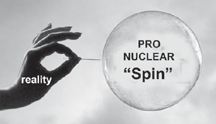
1Courting controversy. Famed director misses the fact that further spending on nuclear power wastes billions of dollars that should go to renewables
Beyond Nuclear Inteenational By John Dudley Miller, 13 Aug 23
Nuclear Now, the latest documentary from controversial writer/director Oliver Stone, argues that an undetermined large number of new nuclear power plants must be built quickly to power the world with clean energy, or it will not be possible to halt global warming at 2 degrees Celsius above preindustrial levels by 2050. If we exceed that limit, devastating climate changes will strike, causing killing heat, monster hurricanes, record-setting droughts, and the displacement of millions of people.
Over the years, Stone has drawn criticism for allegedly misstating historical facts in his movies (“Platoon,” “JFK,” “Natural Born Killers”), creating conspiracies where detractors claim there really were none. Appropriately, this new film begins by claiming a conspiracy against nuclear power. It asserts that nuclear has always been criticized unfairly, particularly by the oil industry, which it alleges has long exaggerated the harm that radiation from nuclear power plants causes.
But on the other hand, the next year the same man helped finance the first Earth Day, which was not and still is not anti-nuclear. That leaves it ambiguous whether his gift to Friends of the Earth was intended explicitly to oppose nuclear power or merely to support the environment.
The documentary states that it is based on a 2019 book, A Bright Future, which also calls for building much more nuclear power quickly. Although one of the book’s authors, Joshua Goldstein, is a non-scientist, international trade expert, the other, Staffan Qvist, is trained as a nuclear engineer and says he works as a “clean-energy” engineer. Stone and Goldstein are co-authors of Nuclear Now. Neither claims any formal training in nuclear engineering………………………………..
The documentary and book take an oddly casual view of the problems of storing spent nuclear fuel while it’s still radioactive. In a very controversial statement, the film claims that “Scientists actually know that nuclear waste doesn’t travel very far” if it leaks out of an underground repository. Since radiation is all around us, the book adds, it wouldn’t be “catastrophic” if some leaked out.
Contrary to the film’s cavalier assertion, however, every reactor fueled with Uranium-238 will automatically produce Plutonium-239 after fissioning, and that deadly element must not be allowed to leak out for the next 241,000 years, because it can cause fatal lung cancer if breathed in. No one can predict for certain what will happen underground that long from now. Homo Sapiens did not exist 241,000 years ago, only its precursor species. It is unlikely that any human-built structure has ever remained completely leak-tight for even 1,000 years.
Rather than tackle that problem, however, the book recommends leaving the waste in above-ground concrete casks for 100 years while some of the radioactivity decays and then letting our great-great-grandchildren worry about it. Why should they mind being saddled with our mess?
The documentary defends nuclear power as the safest energy source of all time. It misleadingly claims that no one died at Three Mile Island or Fukushima, when it’s still not certain that no one will ever die from cancer from those accidents, because radioactivity was released by both of them.
The documentary also presents as fact that only about 50 people died at the scene at Chernobyl, and that only about 4,000 more people will die later from radiation-caused cancers. However, the 2006 TORCH report (The Other Report on Chernobyl), commissioned by the European Parliament’s Green Party and analyzed by two British radiation biologists, estimated that somewhere between 30,000 and 60,000 people will ultimately die from Chernobyl cancers.
……………………………………………………………………. The New York Times reviewer Brandon Yu claims that the documentary “makes a compelling case for [nuclear power] as the energy source that can most reasonably and realistically help us face the [climate] crisis.” In fact, it does no such thing. Yu never compared the evidence for nuclear power to that of its main alternative, renewable power. So, he doesn’t know which one is preferable.
Yu didn’t compare the two energy sources because neither the book nor the documentary ever presents a head-to-head comparison of the costs and construction times necessary to build enough nuclear or renewable power fast enough. What viewers need is a formal cost and construction-time analysis. Instead, they’re left with the book’s unsubstantiated claim: “What the world already knows how to do in 10 or 20 years using nuclear power would take more than a century using renewables alone.” In truth, the needed number of new nuclear plants worldwide could never be built in two decades, judging from how long other reactors have typically required. According to the World Nuclear Industry Status Report 2022, the 62 reactors completed worldwide in the decade between 2012 and 2021 took an average of 9.2 years to build.
The only nuclear plant now under construction in the United States, Vogtle 3 and 4 in Georgia, has been markedly slow and expensive to build. The Vogtle 3 reactor and its twin built on the same site, Vogtle 4, were begun in 2009 and were supposed to be finished in seven years. Fourteen years later, Unit 3 finally entered commercial service on July 31 after several false starts. Unit 4 should be finished early next year. Originally estimated to cost $14 billion altogether, they have already cost $35 billion.
According to the U.S. Energy Information Administration Annual 2023 Energy Outlook, a large nuclear power plant that begins construction this year will, when completed, sell its electricity at 17 cents per kilowatt-hour. But both wind and solar plants begun this year will ultimately sell their power at 4 cents per KW-hr, one-quarter as expensive.
In addition, many American experts believe that large nuclear plants have become so prohibitively expensive that no more will ever be built in the U.S. Instead, small modular reactors (SMRs), creating 30 percent or less of the power of large ones, will take their place.
However, even the model of SMR most similar to current reactors and closest to being constructed, the NuScale reactor, recently announced that it expects to sell its electricity at 11.9 cents per unsubsidized KW-hr, before a years-long, 3-cent per KW-hr temporary subsidy is subtracted. That equals three times the expected cost of renewable power. Since the NuScale has never been built anywhere before and its reactor must first be redesigned, its price per KW-hr may well wind up costing as much or more than the 17 cents that large reactors would.
As expensive as the NuScale reactor may turn out to be, it’s clear that it will be cheaper than all the other proposed “advanced” SMRs that the Department of Energy is building, because none of them utilize water for cooling. Instead, they use exotic coolants like liquid sodium, molten salt or inert gas. Large-size versions of all these other reactors failed in the marketplace between the 1950s and the 1980s, so as new SMRs, they will be extremely expensive to engineer.
In addition, Stanford Professor Mark Z. Jacobson calculates from the exorbitant cost of the Vogtle reactors that any new nuclear power plants of any size will cost five to ten times as much as renewable plants, not just three to four times as much.
What all these analyses further make clear is that Congress should stop allocating billions of dollars to the Department of Energy to subsidize SMRs. Being so much more expensive than renewable power plants, these small plants will never be able to compete with renewables economically. Once DoE stops subsidizing them, they will go out of business. No utility wants to spend what will likely be much, much greater than 12 cents per KW-hr for nuclear power when they can buy renewable power for 4 cents per KW-hr.
Yet another reason why Congress should stop subsidizing SMRs is that they are inherently less economical than large nuclear plants, because they must spread fixed costs like salaries over the fewer kilowatt-hours of energy they create relative to higher-powered reactors. That makes their electricity cost more per KW-hr than that of much more powerful reactors. This built-in diseconomy of scale makes it quite possible that no SMR will ever be able to turn a profit, even if it could somehow find customers willing to pay three to ten times what renewable power costs.
Finally, there is considerable evidence now that renewables alone can be built fast enough to stop all power plant fossil fuel emissions by 2050. The 2021 Princeton University Net-Zero America report shows that that goal can be met in the U.S. The 2023 book by Stanford Professor Jacobson, No Miracles Needed, presents detailed evidence that 139 nations around the world can all meet that deadline if adequately funded………………………………………………….
more https://beyondnuclearinternational.org/2023/08/13/courting-controversy/—
more https://beyondnuclearinternational.org/2023/08/13/courting-controversy/—more https://beyondnuclearinternational.org/2023/08/13/courting-controversy/—
more https://beyondnuclearinternational.org/2023/08/13/courting-controversy/—more https://beyondnuclearinternational.org/2023/08/13/courting-controversy/—
more https://beyondnuclearinternational.org/2023/08/13/courting-controversy/—more https://beyondnuclearinternational.org/2023/08/13/courting-controversy/—
more https://beyondnuclearinternational.org/2023/08/13/courting-controversy/—more https://beyondnuclearinternational.org/2023/08/13/courting-controversy/—
more https://beyondnuclearinternational.org/2023/08/13/courting-controversy/—more https://beyondnuclearinternational.org/2023/08/13/courting-controversy/—
more https://beyondnuclearinternational.org/2023/08/13/courting-controversy/—more https://beyondnuclearinternational.org/2023/08/13/courting-controversy/—
more https://beyondnuclearinternational.org/2023/08/13/courting-controversy/—
Concrete tomb filled with deadly nuclear waste is leaking as it’s starting to crack
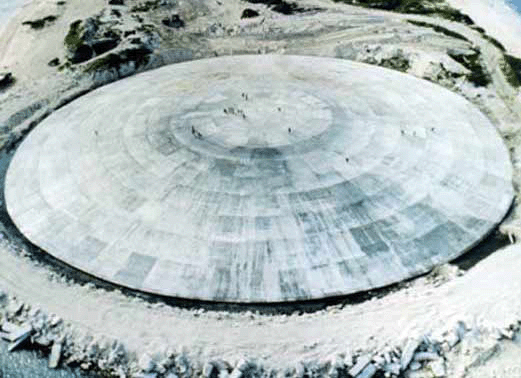
Joe Harker, 12 August 2023 https://www.unilad.com/news/world-news/qin-xi-huang-tomb-china-emperor-terracotta-army-345786-20230809
43 years ago a concrete container of nuclear waste was constructed on a tiny island in the Pacific Ocean, but there’s a big problem with that, it’s leaking.
During the Cold War, the US used islands in the Pacific to test nuclear weapons, and between 1946 and 1958 carried out a series of tests on Enewetak Atoll.
Of course, nuclear bombs poison the ground around them and the waste from these weapons is a dangerous commodity in and of itself. So between 1977 and 1980, a concrete dome was built to store the nuclear waste from the bomb tests.
That ended up being called the Runit Dome, because it was located on Runit Island, though it was also referred to as ‘the tomb’.
Housing radioactive debris, including poisonous plutonium, thousands of people scraped nuclear waste into a blast crater and covered it over with concrete to stop it from getting out.
Unfortunately that plan isn’t going quite so well as, according to IFL Science, a report from 2019 warns that changing conditions on the island are causing the concrete dome to crack.
Increasing temperatures are not helping the problem, while a rise in sea levels is also compounding the problem as the dome is not elevated off the ground, and the lapping waters of the sea are eroding it further.
This is all resulting in radioactive material bleeding out into the ground on the rest of the island and leaking out into the sea as well.
As long as the plutonium stays within the crater covered by the dome then it won’t be a major new source of contamination into the ocean.
That could all change if the cracking dome were to give way and seawater was able to flow in and out of the crater.
This concrete tomb could be a cracking nuclear coffin with a monster inside just waiting to be released, but for now things are still within acceptable levels.
According to the Woods Hole Oceanographic Institution, marine radioactivity expert Dr Ken Buesseler said they’d ‘known for years that the dome is leaking’, but for now only a ‘small amount of radioactivity’ was getting out.
For context, this isn’t putting the surrounding area beyond safety standards just yet, and the plutonium sealed beneath the Runit Dome is only a fraction of what was released during nuclear testing.
While he said things were alright at the moment, he warned that they ‘hadn’t considered sea level rise in the 1970s when they built this’, and said the dome would be ‘at least partially submerged by the end of this century’.
In South Korea, activists march against Tokyo’s waste plan
Hundreds of people in South Korean took to the streets of Seoul on Saturday
to protest against Japan’s contentious plan to release treated nuclear
wastewater into the Pacific Ocean. Tokyo is set to release the water from
the tsunami-hit Fukushima nuclear plant later this month. It has been
approved by the UN nuclear watchdog, and a South Korean assessment found it
meets international standards. But protesters fear marine life will be
destroyed and seafood contaminated. Marching in central Seoul, they held
signs reading “Protect the Pacific Ocean” and “Nuclear Power? No Thanks!”.
BBC 12th Aug 2023
The BRICS Revolt: How Ukraine War Eroded U.S. Authority
SCHEERPOST, by Glenn GreenwaldAugust 13, 2023 he proxy war in Ukraine has presented a grand opportunity for competitors of the U.S. — a chance to exploit longstanding resentments of American empire throughout the international community, and present these nations with compelling economic alternatives to the U.S.
1
Poland admits Ukraine’s counteroffensive won’t succeed
 | |||
| |||
12 Aug 23, https://www.rt.com/russia/581125-duda-counteroffensive-fail-weapons/
Kiev doesn’t have enough weapons to “change the balance of the war,” President Andrzej Duda has said
Polish President Andrzej Duda, one of Kiev’s most ardent foreign backers, has predicted that Ukraine’s counteroffensive against Russian forces will likely fail. Duda, echoing President Vladimir Zelensky, also insisted that even more Western weapons are the answer.
“Does Ukraine have enough weapons to change the balance of the war and get the upper hand?” Duda asked the Washington Post in an interview published on Thursday, before answering, “Probably, no.”
We know this by the fact that they’re not currently able to carry out a very decisive counteroffensive against the Russian military,” he continued. “To make a long story short, they need more assistance.”
Ukraine launched its long-awaited counteroffensive against Russian forces in early June, assaulting multiple points along the frontline from Zaporozhye to Donetsk Regions. However, the Russian military had spent several months preparing a dense and multi-layered network of minefields, trenches, and fortifications, which the Ukrainian side has thus far failed to overcome
Advancing through minefields without air support, Ukraine’s Western-trained and NATO-equipped units have suffered horrendous casualties, losing 43,000 troops and 4,900 pieces of heavy weaponry in just over two months, according to the most recent figures from the Russian Defense Ministry.
Recent media reports suggest that Kiev’s Western backers knew that Ukraine wasn’t ready to go on the offensive, but encouraged the operation nonetheless. Duda was among those cheerleading the counteroffensive, declaring in early June that the operation would lead to “the ousting of Russian military forces from all occupied territories.”
Like Duda, Ukrainian President Vladimir Zelensky now blames his forces’ lack of success on the West, claiming that Ukraine did not receive enough munitions, weaponry, or training to succeed. Zelensky and his senior officials have repeatedly asked the US and its allies for F-16 fighter jets, long-range missiles, and anti-aircraft weaponry, claiming that this equipment will reverse Ukraine’s losing streak on the battlefield.
Moscow has repeatedly urged the West to stop “pumping” weapons into Ukraine, warning that continued military aid will only prolong the conflict and inflict more destruction upon Ukraine, without changing the final outcome.
Public participation for the Flamanville EPR reactor commissioning project (INB 167)
ASN ………………………………………… TERMS OF THE CONSULTATION
Consultation reference [2023.06.39]
Public consultation on the Flamanville EPR reactor commissioning application, with the full application file made available, will take place from 5 June to 15 September 2023 on the ASN website.
Any additional relevant information, in particular with regard to the administrative procedure implemented, may be requested from the Nuclear Safety Authority, the competent authority to make the decision, by electronic means at the address info@asn.fr , or at its premises, 15 rue Louis-Lejeune – CS 70013 – 92541 Montrouge Cedex – by appointment on 01 46 16 42 74.
The paper file can be consulted on request and by prior appointment with the Prefecture of La Manche (on 02 33 75 47 39), which coordinates the availability on its premises, in the sub-prefectures, in the France Services area of the town of Les Pieux and in the town hall of Flamanville.
Observations and proposals from the public can be made on the ASN website for the duration of the consultation. As the project is subject to environmental assessment, the opinion of the Environmental Authority, EDF’s brief in response to this opinion and the opinions of the local authorities concerned by the project can also be consulted on the ASN website.
ASN will take into account the observations and proposals of the public within the framework of the current examination of the commissioning application for the installation. In the event that it considers giving a favorable response to this request, it plans to consult the public on its draft decision authorizing the commissioning…………………………………………….. https://www.asn.fr/l-asn-reglemente/consultations-du-public/mise-a-participation-du-public-pour-le-projet-de-mise-en-service-du-reacteur-epr-de-flamanville#documents-a-consulter
Plush new building for UK’s Nuclear Decommissioning Authority (NDA)
A government agency is moving into a plush 53,000 sq ft building at the
Harwell Science Campus. The Nuclear Decommissioning Authority (NDA) will
have a new office space after Vale of White Horse District Council granted
permission for the building in June. It will be occupied by the NDA but has
been designed to provide flexibility. In addition to workspaces, the
planning consent also includes breakout areas inside and outside of the
building for staff and visitors, enhanced landscaping and tree planting, as
well as car and cycle parking on site.
Oxford Mail 11th Aug 2023
https://www.oxfordmail.co.uk/news/23714472.new-office-space-occupied-harwell-science-campus/
1 This Month

of the week – Shut Down Drone Warfare!


Tell the Ukrainian Government to Drop Prosecution of Peace Activist Yurii Sheliazhenko

Petition to revoke the licensing of the Near Surface Nuclear Disposal Facility (NSDF) at Chalk River. https://www.ourcommons.ca/petitions/en/Petition/Details?Petition=e-7247
To see nuclear-related stories in greater depth and intensity – go to https://nuclearinformation.wordpress.com
-
Archives
- March 2026 (237)
- February 2026 (268)
- January 2026 (308)
- December 2025 (358)
- November 2025 (359)
- October 2025 (376)
- September 2025 (257)
- August 2025 (319)
- July 2025 (230)
- June 2025 (348)
- May 2025 (261)
- April 2025 (305)
-
Categories
- 1
- 1 NUCLEAR ISSUES
- business and costs
- climate change
- culture and arts
- ENERGY
- environment
- health
- history
- indigenous issues
- Legal
- marketing of nuclear
- media
- opposition to nuclear
- PERSONAL STORIES
- politics
- politics international
- Religion and ethics
- safety
- secrets,lies and civil liberties
- spinbuster
- technology
- Uranium
- wastes
- weapons and war
- Women
- 2 WORLD
- ACTION
- AFRICA
- Atrocities
- AUSTRALIA
- Christina's notes
- Christina's themes
- culture and arts
- Events
- Fuk 2022
- Fuk 2023
- Fukushima 2017
- Fukushima 2018
- fukushima 2019
- Fukushima 2020
- Fukushima 2021
- general
- global warming
- Humour (God we need it)
- Nuclear
- RARE EARTHS
- Reference
- resources – print
- Resources -audiovicual
- Weekly Newsletter
- World
- World Nuclear
- YouTube
-
RSS
Entries RSS
Comments RSS
 nuclear-news