Final Hearing on the Chalk River Megadump – Thursday, August 10, Commission hearing, 9am to 12 noon

Gordon Edwards, 9 Aug 23
Thursday, August 10, from 9 am to noon – CNSC will be conducting its final public hearings on the planned “megadump” at Chalk River — a gigantic mound of radioactive and non-radioactive toxic wastes, five to seven stories high, about one kilometre from the Ottawa River. About two-thirds of the radionuclides in the listed radioactive inventory have half-lives in excess of 5000 years. To tune in to the live webcast, visit http://cnsc.isilive.ca
Thursday’s hearings will be for the sole purpose of allowing the Algonquin communities of Kebaowek and Kitigan-Zibi to make their final presentations to the Commissioners. The Chalk River site is situiated on the unceded territory of 11 Algonquin communities. The Commission will not allow the Algonquin representatives to appear in person, they must make their case by zoom. The Indigenous leaders are explicitly forbidden from introducing any new evidence, they are asked to simply summarize the evidence that has already been presented to the CNSC.
Although the United Nations Declaration on the Rights of Indigenous Peoples (UNDRIP) states that hazardous materials cannot be stored or disposed of on Indigenous land without the free, prior, informed consent of the Indigenous people whose land is affected, and although the Government of Canada acknowledges that it has a duty to consult with Indigenous Peoples, the Algonquins were not brought into the process until after all the major decisions had been made, including the site for the megadump (euphemistically called a Near Surface Disposal Facility NSDF).Keboawek Ashinbeg Nation, and Kitigan-Zibi Nation, do not consent to the project. They particularly object to the siting of these very long-lived highly toxic wastes so close to the Ottawa River.
All the key decisions about this project were made by a consortium of multinational corporations headed by SNC-Lavalin — a Quebec-based company that the Prime Minister has been eager to protect from criminal prosecution in the past. SNC-Lavalin was banned for 10 years from bidding on any international projects funded by the World Bank because of a proven record of fraudulent practices in many countries. In Quebec, SNC-Lavalin corporate executives went to jail for fraudulent practices connected with a “Super-Hospital” and a major Bridge, and for an elaborate corporate scheme to funnel illegal donations to political parties while hiding the true facts in its duplicitous corporate ledgers using an elaborate coding system.
The consortium, operating under the name “Canadian Nuclear Laboratories (CNL)”, was originally hired under the Harper administration but with a premature renewal of their contract by the Trudeau administration. CNL has been receiving close to a billion dollars a year in taxpayers money since the consortium was hired.
All Canadians should be concerned that long-lived human-made post-fission wastes are about to be permanently “disposed of” (i.e.placed in a gigantic glorified landfill) without the consent of the Indigenous people or of the 174 municipalities (including the City of Montreal) that have strongly objected to the project. Apparenlty, the convenience of the nuclear promoters with the complicity of a captured nuclear regulator over-rules the wishes of Canadian citizens or the long-term protection of a major river from unnecessary ultimate contamination.
Target China

The UNZ Review, MIKE WHITNEY • AUGUST 3, 2023
The Biden Administration is implementing a plan to draw Taiwan into a direct military confrontation with the People’s Republic of China. The plan bears many similarities to the strategy that was used in Ukraine where Russia was goaded into invading the country in response to emerging threats to its national security. In this case, Beijing is expected to react to mounting challenges to its territorial integrity by US proxies and their political allies operating in Taiwan. These incitements will inevitably lead to greater material support from the United States which has stealthily worked behind the scenes (and in the media) to create a crisis.
The ultimate objective of these machinations, is to arm, train and provide logistical support for Taiwanese separatists who will spearhead Washington’s proxy war on China. According to a number of independent reports, there is already growing operational collaboration between the Taiwanese Army and US Armed Forces. That collaboration will undoubtedly deepen after hostilities break out and the island is plunged into war.
The plan to confront China militarily was outlined in the 2022 National Security Strategy in which the PRC was identified as “America’s most consequential geopolitical challenge” who expressed its “intent to reshape the international order.” This NSS analysis was followed by an explicit commitment to prevail in the struggle to control the “Indo-Pacific” region which “fuels much of the world’s economic growth and will be the epicenter of 21st century geopolitics.”...(“No region will be of more significance to …everyday Americans than the Indo-Pacific.”) Biden’s NSS emphasizes the critical role the military will play in the impending confrontation with China: “We will…modernize and strengthen our military so it is equipped for the era of strategic competition with major powers”… “America will not hesitate to use force to defend our national interests”.
Drawing China into a Taiwan quagmire is the first phase of a broader containment strategy aimed at preserving America’s top spot in the global order while preventing China from becoming the region’s dominant economy. The plan also includes economic, cyber and informational elements that are designed to work in concert with the military component. In its entirety, the strategy represents Washington’s best effort to roll-back the clock to the heyday of the unipolar world order when America set the global agenda and the United States had no rival.
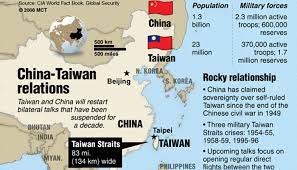
Trouble in Taiwan
Taiwan is not a country. Taiwan is an island off the coast of China much like Santa Catalina is an island off the coast of California. No one disputes that Santa Catalina is part of the United States, just as no one disputes that Taiwan is a part of China. The issue was settled long ago, and the US agrees with the results of that settlement. For all practical purposes, the issue has been resolved.
The United Nations does not recognize Taiwan’s independence nor do the 181 countries that have established diplomatic relations with China. In fact, the UN adopted a General Assembly Resolution back in 1971 acknowledging the “People’s Republic of China as the sole legal government representing the whole of China.”
The One-China policy explicitly relates to the status of Taiwan. Taiwan is part of China, that’s what the One-China policy means. Nations that want to have relations with China must agree on the status of Taiwan; it is the foundational principle upon which all relations with China are based. The issue is not debatable. One can either accept that ‘Taiwan is an inalienable part of China’s territory’ or take their business elsewhere. There is no third option.
The United States claims that it is committed to the One-China policy. In their recent visits to Beijing, all three senior-level officials from the Biden Administration (Anthony Blinken, Janet Yellen and John Kerry) publicly stated their unwavering support for the One-China policy. This is an excerpt from an article at Forbes:

Secretary of State Antony Blinken reiterated the U.S.’ position on its One China policy as he met with China’s leader Xi Jinping Monday, saying it does not support Taiwanese independence and that containing China’s economy was not an American goal….
Blinken said the U.S. held a “One China” policy and does not support Taiwanese independence, but is concerned about China’s “provocative actions” along the Taiwan Strait. Blinken Tells Xi Jinping U.S. Does Not Support Taiwanese Independence, After Meeting To Quell Tensions, Forbes
President Joe Biden has also stated his support for the One-China principle on many, many occasions, which is what you would expect since it is the official position of the United States government. Here’s a short recap on the issue from China’s Ministry of Foreign Affairs:
The US made the following commitments to China regarding the one-China principle in the three China-US joint communiqués.
In the Shanghai Communiqué released in 1972, the US explicitly stated that “The United States acknowledges that all Chinese on either side of the Taiwan Strait maintain there is but one China and that Taiwan is a part of China. The United States Government does not challenge that position”.
In the Joint Communiqué on the Establishment of Diplomatic Relations released in 1978, the US clearly stated that, “The Government of the United States of America acknowledges the Chinese position that there is but one China and Taiwan is part of China”.
In the August 17 Communiqué released in 1982, the US unequivocally stated that “In the Joint Communiqué on the Establishment of Diplomatic Relations on January 1, 1979, issued by the Government of the People’s Republic of China and the Government of the United States of America, the United States of America recognized the Government of the People’s Republic of China as the sole legal Government of China, and it acknowledged the Chinese position that there is but one China and Taiwan is part of China”, and that “it has no intention of infringing on Chinese sovereignty and territorial integrity, or interfering in China’s internal affairs, or pursuing a policy of ‘two Chinas’ or ‘one China, one Taiwan’”. (China’s Ministry of Foreign Affairs)
The western media would like their readers to think there is some “gray area” here and that the issue regarding China’s sovereign territory has not been settled. But—as we have shown—it has been settled. Taiwan is China. We must assume therefore that the media is being intentionally misleading in order to garner support for an “independence” movement that serves only one purpose; to legitimize the arming and training of US assets and insurgents that will be used in a bloody conflagration with China. In truth, the United States is laying the groundwork for a proxy-war on China, and Taiwan has been designated as the frontlines in that war. The independence movement is merely the cover Washington has chosen to conceal its real objectives.
This is why Taiwan has become a flashpoint in US-China relations. This is why numerous US-led delegations have visited Taiwan expressing their tacit support for Taiwan independence. This is why Congress has allocated millions of dollars to provide lethal weaponry for the Taiwanese military. This is why the US Navy has sent warships through the Taiwan Strait and conducted massive military drills on China’s perimeter. This is why Washington continues to provoke Beijing on the one issue that it is most sensitive. All of these incitements were conjured-up with one goal in mind: War with China. This is from Politico:
The Biden administration announced a $345 million weapons package for Taiwan on Friday, the first tranche in a total of $1 billion the U.S. has allotted to be transferred directly from Pentagon stockpiles to the island this year…..………………………………………………..
Repeat: “The move is sure to anger China.”
Indeed, the move was designed to anger China. That was clearly the point. But, why? Why is Washington challenging China on an issue on which there is virtually universal agreement?
- To goad China into overreacting and thus alienating itself from its allies and regional trading partners.
- To turn public opinion against China by portraying the country as a violent aggressor that poses a clear threat to its neighbors.
Here’s more from the World Socialist Web Site:
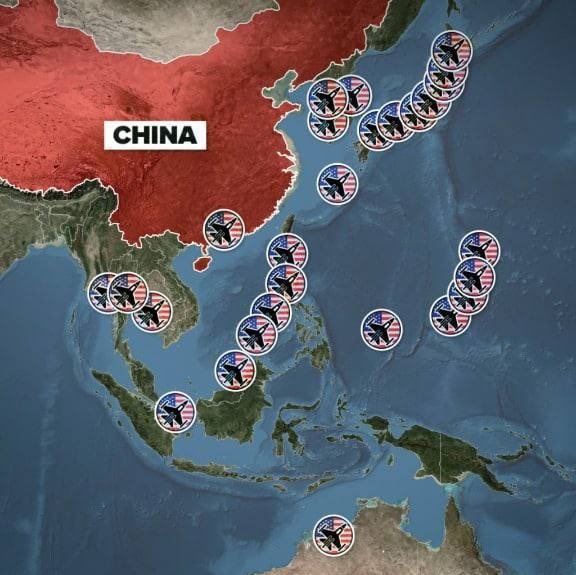
……………………………………………………………………………………………………………………………….. Preparing for war with China, US provides $345 million in arms to Taiwan,
Imagine if China sent millions of dollars of lethal weapons to a budding secessionist movement in Texas. ……………………………………………………………………………………………………………
And, ask yourself this: Haven’t we seen this drill before? Didn’t this same scenario unfold in Ukraine following the CIA-backed coup in 2014 after which the US armed and trained Ukrainian forces to dig-in and provoke hostilities with Russia?……………………………………………………………………………………………………………………………………………………………………………………
Let’s summarize:
- The Indo-Pacific is now America’s top foreign policy priority because that is the area that will experience the most growth
- The US will lead with its military and with the allies who share US interests
- “We will…modernize and strengthen our military” to prevail in our “strategic competition with major powers.”
- America’s Number 1 enemy is China; “the PRC presents America’s most consequential geopolitical challenge ….The PRC is the only competitor with both the intent to reshape the international order and, increasingly, the economic, diplomatic, military, and technological power to do it…”
- “The post-Cold War era is over” but the United States is prepared to preserve the “rules-based order” whatever the cost in blood and treasure.
This is America’s foreign policy in a nutshell. US leaders and their globalist allies are fully committed to prevailing in today’s great power struggle with Russia and China. They have a clear grasp of the objectives they want to achieve and they are prepared to risk anything, including nuclear war, to achieve them. Any developments in Taiwan must be seen through the lens of Washington’s geopolitical ambitions which are clearly driving events.…. more https://www.unz.com/mwhitney/target-china/
Campaign for Nuclear Disarmament Bypasses Gender Parity

“If there is one takeaway from Christopher Nolan’s recent film “Oppenheimer,” it is that the nuclear field has been male-dominated from the very start,”
participants in nuclear negotiations perceive that the field has rewarded characteristics, expertise and experiences that are more commonly associated with men, such as toughness, seriousness, risk-taking and military-training.
Such negotiations would be enhanced, and have more possibility for success, if they broadened the ‘diplomatic tool-box’ to also include ‘feminine’ approaches of flexibility, compromise, multi-faceted problem solving, compassion and human interaction (focusing on the people involved and not just the topics),
InDepthNews, By Thalif Deen https://indepthnews.net/campaign-for-nuclear-disarmament-bypasses-gender-parity/
UNITED NATIONS. 6 August 2023 (IDN) — The United Nations has been a vociferous and longstanding advocate of gender empowerment in its political, social and economic agenda characterized by 17 Sustainable Development Goals (SDGs), including poverty and hunger eradication, quality education, human rights and climate change.
In her 23 July presentation, titled Gender inclusivity and approaches to enhance the NPT Review Process, Vanessa Lanteigne, a Rotary Peace Fellow and representative of Parliamentarians for Nuclear Non-Proliferation and Disarmament (PNND), pointed out that in 2019, 76% of heads of delegations to the NPT were men, and that since 2000, all of the Presidents/Chairs of the NPT Prep-Coms have been male and only one President of an NPT Review Conference has been a woman.
She proposed that NPT institute targets for gender inclusion in State Parties’ delegations, with sanctions for imbalanced delegations similar to those applied by Inter-Parliamentary Union for its assemblies.
Lanteigne also noted that a fully-realized gender equality requires that issues, views, and approaches relating to characteristics associated with masculinity and femininity are both fully represented in security frameworks.
She cited the assessment by Ireland in its working paper Gender in the Non-Proliferation Treaty that the NPT Review process has traditionally taken a ‘one -dimensional security approach to addressing nuclear weapons, in terms of the issues which are prioritised’.
She proposed that the NPT establish a subsidiary body to explore nuclear non-proliferation, risk-reduction and disarmament issues in a broader security framework of common and human security incorporating gender, peace, diplomacy, conflict resolution and international law.
Jackie Cabasso, Executive Director at Western States Legal Foundation, told IDN it is completely obvious that women and gender non-conforming people are grossly under-represented in the NPT process.
“And it’s a matter of common sense that people of all genders should be equal partners in making decisions as consequential as the future of nuclear weapons”, she said.
It is also possible that establishing policies like the Inter-Parliamentary Union’s targets for gender balance in States Parties’ delegations to the NPT—enforced, if necessary, by voting sanctions, could help lead the way to improvements in gender equity in delegations’ home countries, said Cabasso, who co-founded the Abolition 2000 Global Network to Eliminate Nuclear Weapons.
However, when talking about how to challenge the seemingly intractable centrality of nuclear threats as an instrument of global domination, she argued, having equal participation in the discussion by all genders will not solve the problem.
“What is needed is a fundamental transformation in the mindset, values, and practices of the institutions that continue to place the construct of “national security” above the increasingly pressing need for universal “human security,” declared Cabasso.
Shampa Biswas, Judge & Mrs. Timothy A. Paul Chair of Political Science and Professor of Politics at Whitman College, Washington told IDN “It is appalling that we are still talking about gender parity in 2023!”.
“If there is one takeaway from Christopher Nolan’s recent film “Oppenheimer,” it is that the nuclear field has been male-dominated from the very start,” she pointed out.
However, although many fields have made great strides toward gender inclusivity, the nuclear policy-making field still remains woefully behind, said Biswas, is an international relations theorist specializing in postcolonial theory and nuclear politics.
“If we are serious about nuclear disarmament, it is imperative that we diversify the field in substantial ways to include voices that can draw attention to the dangers of nuclear weapons from a variety of perspectives and help redefine the meaning of security away from its masculinist, militarist connotations”.
Women’s voices, she said, are critical to that endeavor.
“I support the idea of instituting targets for more gender-inclusive delegations but wish there was a way to do this via incentives rather than penalties,” declared Biswas.
In her 23 July presentation on further strengthening the review process of the Non-Proliferation Treaty (NPT), Lanteigne said the NPT Review process would be enriched, strengthened and made more effective by elevating gender inclusivity and approaches because we could then access a full range of security approaches to our global challenges.
Gender inclusivity and approaches mean firstly that different sexes (male, female and nondeterminate) are included equitably in decision-making processes and leadership positions within the security sector.
And secondly, that diverse gender perspectives, issues and approaches to peace and security are meaningfully incorporated in order to utilize a more diverse, comprehensive and holistic security framework. Integrating these two principles that will support Security Council Resolution 1325 on Women, Peace and Security, which, “stressed the importance of ‘equal participation and full involvement’ of women and the need to increase [women’s] role in decision-making with regard to conflict prevention and resolution”.
Meanwhile, Sustainable Development Goal 5 focuses on gender equality and empowerment of women and girls.
There are indicators that state parties are not only aware and willing to work towards gender equity and inclusion but are actively referencing and promoting it on their own.
At the 2019 PrepCom more than 20 statements were made on behalf of over 60 State Parties addressing the importance of gender perspectives to the NPT, Lanteigne said.
Three papers were submitted directly related to nuclear issues and gender, and eight working papers included references to the links.
Reviewing policies to support equal access to participation is important because it is correlated with improved organizational efficiency and innovative capacity by including more diverse expertise resulting in creative solutions and sustainable developments.
But a gender-inclusive approach should be supplemented by gender-diverse analyses as well. Gender equality requires that issues, views, and approaches relating to characteristics associated with masculinity and femininity are both fully represented in security frameworks.
Research reports that participants in nuclear negotiations perceive that the field has rewarded characteristics, expertise and experiences that are more commonly associated with men, such as toughness, seriousness, risk-taking and military-training.
Such negotiations would be enhanced, and have more possibility for success, if they broadened the ‘diplomatic tool-box’ to also include ‘feminine’ approaches of flexibility, compromise, multi-faceted problem solving, compassion and human interaction (focusing on the people involved and not just the topics), she argued.
An example of a gender-inclusive approach which could hold lessons for the NPT Review Process comes from the Inter-Parliamentary Union Gender Partnership Group which was instituted to ensure that gender-diverse perspectives were incorporated and that the inclusion of women was not just a numerical representation but holistic in terms of representing security approaches more often associated with women.
Other examples of gender-inclusive principles and approaches can be found in the feminist foreign policies adopted by Canada, Germany, Ireland and Sweden among others.
These political steps forward, though, remain at risk of being rolled back like in the case of Sweden by succeeding governments highlighting the need to institutionalize the importance of gender in international organizations and procedures.
“We propose that the NPT establishes a subsidiary body to explore nuclear non-proliferation, risk reduction and disarmament issues in a broader security framework of common and human security incorporating gender, peace, diplomacy, conflict resolution and international law.”
“This broader framework of common and human security will be beneficial to giving gender-diverse perspectives opportunities to participate in conflict resolution and security fields to ensure that inclusivity is fully and substantively implemented and symbolic tokenism is avoided.” [IDN-InDepthNews]
Oppenheimer’ depicts a man becoming powerful—and irrelevant

By Laura Grego | August 4, 2023, https://thebulletin.org/2023/08/oppenheimer-depicts-a-man-becoming-powerful-and-irrelevant/?utm_source=Newsletter&utm_medium=Email&utm_campaign=MondayNewsletter08072023&utm_content=NuclearRisk_PowerfulAndIrrelevant_08042023
It was a packed house on Barbenheimer’s opening night—a box-office phenomenon of double feature viewing of Greta Gerwig’s Barbie and Christopher Nolan’s biopic Oppenheimer. It was a stormy night, too. So much so that we mistook the thunder outside for sound effects. (The sound design of Nolan’s film was spectacular and powerful, especially the silences.) I was glad to see Oppenheimer with longtime colleagues who work in this field. Like Nolan, so many of my cultural touchstones were about the Cold War. Generation X grew up acutely aware of the possibility of nuclear Armageddon, but it’s been a long time since teenagers were lining up for a film about nuclear weapons.
When I read Kai Bird and Martin J. Sherwin’s book American Prometheus, which the film is based on, a few weeks ago before seeing the movie, I was struck by a few things I hadn’t really known or understood about Oppenheimer. One surprise to me was how much J. Robert Oppenheimer was passionate about his two early loves: physics and New Mexico. By all accounts he loved the land and the people living there. And that love seemed to have been the reason the Manhattan Project’s secret laboratory was built in Los Alamos—though its remoteness seemed to suit the security needs of the project.
By the same logic, when came the moment of testing the bomb, the Trinity team selected a “suitably isolated” spot in the southern New Mexico desert for the first nuclear explosion. Little is said in American Prometheus about those who lived near the Jornada del Muerto site, only that the Trinity team had to “evict a few ranchers by eminent domain.” The scientists and engineers believed that the flat terrain and generally low winds would limit the spread of radiation. While the Tularosa basin was remote, about half-a-million people lived within 150 miles of the Trinity site. They were not warned or told to evacuate, neither before nor after the test. And data on civilian exposure from the Trinity test was not collected, so as not to alarm the public.
In fact, this negligence would become a regular feature of the post-war US nuclear test program, which included more than 200 aboveground nuclear explosions. Data collected by the National Cancer Institute shows the fallout from these tests has led to tens to hundreds of thousands of excess cancers. Some people have received compensation from the government for their illnesses, but not Trinity downwinders. (Though the Senate’s recent vote for a major expansion of the Radiation Exposure Compensation Act may remedy this.)
When I entered the theatre on that stormy night, I wondered whether Nolan’s Oppenheimer would pause to acknowledge that these first casualties of the nuclear age were in a place so close to the heart of Oppenheimer the man. In the end, the film’s perspective is Oppenheimer’s first-person, subjective point of view, with Nolan not inclined to widen the lens further. As someone who has worked on these issues for decades, I felt it to be a great weakness of the film, almost unforgiveable, to make so little room in a three-hour movie for those who suffered from the decisions made by “great men” in cloistered rooms. The film also fails by showing the Hiroshima and Nagasaki devastation only obliquely and reflected to us through Oppenheimer’s emotional remove.
Another thing that struck me in the book is that Oppenheimer’s strategy of persuading other scientists to join the project included his argument that the nuclear weapon would end not just the war in Japan, it would “end all wars,” once people understood the enormity of the weapons. Today it seems an incredibly naïve idea: 80 years later, the United States is still spending a billion dollars every five days to maintain its nuclear weapons. But how was Oppenheimer—so widely educated in history and philosophy and steeped in ethics—unable to see its consequences? Was he blinded by the greatness of his own creation or by ambition? Others would see this more clearly.
In the film, Oppenheimer’s friend and confidante Isidor Rabi provides a much-needed counterbalance to Oppenheimer’s intellectualizing, recognizing that the bomb “will fall on the just and unjust alike,” adding that he did not wish the culmination of three centuries of physics to be a weapon of mass destruction.
To retake control on what had been set in motion, it would have taken not only wisdom but more political savvy than Oppenheimer demonstrated. In the film, the scene in which the decision is taken to drop bombs on Hiroshima and Nagasaki skillfully shows an Oppenheimer who is being outmaneuvered. If he had really intended to argue the position of the Franck report and Szilard petition—two documents pressed on him by Manhattan project scientists—before the US political and military leadership, it seems it would have taken a different temperament and set of skills than he had. Oppenheimer was not the man for that moment.
Oppenheimer’s post-war attempt to advise the US government on nuclear weapons as a political insider ended in 1954 with the cruel public humiliation of the Atomic Energy Commission’s security hearing. After this, either because this experience broke him or he was not suited to the life of a nongovernmental critic, he essentially withdrew from the public debate about nuclear weapons almost entirely. He confined his comments mainly to abstracted and intellectual debates for the rest of his life. Oppenheimer did not sign the Einstein-Russell Manifesto against nuclear war, nor did he join the Pugwash Conferences thereafter.
As American Prometheus puts it, “Oppenheimer was still capable of being a critic; he just wanted to stand alone and with far more ambiguity than his fellow scientists. He was consumed with deep ethical and philosophical dilemmas posed by nuclear weapons, but at times it seemed that, as Thorpe put it, ‘Oppenheimer offered to weep for the world, but not to help change it.’”
Toward the end of the film, Oppenheimer is given an Enrico Fermi Award and being fêted—maybe because, as Einstein’s voiceover suggests, he was no longer so relevant.
Carcinogens found at Montana nuclear missile sites as reports of hundreds of cancers surface

The Air Force has detected unsafe levels of a likely carcinogen in samples taken at a Montana missile base where a striking number of men and women have reported cancer diagnoses
By TARA COPP Associated Press, August 8, 2023 https://abcnews.go.com/US/wireStory/carcinogens-found-nuclear-missile-sites-reports-hundreds-cancers-102087696
WASHINGTON — The Air Force has detected unsafe levels of a likely carcinogen at underground launch control centers at a Montana nuclear missile base where a striking number of men and women have reported cancer diagnoses.
A new cleanup effort has been ordered.
The discovery “is the first from an extensive sampling of active U.S. intercontinental ballistic missile bases to address specific cancer concerns raised by missile community members,” Air Force Global Strike Command said in a release Monday. In those samples, two launch facilities at Malmstrom Air Force Base in Montana showed PCB levels higher than the thresholds recommended by the Environmental Protection Agency.
PCBs are oily or waxy substances that have been identified as a likely carcinogen by the EPA. Non-Hodgkin lymphoma is a blood cancer that uses the body’s infection-fighting lymph system to spread.
In response, Gen. Thomas Bussiere, commander of Air Force Global Strike Command, has directed “immediate measures to begin the cleanup process for the affected facilities and mitigate exposure by our airmen and Guardians to potentially hazardous conditions.”
After a military briefing was obtained by The Associated Press in January showing that at least nine current or former missileers at Malmstrom were diagnosed with non-Hodgkin lymphoma, a rare blood cancer, the Air Force School of Aerospace Medicine launched a study to look at cancers among the entire missile community checking for the possibility of clusters of the disease.
And there could be hundreds more cancers of all types, based on new data from a grassroots group of former missile launch officers and their surviving family members.
According to the Torchlight Initiative, at least 268 troops who served at nuclear missile sites, or their surviving family members, have self-reported being diagnosed with cancer, blood diseases or other illnesses over the past several decades.
At least 217 of those reported cases are cancers, at least 33 of them non-Hodgkin lymphoma.
What’s notable about those reported numbers is that the missileer community is very small. Only a few hundred airmen serve as missileers at each of the country’s three silo-launched Minuteman III intercontinental ballistic missile bases any given year. There have been only about 21,000 missileers in total since the Minuteman operations began in the early 1960s, according to the Torchlight Initiative.
For some context, in the U.S. general population there are about 403 new cancer cases reported per 100,000 people each year, according to the Centers for Disease Control and Prevention, and non-Hodgkin lymphoma affects an estimated 19 of every 100,000 people annually, according to the American Cancer Society.
Minutemen III silo fields are based at Malmstrom, F.E. Warren Air Force Base in Wyoming and Minot Air Force Base in North Dakota.
Missileers are male and female military officers who serve in underground launch control centers where they are responsible for monitoring, and if needed, launching fields of silo-based nuclear weapons. Two missileers spend sometimes days at a time on watch in underground bunkers, ready to turn the key and fire Minuteman III intercontinental ballistic missiles if ordered to do so by the president.
The Minuteman III silos and underground control centers were built more than 60 years ago. Much of the electronics and infrastructure is decades old. Missileers have raised health concerns multiple times over the years about ventilation, water quality and potential toxins they cannot avoid as they spend 24 to 48 hours on duty underground.
The Air Force discovery of PCBs occurred as part of site visits by its bioenvironmental team from June 22 to June 29 in the Air Force’s ongoing larger investigation into the number of cancers reported among the missile community. During the site visits a health assessment team collected water, soil, air and surface samples from each of the missile launch facilities.
At Malmstrom, of the 300 surface swipe samples, 21 detected PCBs. Of those, 19 were below levels set by the EPA requiring mitigation and two were above. No PCBs were detected in any of the 30 air samples. The Air Force is still waiting for test results from F.E. Warren and Minot for surface and air samples, and for all bases for the water and soil samples.
Democracy Needs Healthy Debates About War And Peace
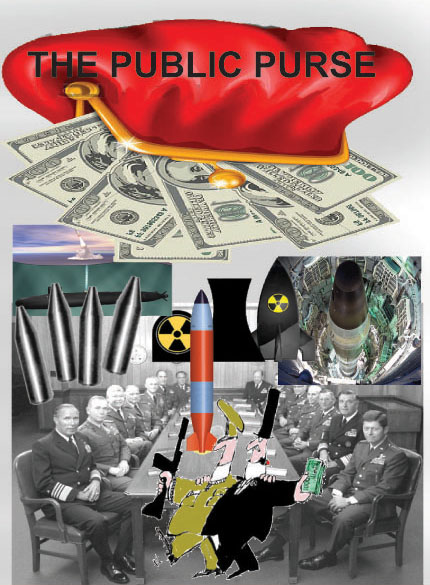
To top it all, the Pentagon has never passed a financial audit! It’s the only major federal agency that hasn’t passed an audit, despite getting more discretionary dollars than any other. That means that we don’t know where our tax money is going.
Who benefits from this lack of transparency? Exactly who you’d think — contractors who profit off war. Around half of the military budget goes to for-profit contractors who make excessive profits at the expense of taxpayers and peace.
by EDITOR, August 7, 2023 https://scheerpost.com/2023/08/07/democracy-needs-healthy-debates-about-war-and-peace/
Congress spent the last “military spending” debate rehashing the culture wars — not the nearly $1 trillion Pentagon budget itself.
By Jyotsna Naidu / OtherWords
If there’s one thing that should be subject to rigorous debate and the will of the people, it’s decisions about war and peace. Unfortunately, that’s not what we got with the huge military policy bill recently passed by the House and Senate.
Somehow, the annual National Defense Authorization Act, or NDAA — which can bring war or peace, and which now costs nearly $1 trillion — never sees much serious debate in Congress about those issues.
Before this year, the NDAA passed easily for 61 years straight. The process is intentionally rushed. Hundreds of amendments are filed and voted at once, leaving little room for serious discourse.
This year was a partial exception. Lawmakers did debate the bill, which passed the House only narrowly. But they debated all the wrong things.
Representatives provoked hate with countless culture war amendments. Ignoring issues of war and peace, far-right members of Congress debated cutting funding for service members’ abortions and diversity programs on military bases.
Here’s what they should have discussed.
In 2021, the Congressional Budget Office published a report detailing three ways to cut military spending by $1 trillion over 10 years without compromising national security. Instead, Congress has given the military even more money each year.
This year, Representatives Barbara Lee (D-CA) and Mark Pocan (D-WI) called to shift $100 billion of the defense budget toward urgent domestic needs. Senator Bernie Sanders (I-VT) introduced a similar amendment in the Senate, which would have cut the Pentagon budget by 10 percent.
An American Friends Service Committee poll released earlier this year showed 56 percent of Americans would support cutting military spending to reinvest in those funds in public programs.
And amendments efforts would have exempted troops’ pay and benefits from any cuts, targeting the bloated military contractorsinstead.
In the House, the amendment was never allowed for debate — and never got a vote. In the Senate, the Sanders amendment got just 11 votes.
To top it all, the Pentagon has never passed a financial audit! It’s the only major federal agency that hasn’t passed an audit, despite getting more discretionary dollars than any other. That means that we don’t know where our tax money is going.
Who benefits from this lack of transparency? Exactly who you’d think — contractors who profit off war. Around half of the military budget goes to for-profit contractors who make excessive profits at the expense of taxpayers and peace.
With these robber baron-like profits, contractors have funded think tanks to produce favorable research and “expert” mediacommentary supporting higher military budgets — while lobbying politicians to keep spending on contractors.
In the House, this year’s NDAA lost its usual broad bipartisan support because of Democrats’ opposition to its far-right culture war amendments, not because there was suddenly political will to address war spending. The Senate simply passed the NDAA without the controversial amendments.
Culture wars aside, we can’t let lawmakers go back to idly voting for pro-war and pro-contractor interests.
I do have hope. People are already winning when they fight. In 2016, for example, activists successfully pressured the Massachusetts company Textron to stop producing cluster munitions, which disproportionately hurt civilians.
And as the congressional opposition to those nasty amendments showed more recently, lawmakers can still respond to public pressure. The onus is now on us to demand our lawmakers have a real democratic debate on war, peace, and the military budget.
Democracy is at stake.
As Japan set to dump nuclear-contaminated wastewater in late August, Japanese nuclear expert vows to ‘fight it to the end’
Global Times, By Xu Keyue, Aug 07, 2023
As mainstream Japanese media revealed that Tokyo could start to dump the nuclear-contaminated wastewater as early as the end this month after the trilateral US-Japan-South Korea summit, observers and the wider public in China, Japan and South Korea reiterated their opposition to the irresponsible move with a Japanese nuclear expert stating that they would continue to protest against the plan.
“We plan to fight it to the end. We are planning to hold a big gathering in front of the prime minister’s office on August 18 and we plan to make a petition and submit signatures,” Hideyuki Ban, a Japanese nuclear expert and co-director of the Citizens’ Nuclear Information Center (CNIC), told the Global Times on Monday.
According to Japanese media outlet Asahi Shimbun, the Japanese government has entered into coordination to determine the wastewater release timing after the summit with the US and South Korea scheduled for August 18. After Prime Minister Fumio Kishida returns from the US, he will hold a ministerial meeting and make a decision over the dumping of contaminated wastewater.
Asahi cited several officials as saying that the dumping is estimated to begin as early as the end of August. The report claimed that Kishida is expected to explain “the safety of the treated water, its scientific basis, and measures to be taken after the release” to the two leaders of the US and South Korea to gain their understanding.
But Ban believes if the contaminated wastewater is dumped in late August, it is the Japanese government that would force the plan without caring for the concerns and opposition from fisheries and the relevant personnel………………………………….
As many parties in Japan and other countries including China oppose the wastewater dumping plan, the Japanese government must be thinking that it will at least get the consent of Seoul and Washington and if the three reach a consensus over the issue during the summit, it is expected to help Tokyo press ahead with its arbitrary plan, Ban pointed out.
Anonymous Japanese officials in the prime minister’s office were quoted by Asahi as saying that they believe since some offshore trawling will commence off the coast of Fukushima Prefecture in September, the government hopes to avoid starting the release after the fishing season has begun. For this reason, it is assumed that the dumping will start around the end of August, Asahi reported. https://www.globaltimes.cn/page/202308/1295820.shtml
Reducing the risks of nuclear war — the role of health professionals
By – Kamran Abbasi, Parveen Ali, Virginia Barbour, Kirsten Bibbins‐Domingo, Marcel GM Olde Rikkert, Andy Haines, Ira Helfand, Richard C Horton, Bob Mash, Arun Mitra, Carlos A Monteiro, Elena N Naumova, Eric J Rubin, Tilman A Ruff, Peush Sahni, James Tumwine, Paul Yonga and Chris Zielinski
Med J Aust || doi: 10.5694/mja2.52054, 7 August 2023
In January 2023, the Science and Security Board of the Bulletin of the Atomic Scientists moved the hands of the Doomsday Clock forward to 90 s before midnight, reflecting the growing risk of nuclear war.1 In August 2022, the UN Secretary‐General António Guterres warned that the world is now in “a time of nuclear danger not seen since the height of the Cold War”.2 The danger has been underlined by growing tensions between many nuclear armed states.1,3 As editors of health and medical journals worldwide, we call on health professionals to alert the public and our leaders to this major danger to public health and the essential life support systems of the planet — and urge action to prevent it.
Current nuclear arms control and non‐proliferation efforts are inadequate to protect the world’s population against the threat of nuclear war by design, error, or miscalculation. The Treaty on the Non‐Proliferation of Nuclear Weapons (NPT) commits each of the 190 participating nations “to pursue negotiations in good faith on effective measures relating to cessation of the nuclear arms race at an early date and to nuclear disarmament, and on a treaty on general and complete disarmament under strict and effective international control”.4 …………………………………………
Any use of nuclear weapons would be catastrophic for humanity. Even a “limited” nuclear war involving only 250 of the 13 000 nuclear weapons in the world could kill 120 million people outright and cause global climate disruption leading to a nuclear famine, putting 2 billion people at risk.7,8 A large‐scale nuclear war between the USA and Russia could kill 200 million people or more in the near term, and potentially cause a global “nuclear winter” that could kill 5–6 billion people, threatening the survival of humanity.7,8. Once a nuclear weapon is detonated, escalation to all‐out nuclear war could occur rapidly. The prevention of any use of nuclear weapons is therefore an urgent public health priority and fundamental steps must also be taken to address the root cause of the problem — by abolishing nuclear weapons.
The health community has had a crucial role in efforts to reduce the risk of nuclear war and must continue to do so in the future.9 In the 1980s the efforts of health professionals, led by the International Physicians for the Prevention of Nuclear War (IPPNW), helped to end the Cold War arms race by educating policy makers and the public on both sides of the Iron Curtain about the medical consequences of nuclear war. This was recognised when the 1985 Nobel Peace Prize was awarded to the IPPNW (http://www.ippnw.org).10
In 2007, the IPPNW launched the International Campaign to Abolish Nuclear Weapons, which grew into a global civil society campaign with hundreds of partner organisations. A pathway to nuclear abolition was created with the adoption of the Treaty on the Prohibition of Nuclear Weapons in 2017, for which the International Campaign to Abolish Nuclear Weapons was awarded the 2017 Nobel Peace Prize……………………………………………………………..
We now call on health professional associations to inform their members worldwide about the threat to human survival and to join with the IPPNW to support efforts to reduce the near‐term risks of nuclear war, including three immediate steps on the part of nuclear‐armed states and their allies: first, adopt a no first use policy;12 second, take their nuclear weapons off hair‐trigger alert; and, third, urge all states involved in current conflicts to pledge publicly and unequivocally that they will not use nuclear weapons in these conflicts. We further ask them to work for a definitive end to the nuclear threat by supporting the urgent commencement of negotiations among the nuclear‐armed states for a verifiable, timebound agreement to eliminate their nuclear weapons in accordance with commitments in the NPT, opening the way for all nations to join the Treaty on the Prohibition of Nuclear Weapons…………….. more https://www.mja.com.au/journal/2023/219/5/reducing-risks-nuclear-war-role-health-professionals
As Threat Remerges, Global Community Must Speak as One, Commit to Nuclear-Free World, Secretary-General Says on Anniversary of Hiroshima Bombing

7 Aug 23 https://press.un.org/en/2023/sgsm21898.doc.htm
Following is UN Secretary-General António Guterres’ message, delivered by Under-Secretary-General and High Representative for Disarmament Affairs Izumi Nakamitsu, at the seventy-eighth anniversary of the atomic bombing of Hiroshima, in Hiroshima, Japan, today:
Nearly eight decades ago, a nuclear weapon incinerated Hiroshima. Yet as anyone who has visited knows, the memories never fade. The A-Bomb Dome, the Cenotaph and the dauntless hibakusha are constant reminders of the catastrophic consequences of nuclear weapons.
For 78 years, the city of Hiroshima and the hibakusha have worked tirelessly to ensure that nuclear weapons are never used again. During my visits to Hiroshima, my meetings with the brave hibakusha — the human face of nuclear cataclysm — have never failed to move and inspire me. They are a potent symbol of forgiveness, hope and resilience. They have transcended tragedy.
I pledge to support them as they continue sharing their accounts — the terror, the pain, the incalculable loss, and above all, the lesson of what happened here on 6 August 1945. World leaders have visited this city, seen its monuments, spoken with its brave survivors and emerged emboldened to take up the cause of nuclear disarmament.
More should do so, because the drums of nuclear war are beating once again. Mistrust and division are on the rise. The nuclear shadow that loomed over the cold war has re-emerged. And some countries are recklessly rattling the nuclear sabre once again, threatening to use these tools of annihilation.
In the face of these threats, the global community must speak as one. Any use of nuclear weapons is unacceptable. We will not sit idly by as nuclear-armed States race to create even more dangerous weapons. That’s why disarmament is at the heart of the recently launched policy brief on a New Agenda for Peace.
The Agenda calls on Member States to urgently recommit to pursuing a world free of nuclear weapons and to reinforce the global norms against their use and proliferation. Pending their total elimination, States possessing nuclear weapons must commit to never use them. The only way to eliminate the nuclear risk is to eliminate nuclear weapons.
The United Nations will continue working with global leaders to strengthen the global disarmament and non-proliferation regime, including through the Treaty on Non-Proliferation of Nuclear Weapons and the Treaty on the Prohibition of Nuclear Weapons.
Eliminating nuclear weapons remains the United Nations highest disarmament priority. We will not rest until the nuclear shadow has been lifted once and for all. No more Hiroshimas. No more Nagasakis.
Disarmament is not some utopian dream. Disarmament is the only pathway to a safer and more secure world for all. The United Nations is proud to stand with the people of Hiroshima and the hibakusha to keep alive the memory of what happened here and the lessons humanity must learn if we are to secure a more peaceful tomorrow. We look forward to working with the people of Japan in this essential effort.
Dounreay inspectors raise further red flag about sodium storage

John O’Groat Journal, By Iain Grant, 5 Aug 23
The Office for Nuclear Regulation (ONR) has issued an enforcement letter to Magnox Ltd after recording a breach of its nuclear site licence.
Sodium was used to cool the prototype fast reactor (PFR) whose closure in 1994 sounded the death knell for the experimental power plant.
Since its removal from the redundant plant, some of the highly volatile liquid metal has been stored in drums.
ONR’s latest concern follows an inspection at the end of April.
The agency has concluded that the storage arrangements do not comply with good practice. Its latest report states: “The dutyholder has failed to safely protect the drums against degradation via air and moisture ingress; large stocks of the inventory are not available for inspection due to the way in which it has been stored; and a number of the storage vessels of the material are not identified on the site maintenance system.
ONR found that Magnox – a wholly owned subsidiary of the Nuclear Decommissioning Authority – had breached the Control of Substances Hazardous to Health Regulations 2002 and its nuclear site licence.
It followed up its enforcement letter with a ‘holding-to-account’ meeting on site in June with Magnox directors.
According to ONS, this was arranged to ‘further secure a commitment to return to compliance.”
In June, the Scottish Environment Protection Agency (Sepa) had fired off a warning letter about a minute leak of radioactive tritium from a sodium drum stored at the PFR in November last year…………………………………………….. https://www.johnogroat-journal.co.uk/news/dounreay-inspectors-raise-further-red-flag-about-sodium-stor-322156/
Ukraine attacks Donetsk with cluster munitions – local authorities
5 Aug 23, https://www.rt.com/russia/580884-donetsk-cluster-shelling/
Civilian targets were affected by Saturday night’s shelling, local officials have said
Ukrainian forces have reportedly fired cluster munitions into Donetsk city, striking a private residence, a university and other civilian targets.
Four rounds of 155mm cluster bombs were fired into the center of the city on Saturday night, triggering fires in three districts, the Joint Center of Control and Coordination (JCCC) for the Donetsk People’s Republic (DPR) said. The cluster munitions reportedly exploded in the air.
The Donetsk University of Economics and Trade was on fire after the shelling, the Mayor of Donetsk Aleksey Kulemzin said in a Telegram post. Fires also were reported in apartment buildings.
The shelling comes after at least three people were killed and ten injured by a Ukrainian bombardment on Monday. The shelling killed another civilian in a nearby town, the JCCC said.
Cluster munitions have been banned by more than 100 countries because of their devastating effects on civilians. Cluster shells are typically designed to open up in midair and release tens or even hundreds of submunitions that can saturate a large area with explosives. They tend to have a high failure rate, creating risks to civilians from unexploded munitions for potentially decades after a conflict ends.
Donetsk and other Donbass cities have been under constant Ukrainian attacks which have claimed numerous civilian lives since 2014, when the region broke away from Kiev after a Western-backed coup in the Ukrainian capital. Over the years, Ukraine’s military established heavily fortified positions around the cit. The attacks intensified after the launch of Moscow’s military operation against Kiev in February 2022, leaving scores of civilians killed and delivering major damage to infrastructure.
The Donetsk People’s Republic became part of Russia last October together with the People’s Republic of Lugansk and Zaporozhye and Kherson Regions, following referendums in which the local populations voted overwhelmingly in favor of the move.
Zelensky fears peace pressure from West – NYT
6 Aug 23 https://www.rt.com/news/580879-zelensky-fears-western-pressure-for-peace-talks/—
The Ukrainian president has reportedly told his diplomats that benefactors may push for a negotiated truce with Russia
Ukrainian President Vladimir Zelensky is reportedly worried that Western nations may ramp up pressure to negotiate a peace agreement with Russia, ending a bloody conflict that has killed tens of thousands of Kiev’s troops in just the past two months.
“As furious battles raged across the front lines of Europe’s bloodiest war in decades, Mr. Zelensky told his ambassadors on Wednesday that things would grow even more difficult as pressure was likely to build in the coming months to find a negotiated path to peace,” the New York Times reported on Saturday.
The Ukrainian president described Wednesday’s gathering in Kiev with diplomats as an “emergency strategy session” heading into this weekend’s Ukraine peace summit in Saudi Arabia, the newspaper said. “The meeting is the starting point of what is expected to be a major Ukrainian diplomatic push in the coming months to try to undercut Russia.”
Zelensky told his ambassadors that they must use every available tool – “official and unofficial, institutional and media, cultural diplomacy and the power of ordinary human sincerity” – to convince both allies and neutral nations that “the only road to a lasting peace is complete Russian defeat,” according to the report.
However, many of the nations attending the summit in Saudi Arabia have resisted US pressure to take sides in the crisis, seeing the conflict as a “contest between superpowers” in which they want no part. “This is not only a conflict between Russia and Ukraine,” said Celso Amorim, an adviser to Brazilian President Luiz Inacio Lula da Silva. Speaking remotely on Saturday at the Saudi-hosted summit, he added: “This is also a chapter in the longstanding rivalry between Russia and the West.”
Russian officials have argued that Kiev’s Western backers are only prolonging the bloodshed in Ukraine by continuing to send billions of dollars’ worth of weapons to the former Soviet republic. More than 43,000 Ukrainian troops have been killed since Kiev began a counteroffensive in the Donbass region in early June, the Russian Defense Ministry said on Friday.
Russian and Ukrainian negotiators were reportedly near a peace deal at talks hosted by Türkiyein March 2022, a little more than a month after the conflict began. “After we pulled troops back from Kiev, as we promised,” Ukrainian leaders “threw it all away, into the garbage dump of history,” Russian President Vladimir Putin said at a meeting with African leaders in July.
Rapid Dragon: the US military game-changer that could affect conventional and nuclear strategy and arms control negotiations
Bulletin, By George M. Moore | August 4, 2023
The United States Air Force recently announced the successful test of its Rapid Dragon system in a major Pacific exercise.[1] This followed an earlier successful test during an exercise in Norway in late 2022.[2]
………………..In standard English, Rapid Dragon converts cargo aircraft into weapons carriers that can deploy cruise missiles (and potentially other standoff or self-defense weapons) by releasing them on pallets via the planes’ rear cargo ramps. Such a system makes a cargo aircraft into the equivalent of a bomber. Potentially the cargo aircrafts’ weapons load is limited only by how many pallets will fit in the cargo bay.
………………………………………………………The potential to develop Rapid Dragon so it can deliver nuclear weapons does not seem to have received any attention. The AGM-86 Air Launched Cruise Missile (ALCM) is nuclear capable and currently deliverable by the B-52. It appears that nothing would prevent the Rapid Dragon deployment of the ALCM, turning any cargo aircraft capable of using Rapid Dragon into a nuclear delivery aircraft.
The potential to use Rapid Dragon for nuclear weapons delivery (and eventually this will occur) will create new issues when serious nuclear weapons limitation resume.
……………………………………..The potential for nuclear launch from cargo aircraft creates new tactical problems that could affect survivability and deterrence concepts. ……………………………………………………………………………………………………
1 This Month
Chernobyl: The Lost Tapes – A good documentary on Chernobyl on SBS available On Demand for the next 3 weeks– https://www.sbs.com.au/ondemand/tv-program/chernobyl-the-lost-tapes/2352741955560

of the week–London Campaign for Nuclear Disarmament

Tell the Ukrainian Government to Drop Prosecution of Peace Activist Yurii Sheliazhenko
To see nuclear-related stories in greater depth and intensity – go to https://nuclearinformation.wordpress.com
-
Archives
- April 2026 (126)
- March 2026 (251)
- February 2026 (268)
- January 2026 (308)
- December 2025 (358)
- November 2025 (359)
- October 2025 (376)
- September 2025 (257)
- August 2025 (319)
- July 2025 (230)
- June 2025 (348)
- May 2025 (261)
-
Categories
- 1
- 1 NUCLEAR ISSUES
- business and costs
- climate change
- culture and arts
- ENERGY
- environment
- health
- history
- indigenous issues
- Legal
- marketing of nuclear
- media
- opposition to nuclear
- PERSONAL STORIES
- politics
- politics international
- Religion and ethics
- safety
- secrets,lies and civil liberties
- spinbuster
- technology
- Uranium
- wastes
- weapons and war
- Women
- 2 WORLD
- ACTION
- AFRICA
- Atrocities
- AUSTRALIA
- Christina's notes
- Christina's themes
- culture and arts
- Events
- Fuk 2022
- Fuk 2023
- Fukushima 2017
- Fukushima 2018
- fukushima 2019
- Fukushima 2020
- Fukushima 2021
- general
- global warming
- Humour (God we need it)
- Nuclear
- RARE EARTHS
- Reference
- resources – print
- Resources -audiovicual
- Weekly Newsletter
- World
- World Nuclear
- YouTube
-
RSS
Entries RSS
Comments RSS
 nuclear-news