Wilfred Burchett: The Atomic Plague
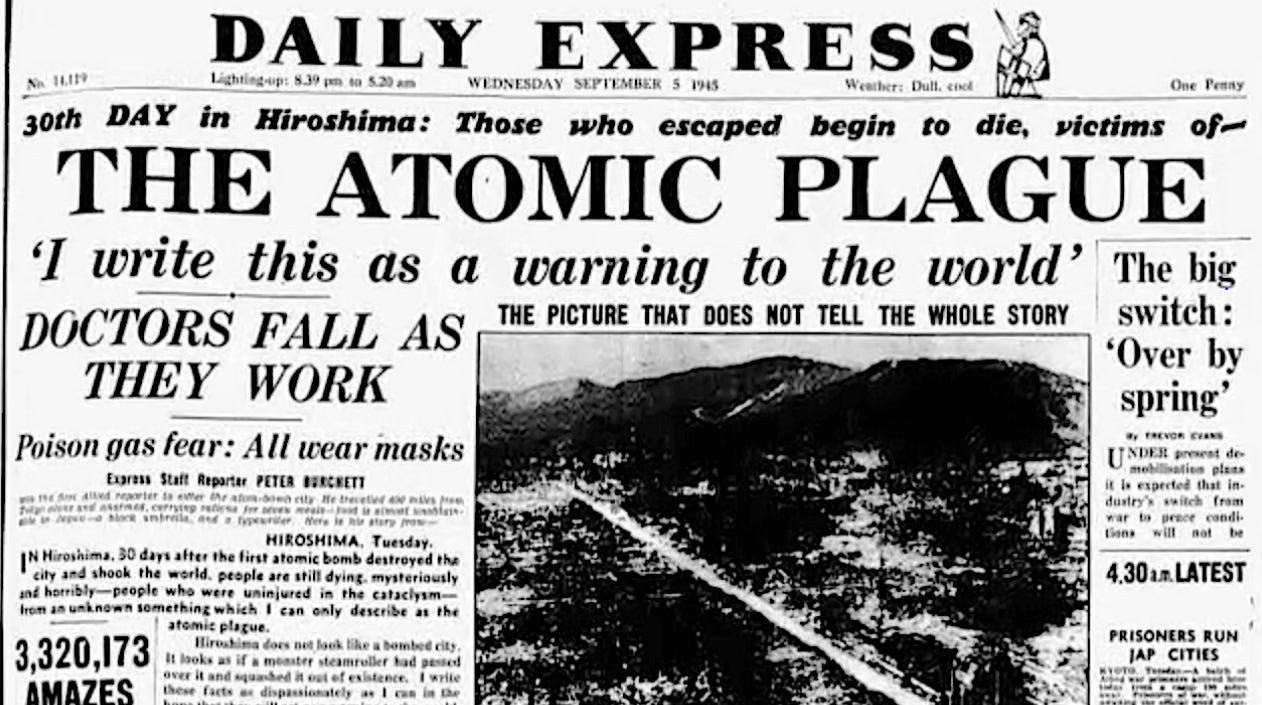
BY WILFRED BURCHETT AUGUST 27, 2014 https://www.fairobserver.com/region/north_america/wilfred-burchett-atomic-plague-99732/
Wilfred Burchett was the first reporter to enter the city of Hiroshima after the bombing in 1945.
Wilfred Burchett’s “The Atomic Plague” is often referred to as “the scoop of the century.” He was the first correspondent to enter the city of Hiroshima after the bombing, arriving with the first wave of US Marines on the USS Millett that landed in Japan on August 14, 1945. Armed with a pistol, a typewriter and a Japanese phrasebook, he traveled through scenes of unparalleled destruction caused by US air raids, onto “where Hiroshima used to be.” “There was devastation and desolation and nothing else.”
Burchett was the first to expose the devastating effects of radiation that was being denied by the Allied forces at the time. His dispatch conveys the harrowing confusion and ignorance of the victims as to what was done to them — it was thought the bombs contained a poisonous gas, perhaps, and doctors hoped the Americans would provide an antidote. By the end of 1945, some 140,000 were dead in Hiroshima and a further 70,000 in Nagasaki — a number that will continue to grow over the course of the century.
Despite the Allied officials’ attempts to censor the story, Burchett’s dispatch was published in The Daily Express on September 5, 1945. It is a piece of journalism that should be read over and over again — “as a warning to the world” — because like no other account, it brings home the inhuman reality of a nuclear holocaust.
“I Write This as a Warning to the World”
The Daily Express, London, September 5, 1945.
Express Staff Reporter Peter Burchett [sic] was the first Allied staff reporter to enter the atom-bomb city. He travelled 400 miles from Tokyo alone and unarmed carrying rations for seven meals — food is almost unobtainable in Japan — a black umbrella, and a typewriter. Here is his story from —
HIROSHIMA, Tuesday.
In Hiroshima, 30 days after the first atomic bomb destroyed the city and shook the world, people are still dying, mysteriously and horribly — people who were uninjured by the cataclysm — from an unknown something which I can only describe as atomic plague.
Hiroshima does not look like a bombed city. It looks as if a monster steamroller had passed over it and squashed it out of existence. I write these facts as dispassionately as I can in the hope that they will act as a warning to the world. In this first testing ground of the atomic bomb I have seen the most terrible and frightening desolation in four years of war. It makes a blitzed Pacific island seem like an Eden. The damage is far greater than photographs can show.
When you arrive in Hiroshima you can look around and for 25, perhaps 30, square miles you can hardly see a building. It gives you an empty feeling in the stomach to see such man-made devastation.
And so the people of Hiroshima today are walking through the forlorn desolation of their once proud city with gauze masks over their mouths and noses. It probably does not help them physically. But it helps them mentally.
I picked my way to a shack [sic] used as a temporary police headquarters in the middle of the vanished city. Looking south from there I could see about three miles of reddish rubble. That is all the atomic bomb left of dozens of blocks of city streets, of buildings, homes, factories and human beings.
Still They Fall
There is just nothing standing except about 20 factory chimneys — chimneys with no factories. I looked west. A group of half a dozen gutted buildings. And then again nothing.
The police chief of Hiroshima welcomed me eagerly as the first Allied correspondent to reach the city. With the local manager of Domei, a leading Japanese news agency, he drove me through, or perhaps I should say over, the city. And he took me to hospitals where the victims of the bomb are still being treated.
In these hospitals I found people who, when the bomb fell, suffered absolutely no injuries, but now are dying from the uncanny after-effects.
For no apparent reason their health began to fail. They lost appetite. Their hair fell out. Bluish spots appeared on their bodies. And the bleeding began from the ears, nose and mouth.
At first the doctors told me they thought these were the symptoms of general debility. They gave their patients Vitamin A injections. The results were horrible. The flesh started rotting away from the hole caused by the injection of the needle.
And in every case the victim died.
That is one of the after-effects of the first atomic bomb man ever dropped and I do not want to see any more examples of it. But in walking through the month-old rubble I found others.
The Sulphur Smell
My nose detected a peculiar odour unlike anything I have ever smelled before. It is something like sulphur, but not quite. I could smell it when I passed a fire that was still smouldering, or at a spot where they were still recovering bodies from the wreckage. But I could also smell it where everything was still deserted.
They believe it is given off by the poisonous gas still issuing from the earth soaked with radioactivity released by the split uranium atom.
And so the people of Hiroshima today are walking through the forlorn desolation of their once proud city with gauze masks over their mouths and noses. It probably does not help them physically. But it helps them mentally.
From the moment that this devastation was loosed upon Hiroshima the people who survived have hated the white man. It is a hate the intensity of which is almost as frightening as the bomb itself.
“All Clear” Went
The counted dead number 53,000. Another 30,000 are missing, which means “certainly dead”. In the day I have stayed in Hiroshima – and this is nearly a month after the bombing – 100 people have died from its effects.
They were some of the 13,000 seriously injured by the explosion. They have been dying at the rate of 100 a day. And they will probably all die. Another 40,000 were slightly injured.
These casualties might not have been as high except for a tragic mistake. The authorities thought this was just another routine Super-Fort raid. The plane flew over the target and dropped the parachute which carried the bomb to its explosion point.
Many people had suffered only a slight cut from a falling splinter of brick or steel. They should have recovered quickly. But they did not. They developed an acute sickness. Their gums began to bleed. And then they vomited blood. And finally they died.
The American plane passed out of sight. The all-clear was sounded and the people of Hiroshima came out from their shelters. Almost a minute later the bomb reached the 2,000 foot altitude at which it was timed to explode – at the moment when nearly everyone in Hiroshima was in the streets.
Hundreds upon hundreds of the dead were so badly burned in the terrific heat generated by the bomb that it was not even possible to tell whether they were men or women, old or young.
Of thousands of others, nearer the centre of the explosion, there was no trace. They vanished. The theory in Hiroshima is that the atomic heat was so great that they burned instantly to ashes – except that there were no ashes.
If you could see what is left of Hiroshima you would think that London had not been touched by bombs.
Heap of Rubble
The Imperial Palace, once an imposing building, is a heap of rubble three feet high, and there is one piece of wall. Roof, floors and everything else is dust.
Hiroshima has one intact building – the Bank of Japan. This in a city which at the start of the war had a population of 310,000.
Almost every Japanese scientist has visited Hiroshima in the past three weeks to try to find a way of relieving the people’s suffering. Now they themselves have become sufferers.
For the first fortnight after the bomb dropped they found they could not stay long in the fallen city. They had dizzy spells and headaches. Then minor insect bites developed into great swellings which would not heal. Their health steadily deteriorated.
Then they found another extraordinary effect of the new terror from the skies.
Many people had suffered only a slight cut from a falling splinter of brick or steel. They should have recovered quickly. But they did not. They developed an acute sickness. Their gums began to bleed. And then they vomited blood. And finally they died.
All these phenomena, they told me, were due to the radio-activity released by the atomic bomb’s explosion of the uranium atom.
Water Poisoned
They found that the water had been poisoned by chemical reaction. Even today every drop of water consumed in Hiroshima comes from other cities. The people of Hiroshima are still afraid.
The scientists told me they have noted a great difference between the effect of the bombs in Hiroshima and in Nagasaki.
Hiroshima is in perfectly flat delta country. Nagasaki is hilly. When the bomb dropped on Hiroshima the weather was bad, and a big rainstorm developed soon afterwards.
And so they believe that the uranium radiation was driven into the earth and that, because so many are still falling sick and dying, it is still the cause of this man-made plague.
At Nagasaki, on the other hand, the weather was perfect, and scientists believe that this allowed the radio-activity to dissipate into the atmosphere more rapidly. In addition, the force of the bomb’s explosion was, to a large extent, expended into the sea, where only fish were killed.
To support this theory, the scientists point out to the fact that, in Nagasaki, death came swiftly, suddenly, and that there have been no after-effects such as those that Hiroshima is still suffering.
Postscriptum
“It so happened that step by step and almost accidentally, I had achieved a sort of journalistic Nirvana, free of any built-in loyalties to governments, parties, or any organizations whatsoever. My loyalty was to my own convictions and my readers. This demanded freedom from any discipline except that of getting the facts on important issues back to the sort of people likely to act — often at great self-sacrifice — on the information they received. This was particularly so during my reporting from Vietnam, the most important of my career, far too important to be swayed by dictates from outside or above. Over the years, and in many countries, I had a circle of readers who did not buy papers for the stock market reports or strip cartoons, but for facts on vital issues affecting their lives and their consciences. In keeping both eyes and both ears open during my forty years’ reporting from the world’s hot spots, I had become more and more conscious of my responsibilities to my readers. The point of departure is a great faith in ordinary human beings and the sane and decent way they behave when they have the true facts of the case.”
— Wilfred Burchett, At the Barricades
Like ‘the tolling of a distant temple bell’, Ibuse Masuji’s Black Rain remembers the horrors of Hiroshima and warns of the inhumanity of war
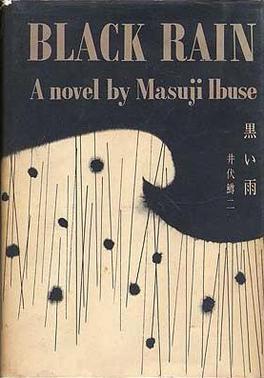
Jindan Ni, August 4, 2023 https://theconversation.com/like-the-tolling-of-a-distant-temple-bell-ibuse-masujis-black-rain-remembers-the-horrors-of-hiroshima-and-warns-of-the-inhumanity-of-war-205837?utm_medium=email&utm_campaign=The%20Weekend%20Conversation%20-%202700227280&utm_content=The%20Weekend%20Conversation%20-%202700227280+CID_e1af8a5e068132789cd3bffaecf54867&utm_source=campaign_monitor&utm_term=Like%20the%20tolling%20of%20a%20distant%20temple%20bell%20Ibuse%20Masujis%20Black%20Rain%20remembers%20the%20horrors%20of%20Hiroshima%20and%20warns%20of%20the%20inhumanity%20of%20war
In May 2023, almost 80 years after its devastation by an atomic bomb, Hiroshima again became the focus of world attention as the host city for the 49th G7 Summit.
On the summit’s official website, Hiroshima is presented as the exemplar of Japan’s postwar success. It is described as an “international city of peace and culture” and “resolute postwar advancement”. There are photos of its serene landscapes, its local delicacies and sake, and its modern sports and street culture.
The bombing of Hiroshima at the conclusion of World War II is mentioned just once. The Hiroshima Peace Memorial, according to the site, “speaks to the horrors of nuclear weapons”.
Hiroshima has more than this to tell us. But its stories, its “several pasts”, have been constantly abridged – or “refashioned”, as Michel Foucault would say. They have been adapted to serve political agendas.
On August 6, 1945, after the atomic bomb was dropped on Hiroshima, President Harry Truman released a statement that praised the scientific achievement:
“Sixteen hours ago an American airplane dropped one bomb on Hiroshima, an important Japanese Army base […]
It is an atomic bomb. It is a harnessing of the basic power of the universe. The force from which the sun draws its power has been loosed against those who brought war to the Far East […]
What has been done is the greatest achievement of organized science in history. It was done under high pressure and without failure”.
The atomic bomb was something altogether different for Japan. After the bombs fell on Hiroshima and Nagasaki, the Japanese emperor Hirohito broadcast his “jewel voice” to make the announcement of Japan’s surrender to his subjects. He spoke in an opaque, classical language almost incomprehensible to ordinary Japanese:
“The enemy has for the first time used cruel bombs to kill and maim extremely large numbers of the innocent and the heavy casualties are beyond measure; if the war were continued, it would lead not only to the downfall of our nation but also to the destruction of all human civilization.“
In these statements, we can see Truman and Hirohito attempting to justify their actions. We can see interpretations of the attacks on Hiroshima and Nagasaki taking different tracks. Such modified national memories install a kind of forgetting. They are ways of marginalising or erasing individual experiences of the war.In these statements, we can see Truman and Hirohito attempting to justify their actions. We can see interpretations of the attacks on Hiroshima and Nagasaki taking different tracks. Such modified national memories install a kind of forgetting. They are ways of marginalising or erasing individual experiences of the war.
During the postwar occupation of Japan, from 1945-1952, the Allied occupiers sought to remould the Japanese minds. The “horrors of nuclear weapons” could not be mentioned. Pictures and narratives about the atomic bombs were subject to strict censorship.
Only after the easing of censorship could Japanese writers begin to reveal the details of the horrendous suffering that occurred in Hiroshima and Nagasaki. These works became collectively known as genbaku bungaku, or “atomic bomb literature”. The explorations of the destructive power of war and institutionalised violence have left their mark on contemporary Japanese literature.
Ibuse Masuji’s Black Rain, which won the prestigious Noma Literary Prize after its publication in 1965, epitomises atomic bomb literature. It is now considered a classic of modern Japanese literature.
Black Rain records the scorching memories of the hibakusha – atomic bomb survivors – of the bombing and its aftermath. More significantly, it critiques the brutality of war, the militarised state, and the purposeful forgetting of history. Ibuse based his novel on journals and interviews with the bomb survivors, writing against amnesia using what he called the “crudest kind of realism”.
Forgetting and stigmatisation
Black Rain begins four years and nine months after the war. Shizuma Shigematsu and his family live a seemingly quiet and normal life in the village of Kobatake, about 100 kilometres from Hiroshima city. But the fact that they once lived and worked close to Hiroshima is still a weight upon their lives.
Shigematsu is vexed about his niece Yasuko’s poor marriage prospects. There are rumours circulating in the village that Yasuko was near the epicentre of the explosion and now has radiation sickness. As her guardian, Shigematsu is agonised with guilt, as it was at his instigation that Yasuko came to Hiroshima city, so as to avoid the army’s conscription of young women to work in the factories that produced military supplies.
During the war, “irresponsible talk” was strictly forbidden by the army. But after the war, Shigematsu laments, rumours stigmatising people like Yasuko are by no means under control. To prove that Yasuko was not exposed to radiation, Shigematsu decides to copy Yasuko’s wartime diary entries and show them to the village matchmaker.
For the survivors of Hiroshima, memories of the bombing return unbidden. The misery of past has to be revisited to ease their present predicament.
Initially, no one knew what happened when the bomb fell. It was beyond everyone’s comprehension. And it is this horror of not knowing that Black Rain agonisingly depicts. Because of this, people who were not at the epicentre went towards it. They went in search of their families and were thus unnecessarily exposed to radiation.
Yasuko was one of these victims. She was 10 kilometres from the epicentre, but became caught in the radioactive “black rain” on the way to find her uncle and aunt. The rain leaves ominous strange black stains on Yasuko. Her dread is heartwrenching:
I felt horrified, and then awfully sad. However many times I went to the ornamental spring to wash myself, the stains from the black rain wouldn’t come off.
Despite Shigematsu’s efforts to prove that Yasuko is free from radiation sickness, she develops symptoms eventually, almost five years after the bomb. There is no cure for this condition and the doctor asks Shigematsu to report Yasuko’s case to the Atomic Bomb Casualty Commission (ABCC), which was established by the Allied occupation in 1947 with “the highest ideals” in order to collect data of the victims.
The commission only documented cases like Yasuko’s; it provided no treatment for the victims.
Tradition versus modernity
In Black Rain, Ibuse boldly challenges the modernisation which Japan has been determined to achieve since the Meiji Restoration, which began in 1868.
His critique of modernity is highly nuanced, with a tinge of humour. For example, when Shigematsu decides to copy Yasuko’s diaries, his wife Shigeko asks him to use Chinese brush ink instead of ordinary pen ink which does not last. To convince him, she shows him a letter which was sent to his great-grandfather from Tokyo in 1870.
The letter sender proudly concludes his letter by emphasising “this letter, in accordance with my promise to you at the time, is written in the ‘ink’ commonly in use in the West.” But the ink has “faded to a pathetic light brown colour”.
Shigematsu agrees to his wife that they should use the traditional brush ink so that their diaries and memories can be well preserved.
In the introduction to his English translation of Black Rain, John Bester writes that Ibuse shows “infinite nostalgia” towards “the beauty of the Japanese countryside and the ancient customs of its people”. For Ibuse, it is only through traditional food and medicine that the damages brought by science and modernity, exemplified by the atomic bomb, can be eased and soothed.
Appeal to nature, humanity and peace
Black Rain dwells on the atrocity of war as it affects people, but it also documents damage that war inflicts on nature. Shigematsu recalls the massive gingko tree he liked to play under, which stood outside his friend Kōtarō’s place. It was cut down for the “national interest” during the war.
Similarly, the novel records that villagers were ordered to dig pine-tree roots to extract oil for “the engines of the planes whose job it was to shoot down B-29s”.
Animals also suffered as a result of the atomic bomb, just as people did. The fish in the lake died. Like the bomb survivors who lost teeth and hair, they lost their scales and could not swim normally.
In Black Rain, the collective forgetting of the direct experiences of the victims leads to systematic stigmatisation and bias against them, which exacerbates their struggle. Shōkichi – Shigematsu’s friend who also survived the bomb – stridently announces:
Everybody’s forgotten! Forgotten the hellfires we went through that day – forgotten them and everything else, with their damned anti-bomb rallies. It makes me sick, all the prancing and shouting they do about it.
Shōkichi’s visceral repulsion to the anti-bomb rallies speaks of a collective forgetting, in which the enduring sufferings of the “precious victims” have been deployed as convenient narratives to serve the “national interest”. As the historian John Dower succinctly puts it, the rallies and memorial activities conformed to the state’s need of “nuclear victimization”, which aimed to shape “new forms of nationalism in postwar Japan”.
One of the maimed survivors in Black Rain writes in his journal that he now has permanent ringing in his ears: “it persists in my ear day and night, like the tolling of a distant temple bell, warning man of the folly of the bomb”.
Black Rain calls for a proper remembering of the war. In Ibuse’s documentary novel, Hiroshima is allowed to speak more and remember more. Through Shigematsu’s voice, Ibuse expresses the anger and despair of the people forced to endure the war:
I hated war. Who cared, after all, which side won? The only important thing was to end it all soon as possible: rather an unjust peace, than a “just” war!
Those who will fire the nuclear weapons are thoroughly trained to have no hesitation. We must stop them.
SCOTT RITTER: The Atomic Executioner’s Lament
Consortium News, August 2, 2023
While the world focuses on the trials and travails of the scientists who invented the atomic bomb, little attention is paid to the hard positions taken by the nuclear executioners, the men called upon to drop these bombs in time of war.
“…………………………………………………………………………… Formed on March 6, 1945, the 1st Ordnance Squadron, Special (Aviation) was part of the 509th Composite Group, commanded by then-Lieutenant Colonel Paul Tibbets. Prior to being organized into the 1st Ordnance Squadron, the men of the unit were assigned to a U.S. Army ordnance squadron stationed a Wendover, Utah, where Tibbets and the rest of the 509th Composite Group were based.
While Oppenheimer and his scientists designed the nuclear device, the mechanism of delivery — the bomb itself — was designed by specialists assigned to the 509th. It was the job of the men of the 1st Ordnance Squadron to build these bombs from scratch.
………………………………..the decision was made that the final assembly of the bomb would be done only after the Enola Gay took off.
One of the 1st Ordnance Squadron technicians placed the uranium slug into the bomb at 7,000 feet over the Pacific Ocean.
The bomb worked as designed, killing more than 80,000 Japanese in an instant; hundreds of thousands more died afterwards from the radiation released by the weapon.
For the pilot and crew of the Enola Gay, there was no remorse over killing so many people………………………………………..Tibbets told Terkel. “If the newspapers would just cut out the shit: ‘You’ve killed so many civilians.’ That’s their tough luck for being there.”
Major Charles Sweeney, the pilot of Bockscar, the B-29 that dropped the second American atomic bomb on the city of Nagasaki on Aug. 9, 1945, held similar convictions about his role in killing 35,000 Japanese instantly.
……………………………………………………………….While the world focuses on the trials and travails of Oppenheimer and Sakharov, they remain silent about the hard positions taken by the nuclear executioners, the men called upon to drop these bombs in time of war. There have only been two such men, and they remained resolute in their judgement that it was the right thing to do.
The executioner’s lament is overlooked by most people involved in supporting nuclear disarmament. This is a mistake, because the executioner, as was pointed out to Oppenheimer by the men of the 1st Ordnance Squadron, is in control.
They possess the weapons, and they are the ones who will be called upon to deliver the weapons. Their loyalty and dedication to task is constantly tested in order to ensure that, when the time comes to execute orders, they will do so without question.
………………………………………………………… Those who will execute the orders to use nuclear weapons in any future nuclear conflict will, in fact, execute those orders. They are trained, like Tibbets and Sweeney, to believe in the righteousness of their cause.
Dmitry Medvedev, the former Russian prime minister and president who currently serves as the deputy chairman of the Russian National Security Council, has publicly warned the Western supporters of Ukraine that Russia would “have to” use nuclear weapons if Ukrainian forces were to succeed in their goal of recapturing the former territories of Ukraine that have been claimed by Russia in the aftermath of referenda held in September 2022………………………………………………………..
The Russians who would execute the orders to launch nuclear weapons against the West would be operating with the same moral clarity as had Paul Tibbets and Charles Sweeney some 88 years ago. The executioner’s lament holds that they will be saddened by their decision but convinced that they had no other choice.
Proving them wrong will be impossible, because unlike the war with Japan, where the survivors were given the luxury of reflection and accountability, there will be no survivors in any future nuclear conflict.
The onus, therefore, is on the average citizen to get involved in processes that separate the tools of our collective demise — nuclear weapons — from the those who will be called upon to use them.
Meaningful nuclear disarmament is the only hope humankind has for its continued survival.
The time to begin pushing for this is now, and there is no better place to start that on Aug. 6, 2023 — the 78th anniversary of the bombing of Hiroshima, when like-minded persons will gather outside the United Nations to begin a dialogue about disarmament that will hopefully resonate enough to have an impact of the 2024 elections. https://consortiumnews.com/2023/08/02/scott-ritter-the-executioners-lament/
‘Barbenheimer’ highlights U.S. ignorance of nuclear reality
Lack of images depicting the real-life horrors of the atomic bombs left a generation in the dark
BY DON CARLETON 4 Aug 23 https://www.japantimes.co.jp/commentary/2023/08/04/japan/barbie-oppenheimer-nuclear-weapons/
As we approach the 79th anniversary of the bombings of Hiroshima and Nagasaki, America is gripped in a confusing and (as some have argued) insensitive cultural moment.
The release of very different movies, “Barbie” and “Oppenheimer,” on the same day has spawned the “Barbenheimer” craze where the two come together in a strange yet symbiotic fashion. Box office records have been broken across America and it has become a trend among moviegoers to express an ironic sense of humor by seeing both films on the same day.
In addition, countless internet jokes and memes — some showing “Barbie” and “Oppenheimer” juxtaposed against the backdrop of atomic explosions — have gone viral. However, the resulting satire has led to deep offense and anger among many Japanese. Things culminated earlier this week when Warner Bros. (the makers of “Barbie”) issued an apology after their official U.S. social media account reacted positively to a Barbenheimer meme.
These memes aren’t harmless fun, because atomic bombs are never harmless. The two bombs dropped by the American armed forces on Hiroshima and Nagasaki created immense and intense human suffering. The Barbenheimer trend thus glosses over the tragedy at the core of “Oppenheimer” and points to the fact that few Americans have ever fully grappled with the enormous devastation of the atomic bombings. In large part, that’s because few Americans have ever seen that reality.
In 2018, I was approached by Hankaku Shashin Undo, the Anti-Nuclear Photographer’s Association (ANPM), who have worked since 1982 to preserve the legacy of Japanese photographers who documented the bombings and their immediate aftermath firsthand in Hiroshima and Nagasaki.
As the executive director of the Briscoe Center for American History at the University of Texas at Austin, a research center dedicated to fostering scholarly and public understanding of U.S. history, I was interested in ANPM’s invitation to collaborate. At the heart of ANPM’s activism is a desire to remove the danger of nuclear war from the world
— a motive we can all support, regardless of how we feel about the American decision to drop the bombs. In working together, we hoped to raise visual awareness of “what actually happened” in Hiroshima and Nagasaki so that a new generation of Americans might better understand the realities of nuclear war.
ANPM agreed to place a large digital archive of photographs at the Briscoe Center and I agreed to publish a book and create an exhibition of selected images. Along with two members of my staff, I visited Hiroshima and Nagasaki in 2018, meeting with museum staff, journalists and hibakusha.
The result was “Flash of Light, Wall of Fire,” a 2020 book and subsequent exhibit. Throughout the project, our goal was simple. We wanted to show Americans something that they had never seen before: comprehensive visual evidence of the devastation and suffering atomic bombs cause.
Why have Americans not seen this evidence until now?
After World War II, photographs of Hiroshima and Nagasaki were immediately suppressed by the Japanese military and later by the American occupation forces in Japan, meaning very few were published on either side of the Pacific Ocean. After the end of the occupation in the 1950s (when Japanese books documenting the bombings began to be published and the memorial museums in Hiroshima and Nagasaki were founded), few photographs made their way from Japan to the United States.
If Americans thought of the bomb at all, their only visual memory was of the mushroom cloud, not the horrors inflicted on the Japanese civilians. This void led to a strange cultural dichotomy during the 1950s.
On the one hand, Americans took the bomb very seriously, with the Cold War fueling moments of political and cultural hysteria from McCarthyism to suburban fallout shelters. On the other hand, cultural fads such as “Miss Atomic Bomb” to atomic-themed candy made light of the bombings. Today, with Barbenheimer, we see that the pattern still resonates — seriousness on one hand, silliness on another, all smushed together in our popular culture.
“Oppenheimer” is a moving and serious film that raises important questions about the consequences of nuclear weapons through the personal experiences of physicist Robert Oppenheimer. It includes harrowing depictions of the July 1945 Trinity test site explosion in New Mexico, as well as a compelling scene where Oppenheimer briefly envisions the terrifying human effects of the bombs during a victory speech.
However, there is no attempt to depict the resulting terrors from the perspective of the people of Hiroshima and Nagasaki. Director Christopher Nolan explains this decision, in part: “(Oppenheimer) learned about the bombings of Hiroshima and Nagasaki on the radio, the same as the rest of the world.” It would be unreasonable to criticize Nolan for not including longer and more graphic scenes of this nature, given his vision for the film’s focus on Oppenheimer’s perspective. But without those scenes, and without any visual record in our collective memory, it is easier to avoid the ramifications of Hiroshima and Nagasaki when our view is taken from the bomb bay doors of the Enola Gay or Bockscar.
Conversely, it is impossible to deny the terror and tragedy of the bombings when one looks through the eyes of Yoshito Matsushige, Yosuke Yamahata, Eiichi Matsumoto, Shigeo Hayashi and other photographers on the ground in 1945. Thus, when the Briscoe Center agreed to receive, display and publish photographs donated by the ANPM, the desire was to get the American mind to look from under the mushroom cloud, so to speak.
Unfortunately, the COVID-19 pandemic disrupted our project (as well as the 75th anniversary commemorations in Japan) and diminished the impact of the center’s book and exhibit. Nevertheless, next year’s 80th anniversary gives historians, archivists and curators around the world a new opportunity.
The Barbenheimer moment shows us that much work remains to be done. If Americans are going to take the very real nuclear dangers of our age more seriously than previous generations (not to mention having a clearer view of what was done to the people of Hiroshima and Nagasaki), they must be confronted with the stark visual evidence of what actually happened. On the whole, Americans are still looking at the history of Hiroshima and Nagasaki from a distance — visually, emotionally and intellectually.
As we approach the 80th anniversary of the bombings, it is time to make a renewed push to change that perspective.
Pacific anti-nuclear groups condemn Fiji’s Prime Minister Sitiveni Rabuka for backing Fukushima wastewater stance
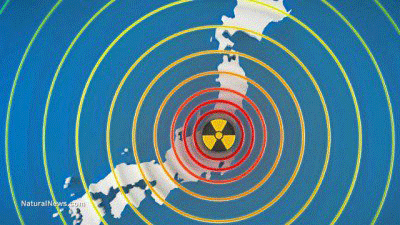
Kelvin Anthony, RNZ 4 Aug 23
Pacific anti-nuclear advocacy groups and campaigners have condemned the Fijian Prime Minister Sitiveni Rabuka’s backing of Japan’s plans release over one million tonnes of treated nuclear wastewater into the Pacific Ocean.
On Thursday, Rabuka announced he was “satisfied” with Japan’s efforts to demonstrate that the release will be safe………………………………..
the Alliance for Future Generation Fiji [https://www.afgfiji.org/post/afg-condemns-fijipm-support-for-fukushima-wastewater said it was “deeply concerned” and “condemned” Rabuka’s stance.
The group is urging Rabuka to reconsider “and take a stronger position” on the issue.
AFG Fiji said releasing treated nuclear wastewater into the Pacific Ocean would have “far-reaching consequences for the entire Pacific region and beyond”.
“This action has the potential to inflict lasting damage to marine ecosystems, threatening the livelihoods of countless communities that depend on the ocean for sustenance and economic well-being. Our concerns regarding this matter are deeply rooted in the Pacific Ocean as a source of identity for all Pacific communities,” it said.
“We urge the Fiji Prime Minister and by extension, his government, to reconsider its stance and take a stronger position in advocating for the implementation of alternative, safe, and sustainable solutions for the Fukushima nuclear wastewater.
“We also urge Pacific leaders to trust the independent panel of scientific experts, appointed by the Pacific Islands Forum to review the data and information provided by Japan. As members of the global community, it is our collective responsibility to uphold principles of environmental stewardship and to prioritize the health and safety of our oceans and the lives they sustain,” the NGO said.
The campaigners are also calling on the international community to show solidarity and “demand that Japan seeks alternative solutions to handle its nuclear waste responsibly”. https://www.rnz.co.nz/international/pacific-news/495162/anti-nuclear-group-condemns-sitiveni-rabuka-s-fukushima-wastewater-stance
UN nuclear watchdog finds no explosives at Zaporizhzhia plant
Experts given access to two units at Russian-held site month after Ukraine claimed there were devices on roofs
The UN nuclear watchdog says it has found no explosives in areas of the Russian-held Zaporizhzhia nuclear power plant in southern Ukraine to which it had requested access a month earlier.
On 4 July, Russia and Ukraine accused each other of planning to stage an attack on Europe’s biggest nuclear power plant, with the latter claiming “operational data” showed “explosive devices” had been placed on the roofs of two units.
The following day the International Atomic Energy Agency, which has repeatedly warned of nearby military clashes potentially causing a nuclear disaster, said access to the roofs of the two units and parts of the turbine halls was essential.
A small IAEA team based at the plant sought to verify the accusations by inspecting areas of the site to which it had already been granted access. It issued updates in the ensuing weeks to say it had found no signs of explosives in those areas, except mines outside the perimeter that appeared to pose no danger to the plant’s safety.
On Friday, it said in a statement: “[IAEA] experts have observed no mines or explosives on the rooftops of unit three and unit four reactor buildings and the turbine halls … after having been given access yesterday afternoon.
“Following repeated requests, the team had unimpeded access to the rooftops of the two reactor units and could also clearly view the rooftops of the turbine halls. The team will continue its requests to visit the roofs of the other four units.”
Building for War: The US Imperium’s Big Spend at the top of the Australian continent
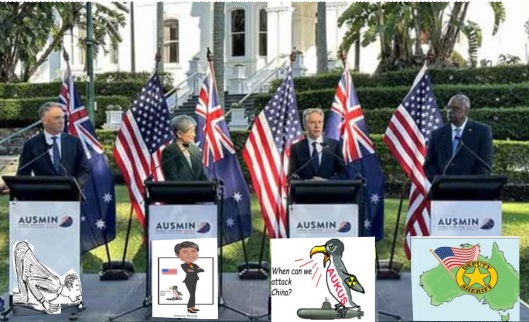
August 5, 2023, Dr Binoy Kampmark, https://theaimn.com/building-for-war-the-us-imperiums-top-end-spend/
The AUSMIN 2023 talks held between the US Secretaries of State and Defense and their Australian counterparts, confirmed the increasing, unaccountable militarisation of the Australian north and its preparation for a future conflict with Beijing. Details were skimpy, the rhetoric aspirational.
But the Australian performance from Defence Minister Richard Marles, and Foreign Minister Penny Wong, was crawling, lamentable, even outrageous. State Secretary Antony Blinken and Defense Secretary Lloyd Austin III could only look on with sheer wonder at their prostrate hosts.
Money, much of it from the US military budget, is being poured into upgrading, expanding and redeveloping Royal Australian Air Force (RAAF) bases in the Northern Territory city of Darwin, and Tindal, situated 320km south-east of Darwin, the intended to “address functional deficiencies and capacity constraints in existing facilities and infrastructure.” Two new locations are also being proposed at RAAF Bases Scherger and RAAF Curtin, aided by site surveys.
The AUSMIN joint statement, while revealing nothing in terms of operational details or costs, proved heavy with talk about “the ambitious trajectory of Enhanced Force Posture Cooperation across land, maritime, and air domains, as well as Combined Logistics, Sustainment and Maintenance Enterprise (CoLSME).” Additionally, there would be “Enhanced Air Cooperation” with a rotating “US Navy Maritime Patrol and Reconnaissance Aircraft in Australia to enhance regional maritime domain awareness, with an ambition of inviting likeminded partners to participate in the future.”
Further details have come to light about the money being spent by the Pentagon on facilities in Darwin. The unromantically titled FY22 MCAF Project PAF160700 Squadron Operations Facility at the RAAF Darwin base “includes the construction (design-bid-build) of a United States Air Force squadron facility at the … (RAAF) in Darwin, Australia.” The project is deemed necessary to add space “for aircrew flight equipment, maintenance and care, mission planning, intelligence, crew briefings, crew readiness, and incidental related work.” Some of the systems are mundane but deemed important for an expanded facility, including ventilating and air conditioning, water heating, plumbing, utility energy meters and sub-meters and a building automation system (HVAC Control system).
Correspondents from the Australian Broadcasting have gone further into the squadron operations facility, consulting US budget filings and tender documents to reveal cost assessments of $26 million (A$40 million). A further parking apron at RAAF Darwin is also featured in the planning, estimated to cost somewhere in the order of $258 billion. This will further supplement plans to establish the East Arm fuel storage facility for the US Air Force located 15 kilometres from Darwin that should be able to, on completion by September this year, store 300 million litres of military jet fuel intended to support US military activity in the Northern Territory and Indo-Pacific region.
According to the tender documents, the squadron operations facility also had a broader, more strategic significance: “to support strategic operations and to run multiple 15-day training exercises during the NT dry season for deployed B-52 squadrons.” The RAAF Tindal facility’s redevelopment, slated to conclude in 2026, is also intended to accommodate six B-52 bombers. Given their nuclear capability, residents in the NT should feel a suitable degree of terror.
Michael Shoebridge, founder and director of Strategic Analysis Australia, is none too pleased by this state of affairs. He is unhappy by Canberra’s reticence on US-Australian military arrangements, and none too keen on a debate that is only being informed by US-based sources. “A public debate needs to be enabled by information and you can’t have a complete picture without knowing where the money is being spent.”
While it is hard to disagree with that tack, Shoebridge’s outfit, in line with such think tanks as the Australian Strategic Policy Institute, is not against turning Australia into a frontline fortress state ready for war. What he, and his colleagues take issue with, is the overwhelmingly dominant role the US is playing in the venture. Those in Washington, Shoebridge argues, seem to “understand the urgency we don’t seem to.” Rather than questioning Australia’s need for a larger, more threatening military capability to fight phantoms and confected foreign adversaries, he accepts the premise, wholeheartedly. Canberra, in short, should muck in more, pull its weight, and drum up Australian personnel for the killing.
Anthony Bergin, a senior fellow of Strategic Analysis Australia, teases out the idea of such mucking in, suggesting a familiar formula. He insists that, in order to improve “our national security, we should be looking at options short of conscription which wouldn’t be as hard to sell to the Australian people.” He thought the timing perfect for such a move. “There’s now a latent appetite for our political leaders to introduce measures to bolster national resilience.”
This silly reading only makes sense on the assumption that the Australian public has been softened sufficiently by such hysterical affronts to sensibility as the Red Alert campaign waged in the Fairfax Press.
Options to add padding to Australia’s military preparedness include doubling or tripling school cadets and cadet programs of the “outdoor bound” type based in the regions. But more important would be the creation of a “national militia training scheme”. Bergin is, however, displeased by the difficulty of finding “volunteers of any kind”, a strange comment given the huge, unpaid volunteer army that governs the delivery of numerous services in Australia, from charities to firefighting.
Alison Broinowski, herself formerly of the Australian diplomatic corps, safely concludes that the current moves constitute “another step in the same direction – a step that the government has been taking a series of for years; accepting whatever the United States government wants to place on Australian soil.” More’s the pity that most details are to come from Washington sources, indicating, with irrefutable finality, Canberra’s abject subordination to the US imperium and its refusal to admit that fact.
Why is Ontario Government bent on building a new nuclear reactor, at a much greater cost than solar or wind technologies?
Ontario Power Generation (OPG), which is 100% owned by the Government of
Ontario, is proposing to build a first of its kind GE-Hitachi 300 megawatt
(MW) boiling water reactor at its Darlington Nuclear Station, east of
Oshawa.
OPG has still not submitted GE-Hitachi’s proposed reactor design
to the Canadian Nuclear Safety Commission for review and potential
approval, despite claiming that construction of the reactor will be
completed by 2028.
According to Lazard, one of the most respected names in
global financial services, the cost of electricity from a new nuclear
reactor is 1.7 times greater than the cost of offshore wind, three times
greater than the cost of solar power, and 3.6 times greater than the cost
of onshore wind.
Clean Air Alliance 3rd Aug 2023
Saudi Arabia could convert civilian nuclear to military, Israeli expert warns

Former deputy head of Atomic Energy Commission fears that Riyadh’s demand to enrich uranium as part of Israel normalization deal may open ‘Pandora’s box,’ launch Mideast arms race
Times of Israel, By TAL SCHNEIDER2 August 2023,
Illustrative: A US nuclear bomb test at the Marshall Islands, 1954. (Wikicommons/US Department of Energy)
A former top official for the Israel Atomic Energy Commission has warned that agreeing to Saudi Arabia’s demand to be allowed to build a nuclear power plant as part of a normalization deal with Israel may create a dangerous international precedent and effectively prompt a nuclear arms race in the Middle East.
“It won’t matter how many guarantees we receive from the International Atomic Energy Agency,” Ariel (Eli) Levite, who served as principal deputy director general for policy at Israel’s Atomic Energy Commission from 2002 to 2007, told Zman Israel, The Times of Israel’s Hebrew-language sister site, on Monday.
Saudi Arabia has reportedly set three conditions for signing a normalization agreement with Israel — access to advanced American defense technology such as the THAAD missile system, the establishment of a defense alliance with the United States, and a green light to develop nuclear power for civilian purposes.
…………………………………………………. “If Saudi Arabia builds a reactor, they can only place it near the Red Sea, because a reactor needs large amounts of water for cooling, and if a disaster or terrorist attack occurs there it won’t be a simple matter — for us too, since we are not far away,” – Levite, the former Atomic Energy Commission deputy director
Illustrative: A US nuclear bomb test at the Marshall Islands, 1954. (Wikicommons/US Department of Energy)
A former top official for the Israel Atomic Energy Commission has warned that agreeing to Saudi Arabia’s demand to be allowed to build a nuclear power plant as part of a normalization deal with Israel may create a dangerous international precedent and effectively prompt a nuclear arms race in the Middle East.
“It won’t matter how many guarantees we receive from the International Atomic Energy Agency,” Ariel (Eli) Levite, who served as principal deputy director general for policy at Israel’s Atomic Energy Commission from 2002 to 2007, told Zman Israel, The Times of Israel’s Hebrew-language sister site, on Monday.
Saudi Arabia has reportedly set three conditions for signing a normalization agreement with Israel — access to advanced American defense technology such as the THAAD missile system, the establishment of a defense alliance with the United States, and a green light to develop nuclear power for civilian purposes.
Binary Options Fraud – ToI journalist Simona Weinglass’ storyPauseNext playlist itemUnmute
Loaded: 49.91%Picture-in-PictureFullscreenClose
For the last demand, National Security Adviser Tzachi Hanegbi said Monday that Israel’s approval would not be required.
“Dozens of countries operate civilian nuclear programs. This is not something that endangers them or their neighbors,” Hanegbi told the Kan public broadcaster, adding that the issue would be solely between Washington and Riyadh.
Get The Times of Israel’s Daily Editionby email and never miss our top storiesNewsletter email addressGET IT
By signing up, you agree to the terms
Levite, the former Atomic Energy Commission deputy director, said there was no problem with nuclear reactors for energy production as long as they are properly maintained. However, he cautioned, “If a security or operational failure occurs, there can be an enormous environmental fallout. We know this from several incidents in the past, such as Chernobyl and Fukushima” — two severe nuclear leaks in Ukraine in 1986 and Japan in 2011.
“If Saudi Arabia builds a reactor, they can only place it near the Red Sea, because a reactor needs large amounts of water for cooling, and if a disaster or terrorist attack occurs there it won’t be a simple matter — for us too, since we are not far away,” he added.
Ariel (Eli) Levite speaking at a conference at the Reichman Institute in Herzliya, 2019. (YouTube screenshot via Zman Israel; used in accordance with Clause 27a of the Copyright Law)
Israel is also worried about the possibility of a civilian reactor being converted for military applications, Levite noted.
He said the biggest problem with Riyadh’s demand was that “they’re not satisfied with reactors for energy purposes, but are also interested in a uranium enrichment program. This is the most problematic and sensitive part of the deal that may be currently in the making.”…………………………………. more https://www.timesofisrael.com/saudi-arabia-could-convert-civilian-nuclear-to-military-israeli-expert-warns/
New Brunswick Power is kicking the can down the road while the planet burns
Dr. Susan O’Donnel, Coalition for Responsible Energy Development in New Brunswick, l Rothesay, New Brunswick, August 3, 2023 – The Coalition for Responsible Energy Development in New Brunswick (CRED-NB) is surprised that NB Power would produce a plan (IRP 2023) for the future electrical grid dependent on a nuclear technology that may never exist. At the same time, NB Power is rejecting the most obvious next step: accepting the federal subsidy for the Atlantic Loop to secure a regional electricity infrastructure for New Brunswickers.
In the presentation in February by CRED-NB to the NB Legislative Assembly Standing Committee on Climate Change and Environmental Stewardship, we quoted the authoritative National Academies’ November 2022 report on advanced reactors: molten salt and sodium-cooled SMRs will have difficulty achieving commercial operations by 2050.
Yet the NB Power plan depends on two startup companies, Moltex from the U.K. and ARC from the U.S., neither of which has ever built a nuclear reactor, to build a SMR and make it produce electricity on the grid by 2035. We note that last year the target was 2029.
NB Power states in their IRP that: “the costs of SMRs are another significant unknown.” The NuScale SMR design, the closest to deployment in the U.S. is foreshadowing the costs to come. The NuScale SMR has been in development for more than 15 years and construction hasn’t started yet. They won’t start building it until enough customers have signed on, but more are leaving than signing on because costs have skyrocketed. The current estimated cost for NuScale SMRs with a capacity of 462 Megawatts (the same as NB Power wants to put on the grid by 2040) is $9.3-billion. That’s for a water-cooled SMR. Molten salt and liquid sodium metal designs are likely to cost far more.
Meanwhile, the planet is burning, and the clock is ticking. We must support the development of the Atlantic Loop and prioritize affordable, reliable, quickly deployed and proven solutions: energy efficiency and renewable energy technologies with storage. While we’re waiting for these SMR experiments to fail, NB Power is wasting time that we must spend urgently on genuine climate action.
CRED-NB represents more than 150 individuals and groups advocating for a nuclear-free renewable energy future in New Brunswick.
Nuclear catastrophe threat is ‘great and growing’, warn over 100 top medical journals
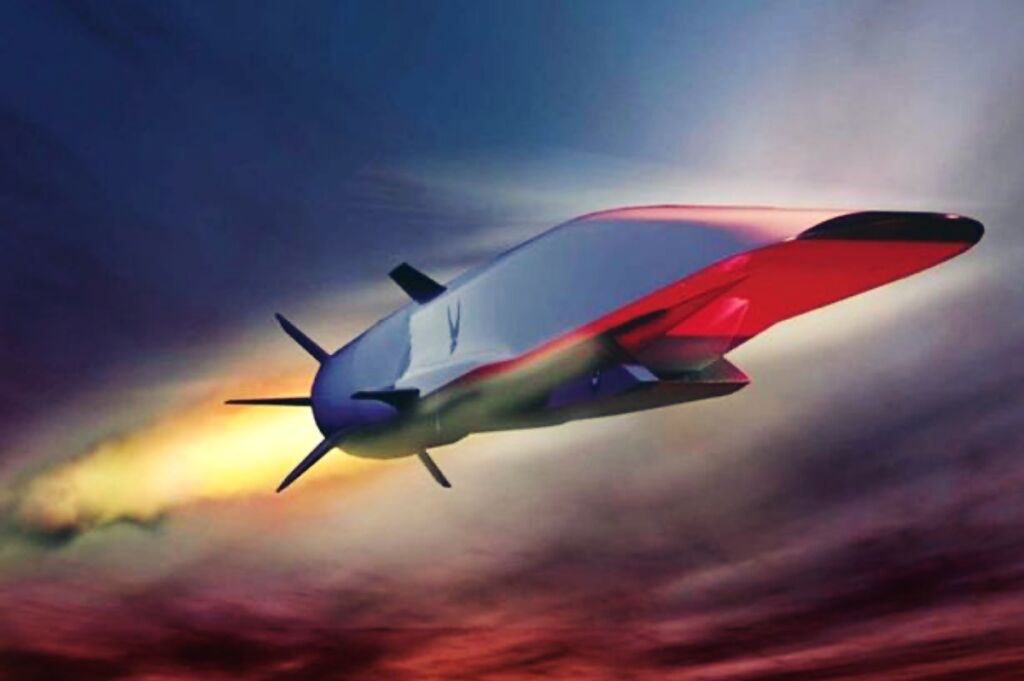
hypersonic missiles under constant development by many countries decrease the time available to distinguish between an attack and a false alarm.
Even ‘limited’ nuclear war with 250 of 13,000 nuclear weapons could kill 120 million people outright, op-ed says
Vishwam Sankaran, 3 Aug, https://www.independent.co.uk/world/nuclear-catastrophe-threat-risk-growing-b2386802.html
The threat of a nuclear catastrophe is “great and growing” under the current global political environment, over 100 top medical journals have warned in a joint editorial.
Current efforts to control nuclear arms, as well as those for non-proliferation are “inadequate” to protect the world’s population against the threat of nuclear war, the editors of the journals warned, while pointing to the danger underlined by growing tensions between many nuclear armed states.
“As editors of health and medical journals worldwide, we call on health professionals to alert the public and our leaders to this major danger to public health and the essential life support systems of the planet – and urge action to prevent it,” the editors of journals like Lancet, BMJ, JAMA and the New England Journal of Medicine said in the op-ed.
They also warned of the increasing risk of rapid escalation with the modernisation of nuclear arsenals by many countries, including China and the US.
Citing an example, the editors noted that hypersonic missiles under constant development by many countries decrease the time available to distinguish between an attack and a false alarm.
“Any use of nuclear weapons would be catastrophic for humanity,” they said.
“Even a ‘limited’ nuclear war involving only 250 of the 13,000 nuclear weapons in the world could kill 120 million people outright and cause global climate disruption leading to a nuclear famine, putting two billion people at risk,” the editorial said.
Once a nuclear weapon is detonated in any part of the world, escalation to an all-out nuclear war can occur rapidly.
They called for the prevention of any use of nuclear weapons as an urgent public health priority, adding that fundamental steps be taken to abolish all nuclear weapons.
The editors called on health professional associations worldwide to support efforts urging the adoption of a “no first use policy” and urge all states currently involved in conflicts to publicly and unequivocally pledge that they will not use nuclear weapons in these conflicts.
“The danger is great and growing. The nuclear armed states must eliminate their nuclear arsenals before they eliminate us,” they wrote.
UK’s Radioactive Waste Management holds meetings in Lincolnshire, seeking a location for nuclear waste dump
Geologists and nuclear scientists will be speaking about nuclear waste
disposal as part of a consultation. A former gas terminal in Theddlethorpe,
near Mablethorpe in Lincolnshire, was identified as a potential location
for an underground disposal site.
Radioactive Waste Management (RWM), a
government agency, is looking at the suitability of possible sites across
the country. The discussion sessions will take place at venues in
Lincolnshire. The events aim to give people an opportunity to find out what
is involved in geological disposal and the process of finding a potential
site for a Geological Disposal Facility (GDF) in the area, according to the
agency.
The GDF would see waste being stored under up to 1,000m of solid
rock until its radioactivity had naturally decayed.
” The sessions will feature a model of what
the GDF could look like as well as items including fuel rods, geological
rock samples, maps and information boards. The events take place on 4
August at Louth Town FC in Louth from 17:00 BST to 20:00, on 5 August at
Mablethorpe Community Hall from 11:00 to 14:00, on 8 August at Gayton Le
Marsh Village Hall from 17:00 to 20:00, on 9 August at Legbourne Village
Hall from 17:00 to 20:00 and on 11 August at St Mary’s Church Hall,
Mablethorpe from 17:00 to 20:00.
BBC 4th Aug 2023
1 This Month
Chernobyl: The Lost Tapes – A good documentary on Chernobyl on SBS available On Demand for the next 3 weeks– https://www.sbs.com.au/ondemand/tv-program/chernobyl-the-lost-tapes/2352741955560

of the week–London Campaign for Nuclear Disarmament

Tell the Ukrainian Government to Drop Prosecution of Peace Activist Yurii Sheliazhenko
To see nuclear-related stories in greater depth and intensity – go to https://nuclearinformation.wordpress.com
-
Archives
- April 2026 (126)
- March 2026 (251)
- February 2026 (268)
- January 2026 (308)
- December 2025 (358)
- November 2025 (359)
- October 2025 (376)
- September 2025 (257)
- August 2025 (319)
- July 2025 (230)
- June 2025 (348)
- May 2025 (261)
-
Categories
- 1
- 1 NUCLEAR ISSUES
- business and costs
- climate change
- culture and arts
- ENERGY
- environment
- health
- history
- indigenous issues
- Legal
- marketing of nuclear
- media
- opposition to nuclear
- PERSONAL STORIES
- politics
- politics international
- Religion and ethics
- safety
- secrets,lies and civil liberties
- spinbuster
- technology
- Uranium
- wastes
- weapons and war
- Women
- 2 WORLD
- ACTION
- AFRICA
- Atrocities
- AUSTRALIA
- Christina's notes
- Christina's themes
- culture and arts
- Events
- Fuk 2022
- Fuk 2023
- Fukushima 2017
- Fukushima 2018
- fukushima 2019
- Fukushima 2020
- Fukushima 2021
- general
- global warming
- Humour (God we need it)
- Nuclear
- RARE EARTHS
- Reference
- resources – print
- Resources -audiovicual
- Weekly Newsletter
- World
- World Nuclear
- YouTube
-
RSS
Entries RSS
Comments RSS
 nuclear-news
