Aggressive U.S. Push for Military Supremacy in the Arctic Could Trigger Nuclear War
Covert Action Magazine By Jeremy Kuzmarov, July 14, 2023 (Excellent pictures on original.)
From 1959 to 1966, the U.S. illegally stored nuclear weapons in Greenland in preparation for a nuclear attack on the Soviet Union and built an underground scientific research center right out of a James Bond movie.
It resulted in the displacement of natives and has left a residue of environmental destruction in the Arctic that will likely be compounded in Cold War Part II.
On June 2, Secretary of State Antony Blinken announced that the U.S. would open its northernmost diplomatic station in the Norwegian Arctic town of Tromsoe, the only diplomatic station above the Arctic Circle. .
The move comes as competition over the Arctic’s resources with Russia intensifies as polar ice melt opens access to rich mineral resources and the new Cold War heats up.
In 2019, then-President Donald Trump had talked about purchasing Greenland in “the real estate deal of a lifetime” that would help secure a land mass a quarter of the size of the U.S.
Danish Prime Minister Mette Frederiksen called the offer “absurd,” saying that Greenland was not for sale. (Denmark is Greenland’s sovereign owner.)
Beyond Trump’s self-aggrandizement lay a calculating imperial strategy in which the U.S. would use Greenland, where the U.S. already possesses the Thule Air Base, to project its power into the Arctic—a growing arena of geopolitical and military competition.
In 2018, China launched the Polar Silk Road initiative which sought to align Chinese Arctic interests with the Belt and Road initiative involving the building of new infrastructure and interlinking of China’s economy with its regional allies and countries around the world.
As part of the Silk Road initiative, China began creating new freight routes extending into the Arctic that would better enable extraction of natural resources while launching a new satellite to track shipping routes and monitor changes in sea ice there.
The Russians have also been busy expanding shipping routes into the Arctic that are navigable because of global warming, and have finished equipping six military bases on Russia’s northern shore and on outlying Arctic Island, while planning to open 10 Arctic search-and-rescue stations, 16 deep-water ports, 13 air fields, and 10 air-defense radar stations across its Arctic periphery.
The New York Times reported last year that, in response to Russia’s military build-up near the Arctic Circle, the U.S. government has been investing hundreds of millions of dollars to expand the port at Nome on the west coast of Alaska, which could transform into a deep-water hub servicing Coast Guard and Navy vessels navigating into the Arctic Circle.
The Pentagon has further plans to increase its presence and capabilities, with the Army releasing its first strategic plan for “Regaining Arctic Dominance.” The U.S. Air Force has transferred dozens of F-35 fighter jets to Alaska, announcing that the state will host “more advanced fighters than any other location in the world.”[1]
Until now, competition in the Arctic was largely mediated through the Arctic Council, founded in 1996, which includes Canada, Denmark, Finland, Iceland, Norway, Russia, Sweden and the U.S., and promotes research and cooperation. But it does not have a security component, and soon all members but Russia will be North Atlantic Treaty Organization (NATO) members.
Admiral Alexander Moiseyev, commander of Peter the Great, the flagship of the Russian Northern Fleet, accused NATO forces and the U.S. of military actions in the Arctic that increased the risk of conflict.
“There haven’t been so many of their forces here for years. Decades. Not since World War Two,” he told a BBC reporter who told him that NATO blamed Russia for the surge in tension. “We see such activity as provocative so close to the Russian border where we have very important assets. By that, I mean nuclear forces.”
First Ice Cold War
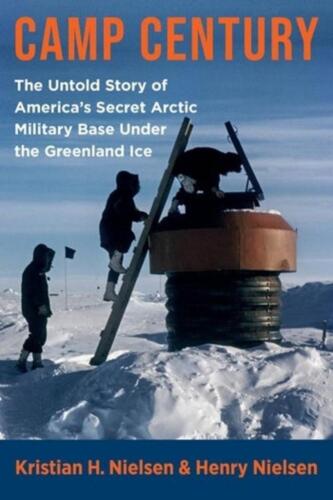
Kristian H. Nielsen and Henry Nielsen,[2] in their recent book Camp Century: The Untold Story of America’s Secret Arctic Military Base Under the Greenland Ice, show that today’s perilous situation has roots in the original Cold War period.
U.S. army engineers then built the subterranean city, Camp Century, under the Greenland ice near the Arctic Circle under the guise of conducting polar research, and explored the feasibility of Project Iceworm, a plan to store and launch hundreds of ballistic missiles with nuclear warheads targeting the Soviet Union from inside the ice.
Described by two Danish journalists as “some monstrous figment of the imagination that could have been featured in an early James Bond film,”[3] Project Iceworm was justified under the 1950s military doctrine of “massive retaliation,” and the Eisenhower administration’s “New Look” policy which advocated for a massive conventional and nuclear arms build-up to counter potential Soviet aggression…………………………………………………………………………………………………………………………………………………………….
“The City Under Ice”—A Science-Fiction Scenario Come True
In 1960, the U.S. Army began initiating research projects near Camp Thule at the underground, nuclear-powered Camp Century, which was established as a kind of science-fiction scenario come true.
The projects aimed to understand the environment and climate on the ice sheet, thereby enabling the U.S. to better establish and secure its northernmost military position…………………………………………………………………………………………………………………………………….
The sub-surface installation of a nuclear reactor within the Greenland ice sheet at Camp Century was an enormous and difficult engineering endeavor that was an astonishing achievement…………………………………….
Almost all of the journalists invited to visit Camp Century in the early 1960s celebrated the major scientific achievements while minimizing the Cold War context and military purposes behind the camp.
………………………………………………………………………………………………………………. an American journalist writing under the pseudonym “Ivan Colt” who, in an article appearing in October 1960, included a vivid description of missile-launching bases beneath the surface of the ice sheet that would be “able to plaster every major Soviet city, H-bomb depot and missile plant.”
Audacious Cold War Project
In 1997, a group of Danish historians were able to locate a classified document proving that the U.S. saw Camp Century as the first step toward a colossal sub-surface tunnel system that would enable the U.S. Army to launch a nuclear-missile strike at virtually any target in the Soviet Union.[10]
These missiles would be protected because of their distance from the U.S. mainland, and location in a secret underground facility……………………………………………………………………………………………..
Health and Environmental Detritus and the Dangers of History Repeating Itself
Camp Century was shut down in 1966, as its sub-surface tunnel system in the Greenland ice sheet was extremely difficult and costly to maintain and the development of Polaris nuclear missiles launchable from submarines made it largely obsolete. However, its remains may soon resurface because of global warming.
Greenland, today a largely self-governing part of Denmark, threatened to bring the case before the UN International Court of Justice if Denmark did not promptly assume responsibility for cleaning up the Camp Century site.
The remaining debris, some 35-70 meters (115-230 feet) beneath the surface of the ice, is known to include not only buildings and structural elements but also radioactive, chemical and biological waste.[12]
Over the years, many workers at Thule Air Base had developed cancers from radiation exposure, as did members of a clean-up crew that was called in to collect snow contaminated with plutonium for transport to the U.S. after a B-52 Stratofortress carrying hydrogen bombs crashed seven kilometers from Thule Air Base in 1968.[13]
The health and environmental detritus is an example of a vast and unrecognized cost of the Cold War arms race that is sadly being reinvigorated today.
As Russia, China and the U.S. compete for renewed control over the Arctic and set up yet more military bases there, the fallout will again be considerable even if the nukes are never deployed, and the tragedy of Camp Century will be repeated.
References: …………………………………………….more https://covertactionmagazine.com/2023/07/14/aggressive-u-s-push-for-military-supremacy-in-the-arctic-could-trigger-nuclear-war/?mc_cid=f5762ce44c&mc_eid=65917fb94b
2 Comments »
Leave a comment
1 This Month
Chernobyl: The Lost Tapes – A good documentary on Chernobyl on SBS available On Demand for the next 3 weeks– https://www.sbs.com.au/ondemand/tv-program/chernobyl-the-lost-tapes/2352741955560

of the week–London Campaign for Nuclear Disarmament

Tell the Ukrainian Government to Drop Prosecution of Peace Activist Yurii Sheliazhenko
To see nuclear-related stories in greater depth and intensity – go to https://nuclearinformation.wordpress.com
-
Archives
- April 2026 (126)
- March 2026 (251)
- February 2026 (268)
- January 2026 (308)
- December 2025 (358)
- November 2025 (359)
- October 2025 (376)
- September 2025 (257)
- August 2025 (319)
- July 2025 (230)
- June 2025 (348)
- May 2025 (261)
-
Categories
- 1
- 1 NUCLEAR ISSUES
- business and costs
- climate change
- culture and arts
- ENERGY
- environment
- health
- history
- indigenous issues
- Legal
- marketing of nuclear
- media
- opposition to nuclear
- PERSONAL STORIES
- politics
- politics international
- Religion and ethics
- safety
- secrets,lies and civil liberties
- spinbuster
- technology
- Uranium
- wastes
- weapons and war
- Women
- 2 WORLD
- ACTION
- AFRICA
- Atrocities
- AUSTRALIA
- Christina's notes
- Christina's themes
- culture and arts
- Events
- Fuk 2022
- Fuk 2023
- Fukushima 2017
- Fukushima 2018
- fukushima 2019
- Fukushima 2020
- Fukushima 2021
- general
- global warming
- Humour (God we need it)
- Nuclear
- RARE EARTHS
- Reference
- resources – print
- Resources -audiovicual
- Weekly Newsletter
- World
- World Nuclear
- YouTube
-
RSS
Entries RSS
Comments RSS
 nuclear-news
There is not 5 years left for most of us and, 10 years left for the rest. What a bogus article. The part about the arctic base, being developed as a premium nuke missle launching site, was interesting. The fact that it is now a radioactive hellhole that has been a part of the massive radionuclide contamination of the arctic, reiforces my thesis. The world is so radionuclide contaminated , polluted w chemicals wasted with climate change, destroyed economically now, that the blood bath has begun. The big one is already happening in ukraine. By this winter nukes will detonate
Things are coming apart, in the west rapidly. Inflation, homelessness, dire poverty. Next year will be mass starvation chaos and blood baths. Ther will be a nuke, detonated in the ukraine before the end of the year. This is silly junk about cold war2 because its all the empty headed blood thirsty generals and greedy corrupt politicians can concieve
The war has already started