TODAY. Forget Oppenheimer. The real nuclear hero is Joseph Rotblat

If only other scientists had followed his example.
If only scientists could learn from Joseph Rotblat, and abandon their dogmatic belief that science is “neutral”
To the end of his life, he believed scientists have personal responsibility for their inventions.
Yeah – you’ve never heard of him, have you? That’s because we have all been brainwashed, in the patriarchy, into believing that heroes are brave tough guys. Joseph Rotblat was brave, but, alas, not a tough guy. So – he don’t qualify.
Robert Oppenheimer might have regretted it later, but he was in favor of using the atomic bomb, seeing it as a terror weapon, that would need to be used only once
Leo Szilard was a “wimp” who did not want the atomic bomb to be dropped on Hiroshima.
But Joseph Rotblat went further than Slizard. In 1943, when it was clear that Germany was not developing atomic weapons, Rotblat saw the danger of atomic warfare, and risk of a nuclear clash with Russia. Rotblat abandoned his role in the Manhattan Project, and left America. USA army intelligence tried hard to depict Rotblat as a Russian agent
After the atomic bombings of Hiroshima and Nagasaki, Rotblat was determined to prevent the development of future nuclear weapons. He devoted the rest of his life to protesting nuclear testing and weapons production.
During the post-war period, Joseph Rotblat did an enormous amount of work in the cause of peace, dialogue and disarmament through the Pugwash movement, with which he shared the Nobel Peace Prize in 1995.
Joseph Rotblat passed away on August 31, 2005. To the end of his life, he believed scientists have personal responsibility for their inventions. Rotblat implored: “Above all, remember your humanity.”
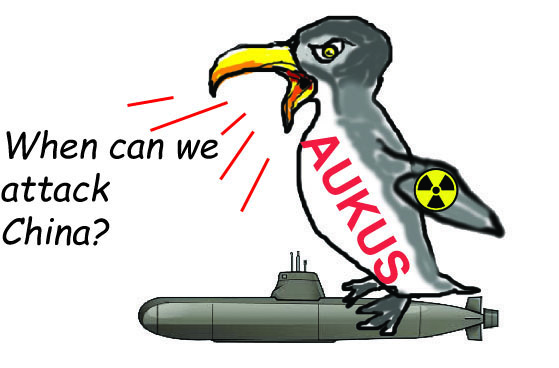
Military Initiative by Australia, the United Kingdom and the United States (AUKUS) is Another Major Step in Prospective War on China
Covert Action Magazine, By Murray Horton, June 29, 2023
Peace groups in all three nations need to rally against provocative alliance that is a pivotal component of war planning.
The AUKUS pact (military initiative among Australia, the UK and U.S.) came out of nowhere in 2021 when Australia broke a $A90 billion contract to buy French submarines.
Instead, it signed up with the U.S and UK to form AUKUS, which will build eight nuclear-powered (but not nuclear-armed) submarines for Australia.
The first get-together of AUKUS leaders did not go well for Australia, when President Biden could not remember the name of its then-Prime Minister, Scott Morrison.
Morrison went behind the backs of the French in order to do a deal, instead, with the U.S. and UK. It led to the most extraordinary diplomatic bust up between those countries—France recalled its ambassadors from both Australia and the U.S. (it is America’s oldest ally, dating back to the American Revolution); President Macron called Morrison a “liar.” When Morrison was voted out a few months later, France’s outgoing foreign minister said: “I can’t stop myself from saying that the defeat of Morrison suits me very well.”…………………………………………………
In May 2022 Scott Morrison’s government was resoundingly voted out of office, but Anthony Albanese’s Labor government wholeheartedly carried on with his Tory predecessor’s foreign policy, including being committed to AUKUS. The last time that an Australian Labor government offered a markedly different foreign policy was the 1972-75 government led by Gough Whitlam, which was overthrown in a CIA-backed coup.[1]
Both Whitlam and Albanese had themselves sworn in as Prime Minister immediately after their respective election wins, but the contrast could not be starker. Whitlam wanted to get go forward with his radically different foreign policy; Albanese wanted to immediately scurry off to Tokyo to meet Joe Biden and reassure him of Australia’s continued loyalty as a good and obedient servant.
The Australian Labor Party has not questioned the American alliance since Whitlam.
The year 2022 came and went but two of the original three AUKUS leaders—Scott Morrison and Boris Johnson—were kicked out of office and AUKUS carried on, building up to its big launch in March 2023, which was hosted by President Biden, alongside Prime Ministers Sunak and Albanese, in front of a massive U.S. nuclear submarine at a San Diego Navy base. Australia will build eight nuclear-powered subs in Adelaide; they will have a British design but American technology.
Eyewatering Cost
The cost is truly eye-watering—anywhere between $A268 billion and $A368b, by 2055. Yes, that’s right—those eight subs will not be ready for more than 30 years.
The first of these eight subs is unlikely to be ready until the 2040s so, to fill that gap, Australia will buy three existing U.S. subs from the early 2030s, at a cost of up to $A58b, with an option to buy two more. There has been zero official discussion about the multitude of things that are likely to change over the next 30 years, militarily, let alone in the wider global society. Think about what has changed in the last 30 years. I would put money on these monstrosities being obsolete long before they are built.
But the politicians and military leaders who commissioned them will be long gone, leaving future taxpayers to shoulder the costs—and the highly likely adverse consequences of such a major push toward war with China. Because that is what AUKUS and its nuclear submarines, and all others, following military technology developments, are aimed at. It has nothing to do with defending Australia, and everything to do with projecting power far from home. That is the point of nuclear-powered subs—they do not need to return to home port to refuel……………………………………………………………………………………………………….
Breakneck Militarization
AUKUS is only part, albeit a very big part, of Australia’s breakneck militarization. “Flying under the radar of last week’s AUKUS submarine announcement was the revelation that the United States had agreed to sell Australia up to 220 Tomahawk cruise missiles.”
“This follows Australia’s purchase in January [2023] of ‘high mobility artillery rocket systems,’ known as HIMARS, which have been used by Ukraine on the battlefield in response to Russia’s invasion. And in 2020, the US approved the sale of up to 200 long-range anti-shipping missiles (LRASM) to Australia.”…………………………………………………………………………………………………………………….
Shortly after Albanese was elected as prime minister in May 2022, he initiated the Defence Strategic Review. It was classified but a redacted version was publicly released in April 2023. It was billed as Australia’s biggest defence overhaul since World War II. “Australia has said the acquisition of nuclear-powered submarines, long-range strike capabilities and its northern bases will be among the country’s six priority areas after a major review of its defence strategy found the armed forces were not ‘fully fit for purpose.’”………………………………………………………………………………………………………………………………………………………………….. more https://covertactionmagazine.com/2023/06/29/military-initiative-by-australia-the-united-kingdom-and-the-united-states-aukus-is-another-major-step-in-prospective-war-on-china/?mc_cid=f5762ce44c&mc_eid=65917fb94b
Opposition to Aukus – especially from New Zealand, but also from Australia and the Pacific, and across the political spectrum

Military Initiative by Australia, the United Kingdom and the United States (AUKUS) is Another Major Step in Prospective War on China
Covert Action Magazine, By Murray Horton, June 29, 2023
“………………………………………………“We Are Not at War, But Neither Are We at Peace”
New Zealanders may not have appreciated the degree of militarization in Australia, much more so than here. AUKUS should jolt us out of any complacency about what is going on with our nearest neighbor—it is preparing for war. Australian media commentary at the time of the AUKUS launch made that clear. “The monumental price tag of the AUKUS pact has made it clear. We are not at war, but neither are we at peace…”
“Almost $A400b, even over three decades, is not peacetime spending in anyone’s book—a fact Government ministers concede privately. Rather, we are navigating a dangerous and unpredictable new grey zone of superpower rivalry between China and the United States. It’s a contest in which we are poised to be a central player despite our geographical isolation and relatively small population.”
“Accepting such a role will require tough spending decisions the nation as a whole is not yet ready to confront. Already, Opposition Leader Peter Dutton is flagging his willingness to support reduced spending on the National Disability Insurance Scheme to pay for the submarine programme. Other unsettling trade-offs will need to be discussed. Even in the short term, before the big bills start arriving, difficult calls will have to be made….This is because…it will cut $A3b from existing defence programmes…This is likely to anger other branches of the military, such as the Army, while the Navy is lavished with money.”[2]
Albanese tried to put a positive spin on it,……………………………………..
Criticism from Inside the Political Elite
Pleasingly, AUKUS was not unopposed among Australia’s political elite (or, at least, former leading members of it). Paul Keating, who was Labor Prime Minister from 1991 to 1996, really put the boot into the good submarine AUKUS and all who sail in her. He did so in a March 2023 speech, the day after the AUKUS announcement. “Former prime minister Paul Keating has launched an extraordinary attack on the Albanese government over its adoption of the AUKUS pact, accusing it of making the worst foreign policy decision by a Labor government since the attempted introduction of conscription in World War I.”
“He said signing up to AUKUS had broken Labor’s long ‘winning streak’ on foreign policy over the past century and was a ‘deeply pathetic’ moment in the Party’s history. ‘Falling into a major mistake, Anthony Albanese, befuddled by his own small-target election strategy, emerges as prime minister with an American sword to rattle at the neighbourhood to impress upon it the United States’ esteemed view of its untrammelled destiny…’”
“‘Naturally, I should prefer to be singing the praises of the government in all matters, but these issues carry deadly consequences for Australia and I believe it is incumbent on any former prime minister, particularly now, a Labor one, to alert the country to the dangerous and unnecessary journey on which the Government is now embarking.’”
“‘This week, Anthony Albanese screwed into place the last shackle in the long chain the United States has laid out to contain China…I don’t think I suffer from relevance deprivation, but I do suffer concern for Australia as it most unwisely proceeds down this singular and dangerous path,’ he said.”
“Keating presented a largely benign view of China’s rise, saying it was ‘not the old Soviet Union’ and was ‘not seeking to propagate some competing international ideology’ to the United States. The fact is China is not an outrider,’ he said. ‘China is a world trading state—it is not about upending the international system,’”
“Keating said: ‘Every Labor Party branch member will wince when they realise that the party we all fight for is returning to our former colonial master, Britain, to find our security in Asia—236 years after Europeans first grabbed the continent from its Indigenous people. That of all things, a contemporary Labor government is shunning security in Asia for security in and within the Anglosphere’”[3]
Nor was Keating alone in his criticism from within the elite. “The Australian National University’s Hugh White, an emeritus professor of strategic studies, unleashed a quite extraordinary criticism of Australia’s nuclear submarine plan…Professor White, a former deputy secretary of the Defence Department, said Australia was not only going to ‘hand over some serious dollars’ to the US but also pay with ‘a promise’ to enter any future conflict with China.’”
“‘This is a very serious transformation of the nature of our alliance with the United States,’ White said in an interview recorded for the ANU’s politics podcast Democracy Sausage. ‘The US don’t really care about our submarine capability—they care deeply about tying Australia into their containment strategy against China.’”
“White said he couldn’t see why the US would sell its own submarines—of which they have fewer than they need—unless it was absolutely sure Australia’s submarines would be available to it in the event of a major conflict in Asia. He said a war between America and China over Taiwan would be ‘World War III’ and have a ‘very good chance’ of being a nuclear conflict.”
“‘Australia’s experience of war [is] shaped by the fact that we’ve tended to be on the winning side, but there is no reason to expect America to win in a war with China over Taiwan,’ he warned. He suggested there was also a high chance the AUKUS deal could fall over under [sic] a future American administration and a worsening strategic environment.”
“White said there were cheaper, quicker, less risky and less demanding ways for Australia to get the submarines it needed, labelling the AUKUS plan a waste of money that ‘doesn’t make sense. There’s going to be no actual net increase in the number of submarines available until well into the 2040s, even if it goes to plan—which it probably won’t,’ he said.”[4]……………………………………………………………………………………………………………………………………………………………………..
Former New Zealand Prime Ministers from Rival Parties Dissent
When AUKUS was first announced in 2021, New Zealand, which was not invited to join, simply confined itself to saying that nuclear-powered submarines would not be allowed into New Zealand territorial waters, or ports, because of our nuclear-free law dating back to the 1980s. So, the issue flew below the radar (or sailed under the water, to put it more appropriately). However, once AUKUS really kicked off in March 2023, debate and disquiet started in New Zealand.
Helen Clark was the Labour Prime Minister (1999-2008) who has dined out for 20 years on having refused to let New Zealand join the U.S., UK and Australia in the illegal and disastrous 2003 invasion of Iraq (in all other aspects Clark was a very loyal servant of the U.S.). She came out quickly and said that New Zealand is better off outside AUKUS (the word she used was “entanglement”).
She was not alone as the only former New Zealand Prime Minister to criticize it. “…[F]ormer National prime minister Jim Bolger [1990-97] participated in a forum about New Zealand’s foreign policy in Wellington, in which he is reported by the Herald’s Audrey Young to have criticised the Australian submarine buy up as ‘beyond comprehension’ because of the cost and the damage to peace in the Pacific region.”
“Bolger said that New Zealand certainly doesn’t want any such submarines, and challenged proponents of the AUKUS deal to defend it: ‘If you can find any Australian official who can explain why they need nuclear-powered submarines, come and tell me. I’d like to know.’ And Young reported Bolger asking rhetorically, ‘How mad are we getting?’ She says ‘he spoke with despair about the near-daily threats of nuclear war, which had the potential to destroy the planet.’”[7]
Opposition Across the Political Spectrum
“As part of the AUKUS deal Western Australia will play host to US and UK nuclear submarines from 2027. With nuclear-capable American B52 bombers and thousands of American marines rotating through the Northern Territory, Australia is lining up as a loyal lieutenant to the United States in the Pacific and would be expected to fight should war break out.”
“Would New Zealanders fight in a war between the nuclear superpowers? While we aren’t required by treaty obligations to act if America or Taiwan are attacked we are if Australia is. It is not an exaggeration to say Australia could be a target in a future war and already the country has been threatened with missile attacks in that scenario.”
“The risks of New Zealand being dragged in are real. Unlike in Australia, the conversation in New Zealand has been much more muted with limited discussion on the likelihood of war. Why aren’t we talking about it? New Zealand is in a difficult situation contemplating conflict between our largest trading partner and traditional security partner.”
“We weren’t invited to join AUKUS and Australian nuclear submarines won’t be allowed to berth here under our nuclear-free legislation. That same legislation sees New Zealand as only a friend and not an ally of the United States, but we are increasingly acting like we are an ally. In the years since New Zealand’s principled decision not to join the invasion of Iraq we have become more enmeshed with the United States defence apparatus.”
………………………………………………………………………………………………….. “New Zealanders need to talk more about the risks, our decision-makers need to explain why New Zealand is aligning more closely with the United States military and as a sovereign country we have to ask are we acting independently or as a cog in a machine? Our role could be focused on reducing tensions, finding solutions and building trust. War is never inevitable.”[8]
Former politicians across the spectrum have come out against AUKUS. For example, Richard Prebble, one-time Labour Cabinet Minister and later ACT Party founder and Leader.
He is currently a relentless right-wing critic of the current Labour government. His take on AUKUS is the classic mercantilist one. “China is New Zealand’s biggest trading partner. This country has joined China’s Belt and Road initiative. China has signed a free trade agreement with New Zealand, something the U.S. Senate refuses to consider.”
“Foreign Minister Nanaia Mahuta has warned that New Zealand’s exports to China could be caught up in a ‘storm,…………….. New Zealand’s exporters are only too aware of their dependency. There is no other obvious alternative to the New Zealand-China trade.”
“New Zealand has no territorial disputes with China. When we recognised the Government of China 50 years ago, we acknowledged Taiwan is part of China. Paul Keating and Helen Clark are correct. New Zealand’s strategic interest is in the peaceful resolution of conflicts with China rather than sleepwalking into anti-Chinese alliances.”[9]
Academic Skepticism
Leading academic Robert Patman spelled it out in an article entitled “Why New Zealand Should Remain Sceptical About AUKUS.” He wrote that “the basic problem facing AUKUS is that it is based on a binary assumption that the fate of the Indo-Pacific will be largely shaped by the outcome of U.S.-China rivalry and, in particular, by the capacity of America and its closest allies to counterbalance Chinese ambitions in the region.”[10]
“Such a perspective is problematic on a number of counts. First, it exaggerates the influence of great powers in the 21st century in a large, diverse region like the Indo-Pacific. The region contains 60% of the world’s population including significant economic players like Japan, South Korea and fast-growing economies such as Vietnam and India.”
“Second, AUKUS does not factor in the Indo-Pacific and European nations’ quite distinctive security and economic interests in countering China. While countries like Malaysia, Indonesia and Vietnam and EU states like Germany and France are deeply worried about China’s forceful diplomacy in the Indo-Pacific, they remain sceptical that a security arrangement involving three English-speaking states, two of whom have baggage in the region, is an adequate response.”
“Third, China’s global ambitions are very real, but they should not be over-hyped. AUKUS states depict China as a ‘systemic threat’ and, according to US Secretary of Defence Lloyd Austin, the ‘only competitor out there with both the intent to reshape the international order and, increasingly, a power to do so.’ Really?…”
“Fourth, the provision of nuclear-powered submarines to Australia has raised very real fears in the Indo-Pacific about nuclear proliferation. In 1995, ASEAN [Association of Southeast Asian Nations] member states signed the Treaty of Southeast Asia Nuclear Weapon-Free Zone (SEANWFZ). Furthermore, Singapore is now the only ASEAN state yet to sign or ratify the Treaty on the Prohibition of Nuclear Weapons (TPNW), a diplomatic initiative heavily promoted by New Zealand.”
………………………………………………………………………. New Zealand remains sceptical that China is a systemic threat to US dominance, sees a good fit between its non-nuclear security policy and the Indo-Pacific region, and views detachment from AUKUS as both consistent with the goal of diversifying New Zealand’s trade ties and building a diplomatic network of like-minded states to strengthen the international rules-based order through measures like UN Security Council reform.”
Madness to Support U.S. War Against China
Mike Treen, veteran union leader and left-wing activist, put it all very succinctly in an article in the Daily Blog on April 21, 2023. He wrote: “The US is going to war against China because it is losing the international economic competition that previously enabled its military and economic bullying to dominate the globe. The empire is in slow decline.”[11]
“China’s extraordinary rise as an economic powerhouse over the past few decades means that it is now the top international trading partner for 120 countries. This has given the world the freedom to act in ways they have never before—politically and economically.
………………………………………………………………………………. “New Zealand was wrong to join the war against Afghanistan. We were wrong to join the occupation of Iraq. We were wrong to become an ‘observer’ at NATO. And it would be foolish and dangerous to become a participant in any way with the AUKUS military provocation against China. New Zealand should be a neutral power that offers medical aid to the world not a tiny jumped-up militarised puppet of the US empire like Australia has become.”
Defence Minister Tempted by AUKUS
The AUKUS carrot that is being dangled in front of New Zealand and Defence Minister Andrew Little is keen to take a bite……………………………………………………..
But Not PM or Minister of Foreign Affairs
However, both the Prime Minister, Chris Hipkins, and the Minister of Foreign Affairs, Nanaia Mahuta, have since “dismissed suggestions the Government has shown interest in joining aspects of the pact.”
Mahuta made a May 2023 speech stressing that New Zealand’s nuclear-free position is a “cornerstone of our independent stance” ………………………
AUKUS Causing Alarm in the Pacific.
“[T]he Pacific Islands Forum warns ‘AUKUS will bring war much closer to home and goes against the Blue Pacific narrative on nuclear proliferation and the cost to climate change.’ Forum secretary-general Mark Brown said AUKUS would heighten geopolitical tensions and disturb the peace and security of the region.”…………………………………………………………………….
New Zealand Needs to Be Aware of War Drums Next Door
…………………………. New Zealand is actively supporting Ukraine in its war against Russia. There is an irony in our government being so invested in a war, and its attendant geopolitics, on the other side of the world while, right next door to home, our Aussie Big Brother is making a major push toward war via AUKUS and accompanying militarization.
………Make no mistake—AUKUS is a major lurch toward war with China and it is unfolding before our eyes.
The Australian peace movement is waging a vigorous and very active campaign against AUKUS. Independent and Peaceful Australia Network (IPAN) https://ipan.org.au/
References:………………………………………………………..
The Sky’s the Limit on Nuclear Weapons Spending, But What Does It Really Get Us?

While it might seem that delays and overruns at this level are unusual, in reality, they are just the most recent in a long history of wasteful spending on nuclear weapons programs.
Union of Concerned Scientists, Eryn MacDonald, August 2, 2023 |
The Congressional Budget Office (CBO) has released a new report on the projected cost of US nuclear weapons over the next ten years, from 2023 to 2032.
Before even reading the first line, I could have predicted two things about this report.
First, projected costs have risen considerably since the CBO released its previous report on this issue two years ago. This is par for the course for military programs in general (perhaps it might be less predictable if the Department of Defense ever managed to pass an audit—a routine requirement for every other part of government) and nuclear weapons are certainly no exception. And secondly, these costs are far higher than is necessary and do nothing to address the needs of most Americans for true human security. These lie in areas like food, housing, healthcare, or gun violence, none of which are improved by spending hundreds of billions on nuclear weapons each year.
To get to the actual numbers, CBO estimates that if the Department of Defense (DOD) and Department of Energy (DOE) carry out their current plans for nuclear forces, it will cost $756 billion from 2023 to 2032—just over $75 billion per year. This is 19% ($122 billion) higher than its previous estimate of $634 billion for the period from 2021-2030. Roughly half of this increase, about $60 billion, is unavoidable: some programs have progressed to more expensive stages of development and production since the last report—this accounts for about $34 billion—while inflation accounts for about $26 billion. But the remainder, $62 billion, is attributable to increases in program budget estimates ($49 billion) and the CBO’s estimate of additional costs based on historical cost growth ($13 billion).
Historical cost growth is the norm
Of CBO’s $756 billion projection, a remarkable $96 billion, or 13 percent, comes from their assumption that current DOD and DOE budget estimates are well below what the actual costs of the nuclear weapons now in development will turn out to be. Historically, this has certainly been true, with both agencies frequently underestimating final program costs, often by significant amounts. For example, since the previous version of this CBO report, DOD has increased its estimate for the total cost of the new Sentinel ICBM by $12 billion. In its report, CBO projects the final costs will rise even more.
In another glaring example of how out of control spending on nuclear weapons programs can get, the General Accounting Office (GAO) in January 2023 found that the National Nuclear Security Administration’s (NNSA’s) plans to develop the capacity to produce at least 80 plutonium pits (the explosive core of modern nuclear weapons) per year at two sites—Savannah River Site and Los Alamos National Laboratory—by 2030 “do not follow best practices and run the risk of cost increases and delays” and that “NNSA lacks both a comprehensive cost estimate and a schedule outlining all activities it needs to achieve this capability.”
The NNSA itself acknowledges that the project cannot be completed on the planned timeline or budget. An internal NNSA document puts the cost for producing 80 pits per year between $8.7 and $16.5 billion, a significant increase over the previous public estimate of $6.9 to $11.1 billion. It also says that the Savannah River Site plant, far from meeting a congressionally mandated deadline to produce at least 50 pits per year by 2030, will not produce any pits at all until 2036.
While it might seem that delays and overruns at this level are unusual, in reality, they are just the most recent in a long history of wasteful spending on nuclear weapons programs. In fact, the plan to produce pits at Savannah River developed after the NNSA project previously planned for the site, the Mixed Oxide Fuel Fabrication Facility, was abandoned following years of delays and cost overruns. By the time it was shut down, NNSA had already spent nearly $8 billion on the facility and estimated that it would need another nearly $50 billion to complete the project.
Unfortunately, similar examples of wasteful spending at both NNSA and DOD are all too easy to find.
Deceptive decrease on the SLCM-N
One category in which projected costs appear to decrease in this report is Tactical Nuclear Delivery Systems and Weapons, which sees a drop of $11 billion. This is deceptive, however, because it comes from eliminating any spending on the new nuclear-armed sea-launched cruise missile (SLCM-N). …………………………..
Even though President Biden wanted to cancel the program, the 2023 National Defense Authorization Act (NDAA) passed by the Democratically-controlled Congress last year included $25 million for DOD to begin work on the cruise missile and $20 million for NNSA to start on the nuclear warhead—known as the W80-4 ALT—that the cruise missile would carry…………………………..
The trend is clearly upward……………………………………………………………
The sky’s the limit?
Discouragingly, this trend may be about to get worse. If the New Strategic Arms Reduction Treaty (New START) between the US and Russia expires in 2026 without a replacement (which now seems like a best-case scenario, given Russia’s announcement in February 2023 that it is suspending the treaty and the US decision to halt data exchanges in response), it is anyone’s guess what the effect on plans for the US nuclear arsenal will be…………………………………………………………………………….
Holding the line, avoiding an arms race
It is difficult to describe the current situation as anything other than dire. Russia’s use of nuclear threats in the Ukraine war, along with a growing tendency in the US to categorize China as another peer competitor in the nuclear realm, has led to a renewed emphasis on nuclear weapons as central to US national security. This is despite the fact that these weapons are no more useful for military purposes than they have ever been, and do not address much more pressing human security needs. We must continue to urge the Biden administration and Congress not to buy into the dangerous idea that the US has no choice but to rely on nuclear weapons for security, and instead to hold the line against a new arms race. https://blog.ucsusa.org/emacdonald/the-skys-the-limit-on-nuclear-weapons-spending-but-what-does-it-really-get-us/
Nuclear war would be more devastating for Earth’s climate than cold war predictions – even with fewer weapons

Christopher Nolan’s biopic of J. Robert Oppenheimer has revived morbid curiosity in the destructive power of nuclear weapons. There are now an estimated 12,512 nuclear warheads.
A war in which even a fraction of these bombs were detonated would create blast waves and fires capable of killing millions of people almost instantly. The radiation-induced cancers and genetic damage would affect the remaining population for generations.
But what sort of world would remain amid the radioactive fallout? For the last four decades, scientists modelling the Earth system have run computer simulations to find out.
Using their knowledge of chemistry and climate modelling, atmospheric scientists Paul Crutzen and John Birks wrote a short paper in 1982 which suggested a nuclear war would produce a smoke cloud so massive that it would cause what became known as a nuclear winter. This, they claimed, would devastate agriculture and with it, civilisation.
A year later, scientists from the US and Soviet Union confirmed first that cities and industrial complexes hit by nuclear weapons would indeed produce much more smoke and dust than burning the equivalent area of forest. And second, this global layer of smog would block out sunlight, causing conditions at Earth’s surface to become rapidly colder, dryer and darker.
Climate modelling shows the reduced sunlight would plunge global temperatures by up to 10˚C for nearly a decade. These freezing conditions, combined with less sunlight for plants to photosynthesise, would have catastrophic consequences for global food production and lead to mass starvation worldwide.
Modern climate models are much more sophisticated than those used in the 1980s. And while there are fewer nukes in working order today, more recent results from computer simulations suggest that the grim prophecy delivered by scientists 40 years ago may actually have been an underestimate.
Clear and present danger
Environmental scientists led by Alan Robock at Rutgers University in the US argued in a recent paper that the nuclear winter theory helped end the proliferation of nuclear weapons during the cold war. In 1986, President Ronald Reagan and General Secretary Mikhail Gorbachev took the first steps in history to reduce the number of nuclear weapons while citing the predicted consequences of a nuclear winter for all life on Earth…………………………. more https://theconversation.com/nuclear-war-would-be-more-devastating-for-earths-climate-than-cold-war-predictions-even-with-fewer-weapons-210567
Australian MPs Blast Blinken Over Assange

The MPs called the U.S. secretary of state’s remarks that Julian Assange threatened U.S. national security “nonsense” and said the U.S. is only bent on revenge, reports Joe Lauria.
SCHEERPOST, By Joe Lauria / Consortium News August 2, 2023
Three Australian members of Parliament have dismissed U.S. Secretary of State Antony Blinken’s strong statement in support of prosecuting imprisoned WikiLeaks publisher Julian Assange as “nonsense.”
Independent MP Andrew Wilkie told The Guardian‘s Australian edition that Assange was “not the villain … and if the US wasn’t obsessed with revenge it would drop the extradition charge as soon as possible.”
“Antony Blinken’s allegation that Julian Assange risked very serious harm to US national security is patent nonsense,” Wilkie said.
“Mr Blinken would be well aware of the inquiries in both the US and Australia which found that the relevant WikiLeaks disclosures did not result in harm to anyone,” said Wilkie. “The only deadly behaviour was by US forces … exposed by WikiLeaks, like the Apache crew who gunned down Iraqi civilians and Reuters journalists” in the infamous Collateral Murder video.
Speaking at a press conference with Australian Foreign Minister Penny Wong in Brisbane on Saturday, Blinken said he understood Australians’ concerns about their imprisoned citizen, but took a hard line against any move to end his persecution. Blinken said:
“…………………………………………………….Mr Assange was charged with very serious criminal conduct in the United States in connection with his alleged role in one of the largest compromises of classified information in the history of our country.
The actions that he is alleged to have committed risked very serious harm to our national security, to the benefit of our adversaries, and put named human sources at grave risk of physical harm, grave risk of detention…………”
As was shown conclusively by defense witnesses in his September 2020 extradition hearing in London, Assange worked assiduously to redact names of U.S. informants before WikiLeaks publications on Iraq and Afghanistan in 2010. U.S. Gen. Robert Carr testified at the court martial of WikiLeaks‘ source, Chelsea Manning, that no one was harmed by the material’s publication.
Instead, Assange faces 175 years in a U.S. dungeon on charges of violating the Espionage Act, not for stealing U.S. classified material, but for the First Amendment-protected publication of it.
The Meaning of ‘National Security’
WikiLeaks has indeed threatened “national security” if the “nation” is defined as merely its rulers. If “national security” however is meant to be the security of the entire nation, then Blinken’s obsession with continuing the war in Ukraine with the risk of nuclear conflict is truly a threat to the nation’s security.
Liberal MP Bridget Archer, another co-chair of the pro-Assange parliamentary group, said: “He continues to suffer mentally and physically, as does his family, and the government should redouble their efforts to secure his release and return to Australia.”
………………………..Labor MP Julian Hill, also part of the Bring Julian Assange Home Parliamentary Group last week called on Assange to take a plea deal, which should not reflect badly on him. In the meantime, Hill said improving prison conditions “should not be difficult to do even while argument continues about resolution of this matter.”
A recent opinion poll shows that 79 percent of Australians want Assange released and bought home. https://scheerpost.com/2023/08/02/australian-mps-blast-blinken-over-assange/—
U.S. aggression against China ignores lessons of Hiroshima

The USA and Australia as its right-hand man in the region has worked to make the idea of war a realistic option. The truth has been distorted in order to sell the idea that it is necessary to stop China. Stop it from doing what? No rational argument has yet been made that can convince any thinking person that China is a threat. The U.S. sees things differently.
And yet China threatens no one. It has no history of expansionism or incursionary activity, effectively has no overseas bases, and its fleet and army are China-based. At the same time, we have the USA and its 800-plus bases, its ring of missiles off China’s shores and its history of blatant aggression, meddling in the affairs of states and regime change.
By William Briggs | 3 August 2023, https://independentaustralia.net/politics/politics-display/us-aggression-against-china-ignores-lessons-of-hiroshima,17773
In its determination to become the superior military power, the U.S. is ignoring historical actions that many consider war crimes, writes Dr William Briggs.
SEVENTY-EIGHT years ago, the United States chose to destroy the cities of Hiroshima and Nagasaki. It was and remains unjustifiable and ought to be regarded as a war crime. The war was all but over. The targets were almost exclusively civilian.
The purpose of the atomic devastation was to signal to the world that a new order was being born. We now know that order as the international rules-based order. We know who sets the rules and what happens if those rules are not obeyed.
Since establishing its new order, the USA and its allies have made the world an intensely more dangerous place to live. War with China is openly discussed. Today, the doomsday clock has its hands set at just 90 seconds to midnight. Never, since the Bulletin of Atomic Scientists put the clock in place, has the world been so close to destruction.
The sword that hangs over us has a double-edged blade. We face both the threat of nuclear destruction and a devastating climate crisis. The two – war and climate – cannot be separated. War, be it conventional or nuclear, will only make the climate crisis immeasurably worse. We are facing an existential crisis on two fronts.
While the planet burns, governments talk about reducing emissions, but emissions from the military are simply not included in the figures. The U.S. military is the single biggest emitter in America. If the U.S. military was a separate country, then it would be among the worst polluters on the planet. The link between the death of the planet by climate change and by military adventures is clear for all to see. The fault lies with those who profit from war and climate destruction and those who allegedly govern us.
Governments of whatever shade have, generation after generation, driven us to war. Lives of soldiers and civilians have been sacrificed, infrastructure wantonly destroyed and vast sums of money that could solve all of humanity’s problems have been wasted. They have been getting away with murder for an awfully long time.
Millions have died in conflict since the end of the war and millions more have been displaced by wars and now by climate destruction.
Today, people ask if war with China is inevitable and whether such a war might involve nuclear weapons. In 2020, the International Committee of the Red Cross polled millennials across 16 countries. Eighty per cent saw a real possibility of a catastrophic war in their lifetime. Fifty-four per cent believe that it will be a nuclear war.
How can this be?
Wars can only be imagined, let alone fought, if they have a degree of “popular” support. Support gives legitimacy. Support is built using a propagandised media that acts in the service of the state that has determined that war is an acceptable option. The motivation for war is almost always economic. It can include a desire to maintain and to secure hegemony, to win political outcomes and to maintain power and prestige. For all these reasons, the U.S. has determined that China is the enemy.
Our leaders accept the U.S. argument without question. Critical thought is made more difficult when enormously influential groups like the Australian Strategic Policy Institute (ASPI) come into play. ASPI receives about a third of its funding from the Government and the rest from the international arms industry. ASPI’s job is to advise the Government about military threats and miraculously, China is confirmed to be the enemy.
And yet China threatens no one. It has no history of expansionism or incursionary activity, effectively has no overseas bases, and its fleet and army are China-based. At the same time, we have the USA and its 800-plus bases, its ring of missiles off China’s shores and its history of blatant aggression, meddling in the affairs of states and regime change.
The road to war with China is not all that new. Since President Obama, there has been a push from the U.S. to “contain” China. This containment was designed to be both economic and military. For every action, however, there has been a reaction. Each push has been met with a reciprocal pushback and gives license for America and its allies to respond to an “assertive” China.
It is in this light that AUKUS assumes special importance. So, too, do declarations of missile production in Australia and a move to what is becoming a war economy. Few can now doubt that there is a push, a drive to war. War plans are openly discussed. It is all on show and the thinking of the Pentagon is there for all to see. U.S. generals make insane and obscene statements but are neither relieved of duty, much less locked away.
To illustrate this point, we have General Mike Minahan, head of the United States Air Force’s Air Mobility Command who recently sent a message to the world. It is blunt, threatening and sinister: ‘My gut tells me we will fight in 2025.’
The General sent his message as a memorandum to the leadership of the 110,000-strong USAF, with the unambiguous title, ‘February 2023 Orders in Preparation for — The Next Fight’.
The chief of the U.S. Marine Corps, Commandant David Berger, was in Australia a few months back. His take on things is that “we can’t slow down, we can’t back off, we can’t get comfortable with where we are”. The message is clear.
If there is a war against China, then it will be the U.S. who will start it. It will push until it gets what it wants. That wish is to hold back, contain or seriously weaken its designated rival and adversary by whatever means it feels appropriate. That includes the use of force. If it is war and it becomes a nuclear conflict, which it might well, then it will be the USA who will be the initiator. This is not being fanciful. China, just as the Soviet Union in the Cold War, has pledged a no-first-use doctrine. The USA refuses to do the same.
The USA and Australia as its right-hand man in the region has worked to make the idea of war a realistic option. The truth has been distorted in order to sell the idea that it is necessary to stop China. Stop it from doing what? No rational argument has yet been made that can convince any thinking person that China is a threat. The U.S. sees things differently.
For America, the threat is about either China as an economic power that will displace it, that China is a socialist threat, or that China is a powerful economy that is possibly moving towards establishing a socialist economy and social system. Any of these scenarios is enough to make the Americans reach for their guns.
What would the world look like if war comes and if it ends up as a nuclear conflict? This does not necessarily mean a repeat of the imagery of mushroom clouds and Hiroshima silhouettes, although that may well be the case. The war would more likely be fought with tactical and “low-yield” nuclear weapons. These are already being produced in industrial numbers and being fitted to U.S. ships and missiles, including Tomahawk cruise missiles.
Significantly, Australia has placed an order for 220 of these missiles. They will fit snugly on the AUKUS submarines and any other ordinance that our masters see fit and can be fitted with nuclear warheads at a moment’s notice.
Missile installations have been strengthened across the region. Nuclear capable missiles are within a few minutes flying time of major Chinese cities. Japan, South Korea, Guam, the Philippines, Australia and importantly Taiwan are all part of the encirclement. Then there is the permanent deployment of 60% of the total U.S. Navy and Air Force, in close proximity to China.
It’s an obvious point but China simply does not threaten mainland USA. New York or San Francisco are not in danger from imminent missile attacks from Chinese offshore bases and installations. Could there be a scenario that might see the U.S. use these missiles to destroy civilian targets in China? Ask the citizens of Hiroshima or Nagasaki.
Nuclear Weapons: Devastation Inside the US
By William J. Kinsella , August 2, 2023
Christopher Nolan’s film Oppenheimer has focused new attention on the legacies of the Manhattan Project — the World War II program to develop nuclear weapons.
As the anniversaries of the bombings of Hiroshima and Nagasaki on Aug. 6 and Aug. 9, 1945, approach, it’s a timely moment to look further at dilemmas wrought by the creation of the atomic bomb.
The Manhattan Project spawned a trinity of interconnected legacies. It initiated a global arms race that threatens the survival of humanity and the planet as we know it. It also led to widespread public health and environmental damage from nuclear weapons production and testing. And it generated a culture of governmental secrecy with troubling political consequences.
As a researcher examining communication in science, technology, energy and environmental contexts, I’ve studied these legacies of nuclear weapons production. From 2000 to 2005, I also served on a citizen advisory board that provides input to federal and state officials on a massive environmental cleanup program at the Hanford nuclear site in Washington state that continues today.
Hanford is less well known than Los Alamos, New Mexico, where scientists designed the first atomic weapons, but it was also crucial to the Manhattan Project. There, an enormous, secret industrial facility produced the plutonium fuel for the Trinity test on July 16, 1945, and the bomb that incinerated Nagasaki a few weeks later.
(The Hiroshima bomb was fueled by uranium produced in Oak Ridge, Tennessee, at another of the principal Manhattan Project sites.)
Later, workers at Hanford made most of the plutonium used in the U.S. nuclear arsenal throughout the Cold War. In the process, Hanford became one of the most contaminated places on Earth (for more see video below). Total cleanup costs are projected to reach up to $640 billion, and the job won’t be completed for decades, if ever.
Victims of Nuclear Tests
Nuclear weapons production and testing have harmed public health and the environment in multiple ways. For example, a new study released in preprint form in July while awaiting scientific peer review finds that fallout from the Trinity nuclear test reached 46 U.S. states and parts of Canada and Mexico.
Dozens of families who lived near the site – many of them Hispanic or Indigenous – were unknowingly exposed to radioactive contamination. So far, they have not been included in the federal program to compensate uranium miners and “downwinders” who developed radiation-linked illnesses after exposure to later atmospheric nuclear tests.
On July 27, however, the U.S. Senate voted to extend the Radiation Exposure Compensation Act and expand it to communities near the Trinity test site in New Mexico. A companion bill is under consideration in the House of Representatives.
The largest above-ground U.S. tests, along with tests conducted underwater, took place in the Pacific islands. Meanwhile, the Soviet Union and other nations conducted their own testing programs. Globally through 2017, nuclear-armed nations exploded 528 weapons above ground or underwater, and an additional 1,528 underground.
Estimating how many people have suffered health effects from these tests is notoriously difficult. So is accounting for disruptions to communities that were displaced by these experiments.
Polluted Soil & Water
Nuclear weapons production has also exposed many people, communities and ecosystems to radiological and toxic chemical pollution. Here, Hanford offers troubling lessons.
Prime Minister Anthony Albanese is reiterating his call for the case against Julian Assange to be dropped
John Pilger @johnpilger comments:
What game is Albanese playing? The Aust. PM says he working to free Julian Assange, then it’s too hard, now it’s game on again. What is the truth? Are you ‘standing up’ or not? Or are you colluding?
- Anthony Albanese throws support behind Julian Assange
- PM has reiterated his call for case against him to be dropped
Daily Mail, By MAEVE BANNISTER FOR AUSTRALIAN ASSOCIATED PRESS 1 August 2023
Prime Minister Anthony Albanese is reiterating his call for the case against Julian Assange to be dropped, brushing off suggestions the United States won’t be swayed on the matter.
Since winning office in 2022, the Albanese government has been advocating for the US pursuit of Assange to end.
But during a visit to Australia last week, US Secretary of State Antony Blinken pushed back against the demands and said Assange was accused of ‘very serious criminal conduct’.
Assange, an Australian citizen, published a trove of classified documents more than a decade ago………………………………….
The prime minister will continue to reiterate to his US counterparts that the matter has gone on for too long, and said ‘enough is enough’. https://www.dailymail.co.uk/news/article-12358859/Prime-Minister-Anthony-Albanese-reiterating-call-case-against-Julian-Assange-dropped.html?fbclid=IwAR3xlP8LNIfTykAyyqrOHlUI6uRALJVpqDiMQ0b8RGbNiKDyiAZzDfIkFQk—
Sweden’s Nuclear Power Ambitions Quashed
By Julianne Geiger – Aug 01, 2023,
Sweden’s hope to build out its nuclear power capacity was quashed this week, with German utility Uniper SE saying it had no intention of throwing more money on nuclear power.
Uniper currently operates Sweden’s largest nuclear power reactor Oskarshamn-3, and has partial stakes in Ringhals and Forsmark. But Uniper isn’t interested in spending on additional nuclear power beyond its existing plants. It instead intends to focus on natural gas and renewables, according to Bloomberg, in line with its home country’s recent mothballing of its last remaining nuclear reactor.
The subject of nuclear power in Europe has been at the center of controversy. Germany—Europe’s largest economy—has made a point to back away from nuclear power, and has argued that it has no place in Europe’s green future……….
Oil Price 1st Aug 2023
https://oilprice.com/Latest-Energy-News/World-News/Swedens-Nuclear-Power-Ambitions-Quashed.html
CIA Director Affirms U.S. Regime Change Strategy in Russia in Address at British Foundation
Coveet Ation MagazineBy Jeremy Kuzmarov, July 10, 2023
Advances the Fantasy that the U.S. is Winning the Ukraine War and that Putin Will Soon Fall
As the Ukrainian counteroffensive continues to sputter, CIA Director William J. Burns delivered a talk at the British Ditchley Foundation on July 1, affirming the U.S. strategy of regime change in Russia.
The talk, titled “A World Transformed and the World of Intelligence,” is available here.
The Ditchley Foundation, a force of British intelligence, was founded in 1958, in Oxfordshire to promote Anglo-American working relationships, and has connections to the British monarchy.
Burns stated in the talk that “disaffection with the [Ukraine] war will continue to gnaw away at the Russian leadership beneath the steady diet of state propaganda and practiced repression. That disaffection creates a once-in-a-generation opportunity for us at CIA—at our core a human intelligence service. We’re not letting it go to waste….”
These comments make clear that the CIA is actively trying to capitalize on disaffection with the Ukraine war in Russia to recruit new Agency assets among the anti-Putin opposition and to ramp up its efforts at regime change.
In March 2022, President Biden admitted in a speech in Warsaw that the U.S. was seeking through its proxy war against Russia to overthrow the Putin government.
In 2021, the National Endowment for Democracy (NED), a CIA offshoot that has helped mobilize opposition groups to carry out color revolutions designed to install pro-Western/pro-NATO leaders in Eastern European countries, provided nearly $12 million in grants to anti-Putin forces in Russia and to support anti-Putin propaganda—up from the $10.67 million in 2020.
In the past, the NED financed an organization employing Alexei Navalny, an opposition figure who supports regional separatist movements that would weaken Russia; the Russian-Chechen Friendship Society, whose director was convicted in 2008 of incitement to ethnic or racial hatred; and a Crimean Tatar leader, Mustafa Dzhemilev, whom Russia accused of helping to coordinate an energy and food blockade of Crimea after it voted to rejoin Russia in March 2014 following a U.S.-backed coup in Ukraine…………………………
The CIA’s current game, as Burns in his speech made clear, is to use Ukraine as a proxy and tool for trying to destabilize and undermine the Putin government.
This is to be achieved by bogging it down in a quagmire—like with the Soviets in Afghanistan in the 1980s—and ratcheting up sanctions that could cripple Russia’s economy. Disaffection is to be further sown by repeatedly vilifying Putin while glorifying his adversaries………………………………………………………………
Burns was overly optimistic in his assessment regarding the success of U.S. strategy overall.
Despite the disaffection that he spoke about, the CIA is well aware that Putin’s popularity has increased since the Special Military Operation in Ukraine began.
Most Russians believe that the U.S. and Ukraine provoked the war and that Russia had to look out for its own security interests and defend the beleaguered Russian-speaking population of eastern Ukraine that was being subjected to bombings and invasion following the 2014 Maidan coup. ….. https://covertactionmagazine.com/2023/07/10/cia-director-affirms-u-s-regime-change-strategy-in-russia-in-address-at-british-foundation/?mc_cid=f5762ce44c&mc_eid=65917fb94b—
1 This Month
Chernobyl: The Lost Tapes – A good documentary on Chernobyl on SBS available On Demand for the next 3 weeks– https://www.sbs.com.au/ondemand/tv-program/chernobyl-the-lost-tapes/2352741955560

of the week–London Campaign for Nuclear Disarmament

Tell the Ukrainian Government to Drop Prosecution of Peace Activist Yurii Sheliazhenko
To see nuclear-related stories in greater depth and intensity – go to https://nuclearinformation.wordpress.com
-
Archives
- April 2026 (139)
- March 2026 (251)
- February 2026 (268)
- January 2026 (308)
- December 2025 (358)
- November 2025 (359)
- October 2025 (376)
- September 2025 (257)
- August 2025 (319)
- July 2025 (230)
- June 2025 (348)
- May 2025 (261)
-
Categories
- 1
- 1 NUCLEAR ISSUES
- business and costs
- climate change
- culture and arts
- ENERGY
- environment
- health
- history
- indigenous issues
- Legal
- marketing of nuclear
- media
- opposition to nuclear
- PERSONAL STORIES
- politics
- politics international
- Religion and ethics
- safety
- secrets,lies and civil liberties
- spinbuster
- technology
- Uranium
- wastes
- weapons and war
- Women
- 2 WORLD
- ACTION
- AFRICA
- Atrocities
- AUSTRALIA
- Christina's notes
- Christina's themes
- culture and arts
- Events
- Fuk 2022
- Fuk 2023
- Fukushima 2017
- Fukushima 2018
- fukushima 2019
- Fukushima 2020
- Fukushima 2021
- general
- global warming
- Humour (God we need it)
- Nuclear
- RARE EARTHS
- Reference
- resources – print
- Resources -audiovicual
- Weekly Newsletter
- World
- World Nuclear
- YouTube
-
RSS
Entries RSS
Comments RSS
 nuclear-news