The unpalatable facts of the costs to consumers of electricity from new nuclear power
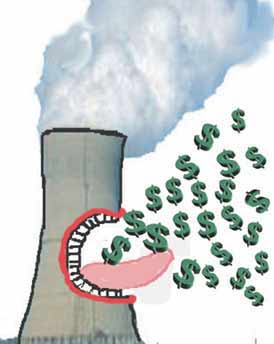
ATLANTA (AP) — The first American nuclear reactor to be built from scratch in decades is sending electricity reliably to the grid, but the cost of the Georgia power plant could discourage utilities from pursuing nuclear power as a path to a carbon-free future.
Georgia Power Co. announced Monday that Unit 3 at Plant Vogtle, southeast of Augusta, has completed testing and is now in commercial operation, seven years late and $17 billion over budget.
……………………………………………………. In Georgia, almost every electric customer will pay for Vogtle. Georgia Power currently owns 45.7% of the reactors. Smaller shares are owned by Oglethorpe Power Corp., which provides electricity to member-owned cooperatives, the Municipal Electric Authority of Georgia and the city of Dalton. Oglethorpe and MEAG plan to sell power to cooperatives and municipal utilities across Georgia, as well in Jacksonville, Florida, and parts of Alabama and the Florida Panhandle.
Georgia Power’s residential customers are projected to pay more than $926 apiece as part of an ongoing finance charge and elected public service commissioners have approved a rate increase. Residential customers will pay $4 more per month as soon as the third unit begins generating power. That could hit bills in August, two months after residential customers saw a $16-a-month increase to pay for higher fuel costs.
The high construction costs have wiped out any future benefit from low nuclear fuel costs in the future, experts have repeatedly testified before commissioners.
“The cost increases and schedule delays have completely eliminated any benefit on a life-cycle cost basis,” Tom Newsome, director of utility finance for the commission, testified Thursday in a Georgia Public Service Commission hearing examining spending.
The utility will face a fight from longtime opponents of the plant, many of whom note that power generated from solar and wind would be cheaper. They say letting Georgia Power make ratepayers pay for mistakes will unfairly bolster the utility’s profits.
“While capital-intensive and expensive projects may benefit Georgia Power’s shareholders who have enjoyed record profits throughout Vogtle’s beleaguered construction, they are not the least-cost option for Georgians who are feeling the sting of repeated bill increases,” Southern Environmental Law Center staff attorney Bob Sherrier said in a statement.
Commissioners will decide later who pays for the remainder of the costs of Vogtle, including the fourth reactor. Customers will pay for the share of spending that commissioners determine was prudent, while the company and its shareholders will have to pay for spending commissioners decide was wasteful.
Georgia Power CEO Kim Greene said the company hasn’t decided how much it will ask customers to pay. https://apnews.com/article/georgia-power-nuclear-reactor-vogtle-9555e3f9169f2d58161056feaa81a425
No comments yet.
1 This Month
Chernobyl: The Lost Tapes – A good documentary on Chernobyl on SBS available On Demand for the next 3 weeks– https://www.sbs.com.au/ondemand/tv-program/chernobyl-the-lost-tapes/2352741955560

of the week–London Campaign for Nuclear Disarmament

Tell the Ukrainian Government to Drop Prosecution of Peace Activist Yurii Sheliazhenko
To see nuclear-related stories in greater depth and intensity – go to https://nuclearinformation.wordpress.com
-
Archives
- April 2026 (139)
- March 2026 (251)
- February 2026 (268)
- January 2026 (308)
- December 2025 (358)
- November 2025 (359)
- October 2025 (376)
- September 2025 (257)
- August 2025 (319)
- July 2025 (230)
- June 2025 (348)
- May 2025 (261)
-
Categories
- 1
- 1 NUCLEAR ISSUES
- business and costs
- climate change
- culture and arts
- ENERGY
- environment
- health
- history
- indigenous issues
- Legal
- marketing of nuclear
- media
- opposition to nuclear
- PERSONAL STORIES
- politics
- politics international
- Religion and ethics
- safety
- secrets,lies and civil liberties
- spinbuster
- technology
- Uranium
- wastes
- weapons and war
- Women
- 2 WORLD
- ACTION
- AFRICA
- Atrocities
- AUSTRALIA
- Christina's notes
- Christina's themes
- culture and arts
- Events
- Fuk 2022
- Fuk 2023
- Fukushima 2017
- Fukushima 2018
- fukushima 2019
- Fukushima 2020
- Fukushima 2021
- general
- global warming
- Humour (God we need it)
- Nuclear
- RARE EARTHS
- Reference
- resources – print
- Resources -audiovicual
- Weekly Newsletter
- World
- World Nuclear
- YouTube
-
RSS
Entries RSS
Comments RSS
 nuclear-news
Leave a comment