TODAY. Pro nuclear spin – the perfect examples of deception in language and logic.

I did find, in the reporting of the finally-in-operation Vogtle nuclear power plant, a fine example of the nuclear lobby’s brilliant, but twisted and irrational, logic.
Department of Energy’s Loan Programs Office director, Jigar Shah, was “optimistic and thinks Vogtle is a nuclear turning point, with a pivot toward smaller-scale projects that will be easier and cheaper to replicate.” “I also think it sets up the U.S. nuclear renaissance very well in small modular reactors,” “The beauty of the small modular reactor is it fits within that $2 [billion] to $4 billion price range,” Shah said.
(That’s the suggested price to build one smr). Upon completion, Vogtle Units 3 and 4 are expected to generate 17,200,000 megawatt-hours . The only Small Modular Reactor (SMR) to receive “design certification”, is the NuScale, which generates 77 megawatts electric (MWe). So – you’d need an awful lot of them to match the Vogtle output, – like over 20,000? At $2 – $4billion each – cost would be? NuScale does put 12 together, to make quite a big nuclear plant ( you’d still need quite a lot of these no-longer-small-plants) . I await some nuclear tech genius to enlighten me on how SMRs are going to produce electricity more cheaply.
But no matter – the logic is – large nuclear reactors produce expensive electricity: therefore small nuclear reactors will produce cheap electricity.
So – we don’t need to discuss other forms of electricity generation (like solar, for example)
Which brings me to another clever aspect of pro nuclear spin, – which is – you just ignore the bits that you don’t like, especially where there might be a comparison with non-nuclear technologies. This is done by concentrating on one aspect that might have popular appeal.
For example: the operating nuclear reactor emits almost no carbon emissions. That point, (excluding the total fuel-cycle) is the focus for claiming that nuclear is “clean” and “safe”. The focus on that claim leaves out altogether other aspects, like safety, security, long-lasting radioactive wastes, potential for nuclear/radioactive weapons, terrorism risks.
And then there’s language. The nuclear lobby used to dazzle us with science. And they still do, especially when the subject of ionising radiation comes up- a beaut collection of jargon words and initials- a confusion of “Intermediate Level” “Restricted Solid Wastes” “Class B Wastes” and many radiation terms.
But today – in this fast-changing world – repetitive, fast, meaningless words and phrases are the order of the day – game-changing, climate-change solution, clean, reliable, affordable, good-paying jobs, ………… most often quoted without any facts supplied to support them
The financial catastrophe that has been the Vogtle nuclear power project – is just another challenge/opportunity for the nuclear lobby. Like Fukushima, like Chernobyl, even like “Oppenheimer” – ’twill be another occasion for the nuclear spin-doctors and their loyal media to broadcast the coming success and benefits of new nuclear power.
First new US nuclear reactor in 3 decades may well also be its last
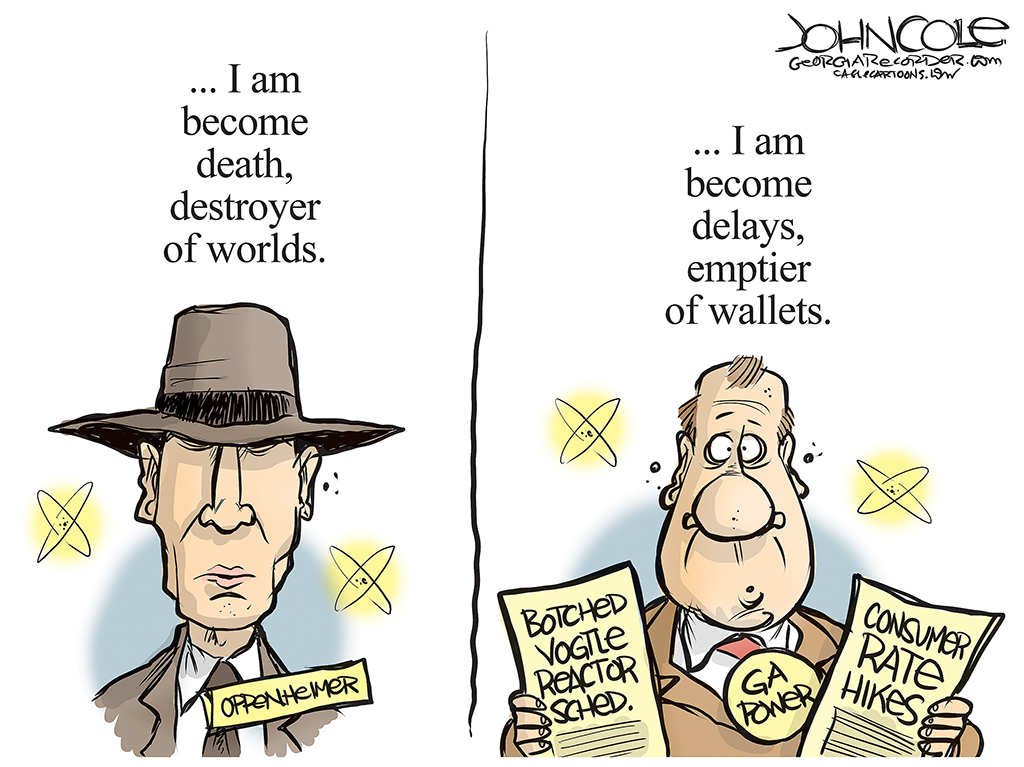
“The only reason there’s a nuclear renaissance is because the federal government is throwing tens of billions of dollars at nuclear,” …….. “Investors aren’t interested.”
Opening of Georgia Power’s Vogtle unit 3 comes 7 years late and billions
of dollars over budget.
FT.com Myles McCormick in Houston, 31 July 2023
The US nuclear energy industry has reached a watershed moment. Plant Vogtle unit 3 began delivering commercial electricity to the Georgia power grid, becoming the first nuclear reactor the country has built from scratch in more than three decades.
Unit 3 and a twin reactor to open in the coming months may also be the last. Years of delays and billions of dollars of cost overruns have made the megaproject as much a cautionary tale as a new chapter for atomic investment.
The 1,100-megawatt Vogtle unit 3 was initially supposed to enter service in 2016, however. Its start of operations was delayed once more in June after the company discovered a degraded seal in its main generator.
“It turns out nuclear construction is hard,” said Bob Sherrier, a staff attorney at the Southern Environmental Law Center, which challenged the project in court.
“Along the way the company kept ratcheting up the cost estimates, pushing back the deadlines a bit at a time. Every time it was raised just enough where it was still within the bounds of justification that it made sense to proceed. But they were wildly off in their estimates every single time.”
“The resurgence of America’s nuclear industry starts here in Georgia, where you’ve just got approval, for the first time in three decades, to build new nuclear reactors,” then-US energy secretary Steven Chu said as Vogtle was authorised in 2012.
The Georgia project was supposed to be the first among dozens of new reactors built across the country. But the renaissance floundered amid safety concerns after the 2011 Fukushima disaster in Japan coupled with plunging prices for natural gas, a competing generation fuel. In the end only four reactors moved ahead and two, Vogtle units 3 and 4, have been built. Unit 4 is scheduled to come online by early 2024.
Soaring costs at Vogtle, along with new reactors at the VC Summer nuclear project in South Carolina, forced engineering contractor Westinghouse into bankruptcy in 2017. While South Carolina utilities pulled the plug on their project, Georgia ploughed ahead.
The $14bn original cost of Vogtle units 3 and 4 has now ballooned to more than $30bn. The cost for Georgia Power, with a 45 per cent share of the project, will be about $15bn.
How the company’s costs are shared with its customers will be decided by the commission once unit 4 is operating: the law allows only costs deemed “prudent” to be passed on to ratepayers.
McDonald said the company should not expect an easy ride. “They are guilty until they prove themselves innocent,” he said.
Georgia Power, a division of New York-listed Southern Company, did not respond to multiple requests for an interview.
……………………………………… there are no other traditional large-scale light water reactors under way in the US. Critics say that investors have been turned off.
“The only reason there’s a nuclear renaissance is because the federal government is throwing tens of billions of dollars at nuclear,” said David Schlissel at the Institute for Energy Economics and Financial Analysis. “Investors aren’t interested.”
For Georgians, the more immediate concern is what the project means for utility bills. Georgia Watch, a consumer group, estimates ratepayers have already paid $900 extra since construction began to cover financing costs. Bills are set to rise by another $3.78, or 3 per cent, on average when unit 3 comes online.
But the ultimate impact will not be felt until unit 4 comes online and the PSC decides how much of the burden will be left for ratepayers to shoulder. Georgia Watch estimates the final increase will add anywhere between 10-13 per cent to bills……………… https://www.ft.com/content/5d8e0c6c-59c9-4b40-806f-604889dd5fb6
How the “Nuclear Renaissance” Robs and Roasts Our Earth

the average age of an operating U.S. reactor is now around 40. None are insured, despite assurances dating to the 1957 Price-Anderson Act that the reactor fleet would get private liability coverage by 1972.
the dangers escalate as the plants age. Meaningful estimates of the cost of a catastrophic accident are hard to come by, but after Chernobyl and Fukushima, the costs have soared into the trillions.
Nuclear power not only costs twice as much as wind and solar, it’s responsible for superheating our air and waterways.
By Harvey Wasserman , TRUTHOUT, July 31, 2023 https://truthout.org/articles/how-the-nuclear-renaissance-robs-and-roasts-our-earth/
Every day, as they burn with nuclear fission at some 571 degrees Fahrenheit, some 430 nuke reactors roast our Earth. They irradiate and superheat our air, rivers, lakes and oceans.
They also spew radioactive carbon, and emit more greenhouse gasses in the mining, milling, enrichment and fabrication processes that produce their fuel. Still more is emitted as they attempt to store their wastes.
Six big reactors and their fuel pools now threaten an apocalypse in Ukraine. Pleas for United Nations intervention are increasingly desperate.
But “nuclear renaissance” proponents say we need even more reactors to “combat climate change.”
However, these mythical new reactors have real costs — and for at least the next six years, they can produce nothing of positive commercial or ecological significance.
The primary reason there’s likely to be no new reactors in the U.S. until at least 2030 (if ever) is economic — the cost of construction is gargantuan.
Let’s consider eight recent major construction failures in Europe and the U.S.
Atomic plants were first constructed during the Manhattan Project that built the atomic bomb. Heralded as the “too cheap to meter” harbinger of an atomic age, the first commercial reactor came online at Shippingport, Pennsylvania, in 1958.
But in the coming decades, as reactor construction took off through the 1960s, ‘70s and into the ‘80s, the industry demonstrated an epic reverse learning curve, what Forbes called in 1985 “the largest managerial disaster in business history, a disaster on a monumental scale.”
At VC Summer Nuclear Station in South Carolina, after a decade of site work marred by faulty construction, substandard materials, bad planning, labor strife, and more, two reactors were abandoned outright in 2017, wasting $10 billion while bankrupting Westinghouse.
By comparison, the previous largest nuke-related bankruptcy, at the Washington Public Power Supply System in 1982, cost about four times less, at $2.5 billion. The biggest solar failure, at Solyndra in 2011, came with the loss of a $535 million government loan, about 15 times less than VC Summer.
In Georgia, two still-unfinished Vogtle reactors are some seven years late and $20 billion over budget, now at a staggering $35 billion plus.
In Hinkley, United Kingdom, two more reactors are also years late and could surpass $42 billion.
In Flamanville, France, a single reactor project begun in 2007 is still unfinished, years past its original promised completion date, and four times over its original cost estimate — with the price tag now beyond $14 billion.
Finland’s Olkiluoto has opened after 18 years of construction at around $12 billion in costs so far — three times the original promise.
All these reactor projects failed due to overly optimistic industry promises designed to attract investors, followed by poor execution, bad design, substandard components, labor strife, and more. Despite the industry hype, none of these eight reactors can ever compete with renewables, whose prices now range as low as a third to a quarter of nuclear — and are dropping.
With incalculable billions and a decade or more needed to build old-style big nuclear reactors, financial experts have long predicted that the necessary capital won’t be anywhere on the horizon.
Instead, the industry has been gouging state and local governments to keep the old reactors running, a desperate and dangerous toss of the dice.
Six billion dollars was pledged to nuclear energy plants in Biden’s infrastructure bill alone. A billion in federal dollars has been promised to keep California’s Diablo Canyon running, along with another billion from the state.
But the average age of an operating U.S. reactor is now around 40. None are insured, despite assurances dating to the 1957 Price-Anderson Act that the reactor fleet would get private liability coverage by 1972. Despite their immense inherent danger, only nominal company participation in a perfunctory insurance fund has been required for a license. Blanket coverage against a cataclysmic accident has not been a legal requirement to build or operate these reactors.
After six decades, reactor owners are still exempted from the costs of a catastrophic accident, and no nongovernmental insurance corporation has stepped in at an appropriate scale.
Yet the dangers escalate as the plants age. Meaningful estimates of the cost of a catastrophic accident are hard to come by, but after Chernobyl and Fukushima, the costs have soared into the trillions.
The oldest operating U.S. plant, at Nine Mile Point on Lake Huron, opened in 1969. Repeated near-disasters at Davis-Besse in Ohio include a hole eaten through a critical core component by boric acid that was missed because the owners refused to do required inspections. Monticello and Prairie Island in Minnesota threaten the entire Mississippi Valley. Critical intake pipes at South Texas recently froze, as its builders never anticipated the cold weather that hit it unexpectedly in 2021.
French and U.S. rivers are often too hot to cool reactor cores, forcing them to cut output or shut altogether.
Palo Verde in Arizona evaporates some 27,000 gallons of water per minute in a roasting desert. San Onofre in California was shut in 2012 because of leaking generators and now stores its high-level waste 100 feet from the ocean. Perry (Ohio) and North Anna (Virginia) have both been damaged by earthquakes.
Former Nuclear Regulatory Commission (NRC) site inspector Michael Peck has warned that Diablo Canyon in California should be closed because of the danger posed by seismic activity. Just 45 miles from the San Andreas Fault, Diablo was on its way to an orderly shut-down when Gov. Gavin Newsom strong-armed the state legislature and Public Utilities Commission to keep the embrittled, under-maintained reactors open despite their ability to blanket the state in terminal radioactivity. The NRC ignored Peck’s warning and he’s now gone from the Commission.
Diablo’s owner, Pacific Gas & Electric, has a blemished record when it comes to public safety — it has admitted to more than 80 counts of felony manslaughter due to the 2018 wildfires in California.
In Ukraine, of six reactors at Zaporizhzhia, five are in cold shut-down while one lingers on to power the place. But six shaky fuel pools contain apocalyptic quantities of radiation. Power supplies are in doubt, vital cooling water is threatened by a sabotaged dam, military attacks are possible, and site workers maintain the plant in a state of terror.
Like Zaporizhzhya, any operating reactor or fuel pool would be devastating targets for military or non-state terrorist attacks. The 9/11 masterminds reportedly toyed with hitting the Indian Point power plant north of New York City, irradiating the northeast. Any of the 90-plus decayed uninsured U.S. nukes are potential Chernobyls or Fukushimas. Deep concerns have been expressed by United Nations inspectors and many others. A public petition now asks that UN peacekeepers take over the Zaporizhzhya site.
So, taken in sum, “nuclear power” to date is defined by catastrophic fiscal failure and public risk. No new plants are under construction and efforts to keep the current fleet operating are fraught with uninsured danger.
In straight-up financial terms, the peaceful atom’s “too cheap to meter” promises can never compete in real terms with renewables, which won’t melt, explode, release mass quantities of radiation or create atomic wastes.
Projections for thorium, fusion, and other futuristic reactors also remain technically and fiscally vaporous. The fusion facility at ITTR in France has already burned through $65 billion.
And a reactor burning at 100 million degrees is as likely to cool the planet as Edward Teller’s fusion superbombs.
Which leaves us with the much-hyped small modular reactors (SMRs), now wallowing in deep delay and soaring prices. SMRs are theoretical nukes designed to be far smaller than today’s 1,000+ megawatt reactors, to be mass produced and buried throughout the country. Only one SMR developer, NuScale, has gotten significant preliminary licensing approval. Cost and delivery projections from Bill Gates’s TerraPower, X-Energy, and other prospective manufacturers are theoretical, with little concrete data to back up when they might be deployed and at what prices.
Projected prices at NuScale have soared from $58/megawatt-hour in 2017 to $89 now, nearly double the range of wind and solar. By 2030, SMR prices are likely to be triple or more. A recent piece by former NRC Chair Allison MacFarlane eviscerated the technology’s potential with a devastating analysis, referring to it primarily as a means of attracting government hand-outs and “stupid money.”
But with no big U.S. reactors being built while SMRs drown in red ink and tape, the industry still burns and irradiates the planet with about 430 aging reactors worldwide and 92 ancient ones here in the U.S. And the odds of an apocalypse at one or more of those old reactors grow with each day they age.
The pitfalls include unsolved problems of reactor waste, deteriorating infrastructure, a fast-retiring workforce, a diminishing ability of the industry to deliver on its promises, a minimum five-year gap before any small reactors could come into significant commercial production, the forever threats of war and terrorism, the killing power of radiation, and much more.
Meanwhile, renewables have long since blown past both nukes and coal in jobs, price, safety, efficiency, reliability, speed to build, and more.
As nuclear investments dry up, offshore wind, rooftop solar, “agri-voltaic” farmland and advanced efficiency are booming.
A pending transition from lithium to sodium may soon transform the battery industry. For reasons of cost, ecological impacts and resistance to mines on Indigenous lands, lithium-based batteries face serious challenges.
But with cheaper, more widely available sodium at their core, battery technologies are poised for a near-term Great Leap. Should that happen soon, the current storage challenges of the green power revolution could all but disappear.
Thus, we face the ultimate test: Can our species replace these failed, lethal nukes with safe and just forms of green power — or will we let this latest atomic con fry us all?
I was a US nuclear missile operator. I’m grateful for the Oppenheimer film
A “Broken Arrow” is defined as an unexpected event that results in the accidental launching, firing, detonating, theft or loss of a nuclear weapon. Since the creation of nuclear weapons, there have been 32 Broken Arrows.
Cole Smith, 24 July 23 more https://www.theguardian.com/commentisfree/2023/jul/24/nuclear-war-oppenheimer-serious?CMP=share_btn_tw
The questions at the center of Oppenheimer don’t feel theoretical to me. From 2012 to 2017 I worked on nearly 300 nuclear silo alerts
Audiences are rushing to theaters to see Oppenheimer. Early buzz is that this movie will be one of the blockbusters of the summer.
One reason for the interest: the film is loaded with the philosophical questions J Robert Oppenheimer and his team faced while developing the first atomic bomb. Do nuclear weapons make us safer? Will they inspire an arms race that will push humanity into extinction? Is it possible this weapon will lead to the destruction of the world?
The questions that the film’s director, Christopher Nolan, places at the center of Oppenheimer don’t feel theoretical to me. From 2012 to 2017 I worked as a nuclear missile operator in the US air force. During that time, I worked nearly 300 “alerts”, or shifts in underground launch control centers, where I oversaw maintenance, security and launch operations for 10 nuclear-tipped intercontinental ballistic missiles (ICBMs).
It may surprise you to hear that I watched a lot of movies while on alert. To be sure, the job of air force missile operators is often very busy. But it is also a 24/7/365 shift schedule. And on those late nights, weekends or holiday shifts when nothing was going on, my crew partners and I would turn to movies to get us through our shifts. It was here that I began to notice Hollywood’s love affair with nuclear weapons.
Early on, Hollywood gave us a lot to chew on. Sidney Lumet’s 1964 film Fail Safe is as serious a commentary on the questions around nuclear deterrence as has ever been presented on the screen. The same year, Stanley Kubrick defined the absurdity of a society that uses a nuclear arsenal to achieve “peace” in his film Dr Strangelove. When these films were released, it had been less than 20 years since Americans dropped the first atomic bombs on Japan. America was just beginning its nuclear arms race with Russia and the nuclear conversation felt very much alive to the average American.
But the American public grew weary of always being on high alert. Hollywood reflected this change as the meticulous films of the 60s began to give way to a new type of cold war thriller – one in which every villain seemed to speak with a Russian accent and wield some sort of vague existential nuclear threat that would be defeated by a red-blooded American. Some of these films, like 1983’s WarGames, were self-aware enough to work. But most existed on a spectrum ranging from Steven Seagal’s Under Siege to The Core – which is to say, mildly entertaining to so bad it’s somehow maybe almost good. As a result, in the decades before the release of Oppenheimer, the nuclear thriller had become an almost taboo genre in Hollywood.
That’s a problem, because the nuclear threat never went away. If anything, it got worse. Today, the United States has about 400 nuclear tipped ICBMs, the ones I operated, ready for launch every single day. It also has a robust nuclear bomber program as well as nuclear-armed submarines. In total, the US owns approximately 6,000 nuclear warheads. What’s more, the air force is currently in the midst of developing a new ICBM nuclear delivery system, called Ground Based Strategic Deterrent (GBSD). In 2020, the air force awarded a $13.3bn sole-source contract for GBSD to Northrop Grumman. The contract was awarded by default with no other competitors for the contract and little to no press coverage or public debate.
When I was a 23-year-old missile operator in the air force, my commander once told me that a good day in nuclear missile operations is a quiet one. Most of the days in the five years I spent working in underground nuclear launch control silos were just that: quiet. But not every day in the history of the US air force nuclear missile program has been quiet. A “Broken Arrow” is defined as an unexpected event that results in the accidental launching, firing, detonating, theft or loss of a nuclear weapon. Since the creation of nuclear weapons, there have been 32 Broken Arrows.
In the five years I served as a nuclear missile operator I performed targeting on dozens of active nuclear missiles. I commanded “major maintenance” operations like warhead swaps from one ICBM to another. We even pulled entire missiles out of the ground and replaced them with refurbished ones. And never once was I worried that I might have a Broken Arrow on my hands.
The problem is that, while a good day in nuclear missile operations is a quiet one, the quiet days don’t lead to a reduction in the number of these weapons. That’s why we need engaging stories about nuclear weapons in our movie theaters. We need journalism that comprehensively unpacks this issue. In short, we need a public that is as engaged with nuclear weapons as they were during the cold war. Otherwise, it’s only on days when Vladimir Putin threatens the use of nuclear weapons, or the days that North Korea test launches its latest ICBM, that we begin to discuss the inherent dangers of a world that allows nuclear missiles to exist. And on those not-so-quiet days, it’s already too late.
In May of 2022, while Nolan was in the midst of principal photography on Oppenheimer, I sat down for lunch in New York with Kai Bird, the co-author of American Prometheus, the book from which Oppenheimer is adapted.
I asked Bird if he thought Nolan would do justice to the subject. Bird told me that Nolan shared a draft of the script with him and asked him to read it for any historical discrepancies. Bird told Nolan that almost everything looked accurate, but that the script put the casualty rate from the bomb used on Hiroshima at 70,000, a number much lower than the casualty count accepted by most historians. Nolan said that he knew this figure was low but that he had gone back and read the original transcripts from the Senate hearing and used the actual words from Oppenheimer’s mouth.
Nolan’s attention to detail is what the nuclear conversation deserves. Oppenheimer sets the stage for a new conversation about nuclear weapons in Hollywood – one that doesn’t rely on overwrought cold war tropes. It’s a more difficult conversation because it’s one where, like Robert Oppenheimer, we have to come to terms with our own actions (or inactions) in order to make decisions about our future. Do we want to live in a world free from the threat of nuclear war? Or do we want to cover our eyes and throw the dice in a world with more than 14,000 nuclear warheads? Nolan isn’t afraid to ask these hard questions. I hope other film-makers follow his lead.
Military interest in nuclear-powered space travel, but solar-powered is just as good, -and safer.
2 Government, Industry Explore Nuclear, Solar Space Engines
COLORADO SPRINGS, Colorado — More commercial and military activity is taking place in space, and the Defense Department and industry are investing in emerging propulsion technologies to move systems in orbit faster, farther and more efficiently.
……………………………………..In 2021, the Defense Advanced Research Projects Agency selected Lockheed Martin as one of three prime contractors — along with General Atomics and Blue Origin — for Phase 1 of its Demonstration Rocket for Agile Cislunar Operations, or DRACO, program to showcase the potential of a nuclear thermal propulsion system in space, a DARPA release said.
This January, NASA announced it had partnered with DARPA on the DRACO program, describing a nuclear thermal rocket engine as “an enabling capability for NASA crewed missions to Mars.” The goal is to demonstrate the system in orbit in fiscal year 2027, with the Space Force providing the launch vehicle for the DRACO mission, a DARPA statement said.
The program is about to enter Phase 2, which “will primarily involve building and testing on the non-nuclear components of the engine” such as valves, pumps, the nozzle and “a representative core without the nuclear materials in it,” DARPA’s program manager for DRACO Tabitha Dodson said during a panel discussion at the Space Foundation’s Space Symposium in April. Dodson said then a Phase 2 decision is “quite close.” However, at press time in mid-July, no contracts have been awarded.
…………………………………“There are no facilities on Earth that we could use for our DRACO reactor’s power test … so we’ve always baselined doing our power test for the reactor in space,” Dodson said. Once in space, DARPA will “very gradually” ramp up the system to “full power thrust,” she said…………………………………………………………………………………………………………………………………………
Despite DARPA’s commitment to safety, nuclear propulsion systems face an uphill battle getting deployed on spacecraft at scale, said Joel Sercel, founder and CEO of TransAstra, a space technology company.
………………………………………………………………………………..In May, the Space Force awarded TransAstra a Phase One Small Business Innovation Research contract to explore new applications for the company’s propellant-agnostic Omnivore thruster.
The Omnivore thruster uses solar reflectors to focus sunlight onto a solar absorber, which then superheats the system’s propellant to generate thrust “typically six times faster and eight times cheaper than electric systems,” a company release said.
Additionally, TransAstra calculated an Omnivore thruster “using liquid hydrogen propellant … will perform similarly to nuclear rockets, but without nuclear materials, costs or risk.”
Sercel said Omnivore has “80 percent of the performance of nuclear at 1 percent of the cost.” The system is essentially nuclear powered, “but the nuclear reactor in question is the fusion reactor at the center of the solar system called the Sun,” he added.
“The nice thing about nuclear reactors is that you have a small, compact reactor versus large deployable solar reflectors, but the basic performance of solar thermal rockets and nuclear rockets is about the same,” he said. And with Omnivore “you don’t have all these safety concerns and radioactive material and reactor control issues and so on. So, we think it’s a much more practical approach.”
Omnivore could have multiple mission applications for the Defense Department, Sercel said. Using liquid hydrogen propellant, the thruster “can deliver hundreds of kilograms” of spacecraft to geosynchronous orbit “on small launch vehicles, and the Space Force seems to be very excited about this,” he said. The system could also deliver spacecraft weighing more than 100 kilograms to cislunar space, he said.
Additionally, TransAstra has an Omnivore variant that uses water as the propellant, the solar absorber superheating the water vapor and releasing the gas through a nozzle to generate thrust.
The water-based variant can be placed on the company’s Worker Bee small orbital transfer vehicles, about 25 of which can fit on a single Falcon 9 rocket, Sercel said.
“Each [Worker Bee] could deliver up to six small [satellites] to their orbital destinations. So, we can deliver a full constellation of 100 small or micro [satellites] to all different inclinations, and you would get global coverage in one launch.”…………………………………………………………more https://www.nationaldefensemagazine.org/articles/2023/7/31/government-industry-explore-nuclear-solar-space-engines
Past and Future Collide over Diablo Canyon Nuclear Power Plant

A History of Accidents and Centuries of Radioactive Waste to Come Dog Diablo Operator PPG&E
By Lauren Hanson and Mary Jones, Sun Jul 30, 2023 https://www.independent.com/2023/07/30/past-and-future-collide-over-diablo-canyon-nuclear-power-plant/
The past and the future collided at a virtual Public Participation Hearing held by the California Public Utilities Commission (CPUC) on July 25. The subject: the potential extension of operations at Diablo Canyon nuclear power plant.
Over 100 commenters spoke. The majority of them (by a 61 percent to 39 percent margin) vigorously opposed continued operations at the plant. As Justin LeBlanc of Sustainable Transit El Dorado put it, “The way of the future is not legacy monoliths.”
Diablo Canyon’s two reactors were scheduled to shut in 2024 and 2025 when their operating licenses expire. A surprise, and very energetic, push by Governor Newsom has led to a last-minute governmental scramble to consider continued operations to 2030 or beyond. The State Legislature has already given a conditional go-ahead.
The CPUC is expected to take a position on the matter before the end of this year. That decision could facilitate or block the extension. Of the five appointed members, a single CPUC commissioner, Karen Douglas, attended the hearing.
Proponents and opponents of the extension definitely did not see the future in the same way. They didn’t agree on the past, either.
Supporters of the extension most frequently cited what they said were ongoing low costs and safe, carbon-free nuclear operations. The mayor of Arroyo Grande, Caren Ray Russom, noted jobs and said that her city is “a direct beneficiary” of the plant’s operations. Jeff Luse, of Generation Atomic, a group that describes itself as “the heart of the pro-nuclear movement,” stated that the radioactive waste stored on site is “safely handled.” Several proponents even advocated adding more nuclear reactors to the site and operating them indefinitely.
Administrative Judge Patrick Doherty, who presided at the hearing, twice had to remind participants to refrain from personal attacks on other speakers. This came after two proponents of the extension referred to those with different views as “eco-terrorists,” “superstitious,” and “propaganda peddlers.”
Those opposed to the extension didn’t need to name-call to make their points. The long list of operational problems of PG&E, Diablo’s operator, did not instill confidence. Elizabeth Brooking of San Francisco, who voiced concerns about how the radioactive waste will be handled for the centuries it will exist, commented that PG&E “doesn’t have an exemplary track record for maintenance.” That’s putting it mildly, as others noted. Adding some dark historical context were Scott Rainsford and Bob Rowen, who described their firsthand experiences with PG&E’s Humboldt Bay nuclear reactor #3, which, they said, experienced a nuclear accident in 1970 that contaminated employees and was covered up by PG&E and the regulatory agencies.
As for continuing Diablo operations beyond the ’24 and ’25 shutdown date, the reasons against that were many and varied. Here are a few that were brought up:
• Under-reported earthquake dangers that downplay the seismic risk to the plant.
• The alarming embrittlement of the metalurgical material inside the reactor vessel of Diablo’s Unit 1: Bruce Severance of San Luis Obispo gave a summary of his findings from reviewing 4,000 pages of U.S. Nuclear Regulatory Commission documents.
• The actual unreliability of the plant’s scheduled operations: Donna Gilmore of SanOnofreSafety.org stated that the two reactors at Diablo had been down 40 percent of the time in the past two years.
• The increasing availability of battery storage as an alternative baseline supply of energy that already exceeds what Diablo offers and will likely exceed it by 3x in the coming two years.
• The uranium mining and transporting that endangers communities near it and contributes significantly to the carbon footprint of nuclear power.
• The financial costs of getting Diablo sufficiently ready to operate any longer than the already agreed upon shutdown: A study by the Environmental Working Group was cited, which states the costs could be as high as $45 billion.
• The absurdity of spending so much to prop up Diablo instead of deploying those funds as rapidly as possible for solar, wind and other renewables: Rooftop solar, in particular, was urged by a number of commenters.
• The danger to the ocean and marine creatures from the once-through cooling system that would apparently be allowed to continue, even though it is no longer an approved process.
• And finally, the unthinkable loss that a catastrophic failure at Diablo would cause.
This last item seems to be something that the proponents of extension want to whistle past, while the opponents of extension do what they can to sincerely sound the loudest possible alarm.
Adrianne Davis of Santa Barbara summed up the Diablo problem succinctly, calling the aging plant a “truly lethal dinosaur.”
And Myla Reson of Santa Monica concluded her remarks with this: “Take a moment to think how you’ll feel if there is a meltdown and you didn’t do anything to shut it.”
There is still time to submit written comments online to the CPUC at apps.cpuc.ca.gov/c/R2301007.
Lauren Hanson and Mary Jones live in Santa Barbara.
Nuclear weapons on the table if Ukraine counteroffensive succeeds: Russia’s Medvedev
There would be ‘no other way out’ if Kyiv takes Russian territory, says the former Russian president and current National Security Council deputy chairman.
Politico, BY VARG FOLKMAN, JULY 30, 2023
If Ukraine’s ongoing counteroffensive against Moscow’s invasion captures Russian territory, there would be no alternative to using strategic nuclear weapons, Russia’s Dmitry Medvedev warned on Sunday.
“There would simply be no other way out” of using nuclear weapons if the Ukrainian offensive succeeded in taking Russian territory, Medvedev, former Russian president and current National Security Council deputy chairman, said in a post on social media.
“Just imagine that the NATO-supported ukrobanderovtsy’s offensive turned out successful, and they took away a part of our land: Then we would have to, following the president’s degree of 02.06.2020, use the nuclear weapon,” Medvedev wrote, referring to followers of Stepan Bandera, a nationalist leader who waged a violent campaign for Ukrainian independence in the 1930s and 1940s.
“That’s why our enemies must worship our warriors. They are keeping global nuclear fire from flaring up,” Medvedev said, referring to Russian efforts to stop the Ukrainian offensive.
Medvedev has not been shy in using Russia’s nuclear arsenal to threaten Ukraine and its Western supporters. During Wagner chief Yevgeny Prigozhin’s failed coup, Medvedev said the rebellion could lead to a nuclear war…………… https://www.politico.eu/article/russia-dmitry-medvedev-ukraine-counteroffensive-russia-invasion-war-nuclear-weapons/
Humans Might Be About to Break the Ocean? Don’t Stop the Presses

JULIE HOLLAR, FAIR, 31 July 23
When a new peer-reviewed study (Nature Communications, 7/25/23) announces that a crucial Atlantic Ocean circulation system, a cornerstone of the global climate, may collapse as quickly as two years from now, you’d think news outlets might want to put that on the front page.
The AMOC (Atlantic Meridional Overturning Circulation) moves warmer water from the tropics to the North Atlantic, where it cools, sinks and returns down the US East Coast. Its collapse would be a “climate tipping point” with, as the British Guardian (7/25/23) explained,
disastrous consequences around the world, severely disrupting the rains that billions of people depend on for food in India, South America and West Africa. It would increase storms and drop temperatures in Europe, and lead to a rising sea level on the eastern coast of North America. It would also further endanger the Amazon rainforest and Antarctic ice sheets.
The study, published by an open-access affiliate of the prestigious scientific journal Nature, used new statistical methods, rather than new observations, to make its prediction, which contradicts the IPCC’s latest assessment. The IPCC (6/14/19) deemed a full collapse this century “very unlikely,” but it relied on data that only went back to 2004. The new study, the Guardian reported, “used sea surface temperature data stretching back to 1870 as a proxy for the change in strength of AMOC currents over time.” The study projected the collapse of the ocean system between 2025 and 2095, with 2050 the most likely date, without sharp reductions in global carbon emissions.
Some climate scientists are cautious about the new study, suggesting that more observational data is needed to say the collapse could happen so imminently (Grist, 7/26/23). But as climate scientist Jonathan Foley argued (Twitter, 7/27/23), though the study doesn’t offer certainty, the consequences are so dire that “the only prudent reaction to this is to work to address climate change, as quickly as possible, to avoid these kinds of impacts.”
“I really wish that journalists and editors took this as seriously as scientists do, and reported it loudly and accurately, taking the time to get the facts right,” Foley wrote. “The planet is in trouble, and we need to have the best possible information.”
Unfortunately for the planet and those who inhabit it, corporate media would rather look the other way, at worst, and offer scary clickbait headlines with few connections to actionable policy at best.
‘Try all that we can’
At the Washington Post, editors put the news on page 12 (7/26/23). …………………………….
The Wall Street Journal, the favored newspaper of the business crowd, didn’t even bother to cover the report, ………………………………..
NPR (7/27/23) focused more on the importance of the timing of the collapse than on the collapse itself,…………………………………..
‘Plausible we’ve fallen off a cliff’
The New York Times (7/26/23) was one of the only major outlets to put the news on its front page, with a well-reported piece by Raymond Zhong. It also did better than many, mentioning “human-driven warming” in the second paragraph, and paraphrasing a scientist that “uncertainty about the timing of an AMOC collapse shouldn’t be taken as an excuse for not reducing greenhouse-gas emissions to try to avoid it.” That scientist, Hali Kilbourne, was given the last word:
“It is very plausible that we’ve fallen off a cliff already and don’t know it,” Dr. Kilbourne said. “I fear, honestly, that by the time any of this is settled science, it’s way too late to act.”
Yet even here, no connections were made to concrete policy options, and no policy experts or activists were quoted to offer them.
The only other front-page US newspaper mention FAIR could find in the Nexis database was in the Charleston Post & Courier (7/25/23), which similarly made no connections to policy.
In the context of a summer of extreme climate events, including unprecedented heatwaves, ocean temperatures and wildfires, we desperately need a media system that treats the climate crisis like the five-alarm fire that it is, and demands accountability from the politicians and industries—not least the fossil fuel industry—driving us off the cliff.
When facts cut through the fog of war
As the Ukraine counteroffensive grinds on, conditions on the ground are now too obvious to ignore. Is it time for talking, yet?
Responsible Statecraft, JULY 28, 2023, Katrina vanden Heuvel and James Carden
The fog of war over much of the last 18 months has skewed press coverage and our understanding of what is happening in Ukraine. Yet media opacity can no longer mask the facts on the ground.
In only the past week, reports have emerged in the Wall Street Journal, CNN, the Financial Times and the New York Times indicating, among other things, that Ukraine’s much awaited spring offensive has ground to a virtual stalemate and munitions from its NATO-allied partners are drying up.
The situation is such that, as the Financial Times columnist Ed Luce noted, “At some point, Volodymyr Zelensky … will need to sit down with Vladimir Putin, or his successor, to reach a deal.”
Perhaps more worrying still was NATO Secretary General Jens Stoltenberg’s admission that “the war in Ukraine is consuming an enormous amount of munitions and depleting allied stockpiles. The current rate of Ukraine’s ammunition expenditure is many times higher than our current rate of production. This puts our defense industries under strain.”
None of this is exactly news. This past April, the so-called “Discord leaks” revealed that Washington officials believed back in February that the war wasn’t going as well as it had been heretofore portrayed. But at the time, the media was more focused on helping authorities hunt down the leaker than reporting the contents of the leak. The unavoidable implication of the leaks, that the Biden administration was presenting two different versions of the war’s progress — one private, the other public — seemed almost willfully deleted from the script.
And so, as the Ukrainian counteroffensive turns into a brutal slog, Kyiv seems to lack the requisite human resources or physical infrastructure to achieve its goals. Isn’t diplomacy now more important than ever? And if not now, when?
There is a growing recognition by a number of experts that conditions do exist for a negotiated settlement to end the war…………………………………………
War casualties (now estimated at well over 350,000 Ukrainian and Russians), the accompanying European economic downturn, the burgeoning food crisis in Africa, the sure-to-be devastating legacy of tens of thousands of unexploded landmines, and the ever-present nuclear risk all tell us one thing: The time has come for talks. https://responsiblestatecraft.org/2023/07/28/when-will-we-concede-that-it-is-time-for-talks/
Scared to Death!

BY JOHN MIKSAD, https://www.counterpunch.org/2023/07/31/scared-to-death/– 31 July 23
I met U.S. Rep. Joe Courtney (D-CT) for the first time recently. I had a short, but revealing conversation with him.
I don’t know what he thought coming away from the exchange, but I know what I felt. I felt afraid. I saw someone who was enthusiastic about the current proxy war with Russia and the potential war with China, two nuclear armed nations. I saw someone who believes that the US only fights for freedom and democracy although I wonder if he could tell me that last war that was fought for freedom or that resulted in democracy.
I will admit that the weapons manufacturers–who Joe staunchly assists at every turn–have experienced more financial freedom (read “profits”) as a result of Joe’s efforts.
I saw someone who had no use for diplomacy because he believes that you can’t negotiate with adversaries, a belief that has led to countless wars through the millennia and continuous war in this century.
This is deeply concerning to me. Violent conflict over land, resources, ideology, power, and ego may have been the only model we’ve been exposed to, but we can no longer afford to continue working within this old paradigm of might makes right, zero-sum games, and endless arms races. All this has led us to where we find ourselves today, on the brink of self-annihilation.
The fear I felt coming away from this conversation stems from the realization that many of our elected officials adamantly maintain that violence is the only way.
We must find a way to talk, negotiate, build trust, and ultimately cooperate with all nations. I come to this conclusion based on the premise that all people of all nations now face the same existential threats from pandemics, climate collapse, and war escalating to nuclear annihilation.
For the first time in history, the entire human species has obvious common interests. The only rational way forward is to put aside our petty grievances and come together to deal with these existential threats. No one nation can solve these threats alone. There is no other way but together as an international community.
People like Joe are unwilling to give peace a chance and in doing so they are condemning all of us to hardship, suffering, and potentially death. They know only “us versus them” thinking.
They cannot get past the obsolete and barbaric paradigm of resolving conflict by violence or the threat of violence. They don’t realize that we will only have safety and security when all nations have safety and security. Their belief system is incompatible with the realities that we face.
They think that fighting over there protects us here. They don’t realize that there is always blowback and tragic predictable consequences from war that come back to bite us in many ways. We now have epidemic levels of violence within a society that has been shown by its government that violence is the best way to settle disputes.
The blood and treasure that war has stolen from us has left us with crumbling infrastructure, poor results in education and health, and a failing democracy. The planet’s climate is fast approaching tipping points (points of no return) as people around the world experience escalating climate catastrophes including deadly heat waves, floods, wildfires, droughts, and storms.
We continue to spend $1 trillion/year on war and militarism when we know from experience that the military cannot protect us from the real threats that we are now facing. In fact, war exacerbates these threats. War is the worst investment ever.
We must start with a reassessment of U.S. foreign policy and draw down our overreaching military with its expensive and ineffective 750 bases on the sovereign soil of some 80 foreign countries.

If we are to survive and help head the world in the right direction, we must join treaties for nuclear weapons. We must create strong democratized international institutions.
The clock is ticking.
Someone needs to take the lead and break the cycle of mistrust we helped create. It takes courage to do this. We must realize that only peace serves our interest and the interests of all our fellow inhabitants of earth.
I believe people can change. People do change. But not everyone will change. There were people who believed that owning slaves was morally acceptable even after slavery was outlawed.
That’s the way it will be with war and militarism as well. Even when it becomes quite obvious to most of us that the only way to deal with the global threats we face is through international cooperation, I suspect that Joe will believe that wars are still the preferable way to resolve our differences. I suspect he will always believe that all US wars are good and noble even though they kill civilians, create refugees, result in war crimes, and creates poverty, trauma, and desperation just like all war does.
Fortunately, we don’t have to convince everyone that war is barbaric and destructive. We only have to convince enough of our fellow citizens. When we reach a tipping point, the old paradigm will come tumbling down like the Berlin Wall.
Joe prefers to cling to his childhood games where he played the “good” cowboy that killed the “evil savages.” I’ve got some bad news for him about that story as well.
Joe is scared to death of Russia, China, Iran and North Korea.
I am scared to death of Joe.
Joe thinks that we should continue fighting over slivers of land on the other side of the planet.
I think we should be fighting to save the planet and all living things.
Joe thinks that nuclear war is on the table.
I think we must do everything in our power to reduce and ultimately eliminate the threat of nuclear annihilation.
Joe’s fear of other nations brings us ever closer to nuclear annihilation while distracting us from dealing with impending climate collapse and future pandemics.
I believe we need international cooperation for the safety, security, and well-being of all people.
Joe’s actions jeopardize the health and well-being of all people.
I believe we need to send an unequivocal message to Joe and the many other warmongers in Congress that they need to give peace a chance, not someday, but now.
John Miksad is Chapter Coördinator with World Beyond War.
BRING IT HOME-Robert F. Kennedy, Jr.

https://www.kennedy24.com/peace 31 July 23, In the long term, a nation’s strength does not come from its armies. America spends as much on weaponry as the next nine nations combined, yet the country has grown weaker, not stronger, over the last 30 years. Even as its military technology has reigned supreme, America has been hollowing out from the inside. We cannot be a strong or secure nation when our infrastructure, industry, society, and economy are infirm.
A high priority of a Kennedy administration will be to make America strong again. When a body is sick, it withdraws its energy from the extremities in order to nourish the vital organs. It is time to end the imperial project and attend to all that has been neglected: the crumbling cities, the antiquated railways, the failing water systems, the decaying infrastructure, the ailing economy. Annual defense-related spending is close to one trillion dollars. We maintain 800 military bases around the world. The peace dividend that was supposed to come after the Berlin Wall fell was never redeemed. Now we have another chance.
As President, Robert F. Kennedy, Jr. will start the process of unwinding empire. We will bring the troops home. We will stop racking up unpayable debt to fight one war after another. The military will return to its proper role of defending our country. We will end the proxy wars, bombing campaigns, covert operations, coups, paramilitaries, and everything else that has become so normal most people don’t know it’s happening. But it is happening, a constant drain on our strength. It’s time to come home and restore this country.
In Ukraine, the most important priority is to end the suffering of the Ukrainian people, victims of a brutal Russian invasion, and also victims of American geopolitical machinations going back at least to 2014. We must first get clear: Is our mission to help the brave Ukrainians defend their sovereignty? Or is it to use Ukraine as a pawn to weaken Russia? Robert F. Kennedy will choose the first. He will find a diplomatic solution that brings peace to Ukraine and brings our resources back where they belong. We will offer to withdraw our troops and nuclear-capable missiles from Russia’s borders. Russia will withdraw its troops from Ukraine and guarantee its freedom and independence. UN peacekeepers will guarantee peace to the Russian-speaking eastern regions. We will put an end to this war. We will put an end to the suffering of the Ukranian people. That will be the start of a broader program of demilitarization of all countries.
We have to stop seeing the world in terms of enemies and adversaries. As John Quincy Adams wrote, “Americans go not abroad in search of monsters to destroy.” Robert F. Kennedy will revive a lost thread of American foreign policy thinking, the one championed by his uncle, John F. Kennedy who, over his 1000 days in office, had become a firm anti-imperialist. He wanted to exit Vietnam. He defied the Joint Chiefs of Staff and refused to bomb Cuba, thus saving us from nuclear Armageddon. He wanted to reverse the imperialistic policies of Truman and Eisenhower, rein in the CIA, and support freedom movements around the world. He wanted to revive Roosevelt’s impulse to dissolve the British empire rather than take it over.
John F. Kennedy’s vision was tragically cut short by an assassin’s bullet. But now we have another chance. The country is ailing, yes, but underneath there is vitality still. America is a land rich in resources, creativity, and intelligence. We just need to get serious about healing our society, to become strong again from the inside.
America was once an inspiration to the world, a beacon of freedom and democracy. Our priority will be nothing less than to restore our moral leadership. We will lead by example. When a warlike imperial nation disarms of its own accord, it sets a template for peace everywhere. It is not too late for us to voluntarily let go of empire and serve peace instead, as a strong and healthy nation.
UK has no coherent plan to develop nuclear energy
In a major report, the Science, Innovation and Technology Committee calls
on the Government to develop and publish a Nuclear Strategic Plan to turn
high level aspirations into concrete steps to deliver new nuclear. The
Committee says that the Government is right to look to nuclear power to
meet our future electricity needs and that this requires a substantial
programme of nuclear new build.
But the Report warns that the Government
target of 24 GW of nuclear generating capacity by 2050 and the aspiration
to deploy a new nuclear reactor every year are more of a ‘wish list’
than the comprehensive detailed and specific strategy that is required to
ensure such capacity is built.
The Government’s stated aim of 24 GW of
nuclear capacity is ambitious: it is almost double the highest installed
nuclear capacity the UK has ever achieved. It could involve new
gigawatt-scale nuclear power, small modular reactors (SMRs) and advanced
modular reactors (AMRs), and further development of nuclear fusion. It
would require substantial progress on technologies, financing, skills,
regulation, decommissioning and waste management.
Science, Innovation, Technology Committee 31st July 2023
Ambition alone will not build UK nuclear power

Greg Clark, former energy minister, writes that the absence of policy continuity has undermined strategy on this issue. The current government claims to be all-in for new
nuclear. Its Energy Security Strategy, published last year, set a target of
24 gigawatts of nuclear energy generating capacity by 2050.
That is highly ambitious. To put it in context, it is three times our current capacity and
nearly twice the highest nuclear capacity that the UK has ever achieved,
even before Magnox plants were retired from service.
Today the cross-party House of Commons Science, Innovation and Technology Select Committee, which I chair, will publish a report endorsing the government’s decision to
look to nuclear power to meet our future electricity needs — especially
if we are to achieve the legal requirement of net zero carbon emissions by
2050. At a time when imported supplies of energy leave us vulnerable to
price spikes at best, and shortages at worst, there is an energy security
case for nuclear power under our own control.
However, we will also warn
that expansive ambition will not get nuclear power built. Much more than
with other energy technologies, the scale, financial demands, workforce
planning and — in the case of advanced nuclear technologies — research
and development needed for new nuclear requires a dependable strategic plan
if hopes are to have any chance of being turned into reality.
Witness after witness who appeared before our inquiry told us that such a strategic plan
for nuclear is missing. For example, there is no indication from the
government on what proportion of the 24GW is intended to be met by
gigawatt-scale plants like Hinkley Point C, or smaller, more distributed
nuclear reactors such as small modular reactors.
The government’s stated
aim to deploy a nuclear reactor a year is not grounded in any explanatory
detail. The role of the new organisation, Great British Nuclear, is obscure
beyond running a competition between potential developers of small modular
reactors. Britain has an opportunity to break out of 70 years of on-off
policy towards nuclear power, with the twin imperatives of energy security
and net zero favouring a substantial future contribution of nuclear to our
electricity needs. But this will not happen without a clear and deliberate
plan on which very long-term investors can rely. If Britain is to have
substantial new nuclear capacity, there is an urgent need to turn hopes
into action.
FT 31st July 2023
https://www.ft.com/content/7499350a-2a4c-430d-a23f-415f3780e0aa
Nuclear power’s landmark project stumbles across the finish line
Politico , By ZACH BRIGHT, 07/31/2023
Critics blast the ever-extending timeline and bloated budget of Plant Vogtle’s expansion. Supporters say the Georgia project is part of a nuclear revival.
Georgia Power was set to reach a milestone last month and open the first of two long-awaited nuclear reactors at Plant Vogtle. Then came a delay — and more uncertainty.
Missed deadlines are a familiar refrain for the project near Augusta, Ga. The expansion is placing the country’s first major reactors built from scratch this century near two existing nuclear units brought online in the 1980s……………………….
The Vogtle expansion’s arrival is a huge moment for the U.S. electric industry that experts and officials expect to ripple well beyond eastern Georgia. Never mind that the two new nuclear gems Southern is scrambling to add to its crown were supposed to be up and running in 2016 and 2017. Or that their cost has more than doubled to over $30 billion.
………………………………… “Yes, we’ve had our challenges,” CEO Chris Womack said during the company’s annual meeting. “I’m confident that the state of Georgia and our customers, our company, the world, will be so proud of the work that we’ve done in bringing Vogtle online.”
Spokespeople for Southern and Georgia Power did not provide updates on future nuclear investment plans when asked last week by E&E News.
‘U.S. nuclear renaissance’
Vogtle’s steps toward completion come as the Georgia Public Service Commission plans to decide how much ratepayer costs should rise to cover the project’s overruns. And U.S. senators last week passed legislation that’s supportive of the nuclear industry.
………………….To help construct the expansion to Vogtle, the Department of Energy’s Loan Programs Office had issued $12 billion in loan guarantees to Georgia power providers. Its director, Jigar Shah, said in an interview that there were a lot of mistakes made and lessons learned……………………
Clean energy groups like the Southern Alliance for Clean Energy warn that the enormous costs of units 3 and 4 could fall on ratepayers, because monopoly utilities, they say, aren’t meaningfully regulated in the region.
“There is no nuclear power plant that we’re aware of that has ever come on in the Southeast on budget or on schedule,” Stephen Smith, the alliance’s executive director, said in an interview.
…………………..Challenges ranged from workforce constraints — the project required 9,000 builders, welders, electricians at the peak of construction — to what critics called a lack of meaningful regulation from public utility commissions to the Nuclear Regulatory Commission.
“It’s not that simple to manufacture these complex components and just stamp them together like Legos,” Lyman said.
Smith from the Southern Alliance for Clean Energy pointed to difficulties at a similar South Carolina nuclear project.
An attempt to add two AP1000s to South Carolina’s V.C. Summer nuclear plant fell through in 2017. The expansion was designed to be similar to Vogtle’s and had an estimated $9.8 billion cost. But its price quickly ballooned, and its construction timeline was pushed back years past scheduled operational dates of 2016 and 2019.
Vogtle may have survived Westinghouse’s bankruptcy, but the plant has “taken so long that the industry itself has kind of moved beyond the whole concept of AP1000s,” Smith said………………………………………………… https://www.politico.com/news/2023/07/31/vogtle-u-s-nuclear-energy-00106597
1 This Month
Chernobyl: The Lost Tapes – A good documentary on Chernobyl on SBS available On Demand for the next 3 weeks– https://www.sbs.com.au/ondemand/tv-program/chernobyl-the-lost-tapes/2352741955560

of the week–London Campaign for Nuclear Disarmament

Tell the Ukrainian Government to Drop Prosecution of Peace Activist Yurii Sheliazhenko
To see nuclear-related stories in greater depth and intensity – go to https://nuclearinformation.wordpress.com
-
Archives
- April 2026 (139)
- March 2026 (251)
- February 2026 (268)
- January 2026 (308)
- December 2025 (358)
- November 2025 (359)
- October 2025 (376)
- September 2025 (257)
- August 2025 (319)
- July 2025 (230)
- June 2025 (348)
- May 2025 (261)
-
Categories
- 1
- 1 NUCLEAR ISSUES
- business and costs
- climate change
- culture and arts
- ENERGY
- environment
- health
- history
- indigenous issues
- Legal
- marketing of nuclear
- media
- opposition to nuclear
- PERSONAL STORIES
- politics
- politics international
- Religion and ethics
- safety
- secrets,lies and civil liberties
- spinbuster
- technology
- Uranium
- wastes
- weapons and war
- Women
- 2 WORLD
- ACTION
- AFRICA
- Atrocities
- AUSTRALIA
- Christina's notes
- Christina's themes
- culture and arts
- Events
- Fuk 2022
- Fuk 2023
- Fukushima 2017
- Fukushima 2018
- fukushima 2019
- Fukushima 2020
- Fukushima 2021
- general
- global warming
- Humour (God we need it)
- Nuclear
- RARE EARTHS
- Reference
- resources – print
- Resources -audiovicual
- Weekly Newsletter
- World
- World Nuclear
- YouTube
-
RSS
Entries RSS
Comments RSS
 nuclear-news