The US and Australia on Friday launched the largest-ever iteration of their Talisman Sabre exercise as the US is increasingly focused on building alliances in the Asia Pacific against China.
The Talisman Sabre started in 2005 as a biennial exercise between the US and Australia. This year’s iteration involves participants from 11 other countries and over 30,000 military personnel.
US Navy Secretary Carlos Del Toro spoke at the opening ceremony on Friday and said the massive drills served as a warning to China. “The most important message that China can take from this exercise and anything that our allies and partners do together is that we are extremely tied by the core values that exist among our many nations together,” he said at a naval base in Sydney.
In a symbolic gesture to demonstrate the growing military ties between the US and Australia, the US on Saturday commissioned a naval vessel in Sydney, the USS Canberra, an Independence-class littoral combat ship. It marked the first time the US ever commissioned a US Navy ship was commissioned in a foreign port.
Del Toro has previously said that the US Navy envisions turning Australia into a full-service submarine hub for the US and its allies in the region under the AUKUS military pact that was signed between the US, Britain, and Australia in 2021 that will result in Canberra acquiring nuclear-powered submarines.
The US and Australia were joined in the Talisman Sabre exercises by militaries from Fiji, France, Indonesia, Japan, South Korea, New Zealand, Papua New Guinea, Tonga, Britain, Canada, and Germany. Personnel from the Philippines, Singapore, and Thailand are attending as observers.
The exercises involve live-fire drills and will conclude on August 4. A Chinese naval vessel was spotted surveilling the drills, which Australian military officials said have happened since 2017.
Extending operations of the Diablo Canyon nuclear power plant through 2045 could cost California ratepayers as much as $45 billion, a new report has found.
The state’s biggest utility, Pacific Gas and Electric (PG&E), is currently in the process of seeking a license renewal that could enable the aging facility to run for another 20 years — with the widespread support of state legislators, but in opposition to environmental activists.
If the plant ends up staying online for two more decades, total costs to run the site could range from more than $20 billion to nearly $45 billion from 2023 through 2045, according to a new analysis from the Environmental Working Group (EWG).
“Keeping Diablo Canyon open past its closure date is a terrible idea for many reasons, including the staggering price tag that unwitting ratepayers will face for keeping the dilapidated and dangerous nuclear plant operating,” EWG President Ken Cook, who is also a Bay Area resident, said in a statement.
While PG&E in 2016 had announced plans to retire the site and decommission its two reactors when their licenses expire — in November 2024 and August 2025, respectively — California enacted legislation last fall seeking to extend operations until 2030.
About six months later, the federal Nuclear Regulatory Commission granted PG&E an exemption that enabled the plant to stay open under its current licenses while the agency considers renewal application — whose terms would apply for 20 years……………………………………
The EWG analysis — based in part on testimony filed by the Utility Reform Network, a consumer advocacy group — estimated that keeping the plant open would likely require hundreds of millions of dollars every year.
Because that cost would need to be passed on to the consumer, households could then expect an increase of between $55–124 per year on typical utility bills, according to the analysis.
“It’s clearly a high-cost, no-reward and puzzling scenario for California, given its decades-long leadership on the environment,” a statement from EWG said……………………………………..
The estimated $20 billion–$45 billion cost to ratepayers could be even higher, the EWG analysts argued, stressing that these projections don’t account for expenditures associated with disasters, such as radiation leaks or earthquake damage.
Grant Smith, EWG energy advisor and co-author of the report, argued that the 6-8 percent of California’s electricity that is provided by Diablo Canyon could easily come from cleaner and safer sources.
“California added enough renewables in the past year to match the power output of Diablo Canyon,” Smith said.
Russian and Eurasian Politics, by GORDONHAHNJuly 22, 2023
To update my original article “The Zaporozhiya Nuclear Power Plant: Zelenskiy’s Next Simulacara” it is worth noting the following points:
(1) There has been no incident, obviously, at the plant either of Russian origin, as Ukrainian president Volodomyr Zelenskiy claimed was being planned, or of Ukrainian origin, as I argued was possible and the Russians claimed was almost certain in response to the Ukrainian claims. However, there was, as I suspected, clearly another Ukrainian fake, another Zelenskiy simulacra, since there was not ‘Russian nuclear terrorist attack and since the IAEA came out and refuted the Ukrainians’ claims that the Russians had planted explosives at the Zaporozhiya plant.
Second, it appears that this particular Zelenskiy simulacra was an effort to push the failure of the Ukrainian counteroffensive out of the headlines on the eve of NATO’s Vilnius summit. It may be that, as some sources report, that European leaders intervened to prevent the Ukrainians from following through on their supposedly planned false flag.
Third, it is astonishing how the Western media and Wstern governments, which was heavy breathing in its hard work of repeating the Kiev Maidan regime’s talking point about the ‘imminent Russian nuclear terrorism, has shoved the entire episode of Zelenskiy’s ‘Russian nuclear terrorist attack’ into the bottomless ‘memory whole’ that serves this war.
This follows the same pattern of moving on quickly after the numerous controversial and false claims that have come out of Kiev both before and during the war. Regarding the latter, there s already a long list: the Kakhovskii damn attack, the Nord Stream pipeline attack, the ‘Russian massacre’ at Bucha (where is the list of names of those killed and the detailed forensics reports on how and when precisely they died?), the hero Ukrainian pilot ‘The Ghost’ who never existed, the heroic defense of Snake Island that never occurred, the bombing of the Mariupol maternity hospital, among others.
This is part of a larger Western pattern of memory-wholing………………………………………….. The point is not that the West and Ukraine always lie or that lie more than Moscow, which it seems they do, however. The point is that Zelenskiy and his government comprise a serial fake artist, the West is their microphone, and Russia has work to do to compete with its opponents in the sphere of ‘public diplomacy.’
The original article reads as follows:
It appears almost certain that Ukrainian President Volodomyr Zelenskiy and his generals, rather than Russian President Vladimir Putin and his, are considering and preparing a false flag nuclear provocation at the Zaporozhiya nuclear power plant (ZNPP) set for July 7-9 to frame NATO summit and perhaps also to provide political cover for a Polish-Baltic republic move of forces into western Ukraine. Such a nuclear event will not be on a scale even approaching the Chernobyl accident, but it will be sufficient so that it can be framed as grave ‘Russian crime against humanity’ and used by Kiev to gain certain advantages via the West,
The incident likely will occur as a result of a Ukrainian attempt to seize the Zaporozhiya NPP in response to which Russian troops will be accused of detonating explosives creating a dirty bomb effect on a small scale. Ukrainian troops will cross the dried-up Dnepr, seize the ZNPP, detonate explosives there themselves. This will allow Kiev and the West to accuse Moscow of ‘nuclear terrorism’.
The signs of an impending false flag operation have been flashing for weeks, with numerous Ukrainian commentaries to the effect that the Russians were planning a nuclear terrorist operation at the Energodar ZNPP.
. The most recent make things pretty clear. IAEA inspections have never endorsed Ukrainian claims – ongoing for over a year now – that it is Russian forces that fire on the ZNPP. Indeed, Russian forces have occupied all of Energodar and the ZNPP and have for well over a year, and IAEA has a team permanently stationed at the plant along with Russian RosAtom personnel, who now run the plant.
More recently, on June 23rd Ukrainian Main Military Intelligence Directorate chief Kyrylo Budanov reported that Russia had completed preparations for carrying out a nuclear terrorist attack at the ZPNN
On June 29-30, Ukraine held nuclear accident civilian defense exercises in Zaporozhiya and the neighboring region of Kherson simulating the effects of an attack on the Zaporizhiya plant………………………………………………………… IAEA inspector recently refuted Zelenskiy’s claims that Russia had moved explosives into the plant in preparation for its terrorist attack, noting “found “no visible indications of mines or other explosives” at the Zaporizhiya plant (www.newsweek.com/russia-could-blow-nuclear-plant-after-handing-it-ukraine-zelensky-1810318). ………………………………………………………………., the pro-Ukrainian Institute for the Study of War concluded it is unlikely that Russia would undertake such a nuclear gambit, casting doubt on Kiev’s propaganda campaign.
It must be kept firmly in mind that Ukraine is desperate. Desperate men do desperate things. Kiev badly needs additional arms supplies from the West, and it was hoped significant gains of territory in the first month of Kiev’s counteroffensive would be sufficient to market Ukraine’s military as worthy of greater support to the July 11 NATO summit, as Zelenskiy himself has acknowledged (https://t.me/rezident_ua/18566). But such success has not materialized and could not have.
Russian forces have overpowering advantages in air, artillery, drone, heavy ground equipment (tanks, APCs) and are attritting Western supplied Abrams tanks and Bradley fighting vehicles rapidly. Ukrainian forces are now increasingly implementing their counteroffensive without air cover, tanks, and artillery, suffering massive casualties for minimal gains in territory, which are most often quickly lost again. In a recent Washington Post interview Zalyuzhniy recently berated the West for its unrealistic expectations regarding the counteroffensive, particularly in light of Western failure to supply Kiev with F-16s and sufficient numbers of tanks, APCs, artillery, and ammunition……………………………………………………………………….. more https://gordonhahn.com/2023/07/22/update-the-zaporozhiya-nuclear-plant-zelenskiys-next-simulacra/
if Japan fought alongside the US in a hypothetical conflict with China over Taiwan, the Japanese civilians and economy would suffer greatly. What’s more, in a conflict between two nuclear powers, China and the US, Japan may itself become a nuclear target,
Despite Japan bolstering its military capabilities under the nation’s new Defense Buildup Program, it appears to have zero appetite to engage in direct confrontation with China over Taiwan, Western media and think tanks say.
US military facilities in Okinawa, Japan, might play a central role in any Taiwan crisis, according to the Western press. Moreover, American military analysts have almost unanimously agreed that Japan is “the most likely US ally to contribute troops” in a potential US conflict with China over the island.
Back in October 2021, War on the Rocks, a US online media outlet, quoted a Japanese poll which appeared to indicate that 74% of respondents would support their government’s military engagement in the Taiwan Strait against China. The report further speculated about the possibilities of circumventing the country’s Constitution, which limits Japan’s ability to participate in conflicts.
Bold statements made by some Japanese officials also seemed to confirm Tokyo’s resolve. One of them, former Minister of Defense Yasuhide Nakayama, insisted in June 2021 that Taiwan is a “red line” and that “we have to protect Taiwan as a democratic country.” Japan and Taiwan are geographically close and any possible military actions over the island could potentially affect Japan’s Okinawa prefecture, Nakayama argued at the time.
Is China Going to Take Taiwan by Force?
The People’s Republic of China, which considers Taiwan its inalienable part, has repeatedly stated that it is going to reunite with the island peacefully, referring to years of fruitful collaboration with the former Taiwanese government formed by members of Kuomintang Party.
The Kuomintang can make a spectacular comeback during the Taiwanese general elections, scheduled for January 2024. The party’s victory could nip the fuss around Taiwan’s secessionism and potential conflict in the bud. Even US lawmakers admit it, considering the Kuomintang’s win a potential “threat” to Washington’s plans in the Asia-Pacific.
Biden Fast-Tracks Arming of Taiwan
For their part, the Biden administration and American legislators have repeatedly issued provocative statements with regard to the island, with the US president claiming time and time again that Washington is ready to “protect” Taiwan “militarily.” The US has also bolstered arms sales to the island.
In late June, Biden approved two potential arms sales totaling $440 million to Taiwan, including ammo and other military equipment. Earlier, in March, the US State Department approved a $619 million sale of hundreds of missiles to Taiwan to arm its new US-made F-16 jet fighters. Moreover, the Biden administration has started to use fast-track authority for accelerating the pace of the arming of Taiwan. The same mechanism has been used by Biden to speed-up Ukraine’s militarization.
Japanese Leadership Seems Unhappy With US Bellicosity
The unfolding situation has apparently given shivers to the Japanese leadership. The Wall Street Journal broke on Monday that the Japanese government is ready to give permission to the US to use bases in Japan in the case of conflict over Taiwan, but Tokyo’s own participation is unlikely.
Per the report, Washington invited Tokyo to consider using its Self-Defense Forces, especially the Maritime Self-Defense Force for hunting for Chinese submarines around the island of Taiwan and for other military missions.
Presently, Japan is home to about 54,000 US troops, according to the Council on Foreign Relations. It also hosts the headquarters of the US Navy’s 7th Fleet and the 31st Marine Expeditionary Unit.
Tokyo’s concerns have certain grounds. In May, Japanese scholar Kiyoshi Sugawa wrote for Responsible Statecraft, the online magazine of the Quincy Institute (a DC-based think tank), that if Japan fought alongside the US in a hypothetical conflict with China over Taiwan, the Japanese civilians and economy would suffer greatly. What’s more, in a conflict between two nuclear powers, China and the US, Japan may itself become a nuclear target, Sugawa warned.
The DC-based think also refers to the recent Japanese polls which indicate that just 11% of Japanese respondents consider it possible to fight alongside the US against China, while 27% said that their forces should not cooperate with the US military at all. The majority (56%) said that providing logistical support to the US would be more than enough in the event of the conflict.
Nobody Wants to Die for Uncle Sam
What’s more, Japan is not the only US ally unwilling to fight with China over Taiwan. The Australian government has recently signaled that it gave no promises to Washington about military participation in a potential conflict. The Philippines does not want to get dragged into the conflict, either.
When it comes to South Korea, it also lacks any enthusiasm of joining the US in a combat operation in the Taiwan Strait. Western observers draw attention to the fact that South Korean President Yoon Suk-yeol avoided meeting with then-US House Speaker Nancy Pelosi in Seoul after her controversial tour to Taiwan. The Diplomat suggested that Seoul has at least three reasons to avoid a possible war over the island. First, the China market accounts for 30% of South Korea’s total trade; second, Seoul fears that a Taiwan conflict would increase “the North Korean threat”; third, for Seoul friendly relations with Beijing is a guarantee against a conflict with Pyongyang.
Still, there is yet another US regional treaty ally, Thailand. However, according to the DC-based think tank, it’s completely impossible to force Bangkok to fight against China for the sake of Taiwan.
While muddying the waters of the Taiwan Strait, the US risks staying face-to-face with China which would mean a defeat in a possible military standoff, judging from the US’ earlier war game simulations.
After a weekend in which Chris Nolan’s new film Oppenheimer opened in UK cinemas to great acclaim, it would be easy to think that nuclear weapons are now a thing of the past – but the UK/Ireland Nuclear Free Local Authorities are all too aware that today’s weapons are infinitely more powerful that the rudimentary ‘gadgets’ dropped on Hiroshima and Nagasaki, and that chillingly many remain on ‘hair-trigger alert’ ready to be fired on warning, targeted at the millions of civilians who live in our cities……………………….
Robert Oppenheimer himself had doubts about the future of humanity should more powerful devices be developed after the war. He called for international control of atomic weapons and for the United States to refrain from developing far more destructive hydrogen bombs; ultimately these actions, contrary to received wisdom in foreign policy and military doctrine, took him from being the darling of the scientific and political elite to its pariah, earning him dismissal from high office and the revocation of his security clearance.
Although the thawing of US-Soviet relations during the Reagan-Gorbachev era and the ending of the Cold War led to a significant reduction in the number of nuclear warheads held by the two superpowers, from a high of around 70,000, the Stockholm International Peace Research Institute (SIPRI) reports in its latest Yearbook that there are still an estimated 12,512 warheads in January 2023, with about 9,576 in military stockpiles for potential use. Of these, an estimated 3,844 warheads are deployed on missiles and aircraft, and around 2,000—nearly all of which belong to Russia or the USA—are kept in a state of high operational alert ready to fire at short notice.
In 2023 we have nine nuclear-armed states (the USA, Russia, UK, France, China, India, Pakistan, North Korea, and Israel). The United States also currently stores air-dropped nuclear bombs in four European nations and in Turkey under a ‘hosting agreement’ to fit them to the nuclear-capable military aircraft of those NATO nations in the event of war, and, with ongoing war in Ukraine and the deployment of Russian nuclear weapons in Belarus, there is a real possibility that US nuclear weapons will soon again be redeployed to USAF / RAF Lakenheath taking us back to Cold War days.
Nuclear weapons are infinitely more powerful and more accurate than the atomic bombs dropped on Japan, and the consequences of their use are too dreadful to contemplate. Brilliant scientist and anti-bomb campaigner Albert Einstein famously said of the impact of any nuclear war that, in addition to the appalling human casualties and the complete destruction of our natural and built environment, human development would be so set back that any Fourth World War would be fought with sticks and stones!
Even the Trinity test itself, played out in a seemingly empty desert, had consequences – for those exposed to the radiation from this and countless further nuclear tests – the so-called Down-winders – suffered terribly from cancers and other fatal illnesses; this even impacted upon some of the leading stars of Hollywood. Literally dying for their art, ninety-two people involved with the production of the 1956 film ‘The Conqueror’ died from cancer. The film depicting the life of a Mongol warlord was shot in the Utah desert chosen as it resembled the vast plains of Mongolia. Unfortunately for the cast and crew, the desert was heavily irradiated from the numerous nuclear tests conducted in neighbouring Nevada, and amongst those who succumbed to the disease were the leading actors John Wayne and Susan Hayward.
The UK/Ireland Nuclear Free Local Authorities was created in response to the threat of nuclear war in the early 1980s. Ironically, its founding member city, Manchester, was the place where the atom was first split, making both nuclear weapons and nuclear power possible, but the City Council was also the first to declare itself a nuclear free city, rejecting any notion of nuclear war and any acceptance that cities are legitimate targets, and to campaign for universal nuclear disarmament.
The NFLAs remain a proud partner in ICAN (the International Campaign to Abolish Nuclear Weapons), the Nobel Peace Prize winning international coalition of campaign groups, scientists, physicians and ‘Hibakusha’ (atomic bomb survivors), which succeeded in outlawing nuclear weapons for the first time in 2021 through the enactment of a UN Treaty on the Prohibition of Nuclear Weapons. We also value our close links with Mayors for Peace, the organisation founded in 1982 by the Mayor of Hiroshima for civic leaders dedicated to working for a peaceful and nuclear weapon free world, with the NFLA Secretary also being the Mayors for Peace UK/Ireland Chapter Secretary.
Reflecting on Oppenheimer, NFLA Steering Committee Chair Councillor Lawrence O’Neill said: “Faced by the awful, awesome might of nuclear weapons, it is understandable for individuals, or even Councils, to feel powerless against the threat, but we can all do something to work to make our world more peaceful and nuclear free. Even Oppenheimer and many of the prominent scientists who played a part in the development of the atomic bomb, such as Albert Einstein and Joseph Rotblat, grew to revile it and to instead dedicate themselves to disarmament.
“I urge anyone watching Oppenheimer who leaves the film with a desire to fight nuclear weapons and the prospect of nuclear war to join their local peace group and become involved with the campaigns of ICAN and I urge all Councillors and Councils who wish to see a nuclear free world to join with the Nuclear Free Local Authorities and with Mayors for Peace to help make that future possible. With the Doomsday Clock now standing at just 90 seconds to midnight, the time to take action is now! As our Japanese friends say: ‘We want to see No More Hibakusha.’”
The International Atomic Energy Agency’s report on Japan’s planned discharge of nuclear-contaminated water into the Pacific Ocean is wrong, a Pakistani nuclear scientist says.
“I think it’s a very favorable treatment to Japan by the IAEA,” Zafar Koreshi, dean of graduate studies at Air University Pakistan, said in an interview with Xinhua News Agency. “It ignored the interests of the local people who are affected by this and of the regional countries who are going to be affected by this.”
So it is legitimate for China, South Korea and other regional countries to demand a joint mechanism to have their concerns addressed, he said. The Fukushima disaster, like the one in Chernobyl in 1986, was a level-7 nuclear accident, the highest on the International Nuclear and Radiological Event Scale. Japan’s plan to dump nuclear-contaminated water into the sea is extremely dangerous and harmful to fish, because it contains cesium, strontium, iodine and tritium, carbon-14 and cobalt 60, with some of them being radioactive, Koreshi said.
Two UAVs crashed into buildings in the Russian capital, with fragments reportedly found not far from the Defense Ministry
The attempted Ukrainian drone attack on Moscow early Monday morning, which damaged several non-residential buildings, is “an act of international terrorism,” Russian Foreign Ministry spokeswoman Maria Zakharova has said.
The spokeswoman condemned the attack on Monday morning while speaking to RTVI TV. Earlier, the Russian Defense Ministry said Ukraine attempted to stage “a terrorist attack” against Moscow using two drones, which were suppressed by electronic warfare systems……………
Kiev applauded the raid, with Mikhail Fedorov, Ukraine’s minister for digital transformation, promising that “there will be more” of these incidents.
Amid the conflict with Russia, Kiev has previously tried to launch drone raids on Moscow and its suburbs. Earlier this month, the Russian Defense Ministry said that air defenses downed four drones in the southeastern districts of the capital, and another UAV was neutralized by electronic warfare systems west of Moscow…………………………… more https://www.rt.com/russia/580185-ukrainian-drone-attack-moscow-international-terrorism/—
In addition to targeting WikiLeaks founder Julian Assange, a CIA-linked private security company based in Spain allegedly spied on former Ecuador president Rafael Correa.
Spanish newspaper El País reported that UC Global director David Morales instructed his employees to collect information from Correa’s 2018 meetings with Latin American leaders that included the “former presidents of Argentina, Brazil and Uruguay—Cristina Fernández de Kirchner, Luiz Inácio Lula da Silva, Dilma Rousseff, and José Mujica.”……………………………………………………………………..
News media that partnered with Assange and WikiLeaks on the publication of documents at issue in the U.S. case—the New York Times, the Guardian, Der Spiegel, and Le Monde—have ignored what has been learned about UC Global and the CIA.
But the uncovered evidence is important and relevant to the U.S. Justice Department’s unprecedented effort to pursue an Espionage Act trial against a journalist and publisher.
“Without civilian nuclear energy there is no military use of this technology — and without military use there is no civilian nuclear energy,” admitted French President Emmanuel Macron in 2019. No surprise then, that France is investing billions in SMR technology.
If you didn’t know better, you’d think Lloyd Marbet was a dairy farmer or maybe a retired shop teacher. His beard is thick, soft, and gray, his hair pulled back in a small ponytail. In his mid-seventies, he still towers over nearly everyone. His handshake is firm, but there’s nothing menacing about him. He lumbers around like a wise, old hobbling tortoise.
We’re standing in the deco lobby of the historic Kiggins Theater in downtown Vancouver, Washington, about to view a screening of Atomic Bamboozle, a remarkable new documentary by filmmaker Jan Haaken that examines the latest push for atomic power and a nuclear “renaissance” in the Pacific Northwest. Lloyd, a Vietnam veteran, is something of an environmental folk hero in these parts, having led the early 1990s effort to shut down Oregon’s infamous Trojan Nuclear Plant. He’s also one of the unassuming stars of a film that highlights his critical role in that successful Trojan takedown and his continued opposition to nuclear technology.
I’ve always considered Lloyd an optimist, but this evening I sense a bit of trepidation.
“It concerns me greatly that this fight isn’t over yet,” he tells me in his deep baritone. He’s been at this for years and now helps direct the Oregon Conservancy Foundation, which promotes renewable energy, even as he continues to oppose nuclear power. “We learned a lot from Trojan, but that was a long time ago and this is a new era, and many people aren’t aware of the history of nuclear power and the anti-nuclear movement.”
The new push for atomic energy in the Pacific Northwest isn’t just coming from the well-funded nuclear industry, their boosters at the Department of Energy, or billionaires like Bill Gates. It’s also echoing in the mainstream environmental movement among those who increasingly view the technology as a potential climate savior.
In a recent interview with ABC News, Bill Gates couldn’t have been more candid about why he’s embraced the technology of so-called small modular nuclear reactors, or SMRs. “Nuclear energy, if we do it right, will help us solve our climate goals,” he claimed. As it happens, he’s also invested heavily in an “advanced” nuclear power start-up company, TerraPower, based up in Bellevue, Washington, which is hoping to build a small 345-megawatt atomic power reactor in rural Kemmerer, Wyoming.
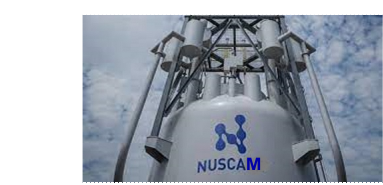
The nuclear industry is banking on a revival and placing its bets on SMRs like those proposed by the Portland, Oregon-based NuScale Power Corporation, whose novel 60-megawatt SMR design was approved by the Nuclear Regulatory Commission (NRC) in 2022. While the underlying physics is the same as all nuclear power plants, SMRs are easier to build and safer to run than the previous generation of nuclear facilities — or so go the claims of those looking to profit from them.
NuScale’s design acceptance was a first in this country where 21 SMRs are now in the development stage. Such facilities are being billed as innovative alternatives to the hulking commercial reactors that average one gigawatt of power output per year and take decades and billions of dollarsto construct. If SMRs can be brought online quickly, their sponsors claim, they will help mitigate carbon emissions because nuclear power is a zero-emissions energy source.
Never mind that it’s not, since nuclear power plants produce significant greenhouse gas emissions from uranium mining to plant construction to waste disposal. Life cycle analyses of carbon emissions from different energy sources find that, when every stage is taken into account, nuclear energy actually has a carbon footprint similar to, if not larger than, natural gas plants, almost double that of wind energy, and significantly more than solar power.
“SMRs are no longer an abstract concept,” Assistant Secretary for Nuclear Energy Kathryn Huff, a leading nuclear advocate who has the ear of the Biden administration, insisted. “They are real and they are ready for deployment thanks to the hard work of NuScale, the university community, our national labs, industry partners, and the NRC. This is innovation at its finest and we are just getting started here in the U.S.!”
A Risky (and Expensive) Business
Even though Huff claims that SMRs are “ready for deployment,” that’s hardly the case. NuScale’s initial SMR design, under development in Idaho, won’t actually be operable until at least 2029 after clearing more NRC regulatory hurdles. The scientists of the Intergovernmental Panel on Climate Change are already calling for fossil-fuel use to be cut by two-thirds over the next 10 years to transition away from carbon-intensive energy, a schedule that, if kept, such small reactors won’t be able to speed up.
And keep in mind that the seemingly prohibitive costs of the SMRs are a distinct problem. NuScale’s original estimate of $55-$58 per megawatt-hour for a proposed project in Utah — already higher than wind and solar which come in at around $50 per megawatt-hour — has recently skyrocketed to $89 per megawatt-hour. And that’s after a $4 billion investment in such energy by U.S. taxpayers, which will cover 43% of the cost of the construction of such plants. This is based on strikingly rosy, if not unrealistic, projections. After all, nuclear power in the U.S. currently averages around $373 per megawatt-hour.
And as the Institute for Energy Economics and Financial Analysis put it:
“[N]o one should fool themselves into believing this will be the last cost increase for the NuScale/UAMPS SMR. The project still needs to go through additional design, licensing by the U.S. Nuclear Regulatory Commission, construction, and pre-operational testing. The experience of other reactors has repeatedly shown that further significant cost increases and substantial schedule delays should be anticipated at any stages of project development.”
Here in the Pacific Northwest, NuScale faces an additional obstacle that couldn’t be more important: What will it do with all the noxious waste such SMRs are certain to produce? In 1980, Oregon voters overwhelmingly passed Measure 7, a landmark ballot initiative that halted the construction of new nuclear power plants until the federal government established a permanent site to store spent nuclear fuel and other high-level radioactive waste. Also included in Measure 7 was a provision that made all new Oregon nuclear plants subject to voter approval. Forty-three years later, no such repository for nuclear waste exists anywhere in the United States, which has prompted corporate lobbyists for the nuclear industry to push several bills that would essentially repeal that Oregon law.
NuScale, no fan of Measure 7, has decided to circumvent it by building its SMRs across the Columbia River in Washington, a state with fewer restrictions. There, Clark County is, in its own fashion, beckoning the industry by putting $200,000 into a feasibility study to see if SMRs could “benefit the region.” There’s another reason NuScale is eyeing the Columbia River corridor: its plants will need water. Like all commercial nuclear facilities, SMRs must be kept cool so they don’t overheat and melt down, creating little Chernobyls. In fact, being “light-water” reactors, the company’s SMRs will require a continuous water supply to operate correctly.
Like other nuclear reactors, SMRs will utilize fission to make heat, which in turn will be used to generate electricity. In the process, they will also produce a striking amount of waste, which may be even more challenging to deal with than the waste from traditional reactors. At the moment, NuScale hopes to store the nasty stuff alongside the gunk that the Trojan Nuclear Plant produces in big dry casks by the Columbia River in Oregon, near the Pacific Ocean.
As with all the waste housed at various nuclear sites nationwide, Trojan’s casks are anything but a permanent solution to the problem of such waste. After all, plutonium garbage will be radioactive for hundreds of thousands of years. Typically enough, even though it’s no longer operating, Trojan still remains a significant risk as it sits near the Cascadia Subduction Zone, where a “megathrust” earthquake is expected someday to violently shake the region and drown it in a gigantic flood of seawater. If that were to happen, much of Oregon’s coastline would be devastated, including the casks holding Trojan’s deadly rubbish. The last big quake of this sort hit the area more than 300 years ago, but it’s just a matter of time before another Big One strikes — undoubtedly, while the radioactive waste in those dry casks is still life-threatening.
Nuclear expert M. V. Ramana, a soft-spoken but authoritative voice in Jan Haaken’s Atomic Bamboozle documentary, put it this way to me:
“The industry’s plans for SMR waste are no different from their plans for radioactive waste from older reactors, which is to say that they want to find some suitable location and a community that is willing to accept the risk of future contamination and bury the waste underground.
“But there is a catch [with SMR’s waste]. Some of these proposed SMR designs use fuel with materials that are chemically difficult to deal with. The sodium-cooled reactor design proposed by Bill Gates would have to figure out how to manage the sodium. Because sodium does not behave well in the presence of water and all repositories face the possibility of water seeping into them, the radioactive waste generated by such designs would have to be processed to remove the sodium. This is unlike the fleet of reactors [currently in operation].”
Other troubles exist, too, explains Ramana. One, in particular, is deeply concerning: the waste from SMRs, like the waste produced in all nuclear plants, could lead to the proliferation of yet more atomic weaponry.
Nuclear Hot Links
As the pro-military Atlantic Council explained in a 2019 report on the deep ties between nuclear power and nuclear weapons in this country:
“The civilian nuclear power sector plays a crucial role in supporting U.S. national security goals. The connectivity of the civilian and military nuclear value chain — including shared equipment, services, and human capital — has created a mutually reinforcing feedback loop, wherein a robust civilian nuclear industry supports the nuclear elements of the national security establishment.”
In fact, governments globally, from France to Pakistan, the United States to China, have a strategic incentive to keep tabs on their nuclear energy sectors, not just for potential accidents but because nuclear waste can be utilized in making nuclear weapons.
Spent fuel, or the waste that’s left over from the fission process, comes out scalding hot and highly radioactive. It must be quickly cooled in pools of water to avoid the possibility of a radioactive meltdown. Since the U.S. has no repository for spent fuel, all this waste has to stay put — first in pools for at least a year or more and then in dry casks where air must be constantly circulated to keep the spent fuel from causing mayhem.
The United States already has a troubling and complicated nuclear-waste problem, which worsens by the day. Annually, the U.S. produces 88,000 metric tons of spent fuel from its commercial nuclear reactors. With the present push to build more plants, including SMRs, spent fuel will only be on the rise. Worse yet, as Ramana points out, SMRs are going to produce more of this incendiary waste per unit of electricity because they will prove less efficient than larger reactors. And therein lies the problem, not just because the amount of radioactive waste the country doesn’t truly know how to deal with will increase, but because more waste means more fuel for nukes.
As Ramana explains:
“When uranium fuel is irradiated in a reactor, the uranium-238 isotope absorbs neutrons and [transmutes] into plutonium-239. This plutonium is in the spent fuel that is discharged by the reactor but can be separated from the rest of the uranium and other chemicals in the irradiated fuel through a chemical process called reprocessing. Once it is separated, plutonium can be used in nuclear weapons. Even though there are technical differences between different kinds of nuclear reactors, all reactors, including SMRs, can be used to make nuclear weapons materials… Any country that acquires a nuclear reactor automatically enhances its ability to make nuclear weapons. Whether it does so or not is a matter of choice.”
Ramana is concerned for good reason. France, as he points out, has Europe’s largest arsenal of nuclear warheads, and its atomic weapons industry is deeply tied to its “peaceful” nuclear energy production. “Without civilian nuclear energy there is no military use of this technology — and without military use there is no civilian nuclear energy,” admitted French President Emmanuel Macron in 2019. No surprise then, that France is investing billions in SMR technology. After all, many SMR designs require enriched uranium and plutonium to operate, and the facilities that produce materials for SMRs can also be reconfigured to produce fuel for nuclear weapons. Put another way, the more countries that possess this technology, the more that will have the ability to manufacture atomic bombs.
As the credits rolled on Atomic Bamboozle, I glanced around the packed theater. I instantly sensed the shock felt by movie-goers who had no idea nuclear power was priming for a comeback in the Northwest. Lloyd Marbet, arms crossed, was seated at the back of the theater, looking calmer than most. Still, I knew he was eager to lead the fight to stop SMRs from reaching the shores of the nearby Columbia River and would infuse a younger generation with a passion to resist the nuclear-industrial complex he’s been challenging for decades.
“Can you believe we’re fighting this shit all over again?” he asked me later with his usual sense of urgency and outrage. “We’ve beat them before and you can damn well bet we’ll do it again.”
Nuclear catastrophe is unacceptable. The U.S. set a global precedent of carelessness surrounding environmental degradation, creating a nuclear nightmare. Though highly contested, Japan plans to dump over a million tons of radioactive waste into the ocean. Robert Richmond, a biologist at the University of Hawaii, shared with NPR that scientists agree the resulting exposure could potentially damage the DNA of marine life.
“We are unanimous in our view that this has not been proven to be safe,” Richmond said. While the plan is approved by the UN’s nuclear watchdog, activists and scientists don’t believe there is enough evidence that the waste isn’t harmful. These regulations are just for show if scientists “unanimously” agree they aren’t well-founded.
The pro-nuclear argument for nearly unlimited energy neglects the present reality that humanity must simply consume less of everything. HEAL Utah, Living Rivers and Uranium Watch stand together against water-hungry nuclear projects in Utah. If we want a lasting and safe energy revolution, we must not engage in nuclear projects, which inevitably degrade local life.
Energy Colonialism
Roger Renteria, a Chicano scholar pursuing his Ph.D. in sociology, offered insight into local environmental degradation. He detailed uranium extraction affecting Indigenous communities, specifically the Navajo Nation.
“[Extraction is] deeply tied into colonialism and the wastelanding of Indigenous spaces and Indigenous people,” Renteria said, describing the process as “energy colonialism.”
From nuclear testing in the Pacific to the targeted destruction of nuclear installations, those in authority prioritize power and also profit. Endless imperial expansion is a logic of conquest and colonization — a desire for endless consumption creates a psychological illness of retention.
Mega-exploiters weaponize these desires against people to blind them to long-term ecological destruction. Today, the uber-wealthy are killing off Indigenous and working-class people for the sake of conveniences made possible by nuclear energy. The most privileged are imposing these ethical responsibilities onto the most vulnerable.
Wastelanding
“We try to separate humanity from the environment, but we are the environment, as well,” Renteria said.
Radioactive waste is already being sent to Utah and the lack of effective regulations surrounding it is already affecting our Indigenous First People. If we wasteland Indigenous spaces, we wasteland Indigenous people. We must not accept this blatant disregard for our communities as the norm.
Utah considers nuclear power to be a potential solution to address climate change. First People downstream from us are the most likely to be impacted by nuclear power. We must not cave to new nuclear installations: nuclear energy is not “clean,” though many believe it to be.
Uranium ore is an essential product for nuclear reactors. Both mining and refining uranium are major environmental concerns because they produce radioactive waste. Uranium mill tailings and spent reactor fuel remain radioactive for thousands of years and become more radioactive as they decay. A reduction in carbon emissions is not always a reduction in environmental cost.
Utah doesn’t have any nuclear facilities that produce the waste it is tasked with maintaining. Even low-level waste requires large amounts of land that become entirely unusable for the foreseeable future. Importation of radioactive waste to Indigenous territories across the American West elevates this problem from environmental degradation to environmental racism.
Waste sites with unregulated disposal practices are often near Indigenous communities. Ongoing protests challenge this environmental racism contributing to the uptick of cancer cases in the Ute Nation near the White Mesa Mill. The nuclear industry targets communities that have no control over their landscape or can’t turn down the money offered for their land rights.
Renteria shared about a case in Monticello, UT where women from the Navajo Nation experienced increased rates of breast cancer. Their families were devastated by the nuclear industry because the men who worked in nearby uranium mines exposed their households to radiation. This tragedy urgently points to the fact that intimacy should never kill, but we have created a world where it can.
Environmental Racism Resistance
“Future generations will have to deal with the effects of radioactive waste,” Renteria said. He emphasized the cascade of harm that our settler nation has already inflicted on Indigenous people. He added when we layer on waste, we only offer “violence to the folks who feel it transgenerationally.” The U.S. government already refuses to take responsibility for Indigenous water rights: protecting commercial interests is of greater importance than clean water for the Navajo Nation, as demonstrated in a recent U.S. Supreme Court ruling.
Renteria said First People would benefit from a seat at the table, while acknowledging the present systems of power are not adequately fit to incorporate their voices. “You get damned in terms of limited access to the table, and then when you get access, you get damned by those dismissing [Indigenous] information and knowledge,” Renteria said. Settler culture otherizes Indigenous ways of knowing. The inability of capitalism to mesh with sustainable existence points to our society’s active refusal to prioritize human well-being.
Collectively
We as a collective must consume less energy, clothing and water. But the most privileged both consume and waste the most. The wealthiest consume up to a million times more energy than the less privileged. It is for this reason that we must oppose projects that further enrich the wealthy. Stand with your fellow humans in efforts that urge for a more equitable distribution of wealth, like workers’ unions.
Renteria noted that Indigenous people face a “lack of political power because the political system doesn’t truly value them.” He said that we face environmental destruction because of “human activity within a specific system,” featuring cogs of capitalism, energy colonialism and wastelanding.
The plastics industry promotes recycling to shift the blame for ecological impact onto consumers and keep plastic in production. The petroleum industry invented the concept of “carbon footprint” to shift responsibility for pollution onto the consumer. Our response to corporate deflection must be to demand accountability for the harm being imposed on our planet and our bodies.
For a better and more sustainable way of life, we must first invest in a lifestyle change. The consumerist tendency to buy first and repent for ecological destruction later must go. We are not in a confession booth. The impact of our energy choices can’t be wished away once we realize capitalistic endeavors have been prioritized over human well-being. Any nuclear waste is too much nuclear waste.
The choice to change the way we see energy must take place before the point of environmental collapse. We must not seek to sustain the unsustainable.
Rather than increasing energy efficiency and productivity and reducing the need for new energy resources, the province has chosen nuclear expansion.
The Star, By Mark Winfield , Friday, July 21, 2023
The consequences of these decisions for Ontario electricity ratepayers and taxpayers are likely to stretch far into the future. No cost estimates are available for the proposed nuclear projects. The bids submitted as part of the province’s last attempt at a new-build nuclear project would optimistically suggest costs in the range of $50 billion for the Bruce project alone. The costs of the four smaller reactors proposed for Darlington remain unknown, given that none of the proposed type of reactor have ever been built or operated before anywhere in the world.
………………………………………. private capital has been hesitant to engage with nuclear projects, and progress on a much-touted nuclear “renaissance” in Europe and North America has been slow. This has been despite aggressive efforts by governments to guarantee returns on investment and assume ultimate liability for waste management, decommissioning costs and accidents. It is no surprise that the only significant investor in the first of the proposed new “small” reactors at Darlington was the federal government’s own Infrastructure Bank.
A rational planning process around electricity and decarbonization would have prioritized the options with the lowest economic, environmental, technological and safety risks first. Higher risk options, like new nuclear, should only be considered where it can be demonstrated that the lower-risk options have been fully optimized and developed in the planning process.
…………………………….. The good news is that the province’s announcements remain at a preliminary stage — key technical approvals for new build reactor projects will still be needed and their economics remain very open questions. There may still be time for Ontario to move toward a more rational, open, and evidence-based approach to energy planning and decarbonization. But nuclear proponents will be doing everything they can to lock in the government’s choices as quickly as possible. https://www.thestar.com/opinion/contributors/ontario-opts-for-high-risk-nuclear-over-low-risk-energy-sources/article_49afb2a3-7cca-5dee-bc2b-5d57eef76a75.html
France and Germany lead the camps in disagreeing on the future of nuclear in Europe. Camille Lafrance and Benjamin Wehrmann at CLEW take a deep dive into the reasons why, quoting experts and politicians. Germany’s vision of a fully renewables-based EU is at odds with France’s unwavering support for low-carbon nuclear energy. European-wide agreement on targets matter because they drive future investment in the targeted technologies and the design of Europe’s grid, markets, policies, budgets and all the rest. A nuclear-light renewables-heavy Europe will look very different from one where nuclear baseload sits robustly within the cross-border market. And a major concern is that more nuclear means less renewables, at a time when wind and solar need all the scale they can get. Yet nuclear is fossil-free too, and France has the lowest emissions per head of any rich country. If agreement cannot be met, can Europe meet its decarbonisation goals? Time is running out.
The role of nuclear power in Europe’s transition away from fossil fuels has been a point of contention between French and German governments for a long time. In the year 2000, Germany decided to phase out nuclear energy and, despite temporarily backtracking on its decision before the Fukushima nuclear disaster in 2011, ultimately completed its nuclear exit in April 2023.
France, on the other hand, has the highest share of nuclear in the energy mix of any country in the world and, despite temporarily considering to radically cut its reliance on nuclear power after Fukushima, has committed to building many new reactors as part of its bid to meet European climate targets and net-zero emissions by 2050.
…………………. disputes about nuclear energy between France and Germany come with major implications for the strategic positioning on energy and climate policy of the whole EU.
…………………………………… …Nuclear safety
And also nuclear safety concerns continue to occupy experts in France as much as anywhere. In mid-2023, 800 French scientists warned against the risks of the country’s new nuclear programme, pointing to unresolved questions of radioactive waste management, which remain largely unresolved in most of the EU, including in France. The scientists also warned against risks of accidental contamination or meltdown.
…Prices, costs
Securing funding from Brussels for the major buildout is regarded as a substantial challenge to France’s plans.
In France, investments in renewable energy have been on the rise since 2016, as costs have gone down. According to data by U.S. investment bank Lazar, prices per megawatt hour (MWh) produced with renewables have dropped dramatically between 2009 and 2019 alone, while that of nuclear power went up. Solar power generation costs dropped nearly 90 percent to 40 dollars per MWh and onshore wind 70 percent to 41 dollars per MWh. Nuclear power costs per unit in the same decade increased 26 percent to 155 dollars per MWh. Meanwhile, nuclear power construction costs have risen, while future EPR costs are still uncertain. The sharp rise in interest rates has made building new nuclear plants even more expensive, compounded by reactor construction delays. Nuclear plant operator Electricite de France estimated the cost to be at least 51 billion euros. A convincing policy framework allowing Paris to classify the nuclear bill as an investment in the EU Green Deal could thus send and important signal to potential nuclear power investors.
France also pushed to include nuclear energy in the EU’sRenewable Energy Directive (RED), a target it achieved after protracted negotiations that saw the country form a ‘nuclear alliance’ with sympathetic governments and in opposition to Germany’s insistence on limiting funding to renewable power installations. The French energy minister, Agnes Pannier-Runacher, in mid-2023 said it was “regrettable that Germany is applying the brake” on reforms that enhance nuclear power’s role, arguing this would fail to take the position of a majority of EU countries into account.
Germany’s priorities largely in line with international trends
But the lack of a shared vision extends beyond the bilateral relationship of France and Germany. European Commission President Ursula von der Leyen declared in spring 2023 that nuclear power was not a ‘strategic’ technology in reaching the EU’s climate goals. Nevertheless, the technology remains at the heart of many debates at the European level. ……………………………………………………………………………………………………….. https://energypost.eu/does-nuclear-slow-down-the-scale-up-of-wind-and-solar-france-and-germany-cant-agree/
ABP News Bureau, 2023-07-23 North Indian states are reeling under severe monsoon mayhem as roads are flooded, rivers are flowing over the danger mark, and waterlogging is hindering all kinds of commute leaving residents helpless. After wreaking havoc in the hill states of Uttarakhand and Himachal Pradesh, heavy showers in Maharashtra, and Gujarat have created a flood-like situation in the two states. Meanwhile, a cloudburst in Ladakh and a fresh spell of rain in Uttarakhand have raised the threat of a rise in the water level again in Delhi which has witnessed the worst flooding since 1978. Here are the latest updates on monsoon fury from across the country:
Governor Sergey Aksyonov has ordered a mass evacuation from the danger zone
A Ukrainian drone strike has resulted in an explosion at an ammunition depot in the central part of the Crimean peninsula, local Governor Sergey Aksyonov said on Saturday. According to preliminary information, the incident has not resulted in any casualties, he added.
Writing on Telegram, Aksyonov said the detonation had taken place in the Krasnogvardeysky district. “A decision has been made to evacuate the population within a 5km radius from the site of the emergency and place them in temporary accommodation facilities,” he added.
The governor stated that the authorities had also suspended rail traffic in the area in order to “minimize risks,” while expressing hope that the emergency would be dealt with quickly.
The Ukrainian Armed Forces have confirmed the strikes, claiming that they “had destroyed an oil depot and Russian military warehouses” in the area.
Crimea has repeatedly been targeted by Ukrainian drone and missile attacks since Moscow launched its military operation against Kiev over a year ago. On Thursday, Aksyonov said a Ukrainian UAV raid on the peninsula had killed a teenage girl and damaged several administrative buildings.
Earlier this week, a sea drone strike on the Crimean Bridge – which Russia called a Ukrainian terrorist attack – damaged one section of the roadway and claimed the lives of a married couple from Belgorod Region, as well as injuring their 14-year-old daughter.
Kiev stopped short of claiming responsibility, but celebrated the incident, while Ukrainian President Vladimir Zelensky later called the bridge a legitimate military target.
Meanwhile, Russian President Vladimir Putin has condemned the raid as a “terrorist attack” that was pointless from a military standpoint, adding that the bridge has not been used for transporting military materials for a long time. In the aftermath of the incident, Moscow launched several “retaliatory strikes” on targets in Ukrainian port cities.
EDF will need to invest around 25 billion euros ($28 billion) each year to keep its nuclear fleet and network in shape and build new reactors required for France’s energy transition, the company’s CEO said on Wednesday.
Grilled by lawmakers during a hearing before the French National Assembly’s economic affairs committee, EDF’s Luc Remont said France also needed to rethink parts of the company’s business model and its electricity tariff policy to allow the utility to boost investments.






 nuclear-news