Event: What’s Next for Nuclear Risk Reduction
Production Date, 01 Aug 2023 https://unidir.org/events/whats-next-nuclear-risk-reduction
Concerns over nuclear risks have been steadily growing over the past decade, leading the UN Secretary General António Guterres to describe the current situation as “a time of nuclear danger not seen since the height of the Cold War”. As a response, efforts to address nuclear risk have started across different fora. The 2022 NPT Review Conference draft Final Document prominently featured nuclear risk reduction measures. However, multiple approaches still exist on how to address nuclear risk in the most efficient way.
UNIDIR and the Government of Switzerland will host a side event “What’s Next for Nuclear Risk Reduction” on the sidelines of the Preparatory Committee for the Eleventh Review Conference of the Treaty on the Non-Proliferation of Nuclear Weapons. The event will discuss recent and ongoing strains of work and investigate what could be done to move the nuclear risk reduction agenda forward collectively.
The speakers will include:
- Amb. Benno Laggner, Permanent Representative of Switzerland to the IAEA and CTBTO,
- Mr. Andrey Baklitskiy, Senior Researcher at UNIDIR,
- Ms. Gaukhar Mukhatzhanova, Director of IONP Program at VCDNP,
- Ms. Alexandra Bell, Deputy Assistant Secretary at the US State Department,
- Ms. María Antonieta Jáquez Huacuja, Coordinator for Disarmament and Nonproliferation at the Ministry for Foreign Affairs of Mexico
WHEN & WHERE
Hybrid Format – Tuesday, August 1, 2023 | 13:15–14:30 CEST | Press Room, Vienna International Centre, Vienna, Austria; and online
Light lunch will be provided at 13:00.
PARTICIPANTS
This is a hybrid event. Participants of the NPT Preparatory Committee are welcomed to join in person
To join online, register here. A link for registered virtual participants will be shared the day before the event.
For any questions, please contact Andrey Baklitskiy at andrey.baklitskiy@un.org.
When 01 August 2023
Whereb Hybrid
Bombs away: Confronting the deployment of nuclear weapons in non-nuclear weapon countries
Bulletin, By Moritz Kütt, Pavel Podvig, Zia Mian | July 28, 2023
The countries of the Nuclear Nonproliferation Treaty (NPT) will meet in Vienna at the end of July and in early August to begin another several-year-long cycle of assessing progress on meeting the goals and obligations of this five-decade-old agreement. A particularly contentious part of the coming global nuclear debate will be the handful of NPT countries that do not have nuclear weapons of their own but instead choose to host nuclear weapons belonging to the United States or Russia. For most NPT countries, such nuclear weapon-hosting arrangements are unacceptable Cold War holdovers that should end.
The new urgency for action on the issue of nuclear host-states follows the first new agreement to transfer nuclear weapons to a host country in many decades. In June 2023, President Vladimir Putin announced that Russia had moved a number of its nuclear weapons to Belarus, its ally and neighbor, with more nuclear weapons on the way, and that “by the end of the summer, by the end of this year, we will complete this work.” For his part, the President of Belarus has proposed to other states: “Join the Union State of Belarus and Russia. That’s all: there will be nuclear weapons for everyone.”
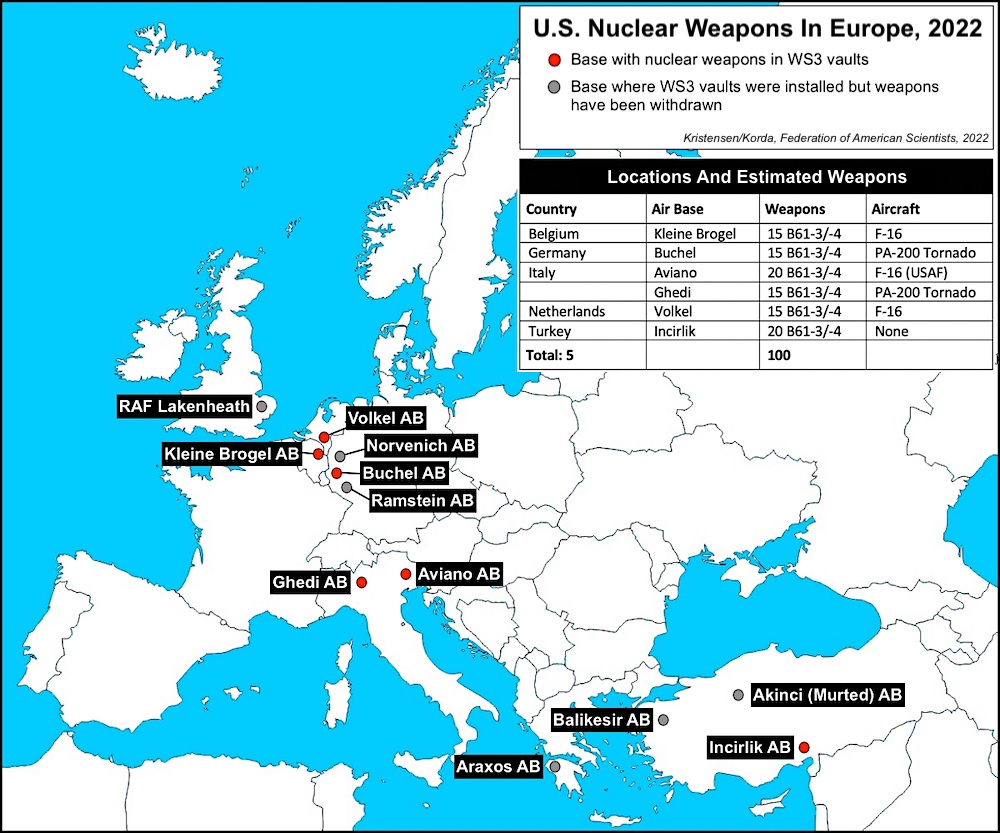
If the transfer of weapons to Belarus is completed, it will become the sixth nuclear-weapon host state. The other five hosting arrangements involve US nuclear weapons in Belgium, the Netherlands, Germany, Italy, and Turkey, in a practice euphemistically dubbed “nuclear sharing” by the US and its NATO allies. One other NATO member is increasingly vocal about wanting to join this gang. After Putin’s announcement about Belarus, Polish Prime Minister Mateusz Morawiecki repeated the call to become a host state for US nuclear weapons. Poland’s President Andrzej Duda had brought up this hosting option last year, but the idea had been floated in 2020 by Poland’s Ambassador to the United States………………………………………………………………………………….
There is a partially declassified history of US foreign nuclear weapon deployments from 1951-1977. The practice of stationing nuclear weapons in allied countries (or territories) began in 1951 with the deployment of weapon components to Guam, followed in 1954 by the dispatch of weapons to Morocco and the United Kingdom. In time, the US stationed its nuclear weapons in 16 countries, mostly in Europe and Asia (not counting Guam and Puerto Rico). Some US nuclear weapons were also stationed in Canada. By the late 1960s, there were about 7,000 US nuclear weapons in Europe, including bombs, missile warheads, artillery shells, and nuclear landmines. The number of US nuclear weapons in Europe peaked in 1971 at about 7,300 before beginning to decline later in the 1970s.
In 1959, the Soviet Union briefly deployed weapons to Eastern Germany. Its most prominent (albeit short-lived) nuclear weapons deployment was to Cuba in 1962. Later, in the mid-‘60s, longer deployments started, with Soviet nuclear weapons going to the Czech Republic, Hungary, Mongolia, Poland, and, again, East Germany. Moscow also deployed nuclear weapons in the Soviet republics, including strategic nuclear weapons in Kazakhstan, Belarus, and Ukraine.
With the end of the Cold War, the United States and Russia began to bring their weapons home. The Soviet Union had removed all weapons from Eastern Europe by the time it broke up in 1991. The withdrawal of all non-strategic weapons from former Soviet republics came by May 1992, and all strategic weapons were returned in November 1996.
Most US nuclear deployments in Asia ended in the mid-‘70s, although nuclear weapons stayed in South Korea until 1991. Deployments in Europe were significantly reduced (below 500 in 1994) and ended in Greece (2001) and in the United Kingdom (2009). However, the United States has not completed this process; about 100 US weapons remain abroad, stationed at bases in Belgium, the Netherlands, Germany, Italy and Turkey. Rather than withdraw the weapons from these countries, the US is sending modernized nuclear weapons to replace them.
The United Kingdom was the only other country to both host weapons (belonging to the US) and to deploy its own weapons in other countries. Its foreign deployments began in the 1960s and were limited to Cyprus, Singapore, and West Germany, and this practice ended in 1998.
There is no information on foreign deployments and nuclear hosting arrangements by other nuclear weapon states. There have been concerns that Pakistan might station some of its nuclear weapons in Saudi Arabia, with former US officials suggesting a “NATO-like model” might be one option for such an arrangement.
In current US nuclear hosting arrangements, the nuclear weapons are supposed to be under the control of US military personnel in peacetime. Specially trained host-nation air force units will carry and use these US weapons in wartime, in accordance with US and allied nuclear war plans. A similar arrangement now exists between Russia and Belarus, with Belarussian pilots trained to fly their planes while armed with Russian nuclear weapons; at least 10 planes may now be nuclear capable. It is also possible that Belarus could use its Russian-supplied, intermediate-range, dual-use Iskander-M missiles to deliver nuclear warheads.
According to the United Nations, the Russian nuclear hosting agreement with Belarus is the first such agreement since the NPT entered into force in 1970. The other hosting arrangements still operating are based on agreements that predate the treaty. The NPT prohibits both the acquisition of nuclear weapons by non-weapon states and the transfer of nuclear weapons to such countries by the five nuclear weapon states who are parties (Russia, China, the United States, the United Kingdom, and France)…………………………………….
While the treaty was being negotiated, US and Soviet officials agreed privately that existing nuclear hosting arrangements could continue even under the NPT.……………………………….
Most NPT member states have a different interpretation of nuclear sharing and for almost three decades have raised their concerns. …………………………………..
The most recent clash came at the August 2022 NPT Review Conference. Speaking on behalf of the 120 countries of the Non-Aligned Movement, Indonesia, said “[i]n the view of the Group … nuclear weapon-sharing by States Parties constitutes a clear violation of non-proliferation obligations undertaken by those Nuclear Weapon States (NWS) under Article I and by those Non-Nuclear Weapon States (NNWS) under Article II.” ………………………………………………………………
China is the only NPT nuclear-weapon state now consistently opposed to nuclear sharing. In its 2022 NPT Review Conference statement, China’s representative stated that “nuclear sharing arrangements run counter to the provisions of the NPT.” …………………………………………………………….
The most significant effort to confront the principles and practices of nuclear hosting is the UN Treaty on the Prohibition of Nuclear Weapons, which entered into force in 2021 and currently has almost 100 state signatories (all of whom also are NPT members). The TPNW prohibits the stationing of foreign nuclear weapons on the soil of its state parties under any circumstances. It offers a means for states who do not wish to be nuclear hosts to affirm this commitment and make it legally binding simply by joining the treaty. The TPNW also offers a path to membership for the states who currently have nuclear weapon hosting arrangements—if they sign the treaty they must undertake “prompt removal of such weapons, as soon as possible” and not later than 90 days. Once the weapons have been sent back home, the country has to make a declaration to this effect to the UN Secretary-General.
For states not yet ready to join the TPNW, several options are possible. States individually could decide to renounce nuclear hosting and sharing. For European NATO countries, one example is offered by Iceland and Lithuania, which are NATO members but refuse to host nuclear weapons under any circumstances. A less clear-cut option is offered by Denmark, Norway, and Spain, which do not allow deployment of nuclear weapons in peacetime.
States could also form nuclear-weapon free zones: Over 110 countries already are in nuclear-weapon-free zone agreements with neighbors. A European nuclear weapon free zone has been a long-standing idea. ………………………………………………
There are of course things nuclear weapon states could do. The five NPT nuclear weapon states could agree to a commitment on no-foreign-deployments as an effective measure relating to nuclear disarmament under their NPT Article 6 obligations…………………………………………
To establish a global principle, the UN General Assembly and the UN Security Council could determine that the hosting of nuclear weapons will henceforth be treated as a threat to international peace and security. https://thebulletin.org/2023/07/bombs-away-confronting-the-deployment-of-nuclear-weapons-in-non-nuclear-weapon-countries/
Archdioceses of Santa Fe and Seattle Delegation to Travel to Hiroshima and Nagasaki
A delegation from the Archdioceses of Santa Fe and Seattle is embarking on a transformative Pilgrimage of Peace to the Japanese cities of Tokyo, Akita, Kyoto, Hiroshima, and Nagasaki, from July 31 to August 12, 2023. The delegation comprises Most Reverend John C. Wester, Archbishop of Santa Fe, and Most Reverend Paul D. Etienne, Archbishop of Seattle, along with representatives from various organizations and archdiocesan offices dedicated to nuclear disarmament and social justice. Funding for the Archdiocese of Santa Fe delegation is strictly through grants and personal contributions; no funds from the Archdiocese of Santa Fe are being used.
Saving the world is cheaper than ruining it
https://futurecrunch.com/good-news-clean-energy-aids-big-cats-africa/?ref=future-crunch-newsletter 27 July 23
Let’s do a quick global whiparound. A former coal plant in the UK is being transformed into the world’s largest battery storage project; European renewables giant Octopus is planning to invest $20 billion in offshore wind by 2030; Thyssenkrupp, Europe’s second-largest steelmaker, has secured €2 billion from the German government for green steel investment; US regulators just opened the Gulf of Mexico to offshore wind leases; Egypt has brought its clean energy targets forward by five years and allocated land for a 10 GW wind project to provide electricity to 11 million households; Israel now requires all new non-residential buildings to be covered in solar; India is about to launch a staggering 20 GW tender for new battery manufacturing; 4.4 GW of rooftop solar has been installed in South Africa in the last year; the Philippines just awarded a whole lot of new solar projects; Brazil says its solar industry has created around 960,000 jobs since 2012; and Barbados is now targeting a 100% carbon neutral economy by 2030.
In the last six months nearly every mainstream media outlet has pointed out that China is still building a lot of coal, implying the country is hedging its bets on renewables. It’s not. In the first half of 2023, around $5 billion has been invested in coal and fossil gas and a similar amount in both hydro and nuclear; $10 billion has been invested in wind, $18 billion in solar, and an astonishing $28 billion in transmission.
The IEA has a new report showing that renewables are on track to meet all the growth in global electricity demand over the next two years. This would represent a key milestone in the fight against climate change–once all new demand is met, renewables will start eating into fossil fuels’ share of the power mix.
The global price of polysilicon (the stuff they make solar panels from) has dropped by 78% over the past year.
Since August 2022, $278 billion in clean energy project investments and 170,600 clean energy jobs have been created in the United States. ‘We’ve been talking about bringing manufacturing jobs back to America for my entire life. We’re finally doing it, right? That’s pretty exciting.’ WaPo
The US offshore wind sector is booming. There has been a 272% increase in the number of offshore wind supplier contracts since 2021, and 47% of that growth has occurred since the passage of the IRA. Nine in every ten contracts are going to companies that are either headquartered or have a presence in the US. Industrial policy FTW. Renew.biz
The 12.5% royalty rate that oil companies in the United States have to pay for the use of federal lands has remained unchanged for over one hundred years. The government is now reforming that system, raising the minimum rate to 16.7% and prioritising renewables development on federal lands over fossil fuel development. Grist.
In the first half of this year, wind and solar generated more power than coal in the United States. Wind and solar produced 343 terawatt-hours (TWh) from January through June 2023, while coal produced 296 TWh. Five years ago, coal’s share was quadruple that of wind and solar combined. Next step: fossil gas. Canary
California, the seventh-biggest US crude oil producer, has put a near-halt on issuing permits for new drilling this year. The state’s Geologic Energy Management Division has approved seven new active well permits in 2023. Compare that with the more than 200 it had issued by this time last year. Reuters
Australia’s big banks have turned their backs on the country’s largest coal miner, refusing to refinance a billion-dollar debt in a major rebuff that will force Whitehaven Coal to source loans offshore, potentially speeding up the demise of the sector. Couldn’t have happened to nicer people. SMH
The European Union has adopted new rules intended to make it easier for electric vehicle owners to travel across the continent. From 2025 onward, the new regulation requires fast-charging stations offering at least 150kW of power to be installed every 60km along the EU’s TEN-T system of highways, the bloc’s main transport corridors. Verge
A reminder from Hannah Ritchie. ‘The internal combustion engine is shockingly inefficient. For every dollar of petrol you put in, you get just 20 cents’ worth of driving motion. The other 80 cents is wasted along the way, most of it as heat from the engine. Electric cars are much better at converting energy into motion. For every dollar of electricity you put in, you get 89 cents out.’………………………………………………………………
NASA solving climate crisis by facilitating escape to Mars?
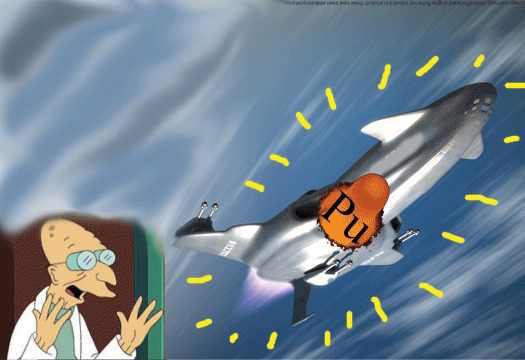
NASA will test launch nuclear-powered spacecraft for the first time to try
and get to Mars faster. Nasa has revealed that it plans to use
nuclear-powered spacecrafts to help humanity land on Mars. Whilst it sounds
like the stuff of science fiction, the space agency has been perfecting the
technology for over 60 years and the first rockets could soon be blasting
off. In fact, the insane tech could be tested within the next couple of
years.
Unilad 27th July 2023
https://www.unilad.com/technology/nasa/nasa-nuclear-powered-rockets-mars-574302-20230727
Russia prepared to seek diplomatic solution in Ukraine, NATO refuses to talk

https://www.rt.com/news/580452-putin-ukraine-nato-talks/ 28 Jul 23
The president says that differences should be resolved at the negotiating table
Russia is prepared to seek a diplomatic solution to the crisis in Ukraine but Kiev and its backers in the US and NATO refuse to talk to Moscow, Russian President Vladimir Putin has said.
“All differences must be solved at the negotiating table,” Putin told African leaders during the Russia-Africa Summit in St. Petersburg on Friday.
“The problem is that they [Ukraine] are refusing to talk to us,” he insisted.
“The current Ukrainian regime is also rejecting negotiations, and announced that officially. Ukrainian President [Vladimir Zelensky] had signed a relevant decree” last autumn, Putin said.
The Russian leader claimed that the root of the conflict between Moscow and Kiev was “the creation of threats to Russia’s security by the US and NATO.”
However, Washington and its allies also “reject negotiations on the issues of assuring equal security for all sides, including Russia,” he added.
“We’ve said many times – and I’ve stated it officially – that we’re ready for those talks,” Putin insisted.
“We can’t force those negotiations on them,” he said, adding that “there needs to be dialogue with the other side too” on the part of the international community in order to persuade Ukraine to engage in talks.
Putin also stressed that Moscow is “grateful to African friends” for their efforts to find a peaceful solution to the Ukraine conflict.
A mission of senior African leaders and officials, including the presidents of South Africa, Senegal, and Zambia, visited St. Petersburg and Kiev in mid-June to propose their ten-point peace initiative to Putin and Zelensky.
The African plan calls for security guarantees and the free movement of grain through the Black Sea, as well as the release of prisoners and the swift start of peace negotiations, among other proposals.
In an interview with RIA Novosti on Thursday, Comoros President Azali Assoumani, who serves as chairman of the African Union (AU) and was part of the peace delegation, said that he and his counterparts “haven’t yet received any convincing confirmation of his [Zelensky’s] interest” in engaging in negotiations with Russia.
Last month, the Ukrainian leader reiterated his stance that talks with Moscow could only start after Russian forces withdraw from all Ukrainian territory within its 1991 borders, including Crimea.
Russia has rejected Zelensky’s demands as unrealistic, arguing that they are a sign of Kiev’s unwillingness to settle the conflict through diplomatic means. According to Moscow, this leaves it with no choice other than to continue working toward achieving its goals in Ukraine through military means.
Old Nuclear Weapons Sites Targeted for Clean Energy Projects.

Daniel Moore, 28 Jul 23 https://news.bloomberglaw.com/environment-and-energy/former-nuclear-weapons-sites-targeted-for-clean-energy-projects
- Agency identifies 70,000 acres at five weapons sites
- DOE land could host largest US solar farm at Hanford Site
The Energy Department plans to turn some of its Cold War nuclear weapons development sites into grounds for clean energy generation, including what could be the largest US solar project, agency leaders announced Friday.
The department has identified about 70,000 acres at five sites that hosted nuclear weapons development and testing and have since been cleaned up, according to details of the announcement shared in advance with Bloomberg Law. The announcement is part of the agency’s new Cleanup to Clean Energy initiative, an effort to repurpose parts of DOE-owned lands into clean energy generation sites.
“It’s a good deal and a huge opportunity,” Energy Secretary Jennifer Granholm said at the outset of a daylong event with clean energy industry representatives held in an auditorium space at the agency’s headquarters in Washington.
Developers would have a unique opportunity to lease land from the Energy Department, Granholm said. The sites have massive tracts of land whose characteristics are already mapped out. The decades of site analysis and remediation would speed up environmental and permitting reviews, too.
“Therefore, it will take less time to get shovels in the dirt,” Granholm said.
One former nuclear testing facility, the Hanford site in Richland, Wash., has the potential to host the largest solar farm in the country, Granholm said.
Another site, the Idaho National Laboratory in Idaho Falls, Idaho, sprawls 890 square miles and purchased about 50 megawatts of power in fiscal year 2020 to support 5,400 employees, 600 vehicles, and 300 buildings and trailers, according to the agency. The other sites under consideration include: Nevada National Security Site, in Nye County, Nev.; the Savannah River Site, in Aiken, S.C.; and the Waste Isolation Pilot Plant, near Carlsbad, N.M.
The agency’s Office of Environmental Management, Office of Legacy Management, Office of Nuclear Energy, and National Nuclear Security Administration all worked to locate the best sites.
The industry officials included those “with proven experience in implementing successful clean electricity projects generating 200 MW or larger,” according to the department.
After the panel, DOE officials told reporters they’re looking forward to project proposals that could power not just DOE facilities but the surrounding region.
Power generators could even propose an arrangement with a customer—a hydrogen producer, semiconductor manufacturer, or other type of facility, said Katy Huff, assistant secretary for the Office of Nuclear Energy.
At the Hanford site, the biggest nuclear cleanup site in the country, “there are certainly plenty of developers who have expressed interest” but the department hasn’t made any decisions, said Ike White, who leads the Office of Environmental Management.
“The department is just opening up this for ideas,” White said, adding the agency is open to a range of clean energy technologies.
If Albanese’s such a buddy of Biden’s, why is Assange still in jail?

An initial refusal from Biden is only an invitation to ask a second time, in a firmer voice
Bob Carr Bob Carr was NSW’s longest-serving premier and is a former Australian foreign affairs minister. 27 jul 23, https://www.theage.com.au/politics/federal/if-albanese-s-such-a-buddy-of-biden-s-why-is-assange-still-in-jail-20230721-p5dqci.html
Julian Assange is in his fourth year in Britain’s Belmarsh prison. If the current appeal fails, he will be shackled and driven off in a prison van and flown across the Atlantic on a CIA aircraft for a long trial. He faces likely life imprisonment in a federal jail, perhaps in Oklahoma.
In 2021, then opposition leader Anthony Albanese said, “Enough is enough. I don’t have sympathy for many of his actions, but essentially, I can’t see what is served by keeping him incarcerated.”
As prime minister, Albanese said he had already made his position clear to the Biden administration. “We are working through diplomatic channels,” he said, “but we’re making very clear what our position is on Mr Assange’s case.”
So we can assume that at one of his seven meetings with US President Joe Biden he has raised Assange, even on the fringes of the Quad or at one of two NATO summits. Or perhaps in San Diego when they launched AUKUS, under which Australia will make the largest transfer of wealth ever made outside this country. This $368 billion is a whopping subsidy to American naval shipyards and to the troubled, chronically tardy British naval builder BAE Systems.
But it clinches Australia’s reputation as a deliriously loyal, entirely gullible US ally. It gives President Biden the justification for telling Republicans or Clinton loyalists in his own party that he had no alternative but to end the pursuit of Assange. “Those Aussies insisted on it. They’re doing us all these favours … we can’t say no.”
In addition to the grandiose AUKUS deal, Biden could list other decisions by the Albanese government that render Australia a military stronghold to help US regional dominance while materially weakening our own security.

Candid words, but they aren’t mine. They belong to Sam Roggeveen of the Lowy Institute in this month’s edition of Australian Foreign Affairs. In a seminally important piece of analysis, Roggeveen nominated Australia’s decision to fully service six American B52 bombers at RAAF Tindal, in the Northern Territory, as belonging on that list. It is assumed these are aimed at China’s nuclear infrastructure such as missile silos. “It is hard to overstate the sensitivity involved in threatening another nation’s nuclear forces,” Roggeveen writes.
In his article, he reminds us we’ve also agreed to host four US nuclear subs on our west coast at something to be called “Submarine Rotational Force-West”. Their mission would be destroying Chinese warships or enforcing a blockade of Chinese ports.
The east coast submarine base, planned most likely for Port Kembla, will also directly support US military operations. It’s another nuclear target. As Roggeveen says, all these locations raise Australia’s profile in the eyes of the Chinese military planners designing their response in the event of war with the US.
In this context, I can’t believe the US president is not on the point of agreeing to the prime minister’s request to drop charges against Assange.
Apart from the titanic strategic favours, two killer facts help our case. One, former US president Barack Obama commuted the sentence of Chelsea Manning, who had supplied Assange with the information he published. The Yank is free, the Aussie still pursued.
Two, the crimes Manning and Assange exposed involved US troops on a helicopter gunning down unarmed civilians in Baghdad. They are directly comparable to the alleged Australian battlefield murders in Afghanistan we are currently prosecuting.
An initial refusal from Biden is only an invitation to ask a second time, in a firmer voice.
It’s possible to imagine an Australian PM – Fraser, Hawke, Keating, Howard or Rudd – being appropriately forceful with a US president. There would be an inflection point in their exchange – prime minister to president – when the glint-eyed Australian says, “Mr President, it’s gone on too long. Both sides of our politics are united. Your old boss commuted Chelsea Manning, an American, in the same case.”
A pause. A beat. Then the killer summation. “Mr President, I speak for Australia.”
Surely this counts.
I don’t believe the president can shake his head and say, “nope”, given all we have gifted – the potent symbolism of B52s, nuclear subs and bases on the east and west coast. It would look like we have sunk into the role of US territory, as much a dependency as Guam or Puerto Rico.
US counter-intelligence conceded during court proceedings there is no evidence of a life being lost because of Assange’s revelations. Our Defence Department reached the same view.
If Assange walks out the gates of Belmarsh into the arms of his wife and children it will show we are worth a crumb or two off the table of the imperium. If it’s a van to the airport, then making ourselves a more likely target has conferred no standing at all. We are a client state, almost officially.
Why investing in new nuclear plants is bad for the climate
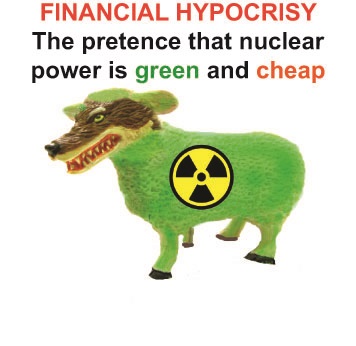
the climate crisis demands urgency and requires such large investments that cost efficiency is of key importance.
Joule, Luke Haywood Marion Leroutier Robert Pietzcker, July 21, 2023
There has been a strong push to promote increased investments in new nuclear power as a strategy to decarbonize economies, especially in the European Union (EU) and the United States (US).
The evidence base for these initiatives is poor. Investments in new nuclear power plants are bad for the climate due to high costs and long construction times. Given the urgency of climate change mitigation, which requires reducing emissions from the EU electricity grid to almost zero in the 2030s (Pietzcker et al.1), preference should be given to the cheapest technology that can be deployed fastest.
On both costs and speed, renewable energy sources beat nuclear. Every euro invested in new nuclear plants thus delays decarbonization compared to investments in renewable power. In a decarbonizing world, delays increase CO2 emissions.
Our thoughts focus on new nuclear power plants (not phasing out existing plants) in the US and Europe. In Europe, new nuclear power plants are planned or seriously discussed in France, Czechia, Hungary, Poland, Bulgaria, Slovenia, Sweden, and the United Kingdom. We do not focus on China, where government-set electricity prices and subsidized capital costs make it more difficult to contrast the profitability of different types of energy sources.
Nuclear energy is expensive
The cost overruns on recent nuclear projects are dramatic. In an international comparative assessment of construction cost overruns for electricity infrastructure, Sovacool et al. 2 find that nuclear reactors are the investment type with the most frequent and largest cost overruns, alongside hydroelectric dams. 97% of the 180 nuclear reactor investment projects included in their analysis suffered cost overruns, with an average cost increase of 117% per project.
More recently, the current estimate of the construction costs of the French Flamanville project stands at €13.2 billion up from an initial €3.3 billion (figures that do not even include financing costs, which the French audit office estimated at €4.2 billion up from an initial €1.2 billion) and those of the recently opened Finish Olkiluoto at €11 billion instead of €3 billion. “Construction costs are high enough that it becomes difficult to make an economic argument for nuclear,” Davis finds. Similarly, Wealer et al.conclude that “investing into a Gen III/III+ nuclear power plant … would very likely generate significant losses.”
Why is nuclear so costly?
Construction costs are driven by safety. Nuclear accidents remain a possibility—and damages may be global. Rangel and Lévêque note that huge damages occurring at “low and uncertain probability” make it difficult to determine whether safety investments are cost-effective. The nuclear plants built relatively quickly in previous decades had lower safety. requirements. Policy makers’ preferences for safety makes sense given that nuclear power plant operators’ private insurance coverage is typically very limited.
Beyond construction costs, the cost of capital is a critical parameter for evaluating the viability of nuclear power. First, the very long construction times and delays generate particularly large financing costs for a given interest rate. Portugal-Pereira et al. report an escalation of capital costs worldwide due to increasing construction delays for the last generation of nuclear reactors constructed since the 2010s. The French court of auditors estimates that the cost of the French nuclear power plant Flamanville will increase from €13.2 billion to €20 billion once financing costs and delays are taken into account. Second, the historically high risk of default translates into higher interest rates. These two factors make the profitability of nuclear projects very dependent on financing conditions.
Finding an economic rationale for continued investment in new nuclear requires optimism regarding costs………………………………………….
Costs are not projected to come down very much even for the six new reactors planned to be built by 2035 (estimated to cost €52 billion in total, or €8.6 billion per reactor). The most recent EPR construction, Sizewell C in the United Kingdom, is also one of the most expensive projects at around €23 billion (£20 billion). This pattern of increasing costs over time has generated some interest in the literature (Lovering et al.7 and Eash-Gates et al.8).
Most of the candidate explanations (in particular, increased safety regulations) do not provide grounds for optimism for the future. In a wide-ranging review of different technologies, Meng et al.9 find nuclear power to be a “notable exception” where progress is overestimated with actual costs consistently higher than expected.

Small modular reactors (SMRs) may not be an exception: their advantages in terms of lower complexity may not translate into sound economics given lower energy production. Glaser et al 10 note that even optimistic estimates require many hundreds of reactors to be built before electricity produced is cost-competitive compared with larger reactor designs. The potential of modularity to reduce costs appears limited in practice.
Nuclear power is not cost-competitive with renewables
Despite poor profitability, nuclear power is advanced as a good investment to fight climate change. However, today, the challenge for nuclear profitability does not come from coal or gas but from renewables. It is hard to overstate how strongly the costs of renewables have decreased (see Figure 1 on original) . Few publications have anticipated these cost decreases, and public debate is often based on outdated cost assumptions.
Baseload and flexibility
…………………………………….Shirizadeh et al. 12 find that costs of storing variable renewable electricity production appear manageable, with storage costs of less than 15% of total costs associated with a fully renewable electricity grid for France. Pietzcker et al.1 find that new nuclear constructions would not decrease the costs of achieving EU climate targets. Shirizadeh and Quirion 13 find that a 100% renewable system is very cost-effective for France.
Taking into account wider economic impacts does not favor nuclear
………………………………….adding non-market benefits to the equation implies that non-market costs should also be considered. This is not easy: how should we account for nuclear waste? Nuclear waste is the unresolved problem of the nuclear industry. Cheap long-term storage for anthropogenic radioactive substances is elusive despite worldwide, decades-old efforts. In absence of any proven low-cost permanent storage technology, nuclear waste will have to be retreated regularly and stored in facilities above the ground.
Costs would arise for many thousands of years. The importance of costs and benefits for future generations in today’s decisions has been a controversial topic for climate change policy, and it appears even more relevant for nuclear waste. Krall et al. 14 argue that SMRs may actually “exacerbate the challenges of nuclear waste management.”
Third, uranium mining causes pollution and radioactive exposure. As a report of the EU’s Scientific Committee on Health, Environmental and Emerging Risks notes, “almost 100% of the total eco-toxicity and human toxicity impacts over the whole nuclear life cycle is connected to mining and milling … While mining and milling is regulated [within the EU], 90% of what the EU need globally comes from 7 countries (none in Europe).” In Niger, for example, the systematic neglect of health and safety procedures in countries producing uranium for EU consumption persists despite evidence of “grave environmental impacts and rampant institutional failures.” 15
Finally, the continued development of nuclear energy could contribute to the risk of proliferation of nuclear weapons, as well as the risk of nuclear power plants being targeted in armed conflict, a permanent risk in Ukraine today.
Building new nuclear takes time we do not have
The business case and economics may be poor, but in light of the very real threat of climate catastrophe, should we not invest in all alternatives to fossil fuels? The problem is that building nuclear plants is slow and delivery is uncertain.
Even the International Atomic Energy Agency and Nuclear Energy Agency—organizations promoting the use of nuclear energy—assume construction times of around one decade, 13 whereas renewables can come online in a fraction of that time. Given lags in planning and regulatory approval, any new nuclear plants would come online too late to help decarbonize our economies on time. However, even this time frame appears optimistic:………………………………………..
Conclusion: In solving the climate crisis, new nuclear is a costly and dangerous distraction
……………………………………………………………….. the climate crisis demands urgency and requires such large investments that cost efficiency is of key importance……………………………… If governments and economic actors believe that nuclear power will come online at a certain date, they will not make alternative plans, and without alternative plans, the current carbon-intensive electricity system will remain in place—rendering climate targets unachievable.
References (many) ……………………….. https://www.cell.com/joule/fulltext/S2542-4351(23)00281-7
$45 Billion to Keep Diablo Canyon Nuclear Power Plant Alive?

Outrageous Costs and Deadly Dangers are the Real Risks of Keeping Diablo Open
Independent , By Grant Smith and Anthony Lacey, Wed Jul 26, 2023
California ratepayers might have to foot a staggering $45 billion-plus cost to keep the aging Pacific Gas & Electric, or PG&E, Diablo Canyon nuclear power plant online beyond its slated 2025 closure.
The outrageous price tag is the estimated cost for operating the plant from 2021-2045, or hundreds of millions of dollars every year. And that’s just the expense of prolonging the troubled facility’s life. It doesn’t account for the enormous extra costs that would be incurred following a major disaster like a reactor leak or an earthquake that damages the plant.
EWG used testimony recently filed by The Utility Reform Network, or TURN, in PG&E’s current rate case to parse the capital and operating expenses of the plant. EWG considered PG&E’s estimates for the plant costs, which likely lowball the true expense, and TURN’s assessment of the plant expenses, which may be closer to the actual burden.
EWG estimates it will likely amount to hundreds of millions of dollars every year, for total costs ranging from more than $20 billionto nearly $45 billion from2023 through 2045 — or more.
That’s just the base cost of running the facility. The alarming figure doesn’t account for the additional massive costs that would come from a disaster at the plant, like an earthquake or a nuclear reactor leak, or unanticipated maintenance and security costs that often plague old nuclear power plants.
That cost — reaching tens of billions of dollars — will be passed on to 15.8 million Californians already fleeced by PG&E’s exorbitant electricity bills. According to EWG estimates, keeping Diablo Canyon open could add from $55to $124 a year to the typical utility bill, considering the cost of the facility as a fixed charge over 23 years.
Or it could be even higher because these costs, at the moment, are highly speculative and the older Diablo Canyon gets, the higher the capital and operating costs will become to keep it online and providing electricity.
An extension of the facility’s life for 20 years after its scheduled 2025 shutdown could also generate other large costs just to ensure its ongoing operation. Many aging nuclear power plants are notorious for wasting millions of dollars on unanticipated maintenance and security costs…………………………………………………..
An Unnecessary Nuclear Facility
What’s just as outrageous as the potential $45 billion-plus cost of extending Diablo Canyon’s life is the fact that the state has no need to keep the plant open after the scheduled 2025 closure………………………………………………………………………
The Danger of Diablo Canyon
Diablo Canyon, located on California’s central coast in San Luis Obispo County, sits atop a web of fault lines and rests above a cliff below the Pacific Ocean, putting it at heightened risk of damage from an earthquake, tsunami or both.
The facility was set to close both of its two reactor units by 2025, following a carefully crafted 2018 deal between PG&E, unions and environmentalists. The deal had the support of state regulators and then-Lieutenant Gov. Gavin Newsom, who was elected governor in 2018.
That deal is now at risk of collapsing………………………….. https://www.independent.com/2023/07/26/45-billion-to-keep-diablo-canyon-nuclear-power-plant-alive/
Massachusetts rejects request to discharge radioactive water from closed nuclear plant into bay
Pilgrim Nuclear Power Station was closed in 2019. Kevin Clark
By MARK PRATT Associated Press https://www.power-eng.com/ap-news/massachusetts-rejects-request-to-discharge-radioactive-water-from-closed-nuclear-plant-into-bay/
BOSTON (AP) — Massachusetts environmental regulators have denied a request by the company dismantling a shuttered nuclear power plant to release more than 1 million gallons (3.8 million liters) of radioactive wastewater into Cape Cod Bay.
The state Department of Environmental Protection’s draft decision issued July 26 said it denied Holtec’s request for a permit modification because the discharge from Pilgrim Nuclear Power Station in Plymouth would violate a state law that designates the bay as an ocean sanctuary.
The draft will not be finalized until after a public comment period that ends Aug. 25.
Environmentalists and politicians praised the decision.
Release of the treated wastewater would pose a threat to the bay’s environment, human health, the fishing and shellfishing industries, and the economy of the region, Andrew Gottlieb, executive director of the Association to Preserve Cape Cod, said in a statement.
“Holtec sought to profit at the expense of the people, the environment and economy of Cape Cod and, like most corporate bullies, needed to be told no,” he said.
Holtec promised a transparent decommissioning process when it took over the plant after it stopped generating power in May 2019, U.S. Sen. Edward Markey said.
UK Government’s infrastructure advisors cast doubt over uks biggest energy projects including nuclear clearup
The UK Government’s infrastructure advisors have warned that it is unlikely
that work to efficiently categorise hazardous waste at the Sellafield site
will be a success.
The Infrastructure and Project Authority (IPA) has also
raised concerns about the majority of the Government’s other key energy
infrastructure programmes, including the Low-Cost Nuclear Programme funding
R&D for small modular reactors.
These warnings are contained within the
Authority’s new annual assessment. Published late last week, it assesses
whether 244 Government-backed projects with a total whole-life cost
exceeding £805bn are progressing well. Projects are given a ‘green’
rating if delivery if on time, there are no significant quality issues and
no other issues that could threaten delivery. Those that are unlikely to be
delivered without a major change of direction are ranked as ‘red’. Those
with delays, quality issues or other problems which may yet be resolved
receive an ‘amber’ rating.
Of the 19 projects covered that are overseen
by the Department for Energy Security and Net-Zero (DESNZ), only three get
the ‘green’ rating. These are the Local Authority Delivery scheme, which
funds councils to upgrade homes and reduce carbon; the SIXEP effluent
treatment plant and the storage plant at Sellafield.
But efforts to improve
analytical services at Sellafield, the former centre of nuclear
reprocessing in the UK, received a ‘red’ ranking. The Authority believes
that the successful delivery of the project “appears to be
unachievable”. The project concerts assessing and categorizing waste on
site.
The Authority has also downgraded the UK Government’s plans for a
major geological nuclear waste storage facility to ‘amber’, from
‘green’ in 2021. This facility is being built both to deal with waste
from new nuclear sites, but also to consolidate existing waste storage; at
present, more than 20 above-ground facilities across the UK are used, each
with a maximum design life of 100 years.
Two DESNZ Projects – Sizewell C
and the development of carbon capture and storage – are exempt from
assessment due to commercial sensitivities. Besides the analytical services
at Sellafield, the others are all ranked as ‘amber’. These include the
national rollout of smart meters to homes; the Net-Zero Hydrogen fund; the
Homes Upgrade Grant (HUG) for home retrofitting; the Public Sector
Decarbonisation Scheme; the Industrial Decarbonisation and Hydrogen Revenue
Support scheme and the Green Homes Grant.
Edie 24th July 2023
Now, not in 15 years’: Call for public vote on Theddlethorpe nuclear waste dump
Campaigners say the area is stuck in limbo. Campaigners are
calling for an immediate public vote on the proposed nuclear waste storage
facility at Theddlethorpe after it was taken off a council agenda last
week.
East Lindsey District Council had been due to discuss whether to move
forward with a public test of support on an underground storage facility.
However this was cancelled as the council sought legal advice, triggering
criticism from both residents and the UK/Ireland Nuclear Free Local
Authorities (NFLA).
The Lincolnite 24th July 2023
The coming Russian-Polish war
Armageddon Newsletter GILBERT DOCTOROW, JUL 23, 2023
This evening’s News of the Week program on Russian state television opened with a 30 minute documentary survey of Polish-Russian relations from the end of WWI and during the period of the Russian Civil War, when the government under Marshal Pilsudski wrested substantial territory from Russian control. It also dealt extensively with Poland’s well documented role as aggressor and occupier of Czechoslovak, Lithuanian, Ukrainian and Belarus lands from before the start of WWII and until Hitler overran Poland. ……………………..
Let us recall that on Friday Putin explained how and why we may expect the formal entry into the war of a Polish-Lithuanian-Ukrainian joint military force that will officially be presented as defending Ukrainian statehood by occupying the Western Ukraine. However, Putin described this as an occupying force which once installed in Lvov and Western Ukraine would never leave. This would in effect be a repeat of the sell-out of Ukrainian interests to Poles and cession of territory to Poland such as had been perpetrated by their leader Semyon Petlyura in April 1920 and has now been repeated in the secret agreements between presidents Zelensky of Ukraine and Duda of Poland. ……………………………………………………..
From Russian talk shows of the past several days, it is easy to understand the Kremlin’s reading of the present proxy war in and around Ukraine: Washington sees that the Ukrainian counter-offensive is a complete failure that has cost tens of thousands of lives among the Ukrainian armed forces and has seen the destruction of a large part of the Western equipment delivered to Ukraine over the past months. Instead of suing for peace, Washington seeks to open a ‘second front,’ using Poland for this purpose. …………………………………………….
The inescapable conclusion from the latest news is that Washington’s incendiary policies and continuing escalation of the conflict cannot secure Russia’s defeat. On the contrary, they may well lead to the total collapse of the NATO alliance once its military value is disproven in a way that cannot be talked away or papered over by the most creative propagandists in DC. https://gilbertdoctorow.substack.com/p/the-coming-russian-polish-war?utm_source=profile&utm_medium=reader2
Will the small states of Oceania be able to maintain their independence in the face of a new Sino-American Cold War?
The ‘friends to all, enemies to none’ strategy is living its last days as the US and China press the island nations to take sides
By Timur Fomenko, a political analyst, https://www.rt.com/news/580174-friends-to-all-enemies-to-none/ 23 July 23
Papua New Guinea is a gateway between continents. The island, being effectively cut in half, demarcates an artificial boundary between Asia and Oceania. In the past several centuries, the broader island has been carved upon between almost every colonial power going, having been ruled at various points by the Dutch, Spanish, German, Japanese and British empires. Even after gaining its formal independence from Australia in 1975, these legacies continue to scar the island, with half of it still belonging to Indonesia, known as West Papua, which is now a source of unrest and insurgency.
The history of constantly fluctuating overlords only demonstrates the country’s perceived strategic and military importance. That’s because whoever dominates it has direct access to both Australia and the Pacific, and can project into Asia itself. It is of little surprise that Papua New Guinea (PNG) became one of the most gruesome fronts of the Pacific War in World War II, which subsequently brought it firmly into the hands of the Anglosphere, where it has remained ever since, making it an effective dependency of Australia in terms of aid and humanitarian assistance.
Despite this, the island has nothing to show for centuries of colonial dominion, or from being a subordinate of the English-speaking world as a black Melanesian country. It is one of the world’s poorer nations, and is in desperate need of infrastructure to develop itself. Because of this, it has developed a foreign policy it describes as ‘friends to all, enemies to none’, which seeks to attain and exploit as many development opportunities as possible and better sustain its own strategic autonomy. This of course, has drawn interest from China, who sees the islands as an important partner as a post-colonial, Global South country. Thanks to PNG being part of the Belt and Road Initiative, Beijing has built airports, highways, sea ports, and telecommunications infrastructure across the country.
Port Moresby, in turn, sees Beijing as a critical economic partner that can help bolster its own infrastructure and development, the two countries recently having negotiated a free trade agreement. But that doesn’t mean trouble is not afoot. While China seeks to bolster economic relations with the country, the US has other ideas; that is, to forcibly transform Papua New Guinea into a military outpost for the purpose, of course, of containing China. Recently, Washington was able to pry a Defense Cooperation Agreement out of the country, which will give the US access to its bases.
PNG, of course, denies that the is specifically opposing China, and does not rule out security cooperation with Beijing itself. However, it is also a reminder that the country’s weak and vulnerable position, along with its historical subservience to the West, means it does not have the power or political privilege to resist these kinds of overtures, and instead must seek a more delicate balance. In response to this, China is likely to increase its engagement with the country; for example, the Bank of China is working to establish a presence there.
Growing competition over Papua New Guinea also comes amid China’s successes in its relationship with the Solomon Islands, which switched allegiance from Taipei to Beijing in 2019. On July 11, the two countries finally signed a security cooperation pact, which has met with vitriol from Western media and politicians.
What this demonstrates is that the Pacific region has become a ‘cold war’ theater between China and the US, with the latter working through its ally, Australia. The US, after all, has long attempted to make the Pacific an ‘extended backyard’ or ‘ranch’, a large open space over which it seeks to be the exclusive military power. But now, China is expanding into it, and this has led to the emergence of strategic competition.
However, these Pacific countries do not really want to take sides – they are tired of being tossed from one master to the other. This means the fundamental challenge for countries such as Papua New Guinea is to gain benefits to strengthen itself, while nonetheless avoiding subservience. This means it has a fight to continue its ‘friends to all, enemies to none’ approach, while tensions rise and both powers start demanding it take sides on various issues. But if worst-case scenarios can be avoided, and the pace of investment in the country from all sides accelerates, the end product may be that competition could ultimately make PNG and the island countries a lot better off, and therefore a lot more capable of exerting their own will.
-
Archives
- February 2026 (220)
- January 2026 (308)
- December 2025 (358)
- November 2025 (359)
- October 2025 (376)
- September 2025 (258)
- August 2025 (319)
- July 2025 (230)
- June 2025 (348)
- May 2025 (261)
- April 2025 (305)
- March 2025 (319)
-
Categories
- 1
- 1 NUCLEAR ISSUES
- business and costs
- climate change
- culture and arts
- ENERGY
- environment
- health
- history
- indigenous issues
- Legal
- marketing of nuclear
- media
- opposition to nuclear
- PERSONAL STORIES
- politics
- politics international
- Religion and ethics
- safety
- secrets,lies and civil liberties
- spinbuster
- technology
- Uranium
- wastes
- weapons and war
- Women
- 2 WORLD
- ACTION
- AFRICA
- Atrocities
- AUSTRALIA
- Christina's notes
- Christina's themes
- culture and arts
- Events
- Fuk 2022
- Fuk 2023
- Fukushima 2017
- Fukushima 2018
- fukushima 2019
- Fukushima 2020
- Fukushima 2021
- general
- global warming
- Humour (God we need it)
- Nuclear
- RARE EARTHS
- Reference
- resources – print
- Resources -audiovicual
- Weekly Newsletter
- World
- World Nuclear
- YouTube
-
RSS
Entries RSS
Comments RSS
 nuclear-news