Why EU sanctions don’t include Russian nuclear industry
DW, Ashutosh Pandey 19 Jul 23
While the EU is on course to wean itself off Russian fossil fuels, it’s struggling to kick its nuclear habit. That’s because Russia’s nuclear industry still wields huge clout.
Less than a week after the first Russian tanks rolled into Ukraine, an Ilyushin Il-76 cargo aircraft, belonging to Russian cargo airline Volga-Dnepr, flew across Belarus and Poland before landing in Slovakia.
The mysterious jet taking off from Russia took flight trackers by surprise as only a day ago the European Union had closed its airspace to Russian airlines and private jets in response to Moscow’s invasion of Ukraine.
Soon, it became clear that the plane was exempted from the ban as it was shipping critical nuclear fuel for Slovakia’s four Russian-designed nuclear reactors.
About a month later, a Russian aircraft of the same make flew even further into neighboring Hungary again to deliver nuclear fuel. Much like Slovakia, Hungary is fully dependent on atomic fuel from Russia to power its nuclear power plants.
The twin flights were yet another symptom of Europe’s decadeslong binge on Russian energy. Nuclear fuel sourced from Russia’s state-owned nuclear agency Rosatom and its units helps generate nearly half the total electricity produced in Slovakia and Hungary and more than a third in the Czech Republic and Bulgaria.
While the EU is on course to wean itself off Russian fossil fuels, it’s struggling to kick its Russian nuclear habit. As a result, hundreds of millions of euros continue to flow into Moscow’s coffers.
The bloc has found it politically unpalatable to impose sanctions on the Russian civil nuclear industry……………………….
The Rosatom leverage
The EU’s foot-dragging stems from the outsized influence the Russian nuclear industry enjoys globally. Russia accounts for more than 45% of the world’s uranium enrichment capacity, delivering atomic fuel to nuclear power plants in several countries, including in the US, which despite its harsh sanctions regime against Moscow continues to pay $1 billion (€912 million) a year to source fuel from Rosatom.
Almost 20% of raw uranium imported by the EU comes from Russia, Euratom Supply Agency data shows, with another 23% coming from Kazakhstan, where Rosatom is a major player. Russia also supplies a large proportion of the fuel rods for European nuclear power plants.
“Rosatom is one of the few companies in the world that has mastered the entire nuclear fuel cycle, i.e. enrichment, fuel production and also reprocessing,” said Sonja Schmid, professor of science and technology studies at Virginia Tech University and the author of “Producing Power: The Pre-Chernobyl History of the Soviet Nuclear Industry.”
Central and Eastern European countries are particularly reliant on Russian fuel. There are a total of 18 Russian-designed nuclear reactors — in Slovakia, Bulgaria, Hungary, the Czech Republic and Finland — that currently run exclusively on Russian fuel and rely on Russian technologies.
Additionally, Rosatom has had a long association with French utility EDF with the two signing a “long-term cooperation agreement” in 2021 to further boost ties……………………………………………………………… more https://www.dw.com/en/why-eu-sanctions-dont-include-russian-nuclear-industry/a-66275352
US Asset Managers Have ‘Significant Investments’ in Nuclear Weapons and Cluster Bombs: Analysis
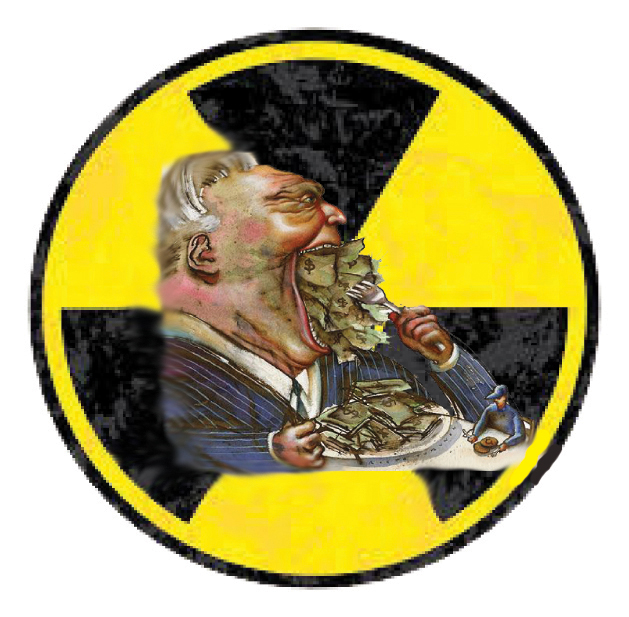
“Many investors, given a choice, would not want to profit from companies that manufacture weapons of mass destruction,” said As You Sow’s Andrew Behar.
By Brett Wilkins / Common Dreams https://scheerpost.com/2023/07/19/us-asset-managers-have-significant-investments-in-nuclear-weapons-and-cluster-bombs-analysis/
Amidst what the Bulletin of Atomic Scientists calls “an exceedingly dangerous nuclear situation” facing humanity today, the largest U.S. mutual funds—which manage the retirement and other savings of tens of millions of Americans—are profiting from investments in nuclear weapons, cluster munitions, and other banned or controversial arms, an analysis by a leading shareholder advocacy group revealed Tuesday.
Measured by dollars invested, the top 25 U.S. asset managers “all earn a D grade or worse, with significant investments in arms manufacturers and major military contractors, including companies involved with nuclear weapons and controversial weapons like cluster munitions, anti-personnel landmines, incendiary weapons, and depleted uranium,” Berkeley, California-based As You Sow said in its new report.
Some of the largest corporate 401(k)s like American Funds, John Hancock Funds, and Franklin Templeton Investments were among the most heavily invested in these armaments, while “fund managers that focus on sustainable investing have less exposure to military weapons, on average.”
Seven funds profiled in the analysis—Eventide Funds, Ecofin, New Alternatives, Vert Asset Management, Aspiration Funds ,Thrivent, and Kayne Anderson—held no investments in the controversial weapons.
“Many investors, given a choice, would not want to profit from companies that manufacture weapons of mass destruction,” As You Sow CEO Andrew Behar said in a statement. “Yet nearly every retirement plan has nuclear and other controversial weapons embedded in their plan. Our new ratings empower investors with the tools to know what they own so they can invest their money in alignment with their values.”
As You Sow’s mutual fund ratings are part of the group’s Weapons Free Funds investment tool, “built to help responsible investors prioritize peace and people over war and violence.”
Nuclear weapons, landmines, and cluster munitions are all banned under international law. However, the United States is not a signatory to any of the bans, and none of the world’s nine nuclear powers have signed the landmark Treaty on the Prohibition of Nuclear Weapons.
Common Dreams reported last month that nuclear-armed nations spent $82.9 billion on their arsenals last year, with the United States accounting for more than half of the global total, according to the Nobel Prize-winning International Campaign to Abolish Nuclear Weapons.
Meanwhile, U.S. House Republicans last week blocked a bipartisan amendment to the 2024 National Defense Authorization Act that would have banned the export of cluster munitions. This, as the Biden administration was giving final approval to transfer cluster bombs to Ukraine’s military—which, like its Russian enemy, has used the weapons during the ongoing war with devastating effects.
Nuclear power: Is it safe to use nuclear energy – there are the health risks with it
A report, published last year by the National Cancer Institute (NCI) about
accidents at nuclear power plants, read: “At high doses, ionizing radiation
can cause immediate damage to a person’s body, including, at very high
doses, radiation sickness and death.
At lower doses, ionizing radiation can cause health effects such as cardiovascular disease and cataracts, as wellas cancer. “It causes cancer primarily because it damages DNA, which can lead to cancer-causing gene mutations. “Children and adolescents can be
more sensitive to the cancer-causing effects of ionizing radiation than
adults because their bodies are still growing and developing. Also,
children and adolescents usually have more years of life following
radiation exposure during which cancer may develop.”
“Researchers at NCIand elsewhere continue to learn about the cancer risks from ionizing
radiation by studying various groups of people, including those who were
exposed as a result of the Chernobyl accident, survivors of the atomic bomb
explosions in Japan during World War II, and people who were exposed to
radiation during medical diagnostic procedures or as part of their job.”
National World 18th July 2023
China’s blanket radiation testing could spell trouble for Japanese seafood imports
Japan Times, BY ERIC JOHNSTON, STAFF WRITER, 19 jul 23
China has begun testing all seafood imports from Japan for radiation, Japanese media reported Wednesday, in a move that could create further diplomatic headaches for Prime Minister Fumio Kishida.
The news comes ahead of Japan’s plan to begin releasing treated radioactive water from the crippled Fukushima No. 1 plant into the sea. It follows a July 7th announcement by China’s customs agency that seafood products from 10 prefectures, including Fukushima, would continue to be banned due to radiation concerns.
Chief Cabinet Secretary Hirokazu Matsuno told reporters in Tokyo on Wednesday that there have been cases where some Japanese seafood exports are being held up by Chinese customs. The reason for this is seen as a result of China’s tightened radiation inspections in response to the planned release of treated water from the nuclear power plant…………. (subscribers only) more https://www.japantimes.co.jp/news/2023/07/19/national/china-radiation-test-japan-seafood-trouble/
UK Government announces fantasy small modular reactor programme as a cover for Sizewelll C failure

By David Toke, https://100percentrenewableuk.org/government-announces-fantasy-small-modular-reactor-programme-as-a-cover-for-sizewelll-c-failure 19 Jul 23
What is really most significant about the Government’s new announcement for £137 million funding for research into so-called small modular reactors (SMRs), is the failure to move forward with plans to finance Sizewell C. This latest nonsense about SMRs can best be seen as a cover for this lack of movement.
The Government and EDF have both taken small part shares in the Sizewell C project. Most people know that the project cannot move forward unless the Government takes more or less the rest of the equity (with maybe EDF making a token extra small gesture). However the Treasury does not like this since then the Government (read taxpayer/electricity consumer) will be mainly on the hook for the inevitable massive cost overruns that will result.
So the Government continues to go through the motions of encouraging private investment in the project that will never occur. The consultants who advise the pension funds etc on whether such an investment is a good thing feel obliged to live in the real world and tell them that this would be a terrible idea. Only action from the Prime Minister can force the Treasury’s hand, but evidently, the PM feels that this can wait to be implemented after the General Election.
Meanwhile, in the real world, as many people have always known but did not want to say, Hinkley C’s construction becomes later and later and more and more incredibly ruinous for EDF. The Chief Finance Officer of EDF resigned when the company gave the final go-ahead for the project in 2016, fearing that it would become the financial disaster that it has now become. But then maybe people always knew that the French Government would end up paying for the project. As in the UK, the British Government will end up paying for the horrendous costs and incredibly late delivery of Sizewell C, albeit passed on to consumer energy bills.
The French, whose electricity system is collapsing because of nuclear power failure have even abandoned any hope in the EPR design that is being planned for Sizewell C (and which is sinking slowly into the Hinkley mud). They now want a simpler design. But we are still plodding on with the old EPR design for Sizewell C.

Meanwhile the Government distracts people’s gaze with fantasy announcements about small modular reactors. They are throwing good money in the direction of bad technologies (high-temperature reactors, molten salt reactors) that were discarded around 60 years ago. Little will happen as a result of this research. Apparently, according to the press release, investments of £20 billion are to follow. Really? On which planet is this happening? Not this one for sure, and certainly not budgeted by the Treasury.
Meanwhile, news about the (rather large) so-called small modular reactors that Rolls Royce was planning has petered out. The Government were supposed to be producing hundreds of millions of pounds to push that boat along. However this earlier (now apparently no longer operative) piece of nuclear fantasy has seemed to disappear to be replaced by a brand new fantasy-packed press release from the Government this very morning.
I never fail to be surprised by how gullible people are when faced by these press releases from the Government when they talk about nuclear power. People obviously have a mixture of very short memories and a huge appetite for wanting to believe wishful thinking about nuclear power.
But the sad thing is that when (let’s assume) Keir Starmer comes in as Prime Minister he will have these fantasy nuclear plans stacked on his desk, or pushed that way by an unwilling Chancellor. How will he deal with them? By pushing much of the funding for otherwise sensible green energy investments into a (Sizerwell C) nuclear black hole?
Read about the 100%RenewableUK energy model and how it compares to the Government’s net zero plan. 100%RE gives lower emissions for much lower overall cost! Our new report concludes that a 100% renewable energy mix for the UK would save well over £100bn in achieving net zero by 2050, compared to the UK Government’s current strategy. It would also mean more than 20% lower cumulative carbon emissions in the process. The study, carried out by renowned energy modelling academics at LUT University in Finland, involves hour-by-hour simulation of different scenarios for reaching net zero for UK energy systems. Click HERE for more information, including links to the report itself and accompanying material
You can see the youtube recording of our seminar on 100percent renewable energy for the UK held in London on April 22nd HERE
Campaign for Nuclear Disarmament (CND) condemns additional billions for Britain’s nuclear arsenal

https://cnduk.org/cnd-condemns-additional-billions-for-britains-nuclear-arsenal/ 19 Jul 23
CND condemns the multi-billion pound announcement for additional spending on Britain’s nuclear weapons, as outlined in the Defence Command Paper 2023 by the Defence Secretary on Tuesday.
It notes that further to the extra £3 billion over the next two years, already announced in this year’s budget, the MoD is receiving “a further £6 billion over the subsequent three years, which will be invested across the defence nuclear enterprise. This is in addition to our current levels of investment.”
CND has regularly highlighted that it is a political choice made by governments to possess nuclear weapons – and a political choice to deny crumbling public services vital funds while spending billions of pounds on maintaining and investing in these weapons of mass destruction.
CND General Secretary Kate Hudson said:
“A week ago, the Prime Minister was announcing a below-inflation pay rise for public sector workers, insisting it was their best and final offer. Now, the Defence Secretary is finding billions of pounds of new money for nuclear weapons seemingly without any pushback. They say there’s no magic money tree to fix the NHS, our schools, or the planet, but there always seem to be billions more pounds of tax payers’ money available for weapons of mass destruction that can destroy us all.”
The dilemma of continuing to produce nuclear trash which will remain harmful for millennia
How would Lincolnshire’s underground nuclear dump work? How do you keep
something securely locked up for tens of thousands of years? That’s the
dilemma facing the nuclear industry as it continues producing waste which
will remain harmful to humans and the environment for millennia.
Lincolnite 18th July 2023
Disunity in NATO?
Why the Ukraine Conflict Will Unravel NATO and Biden
July 19, 2023 SCHEERPOST, By Radhika Desai / CounterPunch
The proxy war on Russia is the centre piece of Biden’s foreign policy of uniting the world’s ‘democracies’ against ‘autocracies’, particularly China and Russia. He boasts repeatedly of uniting US allies, most in NATO, as never before. Though the real unity is spotty at best, until recently, the rhetoric seemed to work. No longer. At its recent Vilnius Summit, NATO’s disunity bubbled over, though not for the reasons most discussed in the press. The real reasons are rooted in developments that threaten to unravel not only Biden’s strategy, but also NATO.
Discordant strains were amply discussed in the run up to the summit. Members could not decide on any successor for Jens Stoltenberg. …………………..President Macron led (a not inconsiderable) opposition to establishing a permanent NATO presence in the East Asian region with an office in Tokyo. Though Finish membership was approved, President Erdoğan opposed Sweden’s membership until Biden offered him not only F-16s but also an IMF loan from aboard Air Force One.
Most spectacularly, while members once again promised to increase defence expenditure and production, and while the alliance made various commitments to supporting Ukraine in its war with Russia, not only did the clamour to induct Ukraine into NATO fail, but NATO proved unwilling even to commit to a timetable for entry. President Zelensky called this ‘absurd’ and the US administration called him ungrateful in return.
………………………………………… Always a work-in-progress, NATO unity has got more difficult as US power has declined. In recent decades, its chief glue has been US military power………….. https://scheerpost.com/2023/07/19/why-the-ukraine-conflict-will-unravel-nato-and-biden/
‘Artificial Escalation’: Imagining the future of nuclear risk
As arms race dynamics push AI progress forward, prioritizing speed over safety, it is important to remember that in races toward mutual destruction, there is no winner. There is a point at which an arms race becomes a suicide race.
Bulletin of the Atomic Scientists, By Anthony Aguirre, Emilia Javorsky, Max Tegmark | July 17, 2023
Imagine it’s 2032. The US and China are still rivals. In order to give their military commanders better intel and more time to make decisions, both powers have integrated artificial intelligence (AI) throughout their nuclear command, control, and communications (NC3) systems. But instead, events take an unexpected turn and spin out of control, with catastrophic results.
This is the story told in a new short film called Artificial Escalation produced by Space Film & VFX for The Future of Life Institute. This plot may sound like science fiction (and the story is fictional), but the possibility of AI integration into weapons of mass destruction is now very real. Some experts say that the United States should build an NC3 system using AI “with predetermined response decisions, that detects, decides, and directs strategic forces.” The US is already envisioning integration like this in conventional command and control systems: the Joint All-Domain Command and Control has proposed connecting sensors from all military services into a single network, using AI to identify targets and recommend the “optimal weapon.” But NC3-AI integration is a terrible idea.
The Stockholm International Peace Research Institute (SIPRI) explored key risks of AI integration into NC3, including: increased speed of warfare, accidental escalation, misperception of intentions and capabilities, erosion of human control, first-strike instability, the unpredictability of AI, the vulnerabilities of AI to adversary penetration, and arms race dynamics. The National Security Commission on AI cautioned that AI “will likely increase the pace and automation of warfare across the board, reducing the time and space available for de-escalatory measures.”
This new rate of warfare would leave less time for countries to signal their own capabilities and intentions or to understand their opponents’ perspectives. This could lead to unintended conflict escalation, crisis instability, and even nuclear war.
As arms race dynamics push AI progress forward, prioritizing speed over safety, it is important to remember that in races toward mutual destruction, there is no winner. There is a point at which an arms race becomes a suicide race. The reasons not to integrate AI into comprehensive command, control, and communications systems are manifold:
Adversarial AI carries unpredictable escalation risk. Even if AI-NC3 systems are carefully tested and evaluated, they may be made unpredictable by design. Two or more such systems interacting in a complex and adversarial environment can push each other to new extremes, greatly increasing the risk of accidental escalation. We have seen this before with the 2010 “flash crash” of the stock market, when adversarial trading algorithms wiped trillions of dollars off the stock exchange in under an hour. The military equivalent of that hour would be catastrophic.
No real training data. AI systems require a lot of data in their training, whether real or simulated. But training systems for nuclear conflict necessitates the generation of synthetic data with incomplete information, because the full extent of an adversary’s capabilities is unknown. This adds another element of dangerous unpredictability into the command and control mix.
Cyber vulnerabilities of networked systems. AI-integrated command, control, and communications systems would also be vulnerable to cyberattacks, hacking, and data poisoning. When all sensor data and systems are networked, failure can spread throughout the entire system. Each of these vulnerabilities must be considered across the systems of every nuclear nation, as the whole system is only as strong as its weakest link.
Epistemic uncertainty. Widespread use of AI to create misinformation is already clouding what is real and what is fake. The inability to discern truth is especially dangerous in the military context, and accurate information is particularly crucial to the stability of command and control systems. Historically, there have been channels of reliable, trustworthy communication between adversaries, even when there were also disinformation campaigns happening in the background. When we automate more and engage person-to-person less, those reliable channels dissipate and the risk of unnecessary escalation skyrockets.
Human Deference to Machines. If an algorithm makes a suggestion, people could defy it, but will they? ……………………………………………………………………………
Integrating AI into the critical functions of command, control, and communication is reckless. The world cannot afford to give up control over something as dangerous as weapons of mass destruction. As the United Nations Security Council prepares to meet tomorrow to discuss AI and nuclear risk, now is the time to set hard limits, strengthen trust and transparency, and ensure that the future remains in human hands. https://thebulletin.org/2023/07/artificial-escalation-imagining-the-future-of-nuclear-risk/
A Scott Ritter Investigation: Agent Zelensky – Part 2
In the intelligence business, every agent is assigned tasks by his or her handlers. In the case of Agent Zelensky, I’ve identified ten obligations that define his relationship with his foreign intelligence masters. Once you’ve examined each of these, it becomes clear why Zelensky the comedian said one thing, and Zelensky the President did another. What are the true reasons behind the current situation in Ukraine today? What kind of operation has the CIA been running in Ukraine over the course of many years? You will find the answers to these and other questions in Part 2 of my investigative documentary film, “Agent Zelensky.” Click here to watch Part 1.
UK government launches”Great British Nuclear” with big bribes, and big promises, for the “small nuclear reactor” industry

Shapps announces £157m in grants at launch of new UK nuclear body
Guardian, Joe Middleton, Tue 18 Jul 2023
The UK government is to offer grants of £157m as part of its launch of a new body to support the nuclear power industry.
Great British Nuclear (GBN) will be tasked with helping deliver the government’s commitment to provide a quarter of the UK’s electricity from nuclear energy by 2050.
The new body will help drive rapid expansion of nuclear power plants in the UK, boost energy security and reduce dependence on fossil fuel imports, said the energy security secretary, Grant Shapps.
It is hoped that a competition to develop small modular reactors (SMRs) will drive billions of pounds of investment into the technology, which the government hopes will be cheaper and quicker to build than traditional large nuclear power plants.
However, environmental campaigners and academics have argued that SMRs have no track record and that time and resources would be better spent on renewables such as more offshore wind.
The launch at the Science Museum in London on Tuesday was delayed from last week after it clashed with the government’s public sector pay deal announcement.
The government’s previous attempts to attract funding for conventional large reactors have so far only yielded the much delayed and over-budget Hinkley Point C nuclear plant in Somerset.
Shapps is expected to announce the winners of the competition in the autumn, with a number of manufacturing firms such as Rolls-Royce and Hitachi interested in developing SMRs.
The government said it was still committed to Hinkley Point C and also Sizewell C, a nuclear power plant in Suffolk that was announced last year and has been backed with £700m of public funds.
In addition to the competition launch, Shapps announced that up to £157m of grant funding would be available. There will be up to £77m to accelerate the development of a nuclear business in the UK and support new designs, and a further £58m for the development and design of a new advanced modular reactor that operates at higher temperatures……………………………………….
Dr Doug Parr, the chief scientist for Greenpeace UK, accused the government of “obsessing” over nuclear power and decried SMRs.skip past newsletter promotion.
“As the government tries to whip up investment for the latest generation of reactors, it is striking how many of the nuclear industry’s speculative claims are being repeated by ministers as fact,” he said. “The hype seems to have been enough to convince our government that nuclear’s last gasp is in fact a new dawn, but at their radioactive cores SMRs remain the same bad bet.
“SMRs have no track record, but initial indications are that the familiar problems of cost overruns and delays will be repeated, and the accumulation of unmanageable waste will continue.”
Parr added: “By continually obsessing about nuclear, the government is taking its eye off the net zero ball, which will have to be delivered through a predominantly renewable, modern electricity grid. No number of SMRs will fix the government’s lacklustre effort to address issues of delayed connections, smart local grids and home efficiency.”
Steve Thomas, an emeritus professor of energy policy at the University of Greenwich, said: “Yet again, the British government has proved credulous to the claims of the nuclear industry that a new generation of technology will solve all the problems of its predecessors.
“SMRs are a long way from being commercially ready and at best will be as uneconomic as existing technology and at worst won’t even be technically feasible. The answers to reaching net zero with electricity are already available – energy efficiency and renewables. This announcement will only divert time and resources from these.” https://www.theguardian.com/business/2023/jul/18/grants-of-157m-offered-in-support-of-uks-nuclear-power-industry
None of the world’s 30 major banks count nuclear energy as “green”
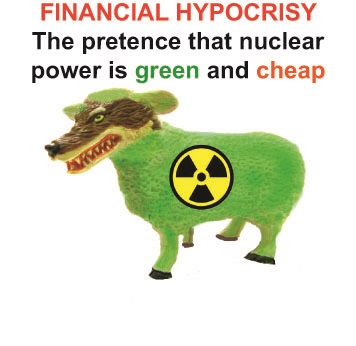
Major banks yet to match EU with nuclear green label, study finds
None of the world’s 30 major banks have explicitly included nuclear
energy in their criteria for issuing green or sustainability-linked bonds,
researchers said on Thursday (6 July), despite an EU decision last year to
label it as sustainable.
The European Union decided last year to include
nuclear power plants in its list of investments that can be labelled and
marketed as green. The move aimed to guide investors towards
climate-friendly technologies, but split EU countries who disagree on
atomic energy’s green credentials.
So far, banks have not followed the
EU’s lead in their own green bond rules, according to an analysis by
Columbia University’s Center on Global Energy Policy. The study looked at
the 30 banks deemed systemically important by the Financial Stability
Board.
Euractiv 6th July 2023 https://www.euractiv.com/section/energy-environment/news/major-banks-yet-to-match-eu-with-nuclear-green-label-study-finds/
Safety lapses at Los Alamos National Laboratory

By Searchlight New Mexico
by Alicia Inez Guzmán, Searchlight New Mexico https://nmpoliticalreport.com/2023/07/17/safety-lapses-at-los-alamos-national-laboratory/
In a windowless corridor of PF-4, the Los Alamos National Laboratory’s plutonium processing facility, the deputy director of weapons stood among a cluster of journalists and National Nuclear Security Administration officials, all clad in anti-contamination lab coats and booties, safety goggles and dosimeters.
“It’s not that scary,” said Robert Webster, during a rare media tour of several rooms brimming with glove boxes, some almost as old as the Cold War-era building itself, others newly installed. “You just have to be careful.”
In these highly classified rooms, each task is the sum of its many protocols, a meticulous choreography that was palpable on a recent morning — June 22 — even in the absence of workers. The respirators, protective clothing, ventilation systems and dosimeters — fail-safes aimed, according to officials, at reducing or detecting the risk of exposure — are routine and required controls at “the plant,” as PF-4 is popularly known. Here, no task can be taken for granted and no movement unintended.
Five years ago, LANL began embarking on a controversial mission — to produce an annual quota of plutonium pits, the triggers for nuclear weapons. Matt Johnson, head of the lab’s Pit Technologies division, characterized it as “probably one of the safest places in New Mexico.”
A recent NNSA investigation portrays another version of the plant, a place cited for its “significant lack of attention or carelessness” in protecting workers and the public, as a Preliminary Notice of Violation read. Released on May 18, the findings detailed four “nuclear safety events” that took place over a five-month period in 2021, including one glove box breach, two floods, and an instance in which too much fissionable material was placed in one area.
The NNSA, as a result, withheld nearly $1.5 million from its 2021 contract award to Triad National Security, the organization that manages and operates the lab. (The NNSA, nonetheless, refrained from exacting additional civil penalties, which could have totalled an extra half a million dollars.)
Its 11-page report revealed an environment in which workers were either too underqualified to perform certain tasks or overburdened by too many tasks to perform them well. Another problem stemmed from faulty equipment, which had presented problems since 1990 and had not been replaced under Triad’s tenure, despite multiple requests.
The report emphasized that Triad routinely focused on “human errors rather than on the conditions that make those errors more likely.”
That particular oversight, in part, led to water entering a ventilation system for multiple rooms and glove boxes — the windowed, stainless-steel containers where radioactive materials are handled. According to the NNSA, it amounted to a violation of “criticality safety requirements.” Water has long been known to enhance fission and, in certain circumstances, cause plutonium to go critical, sending out a blast of blue light and radiation.
The four nuclear safety events cited by the NNSA represented only a small fraction of the many “process deviations” and compliance concerns around handling nuclear materials that have beset the plant since May 2018. That’s the same year the lab was recommended as one of two sites in the country to produce plutonium pits for nuclear warheads.
In an attempt to understand a fuller picture of risks at the plant, Searchlight New Mexico culled through the last five years of weekly reports by the Defense Nuclear Facility Safety Board (DNFSB), a federal watchdog that oversees the U.S. nuclear weapons complex and makes recommendations to the Department of Energy. An analysis like this has never been conducted before, according to the DNFSB.
Searchlight counted at least 100 process deviations at the plant during that period: a mix of safety incidents, emergency events and protocol violations. The examples were wide ranging — from construction accidents and small fires, to floods and worker contamination. Not all had the potential to be catastrophic, but at a facility like PF-4, the consequences can be much higher than in other workplaces.
In 2019, one worker was nearly felled by a 320-pound toxic nuclear waste container and, in 2020, another inhaled plutonium oxide powder — the most dangerous form of plutonium. There was a broken finger, a mysterious head injury and several instances in which containers of toxic waste were backlogged, up to 80 at one point, in a single storage room. The all-important protective gloves inside the glove boxes have on occasion become separated from their ports in the box wall; they’ve also torn on sharp objects or been worn down by tools or overuse. The DNFSB called glove box glove failures and floods “repeat events” — serious incidents they attribute to “poor conduct of operations.” Records show at least 20 such incidents in the last five years that resulted in several instances of skin contamination, though only 2 reports indicated an “uptake” — an absorption of plutonium into the body.
“NNSA is investing billions of dollars in production-related infrastructure at Los Alamos,” a DNFSB spokesperson wrote in an email to Searchlight, “and the Board is continuing to urge commensurate investment in the safety infrastructure needed to ensure workers and the public are adequately protected from potential accidents at PF-4.”
In the June 2020 glove box breach, the worker underwent chelation therapy for significant radiation — on hair, skin and by inhalation — when he “pulled out of the glovebox gloves after weighing and packaging plutonium-238 oxide powder.” As a soluble form of plutonium, oxide powder can begin to circulate in the bloodstream almost immediately and eventually end up in the liver and bones, according to reports. Fourteen other workers were also exposed in that same incident.
Searchlight found other incidents that could be considered outliers. In July 2021, for example, a 4.2 magnitude earthquake hit some 30 miles northwest of the lab, located within the Pajarito Fault System.
The plant’s new glove boxes have been built to withstand an earthquake, according to the DNFSB. But, there are “a large number of existing gloveboxes that do not meet current seismic standards,” the agency’s email to Searchlight made clear.
The worst possible scenario would be a cataclysmic earthquake that triggers a fire at the plant. For almost two decades, the DNFSB has argued that the building’s “passive confinement system” — essentially its capacity to prevent a release of radioactive material from leaking out and reaching the public — is insufficient. After years of back and forth on the matter, and piecemeal enhancements to the plant, the NNSA, in 2022, deemed significant upgrades, including to the ventilation system, were unnecessary — despite DNFSB’s strong recommendations to the contrary.
Another one-off event occurred in February 2019, when two electricians were “inadvertently locked inside a caged storage location” for 40 minutes. “During this time,” the DNFSB reported, “the workers would have been unable to properly respond to alarms associated with a nuclear criticality, an airborne radioactive material release, fire, or other emergency situations requiring egress.”
When asked about a recent spate of glove box and other safety matters at the plant, the lab responded with the following statement:
“PF-4 is one of the safest places in the country as a result of the many redundant safety and security measures in place to protect our workforce, the environment, and the community. We have ongoing programs to ensure the safe handling of materials at TA-55. In the case of glove box breaches, training and controls identified the breaches and allowed us to address them immediately. Employees’ personal protective equipment and the facility and room ventilation systems help keep workers safe at all times.”
Searchlight produced the interactive graphics in this story to help visualize the DNFSB reports. Searchlight’s counts are based on the findings of site inspectors and confirmed by the DNFSB. While there could be many reasons behind an incident, site inspectors categorized the events according to a complex set of procedures. The number of reported incidents in 2022 rose by 33 percent compared to the previous year. In 2022, Triad commenced round-the-clock operations.
Noah Raess contributed to the reporting of this story.
Safety Report Graph:
https://public.tableau.com/app/profile/christian.marquez/viz/Safety_Reports/Dashboard1
Searchlight New Mexico is a nonpartisan, nonprofit news organization dedicated to investigative reporting in New Mexico.
Not nuclear, but wind and solar still cheapest – CSIRO

By Peter Roberts https://www.aumanufacturing.com.au/not-nuclear-but-wind-and-solar-still-cheapest-csiro 18 July 23
There is a huge amount of hype around new energy sources to replace fossil fuels and none more so than the phenomenon of small modular nuclear reactors (SMR).
But the hype remains just that according to the latest GenCost 2022–23 study released today by CSIRO and Australian Energy Market Operator.
While SMRs are likely cheaper to build that traditional large nuclear power stations, renewable power from onshore wind turbines and solar PV are increasingly important as the cheapest sources of new energy generation capacity according to the report.
This holds true whether the costs of integration into the grid are taken into account, or not.
Each year the two bodies work with industry to give an updated cost estimate for large-scale electricity generation in Australia, and each year wind and solar come out on top
The 2022-23 report found that onshore wind and solar PV are ‘the lowest cost generation technology by a significant margin’, despite cost increases averaging 20 per cent for new-build electricity generation in Australia.
Offshore wind is higher cost but competitive with other alternative low emission generation technologies.
CSIRO Chief Energy Economist Paul Graham said: “Innovation in electricity generation technology is a global effort that’s strongly linked to climate change policy ambitions.
“Technology costs are one piece of the puzzle, providing critical input to electricity sector analysis.
“To limit emissions, our energy system must evolve and become more diverse.”
GenCost said the next lowest cost flexible technology in 2023 is gas generation with carbon capture and storage, but only if it could be financed at a rate that does not include climate policy risk.
Fossil fuels were more expensive and faced hurdles such as government legislation and net zero targets, and historically high energy costs.
GenCost said that with SMRs, ‘achieving the lower end of the nuclear SMR range (of cost estimates) requires that SMR is deployed globally in large enough capacity to bring down costs available to Australia’.
As for SMRs, none of this should not be surprising as even the International Atomic Energy Agency does not claim nuclear power is cheaper.
The agency claims only that SMRs, advanced nuclear reactors that have a power capacity of up to 300 MW(e) per unit or about one-third of typical sizes, provide cheaper power than traditional large nuclear stations.
Their advantage over traditional nuclear is linked to the nature of their design – small and modular.
According to the IAEA more than 70 commercial SMR designs are being developed around the world.
The IAEA says on its website: “Though SMRs have lower upfront capital cost per unit, their economic competitiveness is still to be proven in practice once they are deployed.”
.
Nuclear Notebook: French nuclear weapons, 2023
Bulletin, By Hans M. Kristensen, Matt Korda, Eliana Johns, July 17, 2023
France’s nuclear arsenal has remained stable over the past decade and contains approximately 290 warheads……….. Nearly all of France’s warheads are deployed or operationally available for deployment on short notice.
…………………………………………………………………………………………
France’s nuclear doctrine
Successive heads of state, including Presidents Sarkozy, Hollande, and now Macron, have periodically described the role of French nuclear weapons. The Defense Ministry’s 2017 Defense and National Security Strategic Review reiterated that the nuclear doctrine is “strictly defensive,” and that using nuclear weapons “would only be conceivable in extreme circumstances of legitimate self-defense,” involving France’s vital interests. What exactly these “vital interests” are, however, remain unclear.
In February 2020, President Emmanuel Macron announced that France’s “vital interests now have a European dimension,” and sought to engage the European Union on the “role played by France’s nuclear deterrence in [its] collective security” (Élysée 2020). Macron clarified in October 2022 that these vital interests “would not be at stake if there was a nuclear ballistic attack in Ukraine or in the region,” apparently attempting to avoid being seen as expanding French nuclear doctrine (France TV 2022). Explicitly ruling out a nuclear role in case of Russian nuclear escalation in Ukraine appeared to contradict France’s statement at the August 2022 Review Conference for the Treaty on the Non-Proliferation of Nuclear Weapons, which explained that “for deterrence to work, the circumstances under which nuclear weapons would [or would not] be used are not, and should not be, precisely defined, so as not to enable a potential aggressor to calculate the risk inherent in a potential attack” (2020 Review Conference of the Parties to the Treaty on the Non-Proliferation of Nuclear Weapons 2022).
France does not have a no-first-use policy and reserves the right to conduct a “final warning” limitednuclear strike to signal to an adversary that they have crossed a line—or to signal the French resolve to conduct further nuclear strikes if necessary—in an attempt to “reestablish deterrence” (Élysée 2020; Tertrais 2020). Although France is a member of NATO, its nuclear forces are not part of the Alliance’s integrated military command structure.
If an aggressor is not deterred, President Macron explained in 2020, France’s “nuclear forces are capable of inflicting absolutely unacceptable damages upon that State’s centers of power: its political, economic and military nerve centers” (Élysée 2020).
…………………..The possibility of using the nuclear weapon first is assumed: our doctrine is neither that of no first use nor that of the sole purpose, according to which nuclear weapons are only addressed to the nuclear threat … Nuclear deterrence does not seek to win a war or prevent losing one” (Burkhard 2023; our translation).
…………………………………………………………………………… Under President Macron, France has engaged in a long-term modernization and strengthening of its nuclear forces.
……………………………………..Submarine-launched ballistic missiles
The French force of submarine-launched ballistic missiles (SLBMs) constitutes the backbone of the French nuclear deterrent.
………………………………………………….Air-launched cruise missiles
The second leg of France’s nuclear arsenal consists of nuclear ASMPA (air-sol moyenne portée-amélioré) air-launched cruise missiles for delivery by fighter-bombers operated by the Strategic Air Forces and the Naval Nuclear Aviation Force.
……………………………………………………………The French Ministry of the Armed Forces is also developing a successor to the ASMPA-R: a fourth-generation air-to-surface nuclear missile (air—sol nucléaire de 4e génération, ASN4G) with enhanced stealth and maneuverability that is scheduled to reach initial operational capability in 2035 and remain in service beyond the 2050s (Assemblée Nationale 2023)…………………………………..
The nuclear weapons complex
France’s nuclear weapons complex is managed by the Direction des Applications Militaires (DAM), a department within the Nuclear Energy Commission (Commissariat à l’énergie atomique et aux énergies renouvelables, or CEA). DAM is responsible for research, design, manufacture, operational maintenance, and dismantlement of nuclear warheads.
…………………………………………….more https://thebulletin.org/premium/2023-07/nuclear-notebook-french-nuclear-weapons-2023/
1 This Month



26 September – International Day for the Total Elimination of Nuclear Weapons


PLEASE OPPOSE HR 8255 AND S.3639 – bills would accelerate satellite deployment, with no environmental review or safeguards – https://ncstd5li.quorum.us/campaign/169331/
To see nuclear-related stories in greater depth and intensity – go to https://nuclearinformation.wordpress.com
-
Archives
- September 2026 (269)
- August 2026 (330)
- July 2026 (355)
- June 2026 (287)
- May 2026 (306)
- April 2026 (356)
- March 2026 (251)
- February 2026 (267)
- January 2026 (308)
- December 2025 (358)
- November 2025 (359)
- October 2025 (375)
-
Categories
- 1
- 1 NUCLEAR ISSUES
- business and costs
- climate change
- culture and arts
- ENERGY
- environment
- health
- history
- indigenous issues
- Legal
- marketing of nuclear
- media
- opposition to nuclear
- PERSONAL STORIES
- politics
- politics international
- Religion and ethics
- safety
- secrets,lies and civil liberties
- spinbuster
- technology
- Uranium
- wastes
- weapons and war
- Women
- 2 WORLD
- ACTION
- AFRICA
- Atrocities
- AUSTRALIA
- Christina's notes
- Christina's themes
- culture and arts
- Events
- Fuk 2022
- Fuk 2023
- Fukushima 2017
- Fukushima 2018
- fukushima 2019
- Fukushima 2020
- Fukushima 2021
- general
- global warming
- Humour (God we need it)
- Nuclear
- RARE EARTHS
- Reference
- resources – print
- Resources -audiovicual
- Weekly Newsletter
- World
- World Nuclear
- YouTube
-
RSS
Entries RSS
Comments RSS

