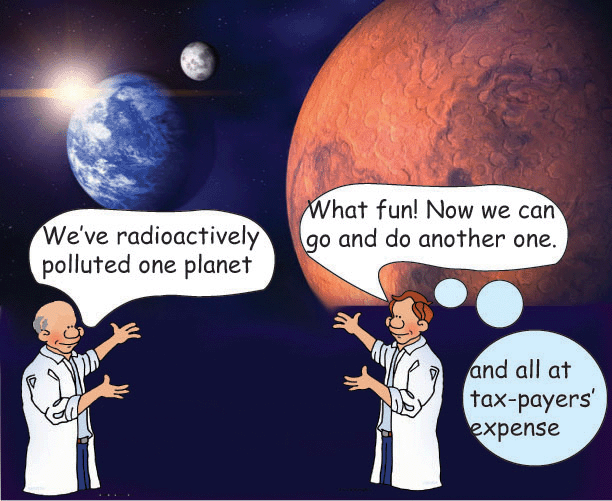
NASA is planning to use nuclear power for the first human trip to Mars
earth.com By Chrissy Sexton 30 July 23
The space race has been revived, but this time, the goal post has been shifted much further – to Mars. As recent technological advancements promise to open new horizons of exploration, NASA plans to cut the travel time to Mars with a nuclear-powered spacecraft.
A trip to Mars currently takes approximately seven months, covering a staggering 300-million-mile journey. NASA, in collaboration with the US Defense Advanced Research Projects Agency (DARPA), now proposes an ambitious plan that hinges on the promise of nuclear thermal propulsion technology to reduce this duration significantly.
DRACO spacecraft is nuclear-powered
NASA aims to launch a nuclear-powered spacecraft, known as DRACO (Demonstration Rocket for Agile Cislunar Operations), into Earth’s orbit either by late 2025 or early 2026. The spacecraft, under construction by Lockheed Martin, a leading aerospace and defense company, will serve as a testbed for this groundbreaking technology.
NASA administrator Bill Nelson said that this technology “would allow humans to travel in deep space at record speed.” However, it remains unclear by how much the nuclear thermal propulsion technology can decrease the travel time.
…………………………………………………………………. The history of NASA’s interest in nuclear propulsion dates back over six decades. The concept was first explored in the 1960s when Wernher von Braun, a pioneer of rocket technology, advocated for a Mars mission utilizing a nuclear propulsion system. Unfortunately, budgetary constraints and shifting priorities resulted in the abandonment of this vision in 1972
But with the dawn of the new space age, NASA’s pursuit of the Red Planet has been rekindled. In collaboration with the US government, the space agency aims to expedite progress with the DRACO nuclear thermal rocket program.
“The ability to accomplish leap-ahead advances in space technology through the DRACO nuclear thermal rocket program will be essential for more efficiently and quickly transporting material to the Moon and eventually, people to Mars,” commented Dr Stefanie Tompkins, director at DARPA………………………………………………………………………………………………
More about Mars…………………….
Size
Mars is about half the size of Earth but has the same amount of dry land. It is much colder than Earth, with temperatures ranging from -195 degrees F in winter at the poles to 70 degrees F in summer near the equator. Mars has the largest dust storms in the solar system, capable of covering the entire planet and lasting for months.
Atmosphere
The planet’s atmosphere is very thin, composed mainly of carbon dioxide (95%), with traces of nitrogen and argon. It lacks a magnetic field, which on Earth serves to protect us from harmful solar radiation. As a result, the surface of Mars is exposed to higher levels of radiation, which can be a challenge for human exploration and potential colonization.
………………………….... Potential for life on Mars
The possibility of liquid water in the past, and thus the potential for life, has made Mars a prime target for future human exploration. The planned missions to Mars, such as NASA’s Artemis program and SpaceX’s Starship project, aim not only to land humans on Mars but also to establish a sustainable colony, marking a significant leap in our exploration of the cosmos. https://www.earth.com/news/could-a-nuclear-powered-spacecraft-shorten-the-trip-to-mars/
No comments yet.
1 This Month
Chernobyl: The Lost Tapes – A good documentary on Chernobyl on SBS available On Demand for the next 3 weeks– https://www.sbs.com.au/ondemand/tv-program/chernobyl-the-lost-tapes/2352741955560

of the week–London Campaign for Nuclear Disarmament

Tell the Ukrainian Government to Drop Prosecution of Peace Activist Yurii Sheliazhenko
To see nuclear-related stories in greater depth and intensity – go to https://nuclearinformation.wordpress.com
-
Archives
- April 2026 (139)
- March 2026 (251)
- February 2026 (268)
- January 2026 (308)
- December 2025 (358)
- November 2025 (359)
- October 2025 (376)
- September 2025 (257)
- August 2025 (319)
- July 2025 (230)
- June 2025 (348)
- May 2025 (261)
-
Categories
- 1
- 1 NUCLEAR ISSUES
- business and costs
- climate change
- culture and arts
- ENERGY
- environment
- health
- history
- indigenous issues
- Legal
- marketing of nuclear
- media
- opposition to nuclear
- PERSONAL STORIES
- politics
- politics international
- Religion and ethics
- safety
- secrets,lies and civil liberties
- spinbuster
- technology
- Uranium
- wastes
- weapons and war
- Women
- 2 WORLD
- ACTION
- AFRICA
- Atrocities
- AUSTRALIA
- Christina's notes
- Christina's themes
- culture and arts
- Events
- Fuk 2022
- Fuk 2023
- Fukushima 2017
- Fukushima 2018
- fukushima 2019
- Fukushima 2020
- Fukushima 2021
- general
- global warming
- Humour (God we need it)
- Nuclear
- RARE EARTHS
- Reference
- resources – print
- Resources -audiovicual
- Weekly Newsletter
- World
- World Nuclear
- YouTube
-
RSS
Entries RSS
Comments RSS
 nuclear-news
Leave a comment