Bombs away: Confronting the deployment of nuclear weapons in non-nuclear weapon countries
Bulletin, By Moritz Kütt, Pavel Podvig, Zia Mian | July 28, 2023
The countries of the Nuclear Nonproliferation Treaty (NPT) will meet in Vienna at the end of July and in early August to begin another several-year-long cycle of assessing progress on meeting the goals and obligations of this five-decade-old agreement. A particularly contentious part of the coming global nuclear debate will be the handful of NPT countries that do not have nuclear weapons of their own but instead choose to host nuclear weapons belonging to the United States or Russia. For most NPT countries, such nuclear weapon-hosting arrangements are unacceptable Cold War holdovers that should end.
The new urgency for action on the issue of nuclear host-states follows the first new agreement to transfer nuclear weapons to a host country in many decades. In June 2023, President Vladimir Putin announced that Russia had moved a number of its nuclear weapons to Belarus, its ally and neighbor, with more nuclear weapons on the way, and that “by the end of the summer, by the end of this year, we will complete this work.” For his part, the President of Belarus has proposed to other states: “Join the Union State of Belarus and Russia. That’s all: there will be nuclear weapons for everyone.”
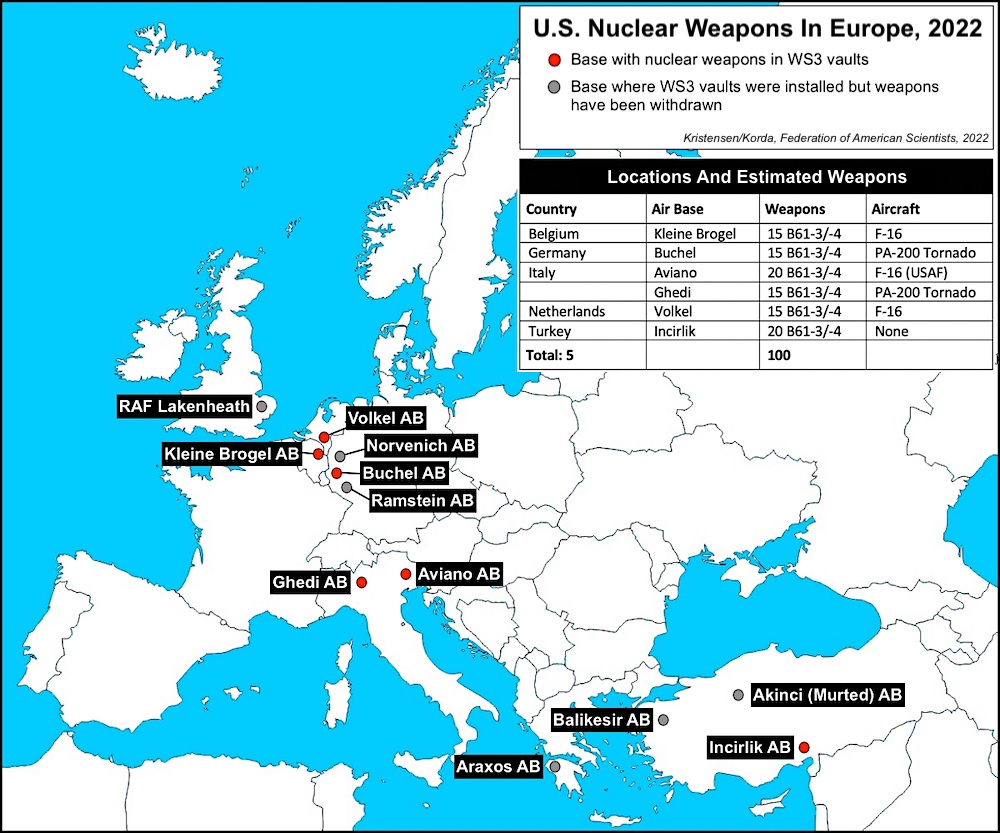
If the transfer of weapons to Belarus is completed, it will become the sixth nuclear-weapon host state. The other five hosting arrangements involve US nuclear weapons in Belgium, the Netherlands, Germany, Italy, and Turkey, in a practice euphemistically dubbed “nuclear sharing” by the US and its NATO allies. One other NATO member is increasingly vocal about wanting to join this gang. After Putin’s announcement about Belarus, Polish Prime Minister Mateusz Morawiecki repeated the call to become a host state for US nuclear weapons. Poland’s President Andrzej Duda had brought up this hosting option last year, but the idea had been floated in 2020 by Poland’s Ambassador to the United States………………………………………………………………………………….
There is a partially declassified history of US foreign nuclear weapon deployments from 1951-1977. The practice of stationing nuclear weapons in allied countries (or territories) began in 1951 with the deployment of weapon components to Guam, followed in 1954 by the dispatch of weapons to Morocco and the United Kingdom. In time, the US stationed its nuclear weapons in 16 countries, mostly in Europe and Asia (not counting Guam and Puerto Rico). Some US nuclear weapons were also stationed in Canada. By the late 1960s, there were about 7,000 US nuclear weapons in Europe, including bombs, missile warheads, artillery shells, and nuclear landmines. The number of US nuclear weapons in Europe peaked in 1971 at about 7,300 before beginning to decline later in the 1970s.
In 1959, the Soviet Union briefly deployed weapons to Eastern Germany. Its most prominent (albeit short-lived) nuclear weapons deployment was to Cuba in 1962. Later, in the mid-‘60s, longer deployments started, with Soviet nuclear weapons going to the Czech Republic, Hungary, Mongolia, Poland, and, again, East Germany. Moscow also deployed nuclear weapons in the Soviet republics, including strategic nuclear weapons in Kazakhstan, Belarus, and Ukraine.
With the end of the Cold War, the United States and Russia began to bring their weapons home. The Soviet Union had removed all weapons from Eastern Europe by the time it broke up in 1991. The withdrawal of all non-strategic weapons from former Soviet republics came by May 1992, and all strategic weapons were returned in November 1996.
Most US nuclear deployments in Asia ended in the mid-‘70s, although nuclear weapons stayed in South Korea until 1991. Deployments in Europe were significantly reduced (below 500 in 1994) and ended in Greece (2001) and in the United Kingdom (2009). However, the United States has not completed this process; about 100 US weapons remain abroad, stationed at bases in Belgium, the Netherlands, Germany, Italy and Turkey. Rather than withdraw the weapons from these countries, the US is sending modernized nuclear weapons to replace them.
The United Kingdom was the only other country to both host weapons (belonging to the US) and to deploy its own weapons in other countries. Its foreign deployments began in the 1960s and were limited to Cyprus, Singapore, and West Germany, and this practice ended in 1998.
There is no information on foreign deployments and nuclear hosting arrangements by other nuclear weapon states. There have been concerns that Pakistan might station some of its nuclear weapons in Saudi Arabia, with former US officials suggesting a “NATO-like model” might be one option for such an arrangement.
In current US nuclear hosting arrangements, the nuclear weapons are supposed to be under the control of US military personnel in peacetime. Specially trained host-nation air force units will carry and use these US weapons in wartime, in accordance with US and allied nuclear war plans. A similar arrangement now exists between Russia and Belarus, with Belarussian pilots trained to fly their planes while armed with Russian nuclear weapons; at least 10 planes may now be nuclear capable. It is also possible that Belarus could use its Russian-supplied, intermediate-range, dual-use Iskander-M missiles to deliver nuclear warheads.
According to the United Nations, the Russian nuclear hosting agreement with Belarus is the first such agreement since the NPT entered into force in 1970. The other hosting arrangements still operating are based on agreements that predate the treaty. The NPT prohibits both the acquisition of nuclear weapons by non-weapon states and the transfer of nuclear weapons to such countries by the five nuclear weapon states who are parties (Russia, China, the United States, the United Kingdom, and France)…………………………………….
While the treaty was being negotiated, US and Soviet officials agreed privately that existing nuclear hosting arrangements could continue even under the NPT.……………………………….
Most NPT member states have a different interpretation of nuclear sharing and for almost three decades have raised their concerns. …………………………………..
The most recent clash came at the August 2022 NPT Review Conference. Speaking on behalf of the 120 countries of the Non-Aligned Movement, Indonesia, said “[i]n the view of the Group … nuclear weapon-sharing by States Parties constitutes a clear violation of non-proliferation obligations undertaken by those Nuclear Weapon States (NWS) under Article I and by those Non-Nuclear Weapon States (NNWS) under Article II.” ………………………………………………………………
China is the only NPT nuclear-weapon state now consistently opposed to nuclear sharing. In its 2022 NPT Review Conference statement, China’s representative stated that “nuclear sharing arrangements run counter to the provisions of the NPT.” …………………………………………………………….
The most significant effort to confront the principles and practices of nuclear hosting is the UN Treaty on the Prohibition of Nuclear Weapons, which entered into force in 2021 and currently has almost 100 state signatories (all of whom also are NPT members). The TPNW prohibits the stationing of foreign nuclear weapons on the soil of its state parties under any circumstances. It offers a means for states who do not wish to be nuclear hosts to affirm this commitment and make it legally binding simply by joining the treaty. The TPNW also offers a path to membership for the states who currently have nuclear weapon hosting arrangements—if they sign the treaty they must undertake “prompt removal of such weapons, as soon as possible” and not later than 90 days. Once the weapons have been sent back home, the country has to make a declaration to this effect to the UN Secretary-General.
For states not yet ready to join the TPNW, several options are possible. States individually could decide to renounce nuclear hosting and sharing. For European NATO countries, one example is offered by Iceland and Lithuania, which are NATO members but refuse to host nuclear weapons under any circumstances. A less clear-cut option is offered by Denmark, Norway, and Spain, which do not allow deployment of nuclear weapons in peacetime.
States could also form nuclear-weapon free zones: Over 110 countries already are in nuclear-weapon-free zone agreements with neighbors. A European nuclear weapon free zone has been a long-standing idea. ………………………………………………
There are of course things nuclear weapon states could do. The five NPT nuclear weapon states could agree to a commitment on no-foreign-deployments as an effective measure relating to nuclear disarmament under their NPT Article 6 obligations…………………………………………
To establish a global principle, the UN General Assembly and the UN Security Council could determine that the hosting of nuclear weapons will henceforth be treated as a threat to international peace and security. https://thebulletin.org/2023/07/bombs-away-confronting-the-deployment-of-nuclear-weapons-in-non-nuclear-weapon-countries/
No comments yet.
1 This Month
Chernobyl: The Lost Tapes – A good documentary on Chernobyl on SBS available On Demand for the next 3 weeks– https://www.sbs.com.au/ondemand/tv-program/chernobyl-the-lost-tapes/2352741955560

of the week–London Campaign for Nuclear Disarmament

Tell the Ukrainian Government to Drop Prosecution of Peace Activist Yurii Sheliazhenko
To see nuclear-related stories in greater depth and intensity – go to https://nuclearinformation.wordpress.com
-
Archives
- April 2026 (139)
- March 2026 (251)
- February 2026 (268)
- January 2026 (308)
- December 2025 (358)
- November 2025 (359)
- October 2025 (376)
- September 2025 (257)
- August 2025 (319)
- July 2025 (230)
- June 2025 (348)
- May 2025 (261)
-
Categories
- 1
- 1 NUCLEAR ISSUES
- business and costs
- climate change
- culture and arts
- ENERGY
- environment
- health
- history
- indigenous issues
- Legal
- marketing of nuclear
- media
- opposition to nuclear
- PERSONAL STORIES
- politics
- politics international
- Religion and ethics
- safety
- secrets,lies and civil liberties
- spinbuster
- technology
- Uranium
- wastes
- weapons and war
- Women
- 2 WORLD
- ACTION
- AFRICA
- Atrocities
- AUSTRALIA
- Christina's notes
- Christina's themes
- culture and arts
- Events
- Fuk 2022
- Fuk 2023
- Fukushima 2017
- Fukushima 2018
- fukushima 2019
- Fukushima 2020
- Fukushima 2021
- general
- global warming
- Humour (God we need it)
- Nuclear
- RARE EARTHS
- Reference
- resources – print
- Resources -audiovicual
- Weekly Newsletter
- World
- World Nuclear
- YouTube
-
RSS
Entries RSS
Comments RSS
 nuclear-news
Leave a comment