The misguided push to weaken nuclear safety standards is gaining steam
The Hill, BY EDWIN LYMAN, OPINION CONTRIBUTOR – 07/25/23
Imagine a future where experimental nuclear reactors are scattered across the U.S. landscape like so many Starbucks, in densely populated and rural areas alike. Also, imagine they are allowed to operate without thoroughly reviewed and validated safety analyses, highly trained personnel at the controls, the protection of armed security officers, any provisions for off-site emergency planning and robust containment structures that would help prevent the release of highly hazardous radioactive materials if the worst happens.
This is the future that many in the nuclear industry, along with their vocal supporters, are working overtime to achieve.
The only bulwark against the most dangerous proposals is the Nuclear Regulatory Commission, the independent federal agency in charge of protecting the public from the radiological hazards of civil nuclear facilities. However, the NRC is facing a coordinated, massive push by the industry to drastically weaken its safety and security regulations and speed up the implementation of its back-to-the-1950s dystopian vision.
NRC critics blame the agency for the slow pace of new nuclear reactor licensing and construction in the U.S. But the NRC should not be scapegoated for the nuclear industry’s own failures. These include repeatedly missing cost and schedule targets for the Vogtle-3 reactor in Georgia, or supplying technically deficient, inadequate applications, such as Oklo’s attempt to apply for a license for a “micro” nuclear reactor, which the NRC justifiably rejected, and NuScale’s application for a standard design approval for its small modular reactor, which the NRC found contained numerous gaps.
The industry’s ire has focused on the NRC’s development of the “Part 53” rule for so-called risk-informed licensing of new reactors, which proponents argue are so much safer than the currently operating fleet that they need far less regulatory oversight across the board. But the fundamental problem is that many of these reactor designs, which introduce new safety and security risks, only exist on paper or have had extremely limited (and not necessarily relevant) real-world experience………………………………………………………………………………………………………………….
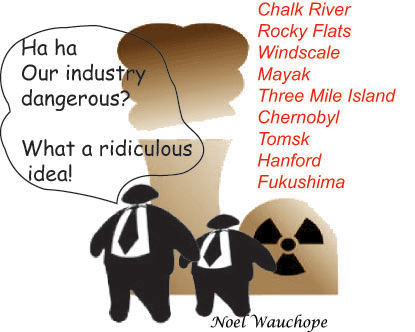
Some may ask why nuclear power still requires stringent regulation given that proponents claim it is already the safest form of energy. But although some nuclear supporters attempt to gaslight the public by playing down the massive health, environmental and economic impacts of the 1986 Chernobyl and 2011 Fukushima disasters, the fact remains that, unlike renewable energy technologies, nuclear power generates vast amounts of uniquely hazardous and long-lived radioactive materials as they operate. Not only are these substances highly carcinogenic, but evidence of their role in cardiovascular disease is growing.
Keeping these materials isolated from the environment will remain a critical obligation of the nuclear power sector as long as reactors continue to run and nuclear waste persists. NRC’s statutory authority must remain focused on ensuring radiological safety and security……………… https://thehill.com/opinion/energy-environment/4116386-the-misguided-push-to-weaken-nuclear-safety-standards-is-gaining-steam/
No comments yet.
1 This Month
Chernobyl: The Lost Tapes – A good documentary on Chernobyl on SBS available On Demand for the next 3 weeks– https://www.sbs.com.au/ondemand/tv-program/chernobyl-the-lost-tapes/2352741955560

of the week–London Campaign for Nuclear Disarmament

Tell the Ukrainian Government to Drop Prosecution of Peace Activist Yurii Sheliazhenko
To see nuclear-related stories in greater depth and intensity – go to https://nuclearinformation.wordpress.com
-
Archives
- April 2026 (139)
- March 2026 (251)
- February 2026 (268)
- January 2026 (308)
- December 2025 (358)
- November 2025 (359)
- October 2025 (376)
- September 2025 (257)
- August 2025 (319)
- July 2025 (230)
- June 2025 (348)
- May 2025 (261)
-
Categories
- 1
- 1 NUCLEAR ISSUES
- business and costs
- climate change
- culture and arts
- ENERGY
- environment
- health
- history
- indigenous issues
- Legal
- marketing of nuclear
- media
- opposition to nuclear
- PERSONAL STORIES
- politics
- politics international
- Religion and ethics
- safety
- secrets,lies and civil liberties
- spinbuster
- technology
- Uranium
- wastes
- weapons and war
- Women
- 2 WORLD
- ACTION
- AFRICA
- Atrocities
- AUSTRALIA
- Christina's notes
- Christina's themes
- culture and arts
- Events
- Fuk 2022
- Fuk 2023
- Fukushima 2017
- Fukushima 2018
- fukushima 2019
- Fukushima 2020
- Fukushima 2021
- general
- global warming
- Humour (God we need it)
- Nuclear
- RARE EARTHS
- Reference
- resources – print
- Resources -audiovicual
- Weekly Newsletter
- World
- World Nuclear
- YouTube
-
RSS
Entries RSS
Comments RSS
 nuclear-news
Leave a comment