‘Oppenheimer’ is a pitch-dark American nightmare. We cannot look away.
America – the Jesuit Review, Ryan Di Corpo, July 21, 2023
Shortly after Little Boy detonated over the morning sky of Hiroshima—choking the city with a plume of dense smoke, scorching the landscape with the white heat of the sun and in a moment banishing tens of thousands of civilians to nothing more than a memory—the 37-year-old Jesuit missionary Pedro Arrupe made his way to the wreckage.
The Basque priest, then appointed as novice master in Hiroshima, had seen the inside of a prison cell years earlier when some Japanese officials wrongly pegged him as a spy. He considered his execution to be a definite possibility, but spared an untimely death, he survived to see Hiroshima transformed into one of history’s largest cemeteries. Father Arrupe wrote that the American bomb exploded “similar to the blast of a hurricane,” and described the scene on the ground.
“I shall never forget my first sight of what was the result of the atomic bomb: a group of young women, 18 or 20 years old, clinging to one another as they dragged themselves along the road.…We did the only thing that could be done in the presence of such mass slaughter: we fell on our knees and prayed for guidance, as we were destitute of all human help.”
In its singular focus on the New York-born, Harvard-educated “father of the atomic bomb” J. Robert Oppenheimer, a man both ridiculed for his past and haunted by the future he unleashed, director Christopher Nolan mostly forgoes graphic depictions of the bombings’ aftermath and leaves the audience to envision the human misery wrought by the nuclear strikes. Perhaps taking a cue from the French filmmaker Robert Bresson, who found that “art lies in suggestion,” Nolan asks the audience to imagine the true face of the monster without fully revealing its form.
A heady, visually arresting and ultimately terrifying tour de force, “Oppenheimer” is both a startling re-examination of American history through the piercing eyes of a man who shaped it and a bleak warning about the nuclear age. Shifting between blazing color and stark black-and-white cinematography, the film is bifurcated by Oppenheimer’s leadership of the Manhattan Project, the clandestine government program to build the world’s first atomic weapon, and an infamous 1954 security hearing that saw Oppenheimer railroaded by McCarthyites for his prior left-wing sympathies.
Once venerated as an American sun god who helped usher his country out of World War II, Oppenheimer was later banished from government work for his onetime interest in communist ideology. Cillian Murphy, in an astounding performance as a man convinced of his own greatness and then tortured by his conscience, plays Oppenheimer as a self-assured, remote and intensely clinical physicist firmly committed to his work—and not much else. In the lab, at parties and in the bedroom, he wields his gaunt and nearly gothic visage as a barrier between his public confidence and increasingly unsettling private doubts. He wears a mischievous look, a gleam in his eye, as if perpetually on the verge of some “Eureka!” moment………………………………………………………………………….
In the film’s most disturbing sequence, Oppenheimer addresses a rabid crowd of patriotic Americans after the bombings, whipping them into a nationalistic frenzy and anointing himself as the man who quenched their bloodlust. “I bet the Japanese didn’t like it!” he exclaims to wild cheers and applause. But as he speaks, the sound cuts out and the crowd is suddenly suffocated by a white light. He sees a vision of a young woman (played by Nolan’s daughter) with her face peeling off, and then looks down to see his foot smashed through the charred remains of a bomb victim. He leaves the speech pallid and conscience-stricken.
…………………………………………………………………………. “Oppenheimer” arrives at a moment where concerns over nuclear power are back in the news.
………………………………………. There are two sides that form the film’s moral conundrum. The Pentagon and some scientists at Los Alamos contend that the atomic bomb must be used (and used repeatedly) to avoid further American casualties and bring a definitive end to the war. Critics opposed to the bomb point out that, by the spring of 1945, Hilter is already dead and the Japanese are poised to surrender………………………………………………………………………… https://www.americamagazine.org/arts-culture/2023/07/21/oppenheimer-nuclear-war-245720?utm_source=piano&utm_medium=email&utm_campaign=2928&pnespid=tKRjWX9aLbgL1qLZojqyGZWP5w2vX5cmduPg27M2rRxmOVvkgFko42gAhR.7PsVTW8PcIjUblQ—
Architect of Annihilation: Oppenheimer’s Deadly Legacy of Nuclear Terror

NoNukes , Klee Benally, Indigenous Action/Haul No!
Contributions by Leona Morgan, Diné No Nukes/Haul No! 20 July 23
The genocidal colonial terror of nuclear energy and weapons is not entertainment.
To glorify such deadly science and technology as a depoliticized dramatic character study, is to spit in the face of hundreds of thousands of corpses and survivors scattered throughout the history of the so-called Atomic age.
Think of it this way, for every minute that passes during the film’s 3-hour run time, more than 1,100 citizens in the cities of Hiroshima and Nagasaki died due to Oppenheimer’s weapon of mass destruction. This doesn’t account for those downwind of nuclear tests who were exposed to radioactive fallout (some are protesting screenings), it doesn’t account for those poisoned by uranium mines, it doesn’t account for those killed during nuclear power plant melt-downs, it doesn’t account for those in the Marshall Islands who are forever poisoned.
For every second you sit in the air conditioned theater with a warm buttery popcorn bucket in your lap, 18 people dead in the blink of an eye. Thanks to Oppenheimer.
Though you’ll certainly learn enough about J. Robert Oppenheimer, the “father of the atomic bomb,” thanks to director Christopher Nolan’s 70mm IMAX odyssey, let’s be clear about his deadly legacy and the overall military and scientific industrial complex behind it.
After the successful detonation of the very first atomic bomb, Oppenheimer infamously quoted the Hindu scripture Bhagavad-Gita, “Now I am become death, the destroyer of worlds.” Barely a month later, the “U.S” dropped two atomic bombs devastating the cities of Hiroshima and Nagasaki and more than 200,000 people were killed. Some of the shadows of those perished were burned into the streets. One survivor, Sachiko Matsuo, relayed their thoughts as they tried to make sense of what was happening when Nagasaki was struck, “I could see nothing below. My grandmother started to cry, ‘Everybody is dead. This is the end of the world.” A devastation that Nolan intentionally leaves out because, according to the director, the film is not told from the perspectives of those who were bombed, but by those who were responsible for it. Nolan casually explains, “[Oppenheimer] learned about the bombings of Hiroshima and Nagasaki on the radio, the same as the rest of the world.”
Months after the atomic detonation at the “Trinity” site in occupied Tewa lands of New Mexico, Oppenheimer resigned. He walked away expressing the conflict of having, “blood on his hands,” (though reportedly he later said the bombings were not “on his conscience”) while leaving a legacy of nuclear devastation and radioactive pollution permanently poisoning lands, waters, and bodies to this day.
U.S. military and political machinery cannibalized the scientist and turned him into a villain of their imperialist cold-war anxiety. They reminded him and the other scientists behind the Manhattan Project, that they and their interests were always in control.
Oppenheimer never was a hero, he was an architect of annihilation.
The race to develop the first atomic bomb (after Nazis had split the atom) never could be a strategy of peaceful deterrence, it was a strategy of domination and annihilation.
Nazi Germany was committing genocide against Jewish people while the U.S. sat on the political sidelines. It wasn’t until they were directly threatened that the U.S. intervened. Though Nazi Germany was defeated on May 8th, 1945, the U.S. dropped two separate atomic bombs on the non-military targets of the Japanese cities of Hiroshima and Nagasaki on August 6th and 9th, 1945.
To underscore Oppenheimer’s complicity, he suppressed a petition by 70 Manhattan Project scientists urging President Truman not to drop the bombs on moral grounds. The scientists also argued that since the war was nearing its end, Japan should be given the opportunity to surrender.
Today there are approximately 12,500 nuclear warheads in nine countries with almost 90 percent of them held by the U.S. and Russia. It is estimated that 100 nuclear weapons is an “adequate… deterrence” threshold for the “mutually assured destruction” of the world.
Oppenheimer built the gun that is still held to the head of everyone who lives on this Earth today. Throughout the decades after the development of “The Bomb,” millions throughout the world have rallied for nuclear disarmament, yet politicians have never taken their fingers off the trigger.
The Deadly Legacy of Nuclear Colonialism……………………………………………………………………………………………………more https://www.indigenousaction.org/architect-of-annihilation-oppenheimers-deadly-legacy-of-nuclear-terror/
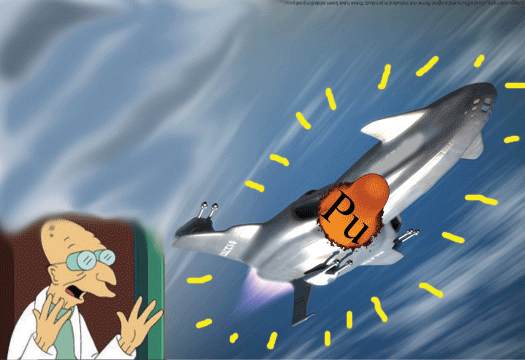
US DOE delivers plutonium-238 for NASA missions.
Nuclear Engineering International, 21 July 2023
The US Department of Energy (DOE) has shipped 0.5 kilograms of heat source plutonium oxide from Oak Ridge National Laboratory (ORNL) to Los Alamos National Laboratory (LANL). It will support future NASA deep space missions that rely on radioisotope power systems, such as the upcoming Dragonfly mission. Dragonfly will be powered by a radioisotope power system called a Multi-Mission Radioisotope Thermoelectric Generator.
DOE achieved a milestone in June in its capacity to package and transport plutonium-238, a key ingredient in radioisotope power systems used in deep space missions from Voyager to the Mars Perseverance rover.
This delivery of heat source plutonium oxide was an order of magnitude greater than previous shipments. It was completed in partnership with NASA, who sponsored the installation of equipment to expand ORNL’s packaging capability.
It was the largest shipment of new heat source plutonium oxide since DOE restarted domestic plutonium-238 production more than a decade ago and strengthens the US supply chain. With this delivery, DOE remains on track to meet its average production target of 1.5 kilograms a year of heat source plutonium oxide by 2026………………………………………………………. more https://www.neimagazine.com/news/newsus-doe-delivers-plutonium-238-for-nasa-missions-11021754
USA government – more money, $19 billion, grant for making deadly plutonium
Senate appropriators boost funding for plutonium, uranium production facilities, By Dan Parsons, 21 Jul 23
Nearly $19 billion is included in the Senate Appropriations Committee’s 2024 spending bill for National Nuclear Security Administration nuclear-weapon programs, with funding boosts for planned facilities that will process plutonium and uranium for refurbished…………… (Subscribers only) https://www.exchangemonitor.com/senate-appropriators-boost-funding-for-plutonium-uranium-production-facilities/
US Republicans threaten to block AUKUS deal

By Anthony Galloway, The Age, July 21, 2023
Australia’s AUKUS submarine deal with the United States has hit a hurdle with Senate Republicans threatening to block the sale unless President Joe Biden boosts funding for the domestic production line.
Republican members of the Senate Armed Services Committee on Friday moved to block legislation which would enable the sale of US Virginia-class submarines to Australia.
Under the AUKUS deal, Washington was set to sell Canberra between three and five of its own nuclear submarines in the 2030s before Australia begins building a new class of boat with Britain.
But the ranking Republican on the Senate Armed Services Committee, senator Roger Wicker, said Biden needed to commit more money to guarantee “we have enough submarines for our own security before we endorse that pillar of the agreement”.
Wicker said Australia’s commitment of US$3 billion ($4.4 billion) for the US production line would not be enough to meet the needs of both countries.
“The president needs to submit a supplemental request to give us an adequate number of submarines,” he told US news outlet Politico…………………………………………………….. https://www.theage.com.au/politics/federal/foolish-us-republicans-threaten-to-block-aukus-deal-20230721-p5dqc3.html
Europe’s black hole: How much of the more than $185 billion given by the West to Ukraine has been stolen?

Rt.com By George Trenin, 20 Jul 23
The fate of huge amounts of aid sent to the country is uncertain amid endemic corruption and a lack of accountability.
As a result of last week’s NATO summit in Vilnius, the US-led military bloc promised Ukraine fresh tranches of financial and military aid. This was despite the fact that by the beginning of the summer, Kiev had already received a total of €165 billion ($185.6 billion) from Western countries. Meanwhile, as the spending increases, the number of US and EU citizens who are willing to sacrifice their own comfort for the sake of Kiev appears to be steadily decreasing.
One of the reasons for this is corruption in Ukraine, which – despite some lofty promises – seems to be as bad now as it was before the Western-backed 2014 ‘Maidan’ coup. If not worse.
Moral compensation
The NATO summit, despite Ukraine’s hopes, did not bring it a long-awaited timeframe for membership. Instead, Western leaders announced new military aid packages for Kiev.
According to the French newspaper Le Monde, French President Emmanuel Macron promised to give Ukraine a “substantial number” of SCALP missiles that can hit targets at a distance of 250 kilometers. According to France24, each costs €850,000.
Berlin announced a package amounting to €700 million. Germany plans to supply Ukraine with launchers for the Patriot missile defense system, Marder-type infantry fighting vehicles, UAVs, Leopard 1 A5 tanks, and artillery shells. However, for Berlin, this is not even close to a record gift value. On May 21, the German Foreign Ministry announced the transfer of military aid to Ukraine worth €2.7 billion.
On July 7, US Under Secretary of Defense for Policy Colin Kahl spoke about a new package of aid from the US which includes cluster munitions – which are banned in 120 countries. The cost was $800 million.
This is the 42nd delivery of aid that Ukraine has received from the US in the past year and a half. Since the beginning of Russia’s offensive, the US Congress has approved military and economic assistance to Ukraine amounting to over $70 billion – and that’s only counting direct expenses.
According to July data from the Kiel Institute (which tracks the volume of aid allocated to Ukraine), total direct subvention provided by the US and its allies in the period from February 24, 2022 to May 31, 2023 topped €165 billion.
The rate at which new tranches are allocated increases every month. For example, at the end of April, the total amount of aid was €15 billion less than it is now – according to NATO Secretary General Jens Stoltenberg, it was then €150 billion. ……………………………………………………………………………..
the risk of corruption exists not only within state borders but that fraud can also occur when concluding contracts in the US. Furthermore, the theft of weapons or other aid may happen as it travels to the war zone through Europe.
Another official involved in criminal investigations at the Pentagon also told Defense One that his department is “concerned about the potential diversion or legal export, or theft for that matter, of the goods.”
Many American businesses do not trust the Ukrainian authorities either and believe that aid is being stolen. According to US Secretary of Commerce Gina Raimondo, private businesses doubt that the funds allocated to Ukraine for reconstruction will be safe from corruption.
nternal games
The corruption issue is acknowledged in Ukraine as well. This spring, the ex-adviser of the office of the president of Ukraine, Aleksey Arestovich, said on his YouTube channel that his old boss, Vladimir Zelensky, has not been able to deal with corruption in Ukraine.
“Ukraine needs only one thing… To have someone come to power who won’t steal. Someone who won’t do it himself and won’t allow others to do so. Unfortunately, so far we haven’t been lucky,” he said.
…………………………………………….. “The Ukrainian president and many in his entourage have been skimming untold millions from the American dollars earmarked for diesel fuel payments. One estimate by analysts from the Central Intelligence Agency put the embezzled funds at $400 million last year, at least,” – American investigative journalist Seymour Hersh stated that Ukrainian President Vladimir Zelensky and his entourage illegally appropriated at least $400 million from funds that were allocated to Kiev for the purchase of diesel fuel.
…………….. Moreover, Hersh says that CIA Director William Burns was displeased with Zelensky because of the possible theft of Western aid, since “he was taking a larger share of the skim money than was going to the generals.” ……………… more https://www.rt.com/russia/579897-europes-black-hole-ukraine/
In Ukraine, US Adds to Barbaric Cluster-Bomb Legacy
SCHEERPOST, by EDITORJuly 21, 2023
2 Millions of people have been affected by the use of cluster munitions by the US in countries like Laos, Vietnam, Cambodia, Afghanistan, and Iraq, even years after the wars have ended. The same plight awaits civilians in the current war zone in Ukraine
By Abdul Rahman / Peoples Dispatch
The sad quip about “NATO fighting against Russia to the last Ukrainian” once again proved apt when U.S. President Joe Biden took the “difficult” decision earlier this month to supply cluster munitions to Ukraine to facilitate its fight against the Russians.
The supply of cluster munitions is a part of a fresh $800 million military aid package to Ukraine, which came on the eve of the NATO summit at Vilnius in Lithuania, which was attended by Ukrainian President Volodymyr Zelensky.
The dangerous nature of cluster munitions, especially for civilians, is well known. Close to 120 countries signed a convention in 2008 against their production and use.
In the present case, the decision is more dangerous for Ukrainians for two specific reasons — first, it provides Russians with a perfect justification to retaliate with far superior force, and second, the battlefields where the munitions will be used are primarily inside Ukraine.
Long-Term Impact
A cluster munition is a bomb containing multiple sub-munitions. They are dropped from air or fired from the ground and explode mid-air to release tens, sometimes hundreds, of sub-munitions which spread across an area equal to several football fields, with no distinction between military and civilian areas.
The sub-munitions explode with impact as they fall on the ground. However, a large number of them fail to explode due to the way in which they fall and become hazardous like landmines, exploding sometimes days or years after they were originally released.
Given the large dud rates — anywhere between 2 percent and 40 percent — it is most likely that whoever wins the war will have a herculean task in cleaning up the unexploded munitions to prevent a large number of civilian casualties due to accidental explosions.
…………………………………. Yet Another U-Turn
The decision to supply cluster munitions is yet another U-turn in the Biden administration’s Ukraine policy, which had expressed doubts just a few months earlier, claiming that they were too dangerous.
This is now a pattern for the Biden administration — first denying a crucial weapon citing possibilities of dangerous escalation with Russia, but later going ahead with the supply or asking allies with the same set of weapons to do so.
U.S. and other NATO members have followed this pattern in the supply of the Patriot missile defense systems, HIMARS rocket launchers, battle tanks and fighter jets to Ukraine.
[Last week the U.S. House of Representatives voted down an amendment to prohibit the transfer of cluster bombs to Ukraine.]
There are already reports about Ukraine’s widespread use of cluster bombs against Russians in the current war and. Cluster bombs were also reportedly used by Ukraine against its own citizens during the initial phases of the Donbass resistance in 2014.
However, following an outcry in the media, it declared that it will not use the bombs received from the U.S. in Russia, which means that they will be used in Russian-controlled regions in Ukraine.
Ukraine anyway has limited or no capacity to drop the bombs deep inside Russian territories.
While saying that Russia has deliberately refrained so far from using cluster munitions in Ukraine given the threat to the civilian population, Russian Defense Minister Sergei Shoigu recently claimed that, “if the U.S. supplies cluster munitions to Ukraine, the Russian armed forces will be forced to use similar means of destruction against the Ukrainian armed forces as a retaliatory measure.” [Human Rights Watch said in May that Russia has already used cluster bombs, as has Ukraine.]
The civilians in Donbass or Crimea are perhaps going to face the impact of the current war for generations thanks to the Biden administration. https://scheerpost.com/2023/07/21/in-ukraine-us-adds-to-barbaric-cluster-bomb-legacy/
 | |||
| |||
Luck Is Not a Strategy for the Ukraine, The Germans Take the “Evidence-based” Path.
We Chat with Nuclear Expert Dr. Paul Dorfman
Hot Globe, STEVE CHAPPLE, JUL 20, 2023
“………………………………………………………………………………. HOT GLOBE: It’s always bothered me that Saudi Arabia because of the Trump administration has now got access to the beginnings of nuclear power, and to a future nuclear bomb. The idea of selling small nuclear reactors around the world raises a pretty problematic point.
DORFMAN: That’s absolutely true. Saudi has made no bones about its nuclear ambitions and I mean its military nuclear ambitions. Saudi diplomats have said quite clearly that they’re looking towards Iran and that they’re seriously thinking about both civil and military nuclear. So there’s a potential for an arms race, a military nuclear arms race in the Middle East region. It’s actually even more bad news for the Middle East because in a proxy war if say, for example, Russian and America wanted to have a bit of a go and they didn’t want to absolutely destroy each other’s country where would they be fighting their proxy nuclear war? The first region that comes to mind is the Middle East and Saudi and Iran.
The economies of small nuclear reactors depend absolutely on production to scale. It’s been proven time and time again that in order to make any money at all, to break even on small nuclear production, you need to sell them abroad. Now, selling them abroad to whom, for what reasons? You’d be selling them to developing nations who may or may not have the capacity to regulate, to protect, to defend in depth, and so therefore you would be significantly expanding the potential for military nuclear risk whether that means a dirty bomb or further nuclear development.
HOT GLOBE: A slightly different question here, but Germany had ongoing nuclear plants and even though they were still producing electricity, they’ve shut those down. That may be a little puzzling to some Americans. Can you explain that?
DORFMAN: First of all, what Germany does is evidence-based policy. Germany puts out its scientific, technological questions, its energy questions, to well-funded high level research units. They go away and do their research. They come back with their research. They give it to the government departments and then the government makes a decision. So it’s evidence-based policy making. Over the years Germany has said well, we want to get to net-zero and we’re kind of worried about nuclear. Now around 2011 when Fukushima happened–remember Chancellor Merkel is a PhD chemist. She realized like many of us that even in an advanced society things could go badly wrong since accidents are by definition accidental.
HOT GLOBE: Good line
DORFMAN: Yeah, who knew? [laughs] So when Fukushima happened, Merkel and many others in Germany said well, look, we can’t stand the pain of this. I was having supper with Naoto Kan, the premier of Japan at the time of Fukushima after we both spoke in Westminster. Even then I was shocked when he turned to me and said that if the wind had been in the wrong direction, they would have lost Tokyo. The majority of the pollution went out into the Pacific Ocean. Now to the point about Germany. It’s landlocked so the Germans looked at the possibility of an accident and they came up with the numbers. It would cost trillions and trillions and trillions of Euros if they had a nuclear accident and they said look, we really can’t be doing this. This is just crazy, basically, and so we’re going to do “the German energy transition.” We’re going to try to lead the world on this and we’re going to move stepwise into renewables-plus, that’s renewables solar wind energy storage, interconnection, demand site management, energy management, distributed grids and a significant centralized upgrade of grids, too.
Now clearly Germany has a core problem, a fossil fuel problem, but they didn’t want to go down the fissile fuel route so Germany has said well OK for the time being we’re going to rely on gas but then we’re going to move to a full renewable economy. Well, the war has speeded that up. Since the war Germany has burnt less coal and Germany has shuttered all its nuclear power plants. It’s done this because what Germany says it will do, it does, unlike many other states. It set upon a route to go renewables. Now there is no such thing as a free lunch. Everything costs and there’s no perfect solution to the energy crisis, but what Germany is trying to do is to lead the world in this so-called energy transition, and I won’t spout numbers but basically what has happened is you’ve just seen significant renewable deployment, significant storage and a water storage as it were deployment which is sort of integrated into the power system and also integrated into the democratic system whereby by local communities also own the local renewable aspects of the local renewable power generation. It’s basically saying well look yes we can do this rather like Americans, you know, we have a dream, we will try to do this, it will be difficult but we will do our best to get there since the costs and the risks of nuclear are far too great. Let’s find a realistic, sustainable, positive, constructive way through……..
more https://hotglobe.substack.com/p/nuclear-power-is-already-a-climate
The Elders publish new policy paper on nuclear weapons
The Elders 21 July 23
The Elders today publish a new policy paper on the existential threat posed by nuclear weapons.
They argue that heightened geopolitical tensions around Russia’s war on Ukraine and Sino-US rivalry, as well as new technological developments such as Artificial Intelligence (AI), make it all the more important that leaders commit to tangible steps towards disarmament and de-escalation…………………………………………………………………………..
n today’s fraught geopolitical environment, The Elders reaffirm their support for the TPNW and the ultimate objective of a world without nuclear weapons, while continuing to advocate for the risk minimisation agenda. They believe this remains the best way to make tangible progress amid the deep divide between nuclear powers and their allies, and the much larger number of states who support the Treaty on the Prohibition of Nuclear Weapons (TPNW). Such progress would deliver a meaningful reduction in both risks and warheads.
The risk minimisation agenda rests on four elements known as the 4 Ds:
- Doctrine: Every nuclear-armed state should make an unequivocal “No First Use” declaration.
- De-alerting: The highest priority must be given to taking as many weapons as possible off their current high-alert status.
- Deployment: More than one-quarter of the world’s stockpile of nuclear weapons is currently operationally deployed. This proportion must be dramatically and urgently reduced.
- Decreased numbers: The number of nuclear warheads should be reduced from 12,500 to the lowest possible level, with the US and Russia reducing to no more than 500 each, which should serve as an upper ceiling for any nuclear state.
The Elders also call on nuclear states – the Permanent 5 UN Security Council members of the United States of America, Russia, China, France and the United Kingdom, as well as India, Pakistan, Israel and North Korea — and their allies to engage constructively with the TPNW, including through attending states parties meetings as observers, and to build common ground with TPNW states around a shared goal of ultimate nuclear disarmament.
TPNW states should work to help turn the Treaty into a binding and effective reality, including through strengthening the treaty’s verification and enforcement provisions.
All countries should work to strengthen the global non-proliferation architecture, including through:
- Increasing safeguards to track the flow of materials inside civil reactors;
- Introducing real penalties for countries that withdraw from the Non-Proliferation Treaty (NPT);
- Strengthening the capacity of the International Atomic Energy Agency (IAEA);
- Ratifying the Comprehensive Test Ban Treaty (CTBT) and bringing to conclusion the long-proposed Fissile Material Cut-Off Treaty.
https://theelders.org/news/elders-publish-new-policy-paper-nuclear-weaponsons
Oppenheimer biographer supports US bill to bar use of AI in nuclear launches

Kai Bird, author of American Prometheus, says technology is ‘too dangerous to gamble with’ and supports senator’s attempt to bar it
Guardian, Martin Pengelly 21 Jul 23
A biographer whose Pulitzer prize-winning book inspired the new movie Oppenheimer has expressed support for a US senator’s attempt to bar the use of artificial intelligence in nuclear weapons launches.
“Humans must always maintain sole control over nuclear weapons,” Kai Bird, author of American Prometheus, said in a statement reported by Politico.
“This technology is too dangerous to gamble with. This bill will send a powerful signal to the world that the United States will never take the reckless step of automating our nuclear command and control.”
In Washington on Thursday, Bird met Ed Markey, the Democratic Massachusetts senator who is attempting to add the AI-nuclear provision to a major defense spending bill………………………………………………………………….. more https://www.theguardian.com/books/2023/jul/21/ai-nuclear-weapons-kai-bird-oppenheimer-author
Ontario – Ford government’s electricity plan takes wrong approach
Windsor Star, By Jack Gibbons 21 Jul 23
Having missed the boat on the global green energy boom by crushing the province’s early leadership on renewable energy, Premier Doug Ford is now trying to take another stab at building a future economy by investing in buggy whip manufacturing.
That’s what spending tens of billions of dollars on high-cost, high-risk nuclear power essentially represents — a bet on a technology that has been in decline for decades.
Instead of trying to catch up with a global marketplace that is decidedly all-in on renewable energy — with the International Energy Agency saying 90 per cent of new electricity capacity will come from renewables over the next five years — Ontario wants to go back to the 1960s and ‘70s and embark on another long shot effort to build nuclear power plants.
It’s important to remember the province’s past nuclear projects have been one fiasco after another. Our most recent nuclear new build project — the Darlington nuclear station — went massively over budget.
The huge cost overruns and poor performance of its nuclear reactors essentially bankrupted the old Ontario Hydro. Ontario power ratepayers and taxpayers were left paying off the utility’s massive $19.4-billion stranded nuclear debt.
That hasn’t stopped a government with a strong distaste for solar panels and wind turbines from warmly embracing a technology that has never lived up to its promise.
It is now planning to build a massive new nuclear plant right beside the Bruce nuclear station which is already the largest nuclear station in the world. It also wants to build mythical “modular” reactors along the waterfront at Darlington right next to Toronto.
That the reactors the government is touting for Darlington are, at this point, nothing more than PowerPoint slides in a nuclear PR presentation hasn’t stopped the government from making wild claims that these unproven (and, at this point, unlicensed and physically non-existent) reactors can be built at what it deems to be a reasonable cost.
In 2009, when the nuclear companies wanted to build two new nuclear reactors at Darlington, the Dalton McGuinty government required them to submit fixed-price bids.
Not surprisingly the most competitive bid was 3.7 times higher than the forecast price. As a result, the government suspended the procurement process and the reactors were never built.
But despite repeatedly slamming the “fiscal irresponsibility” of previous Liberal governments, it appears that Premier Doug Ford is only too happy to give the nuclear industry a blank cheque and allow inevitable cost overruns to be passed on to electricity consumers and taxpayers.
That the projected cost for the province’s new dream nuclear projects are more than three times higher than what we would pay today for power from competitively procured wind and solar also doesn’t seem to bother Energy Minister Todd Smith…………………………………………..
New nuclear reactors that will take at least 10 to 15 years to build can not provide the dramatic reductions in greenhouse gas pollution that we need now. To add insult to injury, Doug Ford’s solution to keeping the lights on in the interim is to ramp up use of climate-wrecking gas plants and, even more astoundingly, build new ones.
But what’s truly scandalous about the government’s Powering Ontario plan is prioritizing phantom nuclear technology over what the world wants: smart, integrated and highly efficient renewable power systems………… more https://windsorstar.com/opinion/letters/guest-column-ontario-governments-electricity-plan-taking-wrong-approach
What We Can Still Learn From J. Robert Oppenheimer
“We believe,” he wrote in 1945, “that the safety of this nation—as opposed to its ability to inflict damage on an enemy power—cannot lie wholly or even primarily in its scientific or technical prowess.”
By Robert C. Koehler / Common Dreams, July 21, 2023
Amere 55 years after his death, the U.S. government has restored J. Robert Oppenheimer’s security clearance, which the Atomic Energy Commission had taken away from him in 1954, declaring him to be not simply a communist but, in all likelihood, a Soviet spy.
Oppenheimer, of course, is the father of the atomic bomb. He led the Manhattan Project during World War II, which birthed Little Boy and Fat Man, the bombs we dropped on Hiroshima and Nagasaki in August 1945, killing several hundred thousand people and ending the war. What happened next, however, was the Cold War, and suddenly commies—our former allies—were the personification of evil, and they were everywhere. The American government, in its infinite wisdom, knew it had no choice but to continue its nuclear weapons program and, for the sake of peace, put the world on the brink of Armageddon.
Hello, H-bomb!
War, the building block of the world’s governmental entities for uncounted millennia, had evolved to the brink of human extinction. Official government policy amounted to this: So what?
Oppenheimer challenged this official policy and shattered his career. Indeed, he saw immediately, as the newly developed bomb was tested at Alamogordo, New Mexico, on July 16, 1945, that Planet Earth was in danger. A team of physicists had just exposed its ultimate vulnerability and he famously noted, as he witnessed the mushroom cloud, that words of Hindu scripture from the Bhagavad-Gita entered his mind: “Now I am become Death, the destroyer of worlds.”
He had not opposed dropping the bombs on Hiroshima and Nagasaki, as some of the Manhattan Project scientists, such as Leo Szilard, did, but when the war ended he became deeply committed to eliminating all possibility of future wars. One of the first actions he took, a week after the bombings, was to write a letter to Secretary of War Henry Stimson, urging him to embrace common sense regarding further development of nuclear weapons.
“We believe,” he wrote, “that the safety of this nation—as opposed to its ability to inflict damage on an enemy power—cannot lie wholly or even primarily in its scientific or technical prowess. It can be based only on making future wars impossible. It is our unanimous and urgent recommendation to you that, despite the present incomplete exploitation of technical possibilities in this field, all steps be taken, all necessary international arrangements be made, to this one end.”
Making future wars impossible! What if American political forces had sufficient sanity to listen to Oppenheimer? Several months after writing this letter, he paid a visit to President Harry Truman, attempting to discuss the placement of international control over further nuclear development. The president would have none of that. He kicked Oppenheimer out of the Oval Office.
Oppenheimer maintained his commitment to the transcendence of war, working with the Atomic Energy Commission to control the use of nuclear weapons—and standing firm in his opposition to the creation of the hydrogen bomb. He continued his opposition even as the bomb’s development progressed and nuclear tests began spreading fallout over “expendable” parts of the world. But, uh oh. Along came the McCarthy era and the accompanying Red Scare.
…………………………………………………………………. It took them about 16 years. They finally succeeded in clearing his name.
And while I applaud their enormous effort and its result, I also note it isn’t finished yet. This is more than simply a personal matter: the righting of a bureaucratic wrong done to one man. The future of humanity remains at stake. The U.S. government has spent multi-trillions of dollars on nuclear weapons development over the years, conducted a thousand-plus nuclear tests, and is currently in possession of 5,244 nuclear warheads, out of an insane global total of some 12,500. Perhaps it’s time to start listening to—and hearing—Oppenheimer’s words. https://scheerpost.com/2023/07/21/what-we-can-still-learn-from-j-robert-oppenheimer/
| |||
| |||
1 This Month
Chernobyl: The Lost Tapes – A good documentary on Chernobyl on SBS available On Demand for the next 3 weeks– https://www.sbs.com.au/ondemand/tv-program/chernobyl-the-lost-tapes/2352741955560

of the week–London Campaign for Nuclear Disarmament

Tell the Ukrainian Government to Drop Prosecution of Peace Activist Yurii Sheliazhenko
To see nuclear-related stories in greater depth and intensity – go to https://nuclearinformation.wordpress.com
-
Archives
- April 2026 (126)
- March 2026 (251)
- February 2026 (268)
- January 2026 (308)
- December 2025 (358)
- November 2025 (359)
- October 2025 (376)
- September 2025 (257)
- August 2025 (319)
- July 2025 (230)
- June 2025 (348)
- May 2025 (261)
-
Categories
- 1
- 1 NUCLEAR ISSUES
- business and costs
- climate change
- culture and arts
- ENERGY
- environment
- health
- history
- indigenous issues
- Legal
- marketing of nuclear
- media
- opposition to nuclear
- PERSONAL STORIES
- politics
- politics international
- Religion and ethics
- safety
- secrets,lies and civil liberties
- spinbuster
- technology
- Uranium
- wastes
- weapons and war
- Women
- 2 WORLD
- ACTION
- AFRICA
- Atrocities
- AUSTRALIA
- Christina's notes
- Christina's themes
- culture and arts
- Events
- Fuk 2022
- Fuk 2023
- Fukushima 2017
- Fukushima 2018
- fukushima 2019
- Fukushima 2020
- Fukushima 2021
- general
- global warming
- Humour (God we need it)
- Nuclear
- RARE EARTHS
- Reference
- resources – print
- Resources -audiovicual
- Weekly Newsletter
- World
- World Nuclear
- YouTube
-
RSS
Entries RSS
Comments RSS
 nuclear-news