TODAY. Is it now OK to talk about ethics again?

The film “Oppenheimer” has raised some awkward questions about the use of weaponry to blast human beings to bits.
And right now, the USA leaders have decide that it’s OK to use cluster bombs and depleted uranium weapons to blow up and poison the “evil” Russians. No doubt Putin will by now have decided to do the same to the “evil” Ukrainians.
Everyone now is seeming to ponder on whether the nuclear bombing of thousands of people is really an OK thing to do.
While I am not minimising the awfulness of atomic bombing, I am thinking of some other things that aren’t very nice, either. Take for example, the Allied bombing of Dresden in February 1945. The main purpose of incinerating this city, (a cultural, not a military, centre) was to frighten and demoralise the civilian population of Germany.
That bombing was so cleverly done. one day, with thousands of bombs killing thousands of people. Then the Allies waited until the next day, when firemen and rescuers had arrived in the ruins, to do the next bombing, again killing many thousands.
So – what weapons are OK? What cruelties are justifiable?
World War 2 does present a dilemma – when the world was confronted with a uniquely evil regime. And I don’t know the answer. But there must be other ways.
The Ukraine situation presents evils, (and on both sides), but it is nowhere near that unique horror of Nazism.
The movie “Oppenheimer” raises the question of ethics and nuclear bombing.
An ethical question is: are there ways other than cruel killing, to resolve conflicts?
The men in charge of the world think that there aren’t. But perhaps they are wrong.

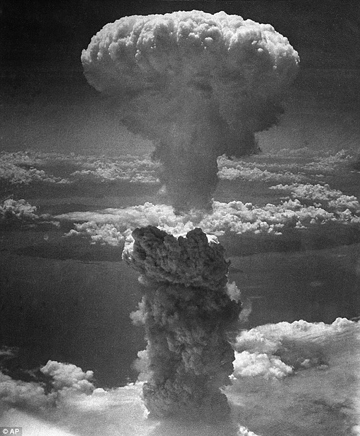
Oppie biopic should rekindle Japanese A bombing debate
Walt Zlotow, West Suburban Peace CoalitionGlen , Ellyn IL 21 Jul 23
The movie ‘Oppenheimer’, based on ‘American Prometheus’ the Pulitzer Prize winning bio of J. Robert Oppenheimer, hits theaters today. Neatly bookended on the calendar between the July 16, 1945 A bomb test and the Hiroshima/Nagasaki strikes 3 weeks later, ‘Oppenheimer’ is sure to be an atomic like blockbuster.
Besides widely informing America of the epic life of possibly its most consequential American in history, it should also spur debate on the necessity for killing over a hundred thousand Japanese civilians in those 2 monstrous attacks.
The mainstream American narrative still portrays the bombings as necessary and just to end the Japanese war without an invasion projected to inflict a million US casualties.
I learned of the atomic bombings 72 years ago at age 6. For the first decade afterward, I swallowed whole the US fairytale that the military and political elite were unified in dropping the bombs to prevent that costly invasion.
Few if any reputable historians buy that version today. They point to a number of top military leaders who opposed the nuclear attacks, for good reasons. Most prominent was U.S. Army Chief of Staff General George C. Marshall who argued not using the Bomb would strengthen America’s prestige and position in post war Asia.
He even advocated for inviting the Russians to view its July 16, 1945 test. Navy Secretary and later Defense Secretary James Forrestal rightly argued the bombings would impede our post WWII relations with the Soviet Union. Fleet Admiral William Leahy, senior US military officer on active duty in WWII, called the proposed bombings “barbaric”.
Assistant Secretary of War John McCloy told Truman that neither invasion nor atomic bombings were necessary. Japan would surrender if we avoided ‘Unconditional Surrender’ terminology since any surrender would amount to that without saying so. McCloy even advocated telling Japanese leaders we had the Bomb as additional incentive to quit the war.
Tho not involved in the atomic bombing decision process, Gen. Dwight Eisenhower was furious we dropped them. He recounted telling Secretary of War Harry Stimson shortly after the attacks “I voiced my grave misgivings, first on my belief that Japan was already defeated and that dropping the bomb was completely unnecessary, and secondly, because I thought that our country should avoid shocking world opinion by the use of a weapon whose employment was, I thought, no longer mandatory as a measure to save American lives. It was my belief that Japan was, at that very moment, seeking some way to surrender with a minimum loss of “face.”
Ike, McCloy, Leahy, Forestall, Marshall and others were right; Truman and his supporters were wrong. Seventy-eight years on America is still the only country to explode nukes in anger. Current US belligerency abrogating sensible nuclear agreements, routinely threatening imagined enemies with “all military options are no the table”, spending a trillion dollars to upgrade our nuclear capability, lurching toward nuclear confrontation with both Russia and China, all bode ill the world will make another 78 years nuclear attack free.
Every American concerned about avoiding nuclear winter should view ‘Oppenheimer’ and ponder the current nuclear dilemma facing peoplekind.
“Nuclear Power Is Already a Climate Casualty”
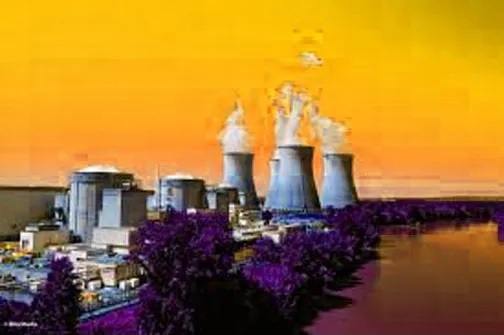
French Rivers Heat Up, Luck Is Not a Strategy for the Ukraine, – We Chat with Nuclear Expert Dr. Paul Dorfman
Hot Globe Substack, STEVE CHAPPLE, JUL 20, 2023
HOT GLOBE:
Paul, thanks for joining us. Let’s talk about nuclear and climate change.
PAUL DORFMAN:
Thanks, Steve. It’s important to understand that nuclear is very likely to be a significant climate casualty.
For cooling purposes nuclear reactors need to be situated by large bodies of water, which means either by the coast or inland by rivers or large water courses. Sea levels are rising much quicker than we had thought and inland the rivers are heating up, potentially drying up, and also subject to significant flooding and flash-flooding and inundation. The key issue for coastal nuclear is storm surge, which is basically where atmospheric conditions meet high tide, which is essentially what happens in Fukushima.
HOT GLOBE: The decommissioned nuclear plant in southern California at San Onofre is a case in point with the cans of nuclear waste still stored in a concrete containment box lapped by the rising tide–
DORFMAN: In France where I am right now [the government utility] just today put out once again warnings about their reactors having to power down because of low river flow, heated river flow. Now that’s not simply for reactor cooling. It’s about the water that the reactors are cooled by, which then need to be discharged back into the rivers. This super-heated water would basically kill the ecology. The reactors have to power down so as not to discharge heated waters back.
Nuclear has been touted as a potential ameliorated solution to climate. The problem, of course, is that nuclear will be, and relatively soon, a climate casualty, so coastal nuclear, unfortunately, is likely to flood via storm surge and inland nuclear will struggle more and more to get reactor cooling water and be able to discharge super-heated water to the receiving river waters.
“The notion that nuclear will will help us with climate is fortunately –unfortunately–simply not the case.”
HOT GLOBE: In America there’s an awful lot of new money sloshing around for climate remediation. Do you have an opinion on Small Nuclear Reactors?
DORFMAN: It’s not been simply I, but the former head of the US nuclear regulatory commission, the NRC, who coauthored a key study which says quite clearly that small modular reactors produce significantly more radioactive waste than conventional reactors. The waste issue is absolutely key, but there are other issues as well. I remember being invited to give a talk at the Royal United Services Institute in the UK, basically the governmental intellectual arm of the military. The compact design of small nuclear reactors is not suited to defense in depth of the nuclear island and the military guys really seemed to get and understand this, similar problem to conventional reactors in terms of safety and security as we’re finding out in Ukraine now.
The other issue is what’s known as the “economies of scale.” The bigger the nuclear plant the cheaper. ……….The economics of small nuclear reactors are proving deeply problematic. The cost per MW hour is rising. Already conventional reactors are hugely, massively, 4 to 5 times more expensive than renewables-plus, and it’s looking more and more that small nuclear reactors will have similar economic and finance problems, and of course small nuclear reactors are still in development. There are no functioning small nuclear reactors in the world producing conventional power, and they are many years from deployment.
So given the fact that we now know we have an existential climate crisis, small nuclear reactors and of course certainly conventional nuclear look to be far too costly and far too late to help the climate crisis.”
HOT GLOBE: Tell us a little bit about the situation in Zaporizhia. It comes and goes in the American media, but it seems pretty freaking scary to us over here in California! How do you estimate the dangers in the last month or so?
DORFMAN: We’ve been lucky so far but luck isn’t a strategy. Zaporizhia –6 very large nuclear power plants, the largest station in Europe with a very significant radiological inventory and critically very significant spent fuel, spent high level radiological nuclear inventory–is in the middle of a shooting war. Now there’s no way that any nuclear power plant can survive a concerted military attack. No nuclear power plant in the world is designed to do this. The International Atomic Energy agency has been very quiet about this for the last few decades which is kind of worrying given the fact that it seems obvious. Basically, people like me and many others haven’t wanted to talk about this in the past for fear of putting ideas into people’s heads, but the cat is really out of the bag now, and in an increasingly unstable world, it seems absolutely clear that nuclear risk for conventional civil nuclear plants is ramping up both in Zaporizhia and elsewhere whether in Israel, Iran, Pakistan, India or any other potential conflict zone. There’s a very real risk that existing and any new nuclear power plants will be in the firing line.
In Zaporizhia the key concern is cooling-–the cooling ponds are open but the reactors themselves are basically open in all these plants, too. They are in cold shutdown but they also need power to keep the internal sort of governance working, so both the reactors in cold shut down, not in active use and certainly the high level radioactive waste, need cooling. If something God forbid goes wrong you’ll see a worst case scenario. You’ll see what happened at Fukushima. Within eight hours you’ll see hydrogen buildup, hydrogen explosion. You’ll then see significant loss of cooling. If the backup diesel generators don’t run within a day or two, you could well see meltdown. The worst case prognosis is very grave.
HOT GLOBE: Oii. Explain the difference between Chernobyl and Fukushima in terms of Zaporizhia.
DORFMAN: Chernobyl was a graphite moderated reactor. Graphite is the kind of thing that you find on the inside of a pencil. When Chernobyl blew, this graphite was distributed high into the atmosphere and could blow far and wide. The kinds of reactors that you find in Zaporizhia are not, thank heavens, of that design. They are slightly newer Russian designed reactors which have gone through certain kinds of safety upgrades post Fukushima, not the spent fueling ponds but the reactors themselves, so if the worst were to happen, you wouldn’t see a Chernobyl. You would more likely see a Fukushima because you wouldn’t see this punch out of the graphite particles into the air, which would carry the radiation far and wide. What you would see, unfortunately, is very severe contamination of the immediate area and of the region, certainly of Ukraine, potentially Russia and certainly middle Europe. Now what’s also critically important post-accident is what would happen to the land. Ukraine is a very significant grain producing nation and other populations including the African population absolutely depend on this grain. So
that’s the thing about nuclear, if something goes wrong you can really start to write off a lot of people’s lives.
The high risk of this form of technology when we have other forms of technology that will lead us to net zero—there really isn’t any significantly good reason to go down the new nuclear route for whole sets of reasons and one of those reasons is we’re living in an increasingly unstable world and nuclear is increasingly, civil nuclear, is increasingly risky………………………………………….
more https://hotglobe.substack.com/p/nuclear-power-is-already-a-climate
UK campaigners call on Australian PM to withdraw Kimba nuke dump threat

UK campaign groups opposed to nuclear waste dumps were ‘delighted’ to hear that their counterparts in Australia, the Barngarla Determination Aboriginal Corporation, have just won their court case against the imposition of a similar dump on their Traditional Lands.
In a historic judgement given earlier this week (18 July), Her Honour Justice Charlesworth in the Federal Court of Australia handed down a decision to quash Federal Government plans to move nuclear waste from the reactor at Lucas Heights to an unwanted waste dump at Napandee near Kimba in South Australia. Justice Charlesworth charged government officials with ‘pre-judgement’ and ‘apprehended bias’.
In March, the UK/Ireland Nuclear Free Local Authorities joined Radiation Free Lakeland, Millom against the Nuclear Dump / South Copeland against GDF, and Guardians of the East Coast, which are local groups fighting plans to locate a so-called Geological Disposal Facility in either West Cumbria or East Lincolnshire, wrote a joint letter to the Australian Government to raise their international objections to the plan.
Our objections were that there was no need for such a dump as the facility at Lucas Heights has capacity to take the waste and that the rights to the land by the Traditional Owners were being wilfully and shamefully disregarded, contrary to international law, with the government giving no proper consideration to the position of the Barngarla.
The attempt to impose a nuclear waste dump is all par for the course in Australia with the ill-treatment of Indigenous Peoples by corporations, political elites and the military over nuclear matters having an established history, with First Nation territories ravaged by uranium mining or shattered by British atomic weapon testing.
Following the damning judgement, the four British organisations have today written to the Prime Minister of Australia Anthony Albanese asking him to ‘take the honourable and courageous course of action’, withdraw the plan and ‘leave the Barngarla in peace’.
A copy of the letter and a message of solidarity will be sent to the Barngarla Determination Aboriginal Corporation. more https://www.nuclearpolicy.info/news/uk-campaigners-call-on-australian-pm-to-withdraw-kimba-nuke-dump-threat/
Feds digging up nuclear waste in Los Alamos for disposal at Carlsbad-area repository
Adrian Hedden, Carlsbad Current-Argus, 21 Jul 23, https://www.currentargus.com/story/news/2023/07/21/feds-digging-up-nuclear-waste-in-los-alamos-for-disposal-at-carlsbad-area-repository/70426843007/
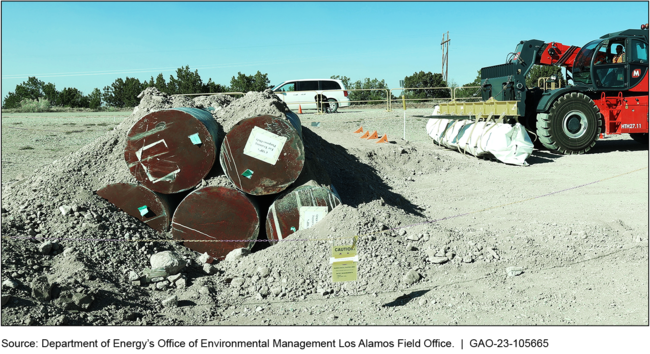
Workers at Los Alamos National Laboratory dug up buried nuclear waste they planned to dispose of at the federal repository near Carlsbad, amid pressure from State officials that the facility prioritize New Mexico waste.
The U.S. Department of Energy’s Los Alamos Field Office and the lab’s cleanup contractor Newport News Nuclear BWXT (N3B) Los Alamos announced Tuesday they began exhuming corrugated metal pipes containing transuranic (TRU) nuclear waste and preparing them for shipment.
At the Waste Isolation Pilot Plant near Carlsbad, TRU waste is disposed of via burial in a salt deposit about 2,000 feet underground, trucked into the site from DOE facilities throughout the country.
TRU waste is made up of irradiated clothing, equipment and other debris from nuclear research and development activities around the U.S.
Before it can be shipped to WIPP, the pipes must be cut using hydraulic sheers, allowing them to be loaded into waste boxes for shipment and disposal.
The pipes weight about 10,000 to 14,000 pounds, and measure about 20 feet long. They are cut into five pieces, with each piece loaded into a box.
It’s occurring at portion of the lab known as Dome 375, and the waste came from Los Alamos’ former radioactive liquid waste treatment facility operating during the Cold War at Technical Area 21 (TA-21).
There were 158 pipes in total transferred from TA-21, records show, containing cemented waste.
They were buried in 1986, where the waste sat until recently when worked began preparing it for final disposal.
The DOE hoped to finish digging up and preparing the pipes for disposal by spring 2024.
More: No progress to report on nuclear waste site aside from Carlsbad-area repository, feds say
The US should end its use of nuclear power plants – the intractible problem of dangerous spent fuel rods

Chicago Tribune, Jul 21, 2023 , Larry R. Eaton, Chicago
Fifty years ago, as chief of the Illinois attorney general’s Environmental Control Law Division, a relatively new field of law at that time, I had the occasion to tour an Illinois nuclear power plant. I was taken aback to see extensive pools of water containing bundles of spent nuclear fuel rods standing on end just beneath the surface of the water. I was advised that a pilot plant study had indicated that it would have an essentially closed-loop system that would not generate large amounts of spent fuel; however, once the full-scale plant became operational, the system failed to perform as anticipated. Plant workers were left with no good alternative but to store spent fuel rods in pools of water, at least temporarily, pending (hopefully) a better idea.
It appears that the nuclear power industry is still waiting for that better idea. A supporter of nuclear power production now maintains, in essence, that we have nothing to be concerned about regarding spent nuclear fuel because all we need to do is encase it in concrete and then open it up and repackage it in concrete every several decades. (In perpetuity, presumably; the radioactivity will remain unabated for a very long time indeed.) To understand how absurd this proposal is requires little more than to say it out loud.
Chernobyl and Three Mile Island were wake-up calls, but we do not appear to have fully awakened. It does not help that a nuclear power plant now sits near the front lines of a shooting war between Russia and Ukraine. Hopefully, we will somehow be lucky enough never to have a massive nuclear power plant disaster. But regardless of that, we will have radioactive spent fuel problems with us forever. We can no longer escape that fact. However, we can choose to stop making it worse.
Germany has decided to end its use of nuclear power. The U.S. should do the same. If there is anything worse than having an enormous carbon footprint, it has to be for that footprint to be radioactive too!
UN proposes elimination of all nuclear weapons as first step under new agenda for peace

Rising geopolitical and geo-economic tensions across the globe need a better, reformed, and updated UN system which reflects the growing multipolarity and is more representative, unbiased, and effective
July 21, 2023 by Peoples Dispatch
United Nations Secretary General António Guterres presented a new policy brief on global security on Thursday, July 20, which calls for the abolition of all nuclear weapons and widespread reforms in the UN structure to make it more representative and efficient.
The New Agenda for Peace policy brief, based on the discussions during the 75th anniversary celebrations of the foundation of the UN in 2020, is part of the preparations for the UN Summit of the Future to be held in 2024.
While launching the brief, Guterres acknowledged that “the post-Cold war period is over, and we are moving towards a new global order and a multipolar world.” The changing world is marred by a new set of geopolitical and geo-economic conflicts with rising “insecurity about the threat of nuclear war” and growing skepticism among a large number of member states about the existing forums of multilateralism.
The brief claims that most of the challenges to global security and peace are interlinked and proposes ways to address this complexity.
Complex nature of rising conflicts
The brief notes that increasing geo-strategic tensions and competition across the globe is pushing global military expenditure to an unprecedented level. In 2022, the cumulative global defense expenditure exceeded $2.24 trillion.
The brief also points out that several arms control regimes created during the Cold War and its immediate aftermath, which were containing great power rivalries, have been eroded in the last few years, which has increased the risk of regional and global wars and paved the way for an arms race. ……………………………………………………………….
Five priority areas and 12 steps to achieve collective security
The brief proposes that trust, solidarity and universality—the well-known principles of the UN charter—would be the basis of its agenda for peace. Guterres emphasized the role of cooperation among nations, saying that it “does not require states to forego their national interest, but to recognize that they have shared goals.”
The brief recommends a 12-point plan of action, divided in five priority areas, to address the growing threats to peace at the global level.
It calls for the elimination of all nuclear weapons and boosting preventive diplomacy to address strategic risks and geopolitical divisions in the world.
It also calls for preventing domestic conflicts by adopting sustainable development methods and catering to climate-related issues and social discrimination with increased funding and help to developing countries to achieve their SDGs by 2030. Peacekeeping and peace enforcement, as well as regional initiatives of peace, should also be updated and strengthened. There should also be steps taken to prevent weaponization of emerging domains and technologies, such as artificial intelligence (AI), and promotion of responsible innovation.
It additionally calls for reforms in the UN system, including in the Security Council to make it more “just and representative,” and talks about countries respecting the impartiality of the UN secretariat so that it can work more effectively as a multilateral forum. https://peoplesdispatch.org/2023/07/21/un-proposes-elimination-of-all-nuclear-weapons-as-first-step-under-new-agenda-for-peace/
Corruption In Ukraine & The U.S. Mutually Rewarding
The Pentagon failed its 5th consecutive audit last year, appearing to lose track of 61% of its $3.5 trillion in assets.
Substack, LISA SAVAGE, JUL 20, 2023
“…………………………………………………………………………………………. Ukraine’s leaders are so over the top that it’s becoming impossible to ignore. Add in the fact that they have been enriched by U.S. taxpayers more or less directly despite crumbling infrastructure, catastrophic homelessness, apartheid healthcare, and a host of other problems that the U.S. could address with adequate funding.
From RT (whose editor-in-chief, Margarita Simonyan, just survived a second assassination attempt):
On July 7, US Under Secretary of Defense for Policy Colin Kahl spoke about a new package of aid from the US which includes cluster munitions – which are banned in 120 countries. The cost was $800 million.This is the 42nd delivery of aid that Ukraine has received from the US in the past year and a half.[emphasis mine] Since the beginning of Russia’s offensive, the US Congress has approved military and economic assistance to Ukraine amounting to over $70 billion – and that’s only counting direct expenses..
“Ukraine needs only one thing… To have someone come to power who won’t steal. Someone who won’t do it himself and won’t allow others to do so. Unfortunately, so far we haven’t been lucky,” [Aleksey Arestovich, former advisor to President Zelensky] said.
Ok, so Arestovich has a motive for trashing the government that used to include him. How about Pulitzer Prize-winning U.S. investigative journalist Seymour Hersh? Hersh does not approve of Russia’s entry into the war but he nonetheless published a piece on rampant corruption in Ukraine, “Trading with the Enemy,” back in April.
Zelensky has been buying fuel from Russia, the country with which it, and Washington, are at war, and the Ukrainian president and many in his entourage have been skimming untold millions from the American dollars earmarked for diesel fuel payments. One estimate by analysts from the Central Intelligence Agency put the embezzled funds at $400 million last year, at least; another expert compared the level of corruption in Kiev as approaching that of the Afghan war………………………………
Then there is President Zelensky, elected on pledges to end corruption and, incidentally, the war on the Donbas.
Pre-2022, i.e. when corporate media headlines about Ukraine did a 180, even The Guardian found he was part of the problem and not likely to be part of the solution.
Neither is the U.S. government likely to be part of the solution. The Pentagon failed its fifth consecutive audit last year, appearing to lose track of 61% of its $3.5 trillion in assets……………………….. more https://went2thebridge.substack.com/p/corruption-in-ukraine-and-the-us?utm_source=post-email-title&publication_id=1580975&post_id=135301485&isFreemail=true&utm_medium=email_medium=email
The Big Problem With Small Nuclear Reactors
The diminutive reactors are likely to be just as prone to delays and cost overruns as their behemoth predecessors.

I just read Pal Hockenos’ fine story about small nuclear reactors. But Hockenos is naive to think that Bill Gates and co. give a hoot about our future. What they do care about is their own increasing $squillions. And the coming source of new $squillions is in weaponry – that’s where all sorts of applications for SMRs lie. And Gates etc are well aware that the fixing-climate story is just a cover for the real practical purpose.
UNDARK BY PAUL HOCKENOS , 07.20.2023
IN RECENT YEARS, the nuclear power lobby and its advocates have begun to sing a new song. They have bailed on the monstrous reactors of the 20th century — not because of safety or toxic waste concerns, but because of the reactors’ exorbitant expense and ponderous rollout schedules. And they have switched their allegiance to a next generation nuclear fission technology: small modular reactors, which they claim will help rescue our warming planet, as well as the nuclear power industry— once they exist.
Respected thinkers such as former U.S. president Barack Obama, French president Emmanuel Macron, and Microsoft co-founder and philanthropist Bill Gates have toasted the idea of small modular reactors, or SMRs, as a potentially reliable, almost-emissions-free backup to intermittent renewable energy sources like wind and solar. Advocates claim that because SMRs will be smaller than the giants that currently dominate horizons, they will be safer, cheaper, and quicker to build. Although SMRs will have only a fraction of the power-generating capacity of traditional nuclear power reactors, proponents envision that they will, one day, be assembled in factories and transported as a unit to sites — like Sears’ mail-order Modern Homes of the early 1900s.
Currently, half of the states in the EU, both major political parties in the U.S, and the five BRICS nations — Brazil, Russia, India, China, and South Africa — have indicated that they want to split atoms for the purpose of generating energy. U.S. President Joe Biden included billions of dollars in tax credits for nuclear energy in the Inflation Reduction Act and the Infrastructure Investment and Jobs Act. Gates has gone so far as to invest a chunk of his fortune in a firm he founded, TerraPower, a leading nuclear innovation company. But despite the prodigious chatter, the endeavor to blanket the Earth with SMRs is a Hail Mary pass that’s very unlikely to succeed.
Granted, it is certainly a step in the right direction that most observers now see the postwar, giga-watt-scale water-cooled reactors as obsolete. When constructed new, these behemoths generate electricity at up to nine times the cost of large-scale solar and onshore wind facilities, and can take well over a decade to get up and running. Perhaps for this reason, there has been one, and only one, new nuclear power project initiated in the U.S. since construction began on the last one 50 years ago: a two-reactor expansion of the Vogtle Electric Generating Plant in Georgia. The first of the reactors came online this year — seven years behind schedule. The staggering $35 billion cost for the pair is more than twice the original projection.
But SMRs are just as likely to face similar delays and cost overruns. Currently, there are just two existing advanced SMR facilities in the world that could be reasonably described as SMRs: a pilot reactor in China and Russia’s diminutive Akademik Lomonosov. More small reactors are under construction in China, Russia, and Argentina, but all of them are proving even more expensive per kilowatt than traditional reactors.
It’s worth noting that in the U.S., and everywhere else in the world, nuclear policy relies heavily on subsidies to be economically competitive. Starting next year, utilities operating nuclear facilities in the U.S. can qualify for a tax credit of $15 per megawatt-hour — a break that could be worth up to $30 billion for the industry as a whole. However, even these giveaways won’t reduce the projected costs of SMR-generated electricity to anywhere near the going prices of wind and solar power.
In the U.S., the only SMR developer with a design approved by the Nuclear Regulatory Commission is NuScale, which plans to deploy six modules at one site in Idaho that will together generate less electricity than a smallish standard nuclear reactor. So far, however, NuScale has yet to lay a single brick. Its biggest win to date is securing $4 billion in federal tax subsidies. In January of this year, NuScale announced plans to sell electricity not at $58 per megawatt-hour, as originally pledged, but at $89 per megawatt-hour, citing higher than anticipated construction costs. The new projection is nearly twice the average global cost of utility-scale solar and onshore wind, according to calculations by BloombergNEF. And without the government subsidies, NuScale’s price tag would be that much higher.
In fact, there’s a fair chance that not a single NuScale SMR will ever be built: The company has said it will not begin construction until 80 percent of its expected generation capacity is subscribed, and currently buyers have signed up for less than a quarter of the plant’s capacity.
Gates’s TerraPower has an even longer way to go, although it too is cashing in on subsidies. The U.S. Department of Energy has pledged up to $2 billion in matching funds to construct a demonstration plant in Wyoming. Yet TerraPower recently announced it’s facing delays of at least two years because of difficulties securing uranium fuel from its lone supplier: Russia.
Even if the unlikely rollout of SMRs eventually happens, it will unfold too late to curb the climate crisis. And the reactors will face many of the same safety and radioactive waste concerns that plagued their larger counterparts, if only at smaller scales. Meanwhile, the siren song of nuclear energy is diverting critical resources from the urgent task of building out clean technologies. And the idea that nuclear reactors would serve as “backups” for wind and solar is misguided because the reactors can’t be ramped up and down quickly.
……………………………The technology of the future is already here. Clean wind and solar energy — coupled with updated smart grids, expanded storage capacity, hydrogen technology, virtual power plants, and demand response strategies — can work. Our energy systems of the future will look like a patchwork quilt, with diverse energy sources kicking in at different times during the day, and with the mix differing from one day to the next.
Bill Gates and like-minded innovators should put their minds and fortunes to work on this futuristic project of the present — and leave the 20th century relic that is nuclear power in the past, where it belongs
Anti-nuclear groups welcome Oppenheimer film but say it fails to depict true horror

UK campaigners hope movie will draw attention to ‘real and present danger’ posed by atomic weapons
Guardian, Rachel Hall 21 July 23
Strips of translucent, flesh-toned material tear off a woman’s face in one of the closing scenes of Oppenheimer, the new film about the invention of the atomic bomb. She represents its victims in Hiroshima and Nagasaki, whose skin was burned off in the blast.
Yet the reality in Japan was far more gruesome than the artful depiction in the film, which skirts around the human suffering caused by the bomb.
Instead, the blockbuster movie from director Christopher Nolan is a pacy look at the scientific quest led by the eponymous J Robert Oppenheimer in the US to build a nuclear weapon faster than the Nazis at the end of the second world war.
The film explores Oppenheimer’s moral quandary over his role in creating the most destructive weapon ever made, but nuclear disarmament campaigners fear its power to persuade people of the existential threat posed by nuclear arms may be diminished by its focus on scientific achievement.
“The overall impact of the film is unbalanced – people leave the theatre thinking how exciting a process it was, not thinking ‘God, this was a terrible weapon of mass destruction and look what’s happened today’,” said Carol Turner, a co-chair of the Campaign for Nuclear Disarmament’s London branch.
“The effect of the [Hiroshima and Nagasaki] blasts was to remove the skin in a much more gory and horrible way – in the film it was tastefully, artfully presented. There’s nothing wrong with that, but if you look at photographs of actual survivors and read accounts of what happened to them it was a very horrifying, gory death.”
She added that although it was historically accurate to portray Oppenheimer’s ethical doubts about his invention, and his subsequent persecution by the US government, in effect this turned him into the film’s hero.
Despite these reservations, Turner considers it positive that the film is drawing people’s attention to the “real and present danger” of nuclear weapons arising from the Russia-Ukraine war, especially at a time when there is limited public discussion, for example the comparative silence around the storage of US nuclear weapons in the UK, relative to the outrage of past decades.
…………………………………………………………………………….. [Nuclear weapons] are as out of control as the climate emergency is, but it’s just getting much, much less attention.” https://www.theguardian.com/world/2023/jul/21/anti-nuclear-groups-welcome-oppenheimer-film-fails-depict-true-horror
The Dynamics of War Insanity: NATO’s Ukraine Roulette
By Alfred de Zayas / CounterPunch https://scheerpost.com/2023/07/20/the-dynamics-of-war-insanity-natos-ukraine-roulette/
Deliberate provocations of a nuclear rival, coups d’état, colour revolutions, broken promises, broken treaties, escalation of tensions, demonization, invective, double-standards — all this while asserting adherence to international legal norms and playing innocent about our aggressions, our violations of the Hague and Geneva Conventions, of articles 1(2)[1], 2(3)[2], 2(4)[3] and 39[4] of the UN Charter.
Abrams tanks, Leopard tanks, F-16, indiscriminate weapons, depleted uranium, cluster bombs. Summits illustrate how the moral compass of the collective West is lost in the avalanche of fake news[5], fake history, fake law, bellicose rhetoric, media hyperbole, serial mobbing of dissenters, persecution of whistleblowers, censorship. The Western binary mindset continues to divide the world into good and bad countries, democracies and autocracies. There is little room to accommodate a comprehensive picture of the pre-history, root causes of conflicts, and nuances. One observes an almost total absence of a sense for proportions.
The Global Majority in Latin America, Africa and Asia is increasingly alarmed by the surrealistic spectacle of a collective West that seems out of control, developing its own lethal dynamic, displaying a paroxysm of Russophobia and Sinophobia, incitement to hatred, cancel culture, refusal to entertain serious dialogue, doubling-down on eschatological demands. Many non-Western thinkers and politicians are articulating justified warnings that the on-going intestinal conflicts in the West are adversely impacting the economies of third-world countries and may ultimately result in Apocalypse for the entire planet. The West is not playing the classical Russian roulette – it has developed its own version: Ukrainian roulette, compulsive apocalyptic vabanque.
Meanwhile the Western media, notably Reuters, AP, CNN, Fox, New York Times, Washington Post, BBC, Le Monde, Figaro, FAZ, der Spiegel, even the Swiss NZZ ensure the daily indoctrination doses for the Western public, purveying skewed narratives that repeat and embellish what Washington and Brussels ordain, blithely ignoring other views and perspectives and the principle audiatur et altera pars. Freedom of the media in the collective West seems to mean the right to repeat NATO narratives ad nauseam, even when they have been proven wrong. This “freedom” also includes the freedom to ignore every critical voice about NATO and to refrain from asking critical questions at NATO press conferences.
Council defers decision over Test of Public Support on the issue of disposal of high level nuclear waste
East Lindsey fudge: Council defers decision over Test of Public Support, Nuclear Free Local Authorities, 20th July 2023
The UK/Ireland Nuclear Free Local Authorities noted that, at last night’s meeting (19 July) of East Lindsey District Council, Councillor Craig Leyland clearly found the notion of determining whether to call for a Test of Public Support on the nuclear waste dump too hard to swallow; instead, the Council Leader appeared to create a new form of confectionary more to his liking – East Lindsey Fudge.
The UK Government is currently looking for a coastal site to locate an undersea repository – a so-called Geological Disposal Facility – in four locations in either West Cumbria or East Lincolnshire. This facility will be used to dispose of the nation’s legacy and future high level radioactive waste. Theddlethorpe, being part of the area administered by East Lindsey District Council, is one of the sites under consideration. Acting on behalf of government, Nuclear Waste Services, which is part of the taxpayer-funded Nuclear Decommissioning Authority, is taking the lead role in the GDF siting process.
Calling for a Test of Public Support is one of the few matters that East Lindsey District Council can determine as part of this, but the administration was clearly reluctant to exercise its mandate when two motions were brought before Council by Councillors from the impacted area last night.
Leader Councillor Craig Leyland was most apologetic to members of the public who had unwittingly traipsed to the meeting expecting their elected representatives to take a vote, but he explained that the matter would be deferred and brought back to Council after taking further legal advice……………………………………………………………………….more https://www.nuclearpolicy.info/news/east-lindsey-fudge-council-defers-decision-over-test-of-public-support/
1 This Month


Tell the Ukrainian Government to Drop Prosecution of Peace Activist Yurii Sheliazhenko

Petition to revoke the licensing of the Near Surface Nuclear Disposal Facility (NSDF) at Chalk River. https://www.ourcommons.ca/petitions/en/Petition/Details?Petition=e-7247


of the week – STOP SMALL MODULAR REACTORS IN CANADA
To see nuclear-related stories in greater depth and intensity – go to https://nuclearinformation.wordpress.com
-
Archives
- March 2026 (183)
- February 2026 (268)
- January 2026 (308)
- December 2025 (358)
- November 2025 (359)
- October 2025 (376)
- September 2025 (258)
- August 2025 (319)
- July 2025 (230)
- June 2025 (348)
- May 2025 (261)
- April 2025 (305)
-
Categories
- 1
- 1 NUCLEAR ISSUES
- business and costs
- climate change
- culture and arts
- ENERGY
- environment
- health
- history
- indigenous issues
- Legal
- marketing of nuclear
- media
- opposition to nuclear
- PERSONAL STORIES
- politics
- politics international
- Religion and ethics
- safety
- secrets,lies and civil liberties
- spinbuster
- technology
- Uranium
- wastes
- weapons and war
- Women
- 2 WORLD
- ACTION
- AFRICA
- Atrocities
- AUSTRALIA
- Christina's notes
- Christina's themes
- culture and arts
- Events
- Fuk 2022
- Fuk 2023
- Fukushima 2017
- Fukushima 2018
- fukushima 2019
- Fukushima 2020
- Fukushima 2021
- general
- global warming
- Humour (God we need it)
- Nuclear
- RARE EARTHS
- Reference
- resources – print
- Resources -audiovicual
- Weekly Newsletter
- World
- World Nuclear
- YouTube
-
RSS
Entries RSS
Comments RSS
 nuclear-news