How the world’s most radioactive man cried blood while his skin melted as he was kept alive in 83-day nightmare after horror accident at Japanese nuclear power plant
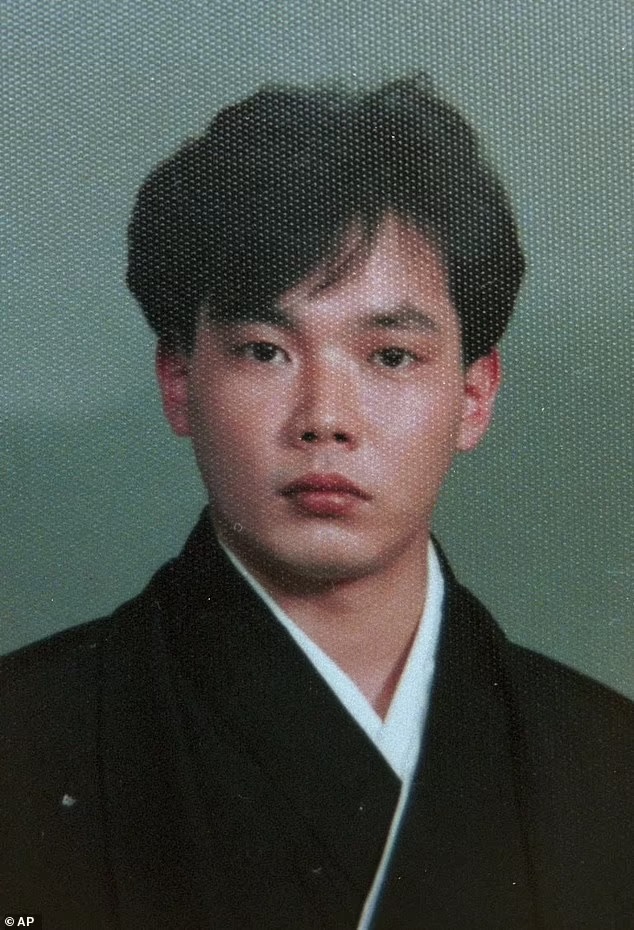
- Hisashi Ouchi, 35, became the world’s ‘most radioactive man’ in 1999
- He was the worst affected by Japan’s 1999 Tokaimura nuclear accident
- Ouchi – reportedly left with ‘melted skin’ and ‘crying blood’ – died after 83 days
Daily Mail , By MATTHEW COX, 14 July 2023
A Japanese nuclear disaster on September 30, 1999, was the world’s worst since Chernobyl, and left the world’s ‘most radioactive’ man with ‘melted skin.’
That victim was Hisashi Ouchi, a worker at the uranium processing plant in Tokaimura – 70 miles northeast of Tokyo – who was exposed to a massive dose of radiation resulting in severe burns.
This was to be the first of 83 days of unimaginable suffering in critical condition for the 35-year-old who died on December 21, after begging doctors to stop treating him months earlier.

The accident was a result of a series of fatal mistakes while he and his colleagues were preparing uranium for use as reactor fuel in the privately-run plant, including carrying the uranium in buckets, and not wearing appropriate protective equipment.
Technicians Ouchi and Masato Shinohara, with supervisor Yutaka Yokokawa, were speeding up the conversion process by putting 16kg of uranium in a vat which had a maximum limit of 2.4kg, when a chain-reaction was caused as Ouchi was ‘draped over’ the tank.
He was exposed to 17 Sieverts of radiation – for comparison, emergency responders at Chernobyl were exposed to 0.25 – over double what is seen as a lethal dose.
That is also the record amount of radiation in any living person, making him the most irradiated man ever, sometimes referred to as the world’s ‘most radioactive.’
He and his co-workers reported seeing a blue flash above the vat, the indication that a reaction similar to that inside an atomic bomb has happened, releasing deadly neutron radiation.
The colleagues rapidly lost consciousness as alarms blared inside the plant and radiation levels shot to 4,000 times typical levels.
The surrounding area was evacuated, with many not having even been aware that the unassuming building was a nuclear facility.
Ouchi was rushed to the University of Tokyo Hospital, where doctors found that he had almost no white blood cells and was in need of extensive skin grafts and multiple blood transfusions.
Local reports at the time claimed that he was also left ‘crying blood,’ and begged doctors to stop treating him.
However, he was resuscitated after multiple heart attacks on his 59th day in hospital.
Ouchi eventually died on December 21, 1999, and a few months later in April 2000 Shinohara, his fellow technician, died of multiple organ failure aged 40………………………. https://www.dailymail.co.uk/news/article-12299235/How-worlds-radioactive-man-cried-blood-kept-alive-83-day-nightmare.html
No comments yet.
1 This Month

of the week – Shut Down Drone Warfare!


Tell the Ukrainian Government to Drop Prosecution of Peace Activist Yurii Sheliazhenko

Petition to revoke the licensing of the Near Surface Nuclear Disposal Facility (NSDF) at Chalk River. https://www.ourcommons.ca/petitions/en/Petition/Details?Petition=e-7247
To see nuclear-related stories in greater depth and intensity – go to https://nuclearinformation.wordpress.com
-
Archives
- April 2026 (91)
- March 2026 (251)
- February 2026 (268)
- January 2026 (308)
- December 2025 (358)
- November 2025 (359)
- October 2025 (376)
- September 2025 (257)
- August 2025 (319)
- July 2025 (230)
- June 2025 (348)
- May 2025 (261)
-
Categories
- 1
- 1 NUCLEAR ISSUES
- business and costs
- climate change
- culture and arts
- ENERGY
- environment
- health
- history
- indigenous issues
- Legal
- marketing of nuclear
- media
- opposition to nuclear
- PERSONAL STORIES
- politics
- politics international
- Religion and ethics
- safety
- secrets,lies and civil liberties
- spinbuster
- technology
- Uranium
- wastes
- weapons and war
- Women
- 2 WORLD
- ACTION
- AFRICA
- Atrocities
- AUSTRALIA
- Christina's notes
- Christina's themes
- culture and arts
- Events
- Fuk 2022
- Fuk 2023
- Fukushima 2017
- Fukushima 2018
- fukushima 2019
- Fukushima 2020
- Fukushima 2021
- general
- global warming
- Humour (God we need it)
- Nuclear
- RARE EARTHS
- Reference
- resources – print
- Resources -audiovicual
- Weekly Newsletter
- World
- World Nuclear
- YouTube
-
RSS
Entries RSS
Comments RSS
 nuclear-news
Leave a comment