‘Atomic Fallout’: Records reveal government downplayed, ignored health risks of St. Louis radioactive waste for decades
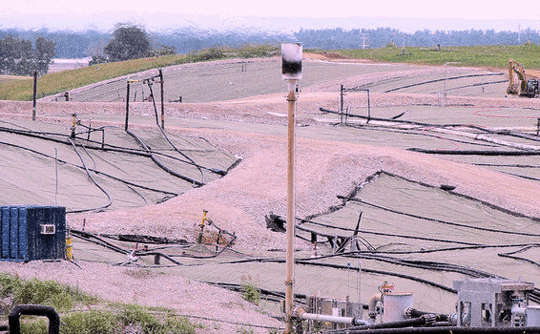
In May, almost 50 years after the waste was dumped at West Lake, the Environmental Protection Agency acknowledged what many residents had long feared: Radiological waste was spread throughout the West Lake Landfill, not confined to two specific portions as officials had long maintained.
The West Lake Landfill contamination was discovered in 1974. It was designated a Superfund site in 1990, and there is still no date certain for when the cleanup will begin.
MuckRock, by Allison Kite, Edited by Derek Kravitz, Jason Hancock 12 July 23
For kids like Sandy Mitchell, Ted Theis and Janet Johnson, childhood in the North St. Louis County suburbs in the 1960s and ‘70s meant days playing along the banks or splashing in the knee-deep waters of Coldwater Creek.
They caught turtles and tadpoles, jumped into deep stretches of the creek from rope swings and ate mulberries that grew on the banks.
Their families — along with tens of thousands of others — flocked to the burgeoning suburbs and new ranch style homes built in Florissant, Hazelwood and other communities shortly after World War II. When the creek flooded, as it often did, so did their basements. They went to nearby Jana Elementary School and hiked and biked throughout Fort Belle Fontaine Park.
Growing up, they never knew they were surrounded by massive piles of nuclear waste left over from the war.
Generations of children who grew up alongside Coldwater Creek have, in recent decades, faced rare cancers, autoimmune disorders and other mysterious illnesses they have come to believe were the result of exposure to its waters and sediment.
“People in our neighborhood are dropping like flies,” Mitchell said.
The earliest known public reference to Coldwater Creek’s pollution came in 1981, when the U.S. Environmental Protection Agency listed it as one of the most polluted waterways in the U.S.
By 2016, the Centers for Disease Control and Prevention was advising residents to avoid Coldwater Creek entirely. Cleanup of the creek is expected to take until 2038. A federal study found elevated rates of breast, colon, prostate, kidney and bladder cancers as well as leukemia in the area. Childhood brain and nervous system cancer rates are also higher.
“Young families moved into the area,” Johnson said, “and they were never aware of the situation.”
Theis, who grew up just 75 yards from the creek and played in it daily, died in August at the age of 60 from a rare cancer. Mitchell is a breast cancer survivor whose father died from prostate cancer. Johnson’s sister has an inoperable form of glioblastoma and other family members, including her father, daughter and nephew, have had various cancers.
Families who lived near Coldwater Creek were never warned of the radioactive waste. Details about the classified nuclear program in St. Louis were largely kept secret from the public. But a trove of newly-discovered documents reviewed by an ongoing collaboration of news organizations show private companies and the federal government knew radiological contamination was making its way into the creek for years before those findings were made public.

Radioactive waste was known to pose a threat to Coldwater Creek as early as 1949, records show. K-65, a residue from the processing of uranium ore, was stored in deteriorating steel drums or left out in the open near the creek at multiple spots, according to government and company reports.
A health expert who, as part of this project, was recently presented with data from a 1976 test of runoff to the creek concluded it showed dangerous levels of radiation 45 years ago.
Federal agencies knew of the potential human health risks of the creek contamination, the documents show, but repeatedly wrote them off as “slight,” “minimal” or “low-level.” One engineering consultant’s report from the 1970s incorrectly claimed that human contact with the creek was “rare.”
The Missouri Independent, MuckRock and The Associated Press spent months combing through thousands of pages of government records obtained through the Freedom of Information Act and interviewing dozens of people who lived near the contaminated sites, health and radiation experts and officials from government agencies.
Some of the documents, obtained by a nuclear researcher who focuses on the effects of radiation, had been newly declassified in the early 2000s. Others had been previously lost to history, packed away in government archives and not released publicly until now. (Read the documents here and learn more about our methodology here.)
All told, the documents from the now-defunct Atomic Energy Commission; its successors, the U.S. Department of Energy and the Nuclear Regulatory Commission; and the Environmental Protection Agency span the 75-year lifespan of the nuclear saga in St. Louis.
It starts in downtown St. Louis, where uranium was processed, and at the St. Louis airport, where it was stored at the end of the war; a monthslong move of the waste to industrial sites on Latty Avenue in suburban Hazelwood and a quarry in Weldon Spring, next to the Missouri River; an illegal dumping of waste at the West Lake Landfill in Bridgeton in the 1970s by a private company; and the declaration of the landfill as a federal toxic Superfund site in 1990.
Since then, the contaminated sites have been subjected to a seemingly endless cycle of soil, air and water testing, anxious community meetings attended by an ever-growing chorus of angry residents and panic when a subsurface smoldering event, similar to an underground fire, at the Bridgeton landfill threatened the radioactive waste buried nearby. That fire sent noxious and hazardous fumes into surrounding neighborhoods. The company in charge of the Bridgeton landfill now spends millions a year to contain it.
The documents have a familiar cadence: Year after year, decade after decade, government regulators and companies tasked with cleaning up the sites downplayed the risks posed by nuclear waste left near homes, parks and an elementary school. They often chose not to fully investigate the potential harms to public health and the environment around St. Louis………………………………………………………………………………………………………………………………………………
Illegal dumping of radioactive waste
When the Atomic Energy Commission sold the remnant nuclear waste, it anticipated being able to get rid of the more than 100,000 tons of toxic residues without spending any money.
The first company to purchase the waste, Continental Mining and Milling Co. of Chicago, borrowed $2.5 million to buy it in 1966 and then, shortly after, went bankrupt. Continental’s lender, Commercial Discount of Chicago, re-purchased the waste at auction for $800,000 and, after failing to get a bidder at a second auction, sold it to the Cotter Corp. To turn a profit, Cotter would ultimately dry the material and ship it to its uranium mill plant in Cañon City, Colorado………………………………………………………….
Cotter asked the government to bury the waste at Weldon Springs multiple times, in the late 1960s and early 1970s, but were rebuffed each time, meeting minutes show.
So, over a period of 2 ½ months in the summer and fall of 1973, Cotter took the problem into its own hands, without telling government regulators.
The company mixed the radioactive waste with tens of thousands of tons of contaminated soil from the site and illegally dumped it in a free, public landfill called West Lake, under three feet of soil and other garbage……………………………..
The AEC released Cotter from its St. Louis permit without immediate sanctions in 1974, but the company is partially responsible for the cleanup costs at the site.
Cotter’s parent company, General Atomics, did not respond to multiple requests for comment……………………………………………………………….
‘Tip of the iceberg’
In 1999, when Robbin Dailey moved into Spanish Village, a neighborhood of only a few dozen homes with its own park less than a mile from the back side of West Lake Landfill, she had no idea she was living next to a Superfund site.
When the EPA decided initially in 2008 to cap the waste at West Lake and leave it in place, Dailey never heard about the plan. Two years later, in 2010, she was alerted to the radioactive waste when a “subsurface smoldering event” — a type of chemical reaction that consumes landfilled waste like a fire but lacks oxygen — sent a pungent stench into the air around her home.
Dailey and her husband had their house tested and found thorium in the dust at hundreds of times natural levels. They sued the landfill’s owners, Republic Services, as well as the Cotter Corp. and Mallinckrodt.
Dailey said she and the companies had “resolved” their legal issues, but she, like all of the residents in North St. Louis County, was still in the dark about where within the landfill site the waste actually was.
Court records reveal a bevy of lawsuits against the private companies involved, at various times, with the West Lake Landfill. Not only that, but the landfill operators sued Mallinckrodt in an attempt to force the maker of the radioactive waste to pay for part of the cleanup.
Since the late 1970s, federal regulators repeatedly failed to uncover the true extent of contamination at West Lake.
In October 1977, the Nuclear Regulatory Commission used a helicopter to take hour-long passes back and forth over the landfill from an altitude of 200 feet. The goal was to measure gamma radioactivity coming from the site using specialized equipment.
While the effort correctly identified two areas with high levels of radiation, it had serious limitations, experts say. A survey of that type can miss contamination if it’s buried deep underground or if the ground is obstructed by vegetation.
And it did…………………………………
In May, almost 50 years after the waste was dumped at West Lake, the Environmental Protection Agency acknowledged what many residents had long feared: Radiological waste was spread throughout the West Lake Landfill, not confined to two specific portions as officials had long maintained……………………..
EPA officials said the contamination was found all over the property — in some areas at the surface and, in other areas, at great depths.
The agency looked at the dates on newspapers above and below the radioactive waste in two areas of the site previously thought to be uncontaminated to approximate when it was dumped, said Chris Jump, the EPA’s lead remedial project manager for the site.
It’s likely been there the whole time.
…………………………… Dawn Chapman, who left her job and co-founded Just Moms STL to advocate for the community around the landfill, said the EPA used to treat her and other activists like their fears were hysterical.
………………
A staffer with the Missouri Department of Natural Resources wrote in 1980 that contamination at the landfill was more severe and widespread than previously thought. In 1986 and 1990, onsite sampling showed possible radiological contamination in the groundwater in areas outside the sections of the landfill thought to be radioactive.
In 1987, the state classified the landfill as a hazardous waste site. The radioactive waste was in direct contact with the groundwater, the agency said in its annual report.
“Based on available information, a health threat exists due to the toxic effects of chemicals and low-level uranium wastes buried at the site and the possibility that off-site migration of these materials might occur,” the agency wrote.
…………………………. The West Lake Landfill contamination was discovered in 1974. It was designated a Superfund site in 1990, and there is still no date certain for when the cleanup will begin.
…………………………………….. Back to the drawing board
EPA’s first plan for the site would not have included moving the radioactive waste at all.
In 2008, the Environmental Protection Agency approved a plan for the landfill’s “primarily responsible parties” — the government and private contractors responsible for the site — to place a cap over the landfill and leave the waste in place.
Following criticism from the surrounding communities, EPA asked the Department of Energy, the Cotter Corp. and the landfill’s owner, Republic Services, to test the site again.
In the meantime, an underground fire brought a new level of scrutiny.
Starting in 2010, the Bridgeton landfill, which sits adjacent to the West Lake Landfill, has been experiencing a subsurface smoldering event.
………………………………………………….. The depth and severity of the new contamination the EPA found is not yet clear. The agency is preparing to release a report that will include the readings, a spokesperson said. A remedial design portion of the project is underway, the last step before the excavation begins.
But EPA doesn’t have a date certain as to when work on the project might start.
Curtis Carey, a spokesperson for the EPA, said despite decades of delays, the agency is planning next steps for the landfill “with a great deal more information because of our purposeful approach than was available 10, 15, 20 years ago.”
The following people contributed reporting, writing, editing, document review, research, interviews, photography, illustrations, analysis and project management. Chris Amico, Dillon Bergin, Kelly Kauffman and Derek Kravitz of MuckRock; Jason Hancock, Allison Kite and Rebecca Rivas of The Missouri Independent; Michael Phillis and Jim Salter of The Associated Press; Sarah Fenske, Theo Welling, Tyler Gross and Evan Sult of the Riverfront Times; EJ Haas, Madelyn Orr, Sydney Poppe, Mark Horvit and Virginia Young of the University of Missouri; Katherine Reed of the Association of Health Care Journalists; Liliana Frankel, Erik Galicia, Laura Gómez, Lauren Hubbard, Sophie Hurwitz and Steve Vockrodt; and Gerry Everding and Carolyn Bower of the original St. Louis Post-Dispatch team that published the seven-part “Legacy of the Bomb” series in 1989. https://www.muckrock.com/news/archives/2023/jul/12/st-louis-landfill-toxic-superfund/
No comments yet.
1 This Month

of the week – Shut Down Drone Warfare!


Tell the Ukrainian Government to Drop Prosecution of Peace Activist Yurii Sheliazhenko

Petition to revoke the licensing of the Near Surface Nuclear Disposal Facility (NSDF) at Chalk River. https://www.ourcommons.ca/petitions/en/Petition/Details?Petition=e-7247
To see nuclear-related stories in greater depth and intensity – go to https://nuclearinformation.wordpress.com
-
Archives
- April 2026 (91)
- March 2026 (251)
- February 2026 (268)
- January 2026 (308)
- December 2025 (358)
- November 2025 (359)
- October 2025 (376)
- September 2025 (257)
- August 2025 (319)
- July 2025 (230)
- June 2025 (348)
- May 2025 (261)
-
Categories
- 1
- 1 NUCLEAR ISSUES
- business and costs
- climate change
- culture and arts
- ENERGY
- environment
- health
- history
- indigenous issues
- Legal
- marketing of nuclear
- media
- opposition to nuclear
- PERSONAL STORIES
- politics
- politics international
- Religion and ethics
- safety
- secrets,lies and civil liberties
- spinbuster
- technology
- Uranium
- wastes
- weapons and war
- Women
- 2 WORLD
- ACTION
- AFRICA
- Atrocities
- AUSTRALIA
- Christina's notes
- Christina's themes
- culture and arts
- Events
- Fuk 2022
- Fuk 2023
- Fukushima 2017
- Fukushima 2018
- fukushima 2019
- Fukushima 2020
- Fukushima 2021
- general
- global warming
- Humour (God we need it)
- Nuclear
- RARE EARTHS
- Reference
- resources – print
- Resources -audiovicual
- Weekly Newsletter
- World
- World Nuclear
- YouTube
-
RSS
Entries RSS
Comments RSS
 nuclear-news
Leave a comment