White House opposes independent oversight of Ukraine aid
https://www.rt.com/news/579510-white-house-opposes-ukraine-aid-oversight/ 12 July 23
President Joe Biden’s administration has urged lawmakers to drop plans for an inspector general to monitor assistance to Kiev
President Joe Biden’s administration has objected to plans by US lawmakers to establish an independent inspector general who would scrutinize Washington’s massive military and economic aid packages for Ukraine.
At issue is a provision added to the $874 billion US defense budget for the government’s next fiscal year, calling for an additional oversight layer on Ukraine aid modeled after the inspector general established for reconstruction in Afghanistan.
Conservative lawmakers, including Representative Matt Gaetz, a Republican from Florida, have argued that the White House lacks adequate controls to prevent fraud and other misuse of the $113 billion in aid approved by Congress to support Ukraine in its conflict with Russia.
However, the administration argued on Monday that the Pentagon inspector general and the Government Accountability Office (GAO) were already working with relevant congressional committees to “ensure accountability” for Ukraine aid. The Pentagon inspector general and the GAO are currently conducting investigations of “every aspect of this assistance,” the White House Office of Management and Budget (OMB) said in a statement.
The White House also opposes an amendment to the defense bill that would expand the authority of the Afghanistan reconstruction inspector general. “This expansion is both unnecessary and unprecedented” because inspectors from both the US State Department and the US Agency for International Development already oversee the aid, the OMB said.
John Sopko, the independent inspector general for Afghanistan reconstruction, warned in February that strong safeguards were needed to prevent corruption from undermining Washington’s aid packages for Ukraine. Failure to learn from the US mistakes in Afghanistan, where much aid was “diverted or stolen,” could lead to a repeat in Ukraine.
You’re bound to get corrupt elements of not only the Ukrainian or host government, but also of US government contractors or other third-party contractors to steal the money,” Sopko told Fox News.
Last year, Congress blocked an initiative spearheaded by Representative Marjorie Taylor Greene, a Republican from Georgia, to audit the aid to Kiev.
Ukraine consistently ranks as one of the most corrupt countries in Europe. Ukrainian President Vladimir Zelensky fired a number of top officials earlier this year for profiteering. An August 2022 report by CBS News indicated that only about 30% of the Western weaponry sent to Kiev was actually making it to the front lines because of waste and corruption.
‘Atomic Fallout’: Records reveal government downplayed, ignored health risks of St. Louis radioactive waste for decades
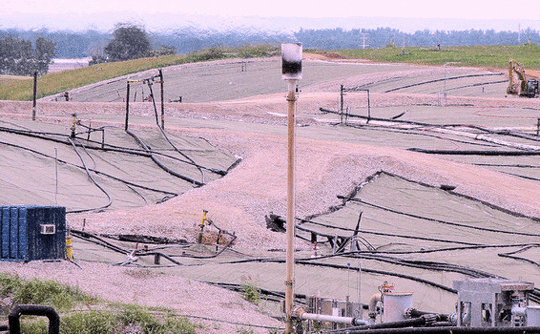
In May, almost 50 years after the waste was dumped at West Lake, the Environmental Protection Agency acknowledged what many residents had long feared: Radiological waste was spread throughout the West Lake Landfill, not confined to two specific portions as officials had long maintained.
The West Lake Landfill contamination was discovered in 1974. It was designated a Superfund site in 1990, and there is still no date certain for when the cleanup will begin.
MuckRock, by Allison Kite, Edited by Derek Kravitz, Jason Hancock 12 July 23
For kids like Sandy Mitchell, Ted Theis and Janet Johnson, childhood in the North St. Louis County suburbs in the 1960s and ‘70s meant days playing along the banks or splashing in the knee-deep waters of Coldwater Creek.
They caught turtles and tadpoles, jumped into deep stretches of the creek from rope swings and ate mulberries that grew on the banks.
Their families — along with tens of thousands of others — flocked to the burgeoning suburbs and new ranch style homes built in Florissant, Hazelwood and other communities shortly after World War II. When the creek flooded, as it often did, so did their basements. They went to nearby Jana Elementary School and hiked and biked throughout Fort Belle Fontaine Park.
Growing up, they never knew they were surrounded by massive piles of nuclear waste left over from the war.
Generations of children who grew up alongside Coldwater Creek have, in recent decades, faced rare cancers, autoimmune disorders and other mysterious illnesses they have come to believe were the result of exposure to its waters and sediment.
“People in our neighborhood are dropping like flies,” Mitchell said.
The earliest known public reference to Coldwater Creek’s pollution came in 1981, when the U.S. Environmental Protection Agency listed it as one of the most polluted waterways in the U.S.
By 2016, the Centers for Disease Control and Prevention was advising residents to avoid Coldwater Creek entirely. Cleanup of the creek is expected to take until 2038. A federal study found elevated rates of breast, colon, prostate, kidney and bladder cancers as well as leukemia in the area. Childhood brain and nervous system cancer rates are also higher.
“Young families moved into the area,” Johnson said, “and they were never aware of the situation.”
Theis, who grew up just 75 yards from the creek and played in it daily, died in August at the age of 60 from a rare cancer. Mitchell is a breast cancer survivor whose father died from prostate cancer. Johnson’s sister has an inoperable form of glioblastoma and other family members, including her father, daughter and nephew, have had various cancers.
Families who lived near Coldwater Creek were never warned of the radioactive waste. Details about the classified nuclear program in St. Louis were largely kept secret from the public. But a trove of newly-discovered documents reviewed by an ongoing collaboration of news organizations show private companies and the federal government knew radiological contamination was making its way into the creek for years before those findings were made public.

Radioactive waste was known to pose a threat to Coldwater Creek as early as 1949, records show. K-65, a residue from the processing of uranium ore, was stored in deteriorating steel drums or left out in the open near the creek at multiple spots, according to government and company reports.
A health expert who, as part of this project, was recently presented with data from a 1976 test of runoff to the creek concluded it showed dangerous levels of radiation 45 years ago.
Federal agencies knew of the potential human health risks of the creek contamination, the documents show, but repeatedly wrote them off as “slight,” “minimal” or “low-level.” One engineering consultant’s report from the 1970s incorrectly claimed that human contact with the creek was “rare.”
The Missouri Independent, MuckRock and The Associated Press spent months combing through thousands of pages of government records obtained through the Freedom of Information Act and interviewing dozens of people who lived near the contaminated sites, health and radiation experts and officials from government agencies.
Some of the documents, obtained by a nuclear researcher who focuses on the effects of radiation, had been newly declassified in the early 2000s. Others had been previously lost to history, packed away in government archives and not released publicly until now. (Read the documents here and learn more about our methodology here.)
All told, the documents from the now-defunct Atomic Energy Commission; its successors, the U.S. Department of Energy and the Nuclear Regulatory Commission; and the Environmental Protection Agency span the 75-year lifespan of the nuclear saga in St. Louis.
It starts in downtown St. Louis, where uranium was processed, and at the St. Louis airport, where it was stored at the end of the war; a monthslong move of the waste to industrial sites on Latty Avenue in suburban Hazelwood and a quarry in Weldon Spring, next to the Missouri River; an illegal dumping of waste at the West Lake Landfill in Bridgeton in the 1970s by a private company; and the declaration of the landfill as a federal toxic Superfund site in 1990.
Since then, the contaminated sites have been subjected to a seemingly endless cycle of soil, air and water testing, anxious community meetings attended by an ever-growing chorus of angry residents and panic when a subsurface smoldering event, similar to an underground fire, at the Bridgeton landfill threatened the radioactive waste buried nearby. That fire sent noxious and hazardous fumes into surrounding neighborhoods. The company in charge of the Bridgeton landfill now spends millions a year to contain it.
The documents have a familiar cadence: Year after year, decade after decade, government regulators and companies tasked with cleaning up the sites downplayed the risks posed by nuclear waste left near homes, parks and an elementary school. They often chose not to fully investigate the potential harms to public health and the environment around St. Louis………………………………………………………………………………………………………………………………………………
Illegal dumping of radioactive waste
When the Atomic Energy Commission sold the remnant nuclear waste, it anticipated being able to get rid of the more than 100,000 tons of toxic residues without spending any money.
The first company to purchase the waste, Continental Mining and Milling Co. of Chicago, borrowed $2.5 million to buy it in 1966 and then, shortly after, went bankrupt. Continental’s lender, Commercial Discount of Chicago, re-purchased the waste at auction for $800,000 and, after failing to get a bidder at a second auction, sold it to the Cotter Corp. To turn a profit, Cotter would ultimately dry the material and ship it to its uranium mill plant in Cañon City, Colorado………………………………………………………….
Cotter asked the government to bury the waste at Weldon Springs multiple times, in the late 1960s and early 1970s, but were rebuffed each time, meeting minutes show.
So, over a period of 2 ½ months in the summer and fall of 1973, Cotter took the problem into its own hands, without telling government regulators.
The company mixed the radioactive waste with tens of thousands of tons of contaminated soil from the site and illegally dumped it in a free, public landfill called West Lake, under three feet of soil and other garbage……………………………..
The AEC released Cotter from its St. Louis permit without immediate sanctions in 1974, but the company is partially responsible for the cleanup costs at the site.
Cotter’s parent company, General Atomics, did not respond to multiple requests for comment……………………………………………………………….
‘Tip of the iceberg’
In 1999, when Robbin Dailey moved into Spanish Village, a neighborhood of only a few dozen homes with its own park less than a mile from the back side of West Lake Landfill, she had no idea she was living next to a Superfund site.
When the EPA decided initially in 2008 to cap the waste at West Lake and leave it in place, Dailey never heard about the plan. Two years later, in 2010, she was alerted to the radioactive waste when a “subsurface smoldering event” — a type of chemical reaction that consumes landfilled waste like a fire but lacks oxygen — sent a pungent stench into the air around her home.
Dailey and her husband had their house tested and found thorium in the dust at hundreds of times natural levels. They sued the landfill’s owners, Republic Services, as well as the Cotter Corp. and Mallinckrodt.
Dailey said she and the companies had “resolved” their legal issues, but she, like all of the residents in North St. Louis County, was still in the dark about where within the landfill site the waste actually was.
Court records reveal a bevy of lawsuits against the private companies involved, at various times, with the West Lake Landfill. Not only that, but the landfill operators sued Mallinckrodt in an attempt to force the maker of the radioactive waste to pay for part of the cleanup.
Since the late 1970s, federal regulators repeatedly failed to uncover the true extent of contamination at West Lake.
In October 1977, the Nuclear Regulatory Commission used a helicopter to take hour-long passes back and forth over the landfill from an altitude of 200 feet. The goal was to measure gamma radioactivity coming from the site using specialized equipment.
While the effort correctly identified two areas with high levels of radiation, it had serious limitations, experts say. A survey of that type can miss contamination if it’s buried deep underground or if the ground is obstructed by vegetation.
And it did…………………………………
In May, almost 50 years after the waste was dumped at West Lake, the Environmental Protection Agency acknowledged what many residents had long feared: Radiological waste was spread throughout the West Lake Landfill, not confined to two specific portions as officials had long maintained……………………..
EPA officials said the contamination was found all over the property — in some areas at the surface and, in other areas, at great depths.
The agency looked at the dates on newspapers above and below the radioactive waste in two areas of the site previously thought to be uncontaminated to approximate when it was dumped, said Chris Jump, the EPA’s lead remedial project manager for the site.
It’s likely been there the whole time.
…………………………… Dawn Chapman, who left her job and co-founded Just Moms STL to advocate for the community around the landfill, said the EPA used to treat her and other activists like their fears were hysterical.
………………
A staffer with the Missouri Department of Natural Resources wrote in 1980 that contamination at the landfill was more severe and widespread than previously thought. In 1986 and 1990, onsite sampling showed possible radiological contamination in the groundwater in areas outside the sections of the landfill thought to be radioactive.
In 1987, the state classified the landfill as a hazardous waste site. The radioactive waste was in direct contact with the groundwater, the agency said in its annual report.
“Based on available information, a health threat exists due to the toxic effects of chemicals and low-level uranium wastes buried at the site and the possibility that off-site migration of these materials might occur,” the agency wrote.
…………………………. The West Lake Landfill contamination was discovered in 1974. It was designated a Superfund site in 1990, and there is still no date certain for when the cleanup will begin.
…………………………………….. Back to the drawing board
EPA’s first plan for the site would not have included moving the radioactive waste at all.
In 2008, the Environmental Protection Agency approved a plan for the landfill’s “primarily responsible parties” — the government and private contractors responsible for the site — to place a cap over the landfill and leave the waste in place.
Following criticism from the surrounding communities, EPA asked the Department of Energy, the Cotter Corp. and the landfill’s owner, Republic Services, to test the site again.
In the meantime, an underground fire brought a new level of scrutiny.
Starting in 2010, the Bridgeton landfill, which sits adjacent to the West Lake Landfill, has been experiencing a subsurface smoldering event.
………………………………………………….. The depth and severity of the new contamination the EPA found is not yet clear. The agency is preparing to release a report that will include the readings, a spokesperson said. A remedial design portion of the project is underway, the last step before the excavation begins.
But EPA doesn’t have a date certain as to when work on the project might start.
Curtis Carey, a spokesperson for the EPA, said despite decades of delays, the agency is planning next steps for the landfill “with a great deal more information because of our purposeful approach than was available 10, 15, 20 years ago.”
The following people contributed reporting, writing, editing, document review, research, interviews, photography, illustrations, analysis and project management. Chris Amico, Dillon Bergin, Kelly Kauffman and Derek Kravitz of MuckRock; Jason Hancock, Allison Kite and Rebecca Rivas of The Missouri Independent; Michael Phillis and Jim Salter of The Associated Press; Sarah Fenske, Theo Welling, Tyler Gross and Evan Sult of the Riverfront Times; EJ Haas, Madelyn Orr, Sydney Poppe, Mark Horvit and Virginia Young of the University of Missouri; Katherine Reed of the Association of Health Care Journalists; Liliana Frankel, Erik Galicia, Laura Gómez, Lauren Hubbard, Sophie Hurwitz and Steve Vockrodt; and Gerry Everding and Carolyn Bower of the original St. Louis Post-Dispatch team that published the seven-part “Legacy of the Bomb” series in 1989. https://www.muckrock.com/news/archives/2023/jul/12/st-louis-landfill-toxic-superfund/
NATO to keep Ukraine at arm’s length
https://www.rt.com/news/579554-nato-summit-communique/ 12 July 23
NATO Secretary General Jens Stoltenberg further elaborated on the matter at a press conference, stating that the bloc must first ensure that Ukraine achieves a “victory” in its ongoing conflict with Russia. Should Kiev not succeed, its NATO membership will be out of the question, he warned.
Kiev will be permitted to join the US-led bloc “when allies agree and conditions are met”
NATO has reaffirmed its readiness to grant Ukraine membership at some point in the future. A joint statement released during the annual summit of the US-led bloc said Kiev would be invited to join only “when allies agree and conditions are met,” but it will be allowed to bypass the so-called Membership Action Plan that is usually required for candidate members.
We reaffirm the commitment we made at the 2008 summit in Bucharest that Ukraine will become a member of NATO, and today we recognize that Ukraine’s path to full Euro-Atlantic integration has moved beyond the need for the Membership Action Plan,” the statement read.
Ukraine has become “increasingly interoperable and politically integrated with the US-led bloc,” it stated. It also outlined the need for “additional democratic and security sector reforms” in the country.
The alliance will support Ukraine in making these reforms on its path towards future membership. We will be in a position to extend an invitation to Ukraine to join the alliance when allies agree and conditions are met,” the statement concluded.
NATO Secretary General Jens Stoltenberg further elaborated on the matter at a press conference, stating that the bloc must first ensure that Ukraine achieves a “victory” in its ongoing conflict with Russia. Should Kiev not succeed, its NATO membership will be out of the question, he warned.
The pledge falls short of calls by top Ukrainian officials, who have repeatedly urged the US-led alliance to accept the country right away or at least produce an official “invitation” for it at the summit. Ukrainian President Vladimir Zelensky made an apparent last-ditch attempt to influence the bloc’s joint statement hours before it was released, taking to social media to criticize NATO and demand “respect” for Ukraine from the alliance.
“It’s unprecedented and absurd when [a] time frame is not set neither for the invitation nor for Ukraine’s membership. While at the same time vague wording about ‘conditions’ is added even for inviting Ukraine,” Zelensky wrote, referring to a draft of the document that was partially leaked to the media.
Nuclear bomb plutonium fallout marks dawn of new epoch in which humanity dominates planet

The AWG has chosen the plutonium isotopes from H-bomb tests as the key marker for the Anthropocene,
Canadian lake chosen to represent start of Anthropocene, Damian Carrington Environment editor, @dpcarringtonWed 12 Jul 2023 https://www.theguardian.com/environment/2023/jul/11/nuclear-bomb-fallout-site-chosen-to-define-start-of-anthropocene
The site to represent the start of the Anthropocene epoch on Earth has been selected by scientists. It will mark the end of 11,700 years of a stable global environment in which the whole of human civilisation developed and the start of a new age, dominated by human activities.
The site is a sinkhole lake in Canada. It hosts annual sediments showing clear spikes due to the colossal impact of humanity on the planet from 1950 onwards, from plutonium from hydrogen bomb tests to the particles from fossil fuel burning that have showered the globe.
If the site is approved by the scientists who oversee the geological timescale, the official declaration of the Anthropocene as a new geological epoch will come in August 2024.
Experts said the decision has social and political importance, as well as great scientific value, as it would testify to the “scale and severity of the planetary transformation processes unleashed by industrialised humanity”.
The climate crisis is the most prominent impact of the Anthropocene, but huge losses of wildlife, the spread of invasive species, and the widespread pollution of the planet with plastics and nitrates are also key features.
The Anthropocene Working Group was set up in 2009 and in 2016 concluded that the human-caused changes to Earth were so great that a new geological time unit was justified. The AWG then assessed in detail a dozen sites across the world as candidates for what geologists call a “golden spike”, ie the place where the abrupt and global changes marking the start of the new age is best recorded in geological strata.
Candidate sites included tropical corals in the US and Australia, a mountainous peat bog in Poland, the Antarctic ice sheet and even the human debris accumulated under the city of Vienna. However, after several rounds of voting by the AWG, Crawford Lake, near Toronto, was selected.
“There is compelling evidence globally of a massive shift, a tipping point, in the Earth’s system,” said Prof Francine McCarthy, a geologist at Brock University, Canada, and AWG member. “Crawford Lake is so special because it allows us to see at annual resolution the changes in Earth history.
The lake, formed in a limestone sinkhole, is 24 metres deep but only 2.4 hectares in area. That tall shape means the bottom waters and surface waters do not mix, which would confuse the record laid down in the sediments. “The bottom of the lake is completely isolated from the rest of the planet, except for what gently sinks to the bottom and accumulates in sediment,” McCarthy said.
The AWG has chosen the plutonium isotopes from H-bomb tests as the key marker for the Anthropocene, as they were spread globally from 1952 but declined rapidly after the Nuclear Test Ban Treaty in the mid-1960s, creating a spike in sediments.
“The presence of plutonium gives us a stark indicator of when humanity became such a dominant force that it could leave a unique global ‘fingerprint’ on our planet,” said Prof Andrew Cundy, an environmental radiochemist at the University of Southampton, and AWG member.
There are other important markers in the lake sediments, including spherical carbon particles produced by the burning of fossil fuels in power plants and nitrates from the mass application of chemical fertilisers. “We have a dramatic increase in the concentration in our core at exactly the same depth that we see the rapid rise in plutonium,” said McCarthy.
The 1950s saw the start of the “great acceleration”, the unprecedented increase in industrial, transport and economic activity that occurred after the second world war and continues today. “It is the great acceleration that we decided to use as a major tipping point in Earth history. But it is the increase in plutonium 239 fallout specifically that we chose as the marker,” said McCarthy.
Prof Jürgen Renn, director of the Max Planck Institute for the History of Science, in Berlin, Germany, said: “The Anthropocene concept has now received a firm anchoring in a very precise stratigraphic definition, [giving] a reference point for scientific discussions.
“It also creates a bridge between the natural sciences and the humanities, because it’s about the humans,” Renn said. “We are looking at something that is shaping our fate as humanity, so it’s very important to have a common reference point.”
Official ratification of the Crawford Lake site and the Anthropocene epoch requires passing three more votes of geological authorities, the subcommission on Quaternary Stratigraphy, the International Commission on Stratigraphy and finally the International Union of Geological Sciences.
The decision may be a difficult one for geologists, who are used to dealing with time periods spanning millions of years and using rocks with fossils as markers. The AWG will present a dossier of evidence hoping to convince the voting bodies that the Anthropocene does represent a planetary change that requires a new geological time period.
Dr Alexander Farnsworth, at the University of Bristol, said plutonium is a radioactive element and decays over time, so might not persist over geological timescales of millions. He also questioned whether an Anthropocene epoch is needed, saying: “We are but a ripple in the river of gene flow through time.”
Prof Colin Waters, AWG chair from the University of Leicester, said: “The Anthropocene that starts in the 1950s represents a very rapid change that we have caused to the planet. There’s hope in that respect. The combined impacts of humanity can be changed rapidly for good and for bad. It’s not inevitable that we have to slide into continuing environmental poverty
Nuclear bomb fallout marks dawn of new epoch in which humanity dominates planet
The Zaporizhzhia nuclear power plant is a ‘dirty bomb’ waiting to happen – a nuclear expert explains
The Conversation, Tilman Ruff July 13, 2023
After the explosion at the Kakhovka Dam in Ukraine last month, many Ukrainians feared the Zaporizhzhia nuclear power plant could be next.
These concerns have been heightened in recent weeks as both Ukraine and Russia have accused each other of planning an attack of the plant, which has been under Russian control since March 2022.
The International Atomic Energy Agency (IAEA) has not found any evidence of explosives in recent inspections, but also said it had yet to be granted access to all parts of the huge plant.
So, how serious are the risks of an attack at the power plant? And how disastrous would this be for Ukraine and the wider world?
Europe’s largest nuclear power plant
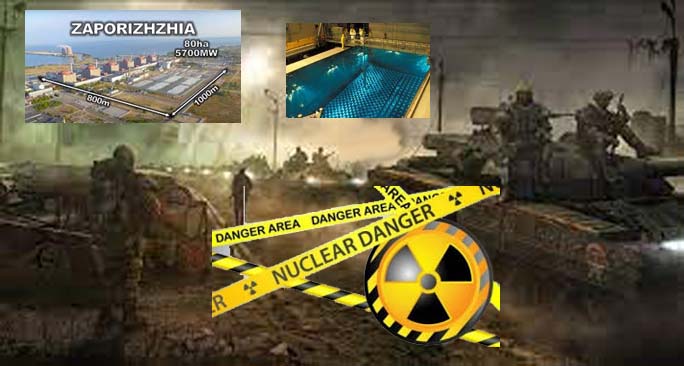
Construction of the Zaporizhzhia power plant began in 1981. Five reactors were commissioned between 1984-89, and a sixth in 1995. The reactors are more modern than the graphite-moderated reactors at Chernobyl, and are similar to the pressurised water reactors in widespread use in the United States and Europe.
The plant is Europe’s largest, built on the southern bank of the Kakhovka Reservoir on the Dnipro River, from which it draws its cooling water. Before the Russian invasion, Ukraine generated about half its electricity from 15 nuclear power reactors across four sites, with Zaporizhzhia generating almost half of this.
The plant has cooling ponds for spent nuclear fuel, which require continuous power and water (like the reactors themselves). It also has a dry cask storage facility for spent reactor fuel when it no longer requires continuous water cooling.
In 2017, Ukraine reported there were just over 2,200 tons of highly radioactive spent fuel at Zaporizhzhia, in the spent fuel pools and dry cask storage.
How quickly a meltdown could happen
Barely a week after the invasion began, Russian forces captured Zaporizhzhia. During heavy combat, a fire broke out in a training facility, while other parts of the plant were damaged.
In September 2022, the plant was fully disconnected from the electricity grid. Five reactors were put into cold shutdown. The sixth was maintained in hot shutdown at around 200 degrees Celsius, producing steam for the plant.
The Ukrainian nuclear regulator ordered a cold shutdown of this reactor last month, but this has not happened. Extensive maintenance work on the reactors is overdue.
The fuel inside nuclear reactors needs continuous, active cooling for many months after a reactor shutdown because of the heat that continues to be produced by the decay of hundreds of different fission products. The longer the fuel is inside a nuclear reactor, the more radioactive it becomes. That is why when fuel is removed from a reactor, it still requires continuous, active cooling for years.
The world saw in dramatic fashion in Fukushima, Japan, in 2011 what can happen when continuous, active cooling of nuclear reactors is disrupted.
More than 70% of the total radioactivity at the Fukushima power plant was in the spent fuel ponds, which have none of the carefully engineered containment layers that reactors typically have.
In his classic 1981 book Nuclear Radiation in Warfare, Nobel Peace Prize-winning physicist Joseph Rotblat documented how
in a pressurised water reactor, the meltdown of the core could occur within less than one minute after the loss of coolant.
The radioactivity released from damaged spent fuel ponds could be even greater than from a meltdown at the reactor itself, he wrote.
His study makes clear that a military attack on a reactor or spent fuel pond could release more radioactivity – and longer-lasting radioactivity – than even a large (megaton range) nuclear weapon.
As nuclear physicist Edwin Lyman makes clear, if the Zaporizhzhia reactor cooling was interrupted, there might be a day or two before the spent fuel began to overheat and degrade.
The melting reactor core would then collapse onto the floor inside its steel primary containment vessel and melt through to the floor of the building. Large amounts of radioactive gases and aerosols would be released into the environment, potentially explosively.
The radioactive release could possibly be at Chernobyl-scale or even larger amounts if multiple reactors and spent fuel ponds were involved. This could then spread across borders and continents with the wind, rivers and currents, and come down in hotspots in rain and snow.
A nuclear plant under continuous assault
The Russian invasion of Ukraine is the first time war has engulfed operating nuclear plants and, in a real sense, weaponised them as potential radiological weapons, or “dirty bombs”…………………………………………………………..
The other three nuclear power plants in Ukraine have also experienced interruptions to their electricity supply. In addition, other nuclear facilities have been shelled, struck by missiles or otherwise damaged.
A wake-up call to the dangers of nuclear power
Some nuclear experts have inappropriately downplayed the risk of deliberate or accidental breach of the containment structures at Zaporizhzhia.
However, the IAEA and independent experts have highlighted the very real risk of a catastrophe.
………………………………………………………………………. No other energy technology is associated with such extreme safety and security risks. If Zaporizhzhia were a wind farm or solar array, the risk of a severe accident with global and intergenerational consequences – not to mention weapons proliferation or intractable waste issues – would be precisely zero.
https://theconversation.com/the-zaporizhzhia-nuclear-power-plant-is-a-dirty-bomb-waiting-to-happen-a-nuclear-expert-explains-209236
Michigan ratepayers will foot the bill for Resuscitation of Palisades Nuclear Reactor
What changed? Holtec saw an opportunity to feed from the public trough by getting billions of dollars of corporate welfare, from both the state and federal government, to raise Palisades from the dead.
CounterPunch, BY JEFF ALSON, 12 July 23
The 52-year old Palisades nuclear power plant near South Haven, Michigan, on the shore of Lake Michigan near both Chicago and Grand Rapids, is one of the oldest and most degraded reactors in the country. In 2006, Palisades’ original owner, Consumers Energy, cited a wide range of major safety concerns when it sold the plant to Entergy, including that Palisades had one of the most embrittled reactor vessels in the country, needed a new reactor vessel head and steam generator, and had suffered from control rod drive mechanism seal leaks since it first opened.
As natural gas, and then wind and solar, became cheaper and cheaper, Palisades’ electricity became increasingly uncompetitive. Michigan ratepayers subsidized its electricity for years, sometimes paying as much as 57% above market rates. Trying to minimize additional costs, Entergy refused to invest in the most important safety repairs.
In 2018, Entergy announced it would sell the old and dangerous plant to Holtec, a decommissioning company, and the U.S. Nuclear Regulatory Commission (NRC) approved. The plant was formally closed on May 20, 2022, nuclear fuel was removed on June 13, and the plant was sold to Holtec on June 28, 2022.
The NRC then terminated Palisades’ operating license.
For four years, from 2018 through 2022, every major stakeholder—Entergy, the NRC, the Michigan Public Service Commission, energy and environmental NGOs, groups representing electricity consumers, and, notably, Michigan Governor Gretchen Whitmer—agreed that Palisades should be shut down.
The Governor’s own MI Healthy Climate Plan, released in April 2022, appropriately ignored Palisades’ imminent closure, since there are far cheaper and safer alternatives to reduce greenhouse gas emissions.
What changed? Holtec saw an opportunity to feed from the public trough by getting billions of dollars of corporate welfare, from both the state and federal government, to raise Palisades from the dead.
Holtec has requested a $300 million subsidy from Michigan taxpayers and in late June got a $150 million blank check from the Michigan legislature added to the current state budget without any public debate whatsoever. More ominous, Holtec also wants Michigan ratepayers to, once again, be forced to buy electricity at above-market prices that could significantly raise Michigan’s electricity rates, already the highest in the Midwest.
…………………………………. .Holtec will likely apply for multiple federal subsidies as well. To reopen Palisades, Holtec has already applied to the Department of Energy (DOE) for a billion dollar nuclear loan guarantee under the 2022 Inflation Reduction Act, and may apply for an additional $1.2 billion from the 2021 Infrastructure bill. Separately, Holtec has applied to DOE for $7.4 billion in loan guarantees under the 2005 Energy Policy Act for one or more future small modular nuclear reactors.
Michigan taxpayers and ratepayers have had too many nuclear white elephants:…………………………………………..
Of course, Michigan is not unique in this regard, as no U.S. nuclear power plants have been built on schedule or on budget in the last 50 years. In the wake of these and scores of other nuclear economic debacles across the country after Three Mile Island, Forbes business magazine concluded, “The failure of the U.S. nuclear power program ranks as the largest managerial disaster in U.S. business history….only the blind, or the biased, can now think that money has been well spent.”
…… A closed U.S. nuclear power plant has never been re-opened and would take, at best, many years. Investing in wind, solar, and battery storage provides much faster, cheaper, and more sustainable greenhouse gas emissions reductions. Of course, nuclear plants also entail unnecessary risks such as high-level nuclear waste, routine radiation releases, the potential for catastrophic accidents, and terrorist attacks…… https://www.counterpunch.org/2023/07/13/michigan-ratepayers-will-foot-the-bill-for-resuscitation-of-palisades-nuclear-reactor/
We must focus our state and federal resources on the most economical and sustainable climate energy solutions, and not squander more taxpayer and ratepayer funds on more misguided investment in nuclear power.
High river temperatures to limit French nuclear power production

By Forrest Crellin, July 13, 2023, PARIS, (Reuters) – Output restrictions are expected at two nuclear plants along the Rhone river in eastern France due to high temperature forecasts, nuclear operator EDF (EDF.PA) said, several days ahead of the similar warning last year, but affecting fewer plants.
The hot weather is likely to halve the available power supply from the 3.6 gigawatt (GW) Bugey plant and the 2.6 GW Saint Alban plant from July 13 and July 16 respectively, the operator said.
However, production will be at least 1.8 GW at Bugey and 1.3 GW at Saint Alban to meet grid requirements, and may change according to grid needs, the operator said.
Kpler analyst Emeric de Vigan said the restrictions were likely to have little effect on output in practice, with cuts likely only at the weekend or midday when solar output was at its peak, so that the impact on power prices would be slim.
He said the situation would need monitoring in coming weeks, however, noting it was unusually early in the summer for such restrictions to be imposed.
Water temperatures at the Bugey plant already eclipsed the initial threshold on July 9 where restrictions are possible, and are currently forecast to peak next week and then drop again, Refinitiv data showed……….
The Garonne river in southern France has the highest potential for warming to critical levels, but the Golfech plant is currently offline for maintenance until mid-August, the data showed.
“(The restrictions were) to be expected and it will probably occur more often,” Greenpeace campaigner Roger Spautz said.
“The authorities must stick to existing regulations for water discharges. Otherwise the ecosystems will be even more affected,” he added………………………….. more https://www.reuters.com/business/energy/high-river-temperatures-limit-french-nuclear-power-production-2023-07-12/
Small nuclear reactor industry in big trouble?

From STOP SMALL MODULAR REACTORS IN CANADA 12 July 23
2 Mycle Schneider, who produces the World Nuclear Industry Status Report (WNISR) says that the recent announcements by the Ontario government about new nuclear reactors at Darlington and Bruce amount to “a mixture of tech fantasy and collective denial of the state of the industry.”
He gave evidence to the Belgian Parliament on SMRs on 20 June 2023, following a first hearing on 30 May 2023. Six of ten presentations were given by technology providers, one by a former administrator of the French Alternative Energies and Atomic Energy Commission (CEA), one by an International Energy Agency representative, and one by a Dutch ex-government “expert” — a very open, balanced panel – sound familiar?
All ten presentations – including Mycle’s – are available in one volume here. Most are in English. He says they provide “useful documentation on current SMR strategies. NuScale and Rolls Royce were invited but did not show up. Maybe NuScale did not feel like coming… When it became public that the NuScale CFO has sold most of his shares, their value on the stock market plunged even further.
The videos of the hearings, including Q&A are here and here.
Small size, big problems: NuScale’s troublesome small modular nuclear reactor plan

EWG, 12 July 23
- Two energy experts discuss the design risks and excessive costs of the NuScale small modular nuclear reactor.
- NuScale project distracts from the need to push clean energy sources.
Despite its small size, NuScale has outsize cost and safety problems.
NuScale is one of several companies making long-shot attempts to commercialize what are known as small modular nuclear reactors, or SMRs. Its 77-megawatt project is the furthest along in the Nuclear Regulatory Commission, or NRC, licensing approval process, but in the earliest stages, with a long way to go. But the NRC has identified serious safety concerns, and cost estimates have ballooned in recent years.
EWG has long warned about the folly of investing in nuclear power, including SMRs that are unlikely ever to get off the ground.
And in a new analysis commissioned by EWG, two nuclear experts with decades of experience note significant NuScale cost and safety drawbacks that have been raised by NRC staff.
The experts recently analyzed the November 15, 2022, pre-application readiness assessment report the NRC issued to NuScale, which details many concerns about the project’s safety. The two authors are Arjun Makhijani, Ph.D., president of the Institute for Energy and Environmental Research, which advocates for a safer environment, and M.V. Ramana, Ph.D., a professor at the School of Public Policy and Global Affairs, University of British Columbia.
Their findings further strengthen the case against more funding for NuScale – yet another nuclear boondoggle that will fleece American taxpayers.
The primary issues they identified were escalation costs and design issues, for which the company has not properly addressed the safety issues involved. These include:
Costs. The projected construction costs of the first proposed NuScale project have grown from $5.3 billion, as estimated in November 2021, to $9.3 billion, in January 2023.
Risks. The NRC and its Advisory Committee on Reactor Safeguards identified several safety risks in the design for the reactor, in particular with the steam generator.
Energy companies, states and the government should stop throwing good money after bad, wasting it on lofty “all of the above” nuclear plans that will never come to fruition.
Instead they should focus on promoting workable, clean power solutions that already exist, like wind, solar and distributed generation, and associated technologies. Taxpayer dollars should be spent only on technologies that fight the climate crisis and do not have a history of persistent, inevitable ratepayer and taxpayer bailouts. Nuclear power and carbon capture and sequestration both fail that test.
The nuclear money pit
The nuclear industry survives in part thanks to assertions of clean, cheap power, which have never materialized, and an oversize influence in Congress and state legislatures………………………………….
Experts: NuScale’s costs soaring
NuScale’s first SMR plant is intended for the Utah Associated Municipal Power Systems, or UAMPS. The goal is to provide power to electric utilities in Utah and surrounding states. The target date is 2029, though nuclear plants have typically been plagued by significant delays. Its estimated cost is over $9 billion for just six small reactors that would, in total, be less than half the size of the standard large nuclear unit.
That estimate has increased by $4 billion in less than two years.
But the government keeps throwing taxpayer dollars at NuScale, promising $1.4 billion to the UAMPS project on top of the $400 million it has already squandered.
Other than these expected costs spiraling out of control, Makhijani and Ramana in their analysis find that even though NuScale keeps changing design specifications for its unit, NuScale’s safety analyses have not evaluated the impact of these design changes.
Experts: Changes in design present dangerous power projections
NuScale has increased by 50 percent the power output of its yet-to-be-built SMR reactor design. This means there will be more heat, pressure and radioactivity, which will further stress critical components of the reactor. These factors increase the risk of a catastrophic breakdown and radiation leak.
Unlike any nuclear power plant that’s already online, NuScale would house the reactor core – the nuclear fuel – and steam generator in the same vessel. This would be a departure from the traditional design, in which the steam generator is separated from the fuel, outside the reactor vessel but inside the secondary containment.
The helical design of the steam generator has also never been used in any other commercial nuclear power plant, which makes it hard to evaluate how it would behave in the long run.
Experts: Risky reactor design
The NRC has preliminarily approved NuScale’s design, despite serious questions about the steam generator. And NuScale still hasn’t produced the necessary analysis of all the accidents that could occur. …………………………………………………………….
Experts: NRC ignored risk guidance
The Advisory Committee on Reactor Safeguards, or ACRS, warned in a letter to NRC the “design and performance of the [NuScale] steam generators have not yet been sufficiently validated.”
The 1954 Atomic Energy Act requires ACRS to review and report to the NRC commissioners and staff about safety studies and reactor facility license and license renewable applications, among other issues.
The ACRS noted that NuScale’s plan “introduces different failure modes.”…………………………………………..
Experts: A flawed energy plan
Makhijani and Ramana conclude that the NuScale project, referred to as VOYGR, has too many problems and that there is insufficient information to justify NuScale’s safety claims.
“[T]he 77-MW VOYGR . . . has not received standard design approval, much less full Commission certification. On the contrary, it has received a letter from the NRC staff with 99 ‘significant’ observations and six major challenges,” they write.
Further, they warn:
These problems need real-world analysis, design, and most important, real-world testing to be resolved. Premature wear of the steam generators and their potential failure were not analyzed properly and insufficiently tested even for the (previous) 50 MW design. The hurdles are even higher with the 77-MW version.
The NuScale project is a trainwreck waiting to happen.
It would be irresponsible for the NRC to proceed at this juncture with any further approval. The question for NRC is whether the agency wants to keep the financially unviable, unsafe nuclear industry alive or focus on public safety and legitimate options for fighting the climate crisis. https://www.ewg.org/news-insights/news/2023/07/small-size-big-problems-nuscales-troublesome-small-modular-nuclear
Protests stopped nuclear waste dumping at Bradwell, and now will likely do so again
Bradwell Revisited – echoes of 1980s as Government looks for somewhere
to dump radioactive waste. Andrew Blowers records how protests stopped
nuclear dumping at Bradwell and would likely do so again in the June 2023. BANNG column for Regional Life.
Older readers will recollect the battle
that raged as mass protests saw off Government plans for a nuclear dump at
Bradwell in the 1980s. The Government is again looking at existing nuclear
sites in which to bury some of the nation’s nuclear wastes.
Bradwell may be in its sights but is wholly unsuitable and any attempt to develop a dump
here will once again be seen off by massive local protest and opposition.
In February, 1986, Bradwell, along with three other sites, in Humberside,
Lincolnshire and Bedfordshire, was identified by the Government’s agency,
Nirex, as a possible site for a shallow disposal facility to take the
nation’s short-lived intermediate level radioactive wastes (ILW). Over
the next two years there ensued what was dubbed the Four Site Saga, as the
communities, backed by their County Councils, worked together in opposition
to the whole project.
BANNG 8th June 2023
Rep. Gaetz Says He Will Co-Sponsor Amendment to Block Cluster Bombs to Ukraine
https://scheerpost.com/2023/07/12/rep-gaetz-says-he-will-co-sponsor-amendment-to-block-cluster-bombs-to-ukraine/ By Dave DeCamp / Antiwar.com
Rep. Sara Jacobs (D-CA) introduced an amendment to the NDAA to block the provision of cluster munitions.
Rep. Matt Gaetz (R-FL) said Monday that he will be the Republican co-sponsor of an amendment to the 2024 National Defense Authorization Act (NDAA) that aims to block the provision of cluster bombs to Ukraine.
The amendment was introduced by Rep. Sara Jacobs (D-CA) and is co-sponsored by Reps. Ilhan Omar (D-MN), Pramila Jayapal (D-WA), and Rep. Jim McGovern (D-MA).
“I’m going to be the Republican co-sponsor of the Jacobs amendment before the House Rules Committee,” Gaetz said on his podcast.
The amendment reads: “Notwithstanding any other provision of law, no military assistance shall be furnished for cluster munitions, no defense export license for cluster munitions may be issued, and no cluster munitions or cluster munitions technology shall be sold or transferred.”
Gaetz said that the NDAA will be voted on this week in the House. “We have an opportunity with bipartisanship to stand against the war-mongering Bidens,” he said.
Cluster bombs spread small submunitions over large areas, many of which do not explode on impact, making them a hazard for civilians who can come across them years or even decades later. Because of their indiscriminate nature, cluster munitions are banned by over 100 countries, including many of the US’s top NATO allies.
“Children will be left without limbs and without parents because of this decision by Joe Biden if we do not work together in a bipartisan fashion to stop it,” Gaetz said.
While there is an effort to block the shipment of cluster bombs to Ukraine, they could already be on the way. The Pentagon announced they were providing cluster munitions in the form of 155mm artillery rounds using the Presidential Drawdown Authority, which allows Biden to ship weapons to Ukraine directly from US stockpiles.
Biden has defended his decision to arm Ukraine with cluster munitions by saying both Ukraine and the US are running low on ammunition. Colin Kahl, undersecretary of defense for policy, said the US will arm Ukraine with “hundreds of thousands” of the munitions.
Nuclear waste issue must be resolved before new facility can be explored, says Saugeen Ojibway Nation
APTN News, By Kierstin Williams, Jul 11, 2023
The Bruce Nuclear Station was built in the 1960s without the consultation or consent of the Saugeen Ojibway Nation.
The Saugeen Ojibway Nation is not making any commitments on the proposed expansion of the Bruce Power nuclear plant until the issue of whether nuclear waste will be stored on its territory is resolved.
Last week, Todd Smith, Ontario’s minister of energy, announced preliminary studies with Bruce Power to explore the expansion of Canada’s largest nuclear plant. The expansion would see an additional 4,800 megawatts of nuclear generation at the site.
The Bruce Power Nuclear Generating Station is located on the eastern shore of Lake Huron, the traditional territory of the Saugeen Ojibway Nation (SON), which is comprised of Saugeen First Nation and the Chippewas of Nawash First Nation.
“We have stated clearly that SON will not support any future projects until the history of the nuclear industry in our Territory is resolved and there is a solution to the nuclear waste problems that is acceptable to SON and its People,” said both chiefs in a letter on behalf of Saugeen and Nawash.
SON says the Bruce Nuclear Station was built in the 1960s without its consultation or consent.
The Nuclear Waste Management Organization (NWMO), the federal agency responsible for the long-term management of Canada’s used nuclear waste, plans to select a host site for its proposed deep geological nuclear waste facility by the fall of 2024. The facility would hold used nuclear fuel in a vault approximately 500 metres underground.
The two possible sites are within Saugeen Ojibway’s traditional territory and Wabigoon Lake Ojibway Nation near Ignace, Ont.
“The long overdue resolution of the nuclear legacy issues must occur before any future project is approved,” said Chief Conrad Ritchie and Ogimaa Kwe Veronica Smith in the letter. “Similarly, we must also have a plan in place that has been agreed to by SON to deal with all current and future nuclear waste before any future projects could go ahead.
“In no way does this announcement commit the SON to new nuclear development on SON territory,” added the letter posted on the band’s Facebook page…………………………………………..
In response to SON’s letter, NWMO said the storage site plan “will only proceed in an area with informed and willing hosts, where the municipality, First Nation communities, and others in the area are working together to implement it.
“This means the proposed South Bruce site would only be selected to host a deep geological repository with Saugeen Ojibway Nation’s willingness,” said the NWMO. https://www.aptnnews.ca/featured/nuclear-waste-issue-must-be-resolved-before-new-facility-can-be-explored-says-saugeen-ojibway-nation/
NATO fails to reduce nuclear risks at Vilnius Summit


https://www.icanw.org/nato_fails_to_reduce_nuclear_risks_at_vilnius_summit 13 July 23
The leaders of NATO countries, meeting in Vilnius at a time of unprecedented nuclear risk, took no action to reduce nuclear dangers and, on the contrary, issued a communique continuing to support the use of nuclear weapons. The alliance pointed to the risks posed by Russia’s nuclear weapons while hailing its own nuclear deterrent and nuclear sharing arrangements. It also criticised the UN Treaty on the Prohibition of Nuclear Weapons, the only area of progress on nuclear disarmament in decades, demonstrating its concern about the Treaty’s power to stigmatise and eliminate nuclear weapons.
The communique, released at the end of the first day of the Summit, condemned Russian deployment of weapons in Belarus and Russia’s “irresponsible nuclear rhetoric and coercive nuclear signalling,” while reiterating the alliance’s willingness to use nuclear weapons itself, and it’s “resolve to impose costs on an adversary that would be unacceptable”.
On nuclear sharing
NATO presented its justification for the U.S. deployment of nuclear weapons in Europe, despite democratic and legal challenges to the practice. It also criticised Russia for the same concept- to deploy nuclear weapons in Belarus. The communique is more explicit on nuclear sharing than previous statements, stating that“NATO’s nuclear deterrence posture also relies on the United States’ nuclear weapons forward-deployed in Europe.” But it ignores concerns raised by parliamentarians and citizens in NATO countries. The communique repeated NATO’s position that “NATO’s nuclear burden-sharing arrangements have always been fully consistent with the NPT,”despite the repeated challenges by other NPT members to this assertion.
Nuclear sharing, or stationing nuclear weapons in another country, is explicitly prohibited under the Treaty on the Prohibition of Nuclear Weapons,
which all countries should join as a matter of urgency to prevent further deployment of nuclear weapons in additional countries.
On the Treaty on the Prohibition of Nuclear Weapons (TPNW)
The communique dedicated several sentences to rebuking the Treaty on the Prohibition of Nuclear Weapons, the only treaty to adopt an action plan on disarmament in over a decade. NATO’s attention to this treaty demonstrates the alliance’s fear about its ability to undermine the possession, threat of use and stationing of nuclear weapons and challenge the practice of nuclear deterrence that all members currently engage in. The reality is that there is no inconsistency between the two treaties (NATO and the TPNW) – only between the practice of nuclear deterrence and joining the TPNW.
The communique claimed that the treaty is “in opposition to and is inconsistent and incompatible with the Alliance’s nuclear deterrence policy.” Yet throughout the history of NATO, members of the alliance have taken different approaches to weapons and strategy issues, and- as the communique itself outlines: Every nation has the right to choose its own security arrangements. There is no legal impediment to NATO members joining the TPNW. In fact several NATO countries are engaging with the constructive work underway in the TPNW, including by observing the first Meeting of States Parties to the TPNW in 2022, including Belgium, Germany, the Netherlands and Norway.
The NATO Summit in Vilnius could have been an opportunity for member states to demonstrate their commitment to bolstering peace and security by reducing the unacceptably high level of nuclear risk. As nuclear-armed states, states that host US nuclear weapons and states that accept the use of nuclear weapons on their behalf, they have the power to agree to end these dangerous practices. Instead, they chose to issue a communique with language on nuclear weapons that was hypocritical and empty. Fortunately, member states to the Treaty on the Prohibition of Nuclear Weapons will meet at the end of November to take real action to address nuclear dangers and advance towards disarmament.
Takeaways from AP’s examination of nuclear waste problems in the St. Louis region
BY MICHAEL PHILLIS AND JIM SALTER, July 12, 2023
ST. LOUIS (AP) — Uranium processing in the St. Louis area played a pivotal role in developing the nuclear weapons that helped bring an end to World War II and provided a key defense during the Cold War. But the cost to the region has been staggering.
Eight decades after Mallinckrodt Chemical Works first began the dangerous task of processing uranium at a sprawling complex near downtown St. Louis, the federal government is still removing soil from a creek and cleaning up a landfill — nuclear contamination sites. Last year, a grade school closed amid worries that contamination from the creek got onto the playground and inside the building.
The government has paid out millions to former Mallinckrodt workers with cancer, or their survivors. Many people with rare cancers who grew up near the waste sites believe their illnesses, too, are connected to radiation exposure.
The Associated Press examined hundreds of pages of internal memos, inspection reports and other items dating to the early 1950s. This story is part of an ongoing collaboration between The Missouri Independent, the nonprofit newsroom MuckRock and AP. The government documents were obtained by outside researchers through the Freedom of Information Act and shared between the news organizations.
Some takeaways from the work:
ST. LOUIS ROLE IN NUCLEAR WORK…………………………………………..
CONTAMINATION IN SEVERAL SITES OF REGION
The Mallinckrodt plant has been closed for years. Nuclear waste was stored near Lambert Airport, where it contaminated a milling site and fouled Coldwater Creek. Other spent uranium was illegally dumped at a landfill in Bridgeton, Missouri, also near the airport. In neighboring St. Charles County, quarries in Weldon Spring were contaminated from uranium processing that moved there in the 1950s.
The plant itself, the milling site and the Weldon Spring site are deemed remediated by the government. Cleanup of Coldwater Creek isn’t expected to finish until 2038, though the Army Corps of Engineers believes the worst of the contamination has been removed. Federal officials plan to remove some of the waste at West Lake Landfill and cap the rest, but the timeline is uncertain.
Mallinckrodt didn’t immediately respond to messages from AP.
DOCUMENTS SHOW INDIFFERENCE TO DANGERS
Examples of indifference to the dangers posed by nuclear waste were abundant in the documents obtained through open records requests. Edwin Lyman, director of nuclear power safety with the Union of Concerned Scientists, told the AP that secrecy was paramount in the era, allowing bad practices to continue for far too long. Also, environmental standards at the time were far looser than today…………………………………………………………………
HEALTH FEARS FOR SOME IN THE REGION
Many people who worked at Mallinckrodt eventually developed cancer. Experts say directly linking cancer to radiation exposure is difficult in part because of the complexity of the disease. Still, the federal government provides compensation of up to $400,000 for stricken former nuclear workers across the U.S., or their survivors. About $23 billion has been paid out over the past two decades.
Today, activists want compensation for those who live near the haphazardly discarded waste. Dawn Chapman and Karen Nickel of St. Louis County formed the group Just Moms STL in 2007 after seeing so many friends and neighbors come down with rare cancers.
………………… Jim Gaffney, now in his 60s, has been battling cancer most of his life and is convinced that his childhood playing in Coldwater Creek is to blame.
Gaffney was diagnosed with Stage 4 Hodgkin’s Disease in 1981 and given little chance to survive. A bone-marrow transplant saved him, but the toll of the radiation, chemotherapy and the disease has resulted in hypertension, heart failure and multiple bladder tumors.
“I’m still here, but it’s not been easy,” Gaffney said. https://apnews.com/article/nuclear-contamination-waste-st-louis-takeaways-39378ddae0cdca09f972196c6965cd28—
1 This Month
Chernobyl: The Lost Tapes – A good documentary on Chernobyl on SBS available On Demand for the next 3 weeks– https://www.sbs.com.au/ondemand/tv-program/chernobyl-the-lost-tapes/2352741955560

of the week–London Campaign for Nuclear Disarmament

Tell the Ukrainian Government to Drop Prosecution of Peace Activist Yurii Sheliazhenko
To see nuclear-related stories in greater depth and intensity – go to https://nuclearinformation.wordpress.com
-
Archives
- April 2026 (126)
- March 2026 (251)
- February 2026 (268)
- January 2026 (308)
- December 2025 (358)
- November 2025 (359)
- October 2025 (376)
- September 2025 (257)
- August 2025 (319)
- July 2025 (230)
- June 2025 (348)
- May 2025 (261)
-
Categories
- 1
- 1 NUCLEAR ISSUES
- business and costs
- climate change
- culture and arts
- ENERGY
- environment
- health
- history
- indigenous issues
- Legal
- marketing of nuclear
- media
- opposition to nuclear
- PERSONAL STORIES
- politics
- politics international
- Religion and ethics
- safety
- secrets,lies and civil liberties
- spinbuster
- technology
- Uranium
- wastes
- weapons and war
- Women
- 2 WORLD
- ACTION
- AFRICA
- Atrocities
- AUSTRALIA
- Christina's notes
- Christina's themes
- culture and arts
- Events
- Fuk 2022
- Fuk 2023
- Fukushima 2017
- Fukushima 2018
- fukushima 2019
- Fukushima 2020
- Fukushima 2021
- general
- global warming
- Humour (God we need it)
- Nuclear
- RARE EARTHS
- Reference
- resources – print
- Resources -audiovicual
- Weekly Newsletter
- World
- World Nuclear
- YouTube
-
RSS
Entries RSS
Comments RSS
 nuclear-news