TODAY. No real research into the effects of releasing nuclear waste-water into rivers and seas. Oh goody! That means it’s OK, (doesn’t it?)
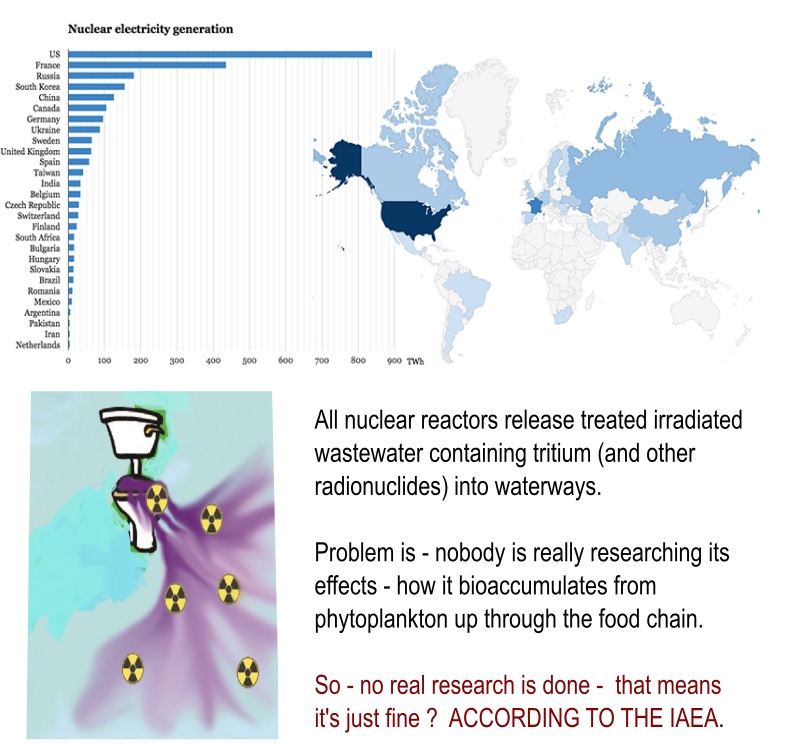
it has become clear that regulation of tritium in the United States is grossly insufficient to the current risk from tritium contamination, not to mention future risks that could arise if tritium production, use, and associated leakage rise
tritium “easily can cross the placenta and irradiate developing fetuses in utero, thereby raising the risk of birth defects, miscarriages, and other problems.”
the dangers this pernicious contaminant will pose in the future, absent more effective regulation that includes lower limits for human tritium exposure. https://thebulletin.org/2023/06/exploring-tritiums-danger-a-book-review/

There is no way to separate tritium from contaminated water. Tritium, a soft beta emitter, is a potent carcinogen which remains radioactive for over 100 years. It concentrates in aquatic organisms including algae, seaweed, crustaceans and fish. Because it is tasteless, odorless and invisible, it will inevitably be ingested in food, including seafood, over many decades. It combines in the DNA molecule – the gene – where it can induce mutations that later lead to cancer. It causes brain tumors, birth deformities, and cancers of many organs. The situation is dire because there is no way to contain this radioactive water permanently and it will inevitable leak into the Pacific Ocean for over 50 years or longer along with many other very dangerous isotopes including cesium 137 which lasts for 300 years and causes very malignant muscle cancers –rhabdomyosarcomas, strontium 90 which also is radioactive for 300 years and causes bone cancers and leukemia, amongst many other radioactive elements. http://akiomatsumura.com/2013/06/experts-explain-effects-of-radioactive-water-at-fukushima.htm
An Attack on the Zaporizhzhia Nuclear Plant Could Still be Catastrophic (- nuclear promoters minimise the risk)

Ed Lyman, July 7, 2023 https://blog.ucsusa.org/edwin-lyman/an-attack-on-the-zaporizhzhia-nuclear-plant-could-still-be-catastrophic/
Ukraine has accused Russia of planning to carry out a sabotage attack at the Zaporizhzhia nuclear plant that it has controlled since it seized it by force in March 2022. Although it reports this morning that this current threat is decreasing, the situation is fluid and the plant remains vulnerable to both accidents and attacks. While this ongoing crisis should not lead to panic, there is no cause for complacency either.
Unfortunately, the American Nuclear Society (ANS) and other commenters have been busy attempting to dismiss the risks that either an accident or a deliberate attack could lead to a significant radiological release with far-reaching consequences. Simply put, the ANS is dead wrong here, and by minimizing the potential risk it is endangering Ukrainians and others who may be affected by lulling them into a false sense of security and undermining any motivation to prepare for the worst. Effective emergency preparedness requires a clear-eyed understanding of the actual threat.
As I have pointed out previously, the fact that the six reactors have been in shutdown mode for many months (with one in “hot”, as opposed to “cold,” shutdown) does reduce the risk somewhat compared to a situation where reactors are operating or have only recently shut down. The decay heat in the reactors’ cores decreases significantly over time, although the rate of decrease slows down quite a bit after a few months. However, this does not mean, as ANS misleadingly implies, that there is no risk of a major radiological release that could disperse over a wide area. What it does mean is that if cooling were disrupted to one or more of the reactors, then there would be a longer period of time—days instead of hours—for operators to fix the problem before the cooling water in the reactor cores would start to boil away and drop below the tops of the fuel assemblies, causing the fuel to overheat and degrade.
Timely operator actions are even more critical for reactors that are shut down than for reactors that are operating, since some automatic safety systems are not functional during shutdown. Indeed, in a 1997 report, the International Atomic Energy Agency (IAEA) points out that “acceptable results for most of events during shutdown modes cannot be achieved without operator intervention.” The IAEA report states that both “preventive and mitigatory capabilities are somewhat degraded” in shutdown conditions, and lists a number of shutdown accident initiators for VVER-1000s.
One class of events of particular concern are “boron dilution” accidents, in which the concentration of boron in cooling water necessary to maintain reactors in a subcritical state becomes reduced and nuclear fission inadvertently begins in the core. This would not only increase the reactor temperature and the amount of heat that would have to be removed, but would also generate new quantities of troublesome short-lived fission products, such as iodine isotopes, which have previously decayed away in the months since shutdown. (This is why it remains important that potassium iodide—a drug that can block uptake of radioactive iodine in the thyroid—continue to be available to communities who may be in the path of any plume.)
It is also important to note that it is very unusual for reactors to be maintained for any length of time in either hot or cold shutdown modes with fuel remaining in the core, as is the case at Zaporizhzhia. Whenever nuclear reactors operate in unusual conditions that have not been thoroughly analyzed, risks increase.
Unfortunately, because of the incredible stress that the greatly reduced staff at Zaporizhzhia are under, and the unclear lines of command under Russian occupation, their ability to efficiently execute all the actions necessary to mitigate any accident or sabotage attack is in grave doubt. And if timely operator intervention does not occur, and the fuel assemblies are exposed, then a core melt accident similar to what was experienced in three of the reactors at Fukushima Daiichi is certainly possible.
Once the water level has dropped below the tops of the fuel assemblies, the original decay heat in the reactor core is no longer a relevant factor because when the zirconium cladding surrounding the fuel rods overheats and reacts with steam or air, it produces additional heat through a so-called exothermic reaction. The heat released in this way would soon become far greater than the original decay heat load and would accelerate the heat-up and degradation of the reactor core. At that point, it would be much harder for operators to arrest the progression of the core melt. Eventually, the molten core would drop to the floor of the steel reactor vessel and melt through it onto the floor of the containment building, where it would react with concrete to generate hot gases. Then, there are multiple ways in which the radioactive gases and aerosols generated during the core melt could be released into the environment, including a containment melt-through mode that is possible in VVER-1000 reactors such as Zaporizhzhia.
There is no technical reason why any resulting radioactive releases could not disperse at least as far as occurred at Fukushima, depending on the meteorological conditions. The heat of the radioactive plumes, which determines how high they will rise in the atmosphere and hence how far they can travel, largely come from the heat released by zirconium oxidation. The magnitude and extent of the resulting environmental contamination would depend on the “source term,” or the inventory and characteristics of the radioactive materials released from the site. Since up to six reactors and six spent fuel pools could be involved—especially if the site is deliberately sabotaged—the source term could ultimately be larger than that of Fukushima, where only three reactors were involved and containments remained largely intact.
Thus it is imperative that the international community take Ukraine’s warnings seriously and provide all the assistance it needs for emergency preparedness. Unjustified complacency could lead to a lack of resolve for addressing the danger, only increasing the potential for a long-lasting disaster that will compound the misery of the Ukrainian people.
Better, safer, alternatives for managing Fukushima’s radioactively polluted wastewater.
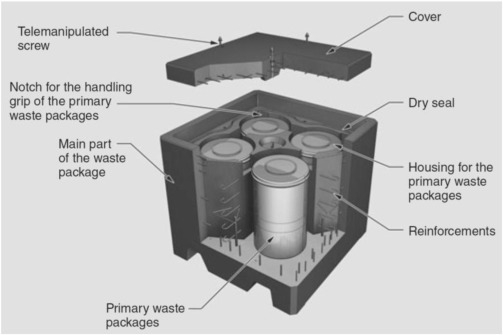
independent marine biologists and, ecosystem specialists have been opposed across the planet, to dumping this partially treated water since the ALPS system was exposed as an inadequate treatment program. All nuclear advocates do is parrot, the limited, legal liability mantra all corporations do.
When did, anyone, read, any BURNING FUEL FOR ENERGY FIRM EVER ADMIT LEGAL LIABILITY over, its production or waste they dump into the ecosystems on a global scale?
Advanced Liquid Processing System (ALPS) largely chosen because it was cheaper than treating it with the more expensive systems offered outside of TEPCO, on the international market.
REVERSE OSMOSIS-RO
TEPCO considered implementing a reverse osmosis system to remove radioactive contaminants from the water. RO is a widely used technology for desalination and purification. But the process was far too expensive given the volumes of water that needed processing, completely removing various radionuclides, including cesium, strontium, and cobalt, from the contaminated water.
CONCRETE ENCAPSULATION
Solidifying the wastewater in concrete has multiple benefits over ocean dumping, would allow all the water to be processed and removed from the tanks in as little as 5 years, considerably faster than the 30+ year timeframe for ocean disposal.
The tritium (which along with carbon-14 is not removed from the water) would remain trapped inside the concrete with negligible dose outside or on its surface since tritium betas cannot penetrate the skin.
Japan consumes approximately 40 million tons of cement annually, according to the Japanese Cement Association. If cement usage patterns in Japan are comparable to those in the United States, roughly one third of that amount, or 13 million tons, is likely used for making concrete for applications with minimal human contact or exposure.
Given this, a significant portion of the ALPS-treated wastewater could potentially be utilized for concrete required for various purposes at the Fukushima Daiichi power plant site itself.
This could include concrete for barrier walls, storage containers, stabilizing radioactive soil piles, and other similar applications.
Therefore, using concrete for low human contact is not without precedent as Japan plans to recycle far more radioactive soil for civil works projects which is another controversial topic domestically.
In addition, fresh water would be conserved since it is not used for manufacturing providing environmental benefits.
As a non-transboundary alternative, concrete encapsulation would likely be advantageous for Japan in its relations with other countries and domestically especially its fishing industry which would likely be severely affected.
UNDERGROUND INJECTION
Another option that was suggested involved injecting the treated water deep underground, into a geological layer that could safely contain the contaminants. This method would require careful consideration of the geology and hydrology of the area to ensure long-term safety.
ADVANCED LIQUID PROCESSING SYSTEM-ALPS
Was developed, in-house, by TEPCO, ALPS and designed to be a more cost-effective system, than on offer by outside developers, claimed to remove various radionuclides, including caesium, strontium, and cobalt, from the contaminated water.
The hope was the treated water, would meet the revised regulatory standards for safe discharge. TEPCO admitted publicaly, not all the caesium, strontium, and cobalt, were removed from the contaminated water.
Tritium was reduced, there is no doubt, even though the testing was reported as flawed and demonstrated in press releases by TEPCO themselves.
Japanese regulator greenlights discharge of nuclear waste from Fukushima plant.

(Rafael Grossi – the consummate hypocrite)
Grossi, however, stressed that the report does not signify support for Japan’s decision to discharge the nuclear-contaminated water into the ocean.
‘IAEA’s conclusion largely limited, incomplete, fails to respond to international community’s concerns,’ says China
AA, Necva Taştan |07.07.2023, ISTANBUL
Japan’s nuclear regulator Friday approved the release of treated radioactive water from the crippled Fukushima nuclear power plant, thus allowing the country to begin discharge of the waste into the sea this summer.
The plant’s operator, Tokyo Electric Power Company Holdings Inc., received certification from the Nuclear Regulation Authority of Japan after the International Atomic Energy Agency (IAEA) approved Japan’s water discharge plan through a comprehensive assessment, Tokyo-based Kyodo News reported.
Neighboring China has fiercely opposed the plan and on Friday imposed a ban on the import of seafood from Japan’s 10 regions.
However, the IAEA its two-year-long safety review report concluded the discharge of nuclear waste will have a “negligible” impact on people and the environment.
However, Beijing disagrees.
The report was submitted to Japanese Prime Minister Fumio Kishida early this week by IAEA chief Rafael Grossi.
“The IAEA conclusion is largely limited and incomplete and failed to respond to the international community’s concerns over Japan’s plan to dump nuclear-contaminated wastewater into the ocean,” said Wang Wenbin, a spokesman for China’s Foreign Ministry, Beijing-based Global Times reported.
Grossi, however, stressed that the report does not signify support for Japan’s decision to discharge the nuclear-contaminated water into the ocean.
Wang said Grossi’s remarks that “one or two experts” of the IAEA team had concerns over the agency’s report on Japan’s nuclear waste, “once again prove the report was hastily released and failed to fully reflect views from experts who participated in the review.”……….
“China urges Japan not to take the report as the greenlight,” but suspend the dumping plan and dispose of the nuclear-contaminated wastewater in a responsible way, Wang added.
Grossi is now traveling to South Korea, New Zealand, and Cook Islands, which is the current chair of the Pacific Islands Forum, to “address concerns, hear views, clarify IAEA role” on Japan’s nuclear waste, the IAEA chief said on Twitter.
Japan’s water discharge plan, announced in April 2021, faced significant criticism from China, South Korea, North Korea, Taiwan, and international organizations, including the UN.
The US supported the proposal, following years of discussions on dealing with over 1 million tons of water stored at the Fukushima nuclear complex since the 2011 disaster.
Despite the pressure, Japan last month initiated the injection of seawater into a drainage tunnel at the damaged Fukushima Daiichi Nuclear Power Plant, marking the initial stage of releasing treated radioactive wastewater into the ocean. https://www.aa.com.tr/en/asia-pacific/japanese-regulator-greenlights-discharge-of-nuclear-waste-from-fukushima-plant/2939518
World’s 30 major banks are NOT investing in so-called “green” “sustainable” nuclear energy
None of the world’s 30 major banks have explicitly included nuclear energy
in their criteria for issuing green or sustainability-linked bonds,
researchers said on Thursday, despite an EU decision last year to label it
as sustainable.
The European Union decided last year to include nuclear
power plants in its list of investments that can be labelled and marketed
as green. The move aimed to guide investors towards climate-friendly
technologies, but split EU countries who disagree on atomic energy’s green
credentials.
So far, banks have not followed the EU’s lead in their own
green bond rules, according to an analysis by Columbia University’s Center
on Global Energy Policy. The study looked at the 30 banks deemed
systemically important by the Financial Stability Board. Of those banks, 17
had explicitly excluded nuclear energy from their green financing
frameworks, while 12 had frameworks that were silent on nuclear, and one
had no such framework, the researchers said.
Reuters 6th July 2023
Jeju islanders protest Japan’s radioactive water discharge
“Twelve fishing vessels helmed by members of local ship owners’ associations, female divers (“haenyeo” in Korean) and young locals set out from Jocheon near the popular Hamdeok Beach on the northern coast of the island. The charging ships ploughed through waves while national flags and yellow banners fluttered in the wind. The banners contained messages like “If the sea dies, Jeju dies as well,” “All Koreans disagree,” “Let’s protect Jeju’s waters” and “Oceans aren’t Japan’s dumping grounds for radioactive waste.”
Jeju islanders protest Japan’s radioactive water discharge (July 6, 2023)
https://www.koreatimes.co.kr/www/nation/2023/07/113_354424.html
Nuclear. The Flamanville EPR impacted by the shutdown of the first reactor in China?
In China, the first EPR reactor is again shut down after the discovery of “excessive oxidation” on the reactor claddings. What effect on Flamanville (Manche)?
It looks like a new pebble in the shoe for the EPR , which already had plenty of it. Officially, however, everything is fine. Shutdown of the Taishan 1 reactor in the first quarter of this year was scheduled. This began on January 31, 2023 .
To this reloading operation, the Chinese operator, of which EDF is a 30% shareholder, added inspections. The objective announced by Taishan Nuclear, three weeks ago, is to “gather data for long-term stable operation “, without giving more details. This shutdown was normally only supposed to last a month…
What effect on Flamanville?
But, according to Le Canard enchaîné , this shutdown is linked to the discovery of “excessive oxidation” on the reactor sheaths.
Designed by EDF, the Chinese EPR of Taishan 1 has broken down due to poor workmanship on the made in France sheaths which protect the nuclear fuel. The most beautiful effect, less than a year from the start of the Flamanville EPR!
These sheaths, manufactured by Framatome , are used in particular to transmit the heat given off by the uranium to the water in the primary circuit. Taishan Nuclear would have discovered that in use, friction would tend to slightly damage these fuel sheaths. To date, no restart date has been mentioned.
The first EPR model built in the world, the Taishan 1 reactor has suffered numerous breakdowns since its commissioning in 2018. This technical shutdown could cost France dearly, while a similar problem had been observed a few years ago. on one of the reactors of the Chooz power plant, in the Ardennes (stopped for five months at the time).
If EDF and Framatone have not communicated in recent days, this umpteenth episode is problematic , while a relaunch of the expansion of the EPR is expected in France, and hoped for internationally.
These five months of shutdown of Taishan 1 are added to the counter of the long months of inactivity of the reactor since its commissioning. While EDF announces that it wants to start up the Flamanville EPR next year, this breakdown shows that the start-up of an EPR reactor is not the guarantee of reliable and abundant production.Greenpeace France
Despite Zelensky’s claims, there’s no evidence that Russia has rigged Ukraine’s Zaporizhzhya plant with explosives, nuclear watchdog says
Business Insider, Charles R. Davis , Jul 8, 2023
- The IAEA said Friday there’s no sign Russia plans to destroy the Zaporizhzhya nuclear power plant.
- Inspectors “have not seen any mines or explosives,” according to the head of the nuclear watchdog.
- However, the IAEA said its experts have not been provided full access to the facility.
The United Nations’ nuclear watchdog said Friday that it has seen no evidence that Russia intends to blow up the largest nuclear power plant in Europe, a finding that comes after the head of Ukraine’s military intelligence walked back an earlier warning of impending disaster.
In a status report on the Zaporizhzhya nuclear power plant, which Russian forces occupied soon after last year’s full-scale invasion of Ukraine, Rafael Mariano Grossi, head of the International Atomic Energy Agency, said inspectors were recently provided “some additional access” to the facility after Ukraine claimed it had been rigged with bombs……………………………………..
Russia has repeatedly denied it has any intention of causing a nuclear disaster. Kremlin spokesperson Dmitry Peskov this week argued that the real threat is Ukrainian “sabotage.”…. https://www.businessinsider.com/no-sign-russia-has-mined-zaporizhzhya-plant-nuclear-watchdog-says-2023-7
Workers, residents at US site that made Nagasaki A-bomb’s plutonium still suffering

June 18, 2023 (Mainichi Japan) https://mainichi.jp/english/articles/20230616/p2g/00m/0in/069000c
HANFORD, Washington (Kyodo) — As cleanup efforts continue in Washington state at a decommissioned U.S. nuclear facility that played a crucial role in the country’s acquisition of the atom bomb in World War II, questions linger over whether the site has caused serious health issues for workers and local residents.
Construction began on the facility, known as the Hanford site, eighty years ago in 1943 and involved the building of the world’s first large-scale nuclear reactor.
Through the Manhattan Project, a U.S. government research and development program for building nuclear weapons, the site’s B reactor, erected on a 580-square-mile stretch of land next to the Columbia River in south-central Washington, produced the nuclear material for one of the only two atomic bombs ever used in an armed conflict.
Codenamed “Fat Man,” the device was detonated over the city of Nagasaki in southwestern Japan on Aug. 9, 1945, effectively ending Japan’s involvement in the conflict.
The 6.2 kilograms of plutonium contained in the nuclear device released energy equivalent to 21 kilotons of TNT, taking the lives of tens of thousands of innocent people while subjecting the surrounding area to deadly radiation, killing countless more.
But citizens of Nagasaki may not be the only victims of Hanford’s plutonium production. During its decades of operation, U.S. residents living near and mainly downwind of the complex experienced severe health effects that they believe stem from the site’s activities.
One such resident is Tom Bailie, 76, who grew up and still resides just miles downwind from Hanford in a farming community.
Reflecting on his upbringing, Bailie recalled during an interview in April that no one ever thought the site at Hanford would cause harm to “patriotic American citizens.”
But, after he and a local journalist conducted a survey on surrounding farms in 1985, Bailie began to have doubts. Nearly all the families living nearby suffered from cancer, birth defects, or thyroid disease, he says — health issues that could be attributed to radiation exposure. This led to the area being coined “the death mile” by some journalists at the time.
Bailie said that his wife, father, and three uncles all had cancer before passing away, while his two sisters also have cancer and take thyroid medicine. The year before Bailie was born, his mother had a stillbirth. Bailie himself was born with birth defects and was on an iron lung when he was 4 years old. He now requires medication for a thyroid problem.
Bailie vividly remembers encounters with “men in space suits,” equipped with dosimeters to measure radiation levels, walking on his farm. The men would collect soil samples and even ask the farmers to send the heads and feet of ducks and rabbits they would kill while hunting to Hanford for analysis.
When he began speaking out about the hardships and health problems that he attributed to the Hanford site, many people from the community dismissed him as “nuts” or “crazy.” Some even mockingly referred to him as the “glow-in-the-dark farmer.”
But documents that were declassified in the late 1980s showed that Hanford had contaminated the surrounding farmland, air, farm animals, and crops with unsafe levels of radiation for years.
One such document shows that in December 1949, in an experiment called “Green Run,” Hanford scientists knowingly released thousands of curies of dangerous radioactive Iodine-131 from the site to track its course and better understand how it dispersed.
Even with the documents, some living downwind who joined the class action suit against the site were unable to explicitly prove their medical problems were caused by the contamination from the Hanford site. But Bailie still firmly believes the facility is the reason for many people’s health problems in the downwind areas.
Bailie said “the government should be ashamed of itself” for what it did to its citizens and that he thinks, at the very least, the government should cover the medical expenses of those who lived downwind.
Before being decommissioned in 1989, Hanford produced around 74 tons of plutonium, nearly two-thirds of all the plutonium produced for government purposes in the United States. One of the consequences of the site’s work was massive amounts of contamination and dangerous leftover byproducts, most of which remain on the site today.
Currently, 177 underground tanks containing 56 million gallons of highly radioactive waste, contaminated buildings, and cocooned reactors still exist there, alongside multiple other buried waste sites.
The same year Hanford was decommissioned, cleanup efforts began for dealing with the dangerous byproducts left over from the production of plutonium. Efforts to clean the area of waste are anticipated to be astronomically costly and time-consuming.
According to Hanford’s latest estimate, released in 2022, the total cost of the cleanup is projected to range from $319.6 billion to $660 billion, with a completion date not expected until at least fiscal 2078.
But Tom Carpenter, 66, former head of Hanford Challenge, a nonprofit organization dedicated to ensuring the responsible and safe clearing of the Hanford site, argues that using the word “cleanup” is misleading.
Carpenter says complete eradication of contamination from thousands of acres is impossible, and not the goal of the cleanup process. He asserts that the best that can be achieved at Hanford is “the mitigation of some risks.”
Hanford Challenge’s primary goal, he says, is to ensure authorities prioritize a swift cleanup and make sure that no corners are cut, nor workers put in unnecessary danger. This includes fighting for those who are currently working on the site.
Many workers involved in the cleanup of the Hanford site continue to be exposed to toxic chemicals, vapors, and radioactive materials, resulting in debilitating health conditions.
A recent survey of the workers by Washington state revealed more than 50 percent of them had been exposed to radioactive or toxic chemicals. Workers exposed to these dangerous materials and vapors have developed beryllium disease, cancers, organ damage, and occupational dementia.
Until recently, these workers had to prove that their health issues were directly caused by their work at the Hanford site to receive assistance with their medical expenses.
According to former worker and Hanford Challenge director Jim Millbauer, 65, proving this was extremely difficult, costly, time-consuming, and often fruitless, as most occupational illness claims were rejected.
But a recent law has changed this, presuming that any health effects suffered by workers who spend just eight hours working at Hanford are caused by working at the facility, making it easier for sick workers to get their treatment paid for.
Ben & Jerry’s, CodePink Co-Founders Arrested in DC Demanding Freedom for Julian Assange
“It seems to me,” said Ben Cohen, “that, right now, unless things change, and unless we change them, freedom of the press is going up in smoke.”
By Brett Wilkins / Common Dreams
Ben Cohen, the co-founder of the ice cream company Ben & Jerry’s, and Jodie Evans, who co-founded the peace group CodePink, were arrested Thursday outside Department of Justice headquarters in Washington, D.C. for blocking an entrance to the building to protest the U.S. government’s prosecution of WikiLeaks publisher Julian Assange.
Cohen and Evans were arrested while other demonstrators chanted slogans demanding freedom for Assange, the 52-year-old Australian facing extradition from the United Kingdom to the U.S., where he has been charged with Espionage Act violations and could be imprisoned for up to 175 years if convicted on all counts.
“It’s outrageous. Julian Assange is nonviolent. He is presumed innocent. And yet somehow or other, he has been imprisoned in solitary confinement for four years. That is torture,” Cohen said during the protest. “He revealed the truth, and for that he is suffering, and… we need to do whatever we can to help him, and to help preserve democracy, which is based on freedom of the press.”
“It seems to me that, right now, unless things change, and unless we change them, freedom of the press is going up in smoke,” Cohen asserted before lighting an effigy of the Bill of Rights in four places.
Evans asked, “Why do we have freedom of the press?”
“Because there needs to be someone reporting the truth about the violence of power,” she said. “When you don’t have freedom of the press and no one’s telling the truth, it weaponizes your capacity to feel, to have compassion and empathy.”
“If you don’t have the full story and if your heart is being manipulated with lies, then we’re all lost,” Evans added. “How can we have peace in the world if we’re just drowning in lies?”‘
Assange—who suffers from physical and mental health problems including heart and respiratory issues—published classified U.S. government documents, many of them provided by whistleblower Chelsea Manning. Some of the files exposed U.S. and allied war crimes, including the “Collateral Murder” video showing a U.S. Army helicopter crew killing a group of Iraqi civilians, the Afghan War Diary, and the Iraq War Logs.
According to the United Nations Working Group on Arbitrary Detention, Assange has been arbitrarily deprived of his freedom since he was arrested on December 7, 2010. Since then he has been held under house arrest, confined for seven years in the Ecuadorean Embassy in London while he was protected by the administration of former Ecuadorean President Rafael Correa, and jailed in Belmarsh Prison, where he is now.
After a U.K. court last month rejected Assange’s appeal against his extradition order to the United States, press freedom groups renewed calls for U.S. President Joe Biden to drop the charges against him.
Scenario for a War in Eastern Ukraine
John Stanton, Sri Lanka Guardian•February 05, 2022
The United States Views Russians Just as the Nazi’s Did in World War II
by John Stanton
“There is a sense of open, almost joyful viciousness in all this pro-war, anti-Russian sentiment on opinion pages and television broadcasts. It is certainly racist and demeaning in tone. Such is the first step in convincing the public that the “transgressor” is equivalent to a retrovirus.”John Stanton, Dissident Voice, 2015
Vietnam 2.0 is in the making in Ukraine. The US civil-military establishment, Republicans and Democrats alike, want a shooting war with Russia, even though it was the US that caused the carnage in Ukraine, not the Russians. Yet, that inconvenient reality has been nullified by the US propaganda campaign which, of course, the Russians have responded to with their own.” John Stanton, Counterpunch, 2015
Preparing for War with Russia Since 1992
As President Joe Biden announced the transfer of 2000 US troops to Poland and Germany on February 3, 2022, and the movement of an additional 1000 troops from Western Europe to Romania, I shook my head and looked to the sky thinking, “the United States and its elites really want a war with Russia, both economic and military. US generals want to use tanks, missiles, and aircraft against a near-peer competitor. They can’t beat sandal wearing insurgents in Afghanistan, so they want to mix it up with the A-Team, i.e., Russia.”……………………
The Washington Post and New York Times and the major networks, NBC, CBS, ABC, CNN, FOX, et al, are salivating at the prospect of a Russian invasion of Eastern Ukraine, specifically the Donbass, home to separatist republics in Luhansk and Donetsk. As I wrote in April 2014, “There is a sense of open, almost joyful viciousness in all this pro-war, anti-Russian sentiment on opinion pages and television broadcasts. It is certainly racist and demeaning in tone. Such is the first step in convincing the public that the “transgressor” is equivalent to a retrovirus.” John Stanton, Dissident Voice, 2014
NATO: Causing Trouble since 1949
Presidents Bill Clinton, George W. Bush, Barak Obama, Donald Trump and now Joe Biden have pushed NATO expansion right up to Russia’s border. For example, Estonia and Latvia are NATO members. Estonia is 120 miles from St. Petersburg.NATO is purely a military alliance led by the USA. Its members serve simply military bases (some probably with tactical nuclear weapons) for US military forces and its many military contractors.
Is there any wonder that the President of Russia Vladimir Putin should be concerned?Are NAZI’s in the USA and NATO pushingthe expansion of NATO, the racial hatred of Russians, and seeking a hot war? It is revolting.
NATO: Causing Trouble since 1949
Presidents Bill Clinton, George W. Bush, Barak Obama, Donald Trump and now Joe Biden have pushed NATO expansion right up to Russia’s border. For example, Estonia and Latvia are NATO members. Estonia is 120 miles from St. Petersburg.NATO is purely a military alliance led by the USA. Its members serve simply military bases (some probably with tactical nuclear weapons) for US military forces and its many military contractors.
Is there any wonder that the President of Russia Vladimir Putin should be concerned?Are NAZI’s in the USA and NATO pushing the expansion of NATO, the racial hatred of Russians, and seeking a hot war? It is revolting……………………………….
Attack Scenario, just a Guess: If Russia’s Hand is Forced by USA-NATO
Russian military forces fought in Ukraine during World War II against NAZI Germany. For example, the Battle of Kiev and The Battle of the Dnieper. There is an historical record for Russian military planners to refer to. The Battle of Grozny in Chechnya will weigh heavily on Russian military planners as the decide which communities to take control of………………………………………………..more http://www.srilankaguardian.org/2022/02/scenario-for-war-in-eastern-ukraine.html?m=1
John Bolton Accidentally Explains Why US Policy On Russia And China Is Wrong

Caitlin Johnstone 7 July 23
Professional psychopath John Bolton has an article out with The Hill titled “America can’t permit Chinese military expansion in Cuba” which inadvertently spells out exactly what’s wrong with the way the US empire keeps amassing heavily armed proxy forces on the borders of its large Asiatic enemies.
Citing a Wall Street Journal report from last month in which anonymous US officials claim that Havana has entered negotiations with Beijing for a possible future joint military training facility in Cuba, Bolton argues that the US must use any amount of aggression necessary to prevent this facility’s construction, up to and including regime change interventionism.
“The potential of significant Chinese facilities in Cuba is a red-flag threat to America,” Bolton writes, arguing that such activities “could well camouflage offensive weapons, delivery systems or other threatening capabilities.”
“For example, hypersonic cruise missiles, already harder to detect, track, and destroy than ballistic missiles, are natural candidates for installation in Cuba, a prospect we cannot tolerate, along with many other risks, like a Chinese submarine base,” he adds.
All of which are arguments that could be made pretty much note-for-note by Russia and China about the ways the US has been threatening their security interests with war machinery in their immediate surroundings…………………………………………………………….
This would be the same John Bolton who in 2002 falsely accused Cuba of having a biological weapons program in a bid to sweep the island up in the same post-9/11 war push he was helping the US construct against Iraq with extreme aggression…………………………………………..
The single dumbest thing the US-centralized empire asks us to believe is that the military encirclement of its top two geopolitical rivals is a defensive action, rather than an act of extreme aggression. The idea that the US militarily encircling Russia and China is an act of defense rather than aggression is so in-your-face transparently idiotic that anyone who thinks critically enough about it will immediately dismiss it for the foam-brained nonsense that it is, yet because of propaganda that is the mainstream narrative in the western world, and millions of people accept it as true.
………………. If the US would interpret a Chinese military presence in Cuba as an incendiary provocation, then logically the far greater military presence the US has amassed on the borders of Russia and China is a vastly greater provocation by that same reasoning, and the US knows it. There exists no argument to the contrary that doesn’t rely on baseless “well it’s different when we do it” assertions.
Demanding that Russia and China tolerate behavior from the US that the US would never tolerate from Russia or China is just demanding that the world subjugate itself to the US empire. Those who argue that Russia should have tolerated Ukraine being made into a NATO asset or that China should just accept US military encirclement because something something freedom and democracy are really just saying the US should be allowed to rule every inch of this planet completely uncontested……..https://caityjohnstone.medium.com/john-bolton-accidentally-explains-why-us-policy-on-russia-and-china-is-wrong-1ce1bcbb0074
1 This Month


Tell the Ukrainian Government to Drop Prosecution of Peace Activist Yurii Sheliazhenko

Petition to revoke the licensing of the Near Surface Nuclear Disposal Facility (NSDF) at Chalk River. https://www.ourcommons.ca/petitions/en/Petition/Details?Petition=e-7247


of the week – STOP SMALL MODULAR REACTORS IN CANADA
To see nuclear-related stories in greater depth and intensity – go to https://nuclearinformation.wordpress.com
-
Archives
- March 2026 (204)
- February 2026 (268)
- January 2026 (308)
- December 2025 (358)
- November 2025 (359)
- October 2025 (376)
- September 2025 (258)
- August 2025 (319)
- July 2025 (230)
- June 2025 (348)
- May 2025 (261)
- April 2025 (305)
-
Categories
- 1
- 1 NUCLEAR ISSUES
- business and costs
- climate change
- culture and arts
- ENERGY
- environment
- health
- history
- indigenous issues
- Legal
- marketing of nuclear
- media
- opposition to nuclear
- PERSONAL STORIES
- politics
- politics international
- Religion and ethics
- safety
- secrets,lies and civil liberties
- spinbuster
- technology
- Uranium
- wastes
- weapons and war
- Women
- 2 WORLD
- ACTION
- AFRICA
- Atrocities
- AUSTRALIA
- Christina's notes
- Christina's themes
- culture and arts
- Events
- Fuk 2022
- Fuk 2023
- Fukushima 2017
- Fukushima 2018
- fukushima 2019
- Fukushima 2020
- Fukushima 2021
- general
- global warming
- Humour (God we need it)
- Nuclear
- RARE EARTHS
- Reference
- resources – print
- Resources -audiovicual
- Weekly Newsletter
- World
- World Nuclear
- YouTube
-
RSS
Entries RSS
Comments RSS
 nuclear-news