TODAY. IAEA hypocrisy, and the little Fukushima nuclear radiation mill

Do you remember the old Norwegian folk story? In this, the little salt mill is thrown into the sea, because it won’t stop producing salt. That’s why the sea is salty.
Well, the not-so-little damaged Fukushima nuclear reactor will soon be releasing radioactively-contaminated water (equivalent in volume to about 500 Olympic-size swimming pools) into the sea – and that’s just the start.

The International Atomic Energy Agency’s Director General Rafael Grossi will visit Japan from Tuesday to deliver a final report on the safety of the process.
That is just a formality. Despite the perilous situation at the Zaporizhzhia nuclear power plant, Rafael Grossi and the rest of the well-paid IAEA troop, and Japan’s political big-wigs, and TEPCO -all are happy to release irradiated water ad infinitum into the world’s oceans.
This really should be a wake-up call for the world. The International Atomic Energy Agency doesn’t give a damn about your health, your children’s health, your grandchildren’s health, your great-grandchildren’s health – and so on ad infinitum.
The religious belief that nuclear reactors, and especially small nuclear reactors will save the world from global heating – that is a load of codswallop, and the IAEA knows this.
There are safer alternatives for dealing with the Fukushima nuclear wastewater, and with wastes from other nuclear reactors.
This “permission” – from the ultimate authority whose real job is saving the nuclear industry, this “permission” should be a wake-up call to the world.
Chris Hedges: They Lied About Afghanistan. They Lied About Iraq. And They Are Lying About Ukraine.
The U.S. public has been conned, once again, into pouring billions into another endless war.
The playbook the pimps of war use to lure us into one military fiasco after another, including Vietnam, Afghanistan, Iraq, Libya, Syria and now Ukraine, does not change. Freedom and democracy are threatened. Evil must be vanquished. Human rights must be protected. The fate of Europe and NATO, along with a “rules based international order” is at stake. Victory is assured.
The results are also the same. The justifications and narratives are exposed as lies. The cheery prognosis is false. Those on whose behalf we are supposedly fighting are as venal as those we are fighting against.
The Russian invasion of Ukraine was a war crime, although one that was provoked by NATO expansion and by the United States backing of the 2014 “Maidan” coup which ousted the democratically elected Ukrainian President Viktor Yanukovych. Yanukovych wanted economic integration with the European Union, but not at the expense of economic and political ties with Russia. The war will only be solved through negotiations that allow ethnic Russians in Ukraine to have autonomy and Moscow’s protection, as well as Ukrainian neutrality, which means the country cannot join NATO. The longer these negotiations are delayed the more Ukrainians will suffer and die. Their cities and infrastructure will continue to be pounded into rubble.
But this proxy war in Ukraine is designed to serve U.S. interests. It enriches the weapons manufacturers, weakens the Russian military and isolates Russia from Europe. What happens to Ukraine is irrelevant.
“First, equipping our friends on the front lines to defend themselves is a far cheaper way — in both dollars and American lives — to degrade Russia’s ability to threaten the United States,” admitted Senate Republican Leader Mitch McConnell.
“Second, Ukraine’s effective defense of its territory is teaching us lessons about how to improve the defenses of partners who are threatened by China. It is no surprise that senior officials from Taiwan are so supportive of efforts to help Ukraine defeat Russia. Third, most of the money that’s been appropriated for Ukraine security assistance doesn’t actually go to Ukraine. It gets invested in American defense manufacturing. It funds new weapons and munitions for the U.S. armed forces to replace the older material we have provided to Ukraine. Let me be clear: this assistance means more jobs for American workers and newer weapons for American servicemembers.”
Once the truth about these endless wars seeps into public consciousness, the media, which slavishly promotes these conflicts, drastically reduces coverage. The military debacles, as in Iraq and Afghanistan, continue largely out of view. By the time the U.S. concedes defeat, most barely remember that these wars are being fought.
The pimps of war who orchestrate these military fiascos migrate from administration to administration. Between posts they are ensconced in think tanks — Project for the New American Century, American Enterprise Institute, Foreign Policy Initiative, Institute for the Study of War, The Atlantic Council and The Brookings Institution — funded by corporations and the war industry. Once the Ukraine war comes to its inevitable conclusion, these Dr. Strangeloves will seek to ignite a war with China. The U.S. Navy and military are already menacing and encircling China. God help us if we don’t stop them.
…………………………………………………………………………………… And what of the Ukrainian democracy we are fighting to protect? Why did the Ukrainian parliament revoke the official use of minority languages, including Russian, three days after the 2014 coup? How do we rationalize the eight years of warfare against ethnic Russians in the Donbass region before the Russian invasion in Feb. 2022? How do we explain the killing of over 14,200 people and the 1.5 million people who were displaced, before Russia’s invasion took place last year?
How do we defend the decision by President Volodymyr Zelenskyy to ban eleven opposition parties, including The Opposition Platform for Life, which had 10 percent of the seats in the Supreme Council, Ukraine’s unicameral parliament, along with the Shariy Party, Nashi, Opposition Bloc, Left Opposition, Union of Left Forces, State, Progressive Socialist Party of Ukraine, Socialist Party of Ukraine, Socialists Party and Volodymyr Saldo Bloc? How can we accept the banning of these opposition parties — many of which are on the left — while Zelenskyy allows fascists from the Svoboda and Right Sector parties, as well as the Banderite Azov Battalion and other extremist militias, to flourish?
How do we deal with the anti-Russian purges and arrests of supposed “fifth columnists” sweeping through Ukraine, given that 30 percent of Ukraine’s inhabitants are Russian speakers? How do we respond to the neo-Nazi groups supported by Zelenskyy’s government that harass and attack the LGBT community, the Roma population, anti-fascist protests and threaten city council members, media outlets, artists and foreign students? How can we countenance the decision by the U.S and its Western allies to block negotiations with Russia to end the war, despite Kyiv and Moscow apparently being on the verge of negotiating a peace treaty?
I reported from Eastern and Central Europe in 1989 during the breakup of the Soviet Union. NATO, we assumed, had become obsolete. President Mikhail Gorbachev proposed security and economic agreements with Washington and Europe. Secretary of State James Baker in Ronald Reagan’s administration, along with the West German Foreign Minister Hans-Dietrich Genscher, assured Gorbachev that NATO would not be extended beyond the borders of a unified Germany. We naively thought the end of the Cold War meant that Russia, Europe and the U.S., would no longer have to divert massive resources to their militaries.
The so-called “peace dividend,” however, was a chimera……………………
It was universally understood in Eastern and Central Europe following the collapse of the Soviet Union that NATO expansion was unnecessary and a dangerous provocation. It made no geopolitical sense. But it made commercial sense. War is a business.
In a classified diplomatic cable — obtained and released by WikiLeaks — dated Feb. 1, 2008, written from Moscow, and addressed to the Joint Chiefs of Staff, NATO-European Union Cooperative, National Security Council, Russia Moscow Political Collective, Secretary of Defense, and Secretary of State, there was an unequivocal understanding that expanding NATO risked conflict with Russia, especially over Ukraine………………………………………………………..
The Russian invasion of Ukraine would not have happened if the western alliance had honored its promises not to expand NATO beyond Germany’s borders and Ukraine had remained neutral. The pimps of war knew the potential consequences of NATO expansion. War, however, is their single minded vocation, even if it leads to a nuclear holocaust with Russia or China.
The war industry, not Putin, is our most dangerous enemy. https://scheerpost.com/2023/07/02/chris-hedges-they-lied-about-afghanistan-they-lied-about-iraq-and-they-are-lying-about-ukraine/
International community cannot tolerate Japan’s nuclear-contaminated water dumping.
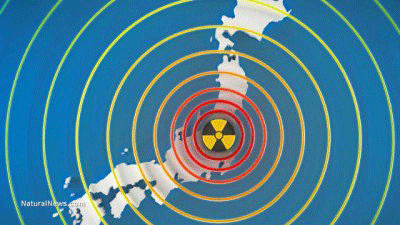
By Global Times, Jul 03, 2023 , https://www.globaltimes.cn/page/202307/1293596.shtml
Japan is making final preparations for dumping nuclear-contaminated wastewater into the sea. According to local media reports, Japan’s nuclear regulator finished inspecting a newly completed system to release radioactive water from the Fukushima Daiichi nuclear plant into the sea, presenting a posture that everything is ready. Rafael Mariano Grossi, director General of the International Atomic Energy Agency (IAEA), will visit Japan from Tuesday to Friday, and the IAEA’s final assessment report on Japan’s dumping plan will soon be released. Will Grossi’s attitude, or the IAEA’s final assessment, change Japan’s decision to dump wastewater into the sea? It seems unlikely.
In fact, the Japanese side officially approved the dumping plan as early as July 22 last year. Since then, it has been working intensively on implementing the plan. At the same time, it has been spending a lot of effort on public relations, never taking seriously of the strong concerns at home and abroad, and failing to conduct adequate and well-intentioned consultations with stakeholders. And the IAEA is being targeted by the Japanese side as a priority in networking. Although the organization cannot give Japan a “license” and a “talisman” for dumping nuclear-contaminated water into the sea, the Japanese side may make an issue of how the IAEA writes its assessment report and draws its conclusions.
We still urge the IAEA to uphold the principles of objectivity, professionalism and impartiality, develop an assessment report that can stand the test of science and history, and not endorse the Japanese side’s dumping plan. Tokyo’s calculation is to force the international community to accept that what’s done is done. Japan hopes that after resisting the pressure for some time, perhaps the international community’s attention will turn to other areas, and the opposition to dumping nuclear-contaminated wastewater into the sea will weaken. We cannot let such a scheme succeed.
Now we need to be particularly vigilant that some governments and the Japanese side have reached a political deal over the issue of the wastewater dumping plan, which is a colluded betrayal of the public interest of mankind and marine ecology. Washington was the first to give Tokyo the green light for geopolitical reasons and then persuaded its other allies. The South Korean government has also started to release ambiguous messages frequently despite strong opposition from the public. To dispel the public’s doubts, some lawmakers from the South Korean ruling party even went to the seafood market in groups to drink seawater from the breeding pond, and “even the fish in the pond found it ridiculous.” Some European governments have also relaxed their attitude over the issue.
There have been concerns, objections, and questions about the discharge of nuclear-contaminated wastewater into the sea from ASEAN countries, Pacific Island countries, and others including Japan. Although the US and Japanese governments have tried to marginalize such voices, they have never disappeared. China’s position as a major power is clear and has remained unchanged. The discharge of nuclear-contaminated wastewater into the sea is a matter of common interest for the international community, not a private matter for Japan. So China urges the Japanese side to stop pushing forward with the dumping plan, effectively dispose of the nuclear-contaminated water in a scientific, safe and transparent manner, and accept strict international supervision. This is a voice from a scientific and all-human perspective, which is justified and couldn’t be alone.
In order to promote the safety of seafood from Fukushima, the Japanese government once attempted to use Fukushima’s seafood in the meals of primary and secondary schools in the prefecture. However, all schools in Fukushima prefecture rejected this proposal. According to reports, content of Cs-137 in fish recently caught in the harbor of the Fukushima Daiichi Nuclear Power Plant is 180 times that of the standard maximum stipulated in Japan’s food safety law, which is extremely alarming.
In this situation, claiming that the contaminated wastewater is safe is nothing but a lie. As officials from Pacific island countries have said, if the so-called “treated water” meets the standards and can be discharged, why doesn’t Japan use this contaminated wastewater in its own country, especially in its agricultural sector?
Japan does have other more appropriate choices. The Japanese government has considered five different treatment options, but it ultimately chose the cheapest and easiest one, which is to discharge the contaminated wastewater into the ocean. From a technical standpoint, this is the solution with the lowest economic cost to Japan, but it releases the highest amount of radioactive substances into the global environment. Japan is unwilling to spend money on safely treating the contaminated wastewater but is willing to invest in public relations. According to recent reports from South Korean media, Japanese officials made political donations worth over EUR 1 million to the staff of the IAEA Secretariat and there has been no response to this matter so far.
According to a German marine scientific research institute, with the world’s strongest currents along the coast of Fukushima, radioactive materials could spread to most of the Pacific Ocean within 57 days from the date of discharge. However, Japan has failed to provide a comprehensive and systematic monitoring plan for the disposal of nuclear-contaminated wastewater into the sea. The current monitoring scope is small, with few sampling points and low frequency, making it difficult to timely detect abnormal situations such as discharging pollutants in levels that exceed the stipulated standards. In short, Japan’s forceful disposal of nuclear-contaminated water into the sea is illegal and violates a series of international legal obligations, constituting a crime against all of humanity. China and the international community’s forces of justice stand together against such behavior and will never compromise or tolerate it.
Japan Set to Pour Fukushima Water Into Pacific, Irking China

- IAEA to give decision on proposal to discharge Fukushima waste
- Ocean isn’t “Japan’s private sewer”: China’s foreign ministry
By Shoko Oda and Isabel Reynolds, July 3, 2023 https://www.bloomberg.com/news/articles/2023-07-02/japan-is-set-to-pour-fukushima-wastewater-into-pacific
Japan is set to win approval to discharge more than a million cubic meters of treated water from the Fukushima nuclear disaster site into the Pacific Ocean, a contentious plan that’s soured ties with neighbors including China.
The International Atomic Energy Agency’s Director General Rafael Grossi will visit Japan from Tuesday to deliver a final report on the safety of the process and meet with officials including Foreign Minister Yoshimasa Hayashi. A domestic nuclear regulator is also set to issue a crucial assessment.
Both studies are poised to give backing to Tokyo Electric Power Co. to begin releasing the water — equivalent in volume to about 500 Olympic-size swimming pools — into the sea, a step that’s needed to allow full decommissioning of the Fukushima site following the 2011 earthquake and tsunami that triggered the world’s worst atomic disaster since Chernobyl.
Japan has assured other nations that the release of the water is safe, is in line with standard industry practice and that it’s necessary, because about 1,000 storage tanks at Fukushima will hit capacity early in 2024. Other countries with nuclear plants already safely discharge similar diluted waste offshore, according to the IAEA.
It also comes as Japan joins a wider global reappraisal of nuclear power, with several nations seeking to boost energy self-sufficiency by reviving idled reactors, adding plants or investing in new technology. Prime Minister Fumio Kishida is aiming to build on improving domestic support for the energy source, and Japan’s efforts to complete the closure of the Fukushima site are seen as a crucial in inspiring confidence.
Despite Japan’s diplomatic push, the discharge plan is complicating some global relationships.
The ocean is “not Japan’s private sewer,” Chinese Foreign Ministry spokesman Wang Wenbin said last month, warning the proposed release carries risks for the country’s neighbors and Pacific Island nations. Wang called it a selfish move “that puts the common interests of all humanity in jeopardy.”
Japanese cosmetics brands have been targeted by a viral campaign tied to the issue that spread unproven safety allegations on Chinese social media platforms. In South Korea, demand for sea salt has rocketed as consumers stockpile the condiment amid worries the release of wastewater could taint future supplies.
While the central government in Seoul hasn’t pushed back against Japan’s plans publicly, a survey by the Yomiuri newspaper and South Korea’s Hankook Ilbo conducted in May found 84% of respondents opposed the discharge. A separate poll found almost three-quarters of South Koreans surveyed didn’t trust a delegation of experts sent from Seoul to review Japan’s preparations.
The Pacific Islands Forum, a group of 18 nations including Fiji, Papua New Guinea and Australia, has urged Japan to consider alternatives and called for additional discussions on the risks.
“People’s fears and uncertainties in the region are real, however safely the release will be handled, and however minimal the risk is,” said Nancy Snow, a reputation security consultant in Tokyo and author of a book on Japan’s public diplomacy. “Their concerns cannot be taken lightly or dismissed.”
Japan announced in 2021 it planned a gradual release of about 1.3 million cubic meters of treated wastewater from the Fukushima Dai-ichi nuclear power plant that has accumulated at the site since 2011. Tepco cycles in water to keep debris and fuel at the wrecked nuclear reactors cool, and the contaminated liquid — along with other groundwater and rain — is processed to remove most radioactive elements. The treated water, which still contains tritium, has been collected and stored.
Tepco expects the fleet of about 1,000 storage tanks to reach maximum capacity between February and June next year and the utility has argued it cannot continue to clear space for additional vessels because that’s needed for other parts of the decommissioning process. Storing the water also carries risks of leaks, which are amplified by the nation’s status as one of the most earthquake-prone countries.
In one of its preliminary reports in April, the IAEA said Tepco had taken into account issues raised in previous safety reviews and had “made significant progress to update its plans,” signaling the agency is likely to grant final approval. Grossi will visit Fukushima during his trip to Japan and open an IAEA office at the site, the agency said Friday.
Tepco plans to mix the treated fluid with seawater to dilute the concentration of tritium to “well below” both Japanese government and World Health Organization guidelines, before discharging it into the ocean over the course of as long as 40 years through an undersea tunnel. Tritium has a radioactive half-life of a little over 12 years, according to the IAEA.
Japan’s government has not yet set any specific date to begin releasing the water, and has said it will continue to hold talks with local communities, including the fishing sector, to try to alleviate their concerns.
Releasing water from nuclear power plants is a standard practice and most operations globally release small amounts of tritium and other radioactive material into rivers and oceans, the IAEA said previously.
— With assistance by Ben Westcott
IAEA debunks Ukrainian claim about Europe’s largest nuclear plant
https://www.rt.com/russia/578480-iaea-zaporozhye-nuclear-mines/ 26 June 23
There are no mines at the cooling pond of the Zaporozhye NPP, the UN watchdog has said
Rafael Mariano Grossi, the director-general of the International Atomic Energy Agency (IAEA), denied on Tuesday claims made by the Ukrainian government that the cooling pond of the Zaporozhye Nuclear Power Plant (ZNPP) had been rigged with explosives.
“The IAEA is aware of reports of mines having been placed near the cooling pond. No mines were observed at the site during the Director General’s visit, including the cooling pond,” Grossi said in a report on the situation at Europe’s largest atomic power facility.
There were mines outside the perimeter and “at particular places inside,” which the security personnel at ZNPP explained were for defensive purposes, the IAEA head said.
“Our assessment of those particular placements was that while the presence of any explosive device is not in line with safety standards, the main safety functions of the facility would not be significantly affected,” added Grossi.
His report comes after claims by Ukrainian President Vladimir Zelensky and his aide Mikhail Podoliak that Russia had prepared a “terrorist attack” on the facility it has controlled since March 2022.
Ukrainian intelligence has received information that Russia is planning “a terrorist attack with radiation leakage,” Zelensky said in a tweet on Thursday morning, adding that “the world has been warned, so the world can and must act.”
Podoliak claimed that Russia was “considering a large-scale terrorist attack at the ZNPP to stop the Ukrainian counteroffensive and create a depopulated sanitary gray zone,” and was mining the cooling pond, demanding that “the global world” should announce consequences “not tomorrow. Today.”
Zelensky’s claims are “yet another lie,” Kremlin spokesman Dmitry Peskov said on Thursday, noting that Russia has fully cooperated with the IAEA. Moscow has insisted that Kiev was behind the destruction of the Kakhovka dam earlier this month, which the IAEA described as a potential threat to the ZNPP’s supply of cooling water.
According to Russia, Ukraine has also repeatedly attacked the ZNPP, including an attempted commando raid in September 2022, as the IAEA mission was en route to the site. The most recent attack was on June 9, when Russian air defenses reported bringing down three drones headed for the plant.
The Zaporozhye Nuclear Power Plant has six reactors and is located in Energodar, on the right shore of the Dnieper River. It is currently operated by Rosatom in standby mode. The surrounding region officially became part of Russia last September.
Small nuclear reactors are unaffordable, and Rafael Grossi and the IAEA know this!

Minireactor cost surge threatens nuclear’s next big thing, BY JONATHAN TIRONE, (BLOOMBERG), Japan Times 2 July 23
High inflation and rising interest rates are driving up the cost of a new generation of miniature atomic reactors that the nuclear industry is relying on to lift sales and help meet climate targets.
Nuclear-company executives and regulators met this week at the International Atomic Energy Agency to negotiate potential manufacturing and technology standards, a key step the industry needs to take in order to make prices competitive with other emissions-free energy sources. There are currently more than 80 unique small modular reactor, or SMR, designs under development, resulting in sprawling supply chains and caps on scaling up production.
“With higher interest rates to deal with and inflation pushing up the cost of steel, copper wire and just about everything else that goes into building an SMR, we know that even the most promising projects are having to tell their investors and buyers that prices have risen substantially,” IAEA Director General Rafael Mariano Grossi said at the meeting in Vienna. “Avoiding, or at least mitigating, cost rises and delays is now even more crucial.”………………
Nuclear energy costs in the U.S. currently level out to an average of $373 a megawatt hour, according to the latest estimates by BloombergNEF. That’s significantly higher than solar or onshore wind at $60 and $50 a megawatt hour, respectively.
Enter companies like NuScale Power Corp., the first U.S. SMR developer with a licensed design, and which wants to begin generating at the end of the decade. NuScale originally foresaw average generation costs of $55 a megawatt hour in 2016, which was slightly lifted to $58 five years later.
But new estimates show costs surged to almost $120 a megawatt hour this year, according to company data analyzed by the Institute for Energy Economics. Skyrocketing prices of commodities including steel, carbon fiber and copper drove the increase, according to the report. NuScale’s stock has tumbled a third a third this year………..
The IAEA’s Grossi chided delegates that they need to work together to develop industry standards, lest they contribute to the industry’s “reputation of unfulfilled promises.” https://www.japantimes.co.jp/news/2023/07/03/business/mini-nuclear-reactor-cost-surge/
Even the science engineering big-wigs don’t seem too enthusiastic about nuclear fusion

Nuclear fusion breakthrough: Decades of research are still needed before fusion can be used as clean energy, The Conversation June 28, 2023, Kristen Schell Assistant Professor, Mechanical and Aerospace Engineering, Carleton University. Ahmed AbdullaAssistant Professor, Mechanical and Aerospace Engineering, Carleton University
“…………………………………………….. The efficiency of a potential fusion energy power plant remains to be seen. The reported fusion net gain actually required about 300 megajoules of energy input, which was not included in the energy gain calculation. This energy input, needed to power 192 lasers, came from the electric power grid.
In other words, the experiment used as much energy as the typical Canadian household does in two days. In doing so, the fusion reaction output enough energy to light just 14 incandescent bulbs for an hour.
The same is true of nuclear fission, which is the reaction inside current nuclear power plants. The complete fission of one kilogram of Uranium-235 — the fissile component of nuclear fuel — can generate about 77 terajoules. But we cannot convert all of that energy into useful forms like heat and electric power.
Instead, we have to engineer a complex system that can control the nuclear fission chain reaction and convert the generated energy into more useful forms.
This is what nuclear power plants do — they harness the heat generated during nuclear fission reactions to make steam. This steam drives a turbine connected to an electric power generator, which produces electricity. The overall efficiency of the cycle is less than 40 per cent.
In addition, not all of the uranium in the fuel is burned. Used fuel still contains about 96 per cent of its total uranium, and about a fifth of its fissile Uranium-235 content.
Increasing the amount of uranium spent in our current fleet is possible — it’s an ongoing sphere of work — but it poses enormous engineering challenges. The huge energy potential of nuclear fuel is currently mitigated by the engineering challenges of converting that energy into a useful form.
From science to engineering
Until recently, fusion has been seen primarily as a scientific experiment, not as an engineering challenge. This is rapidly changing and regulators are now investigating how deployment might unfold in the real world.
Regardless of the efficiency of a future fusion power plant, taking energy conversions from basic science to the real world will require overcoming a multitude of challenges………………….
The science of fusion energy, as with nuclear fission, is rooted in efforts to develop nuclear weapons. Notably, several nuclear physicists who helped develop the nuclear bomb wanted to “prove that this discovery was not just a weapon.”
The early history of nuclear power was one of optimism — of declarations the technology would advance and be able to meet our need for ever-increasing amounts of energy. Eventually, fusion power would come along and electricity would become “too cheap to meter.”
Lessons learned
What have we learned over the past 70 years since the onset of nuclear power? First, we’ve learned about the potentially devastating risk of technology lock-in, which occurs when an industry becomes dependent on a specific product or system.
Today’s light-water fission reactors — reactors that use normal water as opposed to water enriched with a hydrogen isotope — are an example of this. They were not chosen because they were the most desirable, but for other reasons.
These factors include government subsidies that favoured these designs; the U.S. Navy’s interest in developing smaller-scale pressurized water reactors for submarines and surface warships; advances in uranium enrichment technology as a result of the U.S. nuclear weapons program; uncertainties regarding nuclear costs that led to the assumption that large light-water reactors are simply scaled-up versions of smaller ones; and conservatism regarding design choices given the high costs and risks associated with nuclear power development.
We have been struggling to move to other technologies ever since……………………………………………
Large infrastructure projects are extremely complex systems that rely on enormous work forces and co-ordination. They can be managed, but they usually go over-budget and fall behind schedule. Modular technologies exhibit better affordability, cost control and economies, but micro and small nuclear reactors will also be economically challenged.
……………………………………………….. Fusion reactors generate large amounts of waste, though not the same kind fission does.
………………………………………..Billions of dollars are needed to advance nuclear fission technology, and we have far more experience with fission than with fusion. An appetite for funding must be demonstrated by governments, electric utility companies and entrepreneurs……………….. https://theconversation.com/nuclear-fusion-breakthrough-decades-of-research-are-still-needed-before-fusion-can-be-used-as-clean-energy-196758
2 important Russo Ukraine war stories: 1 covered 24/7; 1 covered up

It would be so nice for me to think (as a good, genuinely conservative, Christian Westerner and patriotic Australian) , – that this Walt Zlotow story is a pack of lies, (obviously from a paid stooge of Putin)
My problem is: that everything that I see, read, hear, on Australian corporate media and the Australian Broadcasting Corporation – just happens to tally with what he is saying.
Good on Walt Zlotow for having the guts to speak out.
I’m just sorry that I think that he is not going to be believed. The end result? We might find a small group of (?)wealthy individuals presiding over a nearly dead planet.

Walt Zlotow West Suburban Peace Coalition, Glen Ellyn IL 27June 23
Mainstream news got the figurative memo from the US State Dept. and military Friday: Full media press coverage of the mini insurrection against Russian President Putin that could potentially have toppled him. But not one word on the apparently failing Ukrainian counteroffensive the US was counting on before even considering negotiations to end the 17 month war.
That coverage simply continues the 487 days of media compliance with US not so subtle demands that the war be reported as Ukraine largely defeating a Russia hopelessly unable to secure control of Donbas and keep NATO off its doorstep.
If the American people were informed on Ukraine’s near complete inability to repel the Russian invaders, they might push back against the squandering of over a hundred billion dollars in US treasure on a futile cause not affecting US national security in the least.
If they knew we’re sending cluster bombs, prohibited by most countries, that can kill long after the war ends, if ever, they might call for negotiations, not more weapons.
If they knew we’re sending long range missiles to strike deep in Russia, possibly triggering nuclear confrontation, they might protest this madness.
But most Americans don’t know any of this. Like the apparently failing Ukrainian offensive, only good news, justifying America’s ghoulish demand this war goes on endlessly, gets on mainstream news.
If the US had that insane approach to diplomacy and negotiations during the Cuban Missile Crisis, we wouldn’t be having this discussion. We’d have all been blown away 61 years ago. more at https://www.antiwar.com/blog/author/walt_zlotow/
Charming optimism, as a Japanese non-profit group plans for bunkers for the community to be OK in a nuclear war.

2 NPO pushes nuclear bunkers in Japan amid growing security threats
TSUKUBA
Amid growing security concerns over Russia’s nuclear threat and North Korea’s missile ambitions, a nonprofit organization in Japan has built a model nuclear shelter near Tokyo to raise awareness and encourage people to consider digging a doomsday bunker of their own.
While not yet open to the public, the underground concrete structure opened on May 10 in a parking lot opposite the Japan Nuclear Shelter Association’s office in Tsukuba, Ibaraki Prefecture. It has already hosted about 40 tours by construction professionals, national and local politicians, government agencies and the media.
The association says it aims to see shelters built in Japan to established standards. Interest in its activities has exploded last year, it said, with its membership rising from just two companies to around 30 in over a year.
“We were thinking about building this even before the (Russian) invasion of Ukraine, but decided we really had to from spring last year,” said director Takahiro Kawashima.
The facility is built to specifications from Switzerland, where 1960s legislation at the height of the Cold War required shelters be made available to all citizens.
The structure can withstand a blast like the 1945 atomic bombings of Hiroshima and Nagasaki, provided it is just under a kilometer or more from the explosion’s center, according to the association.
It says the underground shelter can house a family of four adults, three children and one pet for a maximum of two weeks. While the entire space is about 48 square meters, its living area is around 25.6 square meters……………………………….
it remains unclear how much a system like the one the association is showcasing would cost if it became a national standard.
Construction of the model shelter came in at a total of around 40 million yen ($277,000) to build and outfit but the organization maintains that a more standard price would be around 20 to 30 million yen per unit, not inclusive of the land on which it is constructed…… https://japantoday.com/category/national/npo-pushes-nuke-bunkers-in-japan-amid-growing-security-threats
Japan’s nuclear regulator finishes inspection of Fukushima radioactive wastewater release system
Japan’s nuclear regulator has finished inspecting a newly completed system to release radioactive wastewater from the crippled Fukushima Daiichi nuclear power plant into the sea, local media reported.
The Nuclear Regulation Authority (NRA) checked for leaks and other abnormalities on Friday by passing water through the system and inspected the emergency shut-off valves to make sure they function properly, public broadcaster NHK reported.
NRA officials have reported no particular problem with the facility’s overall performance. The nuclear regulatory body is due to draw up a report on the results in about a week, it said.
If the NRA issues a certificate to the plant’s operator Tokyo Electric Power Company (TEPCO), the system will be ready to operate, it added.
The NRA wrapped up three days of final on-site inspections on Friday. TEPCO completed the construction of the wastewater discharge system on Monday.
Despite continuous opposition from its neighbors and the Pacific Island Countries, Japan has been rushing to carry out its plan of dumping treated radioactive wastewater from the crippled Fukushima nuclear power plant into the Pacific.
What to know about Japan’s plan to release treated radioactive water from Fukushima nuclear plant into the sea
- The plan to dump treated radioactive waste water from a nuclear plant into the sea has stirred debates in South Korea, and led to boycotts of Japanese goods in China
- Japanese fishermen, whose livelihoods could be severely impacted, have also vehemently opposed the waste water disposal plan
Babbling about Prigozhin (and “the end of Putin”
There was much breathless, excited pontification about the end of Putin, despite the obvious fact that this insurrection had failed in its tracks.
June 27, 2023, by: Dr Binoy Kampmark https://theaimn.com/babbling-about-prigozhin/
A lot of nonsense is being spouted by a bevy of spontaneous “Russian experts” in light of the Prigozhin spray, a mutiny (no one quite knows what to call it), stillborn in the Russian Federation. It all fell to the theatrical sponsor, promoter and rabble rouser Yevgeny Prigozhin, a convict who rose through the ranks of the deceased Soviet state to find fortune and security via catering, arms and Vladimir Putin’s support.
In the service of the Kremlin, Prigozhin proved his mettle. He did his level best to neutralise protest movements. He created the Internet Research Agency, an outfit employing hundreds dedicated to trolling for the regime. Such efforts have been apoplectically lionised (and vilified) as being vital to winning Donald Trump the US presidency in 2016.
His Wagner mercenary outfit, created in the summer of 2014 in response to the Ukraine conflict, has certainly been busy, having impressed bloody footprints in the Levant, a number of African states, and Ukraine itself. Along the way, benefits flowed for the provision of such services, including natural resource concessions.
But something happened last week. Suddenly, the strong man of the mercenary outfit that had been performing military duties alongside the Russian Army in Ukraine seemed to lose his cool. There were allegations that his men had been fired upon by Russian forces, a point drawn out by his capture of the 72nd Motorised Rifle Brigade commander, Lieutenant Colonel Roman Venevitin. Probably more to the point, he had found out some days earlier that the Russian Defence Ministry was keen to rein in his troops, placing them under contractual obligations. His autonomous wings were going to be clipped.
The fuse duly went. Prigozhin fumed on Telegram, expressing his desire to get a number of officials, most notably the Defence Minister, Sergei Shoigu, and Chief of the General staff Valery Gerasimov, sent packing. A “march for justice” was organised, one that threatened to go all the way to Moscow.
President Vladimir Putin fumed in agitation in his televised address on June 24, claiming that “excessive ambition and personal interests [had] led to treason, to the betrayal of the motherland and the people and the cause.” Within hours, Belarussian President Alexander Lukashenko, whose diplomatic skills are threadbare, had intervened as mediator, after which it was decided that the Wagner forces would withdraw to avoid “shedding Russian blood.”
This all provided some delicious speculative manna for the press corps and commentariat outside Russia. Nature, and media, abhor the vacuum; the filling that follows is often not palatable. There was much breathless, excited pontification about the end of Putin, despite the obvious fact that this insurrection had failed in its tracks. John Lyons of the Australian Broadcasting Corporation was aflame with wonder. Where, he wondered, was the Russian President? Why did the Wagner soldiers “get from Ukraine to Rostov, take control of Ukraine’s war HQ then move to Voronezh without a hint of resistance”?
John Lough of Chatham House in London claimed that Putin had “been shown to have lost his previous ability to be the arbiter between powerful rival groups.” His “public image in Russia as the all-powerful Tsar” had been called into question. Ditto the views of Peter Rutland of Wesleyan University, who was adamant in emphasising Putin’s impotence in being “unable to do anything to stop Prigozhin’s rogue military unit as it seized Rostov-on-Don,” only to then write, without explaining why, about uncharacteristic behaviour from both men in stepping “back from the brink of civil war.”
-ADVERTISEMENT-
Then came the hyperventilating chatter about nuclear weapons (too much of the Crimson Tide jitters there), the pathetic wail that accompanies those desperate to fill both column space. The same degree of concern regarding such unsteady nuclear powers as Pakistan is nowhere to be seen, despite ongoing crises and the prospect of political implosion.
Commentors swooned with excitement: the Kremlin had lost the plot; the attempted coup, if it could even be called that, had done wonders to rattle the strongman. Those same commentators could not quite explain that Prigozhin had seemingly been rusticated and banished to Belarus within the shortest of timeframes, where he is likely to keep company with a man of comparatively diminished intellect: Premier Lukashenko himself. Prigozhin, for all his aspirations, has a gangster’s nose for a bargain, poor or otherwise.
As Kremlin spokesman Dmitry Peskov put it, the original criminal case opened against Prigozhin for military mutiny by the Kremlin would be dropped, while any Wagner fighters who had taken part in the “march for justice” would not face any punitive consequences. Those who had not participated would be duly assimilated into the Russian defence architecture in signing contracts with the Defence Ministry.
The image now appearing – much of this subject to redrawing, resketching, and requalifying – is that things were not quite as they seemed. Assuming himself to be a big-brained Wallerstein of regime stirring clout, Prigozhin had seemingly put forth a plan of action that had all the seeds of failure. Britain’s The Telegraph reported that “the mercenary force had only 8,000 fighters rather than the 25,000 claimed and faced likely defeat in any attempt to take the Russian capital.”
Another reading is also possible here, though it will have to be verified in due course. Putin had anticipated that this contingently loyal band of mercenaries was always liable to turn, given the chance. Russia is overrun with such volatile privateers and soldiers of fortune. Where that fortune turns, demands will be made.
Ultimately, in Putin’s Russia, the political is never divorceable from the personal. Chechnya’s resilient thug, Ramzan Kadyrov, very much the prototypical Putin vassal only nominally subservient, suggests that this whole matter could be put down to family business disputes. “A chain of failed business deals created a lingering resentment in the businessman, which reached its peak when St. Petersburg’s authorities did not grand [Prigozhin’s] daughter a coveted land plot.” The big picture, viewed from afar, can be very small indeed.
Italy’s Nuclear Energy Debate: Past, Present, and Future
Note that Italy has actually held 2 referendums about nuclear power, and both resulting in a definite “NO”
It seems that the public, the ordinary people, might have more sense than their leaders?
Italy’s nuclear energy debate has been a long-standing and complex issue, with a history of fluctuating public opinion, political decisions, and technological advancements. The country’s relationship with nuclear power began in the 1960s, when Italy was one of the first European countries to invest in nuclear energy. However, the nuclear debate has evolved significantly over the past few decades, with Italy’s nuclear energy program experiencing a series of stops and starts, ultimately leading to its current state of uncertainty.
……………………………………. Italy held a national referendum in 1987, in which a majority of voters chose to phase out the country’s existing nuclear power plants. By 1990, all four of Italy’s nuclear power plants had been shut down.
………………………………….. In the early 2000s, Italy’s nuclear energy debate re-emerged as a prominent issue, as the country faced growing energy demands and concerns about climate change. In 2008, the Italian government announced plans to resume investment in nuclear power, with the goal of generating 25% of the country’s electricity from nuclear energy by 2030.
……………………………………However, the 2011 Fukushima nuclear disaster in Japan once again shifted public opinion on nuclear energy, reigniting concerns about the safety of nuclear power plants. In response to the disaster, Italy held another national referendum in June 2011, in which a majority of voters chose to maintain the country’s moratorium on nuclear power. As a result, the Italian government abandoned its plans to invest in new nuclear power plants.
Since the 2011 referendum, Italy’s nuclear energy debate has remained a contentious issue,…………………………………………….Opponents argue that the risks associated with nuclear power, particularly in terms of safety and waste disposal, outweigh its potential benefits.
In recent years, Italy has made significant investments in renewable energy sources, such as solar and wind power, in an effort to diversify its energy mix and reduce its reliance on imported energy. However, the question of whether nuclear power should play a role in Italy’s energy future remains unresolved………………….. https://www.energyportal.eu/news/italys-nuclear-energy-debate-past-present-and-future/45044/
Hanford nuclear waste site has a clean-up bill of 560 billion USD in Washington DC
2 as reported by the New York Times (June 1, 2023).
The Hanford site will never be fully decontaminated and will remain indefinitely.
Selected quotes:
“But construction of a five-story, 137,000 square-foot chemical treatment plant for the task was halted in 2012 — after an expenditure of $4 billion — when it was found to be riddled with safety defects. The naked superstructure of the plant has stood in mothballs for 11 years, a potent symbol of the nation’s failure, nearly 80 years after the Second World War, to deal decisively with the atomic era’s deadliest legacy.”
“Leaders of the Yakama Nation, an 11,000-member tribe whose ancestral lands once included the Hanford site, say their 1855 treaty promised that tribe members would have the right to hunt and fish on healthy lands.”
“Before the Manhattan Project, there was a handshake agreement that this area would be returned to the way it was,” said Trina Sherwood, a cultural specialist in the tribe’s natural resources department. “How can we agree to leave the poison in the land?”
“Yet returning the land to what it once was is an outcome that almost no one expects.”
“There are parts of the site that will never be turned over,” Mr. Vance, the Hanford site manager, said. “We are going to be here a long time.”
New York Times Article, Published June 1, 2023
By Ralph Vartabedian, Reporting from Richland, Wash. May 31, 2023
Sweden goes for small nuclear reactors, dumps renewable energy plans

Sweden dumps renewables target as it seeks more nuclear power, Sydney Morning Herald, By Rob Harris, June 29, 2023
London: Sweden’s parliament has dumped its 100 per cent renewable target amid ongoing concerns about short-term energy security as it looks to join several European nations to build new nuclear plants.
The country’s governing centre-right coalition, headed by Moderate Party Prime Minister Ulf Kristersson, recently joined 11 fellow European Union members in an informal group of member states called the Nuclear Alliance, with the objective to strengthen cooperation in energy generation…………………………………………………………..
Vattenfall, Sweden’s state-owned utility, plans to build at least two small modular reactors and extend the lifetime of the country’s existing nuclear reactors. https://www.smh.com.au/world/europe/sweden-dumps-renewables-target-as-it-seeks-more-nuclear-power-20230629-p5dkae.html
1 This Month
Chernobyl: The Lost Tapes – A good documentary on Chernobyl on SBS available On Demand for the next 3 weeks– https://www.sbs.com.au/ondemand/tv-program/chernobyl-the-lost-tapes/2352741955560

of the week–London Campaign for Nuclear Disarmament

Tell the Ukrainian Government to Drop Prosecution of Peace Activist Yurii Sheliazhenko
To see nuclear-related stories in greater depth and intensity – go to https://nuclearinformation.wordpress.com
-
Archives
- April 2026 (139)
- March 2026 (251)
- February 2026 (268)
- January 2026 (308)
- December 2025 (358)
- November 2025 (359)
- October 2025 (376)
- September 2025 (257)
- August 2025 (319)
- July 2025 (230)
- June 2025 (348)
- May 2025 (261)
-
Categories
- 1
- 1 NUCLEAR ISSUES
- business and costs
- climate change
- culture and arts
- ENERGY
- environment
- health
- history
- indigenous issues
- Legal
- marketing of nuclear
- media
- opposition to nuclear
- PERSONAL STORIES
- politics
- politics international
- Religion and ethics
- safety
- secrets,lies and civil liberties
- spinbuster
- technology
- Uranium
- wastes
- weapons and war
- Women
- 2 WORLD
- ACTION
- AFRICA
- Atrocities
- AUSTRALIA
- Christina's notes
- Christina's themes
- culture and arts
- Events
- Fuk 2022
- Fuk 2023
- Fukushima 2017
- Fukushima 2018
- fukushima 2019
- Fukushima 2020
- Fukushima 2021
- general
- global warming
- Humour (God we need it)
- Nuclear
- RARE EARTHS
- Reference
- resources – print
- Resources -audiovicual
- Weekly Newsletter
- World
- World Nuclear
- YouTube
-
RSS
Entries RSS
Comments RSS
 nuclear-news