Workers, residents, at US site that made Nagasaki A-bomb’s plutonium, are still suffering
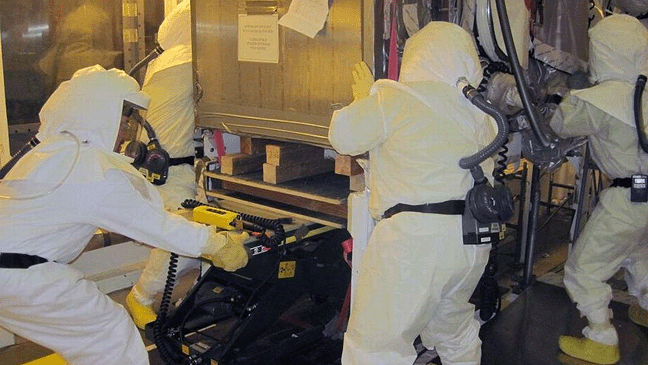
after he and a local journalist conducted a survey on surrounding farms in 1985, Bailie began to have doubts. Nearly all the families living nearby suffered from cancer, birth defects, or thyroid disease, he says — health issues that could be attributed to radiation exposure. This led to the area being coined “the death mile” by some journalists at the time.
documents that were declassified in the late 1980s showed that Hanford had contaminated the surrounding farmland, air, farm animals, and crops with unsafe levels of radiation for years.
June 18, 2023 , Mainichi, Japan
HANFORD, Washington (Kyodo) — As cleanup efforts continue in Washington state at a decommissioned U.S. nuclear facility that played a crucial role in the country’s acquisition of the atom bomb in World War II, questions linger over whether the site has caused serious health issues for workers and local residents.
Construction began on the facility, known as the Hanford site, eighty years ago in 1943 and involved the building of the world’s first large-scale nuclear reactor.
Through the Manhattan Project, a U.S. government research and development program for building nuclear weapons, the site’s B reactor, erected on a 580-square-mile stretch of land next to the Columbia River in south-central Washington, produced the nuclear material for one of the only two atomic bombs ever used in an armed conflict.
Codenamed “Fat Man,” the device was detonated over the city of Nagasaki in southwestern Japan on Aug. 9, 1945, effectively ending Japan’s involvement in the conflict.
The 6.2 kilograms of plutonium contained in the nuclear device released energy equivalent to 21 kilotons of TNT, taking the lives of tens of thousands of innocent people while subjecting the surrounding area to deadly radiation, killing countless more.
But citizens of Nagasaki may not be the only victims of Hanford’s plutonium production. During its decades of operation, U.S. residents living near and mainly downwind of the complex experienced severe health effects that they believe stem from the site’s activities.
One such resident is Tom Bailie, 76, who grew up and still resides just miles downwind from Hanford in a farming community.
Reflecting on his upbringing, Bailie recalled during an interview in April that no one ever thought the site at Hanford would cause harm to “patriotic American citizens.”
But, after he and a local journalist conducted a survey on surrounding farms in 1985, Bailie began to have doubts. Nearly all the families living nearby suffered from cancer, birth defects, or thyroid disease, he says — health issues that could be attributed to radiation exposure. This led to the area being coined “the death mile” by some journalists at the time.
Bailie said that his wife, father, and three uncles all had cancer before passing away, while his two sisters also have cancer and take thyroid medicine. The year before Bailie was born, his mother had a stillbirth. Bailie himself was born with birth defects and was on an iron lung when he was 4 years old. He now requires medication for a thyroid problem.
Bailie vividly remembers encounters with “men in space suits,” equipped with dosimeters to measure radiation levels, walking on his farm. The men would collect soil samples and even ask the farmers to send the heads and feet of ducks and rabbits they would kill while hunting to Hanford for analysis.
When he began speaking out about the hardships and health problems that he attributed to the Hanford site, many people from the community dismissed him as “nuts” or “crazy.” Some even mockingly referred to him as the “glow-in-the-dark farmer.”
But documents that were declassified in the late 1980s showed that Hanford had contaminated the surrounding farmland, air, farm animals, and crops with unsafe levels of radiation for years…………………….
Before being decommissioned in 1989, Hanford produced around 74 tons of plutonium, nearly two-thirds of all the plutonium produced for government purposes in the United States. One of the consequences of the site’s work was massive amounts of contamination and dangerous leftover byproducts, most of which remain on the site today.
Currently, 177 underground tanks containing 56 million gallons of highly radioactive waste, contaminated buildings, and cocooned reactors still exist there, alongside multiple other buried waste sites.
The same year Hanford was decommissioned, cleanup efforts began for dealing with the dangerous byproducts left over from the production of plutonium. Efforts to clean the area of waste are anticipated to be astronomically costly and time-consuming.
According to Hanford’s latest estimate, released in 2022, the total cost of the cleanup is projected to range from $319.6 billion to $660 billion, with a completion date not expected until at least fiscal 2078.
But Tom Carpenter, 66, former head of Hanford Challenge, a nonprofit organization dedicated to ensuring the responsible and safe clearing of the Hanford site, argues that using the word “cleanup” is misleading.
Carpenter says complete eradication of contamination from thousands of acres is impossible, and not the goal of the cleanup process. He asserts that the best that can be achieved at Hanford is “the mitigation of some risks.”
Hanford Challenge’s primary goal, he says, is to ensure authorities prioritize a swift cleanup and make sure that no corners are cut, nor workers put in unnecessary danger. This includes fighting for those who are currently working on the site.
Many workers involved in the cleanup of the Hanford site continue to be exposed to toxic chemicals, vapors, and radioactive materials, resulting in debilitating health conditions.
A recent survey of the workers by Washington state revealed more than 50 percent of them had been exposed to radioactive or toxic chemicals. Workers exposed to these dangerous materials and vapors have developed beryllium disease, cancers, organ damage, and occupational dementia.
Until recently, these workers had to prove that their health issues were directly caused by their work at the Hanford site to receive assistance with their medical expenses.
According to former worker and Hanford Challenge director Jim Millbauer, 65, proving this was extremely difficult, costly, time-consuming, and often fruitless, as most occupational illness claims were rejected.
But a recent law has changed this, presuming that any health effects suffered by workers who spend just eight hours working at Hanford are caused by working at the facility, making it easier for sick workers to get their treatment paid for. https://mainichi.jp/english/articles/20230616/p2g/00m/0in/069000c
Putin warns NATO over being drawn into Ukraine war
By Zahid Mahmood, CNN, June 17, 2023
Russian President Vladimir Putin has warned there is a “serious danger” of NATO being drawn further into the Ukraine war if members of the alliance continue to supply military weaponry to Kyiv.
“NATO, of course, is being drawn into the war in Ukraine, what are we talking here,” Putin said at the St. Petersburg International Economic Forum on Friday.
“The supplies of heavy military weaponry to Ukraine are ongoing, they are now looking into giving Ukraine the jets.”
The comment appeared to be a reference to the F-16 fighter jets some members of the NATO alliance are making plans to supply Ukraine with.
NATO, or the North Atlantic Treaty Organization, was formed in the aftermath of World War II to defend Western nations from the Soviet Union [despite USSR being their ally in WW2 !]and the alliance contains a mutual defense clause where an attack on any one member is considered an attack on all. While Ukraine is not a member of NATO, some NATO members have been supplying Kyiv with tanks, armored vehicles and other weaponry – prompting threats of retaliation from Russia.
German Leopard 2 tanks, British Challenger 2 tanks and American Bradley and Stryker vehicles are among the Western equipment that has been sent to Ukraine.
In late April, NATO Secretary-General Jens Stoltenberg said that NATO allies and partners had delivered more than 1,500 vehicles and 230 tanks to the country.
During his speech in St. Petersburg, Putin said Russia had destroyed tanks “including Leopards” at the front lines.
“And if they are based abroad, but used in fighting we’ll see how to hit them, and where we can hit those means that are used against us in fighting,” Putin said.
“This is a serious danger of further drawing NATO into this military conflict,” he added………………………….. https://edition.cnn.com/2023/06/17/europe/nato-danger-ukraine-war-putin-intl-hnk/index.html
“Radioactive” is compelling viewing
New film spotlights women’s experiences with the Three Mile Island nuclear accident
By Karl Grossman
Radioactive: The Women of Three Mile Island is the title of a newly-released documentary feature film directed, written and produced by award-winning filmmaker Heidi Hutner, a professor of environmental humanities at Stony Brook University, a “flagship” school of the State University of New York.
With greatly compelling facts and interviews, she and her also highly talented production team have put together a masterpiece of a documentary film.
It connects the proverbial dots of the 1979 Three Mile Island nuclear plant disaster—doing so brilliantly.
The documentary has already received many film awards and has had a screening in recent months in New York City—winning the “Audience Award for Best Documentary” at the Dances With Films Festival—and Harrisburg, Pennsylvania; Sarasota, Florida; Dubuque, Iowa; Long Island, New York; First Frame International Film Festival in New York City; the Environmental Film Festival in Washington D.C., and is soon the featured film at Kat Kramer’s #SHEROESForChange Film Festival in Los Angeles and the Cinequest Film Festival in San Jose, California, as well as the Uranium Film Festival in Rio de Janeiro in Brazil. And there will be tours across the U.S.
Resident after resident of the area around Three Mile Island is interviewed and tells of widespread cancer that has ensued in the years that have followed the accident—a cancer rate far beyond what would be normal. Accounts shared in the documentary are heartbreaking.
A whistleblower who had worked at the nuclear plant tells Hutner of the deliberate and comprehensive attempt by General Public Utilities, which owned TMI, to cover up the gravity of the accident and its radioactive releases, especially of cancer-causing Iodine-131 and Xenon 133.
An attorney, Lynne Bernabei, involved in litigation in the wake of the accident, says the Three Mile Island “cover-up was one of the biggest cover-ups in history.” Meanwhile, the U.S. Nuclear Regulatory Commission which is “supposed to protect the public” has then and since been just “interested in is promoting the [nuclear] industry. This is corrupt,” says attorney Joanne Doroshow, now a professor at New York Law School and director of the Center for Justice & Democracy. Many examples of this are presented.
The documentary’s focus on women includes women being far more at risk to the effects of radioactivity than men. Mary Olson, a biologist, founder, and director of the Gender & Radiation Impact Project, says in the film that those setting radiation standards in the U.S. from the onset of nuclear technology in 1942, based impacts on a “25 to 30 years-old” male “defined as Caucasian.” She said, “It has come to be known as the ‘Reference Man.” However, Olson cites research findings that “radiation is 10 times more harmful to young females” and “50 percent more harmful to a “comparable female” than it is to “Reference Man” who is “more resistant” to radioactivity than a woman.
There’s the scientist Dr. Aaron Datesman, who is now pursuing a major chromosomal study regarding the impact of the disaster on the health of people in the area and how people have been harmed despite the denials of the nuclear industry. This study is based on his recent ground-breaking work, “Radiological Shot Noise,” in Nature.
And more and more…………………………………………………………………………. more https://beyondnuclearinternational.org/2023/06/18/radioactive-is-compelling-viewing/—
More trouble at Vogtle
June 19, 2023 https://beyondnuclear.org/more-trouble-at-vogtle/
The nuclear drumbeaters ignore stories like this latest setback out of Georgia because the inconvenient truth of nuclear power is that it is NOT reliable, is far too slow and expensive and of course comes with a myriad of safety problems and no solution to the radioactive waste it generates.
The only US flagship for new reactors is the Vogtle 3 and 4 project in Georgia, which continues to stutter and stumble as it tries to bring two AP 1000 reactors to life, already heralded as a “milestone” with neither reactor yet on line.
Vogtle 3 has already had several setbacks delaying its commercial operation. The most recent is a problem in the hydrogen system that is used to cool its main electrical generator, delaying operations until July (barring other problems that could still arise.)
The twin reactor project is already 16 years in the making and now at least $20 billion over budget. Despite all this and the nuclear poster child for risk that is the 6-reactor Zaporizhzhia nuclear power plant in Ukraine, embroiled in a war, the pro-nuclear propaganda machine rolls blindly on.
“……………………………………In Georgia, almost every electric customer will pay for Vogtle. Georgia Power’s 2.7 million customers are already paying part of the financing cost and elected public service commissioners have approved a monthly rate increase of $3.78 a month for residential customers as soon as the third unit begins generating power.
A July operation date means that increase would hit bills in August, two months after residential customers see a $16-a-month increase to pay for higher fuel costs. Georgia Power also raised rates by 2.5% in January after commissioners approved a separate three-year rate plan. Increases of 4.5% will follow in 2024 and 2025 under that plan.
Commissioners will decide later who pays for the remainder of the costs of Vogtle, including the fourth reactor.
Japan urged to halt release of toxic water
By Xu Weiwei in Hong Kong and Karl Wilson in Sydney, China Daily : 2023-06-19
Impact of Fukushima nuclear plant discharge plan seen as catastrophic
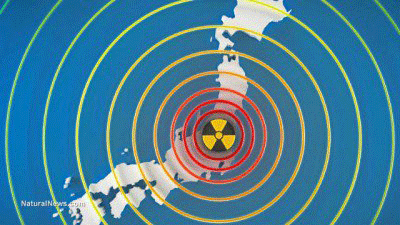
Environmental and social experts from across Asia have called on Japan to refrain from contaminating the sea with radioactive wastewater after it began test running the equipment to discharge toxic water from a crippled nuclear power plant into the Pacific.
The nuclear-contaminated wastewater from the Fukushima Daiichi Nuclear Power Plant will contain traces of tritium, a radioactive isotope, and possibly other radioactive traces such as carbon-14, scientists said.
“Nobody wants to dump (radioactive substances) into the ocean,” said David Krofcheck, senior lecturer in the faculty of science at the University of Auckland in New Zealand.
“We need to be aware of the difference between tritium and carbon-14, on one hand, and the radioactive fission products which tend to remain in the human body,” he said, adding that tritium could still enter the food chain throughout its buildup in underwater plants.
“This organically bound tritium still decays with a half-life of 12.3 years, and it stays in the human body for about 10 days, the biological half-life, before excretion.”
Instead of pumping the wastewater into the sea, Japan can dispose of it safely, Krofcheck said, offering an alternative for managing the Fukushima water: to hold it on site in an ever “growing number of water tanks”.
“If the water is properly filtered to leave only tritium and carbon-14, the natural decay of tritium can be used to reduce its radioactivity.
“Since the radioactive half-life of tritium is 12.3 years, holding the water in tanks for seven half-lives would reduce the tritium content to less than 1 percent of its current value.”
This option still leaves the carbon-14 that would still roughly have the same radioactivity because of its 5,730-year half-life, he said.
The potential impact of releasing treated radioactive water from the Fukushima plant into the ocean remains a subject of contention and concern among stakeholders, said Anjal Prakash, clinical associate professor (research) and research director of the Bharti Institute of Public Policy at the Indian School of Business in Hyderabad.
“The ocean release decision itself has sparked opposition, leading to ongoing debates on alternative water management strategies. The decision-making process weighs safety, public perception, regulations and potential impacts on industries and trade.”
While the Japanese government and the Tokyo Electric Power Company, operator of the crippled plant, say there is minimal risk, differing opinions persist, Prakash said, adding that factors such as ocean currents, distance, dilution and treatment efficacy will determine the impact on neighboring areas, including South Asia, Pacific Island countries, Australia, New Zealand and the rest of the world.
Long-term effects and bioaccumulation concerns remain, he said. “Evaluating the precise impact is complex, necessitating considerations of various factors and ongoing scientific research.”
Despite continuing opposition from domestic experts, civic groups and fishery organizations, Japan has been rushing to dump the nuclear-contaminated water into the ocean, which has also spurred protests from neighboring countries and communities within the Pacific Islands.
Firm opposition
In April the Fijian government reaffirmed its opposition to Japan’s plan to discharge nuclear-contaminated wastewater into the Pacific Ocean.
Fiji’s Deputy Prime Minister Manoa Kamikamica said earlier that the Pacific Ocean should not be seen as an easy and convenient dumping ground for unwanted and dangerous materials and waste that larger countries produce but do not want to use in their own ecosystem, local media reported.
“The social and economic impact of this irresponsible behavior is catastrophic, particularly on our vulnerable communities,” he said.
Environmental groups have argued that the move sets a bad precedent and poses a serious danger to Pacific communities that depend on the ocean for their livelihoods…………….
Many people are asking why, if the wastewater treated by Japan’s Advanced Liquid Processing System is so safe, Japanese are not using such water for alternative purposes, in manufacturing and agriculture for instance.
According to a report issued by Tokyo Electric Power Company on June 5, the radioactive elements in the marine fish caught in the harbor of the Fukushima plant far exceed safety levels for human consumption. In particular, the content of cesium-137, a radioactive element and a common byproduct in nuclear reactors, is said to be 180 times that of the standard maximum stipulated in Japan’s food safety law.
Kalinga Seneviratne, a visiting lecturer at the University of the South Pacific in Fiji, said: “The contamination will affect the South Pacific Nuclear Free Zone Treaty (adopted in 1986) areas as well when it eventually flows there. Also, since fish stocks are migratory, contaminated fish could be caught within the treaty area.”…………………………. https://global.chinadaily.com.cn/a/202306/19/WS648f8421a31033ad3f7bce66.html
“Nuclear is CLEAN” Trumpets Westinghouse’s Uranium Fuel in Cumbrian Press Adverts
Name: Anita Stirzaker Ad type:Brand/product: Westinghouse Electric Company
Your complaint:
Advert in the Whitehaven News (and other regional papers?) for Westinghouse “Shaping Tomorrow’s Energy to deliver a carbon-free future in the UK. Westinghouse is shaping the future of clean energy in the UK.”
The advert talks about the AP1000 “ready for deployment in the UK” – this is not the case – the AP1000 has not been given licence approval for any sites in the UK as far as I know and there are no operational AP1000 reactors anywhere in Europe as far as I know. The AP1000 would not be “carbon free” as the uranium fuel requires fossil fuel at every stage from mining to looking after the wastes. The Westinghouse plant at Springfields itself uses enormous amounts of gas to manufacture uranium fuel and has I believe its own dedicated gas pipeline into the site. Sellafield is where the fuel from Springfields ends up and this has its own gas plant on site called Fellside. Westinghouse itself in its 2022 Sustainability report (https://www.westinghousenuclear.com/Portals/0/about/Westinghouse%202023%20ESG%20Report.pdf) says it has a “net-zero” carbon emissions target by 2050″ note this is the more slippery accounting of “net-zero” which is definitely not “carbon free” as the advert in the Whitehaven News claims.
The advert claims that Westinghouse is shaping “clean energy”. this is not the case – the Springfields site itself uses lots of freshwater in all its processes – far more I believe than the fracking industry would have done in the Preston area. The fresh water use is enormous especially if the leaching of uranium fuel from the grounds of foreign countries is included along with cooling the hot nuclear wastes at Sellafield.
The nuclear industry cannot legitimately claim to be clean while radioactive and chemical emissions are routinely dumped to the environment. Then there is the possibility of catastrophic accident. What other industries have such large Emergency Zones in the case of accident ? At the lancaster canal alongside the Springfields plant there are Westinghouse notices saying “if you hear a loud, continous siren (like an air-raid siren) you should leave this area as quickly as possible”.
There is another conflicting notice saying “Go inside your boat and stay inside until instructed otherwise. Close all windows and doors. Switch off all heating, ventilation and air conditioning systems. Tune to the local radio station and listen for announcements telling you what to do.”
That is not a “clean” industry!
From Springfields Westinghouse site there are a cocktail of radioactive an chemical wastes going into the landfill at Clifton Marsh – the latest plan is to open an incineration plant on the Westinghouse Springfield site to take in nuclear waste (including intermediate nuclear wastes) from Europe and burn it there.
That is not a “clean” industry.
If Shell has been taken to task for its “clean” claims then the nuclear industry cannot be allowed to get away with this greenwashing of its fossil fuel use alongside its radioactive and chemical emissions to land, rivers,sea and air. The nuclear industry is not fully insured for good reason – it is uninsurable.
Zelensky admits that there was an ongoing civil war prior to the Russian invasion, claims Russia will attack a NATO member
Zelensky Slams Trump for Saying He Would End the War in Ukraine
The Ukrainian leader admitted that there was an ongoing civil war prior to the Russian invasion.
By Kyle Anzalone / Antiwar June 18, 2023
In an interview with NBC News, Ukrainian President Volodymyr Zelensky attacked former President Donald Trump’s pledge to end the war. He argued that if Kiev does not defeat Moscow, Russia will attack a NATO member state and force the US into a direct conflict.
Zelensky was asked about Trump’s claim he would immediately engage the Kremlin in talks and bring the war to a negotiated settlement. “Are they ready to start a war to send their children? Are they ready to die?” he said in the interview that was published on Thursday. “If Russia occupies Ukraine, they will move on to the Baltic countries, to Poland, to any NATO country, and in that particular case the U.S. will have to choose between dismantling NATO or fighting.”
Kiev and hawks in Washington have asserted that Ukraine is a bulwark, protecting members of NATO from Moscow’s expansionist ambitions. However, there is no evidence that the Kremlin eyes attacking another country. Russian President Vladimir Putin views Ukraine as a unique security threat to his county and says seizing territory protects Moscow against the expanding NATO alliance.
Ukraine hopes to be added as a member of the alliance once the war is over. “We need an invitation, and it needs to be clear that after this war, if we are ready, and if the Ukraine army is ready to NATO standards, then after the war we will be invited to join.” Zelensky continued, “It’s very important to hear the truth and not tell us lies.”
In 2008, Ukraine was told it would one day receive full NATO membership. At the time, Moscow denounced the proposal, saying it violated red lines and, from the Russian perspective, would create a significant security threat.
Despite the Russian objections, NATO maintains its doors are open to new members, but Ukraine does not currently meet the requirements. As Kiev is currently at war with Moscow, admitting Ukraine into the alliance will put NATO in direct confrontation with Russia.
At times, Kiev appears to be frustrated with NATO refusing to make a formal commitment to Ukraine. Zelensky is threatening to sit out a coming meeting of the North Atlantic alliance in July because Ukraine will not receive a pledge to become a member at the end of the war.
Zelensky went on to slam Trump, claiming he was unable to end the war in Ukraine while he was in office. “Why didn’t he do that earlier? He was president when the war was going on here,” he explained. “I think he couldn’t do that. I think there are no people today in the world who could just have a word with Putin and end the war.”
The statement appears to be an admission from Zelensky that the war in Ukraine began before the Russian invasion in 2022. Prior to the Russian invasion, Ukraine was embroiled in an eight-year-long civil war. Washington and NATO justify their support for Kiev by saying the Russian invasion was “unprovoked.”
The Minsk Accords were agreed to by Ukraine, Russia, Germany and France with the intention of ending the civil war. However, Zelensky was unable to get neo-nazi paramilitaries fighting for Ukraine to comply with the agreement. In the days before the Russian invasion, there was a surge in fighting between Ukrainian forces and rebels in the Donbas region.
Global biodiversity crisis

Nature is in crisis. Soils are being depleted faster than they can
regenerate, wildlife populations have crashed by two thirds in 50 years,
bird species are vanishing, a quarter of all plant and animal species are
dying out and their rate of disappearance is accelerating.
We are living through the sixth mass extinction in the planet’s history. For the first
time we are the cause. It’s not a distant threat but an immediate one. We
have had our free lunch building, poisoning, extracting, dredging,
harvesting, rapaciously demanding all the natural world can offer us. We
are treating the planet’s life as an infinitely exploitable, adaptable
resource. It isn’t. We are killing the web of growing things on which our
own survival depends.
Times 16th June 2023
https://www.thetimes.co.uk/article/a-thousand-little-acts-can-help-save-nature-0lcflzwgf
Ukraine’s “spring counteroffensive not making progress: will NATO resort to deploying tactical nuclear weapons for Ukraine?
Since the initiation of the United States’ multitrillion-dollar nuclear weapons buildup in 2016, the US has been working to create smaller and lower-yield “usable” nuclear weapons.
Are nuclear weapons the next red line NATO will cross in Ukraine?
Andre Damon @Andre__Damon, 16 June 2023, WSWS
Nearly two weeks in, it is clear that Ukraine’s “spring counteroffensive,” promoted for months by the US media, has made no significant headway, while the Ukrainian armed forces have taken devastating physical losses.
Ukrainian officials claim to have retaken 38 square miles since the start of the offensive. These scraps of territory have been purchased with as many as 1,000 casualties per day, putting the total at up to 12,000 since the start of the offensive. Russian officials have released video of armored vehicles being destroyed by missiles, drones and long-range artillery, including over one dozen advanced Leopard 2 tanks and Bradley infantry fighting vehicles.
For the first year and a half of the conflict, the US and NATO powers have operated on the premise that they could prosecute the war by sending ever more advanced weapons to Ukraine, while letting Ukrainians serve as cannon fodder on the battlefield.
With cold indifference to the catastrophic loss of human life, the Biden administration has sought to fight the war to the last Ukrainian. But the problem with this strategy is that NATO is running out of Ukrainians to send to their deaths.
Hundreds of thousands of Ukrainian soldiers have been killed or injured so far. This is a substantial portion of the fighting-age population, leading the Zelensky government to more desperate measures to find new bodies to throw at the front lines.
Against this backdrop, the defence ministers of NATO countries concluded a two-day summit Friday aimed at finalizing plans for a military alliance between NATO and Ukraine. On Thursday, a Biden administration official told CNN that they are “open” to an accelerated plan for Ukraine to join NATO.
This will be the content of the upcoming NATO summit in Vilnius, Lithuania, whether through Ukraine directly joining NATO or in the form of the provision of “security guarantees.”
The real issue, however, is not Ukraine entering NATO, but NATO “entering” Ukraine through a vast escalation of its involvement in the war. The only reason for accelerating Ukraine’s entry into NATO is to create the framework for such an escalation.
The entire credibility of NATO has been staked on an effort to hurl the Russians over the border, generating a crisis that would lead to the collapse of the Putin government. The logic of escalation leads inexorably to direct NATO intervention in the conflict.
Every time the US and NATO powers have claimed they would not do something in Ukraine, they have gone ahead and done it, from the provision of battle tanks and fighter jets, to weaponry that has been used to attack Russian soil.
What will be the next “red line” that NATO will cross in response to the deteriorating military situation in Ukraine? There are several possibilities:
First, the creation of a “no-fly zone” and the direct engagement of Russian forces by NATO aircraft.
Second, the direct deployment of NATO troops into the war zone.
And third, the deployment or even use of tactical nuclear weapons by NATO to prevent a Russian victory in the conflict.
It is worth noting that during the Cold War, the US geopolitical strategist Henry Kissinger, recently the subject of media adulation on the occasion of his 100th birthday, once described the use of tactical nuclear weapons to avert a disaster precisely like that faced by Ukrainian forces.
In his 1957 book Nuclear Weapons and Foreign Policy, Kissinger argued for the deployment of nuclear weapons in frontline combat and their use on the battlefield by the United States in the struggle to prevent advances by conventional forces.
“Limited nuclear war,” that is, nuclear war that does not lead to global annihilation and “Mutually Assured Destruction,” Kissinger argued, “is in fact a strategy which will utilize our special skills to best advantage, and it may be less likely to become all-out than conventional war.”
He argued that such a war would be “improvised in the midst of military operations [and] would be undertaken under the worst possible conditions, both psychological and military,” i.e., precisely the conditions now developing in Ukraine.
Rather than targeting “the largest centers of population,” Kissinger argued, nuclear weapons could be used as part of warfare “based on small, highly mobile, self-contained units” aimed at “depriving aggression of one of its objectives: to control territory.” He continued, “Small, mobile units with nuclear weapons are extremely useful for defeating their enemy counterparts or for the swift destruction of important objectives.”
There was one overwhelming flaw in Kissinger’s strategy. It assumed that those targeted by US nuclear weapons would restrict their own responses and that escalation would be contained. But for all their evident insanity, Kissinger’s doctrines have, in fact, been a major inspiration for the current US nuclear strategy.
Since the initiation of the United States’ multitrillion-dollar nuclear weapons buildup in 2016, the US has been working to create smaller and lower-yield “usable” nuclear weapons.
A 2015 paper by the Center for Strategic and International Studies (CSIS) noted, “The scenarios for nuclear employment have changed greatly since the ‘balance of terror’ between the two global superpowers.” As a result, the “second nuclear age” involves combatants “thinking through how they might actually employ a nuclear weapon, both early in a conflict and in a discriminate manner.”
In 2019, Foreign Affairs published an article entitled “If You Want Peace, Prepare for Nuclear War” by Elbridge Colby, one of the principal authors of Trump’s 2018 National Defense Strategy. Colby wrote, “The risks of nuclear brinkmanship may be enormous, but so is the payoff from gaining a nuclear advantage over an opponent.
“The best way to avoid a nuclear war,” Colby continued, “is to be ready to fight a limited one.”
The 2022 US Nuclear Posture Review makes clear that the US reserves the right to use nuclear weapons to achieve any kind of national objective. It declares, “Although the fundamental role of US nuclear weapons is to deter nuclear attack, more broadly they deter all forms of strategic attack, assure Allies and partners, and allow us to achieve Presidential objectives if deterrence fails.”
The US and NATO powers have staked their entire credibility on the objective of inflicting a strategic defeat on Russia……………. https://www.wsws.org/en/articles/2023/06/17/bwxw-j17.html
Ukraine sustains massive single-day losses – Russian MOD
https://www.rt.com/russia/578244-ukraine-heavy-casualties-mod/ 19 June 23
Kiev’s forces have lost over 1,000 soldiers and 20 tanks in a single day across the frontlines, the Russian Defense Ministry claims
Ukrainian military forces have sustained heavy casualties across the frontlines during the last 24 hours, the Russian Defense Ministry has said. Russia’s Zaporozhye and Donetsk regions have seen the most intense fighting, with Kiev losing more than 800 soldiers in those regions.
“Over the past day, enemy losses in the Southern Donetsk and Zaporozhye directions amounted to more than 800 Ukrainian servicemen, 20 tanks, four infantry fighting vehicles, [and] 15 armored fighting vehicles,” the military stated on Sunday during a daily media briefing. The ministry did not elaborate on whether its figures for casualties includes those killed and injured or fatalities exclusively.
As well as these setbacks in personnel and equipment, Ukrainian troops also lost two US-made M777 howitzers and several Soviet-made artillery systems, the military added.
The immediate vicinity of Donetsk city has also seen intense fighting, with Ukrainian forces losing over 200 soldiers on this axis, according to the ministry. The Russian military has destroyed multiple soft and armored vehicles on the outskirts of Donetsk, it also said, as well as two major ammunition stockpiles to the northwest of the city.
The ongoing conflict between Russia and Ukraine has intensified after Kiev launched its long-heralded counteroffensive in early June. Thus far, the Ukrainian military has failed to make any major gains, sustaining heavy losses in the process and losing large amounts of Western-supplied hardware. According to the estimates of Moscow’s military, some 7,500 Ukrainian soldiers have been killed or wounded amid the counteroffensive effort.
Week to June 19, in nuclear news

A bit of good news . The ‘lost’ underwater forests that came back from the dead.
Climate. Greta Thunberg: not phasing out fossil fuels is ‘death sentence’ for world’s poor……. . Oil-rich nations dominate COP28 – now offering rich sponsorships, in the effort to silence critics. Fossil fuel lobbyists will have to identify themselves as such in registering for the UN Cop28 climate summit,
Environment. Global biodiversity crisis
Nuclear. Russiamoved small “tactical” nuclear weapons to Belarus, sparking anxiety that the Ukraine war could “go nuclear”. Meanwhile, I have no doubt that Russia propaganda is portraying the war as being won by Russia. And it is also patently obvious that Western media depicts the Ukraine “counter-offensive” as being a winner. What gets me is that we – that’s the USA and all its “like-minded” hangers-on – are not actually at war against Russia. So we don’t really have to have the blanket of anti-Russian spin thrown over every news item of this proxy war, (as is the practice in a real war)
Christina notes. Rafael Grossi – suffering a sort of “Schizophrenia” about nuclear so-called “safety? Nuclear industry puppet France is bullying Europe into environmental destruction. Council of Polluting Corporations COP28 – in charge of the November-December global climate talks.
TOP STORIES
The Imminent Extradition of Julian Assange and the Death of Journalism.
Milley Predicts Long, ‘Very Violent’ Ukrainian Counter-offensive. Jacques Baud on the legitimacy and legality of Russia’s Special Military Operation in Ukraine. The Voltaire Network on the collapse of Kiev. Ukraine -its past, and now.
EU states back nuclear energy while diluting biodiversity reforms.
USA’s Inflation Reduction Act expands tax-payer funding for nuclear power plants.
USA Majority say taking nuclear, military secrets a national security threat. https://www.youtube.com/watch?v=P_j38JnnKxw
Fukushima waste-water plan a nuclear threat to Asia-Pacific.
AUSTRALIA.
The AUKUS mess – false promises about Australian jobs: Richard Marles, Jonathon Mead duped? Dreadnoughts and Virginias: why is Australia paying more than twice the price for submarines?
Australia’s Atomic Survivors want Prime Minister Albanese to sign treaty to ban nuclear weapons. Karina’s father went blind at Emu Field. Now, she’s fighting for a treaty on nuclear weapons.
Pro-nuclear brigade ignores inconvenient truth. Member of Parliament Ted O’Brien gets it so wrong about nuclear power.
CIVIL LIBERTIES. Democracy out the window in USA – as teachers and others punished for making pro-Russian comments.
CULTURE and ARTS. The Fukushima Wastewater ‘Discharge’: What’s in a Name? – technostrategic language.
ECONOMICS.
- Lawmakers seek clearer picture of nuclear command and control costs.
- Pension funds and investment managers are not willing to take the risks on the dying nuclear industry.
- More trouble at Vogtle.
- Marketing. USA to market small nuclear reactors to Slovakia? Egypt joining IAEA’s Convention on Nuclear Safety, as Russia successfully markets its nuclear industry to Egypt; Russia trying to market nuclear power stations to Sri Lanka. USA marketing nuclear power to Bulgaria.
EMPLOYMENT. Workers, residents, at US site that made Nagasaki A-bomb’s plutonium are still suffering.
ENERGY. Expert: Germany’s energy system has coped with nuclear shutdown. 45 nations pledge to double their rate of energy efficiency improvements. Nuclear Free Local Authorities – visiting community owned project in the UK, at the start of Community Energy Fortnight.
ENVIRONMENT The profligate use of our stressed freshwater resource by the nuclear industry. https://www.youtube.com/watch?v=ogeKk9b-yjY Macao SAR to suspend Japanese food import after nuclear-contaminated wastewater discharge. Japan urged to halt release of toxic water.
HEALTH. Cancer patients can possibly avoid radiation. Silent Danger: Hidden Link Discovered Between Low-Dose Radiation and Heart Disease.
LEGAL. Why Biden Wants Assange in Jail: Case at the Tipping Point, https://www.youtube.com/watch?v=joAMokiAllk
MEDIA. “Radioactive – The Women of Three Mile Island”” is compelling viewing. https://www.youtube.com/watch?v=iotD7_cKWfc
POLITICS.
- Japanese government making “all-out” efforts to convince fishermen that Fukushima waste-water release is OK .
- U.S. Congress caves in to nuclear industry pressure for the Nuclear Regulatory Commission to dumb down standards, and shift fees to tax-payers.
- Connecticut Governor Lamont should veto SB 7 that would advance dangerous nuclear power.
- Beware: we ignore Robert F Kennedy Jr’s candidacy at our peril.
- Why Saudi Arabia wants a ‘nuclear Aramco’.
- Zelensky’s Swiss parliament speech boycotted by right-wing Swiss People’s Party.
- ‘Nuclear not allowed’: Papua New Guinea’s Marape backtracks on comments about Japan’s plan to dump nuclear wastewater.
- Independent Scotland would ban nuclear weapons in written constitution.
POLITICS INTERNATIONAL and DIPLOMACY.
- Victoria Nuland to announce Ukraine to join NATO – the start of World War 3. In July, NATO nations will upgrade Ukraine’s status as a future member, but in a rather confusing way. Zelensky admits that there was an ongoing civil war prior to the Russian invasion, claims Russia will attack a NATO member.
- Iranian Supreme Leader Says ‘Nothing Wrong’ With A Nuclear Deal With West.
- Oman facilitating Iran-US talks to replace 2015 nuclear accord.
- EU to vote on renewables bill again after being stalled on nuclear row. Key renewables vote in European Council postponed over nuclear spat.
- South Korea begins public briefings to address concern over Fukushima water.
SAFETY. UN: Ukraine Nuclear Power Plant, Europe’s Largest, Faces ‘Dangerous Situation‘. UN nuclear chief Rafael Grossi continues to have a bet each way on nuclear power “safety”. UN concerned by ‘discrepancy’ in Ukraine nuclear plant water levels after dam collapse. U.N. nuclear chief visits Ukraine nuke plant after dam explosion, to “help prevent a nuclear accident“.
French nuclear watchdog specifies questions for EDF reactor life extensions. Safety issues for 9 French nuclear reactors make their lifetime extension doubtful.
Nuclear Weapons Cybersecurity. Lawmakers propose shoring up nuclear cyber standards ahead of National Defense Authorization Act markup.
SECRETS and LIES. CIA: Black Market of Arms Trade. Part 1. Israel Worries U.S. Weapons for Ukraine Are Ending Up in Iran’s Hands.
SPINBUSTER. Ukraine’s propaganda machine is vital for Zelensky: Here is how it works. Ignoring the Fiction of a Nuclear Silver Bullet. The absurdity of Western reporting on the war in Ukraine – Schrodinger’s Offensive. “Nuclear is CLEAN” Trumpets Westinghouse’s Uranium Fuel in Cumbrian Press Adverts.
WASTES.
- Czech nuclear problem: Where to store toxic waste?
- Ontario Government Response on Nuclear Proximity Principle Expected by Mid-October.
- Fukushima nuclear plant begins tests of wastewater release plan; fishing officials remain opposed.
- Talks ongoing over plans for UK’s Vulcan base to move into hands of Nuclear Decommissioning Authority
- The US Energy Department is spending $26M to help find a temporary site to store spent nuclear fuel.
WAR and CONFLICT. Zelensky Confirms Ukrainian Counteroffensive Has Started. Kiev intends to kill as many Russians as possible – top Zelensky aide. Moscow estimates Ukraine’s counteroffensive losses. Why Russia must not take the Western bait, to use nuclear weapons in the Ukraine war. Putin warns NATO over being drawn into Ukraine war. Time to remove nuclear weapons from NATO countries, in return for Putin not putting them in Belarus? [ on nuclear-news.net]Trudeau visits Kiev to bolster US-NATO war on Russia. Vienna Summit: Anti-War Activists From 32 Countries Call For Diplomacy to End Ukraine War. Ukraine Becomes A ‘Nuclear Battleground’ As US, UK Russia Could Unleash Their ‘Cursed Ammo’ To The Warzone. Norman Solomon: Bipartisan Obsession With War.Darkness: nuclear winter – fire, ice, famine.
WEAPONS and WEAPONS SALES. Number of nuclear weapons held by major powers rising, says thinktank. Nuclear weapons on rise in a world where ‘peace through deterrence’ is a myth. Nuclear weapons spending increases while global security decreases. Nuclear arsenals growing as chances for diplomacy shrink: report. Tit For Tat: Putin says Russia will use depleted uranium against Ukraine if necessary. US nuclear-powered submarine arrives in South Korea.
The absurdity of Western reporting on the war in Ukraine – Schrodinger’s Offensive
JULIAN MACFARLANE. JUN 17, 2023
Ukraine is mounting Schrodinger’s Offensive. If it succeeds, it has already started. If it fails, then it hasn’t even begun. Clint Ehrlich.
Schrodinger’s famous paradox as applied to the “counter-offensive” Ukraine
“…this is what I like to call “Schrodinger’s War Effort,” in that we’re meant to believe that Ukraine is simultaneously easily winning and also desperately needs gear because it’s on the brink of catastrophic collapse.
Similarly, Russia is simultaneously comically weak and incompetent and able to conquer Europe if they are not stopped in Ukraine.”
….. Zelensky met with Justin Trudeau in Kiev…Zelensky finally acknowledged that there was indeed a “Counteroffensive”…. Trudeau gave him half a billion dollars ……. Schrodinger’s box had been opened.
But….the cat was still both alive and dead— the offensive both a failure and a success. While the Counteroffensive has officially begun, it has…well…not started in actuality since Kiev has instructed its single source media to refer only to “probing attacks”.
The UAF suffered losses of perhaps 10,000 men in its counteroffensive inthe first ten days along with substantial amounts of equipment including Leopard tanks, Bradleys and mine clearing vehicles—at least 160 tanks, mostly irretrievably damaged and hundreds of other vehicles, according to most sources. By the time you read this, the numbers will be higher, roughly a thousand men every day and 10 tanks, plus AFVs.
Yet, the UAF has been unable to breach Russian minefields to get to Russia’s real, multilayered fortifications 20 km beyond…………………
Right now, 10 Ukrainians die for every Russian, far in excess of the 3:1 ratio expected in assaults against defended positions.
The majority of the UAF losses of armor are not actually tanks blown to pieces but many damaged or abandoned on the battlefield — “irretrievable” losses.
Russia had 54 tanks put of action in the first 10 days but perhaps 30 of these could be can be salvaged or repaired.
Here too the UAF / RF loss is ratio is lop-sided.
$ilk purses out sow’s ears
Failing in the Zaporozhe region, the Ukrainians attacked in southern Donetsk , Zelensky first claimed to have taken three uninhabited villages in the Vremevka “gray zone”.
These villages are tiny — one had only five buildings. But here too, the UAF has suffered losses all out of proportion to any tactical benefits…………………………………………………………………….
General Milley recently acknowledged that the US is no longer the only military superpower. Russia and China are super powers too. Then he went on to promise the Ukraine more weaponry to commit national suicide.
Contradictions? Schrodinger lives.
What exactly is going on?……………………………………………………………….
The Absurdity of a “Big Splash”
For the UAF to overcome Russian defenses and cut the land bridge they would need:
- Roughly 5 as many troops as they have
- Full SEAD, which means full air superiority, advanced AD and EW.
- 5 to 10 times their current force of armor,
- A massive improvement in logistics.,
- A huge increase in ammo.
- 10 times more artillery
- Upgraded coordination, communications and command structures without ideological (Nazi) and political interference.
- An efficient logistics system
- An engineering corps capable of providing bridges and mine-clearing
- Battlefield medical
Yeah — it’s a lonnnnnnnnnng list. And incomplete at that…………………………………………………………….
Always follow the money. Cui Bono?
As I have suggested it’s MICIMATT—the Military-Industrial-Congressional-Intelligence-Media-Academia-Think Tank complex that calls the shots. When the USSR disappeared, they were faced with the awful fact that there was no major threat to them to support their huge budgets. How, oh how, could they afford new BMWs for each of the kids and the dog, too?
In this topsy turvey world, American military industrial companies are now profiting from the failure of Germany’s wunderwaffen Leopard 2s in the CounterOffensive — which almost guarantees providing Abrams tanks to Ukraine. The US has already said it will supply DU munitions — which the Russians will presumably blow up in Western Ukraine, polluting Europe to the West.
…………………………………….. In the meantime, absurdity has to be managed. The cat has to be fed.
But how does one handle the Unbelievable?
Magicians do it through misdirection. People believe what they see — which is unfortunately also what they don’t see. Which was Schrodinger’s point, of course.
So, the UAF attacked the Kakhovka Dam. That re-directed attention from Ukrainian military failures……………………………………………..
In the meantime, absurdity has to be managed. The cat has to be fed.
……….The event was trumped in the Western Press as yet another proof of a.) Russian desperation b.) Russian Evil.
So if the “Counteroffensive” fails, it’s because the Russians play dirty and to not care about the environment or human life. Russian “success” and Ukrainian failure therefore become somehow irrelevant.
……………………………………………….. the West insists that Russia is collapsing. Yet also preparing to conquer Europe. The Ukrainians will keep on coming……………………………………………… https://julianmacfarlane.substack.com/p/schrodingers-offensive
Safety issues for 9 French nuclear reactors make their lifetime extension doubtful

Up to nine French nuclear reactors (9 GW) may not be suitable for lifetime
extensions beyond their 50-year operating stint due to safety issues, said
the country’s ASN nuclear regulator.
The safety body – which would make a
final decision by late 2026 on plans by operator EDF to extend the lives of
as many if the country’s 56 reactors to 60 years or more – was particularly
concerned about certain pipe bends in the primary circuit of five reactors,
it added in a report late on Wednesday.
The reactors were Blayais 3,
Dampierre 4, St Laurent 2, Tricastin 4 (around 900 MW each), and Paluel 2
(1.3 GW). Meanwhile, in southeastern France, the 3.7 GW Cruas nuclear plant
could also be shut down if a fault line was discovered where the unit was
sited, said the ASN. Investigations were underway following an earthquake
that occurred 15km away in November 2019.
Montel News 15th June 2023
https://www.montelnews.com/news/1505270/9-french-reactors-may-not-be-suitable-for-extensions–asn
Pension funds and investment managers are not willing to take the risks on the dying nuclear industry
With their costs falling, the UK is aiming to get most of its power from renewables, but the British Energy Security Strategy also includes an ambition for the UK to produce ‘up to 24 GW’ of civil nuclear power by 2050, which might mean that nuclear energy would provide up to 25% of the UK’s electricity. The government wants it to be mainly private sector funded, but this major expansion programme has not been going very well.
Despite government encouragement and some seed corn cash, pension fund and investment managers have not been keen to face the risks and uncertainties, for example of the proposed large new EPR plant at Sizewell. Even NEST, the government’s workplace pension scheme, the National Employment Savings Trust, says it will not invest in nuclear projects like this, despite government policy directives
Some remain hopeful that smaller modular reactor (SMR) projects will be more attractive to investors, but SMRs are some way off yet. Rolls Royce had been promoting the development of an SMR with some government support, but the head of the project at Rolls was a casualty of a management change recently. Its whole SMR project might soon also be one. An aviation industry expert told the Telegraph: ‘it will inevitably get more expensive than you expected, they always do. And meanwhile, renewables are still getting cheaper.’ Maybe Rolls should just stick to aero-engines. …………………………………
Meantime, Germany has finally closed the last three of its nuclear plants, and, although some think that may have be premature (they should perhaps have got rid of coal first), it’s now a done deal and does not seem to have caused major problems. The 4GW or so of lost capacity is well on the way to being replaced by renewables, as their cost fall and they accelerate ahead. So, although reliance on Russian gas has been problematic, that seem now to have been faced, with some now seeing Germany as pioneering a nuclear- free way forward.
Of course not everyone sees it that way. Despite the dire financial state of EDF, France has defended nuclear strongly and challenged the German phase out. It even tried to hijack the EU Renewables Directive. And there is no shortage of pro-nuclear propaganda around the world. Some of it arguably is rather odd. For example, what are we to make of Oliver Stone and his ‘Nuclear Now’ film? He has been quoted as saying ‘in the face of climate change, nuclear isn’t only an option it’s the only option,’. And also that ‘Russia is doing a great job with nuclear energy’. Well, tell that last bit to the G7 group countries, 5 of whom have just tried to undermine Russia’s grip on global nuclear power supplies by shutting it out of a new alliance. Or for that matter, those in Ukraine (and elsewhere) who worry about nuclear plant security in war zones.
……………………… the US Department of Energy recently said that the US domestic nuclear industry has the potential to ‘scale from ~100 GW in 2023 to ~300 GW by 2050 – driven by deployment of advanced nuclear technologies.’
Would that scale of expansion be wise? Energy Intelligence thought not. Indeed, challenging the US DoE projection, it said it was ‘beyond absurd – it’s irresponsible. It’s absurd because the US no longer has the supply chain needed for large-scale nuclear projects- it can’t even forge a pressure vessel; it’s irresponsible because the cost of building 200-300 new reactors would be more than $3 trillion. Resources devoted to rescuing a dying industry are resources that wouldn’t be available for viable, less-costly strategies to achieve net-zero emissions in the power sector. More than that, the report reflects an energy agency still dominated by a nuclear-centric culture, and badly out of step with the times’. Quite so. A worryingly backward looking approach. But there is a lot of it about… https://renewextraweekly.blogspot.com/2023/06/nuclear-update-its-still-with-us.html
-
Archives
- February 2026 (220)
- January 2026 (308)
- December 2025 (358)
- November 2025 (359)
- October 2025 (376)
- September 2025 (258)
- August 2025 (319)
- July 2025 (230)
- June 2025 (348)
- May 2025 (261)
- April 2025 (305)
- March 2025 (319)
-
Categories
- 1
- 1 NUCLEAR ISSUES
- business and costs
- climate change
- culture and arts
- ENERGY
- environment
- health
- history
- indigenous issues
- Legal
- marketing of nuclear
- media
- opposition to nuclear
- PERSONAL STORIES
- politics
- politics international
- Religion and ethics
- safety
- secrets,lies and civil liberties
- spinbuster
- technology
- Uranium
- wastes
- weapons and war
- Women
- 2 WORLD
- ACTION
- AFRICA
- Atrocities
- AUSTRALIA
- Christina's notes
- Christina's themes
- culture and arts
- Events
- Fuk 2022
- Fuk 2023
- Fukushima 2017
- Fukushima 2018
- fukushima 2019
- Fukushima 2020
- Fukushima 2021
- general
- global warming
- Humour (God we need it)
- Nuclear
- RARE EARTHS
- Reference
- resources – print
- Resources -audiovicual
- Weekly Newsletter
- World
- World Nuclear
- YouTube
-
RSS
Entries RSS
Comments RSS
 nuclear-news