Amidst all the enthusiastic promotion of Small Nuclear Reactors, there’s still the admission that SMRs are simply unaffordable

The future of energy: small modular reactors (SMRs) and nuclear power, small caps, By Colin Hay June 5, 2023
‘………………………………………………………………………………………… A recent report from international energy analysts Wood Mackenzie, suggested that lower costs technological developments such as small modular reactors (SMRs) may help speed up the introduction of new nuclear power plants……………………
However, the company added that for nuclear power to flourish, governments, developers and investors must work together to establish a new nuclear ecosystem, one that makes nuclear affordable………………
According to one Wood Mackenzie report, ‘The nuclear option: Making new nuclear power viable in the energy transition’, despite policy support and market growth, cost is the biggest economic hurdle to the uptake of more nuclear power and the much-vaunted small modular reactors systems…………………..
“The nuclear industry will have to address the cost challenge with urgency if it is to participate in the huge growth opportunity that low-carbon power presents. At current levels, the cost gap is just too great for nuclear to grow rapidly,” said David Brown, a Director, Energy Transition Service at Wood Mackenzie, and lead author of the report.
Mr Brown said scaling up the SMR market will depend on how fast costs fall to a level that is competitive against other forms of low-carbon power generation.
According to Wood Mackenzie estimates, conventional nuclear power currently has a levelised cost of electricity (LCOE) of at least four times that of wind and solar……………..
CSIRO plays down SMR’s Australian potential
Australia’s leading science agency, the CSIRO, has also recently raised the cost issue with regard to the local introduction of new nuclear technology.
In a recent report, “The question of nuclear in Australia’s energy sector”, the CSIRO noted that there has been increased debate around the use of nuclear power in Australia.
………. the report suggested that at present, the numbers don’t stack up.
“… a review of the available evidence makes it clear that nuclear power does not currently provide an economically competitive solution in Australia – or that we have the relevant frameworks in place for its consideration and operation within the timeframe required,” the CSIRO report said.
……. The report noted that only two SMRs are currently in operation, located in Russia and China, and both have experienced cost blowouts and delays.
Paul Graham, a CSIRO energy economist and lead author of the Australian Energy Market Operator’s (AEMO) GenCost report, says more data needs to be provided to support the push for nuclear power in Australia.
He said that with the use of standard formula for levelised costs, plus the additional calculations specific to storage and transmission, wind and solar come in at a maximum of $83 per megawatt hour in 2030.
“In contrast, SMRs come in at $130 to $311 per megawatt hour.”…………………………………………….. m https://smallcaps.com.au/future-energy-small-modular-reactors-smrs-nuclear-power/
Mediterranean now a global heating hotspot
Shortly after Easter this year, in the midst of a historic, multi-year
drought, temperatures in parts of the western Mediterranean climbed a
barely believable 20C higher than seasonal norms, hitting a
record-shattering 39C in southern Spain. And that was in April.
As global heating advances, July and August in the world’s most-visited holiday
destination – pre-Covid, more than 300 million tourists a year headed to
the Med, a figure some predict could rise to 500 million by the end of the
decade – risk becoming unbearable.
The Mediterranean basin is a global
heating hotspot. While the world is now about 1.1C warmer than it was in
the 1970s, the region is already up 1.5C and on course for 3C by the end of
the century (or 5C, in a worst-case scenario). Rising temperatures and more
frequent heatwaves are not the only challenge. Most climate models agree
that in most parts of the world, warmer will also mean wetter – but not in
the Med, where rainfall is set to plunge by between 10% and 60%.
Guardian 3rd June 2023
Increasing heat could turn ocean plankton microbes into carbon emitters

Warming climate could turn ocean plankton microbes into carbon emitters.
New research finds that a warming climate could flip globally abundant
microbial communities from carbon sinks to carbon emitters, potentially
triggering climate change tipping points. The findings are published in
Functional Ecology.
Phys.org 1st June 2023
https://phys.org/news/2023-05-climate-ocean-plankton-microbes-carbon.html
Greenland refuses to allow exploitation for uranium
Energy Transition Minerals, formerly Greenland Minerals A/S, has been
informed by Naalakkersuisut that their application for an exploitation
permit in Kuannersuisut has been refused. The ministry announced this in a
short press release on Friday afternoon. Energy Transition Minerals has
applied for permission for exploitation at Kuannersuit in Narsaq,
targeting, among other things, rare earths, zinc and uranium.
Sermitsiaq 2nd June 2023
Unseemly scramble as makers of small nuclear reactors try to con UK government

NuScale joins Rolls-Royce and Bill Gates in race to build UK nuclear
reactors. A US nuclear developer is poised to join the race to build new
reactors in the UK and has urged the government to go faster in picking a
preferred technology.
NuScale, based in Oregon, said it was “very
active” in the UK market and that it would “engage with the activity
around the government’s SMR competition”.
The UK is running a contest to
find suppliers of small modular reactors (SMRs), which hold the promise of
zero-emission, lower-cost nuclear power as they can be made in a factory
and assembled on site. This reduces the vast overheads of large nuclear
projects.
NuScale is developing an SMR called VOYGR, which is based on a
traditional nuclear design called a pressurised water-cooled reactor. It is
the first SMR to have been certified by the US Nuclear Regulatory
Commission.
The UK government has set up a new body, Great British Nuclear
(GBN), to select new projects. It is aiming to settle on winning SMR
designs by the autumn.

Tom Mundy, president of VOYGR services and delivery,
said NuScale would not require development money from GBN as its project
was ready to deploy. “We don’t need the support that has been suggested
… We’re ready to deliver the project much earlier than GBN has
suggested,” he said. “GBN suggests people could start building SMRs by
2030. That means taking a final investment decision then. That’s too late
for us. We have got customers taking final investment decisions much
earlier,” Mundy added. “Let’s get going.”
NuScale’s rivals in the
race include GE Hitachi, also of the US, and Rolls-Royce, which wants to
win an order in its home market. TerraPower, a start-up founded and chaired
by Bill Gates, has also indicated that it wants to build nuclear projects
in the UK. It has a type of SMR called an advanced modular reactor (AMR) in
development.
Times 4th June 2023
Nuclear energy just helped Finland slash electric costs by a staggering 75% — so why doesn’t the US follow suit? 3 reasons we are cool on the power source
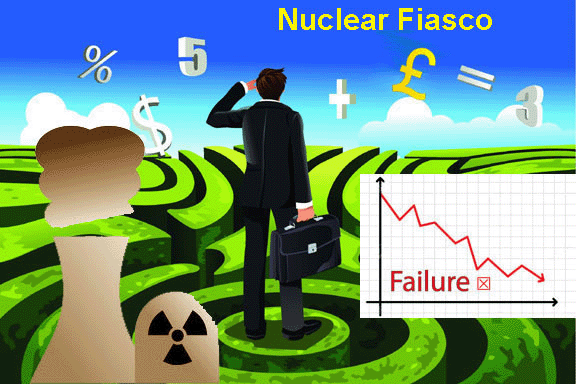
Of course all bets on stability are off in the event of a meltdown — and in terms of catastrophes compared to anything possible with solar or wind, you might also say it’s not even close.
But in the end, nuclear is complicated — and it only takes a tsunami, fat finger on the control panel or mechanical breakdown to once again become reacquainted with the fallout.
Vishesh Raisinghani, Sun, June 4, 2023 https://finance.yahoo.com/news/nuclear-energy-just-helped-finland-110000152.html
The first new European nuclear plant in 16 years has already slashed Finland’s energy bill by three-fourths.
Olkiluoto 3, or OL3, joins two existing reactor units that have powered Finland’s grid for decades. This latest unit adds 1,600 megawatts to the plant’s production capacity — which means 30% of the nation’s electricity will soon come from just one plant on a tiny island in Western Finland.
When the new OL3 unit was fully activated in April, average spot electricity prices fell to €60.55 ($65.69) per megawatt hour. That’s 75.38% lower than the average spot price in December 2022 (€245.98 per megawatt hour).
While its operating company TVO called it “the greatest single climate act in Finland,” others argue that the benefits are hardly worth the risks.
Here’s why most countries are cool on this technology.
Fear
High-profile incidents like at Three Mile Island, Chernobyl and Fukushima have severely impacted the reputation of nuclear energy. Even if an overwhelming number of plants are safe, it only takes one accident to render the land around a plant uninhabitable.
In the U.S., “nukes” (as protesting musicians nicknamed them in the 1980s) continue to be unpopular. The number in the U.S. has dropped from a peak of 107 in 1990 to 93 as of 2022, according to the Pew Research Center.
Roughly 1-in-4 Americans say their government should actively discourage nuclear energy production, which could explain why so few plants have been built over the last 10 years. Yet fear is only part of the equation, as the financial bottom line also plays a crucial role in the lack of any nuclear energy embrace.
Cost
New nuclear power plants are mostly being built in countries where all infrastructure is cheaper to build. China is currently developing 24 new plants — the most in the world. Meanwhile, India is building eight new reactors. It’s simply cheaper to build plants in these regions.
According to the World Nuclear Association, the overnight cost of building a new plant in China, which assumes no interest payments, is $2500/kWe, while the cost in the U.S. is $6041/kWe (short for kilowatt-electric or one thousand watts of electric capacity). This price disparity is another reason why nuclear power isn’t favored in the developed world — though the causes go far beyond this.
Time
Nuclear power takes several years to deploy — and that’s on the conservative end. A plant can typically be constructed over a period of five years. However, regulatory and financial hurdles could delay these projects along the way. Meanwhile, a typical wind farm can be fully deployed in as little as six months, according to EDF Energy.
The classic example of how mismanaged a nuclear project can get is as close as Georgia. There, the third reactor at Plant Vogtle went online at full capacity in late May but was supposed to start generating power in 2016. It was approved for construction in 2009, and overruns pushed the cost to more than $17 million; combined with a fourth reactor still in the testing phase, the total price comes to a staggering $35 billion.
‘The most reliable source’
Indeed, time and cost ultimately represent the biggest barrier to adoption. Even Finland’s energy experts understand the commercial challenges. “[Nuclear] it seems is not very attractive for the investors,” Jukka Ruusunen, chief executive of Finland’s national grid operator Fingrid, told The National.
However, nuclear power has several non-commercial advantages. Unlike wind and solar, nuclear energy output is stable regardless of weather and sunshine hours. The U.S. Energy Department once called it “the most reliable energy source and it’s not even close.”
Of course all bets on stability are off in the event of a meltdown — and in terms of catastrophes compared to anything possible with solar or wind, you might also say it’s not even close.
Russia’s invasion of Ukraine has also highlighted nuclear’s potential to deliver national security and energy independence. Yet the near catastrophes at the Chernobyl plant during the war almost seem to counteract that fact.
On the upside, Finland’s new nuclear plant has helped it avoid blackouts despite sanctions on Russian energy and could help explain why several other European countries are also now pushing for more nuclear power.
But in the end, nuclear is complicated — and it only takes a tsunami, fat finger on the control panel or mechanical breakdown to once again become reacquainted with the fallout.
Concern over low flying aircraft circling over Hunterston nuclear power station
Concerns have been raised with civil nuclear police over low flying
aircraft over Hunterston. Aircraft apps showed that a Pilatus PC-6/B2-H4
plane repeatedly circled the nuclear power plant – leading to the matter
being raised by a concerned resident at a public meeting this week.
West Kilbride community councillor John Lamb, who was attending the Hunterston
Site Stakeholders Group, asked the civil nuclear police if they were aware
that there was low flying aircraft over the power station zone.
The incident happened on May 25 and the fFlightradar app showed that the plane
travelled across Ayrshire before repeatedly circling Hunterston. Mr Lamb
asked if the Civil Aviation Authority had altered the guidance regarding
the ‘no flight zone’ over Hunterston. Inspector Paul Gilmartin of the Civil
Nuclear Police told the meeting that he was unaware of any reports of low
flying aircraft and the matter had not been flagged up to him.
Largs & Millport Weekly News 2nd June 2023
EDITORIAL: Government turns a blind eye to lessons from nuclear disaster

https://www.asahi.com/ajw/articles/14923055 June 2, 2023
It appears that the lessons learned from the 2011 Fukushima nuclear disaster have been taken so lightly.
The government and a majority of the Diet are heavily responsible for pushing through a reversal of the nation’s nuclear policies without careful deliberation, shifting from a “reduction of dependence” on nuclear power and heading to its “maximum utilization.”
We must keep asking ourselves whether we can solve the many difficult problems plaguing nuclear power plants and whether they could end up haunting future generations.
This week, a bill related to promoting nuclear plants was passed by the Diet.
The government’s responsibilities and measures aimed at the active utilization are stipulated in the Atomic Energy Basic Law.
The new law also relaxed restrictions on nuclear reactors’ operational periods introduced after the catastrophic disaster at the Fukushima No. 1 nuclear power plant, opening a path to allowing reactors to operate beyond 60 years if certain conditions are met.
The Asahi Shimbun in its editorials has opposed the bill and called for its reconsideration.
That is because nuclear plants are plagued with a mountain of issues such as the ever-growing nuclear waste and Japan’s nuclear fuel cycle that has reached an impasse, not to mention safety and economic concerns.
And it is unacceptable for the government to reverse its stance to restarting nuclear plants without showing a path to solving the problems.
Now is the time to speed up reforms to make renewable energy a primary power source from the standpoint of the overall energy policy.
Returning to dependence on nuclear plants could lead to going down the wrong path.
The bill was also rushed along as the government adopted the new policy last year after only several months of debate.
The Diet was supposed to do everything in its power to scrutinize the bill from multiple perspectives, but no deep discussions ensued.
We can’t help but be disappointed.
Reasons cited for the about-face were the need for a stable supply of energy and the decarbonization of energy sources.
But how much of a role do nuclear plants actually play in these goals? And why is it necessary to treat them differently?
The government shied away from answering these questions head-on and repeatedly said it was important to pursue all possible options, including nuclear energy.
With several bills covering a variety of issues bundled into the legislation, discussions on concrete measures also wandered off-track.
It had been explained that the limit on the reactors’ operational periods was originally intended to reduce safety risks.
But the government claimed that it decided from the standpoint of the nation’s energy strategy, instead of safety regulations.
Although it was a major shift, the government failed to provide convincing explanations.
After all, numerous questions, including fundamental problems, were left unanswered.
If this stance continues, it will be inevitable for the government to single-mindedly devote itself to the promotion of its new polices on nuclear plants.
The latest policy shift was led by the economy ministry, seriously undermining the principle of separation between “promotion and regulation,” which is the heart of the nuclear policy introduced in light of the Fukushima disaster.
The government seems set to support the restart of nuclear plants and construction of new ones.
However, at the very least, safety procedures and economic benefits of nuclear plants must be thoroughly considered.
And, no matter how many efforts are made, inconvenient realities about nuclear plants won’t disappear.
The government and party members who voted for the bill must keep firmly in mind that they will have to face these realities sooner or later.
Unlimited money to Ukraine is now allowed, through USA’s “Debt Sealing” arrangement.

Debt Ceiling Deal Puts No Limits on Ukraine Aid https://scheerpost.com/2023/06/02/debt-ceiling-deal-puts-no-limits-on-ukraine-aid/
Emergency spending that has been used to arm Ukraine is exempt and it could also be used to arm Taiwan
June 2, 2023, By Dave DeCamp / Antiwar.com
The debt ceiling agreement reached between the White House and House Republicans places no constraints on spending on the war in Ukraine, a White House official told Bloomberg.
The $113 billion that has been authorized to spend on the war in Ukraine so far was passed as supplemental emergency funds, which is exempt from the spending caps that are part of the debt ceiling deal.
According to the Congressional Budget Office, funding “designated as an emergency requirement or for overseas contingency operations would not be constrained, and certain other funding would not be subject to the caps.” The deal suspends the nation’s debt limit through January 1, 2025.
Hawks in Congress are looking to use emergency spending to increase the $886 billion military budget that was agreed to as part of the deal. The emergency funds could go beyond Ukraine and might be used to send weapons to Taiwan or for other spending that hawks favor as part of their strategy against China.
“We are almost certainly going to need a supplemental for Ukraine, which is, in my view, one of the most pressing defense challenges we have right now,” said Sen. Richard Blumenthal (D-CT), according to Roll Call. “And the other obligations flow from China and Taiwan on one hand and Russia and Ukraine on the other.”
Other senators said they favor using the emergency funding to raise military spending altogether. The $886 billion budget is what President Biden asked for 2024, but Republican hawks have blasted the request as “inadequate.”
“Clearly our support for Ukraine will be outside the budget, as it has been in the past, but I’d like to see additional support for our own military in emergency supplementals as well,” said Sen. Mitt Romney (R-UT).
The Senate passed the agreement, known as the Fiscal Responsibility Act of 2023, on Thursday night in a vote of 63-36, sending the bill to President Biden’s desk. The legislation was passed through the House on Wednesday in a vote of 314-117.
Bellona publishes new report on Ukraine’s besieged Zaporizhzhia nuclear plant
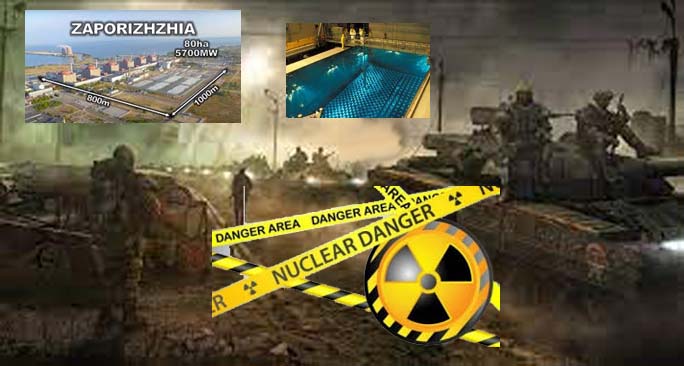
It’s something the world nuclear energy community never thought it would see — and thus never prepared for.
June 1, 2023 by Charles Digges https://bellona.org/news/nuclear-issues/2023-06-zaporizhzhia-nuclear-report
For a year and a half, the world has bourn witness to an unprecedented spectacle: the military occupation of a civilian atomic energy station.
The March 2022 seizure by Russian troops of the Zaporizhzhia Nuclear Power Plant in Southeastern Ukraine has forced six nuclear reactors and pools of spent nuclear fuel onto the front lines of the biggest land war in Europe since World War II.
It’s something the world nuclear energy community never thought it would see — and thus never prepared for. As a result, the world has watched helplessly as heavy ordinance strikes nail-bitingly close to the plant on a regular basis, repeatedly severing outside power to the facility’s cooling and safety systems.
According to Rafael Grossi, who heads the UN’s atomic energy agency —and who has repeatedly beseeched Moscow and Kyiv to create a non-military safe zone around the plant — the situation is a gamble with radioactive stakes.
“We are rolling a dice and if this continues then one day our luck will run out,” he has said more than once.
Unfortunately, the time has come to ponder just what it would look like were that to happen.
This is the subject of a new Bellona report entitled “The Radiation Risks of Seizing the Zaporizhzhia Nuclear Power Plant.”
In it, we analyze a variety of war-time scenarios that could befall the plant and what the consequences of those might be.
What would happen if any of the plant’s six Soviet-built VVER-1000 nuclear reactors were struck by artillery? Or a missile? What about the spent nuclear fuel storage pools? What if those were struck? Where would the radioactive fallout from any of these events go?
And perhaps, in light of recent events, the most salient danger — what would happen if the plant was unable to maintain outside power to run reactor cooling systems? Would that amount to Fukushima redux?
We also present a number of recommendations that should be followed in order to keep the plant safe while it continues to be hostage to the aggression.
Among them, we urge the Russian and Ukrainians struggling for control of the plant to keep the reactors in shut-down mode, which would greatly reduce the severity of a radiological accident. We also recommend that no nuclear fuel be unloaded, packed for storage or transported. These are complex technical tasks that cannot be undertaken by a hostage workforce while a war rages on around them.
Above all, we urge a Russian withdrawal from the plant and Ukraine as a whole, for it is not until then that anything like safe operation of Europe’s largest nuclear power plant can be restored.
France, Germany Dispute Over Nuclear Energy Leaves EU Deadlocked on Renewables
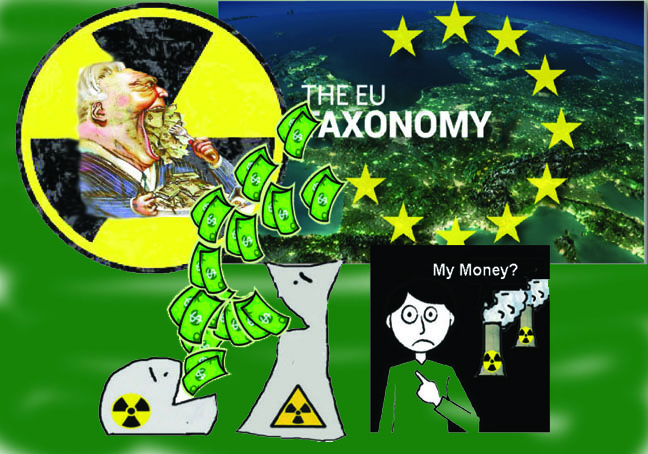
- Paris wants to win greater role for nuclear in energy revamp
- Disputed law on clean energy is key element of EU Green Deal
Bloomberg ,By Ewa Krukowska, Ania Nussbaum and, Petra Sorge, 3 June 2023
France is seeking to reopen negotiations over a key Green Deal law in an effort to ensure a greater role for nuclear in Europe’s energy transition, a move fiercely opposed by Germany, leaving the talks in deadlock.
The government in Paris has informed Sweden, which holds the EU’s rotating presidency, that it’s seeking changes to an agreement already brokered with other EU entities, according to officials with knowledge of the matter. Such a step would require revisiting talks with the bloc’s parliament and the European Commission ………………………….. (Subscribers only) https://www.bloomberg.com/news/articles/2023-06-02/eu-in-deadlock-over-renewables-as-france-and-germany-lock-horns#xj4y7vzkg
Warren Report Reveals Vast Pentagon-to-Defense Contractor Lobbying Pipeline
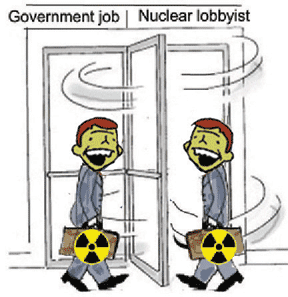
In 2021, there were at least 672 former government officials working for top defense contractors like Lockheed Martin. By Sharon Zhang , TRUTHOUT April 27, 2023 https://truthout.org/articles/warren-report-reveals-vast-pentagon-to-defense-contractor-lobbying-pipeline/?utm_campaign=Truthout+Share+Buttons
Hundreds of former government officials, including former Pentagon officials, have been funneled through the infamous public-to-private revolving door to take their insider government knowledge to lobby for top defense contractors, a new report from the office of Sen. Elizabeth Warren (D-Massachusetts) reveals.
According to the report released Wednesday, as of 2021, there were at least 672 former officials who were working for the top 20 defense contractors, with the vast majority — 91 percent — in positions lobbying the very government they formerly worked for. Officials who weren’t lobbyists were in top positions as board members or senior executives. The officials include former members of Congress, senior staffers and military officers.
Perhaps not coincidentally, the companies that employed the most former government officials are also the companies who receive the most from the government in contracts. In 2021 and 2022, Lockheed Martin, Boeing, Raytheon, General Dynamics and Pfizer were the top 5 federal defense contractors in the U.S. — and in 2021 also employed among the highest numbers of “revolving door hires” out of the top 20 contractors, the report found, each with dozens of former government employees.
Hiring former government employees is extremely lucrative for the private sector. This is especially true for lobbying firms, who can benefit greatly from the knowledge and connections brought by former government employees, but is also true for many industries; for instance, there is a well-established revolving door between jobs at the Treasury Department and other tax-related agencies and top accounting firms, an issue Warren has previously raised.
Defense contractors are especially able to take advantage of such lobbying, as Congress and the president regularly approve huge sums of money for defense each year —– more than half of that money typically goes straight to contractors, amounting to hundreds of billions of dollars a year. Over the years, this leads to trillions of dollars in profits for defense contractors.
Warren highlighted the dangers of the revolving door in a hearing in the Senate Armed Services Subcommittee on Wednesday.
“Why is it they want to hire former Pentagon employees to work for them as lobbyists?” Warren asked Lawrence B. Wilkerson, chief of staff to George W. Bush’s Secretary of State, Colin Powell. “Why is it better to have someone who, for instance, they could hire people whose profession is lobbying, someone who’s lobbied in another field, say for the last 10 years. But they don’t want that — they’ll take somebody who’s never lobbied before, but who’s been employed at the Pentagon. Why is that?”
Wilkerson responded that the former Pentagon official “knows how to work those contacts” within the government and knows what “lies” to tell to sell the company’s services.
“If it’s specific program like the F-35, for example, which I’m somewhat familiar, then you get people who are very familiar with that on the inside, know all about the lies that you’ve been telling the federal government with regard to the program, and will come out and reinforce those lies, deceit, if you will, from their position with your business,” Wilkerson said. “It’s a very insidious, pernicious thing.”
These issues are compounded by the fact that defense spending is rife with fraud and abuse, as those who support reducing the Pentagon budget point out. Despite receiving the vast majority of federal discretionary spending year over year, the Pentagon is the only federal agency to never have passed an audit.
Scientists heat nuclear reactor heated to 100 MILLION degree Celsius – hotter than the SUN (what could possibly go wrong?)

- British company achieved the milestone using a ‘spherical tokamak’ called ST40
- Nuclear fusion reactors copy the energy-producing process of stars like our sun
By JONATHAN CHADWICK FOR MAILONLINE , 2 June 2023
Described as the ‘holy grail’, the milestone was achieved using the ST40 ‘spherical tokamak’ – a ‘cored-apple’ shaped nuclear device in Oxfordshire – and the team is now working on a fusion reactor that can connect to the national grid in the 2030s.
The milestone is short of the record set by Chinese scientists in 2021, who ran their reactor at 120 million degrees Celsius. ……………………………………………………………………………….
Funded by the UK government, STEP will be located at the existing West Burton power station in Nottinghamshire, it was announced last October……………………………………………………………………………………………………… https://www.dailymail.co.uk/sciencetech/article-12147389/Nuclear-fusion-breakthrough-Holy-grail-power-production-closer-reality.html
Andrew Little tells nuclear powers New Zealand’s stance isn’t just ‘wishful thinking’
Thomas Manch in Singapore , 3 June 23 https://www.stuff.co.nz/national/politics/132221789/andrew-little-tells-nuclear-powers-new-zealands-stance-isnt-just-wishful-thinking
Defence Minister Andrew Little has told the nuclear powers that New Zealand’s nuclear-free stance is not “wishful thinking”, and the country will gear up to defend “our free and democratic way of life”.
Little gave a speech on nuclear threats at the Shangri-La Dialogue, a summit held in Singapore, on Friday evening. He told an audience that New Zealand had “clear eyes” about challenges to security and was increasing its military spending.
“Do not confuse my country’s moral clarity with wishful thinking,” he said.
“New Zealanders must be prepared to equip ourselves … to protect our own national security. And we are
“We will stand prepared, and will maintain the military capability necessary to contribute to the rules- based international order and protection of our free and democratic way of life now and in the future.”
Little was part of a panel discussion on nuclear issues that included General Sahir Shamshad Mirza of Pakistan, a nuclear state; Kim Gunn, a South Korean special representative; and Angus Lapsley, assistant secretary general of the nuclear deterrent alliance Nato.
On the sidelines of the summit on Friday, he also met Chinese Defence Minister Li Shangfu, Ukraine’s defence minister Oleksiy Reznikov, Singapore Defence Minister Ng Eng Hen and the East Timor Defence Minister Filomeno da Paixão de Jesus.
Speaking at the panel discussion, Little said a range of regional issues, including “destabilising” actions in the South and East China Seas and “Pacific Rim state” Russia invading of Ukraine, had heightened tensions – and increased nuclear threats.
He said there had been a “false” categorisation of “so-called tactical or battlefield nuclear weapons”. Reuters reported last week that Russia was progressing plans to station such weapons in neighbouring Belarus.
“There are no circumstances in which their use could be morally justified,” he said.
”It is not possible to confine all of the effects of the use of nuclear weapons to a period of kinetic engagement or a zone of conflict.”
Little said there was “no ambiguity” in New Zealand’s position on nuclear weapons, and its nuclear ban would remain, including for nuclear-powered vessels. New Zealand’s only formal defence ally, Australia, is planning to obtain nuclear-powered submarines in the coming decades.
“For small, liberal democracies like New Zealand, we do not get to avoid the real-life effects of geostrategic competition,” Little said.
“Our way of life, including the freedoms we cherish … can never be fully safeguarded from the effects of nuclear conflict in a world that tolerates nuclear weapons.”
The Shangri-La Dialogue is the Asia region’s premier defence summit, attended by defence minister and military leaders from 40 countries. It is hosted by London-based think-tank International Institute for Strategic Studies.
Security and access to the event is tight. Singapore has closed the airspace within 1 kilometre of the Shangri-La hotel, and its special police force of Gurkhas from Nepal are guarding the event. There is no space afforded for media in the rooms where delegates are speaking, except for limited photo and video opportunities.
The headline speakers at the event will be Australian Prime Minister Anthony Albanese, giving the keynote speech late on Friday evening, United States defence secretary Lloyd Austin and China’s defence minister Li, speaking on Saturday and Sunday respectively.
Finland’s newest nuclear plant is warming the sea, harming wildlife
yle 1 June 23
The Olkiluoto 3 reactor became fully operational in April after a decade-long delay.
“……… climate groups have pointed to a number of adverse effects the largest reactor in the Nordic region will have on its surrounding environment, including the warming of the seawater used to cool the plant and its effects on marine life.
Olkiluoto 3 is by far the largest of the three reactors located at Eurajoki and its operations will almost double the amount of water required to cool the plants.
In total, the three reactors need around 120-130 cubic metres of cooling water per second. This is more than half the average flow of the nearby Kokemäenjoki river, and Olkiluoto 3 accounts for about 57 cubic metres of this volume.
Court orders investigation
The seawater used to cool the nuclear power plant will also inevitably contain fish and other marine organisms.
Finland’s Administrative Court ordered an investigation to be carried out into the effects of Olkiluoto 3 on the local marine life when regular electricity production began in April………………………………………………………………………………………… https://yle.fi/a/74-20034904
1 This Month
23 April – WEBINAR – Why new nuclear reactors are the wrong tools for decarbonization Thursday, April 23 • 1 AM – 2 AM AEST


Pine Ridge Uranium is the real threat, not Tehran- Tell Burgum: Stop the Extraction.
Chernobyl: The Lost Tapes – A good documentary on Chernobyl on SBS available On Demand for the next 3 weeks– https://www.sbs.com.au/ondemand/tv-program/chernobyl-the-lost-tapes/2352741955560
To see nuclear-related stories in greater depth and intensity – go to https://nuclearinformation.wordpress.com
-
Archives
- April 2026 (241)
- March 2026 (251)
- February 2026 (268)
- January 2026 (308)
- December 2025 (358)
- November 2025 (359)
- October 2025 (376)
- September 2025 (257)
- August 2025 (319)
- July 2025 (230)
- June 2025 (348)
- May 2025 (261)
-
Categories
- 1
- 1 NUCLEAR ISSUES
- business and costs
- climate change
- culture and arts
- ENERGY
- environment
- health
- history
- indigenous issues
- Legal
- marketing of nuclear
- media
- opposition to nuclear
- PERSONAL STORIES
- politics
- politics international
- Religion and ethics
- safety
- secrets,lies and civil liberties
- spinbuster
- technology
- Uranium
- wastes
- weapons and war
- Women
- 2 WORLD
- ACTION
- AFRICA
- Atrocities
- AUSTRALIA
- Christina's notes
- Christina's themes
- culture and arts
- Events
- Fuk 2022
- Fuk 2023
- Fukushima 2017
- Fukushima 2018
- fukushima 2019
- Fukushima 2020
- Fukushima 2021
- general
- global warming
- Humour (God we need it)
- Nuclear
- RARE EARTHS
- Reference
- resources – print
- Resources -audiovicual
- Weekly Newsletter
- World
- World Nuclear
- YouTube
-
RSS
Entries RSS
Comments RSS
 nuclear-news