Problems ahead for the nuclear industry in the closing and disposal of dead nuclear reactors
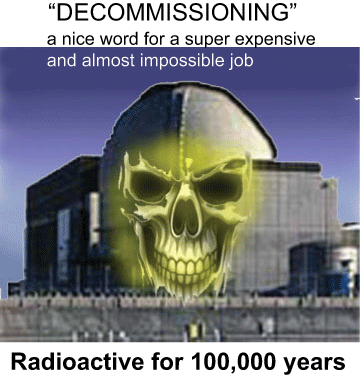
Regions like Europe are expected to face significant growing pains as the
expansion of nuclear generation picks up pace. This will include not only
the challenge of building new facilities, but also how to handle more
widespread decommissioning and maintenance work.
Many existing plants are
ageing, built as long ago as the 1970s with a typical lifespan of around 40
to 50 years. These assets will need to be replaced in the coming decades
for the continent to meet its energy transition goals. The growing need for
decommissioning and maintenance should be met most efficiently and –
above all – safely.
A major challenge that will be increasingly faced by
nuclear projects is the sheer variety of different facilities that were
built from the 1970s onwards. This means that there is no one methodology
that can be applied across all sites. This is not simply a case of
construction and layout, but also the data available – it is quite common
to have to work with a lack of detailed information on older plants built
some 50 years ago or more.
This means that more work is needed early in
each project to ensure the logistic methodologies will work within the
site. This early involvement also gives suppliers the best chance of
developing bespoke equipment within the project timeframe. Problems can
often be solved by addressing them laterally. It can be highly undesirable
or simply impossible to move modules through the plant itself. Instead,
alternative options should be considered such as cutting a hole in the roof
of the containment building, lifting the vessel out using a crane or
gantry, or creating a bespoke engineering solution that has not been used
before.
NS Energy 7th June 2023 https://www.nsenergybusiness.com/features/how-to-ensure-safe-and-effective-nuclear-decommissioning-and-maintenance/
German TV Shows Nazi Symbols on Helmets of Ukraine Soldiers

In a ZDF report on the fragile cease-fire in eastern Ukraine, images were shown of soldiers wearing combat helmets with SS insignia and swastikas.
Sept. 10, 2014, https://www.nbcnews.com/storyline/ukraine-crisis/german-tv-shows-nazi-symbols-helmets-ukraine-soldiers-n198961
Germans were confronted with images of their country’s dark past on Monday night, when German public broadcaster ZDF showed video of Ukrainian soldiers with Nazi symbols on their helmets in its evening newscast. In a report on the fragile cease-fire in eastern Ukraine, Moscow correspondent Bernhard Lichte used pictures of a soldier wearing a combat helmet with the “SS runes” of Hitler’s infamous black-uniformed elite corps. A second soldier was seen with a swastika on his gear. “Volunteer battalions from nearly every political spectrum are reinforcing the government side,” the ZDF correspondent said in his report.
The video was shot last week in Ukraine by a camera team from Norwegian broadcaster TV2. “We were filming a report about Ukraine’s AZOV battalion in the eastern city of Urzuf, when we came across these soldiers,” Oysten Bogen, a correspondent for the private television station, told NBC News. Minutes before the images were taped, Bogen said he had asked a spokesperson whether the battalion had fascist tendencies. “The reply was: absolutely not, we are just Ukrainian nationalists,” Bogen said.
Snowden Warns Today’s Surveillance Technology Makes 2013 Look Like ‘Child’s Play’

“We trusted the government not to screw us,” said Edward Snowden. “But they did. We trusted the tech companies not to take advantage of us. But they did. That is going to happen again, because that is the nature of power.”
by EDITOR, June 9, 2023 https://scheerpost.com/2023/06/09/snowden-warns-todays-surveillance-technology-makes-2013-look-like-childs-play/
By Julia Conley / Common Dreams
With this week marking 10 years since whistleblower Edward Snowden disclosed information to journalists about widespread government spying by United States and British agencies, the former National Security Agency contractor on Thursday joined other advocates in warning that the fight for privacy rights, while making several inroads in the past decade, has grown harder due to major changes in technology.
“If we think about what we saw in 2013 and the capabilities of governments today,” Snowden told The Guardian, “2013 seems like child’s play.”
Snowden said that the advent of commercially available surveillance products such as Ring cameras, Pegasus spyware, and facial recognition technology has posed new dangers.
As Common Dreams has reported, the home security company Ring has faced legal challenges due to security concerns and its products’ vulnerability to hacking, and has faced criticism from rights groups for partnering with more than 1,000 police departments—including some with histories of police violence—and leaving community members vulnerable to harassment or wrongful arrests.
Law enforcement agencies have also begun using facial recognition technology to identify crime suspects despite the fact that the softwareis known to frequently misidentify people of color—leading to the wrongful arrest and detention earlier this year of Randal Reid in Georgia, among other cases.
“Despite calls over the last few years for federal legislation to rein in Big Tech companies, we’ve seen nothing significant in limiting tech companies’ ability to collect data.”
Last month, journalists and civil society groups called for a global moratorium on the sale and transfer of spyware like Pegasus, which has been used to target dozens of journalists in at least 10 countries.
Protecting the public from surveillance “is an ongoing process,” Snowden told The Guardian on Thursday. “And we will have to be working at it for the rest of our lives and our children’s lives and beyond.”
In 2013, Snowden revealed that the U.S. government was broadly monitoring the communications of citizens, sparking a debate over surveillance as well as sustained privacy rights campaigns from groups like Electronic Frontier Foundation (EFF) and Fight for the Future.
“Technology has grown to be enormously influential,” Snowden told The Guardian on Thursday. “We trusted the government not to screw us. But they did. We trusted the tech companies not to take advantage of us. But they did. That is going to happen again, because that is the nature of power.”
Last month ahead of the anniversary of Snowden’s revelations, EFF notedthat some improvements to privacy rights have been made in the past decade, including:
- The sunsetting of Section 215 of the PATRIOT Act, which until 2020 allowed the U.S. government to conduct a dragnet surveillance program that collected billions of phone records;
- The emergence of end-to-end encryption of internet communications, which Snowden noted was “a pipe dream in 2013”;
- The end of the NSA’s bulk collection of internet metadata, including email addresses of senders and recipients; and
- Rulings in countries including South Africa and Germany against bulk data collection.
The group noted that privacy advocates are still pushing Congress to end Section 702 of the Foreign Intelligence Surveillance Act, which permits the warrantless surveillance of Americans’ communications, and “to take privacy seriously,” particularly as tech companies expand spying capabilities.
“Despite calls over the last few years for federal legislation to rein in Big Tech companies, we’ve seen nothing significant in limiting tech companies’ ability to collect data… or regulate biometric surveillance, or close the backdoor that allows the government to buy personal information rather than get a warrant, much less create a new Church Committee to investigate the intelligence community’s overreaches,” wrote EFF senior policy analyst Matthew Guariglia, executive director Cindy Cohn, and assistant director Andrew Crocker. “It’s why so many cities and states have had to take it upon themselves to ban face recognition or predictive policing, or pass laws to protect consumer privacy and stop biometric data collection without consent.”
“It’s been 10 years since the Snowden revelations,” they added, “and Congress needs to wake up and finally pass some legislation that actually protects our privacy, from companies as well as from the NSA directly.”
Timeline: The history of radioactive contamination in St. Louis County
The long history of radioactive contamination in St. Louis County began with the Manhattan Project during World War II.
5 on Your Side, Clarissa Cowley, June 8, 2023
FLORISSANT, Mo. — Jana Elementary School has been in the spotlight for months after conflicting reports regarding radioactive pollution at the school. At its root is nearby Coldwater Creek, which was contaminated for years by improperly stored nuclear waste.
In the months since an independent report showed high levels of radioactive lead at the school, parents and community members have called for action to clean up the pollution, and some families said they are even moving out of their homes and away from the Hazelwood School District.
Now the U.S. Army Corps of Engineers planned to hold a public meeting Thursday night at Jana Elementary School after it made public the final results of its testing, which conversely found no radiological concerns at the school.
5 On Your Side has created a timeline of the decades-long saga leading up to this point, citing public documents as well as our own records and reporting.
The details below include information about the atomic waste illegally dumped in the Bridgeton Landfill, which sits inside the West Lake Landfill site off St. Charles Rock Road. It was a dumpsite for radioactive material following World War II, and in 2010, a fire broke out underground not far from that dump site that is still burning. In addition, this timeline breaks down the history of chemical pollution alongside Coldwater Creek near Jana Elementary School.
Timeline:
1940
- The Manhattan Project, an American-led effort during World War II to develop a functional atomic weapon, is officially created. The Mallinckrodt Chemical Works plant in St. Louis begins processing uranium oxide used by the Manhattan Project.
- 1947
- Waste from the uranium oxide production is taken and stored at a site north of St. Louis Lambert International Airport from 1947 until the late 1960s.
- 957
- Mallinckrodt moves uranium processing to a Weldon Spring facility, where it would continue until 1966.
- 1960s
- The toxic waste is purchased and moved from the airport site to a site half a mile away on Latty Avenue. This site and the airport site were located near 19-mile-long Coldwater Creek. Radioactive waste would contaminate the creek, which would then carry the contamination into north St. Louis County.
- 1973
- Atomic waste is illegally dumped in the West Lake Landfill.
- A long-time employee of the Mallinckrodt plant, who took radioactive waste to Coldwater Creek in Styrofoam containers in an open-air truck, dies of brain cancer.
- The EPA takes over West Lake Landfill as a Superfund Site.
- 2004
- Mallinckrodt employees, who worked with uranium used in nuclear weapon manufacturing, become eligible for compensation in Weldon Spring and St. Louis. Workers had to prove how much exposure they had to radiation while working for the Mallinckrodt facility.
- 2010
- A smoldering underground fire is found at the Bridgeton Landfill, raising concerns it would threaten the nearby radioactive material.
- Families and workers around the Bridgeton Landfill are burdened by smelly fumes that were emitting from the fire still burning underground. The smoldering accelerated the decay of solid waste at the site, causing excessive gas release and powerful odors that many living nearby said made them sick.
- 2012
- The Centers for Disease Control and Prevention (CDC) said the United States Army Corps of Engineers (USACE) began a detailed investigation of Coldwater Creek and its floodplain areas in October 2012, working downstream from the historical source areas.
- 2013
- Three years after the underground smoldering started at the landfill, then-Attorney General Chris Koster files a lawsuit against Republic Services over ongoing concerns.
…………………………………………………….January 2022
- The Army Corps of Engineers notified the district that there was low-level radioactive pollution at Coldwater Creek, which is on the edge of Jana Elementary’s property boundary. The letter also said the contamination did not pose an immediate risk. The Corps had previously found low-level radioactive contamination on the banks of Coldwater Creek in its soil samples.
- March 2022
- The EPA’s plan for a $205 million clean-up project at Bridgeton’s West Lake landfill is delayed after finding more extensive radioactive waste.
…………………………August 2022: Several details regarding the levels of contamination begin to come to light. Parents are notified that soil sampling showed a presence of low-level radioactive contamination on the banks of Coldwater Creek. The amount of toxins found around Jana Elementary and the two landfills (Bridgeton and West Lake) had to reach a certain threshold, according to CDC guidelines. Based on these findings, parents became concerned about exposure and health risk.
…………………………………………………………………..June 8, 2023
- The Army Corps of Engineers planned to hold a public meeting to discuss the findings of all three reports with the community.
All Army Corps of Engineers reports can be found here.
Suicide Day Four, all so that NATO can Expand
OLIVER BOYD-BARRETT, JUN 9, 2023 https://oliverboydbarrett.substack.com/p/suicide-day-four-all-so-that-ukraine?utm_source=post-email-title&publication_id=305689&post_id=126964531&isFreemail=true&utm_medium=email
The fourth day of the Ukrainian counteroffensive yesterday towards Russian defensive lines in Zaporizhzhia appears to have involved some 20,000 soldiers (one thousandth of Ukraine’s remaining population) backed by many tanks (including German Leopards), howitzers, artillery vehicles, hundreds of infantry fighting vehicles and so on. It involves crossing into uncleared mine fields, without air support or sufficient artillery backing, and without yet engaging with principal layers of Russian fortifications.
No strategic objecties have yet been accomplished, to my knowledge.
Losses are reportedly very heavy. There are also Ukrainian pushes in southern Donetsk, around Bakhmut, and Belgorod (where another 500 artillery shells have landed on residential buildings over the past few hours). If 4,000 Ukrainian soldiers had been killed or wounded by the end of Day 3 (by contrast with Russia’s 300), I will not be surprised if another 4,000 Ukrainian losses will be added by the end of Days 4 and 5 with a similarly disproportionate discrepancy compared with Russian losses as we saw on Days 1-3.
In addition, there has been what is presumably a Ukrainian terrorist attack on an ammonia pipeline near Kharkov which will likely have the effect of scuppering plans for an extension of the Turkish negotiated grain deal, reducing food production in the region (already impacted by the recent Ukrainian destruction of the Nova Kharkovka dam which has reduced the flow of irrigation water on the Russian controlled eastern bank of the Dnieper) and reducing food production in the world generally, thus increasing food prices and contributing to global levels of starvation.
Russia is the biggest exporter to the world of fertilizer of which a major component is ammonia. This is sent out to the world from Odessa (providing another reason why Russia would want to seize Odessa) and then through the Dardenelles. The pipeline had already been shut down by Ukraine and Russia had been campaigning for its reopening as a condition for extension of the grain deal. Ukraine has now blown it up. So, end of the grain deal and end of whatever advantages to Ukrainian agricultural exports that the grain deal offered them. Huge amounts of ammonia now cover the forest areas around Kharkov, and these clouds are already negatively impacting Ukrainian troops and settlements in the area.
This follows, as I have said, what is now almost certainly Ukraine’s responsibility for the destruction of the Nova Kharkovka dam – something that is in line with a previous pattern of Ukraine’s destruction of its own infrastructure, including the blowing up of dams, as a means of holding back possible Russian advances.
Ukraine continues to release more Dnieper water downstream from the Dnieper Hydroelectric plant (above the now damaged Kharkovka dam) in order to widen the area of resulting flooding on the Russian-controlled east bank. In 72 hours, the water levels may fall back to normal or lower levels and at that stage – some Russian commentators anticipate – an attempted Ukrainian amphibious crossing can take place under more favorable conditions than heretofore (i.e. given the absence of now flooded-out Russian positions and inoperable minefields that the floods will have left behind). The absence of a Russian presence that might otherwise have threatened a Russian crossing and chase will also expedite the movement of Ukrainian troops from Kherson area to join the Ukrainian counteroffensive forces in Zaporizhzhia.
Increasing food prices will add to the economic pressures on Europe as the Eurozone in general and Germany in particular enter into recession, soon to be joined by the UK, and possiby, further down the line, the US.
These are the results, mainly, of the collective west’s suicidal neocon proxy war with Russia over Ukraine. Food prices are a principal driver, along with fuel prices, of high European inflation rates which in turn have prompted Europe’s financial response of higher interest rates. These in turn add further pressue to the overall economic crisis that will be consolidated by Russia’s agreement with Saudi Arabia to cut back, again, on oil production. This has been necessary because of falling oil prices which, in turn, have been caused by Europe’s voluntarily-induced recession, German deindustrialization, and by a slower-than-expected recovery of the Chinese economy in the context of decoupling from western markets.
Coupled with an increasingly gloomy economic outlook, the collective west (and, of course, Ukraine, which is almost entirely dependent on money and weapons from the collective west) now stares directly into a weapons crisis … notably, a crisis in the provision of shells of all kinds, including the vital 155mm shells used in most advanced missile systems. (Like the German Iris-T advanced missile system that Ukraine just deployed to the front and which has been destroyed, almost immediately, by Russian Lancet missiles).
Congressional representatives in Washington are being advised that US stocks of shells are now so low that they threaten US ability to fight a major war (hallelueh!). The US has already dedicated 2 million shells on the altar of Ukraine and Ukraine has consumed all of them. US monthly production of shells is currently around 20,000 a month, whereas Ukraine has recently been using them up at a rate of 130,000 a month. This discrepancy is totally unsustainable. The European contribution of shells at around 4,000 a month is neligible.
Instead of all of this encouraging a pivot to realism in Washington, the Biden/Blinken-led neocon cabal is proposing to escalate to another level by putting pressure on the next NATO meeting in Vilnius, Lithuania, by way of Anders Rasmussen, a former NATO secretary general and former prime minister of Denmark. Rasmussen is proposing that if NATO cannot agree collectively to a deployment of NATO troops into western Ukraine, then an alliance of the more evangelical NATO warmongering powers (including Poland, the Baltics and a few others) should take action of their own.
The presumption that Russia will hold back from firing on these NATO troops seems implausibly silly. It may be that the anticipated purpose of such a deployment would be to try to impose some form of “frozen conflict” solution. This will not find favor in Moscow, in my view, which is not only currently winning the conflict, but finds itself under pressure from its more nationalist right wing whose influence has been bolstered by the terror war conducted by Ukrainian Nazis and their few Russian affiliates against villages of Belgorod (principally by artillery fire – which further drains Ukrainian shells; the insurgents appear to have been rounded up or routed), and the growing conflict between Prigozhin and Shoigu.
The NATO meeting in Vilnius on July 11 and 12 will consolidate positions both among:
(1) the realist elements of NATO political and military elites who are cognizant of the extent to which they have been converted into Washington puppets and groomed for battlefield extinction in circumstances in which Russia has the most important military advantages and most advanced nuclear weapons and has at its back a newly militant China and BRICS alliance
and (2) the coalition of (2a) European civilizational ideologues, the crusaders (if not the conquistadores) who see themselves as saviours of the world for “democracy”, and “freedom,” and for the right to intervene and cause existential havoc in any country that does not enjoy their divinely inspired favor, under such pretexts as human rights, womens rights, LGBT rights almost all other forms of identity rights – the upholders, no less, of general virtue and goodness,
and (2b) neocon war profiteers who understand that the current conflict is no longer just an existential battle for the Russian Federation and eastern civilizations but is becoming, as a direct result of their own greed and stupidity, an existential battle for Europe, one in which the US will stand back and even take some comfort from.
World Ocean Day appeal to international bodies over Fukushima dump plan

Nuclear Free Local Authorities 8 June 23
Today (8 June) is celebrated the world over as UN World Ocean Day. The UK/Ireland Nuclear Free Local Authorities have chosen this day to make a final appeal to the International Maritime Organisation and the United Nations to intercede to stop the Japanese Government and nuclear industry from committing a criminal folly.
For the Japanese Government and executives at Tokyo Electric Power (TEPCO) which formerly operated the Fukushima nuclear power plant, plan imminently to dump well over one million tonnes of radioactive water into the Pacific Ocean. This water has been used to cool the reactors at the plant which were destroyed by an earthquake and tsunami in March 2011. The radioactive water has been stored on site in large drums; now there are plans to start to discharge the water out to sea through a pipeline especially built for this purpose.
Although the water has been ‘treated’ this cannot remove the radioactive tritium that is present that if inhaled or ingested can become fatal to marine life and ultimately to any humans who come into contact with it.
Councillor Lawrence O’Neill, Chair of the UK/Ireland Nuclear Free Local Authorities, said: “In looking to release the contaminated water, Japan will be transgressing the commitments it has made as a nation under the London Protocol and the UN Law of the Sea not to pollute our oceans and, more specifically, not to pollute them with radioactive materials.
“We are concerned that not only will marine life be jeopardised but human life too and that the discharge will destroy many livelihoods as this will have an adverse impact on the fishing and tourism industries. We stand with the people and nations of the Pacific in calling upon the Japanese Government and nuclear industry to step back and save our ocean from this blight. This water should be retained on land until it is truly safe.”…………….more https://www.nuclearpolicy.info/news/world-ocean-day-appeal-to-international-bodies-over-fukushima-dump-plan/
Fukushima dumping threat makes U.S. groups ask FDA for tighter food standards
June 9, 2023 https://beyondnuclear.org/fukushima-dumping-threat-makes-u-s-groups-ask-fda-for-tighter-food-standards/
As Japan prepares to release 1.3 million tons of Fukushima radioactive wastewater into the Pacific Ocean this summer, an increasing number of countries continue to voice strong opposition.
A report released Monday by Fukushima operator, TEPCO, showed that fish caught off the harbor at Fukushima contained 180 times the level allowed in Japan of radioactive isotope cesium (100 Bq/kg). The U.S. limit for radiocesium in food is 12 times higher than Japan’s (1200 Bq/kg), and this is why, in 2013, parents and radiation health experts filed a Citizen Petition with the FDA calling for safer guidelines for radioisotopes in food.
Fukushima Fallout Awareness Network (FFAN), Citizens for Health, Ecological Options Network (EON), and Beyond Nuclear petitioned FDA to lower the non-binding FDA guideline of 1,200 becquerels per kilogram (Bq/Kg) for cesium 134 and 137 to a binding 5 Bq/kg. The FDA has to date, failed to act. U.S. groups are now again, demanding FDA establish safer rules for radioisotopes in food, as current guidelines lag behind science and other countries.
The groups are taking this opportunity to challenge not only FDA’s standards for cesium 134 and 137 but also FDA’s position that tritium carries an extremely low health risk compared to other radioisotopes. Tritium cannot be filtered from water and has been known to bioaccumulate in seafood. A recent peer-reviewed, published paper that reviews all of the data on tritium, concludes “contrary to some popular notions that tritium is a relatively benign radiation source, the vast majority of published studies indicate that…internal exposures… can have significant biological consequences including damage to DNA, impaired physiology and development, reduced fertility and longevity, and can lead to elevated risks of diseases including cancer. Our principal message is that tritium is a highly underrated environmental toxin that deserves much greater scrutiny.
Washington banned Kiev from signing truce with Moscow – Russian security chief
Prolonging violence in Ukraine at any cost is in the interest of the US, Nikolay Patrushev has claimed.
https://www.rt.com/russia/577700-patrushev-us-truce-ukraine/ 8 June 23
Nikolay Patrushev, one of Russia’s senior security officials, has accused the US and the UK of standing in the way of peace. Unlike the peoples of Russia and Ukraine, the two English-speaking countries are interested in prolonging the violence and do not care about human suffering, he alleged.
“I can identify the nations that are most interested [in continued hostilities] – they are the US and England,” he said on Thursday during a press conference in Belarus. “And one should clearly realize that they do not care about people dying, because it’s not their people, they are not waging the war on their own soil.”
Patrushev, who serves as secretary of the Security Council, reminded journalists that Moscow and Kiev were on the verge of a truce in the first weeks of the conflict. But the Ukrainian government pulled out of peace talks under US pressure, he added.
The official was referring to negotiations in Istanbul, during which Ukraine proposed to pledge neutrality in exchange for security guarantees, to which Moscow provisionally agreed.
“Russia is not the ultimate target [for Western nations],” Patrushev assessed. “Their ultimate target is China. They [intend to] dominate the world, but that is unacceptable and won’t happen.”
Patrushev was visiting the Belarusian capital Minsk for a meeting of security chiefs from members of the Collective Security Treaty Organization (CSTO), a regional mutual defense bloc that also includes Armenia, Kazakhstan, Kyrgyzstan and Tajikistan.
Russian officials have described the hostilities in Ukraine as part of a larger proxy war waged by the US and its allies against Moscow, aimed at preserving Western powers’ hegemony.
Washington has declared the “strategic defeat” of Russia as its goal in Ukraine and pledged to provide military assistance to Kiev for as long as it takes to achieve that objective.
Amid Blinken visit, top Saudi diplomat says kingdom seeks U.S. nuclear aid

PBS. Jun 8, 2023
DUBAI, United Arab Emirates (AP) — Saudi Arabia’s foreign minister said after meeting with the visiting U.S. secretary of state on Thursday that while the kingdom would welcome U.S. aid in building its civilian nuclear program, “there are others that are bidding.”
Foreign Minister Prince Faisal bin Farhan was responding to a question about recent news reports that Saudi Arabia is asking for U.S. aid in building its own nuclear program in exchange for establishing diplomatic relations with Israel.
“It’s no secret that we are developing our domestic civilian nuclear program and we would very much prefer to be able to have the U.S. as one of the bidders,” he said. “Obviously we would like to build our program with the best technology in the world.”
Prince Faisal went on to say that normalization with Israel would have “limited benefits” without “finding a pathway to peace for the Palestinian people.” He did not say whether the nuclear issue is linked to normalization.
The exchange came at the end of a two-day visit to the kingdom in which U.S. Secretary of State Antony Blinken met with senior Saudi officials, including the country’s de facto leader, Crown Prince Mohammed bin Salman, and co-hosted a meeting of the global coalition fighting the Islamic State group………………………………………………………………………………………….
Critics say Saudi Arabia’s diplomatic efforts and its push into international sports are aimed at repairing the kingdom’s image after the 2018 killing and dismemberment of Jamal Khashoggi, a prominent Saudi dissident and Washington Post columnist. U.S. intelligence concluded that Prince Mohammed likely approved the operation carried out by Saudi agents — allegations he denies.
Critics also point to an unprecedented crackdown on dissent in recent years, with authorities jailing everyone from liberal women’s rights activists to ultra-conservative Islamists, and even targeting Saudis living in the United States.
Blinken said “human rights are always on the agenda” and that he had raised “specific cases,” but did not say whether any progress had been made on the release of detainees or the lifting of travel bans on prominent activists…… https://www.pbs.org/newshour/world/amid-blinken-visit-top-saudi-diplomat-says-kingdom-seeks-u-s-nuclear-aid
BLINKEN’S BATTLE HYMN

Biden’s favorite hawk calls for no end to the bloodshed in Ukraine
SEYMOUR HERSH, JUN 7, 2023
Secretary of State Antony J. Blinken in a June 2 speech in Helsinki welcomed Finland as NATO’s newest member state. A career hawk when it comes to Russia, he outdid himself in the fierceness of his commitment to the Ukraine war. Once again he was dismissive of any talk of a ceasefire—something desperately needed by an increasingly besieged Ukrainian army and citizenry.
“Now, over the coming weeks and months,” Blinken explained, “some countries will call for a ceasefire. And on the surface, that sounds sensible—attractive, even. After all, who doesn’t want warring parties to lay down their arms? Who doesn’t want the killing to stop? But a ceasefire that simply freezes current lines in place and enables Putin to consolidate control over the territory he’s seized, and then rest, re-arm, and re-attack—that is not a just and lasting peace. It’s a Potemkin peace. It would legitimize Russia’s land grab. It would reward the aggressor and punish the victim.”
Does America’s secretary of State not know—or want to know—the historical importance and success of international peace-keeping forces? Is he not aware of the work done by the diplomat Richard Holbrooke, controversial as he may have been? In 1995 he negotiated an end to the murderous ethnic violence in Bosnia and Herzegovina among Serbs, Croats, and Muslims. Their hatred for each other was as intense as the feelings now simmering among the citizenry and military in Ukraine for their Russian adversaries.
Blinken concluded his speech: “when a free people like the Ukrainians have at their backs the support of free nations around the world—nations who recognize their fates and freedom—their rights and security are inextricably bound together, the force they possess is not merely immense. It is unstoppable.”
His real message might be put more bluntly: I hate the Russians and let the blood flow.
………………. More than fifteen months later, Blinken told the Finnish crowd that there’s a bright side to the continuing carnage: “There is no question: Russia is significantly worse off today than it was before its full-scale invasion of Ukraine—militarily, economically, geopolitically.” The European Union is more united than ever, he asserted, and has supplied more than $75 billion in military, economic, and humanitarian aid to Ukraine. It has also absorbed more than 8 million Ukrainian refugees. (I have written of the growing costs and anxieties of the regional refugee crisis due to the war. Many of Ukraine’s neighbors, while hostile to Russia and to Putin, have been secretly urging the Ukrainian President Volodymyr Zelensky to seek a ceasefire and an end to the slaughter.)
Russia’s economic growth has diminished due to the cost of the war, but Russia is far from isolated. The Economist’s Intelligence Unit reported in March, one year after Russia attacked Ukraine, that “an increasing number of countries are siding with Russia. . . …………….
One would imagine that an American secretary of State, with his international influence, would have an obligation not to diminish American credibility by misrepresenting the state of the world. Another explanation is that the world that backs American power is the world only he sees.
………………….. Samuel Charap, a Russia scholar, just published an essay in Foreign Affairs about Washington’s strategy in Ukraine. Charap served in the Obama administration and is now at the RAND Corporation. He is no fan of Russia or what he termed America’s “nebulous” notions about an endgame to the war, or lack thereof. He has a lot of ideas about intermediate steps that could lead to serious peace talks or, as he puts it, “facilitating an endgame.” These include an armistice agreement, demilitarized zones, joint commissions for dispute resolution, and third-party guarantees—feel-good moves aimed at allowing bitter enemies to achieve peace without resolving their fundamental differences.
It’s not much but it could be a start. Too bad that the name Antony Blinken never appears in Charap’s article. https://seymourhersh.substack.com/p/blinkens-battle-hymn?utm_source=post-email-title&publication_id=1377040&post_id=126473084&isFreemail=false&utm_medium=email
Ukraine: Nuclear threat shows danger of small modular reactors
The National, By James Walker@James_L_Walker, Multimedia Journalist, 9 June 23
THE Kakhovka dam destruction – and the “immense” nuclear threat seen in Ukraine – could undermine the case for small modular reactors as a green energy solution, the SNP Campaign for Nuclear Disarmament (CND) convenor has warned.
On Tuesday, Ukraine accused Russian forces of blowing up the Kakhovka dam and hydroelectric power station, which Moscow has controlled for more than a year.
There are concerns that the damage to the dam could have broad consequences including depleted water levels upstream that help cool Zaporizhzhia nuclear power plant – Europe’s largest.
Bill Ramsay…….argued that the threat posed by Zaporizhzhia shows how the potential proliferation of small modular reactors could have important national security implications in the future.
It comes as Chancellor Jeremy Hunt confirmed plans in March to set up Great British Nuclear, a new body to oversee the revival of atomic energy and smooth the development of a new pipeline of power stations in the UK……………
“New nuclear power is expensive and will take years, if not decades, to become operational and has significant environmental concerns.”
Ramsay said that small modular reactors could also constitute a “longer-term danger”.
He said: “Reporting on the implications of the presence of a nuclear power plant in a dangerous war zone has been somewhat muted so far. But the threat is immense.
“From time to time, particularly as the war drags on, some stories around the Russian occupation of the Zaporizhzhia nuclear power plant have popped up, but then have disappeared again.
“In my view, this lack of focus on Zaporizhzhia has been deliberate, because it throws up a potentially much longer-term danger, the implications of the proliferation of Small Modular Reactors as a so-called solution to global warming.
“However, the statement by President Zelensky’s security chief makes it increasingly difficult to avoid speaking about the nuclear dimension not only in the current conflict but, potentially, of future conflicts caused by climate change.” https://www.thenational.scot/news/23580288.ukraine-nuclear-threat-shows-danger-small-modular-reactors/
US “Doomsday” Plane, Capable Of Surviving Nuclear War, Just Got A Big Revamp

The E-6B Mercury has been called the Pentagon’s deadliest aircraft, even though it doesn’t carry any weapons.
IFL Science, TOM HALE 9 June 23
The US Navy has just received a revamped “Doomsday” plane that has been kitted out with new communications hardware to connect the President’s “big red button” to the nation’s nuclear forces.

Defense contractor Northrop Grumman recently returned the first E-6B Mercury aircraft to the US Navy after installing five new kits onboard that improve its “aircraft command, control, and communications functions,” according to an announcement on the company’s website.
The renovation was all part of a $111 million contract between Northrop Grumman and the US Navy. …………………
What is the E-6B Mercury “Doomsday” plane?
The E-6B Mercury is essentially a flying command post that helps to relay instructions from the National Command Authority – the ultimate authority that decides whether to “push the red button” – and the nuclear forces of the US.
Given its potential role in nuclear war, the aircraft is often nicknamed the “doomsday” plane.
The idea is that an airborne command post is a much more reliable communications outpost for military commands in the event of a crisis like, let’s say, a nuclear war. Even if the worst does happen, the E-6B Mercury fleet will allow decision-makers to maintain communication with their nuclear weapon delivery systems…….. https://www.iflscience.com/us-doomsday-plane-capable-of-surviving-nuclear-war-just-got-a-big-revamp-69321
Hong Kong to ban seafood from high-risk regions near Fukushima if Japan dumps nuclear-contaminated water into ocean
Global Times, By GT staff reporters Jun 08, 2023
Hong Kong will ban seafood from high-risk regions near Fukushima at once if Japan starts to dump nuclear-contaminated water from its crippled Fukushima Daiichi nuclear power plant into the Pacific Ocean, said Hong Kong’s Environment and Ecology Bureau told the Global Times.
HK to ban seafood from high-risk regions near Fukushima if Japan dumps nuclear-contaminated water into ocean
Hong Kong will ban seafood from high-risk regions near Fukushima at once if Japan starts to dump nuclear-contaminated water from its crippled Fukushima Daiichi nuclear power plant into the Pacific Ocean, said Hong Kong’s environment chief on Thursday.
The Hong Kong Special Administrative Region has set up a special group to guarantee food security for residents, said Secretary for Environment and Ecology Tse Chin-wan, emphasizing that if Japan starts dumping the nuclear-contaminated wastewater, the government will take immediate measures to ban the import of aquatic products from high-risk regions along the Fukushima coast and to impose strict import controls on aquatic products from other risk regions in Japan…………………………………….more https://www.globaltimes.cn/page/202306/1292233.shtml
Wind and solar overtake fossil fuel generation in the European Union
New data from energy think tank Ember shows that wind and solar produced
more EU electricity than fossil fuels in May, for the first full month on
record. Almost a third of the EU’s electricity in May was generated from
wind and solar (31%, 59 TWh), while fossil fuels generated a record low of
27% (53 TWh). “Europe’s electricity transition has hit hyperdrive,”
said Ember’s Europe lead Sarah Brown. “Clean power keeps smashing
record after record.”
Ember 8th June 2023
https://ember-climate.org/press-releases/wind-and-solar-overtake-fossil-generation-in-the-eu/
Business Green 8th June 2023
AUKUS coming to dinner

AUKUS dinner guests at the Cosmos Club, Washington: US Secretary for Navy, Carlos Del Toro; Republican Congressman Rob Wittman; Labor MP Meryl Swanson; Australian ambassador, Kevin Rudd; Liberal senator James Paterson; ex-Minister for Defence, lobbyist Christopher Pyne. (Photo: Pyne & Partners)
by Kellie Tranter | Jun 10, 2023 https://michaelwest.com.au/aukus-coming-to-dinner/
Declassified Australia reveals the feast for lobbyists, US defence contractors and hangers-on which is the AUKUS $370bn submarines deal, Kelly Tranter reports.

The defence lobbying firm Pyne & Partners – chaired by the former Australian Defence Minister Christopher Pyne – co-hosted an AUKUS reception and dinner in Washington at the swanky Cosmos Club on Embassy Row, with Northrop Grumman Corporation, on 3 April 2023.

Northrop Grumman is one of the largest defence companies in the world, and is the parent company to spin-off Huntington Ingalls, the US’s largest naval shipbuilder and one of the builders of the Virginia-class submarines destined to come to Australia.
The meeting was ‘private’ even though it concerned Australian defence contracts and arrangements and was attended by the Australian Ambassador and two Australian MPs, and senior US defence officials. Without public disclosure of what happened at the gathering, the Australian public once again is left in the dark.
However, Declassified Australia has been able to prise open the locked shutters on the private event to shine in some needed light. With hundreds of billions of dollars at stake through the AUKUS submarine deal, what calibre of people could be expected to attend such an event and what could possibly be their interest?
Documents produced pursuant to Freedom of Information (FOI) laws, by this writer, confirm that Australia’s Ambassador to the USA, Kevin Rudd, was invited to provide a speech, the contents of which journalists had previously reported to be ‘off the record’.
Declassified Australia has obtained the Ambassador’s briefing notes – though somewhat redacted due to national security considerations, ‘for the security of the Commonwealth’ and to avoid ‘damage to the defence, or international relations, of the Commonwealth’.
Rudd’s address was scheduled to follow those of the US Secretary for Navy, Carlos Del Toro, and Congressional Representative Rob Wittman. Rudd was allowed a period of five minutes for his remarks, ‘in between the main course and dessert’.
Congressman Wittman was among a bipartisan group of members of the US House of Representatives who in January sent a letter to President Joe Biden expressing support for the AUKUS deal. He unsurprisingly welcomed the huge AUKUS submarine spend as ‘a unique opportunity to leverage the support and resources possible under AUKUS to grow our industrial base to support both US and Australian submarine construction’.
In January he also was suggesting sending a jointly operated US submarine to Australia, saying, “I think it would be dual-crewed. I think too, that the command of the submarine would be a dual command”. These remarks, of course, raise sovereign control issues.
Another claim to fame of Representative Wittman was being named in a September 2022 analysis by The New York Times as one of at least 97 members of Congress who bought or sold stock, bonds or other financial assets that intersected with their congressional work or reported similar transactions by their spouse or a dependent child.
Rob the insider trader
Although the Times noted that U.S. lawmakers are not banned from investing in any company, including those that could be affected by their decisions, the report confirmed that Congressman Wittman traded shares of three defence contractors while he was a member of the House Armed Services Committee, which incidentally included the AUKUS event co-sponsor, Northrop Grumman
The Congressman’s response to the media revelation was to say: “I have consistently believed members of Congress should not improperly benefit from their role, and I support measures to avoid conflicts of interest.” He went on to say, “This is why I relinquish all control of my investment decisions to my financial adviser to use third-party investment managers who implement trades at their own discretion without my consultation or input,” which, he noted, is allowed under House ethics rules.
The new FOI documents confirm that Congressman Wittman is currently the Vice Chair of the US House Committee on Armed Services, Chair of the Tactical Air and Land Forces Committee and Seapower and Projection Forces Subcommittee, is on the House Select Committee on Strategic Competition between the US and the Chinese Communist Party (sic), and is on the Energy and Mineral Resources Subcommittee of the US Congress.
The FOI documents reference that, ‘Rep Rob Wittman was first elected to serve the first congressional district of Virginia in December 2007. His district is adjacent to Naval Base Norfolk as well as the major shipbuilding facilities in Newport News, Virginia – including one of the shipyards that builds Virginia-class attack submarines (Huntington Ingalls). Many of his constituents are employed either by the shipyards themselves, or by the supporting industry in the region.’
So it’s all just hunky-dory that through his investment advisor he can invest to profit from the success of defence contractors.
As to Secretary of the Navy, The Hon Carlos Del Toro, the FOI document suggests under the sub-heading, ‘Industrial collaboration’, that Ambassador Rudd was specifically tasked to ‘seek Toro’s ongoing support and endorsement’, and to recognise that ‘we continue to work with the US government agencies to overcome barriers to industrial base, supply chain and technology collaboration’.
China’s military modernisation program and its operation of nuclear-powered submarines, including both nuclear and conventionally armed, are mentioned in Ambassador Rudd’s ‘briefing notes’ obtained under FOI, along with this acknowledgement:
‘We do not oppose any nation’s right to invest in and develop defence capabilities. However, a lack of transparency around military capabilities can fuel insecurity.’
Transparency debacle
The stated concern about lack of transparency is at odds with the Australian government’s own lack of transparency to Australian citizens in relation to the entire AUKUS deal. They have yet to make signed copy of the agreement publicly available.
As to the effect of AUKUS on Australia’s defence sovereignty, Rudd’s briefing notes confirm Australia’s generous desire to ‘ease pressure on the US supply chains’ and provide the US submarines with their long-desired Indian Ocean naval base:
‘Australia will build new maintenance and repair capabilities that will directly benefit US submarines rotating through HMAS Stirling [naval base near Perth]’.
The language of the FOI document – ‘aligning national priorities’, ‘collective strength’, ‘mutual strategic benefit’, ‘deeper cooperation’ – all seems to be geared towards a fully integrated strategic and industrial base with little room for Australia’s sovereign defence issues.
And what does it say when a private Australian defence lobbyist funds eight-day international trips for the attendance of two Australian ‘non-Defence’ politicians to a private Washington event it is co-hosting with one of the largest defence companies in the world? And what does it say when the lobbyist invites a US guest speaker who trades in defence company stocks while holding political defence offices? And what does it say when input by senior US military officials and by our own ambassador to the US, until this FOI application, we’re not even permitted to see?
Transparency and integrity of decision-making in relation to AUKUS ought not be shrouded in lavish invitation-only discussions where private interests eye-off the billions in potential profits — and where Australia’s future is on the table.
This story was first published by Declassified Australia
-
Archives
- February 2026 (228)
- January 2026 (308)
- December 2025 (358)
- November 2025 (359)
- October 2025 (376)
- September 2025 (258)
- August 2025 (319)
- July 2025 (230)
- June 2025 (348)
- May 2025 (261)
- April 2025 (305)
- March 2025 (319)
-
Categories
- 1
- 1 NUCLEAR ISSUES
- business and costs
- climate change
- culture and arts
- ENERGY
- environment
- health
- history
- indigenous issues
- Legal
- marketing of nuclear
- media
- opposition to nuclear
- PERSONAL STORIES
- politics
- politics international
- Religion and ethics
- safety
- secrets,lies and civil liberties
- spinbuster
- technology
- Uranium
- wastes
- weapons and war
- Women
- 2 WORLD
- ACTION
- AFRICA
- Atrocities
- AUSTRALIA
- Christina's notes
- Christina's themes
- culture and arts
- Events
- Fuk 2022
- Fuk 2023
- Fukushima 2017
- Fukushima 2018
- fukushima 2019
- Fukushima 2020
- Fukushima 2021
- general
- global warming
- Humour (God we need it)
- Nuclear
- RARE EARTHS
- Reference
- resources – print
- Resources -audiovicual
- Weekly Newsletter
- World
- World Nuclear
- YouTube
-
RSS
Entries RSS
Comments RSS
 nuclear-news