Mayors call for action against nuclear war
Beyond Nuclear, June 9, 2023
At the close of its 91st Annual Meeting in Columbus, Ohio, on June 5, 2023, the final business plenary of the United States Conference of Mayors (USCM) unanimously adopted a new resolution, titled, “Calling for Urgent Action to Avoid Nuclear War, Resolve the Ukraine Conflict, Lower Tensions with China, and Redirect Military Spending to Meet Human Needs.” This is the eighteenth consecutive year that the USCM has adopted a resolution submitted by U.S. members of Mayors for Peace.
The resolution’s lead sponsor, Mayor Frank Cownie of Des Moines, Iowa, (pictured) and U.S. Vice-President of Mayors for Peace, commented: “This resolution carries on the U.S. Conference of Mayors’ proud tradition for nearly two decades of standing for the non-use and global elimination of nuclear weapons.”
Jackie Cabasso, Mayors for Peace North American Coordinator, added: “For the first time, a U.S. Conference of Mayors resolution on nuclear disarmament lends the organization’s support to a specific legislative measure, H. Res. 77, ‘Embracing the Goals and Provisions of the Treaty on the Prohibition of Nuclear Weapons’.”
Res. 77, introduced in the U.S. House of Representatives by Rep. Jim McGovern (D-MA) and Rep. Earl Blumenauer (D-OR) on January 31, 2023, calls on the United States to adopt the Back from the Brink Campaign’s comprehensive policy prescriptions for reducing nuclear risks and preventing nuclear war. More than 70 cities, towns, counties and states have passed Back from the Brink resolutions, and more than 400 organizations have endorsed the Back from the Brink platform………………………………………………… more https://beyondnuclear.org/mayors-call-for-action-against-nuclear-war/
Starve the Poor; Feed the Pentagon
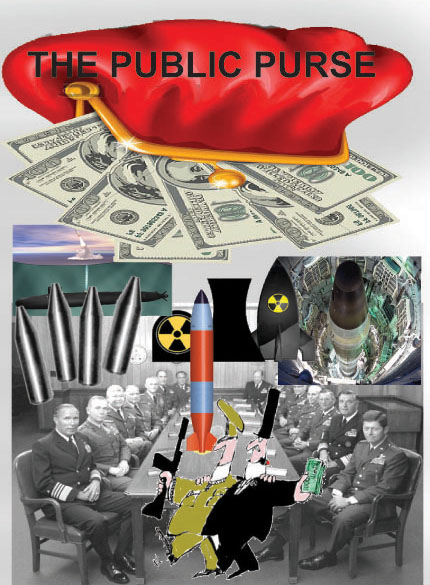
As Hartung writes, Congress is bought by the weapons industry. It is a kind of money laundering scheme where increased military spending comes back as campaign donations, a perfect example of the legalized bribery that is the real governing system of the U.S.
BY PATRICK MAZZA, CounterPunch 8 June 23
Once again, while other needs are squeezed, a federal budget deal will literally starve the poor to feed the military. While new work requirements are placed on SNAP recipients that will drive some from the food support program, the military budget (never call it defense) remains untouched. The recent debt ceiling deal leaves Joe Biden’s $886 billion 2024 Pentagon budget request intact while domestic programs are slashed.
In real terms it is the largest military budget in U.S. history, the only exceptions being World War II and the height of the Iraq and Afghanistan wars that came after 9-11. Larger by far than during the Korean and Vietnam Wars, or the Reagan military buildup.
The real military budget is even higher. Adding in nuclear weapons, foreign military aid and “intelligence,” the project puts the current 2023 budget at $920 billion. That is still an undercount. William Hartung, an expert on military spending, calculates that even in fiscal year 2020 the total military expenditure was $1.25 trillion, adding in other costs such as support for veterans and debt service. It’s easily pushing $1.5 trillion by now.
The U.S. by far is the biggest military spender on Earth, with 39% of the total, exceeding the next 10 nations combined, as this chart [on original] shows:
So why is the military budget so unassailable? Why, no matter how often bloated military spending is denounced, does the budget climb toward ever greater heights? Even after Dwight Eisenhower made the famous warning in his farewell address:
“In the councils of government, we must guard against the acquisition of unwarranted influence, whether sought or unsought, by the military-industrial complex. The potential for the disastrous rise of misplaced power exists and will persist. We must never let the weight of this combination endanger our liberties or democratic processes. We should take nothing for granted. Only an alert and knowledgeable citizenry can compel the proper meshing of the huge industrial and military machinery of defense with our peaceful methods and goals, so that security and liberty may prosper together.
Ike would have known, being one of the progenitors of that complex as the general leading U.S. forces that invaded Europe during D-Day and as the president during the nuclear buildup of much of the early Cold War. One clue as to why his warning went unheeded is in the fact he originally wanted to call it the military-industrial-congressional complex, the “iron triangle” that keeps pumping up military expenditures. As Hartung writes, Congress is bought by the weapons industry. It is a kind of money laundering scheme where increased military spending comes back as campaign donations, a perfect example of the legalized bribery that is the real governing system of the U.S.
But there are deeper reasons, explaining why that “alert and knowledgeable citizenry” for which Ike called has never appeared, at least to the level able to tie back the power of the complex. War and militarism are rooted deep in the U.S. of American experience. As former President Jimmy Carter said, “If you go around the world and ask people which is the most warlike country on Earth, which one do you think they would respond? The United States. Since we left the Second World War, and even before, the United States has constantly been at war in some part of the world. We’ve been in about 30 combats with other countries since the Second World War . . . So I would say that the military-industrial complex, the manufacturers of all kinds of weapons, are very influential in the country and the Congress as well.”
Carter noted that the U.S. hasn’t been at war with someone only 16 years of its 242-year history. (Even that is doubtful ……………………………………………….
We are enmeshed in the ways of empire.
“Empire became so intrinsically our American way of life that we rationalized and suppressed the nature of our means in the euphoria of the enjoyment of the ends . . . It is perhaps a bit too extreme, but only by a whisker, to say that imperialism has been the opiate of the American people.”………………………………………………………………………………………………………….
The planet’s economist: has Kate Raworth found a model for sustainable living?

Her hit book Doughnut Economics laid out a path to a greener, more equal society. But can she turn her ideas into meaningful change?
by Hettie O’Brien, Guardian, 8 June 23
The problem is that there are few templates for an economy that
radically shrinks the world’s carbon footprint without also shrinking our
quality of life. The economist Kate Raworth believes she has a solution.
It is possible, she argues, to design an economy that allows humans and the
environment to thrive. Doing so will mean rejecting much of what defined
20th-century economics. This is the essential premise of her only book,
Doughnut Economics: Seven Ways to Think Like a 21st Century Economist,
which became a surprise hit when it was published in 2017.
The book, which
has been translated into 21 languages, brings to mind a charismatic
professor dispensing heterodox wisdom to a roomful of students. “Citizens
of 2050 are being taught an economic mindset that is rooted in the
textbooks of 1950, which in turn are rooted in the theories of 1850,”
Raworth writes.
By exposing the flaws in these old theories, such as the
idea that economic growth will massively reduce inequality, or that humans
are merely self-interested individuals, Raworth wants to show how our
thinking has been constrained by economic concepts that are fundamentally
unsuited to the great challenges of this century.
Guardian 8th June 2023
Canada’s controversial nuclear waste disposal design for Chalk River

How safe is the Ottawa River from nuclear waste? Canada’s National Observer April 8th 2019 “……..Nuclear disposal site design
The proposed Near Surface Disposal Facility is not new technology, according to its proponents. The same technology set for Chalk River has also been adopted in the U.K. and Belgium, the company says.
The key component is an engineered containment mound. It is contained by a large cover system designed to keep out rain and other elements. Below the cover, a liner system is meant to collect contaminated water — and alert monitoring systems to leaks — and direct the effluent to treatment systems.
The timeline for the project is monumental. The mound will be filled with low-level nuclear waste that is currently held on site at Chalk River, as well as a small amount of waste that will be transported to the facility from other locations such as hospitals, universities and other nuclear facilities in Canada. Five per cent of the total waste will come from Whiteshell Laboratories in Manitoba, which is undergoing its own decommissioning process.

The waste in the mound would be split into cells according to contaminants or time for decay. A temporary cover would allow time to add radioactive waste for 50 years. When the site is full it would be permanently sealed.
The site would be monitored for 300 years after the permanent cover is installed at which point the radioactive material will have decayed. The facility is designed to last 550 years, the company says.
The radioactive waste inside the mound will break down. The half-life for tritium is around 12 years, and the half-life for strontium-90 is about 29 years. That means half of the tritium or strontium stored on the site decays during that period, with half of the remainder taking a further 12 or 29 years to decay. The process keeps repeating itself until ultimately all the material has broken down.
The engineered containment mound is CNL’s preferred nuclear waste storage option. In its draft environmental impact statement, CNL includes a discussion of the various other types of disposal options and techniques including deep-underground repositories, above-ground cement vaults and different on-and off-site locations.
In an opinion article in the Ottawa Citizen in April 2018, Eva Schacherl, a former executive director of the Canadian Environmental Network, argued the project was “the wrong plan at the wrong site,” and a vault buried hundreds of metres deep below the grounds should have been chosen.
In a draft environmental assessment, the lab did not conduct geological tests far below the surface. Although the deep-underground method provides additional protections against leakage, CNL says there is not enough evidence to outweigh the benefits of its chosen model.
A deep-underground vault would be much more expensive to monitor and maintain over its life cycle, according to CNL’s analysis. CNL has made several changes to the proposal since public consultations began in May 2016, in response to some of the hundreds of initial comments by the public during an ongoing environmental assessment.
Ottawa Riverkeeper advocates a type of facility that does not come into contact with water. “We want a solution that will safeguard all species from the radioactive waste that is currently onsite at Chalk River and Rolphton,” Riverkeeper said in a Nov. 1 update. “We would like to see Canada look to countries like Finland who have constructed siloed geological repositories to safeguard all levels of radioactive waste. We want a disposal facility where radioactive waste does not come into contact with water.”
CNL acknowledged during an interview for this story that it was not transparent enough during the environmental impact statement process in explaining why the particular location near the Ottawa River on the CRL site was the best choice.
Subsequent studies, analyses and updates to the document are part of the delay that will push the delivery of CNL’s final environmental impact statement to the CNSC for approval back to around spring 2020, according to the company. The delay was also caused by technical questions from provincial and government agencies that have required additional study, including a notable point where nuclear waste is discharged into Perch Lake.
The public comment process has led to other significant changes to the project design. The original project was meant to hold predominantly low-level intermediate waste, but also allowed for about one per cent intermediate-level waste or mixed wastes. The company has now decided to restrict the waste going into the storage facility to only the low-level category.
The change was purely driven by feedback from the community, the company representatives said. The site was never intended to hold high-level waste, such as spent nuclear fuel from a reactor.
“It’s in response to concerns from the public or interest groups,” said Meggan Vickerd, director of the nuclear waste facility project for CNL. “Intermediate-level waste was only a fraction of the inventory, plus it was not all of the intermediate-level waste, so we knew we still needed another facility.”
Controversy over near-surface disposal
The company says the project prompted hundreds of public comments during its opening consultation phase. Pat Quinn, CNL’s communications director, says the company is dedicated to transparency and open communication.
Activist organizations and Indigenous groups have raised a number of red flags about the suggested nuclear waste site and the overall security of decommissioning, including its construction about one kilometre away from the river.
Riverkeeper has also emphasized that despite the Canadian government’s rhetoric about the importance of a Nation to Nation relationship, “there has been no consultation with Indigenous Governments to develop a radioactive waste policy on terms that would be acceptable to Indigenous peoples.
“Likewise, there has been no consultation with the Algonquin Anishinaabe people about consolidating all federal radioactive wastes within their traditional, unsurrendered territory.”
Some local farmers have also expressed concern. One is Taylor Hanrath, an organic pork farmer and the owner of Butternutty Farm who lives downstream in Pembroke.
“If there’s a leak at all, in some way, shape, or form it would have the pretty big Ottawa River right beside it to transport it quickly and there’s always going to be the potential for human error, on top of a possible earthquake or tornado.” Hanrath said. “Even right now I don’t know what the plan would be for my farm if a leak were to happen at the current site.”
………The International Atomic Energy Agency indicates better ways to store nuclear waste are to bury it in “caverns, vaults, or silos, at least a few tens of metres below ground level, and up to a few hundred metres below ground level.” It does state, however, that a near-surface facility would be sufficient for low-level waste, such as decommissioned structures, old laboratory materials and soil.
Chalk River: Radioactive Wastes and the Honour of the Crown
Background: May 9, 2023
A consortium of multinational corporations, operating under the banner CNL (Canadian Nuclear Laboratories), is contracted to manage all of the federal government’s nuclear facilities. The contract obliges CNL to “reduce the liability” associated with the multibillion dollar legacy of radioactive wastes created in the name of the Crown by uranium processing (mainly at Port Hope, Ontario) and by nuclear fission (mainly at Chalk River). CNL has been given close to a billion dollars a year for the last five years from Canadian taxpayers.
The Port Hope and Chalk River nuclear facilities are outgrowths of the World War II Atomic Bomb project and the subsequent Cold War era. Canada sold uranium and plutonium almost exclusively for nuclear weapons use from 1941 to 1965. In a very real sense, the “legacy radioactive wastes” at these two sites are in large part leftovers of the American bomb program and the Cold War arms buildup.
How does CNL propose to deal with the radioactive legacy of the nuclear age? At Chalk River, CNL proposes to build a huge earthen mound of “low-level” radioactive and toxic chemical wastes within one kilometre of the Ottawa River. The low-level waste is a minute fraction of the total radio-toxic burden at Chalk River, which includes highly radioactive reactor cores, tanks of reprocessing liquid, plutonium handling facilities, and large quantities of high-level and intermediate-level radioactive wastes for which there is as yet no plan at all. The mound is a cheap and convenient way of dealign with the most voluminous material, clearing the decks for building new facilities that will produce even more challenging forms of nuclear wastes, while ignoring the bulk of the radioactivity that afflicts this “Nuclear Sacrifice Zone”.
The engineered mound – a glorified landfall 5 to 7 stories high – will hold a million cubic metres of toxic waste, on a site that drains into Perch Lake and then into the Ottawa River. Called a “Near Surface Disposal Facility” (NSDF), this megadump is planned to be built on lthe unsurrendered territory of several Algonquin communities that have inhabited the Ottawa Valley for thousands of years.
Canada’s nuclear regulator, the Canadian Nuclear Safety Commission (CNSC) conducted an environmental assessment of the NSDF and held a week of public hearings in February 2022. Since then, two Algonquin communities – the Keboawek First Nation (KFN) and the Kitigan Zibi Anishinabeg (KZA) community, have demonstrated their strong opposition to the proposed megadump, as have more than a hundred communities downstream from Chalk River, including the 18 municipalities comprising the Montreal City Agglomeration Council. KFN has done outstanding work in documenting several key species inhabiting the proposed site that have been totally ignored by the environmental assessment process.CNL is now asking CNSC to grant CNL a licence amendment to prepare the contested site for the NSDF.
Public hearings will be held remotely on June 27 with no opportunity for intervenors to appear in person before the Commission, despite strong requests from the Indigenous communities to allow face-to-face meetings.
All those who intervened in the February 2022 hearings are allowed no more than 5000 words to give their final input on this issue before CNSC renders its decision. Here is the final submission from the Canadian Coalition for Nuclear Responsibility.
Radioactive Wastes and the Honour of the Crown
Final report submitted to the Canadian Nuclear Safety Commission
by Gordon Edwards, president, Canadian Coalition for Nuclear Responsibility
www.ccnr.org/CCNR_CNSC_NSDF_final_2023.pdf
Contents –
1. The Honour of the Crown
2. Protecting the Environment & the Health and Safety of Persons
3. Communicating with Future Genera>ons
4. Safety Culture and the Justification Principle
5. A Tale of Two Dumps
6. List of radioactive poisons
Water levels at Zaporizhzhia nuclear plant ‘critical’ after dam collapsesin Ukraine.
Water levels at Zaporizhzhia nuclear plant ‘critical’ after dam collapses
in Ukraine. Water levels have fallen below a critical point for being able
to supply cooling water to the Zaporizhzhia nuclear power station, the
operator of the Kakhovka dam in Ukraine has said.
Mirror 8th June 2023
https://www.mirror.co.uk/news/world-news/breaking-water-levels-zaporizhzhia-nuclear-30109697
US presidential candidate Nikki Haley says that arming Ukraine is “preventing war”
US presidential candidate Nikki Haley insists on WW3 if Ukraine loses, 9 June 23, https://www.rt.com/news/577539-nikki-haley-ukraine-ww3-cheerleading/
The Republican presidential candidate explained that the only way to prevent war was to “send a message” by fighting one
Allowing Ukraine to lose to Russia on the battlefield will unleash world war, according to US Republican presidential candidate Nikki Haley. The former South Carolina governor told a town hall audience in Iowa on Sunday that arming Kiev was all about “preventing war” by “sending a message” to America’s rivals.
“When Ukraine wins, that sends a message to China with Taiwan, it sends a message to Iran that wants to build a bomb, it sends a message to North Korea testing ballistic missiles, it sends a message to Russia that it’s over.”
“It is in the best interests of America, it is in the best interests of our national security for Ukraine to win. We have to see this through, we have to finish it,” Haley declared.
Regarding how the war might finish, Haley was less forthcoming. “It would end in a day if Russia would pull out,” she suggested. “If Ukraine pulls out, then we’re all looking at world war.” To prevent that, she explained, Kiev needed weapons – lots of them.
“A win for Ukraine is a win for all of us, because tyrants tell us exactly what they’re gonna do,” Haley continued, claiming “Russia said Poland and the Baltics are next,” should Ukraine fall. “If that happens, we’re looking at a world war,” she repeated.
While much has been written about the possibility of a Russian invasion of Poland or the Baltic states, even most US experts admit these are unlikely. Invading any of those countries would trigger Article 5, NATO’s mutual-defense clause, turning a conflict many have described as a proxy war between Moscow and Brussels into a direct war between nuclear powers.
Haley has been quick to set herself apart on foreign policy matters from Republican frontrunner Donald Trump, who quipped earlier this year that it was the US, not Russia, that needed regime change, and from challenger Ron DeSantis, who downplayed the conflict in Ukraine as a “territorial dispute.”
During the town hall, she again scoffed at the notion of remaining neutral in the conflict, insisting “This is a war about freedom and it’s one we have to win.”
While Haley served as US ambassador to the United Nations under Trump, she made no secret of her interventionist leanings, even announcing an unexpected round of sanctions against Russia that the White House then had to retract. She has urged the Biden administration to give in to Ukrainian President Vladimir Zelensky’s demands for F-16 fighter jets for months and impose even more sanctions, insisting Washington is too soft on Moscow.
The Zaporizhzhia nuclear plant used water from the destroyed Nova Kakhovka dam. What happens now?
By Felicity Ripper with wires, ABC, 9 June 23
One of the world’s largest nuclear power plants relies on a water reservoir linked to the destroyed Nova Kakhovka dam.
So what does that mean for the Zaporizhzhia Nuclear Power Plant?
What is the relationship between Nova Kakhovka dam and the Zaporizhzhia plant?
The main line of water used at the plant is pumped out of the reservoir above the dam, and up to the site.
This reservoir is currently draining because the downstream dam has collapsed………………………
But isn’t the plant in shutdown?
Zaporizhzhia was placed in a cold shutdown in September 2022.
While it doesn’t need the large amounts of water it would while operating normally, it still needs some supplies for cooling.
Dwindling water supplies also complicate any future prospects of restarting the power plant.
Has the plant lost its water supply from the dam reservoir?
Not yet.
International Atomic Energy Agency (IAEA) chief Rafael Grossi said water could still be pumped out for a few days after the dam’s collapse.
“The rate may reduce as the water lowers,” he said.
Mr Grossi on Tuesday said that the water in the reservoir was sitting at 16.5m, and once it reached 2.7m it could no longer be pumped out.
He said while there was no reason for panic, the plant was facing a serious situation. ………………………….. https://www.abc.net.au/news/2023-06-09/explainer-zaporizhzhia-nuclear-nova-kakhovka/102454194
Letter. Nuclear plan raises suspicions
By Carrie Parks, Vancouver, June 9, 2023, https://www.columbian.com/news/2023/jun/09/letter-nuclear-plan-raises-suspicions/
I am opposed to using my ratepayer money to subsidize a study for Energy Northwest (Formerly WPPSS or “Whoops”) to start developing small modular nuclear reactors.
First, this idea seems to be getting rushed through without enough public attention or comment. That raises my suspicions right there. Second, WPPSS already stuck the taxpayers of this state once before with huge expenses when nuclear power failed, causing the second-largest municipal bond default in U.S. history.
Third, they are justifying nuclear power to help get us off fossil fuels, but this is a false argument. We still have no way to safely store nuclear waste, which can remain dangerously radioactive for thousands of years. So to build multiple plants that will create more such waste will only substitute one type of environmental poison for another.
We need to find solutions that work in concert with nature, not ones that destroy it. I suggest you review the website https://www.drawdown.org/, which has many practical, science-based ways to both conserve and create energy to meet our needs in a much safer and responsible manner.
Are We Back to Nuclear Brinkmanship for Good?
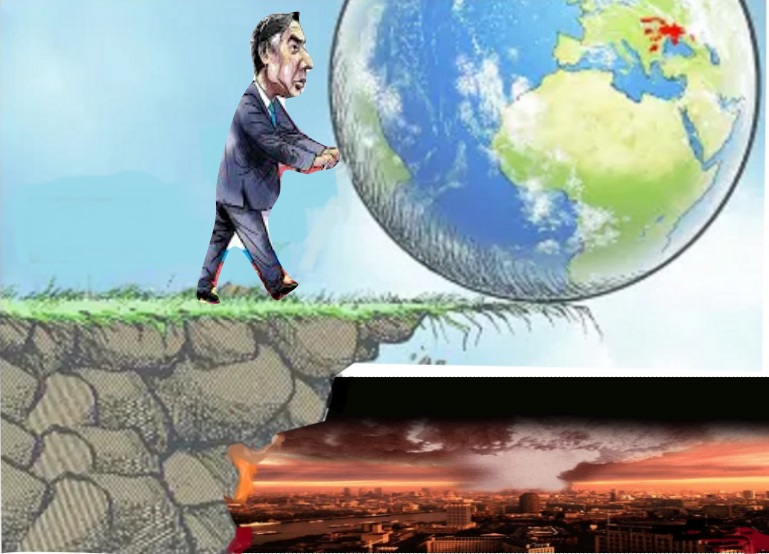
It’s not just Putin who has re-embraced nuclear threats. The U.S. and China are also cracking open the door.
By Michael Hirsh, a columnist for Foreign Policy. https://foreignpolicy.com/2023/06/09/nuclear-brinksmanship-arms-control-jake-sullivan-putin-china-russia/
Sixty years ago this week, U.S. President John F. Kennedy gave a speech at American University that transformed the nature of the Cold War, turning the insanity of nuclear brinkmanship into the relative safety of negotiation. Coming just eight months after the Cuban Missile Crisis brought the world harrowingly close to armageddon, Kennedy noted the “ironic but accurate fact that the two strongest powers [on earth] are the two in the most danger of devastation.”
That, he said, had to stop—not to achieve some “infinite concept of universal peace and goodwill” but rather to secure “a more practical, more attainable peace.”
In an act of political courage for the time, Kennedy then delivered a unilateral concession to Moscow, saying the United States “does not propose to conduct nuclear tests in the atmosphere so long as other states do not do so.”
Astonishingly, given the hostility between the United States and the Soviet Union, the Soviet government broadcast Kennedy’s June 10, 1963, address in its entirety, and it was published by the Soviet newspapers Izvestia and Pravda. On July 25, 1963, after only 12 days of negotiations, a nuclear test ban treaty was signed.
Where is the political courage of yesteryear?
In a speech at the Arms Control Association’s annual conference on June 2, U.S. National Security Advisor Jake Sullivan took a very different tack. Sullivan signaled—though he likely didn’t intend to—that there is little hope for restraining the threat of nuclear war in the foreseeable future. Sullivan conceded that there was no meaningful U.S. communication with either Russia or China, that Washington was engaging in tit-for-tat reprisals against Moscow by suspending day-to-day missile operations notification, and that the United States would continue to push for military dominance over both Russia and China for decades to come.
Sullivan, rightly blaming Russian President Vladimir Putin for bringing nuclear brinkmanship back into the conventional war equation, said “the cracks in our post-Cold War nuclear foundation are substantial and they are deep.” But in the end, Matthew Bunn, a nuclear expert at Harvard University, told Foreign Policy, Sullivan “offered nothing, no proposals.”
To be fair, the Biden administration is already being criticized by Republicans for proposing unconditional nuclear talks with both Russia and China. Indeed, U.S. President Joe Biden is clearly avoiding what may be his biggest foreign-policy fear leading up to the 2024 presidential election: the perception of being soft on China. That sort of political pressure at home, combined with Chinese President Xi Jinping’s apparent determination to rapidly build up his nuclear capability, suggests a long-term arms race.
Yet Sullivan did little to ameliorate those fears last week. On the contrary, he announced that the United States is pursuing an arms race in order to prevent an arms race. “Together with our NATO allies, we’ve been laser-focused on modernizing the alliance’s nuclear capabilities,” Sullivan said, including “certifying our F-35 aircraft to be able to deliver modern nuclear gravity bombs. … Together, these modernization efforts will ensure our deterrent capabilities remain secure and strong as we head into the 2030s—when the United States will need to deter two near-peer nuclear powers for the first time in its history.”
Sullivan denied that he was calling for a new arms race, contending the Biden administration was taking a “better” approach rather than a “more” one. “The United States does not need to increase our nuclear forces to outnumber the combined total of our competitors in order to successfully deter them,” he said. But Sullivan was basically telling the Chinese and Russians that Washington will continue to insist on precisely what both Beijing and Moscow have said they can no longer accept: U.S. hegemony in the global system.
As a result, Bunn said, “I’m fairly worried that we have a level of hostility that is the worst since the Cuban Missile Crisis.”
TODAY. What is Zelensky’s “peace formula”, and why on Earth are we backing it?
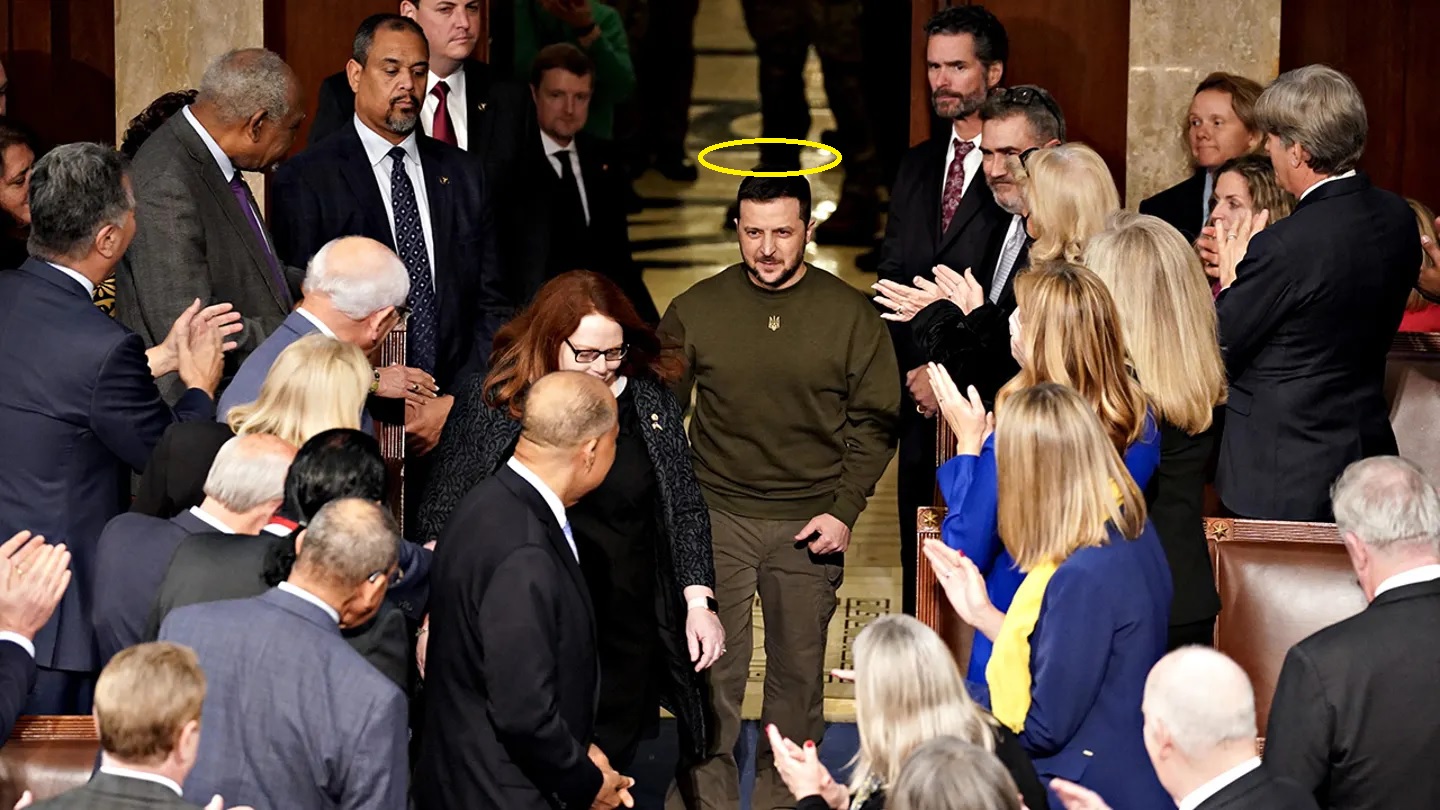
The “peace formula” is a list of Zelensky’s demands first revealed in November 2022, ranging from Russia’s withdrawal from all territories Ukraine claims – including Crimea and the Donbass – payment of reparations, war crimes trials for the Russian leadership, and Ukraine’s membership in NATO.
USA, NATO, and all “like-minded countries” are mindlessly pouring weapons into Ukraine, putting up with the effects of economic sanctions, putting up with a tsunami of anti-Russian propaganda and distortion of history. We’re agonising over Russian atrocities, but completely ignoring Ukrainian atrocities.
It would be laughable if it were not so serious. We’re supplying weapons for Ukrainian troops some wearing NAZI insignia, at the very same time that we are condemning and banning NAZI insignia in Western countries.
There has been no attempt by our great leader, USA, to allow negotiations with Russia, (which Zelensky, earlier on, actually wanted). No attempt to understand the pain of ethnic Russians in Ukraine, of 8 years of war in the Donbass, with many there wanting autonomy from Ukraine. The reality of Crimea, reasonably comfortable, with its large Russian population, as now part of Russia. The reality of Russia seeing its virtually complete encirclement by NATO , with Ukraine as NATO member, as utterly unacceptable.
Zelensky’s “peace formula” is impossible – and everyone knows that. Carried away by his own charisma, Zelensky is plunging his people into dreadful destruction.
USA and NATO glorify this fool, as they pursue their war-mongering goal. And we, Western media consumers, join in this adoration.
Kiev’s Long Term Plans To Blow Up The Kakhovka Dam

June 6, 2023 by Raúl Ilargi Meijer https://www.theautomaticearth.com/2023/06/kievs-long-term-plans-to-blow-up-the-kakhovka-dam/
I had some discussion with Andrew about this article, since the December 2022 WaPo article he refers to was not the first time Kiev’s plans to blow up the dam were mentioned. There was this, for instance, 2 months earlier. Then again, Andrew is right in saying that the WaPo piece is the first where people other than Zelensky mention it. And we agree that now blaming the attack on Russia is really out of left field. Those darn Russkies keep on aiming for their own feet. And that’s the only thing(s) they can hit.
Andrew Korybko:
The partial destruction of the Kakhovka Dam on early Tuesday morning saw Kiev and Moscow exchange accusations about who’s to blame, but a report from the Washington Post (WaPo) in late December extends credence to the Kremlin’s version of events. Titled “Inside the Ukrainian counteroffensive that shocked Putin and reshaped the war”, its journalists quoted former commander of November’s Kherson Counteroffensive Major General Andrey Kovalchuk who shockingly admitted to planning this war crime:
“Kovalchuk considered flooding the river. The Ukrainians, he said, even conducted a test strike with a HIMARS launcher on one of the floodgates at the Nova Kakhovka dam, making three holes in the metal to see if the Dnieper’s water could be raised enough to stymie Russian crossings but not flood nearby villages. The test was a success, Kovalchuk said, but the step remained a last resort. He held off.”
His remark about how “the step remained a last resort” is pertinent to recall at present considering that the first phase of Kiev’s NATO–backed counteroffensive completely failed on Monday according to the Russian Ministry of Defense. Just like Ukraine launched its proxy invasion of Russia in late May to distract from its loss in the Battle of Artyomovsk, so too might does it seem to have gone through with Kovalchuk’s planned war crime to distract from this most recent embarrassment as well.
The abovementioned explanation isn’t as far-fetched as some might initially think either. After all, one of complexity theory’s precepts is that initial conditions at the onset of non-linear processes can disproportionately shape the outcome. In this context, the first failed phase of Kiev’s counteroffensive risked ruining the entire campaign, which could have prompted its planners to employ Kovalchuk’s “last resort” in order to introduce an unexpected variable into the equation that might improve their odds.
Russia had over 15 months to entrench itself in Ukraine’s former eastern and southern regions that Kiev still claims as its own through the construction of various defensive structures and associated contingency planning so as to maintain its control over those territories. It therefore follows that even the most properly supplied and thought-out counteroffensive wasn’t going to be a walk in the park contrary to the Western public’s expectations, thus explaining why the first phase just failed.
This reality check shattered whatever wishful thinking expectations Kiev might have had since it showed that the original plan of swarming the Line of Contact (LOC) entails considerable costs that reduce the chances of it succeeding unless serious happens behind the front lines to distract the Russian defenders. Therein lies the strategic reason behind partially destroying the Kakhovka Dam on Tuesday morning exactly as Kovalchuk proved late last year is possible to pull off per his own admission to WaPo.
The first of Kiev’s goals that this terrorist attack served was to prompt global concern about the safety of the Russian-controlled Zaporozhye Nuclear Power Plant, which relies on water from the now-rapidly-depleting Kakhovka Reservoir for cooling. The International Atomic Energy Agency said that there’s “no immediate nuclear safety risk”, but a latent one can’t be ruled out. Should a crisis transpire, then it could throw Russia’s defenses in northern Zaporozhye Region into chaos.
The second goal is that the downstream areas of Kherson Region, which are divided between Kiev and Moscow, have now been flooded. Although the water might eventually recede after some time, this could complicate Russia’s defensive plans along the left bank of the Dnieper River. Taken together with the consequences connected to the first scenario, this means that a significant part of the riparian front behind the LOC could soon soften up to facilitate the next phase of Kiev’s counteroffensive.
In fact, the geographic scope of Kiev’s “unconventional softening operation” might even expand to Crimea due to the threat that Tuesday morning’s terrorist attack could pose to the peninsula’s water supply via its eponymous canal. The regional governor said that sufficient supplies remain for now but that the coming days will reveal the level of risk. While Crimea still managed to survive Kiev’s blockade of the canal for eight years, there’s no doubt that this development is disadvantageous for Russia.
The fourth strategic goal builds upon the three that were already discussed and concerns the psychological warfare component of this attack. On the foreign front, Kiev’s gaslighting that Moscow is guilty of “ecocide” was amplified by the Mainstream Media in spite of Kovalchuk’s damning admission to WaPo last December in order to maximize global pressure on Russia, while the domestic front is aimed at sowing panic in Ukraine’s former regions with the intent of further softening Russia’s defenses there.
And finally, the last strategic goal that was served by partially destroying the Kakhovka Dam is that Russia might soon be thrown into a dilemma. Kiev’s “unconventional softening operation” along the Kherson-Zaporozhye LOC could divide the Kremlin’s focus from the Belgorod-Kharkov and Donbass fronts, which could weaken one of those three and thus risk a breakthrough. The defensive situation could become even more difficult for Russia if Kiev expands the conflict by attacking Belarus and/or Moldova too.
To be absolutely clear, the military-strategic dynamics of the NATO-Russian proxy war in Ukraine still favor Russia for the time being, though that’s precisely why Kiev carried out Tuesday morning’s terrorist attack in a desperate attempt to reshape them in its favor. This assessment is based on the observation that Russia’s victory in the Battle of Artyomovsk shows that it’s able to hold its own against NATO in the “race of logistics”/“war of attrition” that the bloc’s chief declared in mid-February.
Furthermore, even the New York Times admitted that the West’s sanctions failed to collapse Russia’s economy and isolate it, while some of its top influencers also admitted that it’s impossible to deny the proliferation of multipolar processes in the 15 months since the special operation began. These include German Chancellor Olaf Scholz, former US National Security Council member Fiona Hill, and Goldman Sachs’ President of Global Affairs Jared Cohen.
The military-strategic dynamics described in the preceding two paragraphs will inevitably doom the West to defeat in the New Cold War’s largest proxy conflict thus far unless something major unexpectedly happens to change them, which is exactly what Kiev was trying to achieve via its latest terrorist attack. The reason why few foresaw this is because Kovalchuk admitted to WaPo last December that his side had previously planned to blow up part of the Kakhovka Dam as part of its Kherson Counteroffensive.
It therefore seemed unthinkable that Kiev would ultimately do just that over half a year later and then gaslight that Moscow was to blame when the Mainstream Media itself earlier reported the existence of Ukraine’s terrorist plans after quoting the same Major General who bragged about them at the time. Awareness of this fact doesn’t change what happened, but it can have a powerful impact on the Western public’s perceptions of this conflict, which is why WaPo’s report should be brought to their attention.
Patrick Lawrence: Neo-Nazis in Ukraine? No, Yes, No–Yes
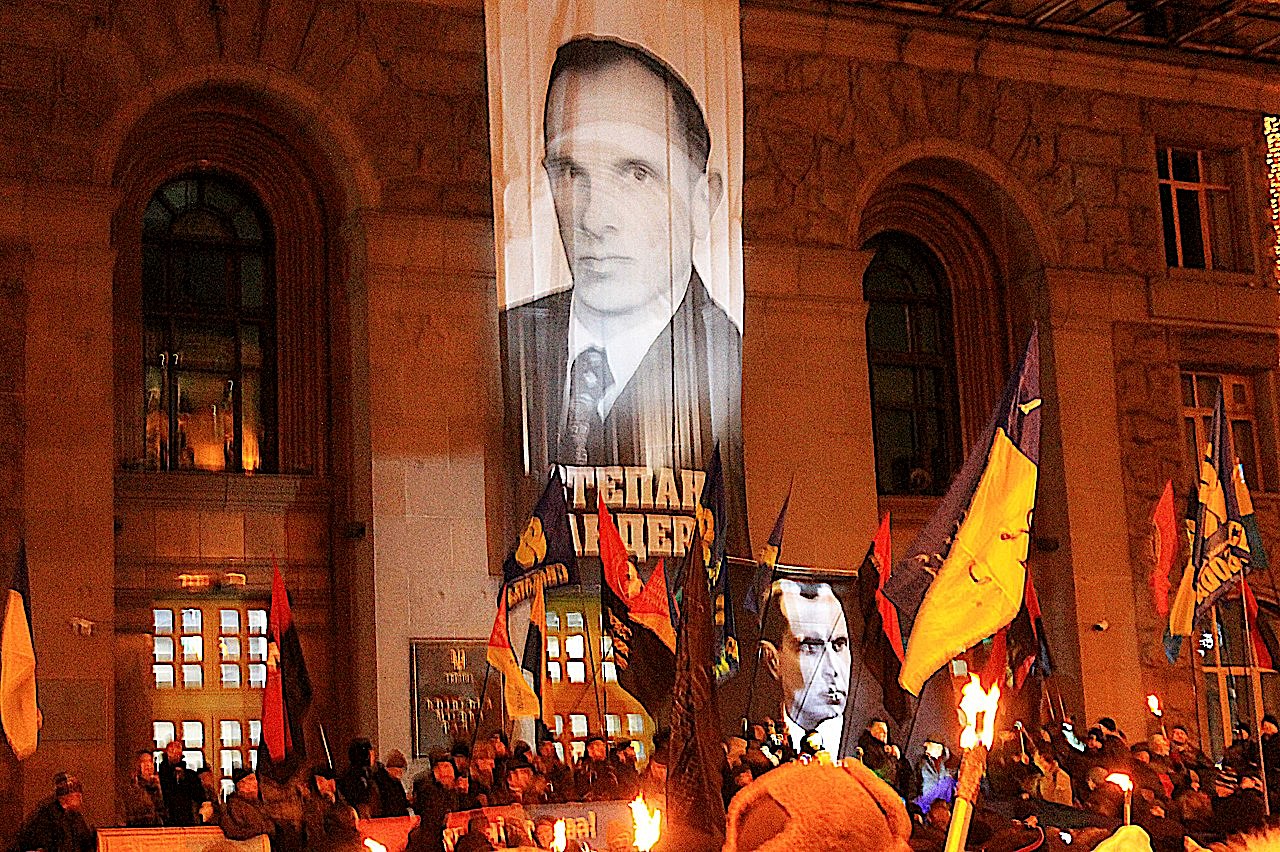
Stepan Bandera torchlight parade in Kiev, Jan. 1, 2020. (A1/Wikimedia Commons)
As is well-known and documented, the neo–Nazis who infest the Armed Forces of Ukraine, the AFU — among many other national institutions — have made idols of such figures as Stepan Bandera, the freakishly murderous nationalist who allied with the Nazi regime during the war.
A New York Times’ reporter’s job this week is to persuade us that all those Ukrainian soldiers wearing Nazi insignia and marching through Kiev in Klan-like torch parades are not what you think.
June 7, 2023, By Patrick Lawrence, Original to ScheerPost
I tell you, serving as a New York Times correspondent these days cannot be easy.
You have to convey utter nonsense to your readers while maintaining a straight face and a serious demeanor.
You have to suggest the Russians may have exploded a drone over the Kremlin, that they may have blown up their own gas pipeline, that their president is an out-of-touch psychotic, that their soldiers in Ukraine are drunkards using faulty equipment, that they attack with “human hordes” (Orientalism, anyone?) and on and on — all the while affecting the gravitas once associated with the traditional “Timesman.” You try it sometime.
………………….. now we have the case of Thomas Gibbons–Neff, a square-jawed former Marine covering the Ukraine war for the Times — strictly to the extent the Kyiv regime permits him to do so, as he explains with admirable honesty. This guy is serious times 10, he and his newspaper want us to know.
Tom’s job this week is to persuade us that all those Ukrainian soldiers wearing Nazi insignia, idolizing Jew-murdering, Russophobic collaborators with the Third Reich, gathering ritually in Nazi-inspired cabals, marching through Kyiv in Klan-like torch parades are not what you think.
Nah, our Tom tells us. They look like neo–Nazis, they act like neo–Nazis, they dress like neo–Nazis, they profess Fascist and neo–Nazi ideologies, they wage this war with the Wehrmacht’s visceral hatred of Russians — O.K., but whyever would you think they are neo–Nazis?
They are just regular guys. They wear the Wolfsangel, the Schwarze sonne, the black sun, the Totenkopf, or Death’s Head — all Nazi symbols — because they are proud of themselves, and these are the kinds of things proud people wear. I was just wearing mine the other day.
The slipping and sliding starts early in “Nazi Symbols on Ukraine’s Front Lines Highlight Thorny Issues of History,” the piece Gibbons–Neff published in Monday’s editions.
He begins with three photographs of neo–Nazi Ukrainian soldiers, SS insignia plainly visible, that the Kyiv regime has posted on social media, “then quietly deleted,” since the Russian intervention began last year.
“The photographs, and their deletions,” Gibbons–Neff writes, “highlight the Ukrainian military’s complicated relationship with Nazi imagery, a relationship forged under both Soviet and German occupation during World War II.”
Complicated relationship with Nazi imagery? Stop right there, Mr. Semper fi. Ukraine’s neo–Nazi problem is not about a few indiscreetly displayed images. Sorry. The Ukrainian army’s “complicated relationship” is with a century of ultra-right ideology drawn from Mussolini’s Fascism and then the German Reich.
As is well-known and documented, the neo–Nazis who infest the Armed Forces of Ukraine, the AFU — among many other national institutions — have made idols of such figures as Stepan Bandera, the freakishly murderous nationalist who allied with the Nazi regime during the war.
This history is a matter of record, as briefly outlined here, but Gibbons–Neff alludes to none of it. It’s merely a matter of poor image-making, you see. In support of this offensive whitewash, Gibbons–Neff has the nerve to quote a source from none other than Bellingcat, which was long, long back exposed as a C.I.A. and MI6 cutout and which is now supported by the Atlantic Council, the NATO–funded, spook-infested think tank based in Washington.
“What worries me, in the Ukrainian context, is that people in Ukraine who are in leadership positions, either they don’t or they’re not willing to acknowledge and understand how these symbols are viewed outside of Ukraine,” a Bellingcat “researcher” named Michael Colborne tells Gibbons–Neff. “I think Ukrainians need to increasingly realize that these images undermine support for the country.”
[Related: Ukraine Parliament Cheers Nazi Collaborator]
Think about that. The presence of Nazi elements in the AFU is not a worry. The worry is merely whether clear signs of Nazi sympathies might cause some members of the Western alliance to decide they no longer want to support Nazi elements in the AFU.
I am reminded of that Public Broadcasting news segment last year, wherein a provincial governor is featured with a portrait of Bandera behind him. PBS simply blurred the photograph and ran the interview with another of the courageous, admirable Ukrainians to which we are regularly treated.
I hardly need remind paying-attention readers that the neo–Nazis-who-are-not-neo–Nazis were for years well-reported as simply neo–Nazis in the years after the U.S.–cultivated coup in 2014.
[Related: Caitlin Johnstone: What MSM Can No Longer Say]
The Times, The Washington Post, PBS, CNN — the whole sorry lot — ran pieces on neo–Nazi elements in the AFU and elsewhere. In March 2018, Reuters published a commentary by Jeff Cohen under the headline “Ukraine’s Neo–Nazi Problem.”
Three months later The Atlantic Council, for heaven’s sake, published a paper, also written by Cohen, titled, “Ukraine’s Got a Real Problem with Far–Right Violence (And no, RT Didn’t Write This Headline).”
I recall, because it was so surprising coming from the council. The original head on that paper was “Ukraine’s Got a Neo–Nazi Problem,” but that version now seems lost to the blur of stealth editing.
Then came the Russian intervention, and Poof! There are no more neo–Nazis in Ukraine.
There are only these errant images that are of no special account.
And to assert there are neo–Nazis in Ukraine — to have some semblance of memory and a capacity to judge what is before one’s eyes — “plays into Russian propaganda,” Gibbons–Neff warns us.
It is to “give fuel to his”— Vladimir Putin’s — “false claims that Ukraine must be de–Nazified.” For good measure Gibbons–Neff gets out the old Volodymyr-Zelensky-is-Jewish chestnut, as if this is proof of… of something or other.
My mind goes to that lovely Donovan lyric from the Scottish singer’s Zen enlightenment phase. Remember “There Is a Mountain?” The famous lines went, “First there is a mountain/ Then there is no mountain/ Then there is.” There were neo–Nazis in Ukraine, then there were no neo–Nazis, and now there are neo–Nazis but they aren’t neo–Nazis after all.
………………………………….. Gibbons–Neff resolutely avoids dilating his lens such that the larger phenomenon comes into view. It all comes down to those three unfortunate insignia in those three deleted photographs.
The parades, the corridors of neo–Nazi flags, the ever-present swastikas, the reenactments of all-night SS rituals, the glorification of Nazis and Nazi collaborators, the Russophobic blood lust: Sure, it can all be explained, except that our Timesman does not go anywhere near any of this.
Gibbons–Neff resolutely avoids dilating his lens such that the larger phenomenon comes into view. It all comes down to those three unfortunate insignia in those three deleted photographs.
The parades, the corridors of neo–Nazi flags, the ever-present swastikas, the reenactments of all-night SS rituals, the glorification of Nazis and Nazi collaborators, the Russophobic blood lust: Sure, it can all be explained, except that our Timesman does not go anywhere near any of this.
“It is, of course, true that, for instance, the Azov Battalion was originally founded by neo–Nazi and far-right groups (as well as many soccer ultra-fans), which brought along with it the typical aesthetics — not only neo–Nazi insignia but also things like Pagan rituals or names like ‘The Black Corps,’ the official newspaper of Nazi Germany’s major paramilitary organization Schutzstaffel (SS).”
But worry not, readers. It is merely an aesthetic, part of a harmless, misunderstood “subculture”:
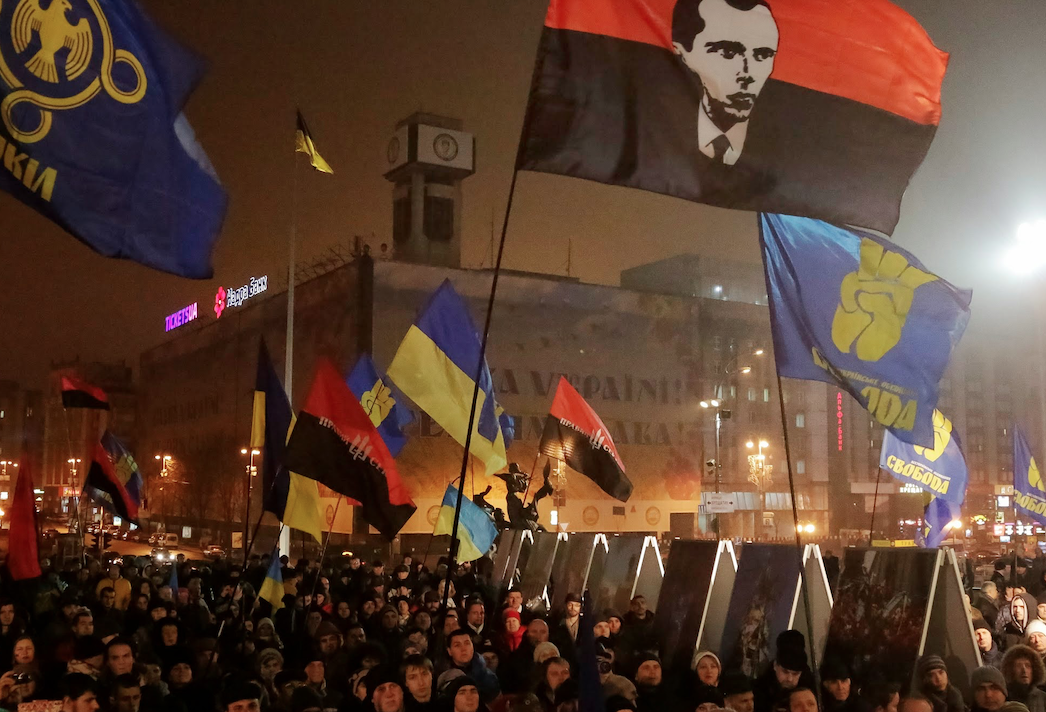
Torchlight procession in honor of the 106 anniversary of the birthday of Stepan Bandera, Kiev, Jan. 1, 2015. (All-Ukrainian Union CC BY 3.0, Wikimedia Commons)
…………………………………………….It is always interesting to ask why a piece such as this appears when it does. Dead silence for months on the neo–Nazi question, and then suddenly a long explainer that does its best to avoid explaining anything. Always interesting to ask, never easy to answer.
It could be that a lot of stuff on these awful people is sifting out from under the carpet. Or maybe something big is on the way and this piece is preemptive. Or maybe either Gibbons–Neff or his editors saw the Ponomarenko piece as an opportunity to dispose of one of the Kyiv regime’s most embarrassing features.
Or maybe the larger context counts here. As mentioned in this space last week, the Times’ Steve Erlanger recently suggested from Brussels that NATO might do a postwar Germany job with Ukraine: Welcome the West of the country to the alliance and let the eastern provinces go for an indefinite period, unification the long-term objective.
Late last week Foreign Affairs ran a fantastical piece by Andriy Zagorodnyuk, formerly a Ukrainian defense minister and now, yes indeedy, a distinguished fellow at the Atlantic Council. It appeared under the headline, “To Protect Europe, Let Ukraine Join NATO—Right Now.” ……………………………………….more https://consortiumnews.com/2023/06/07/patrick-lawrence-neo-nazis-in-ukraine-no-yes-no-yes/?fbclid=IwAR2qutGUc886hz22JN9TvBgmNTXCb-dJwB1TvxPfsnvxCTT6d9yuEoeJOH8
France fully nationalises debt-laden nuclear power group EDF, after its record loss last year
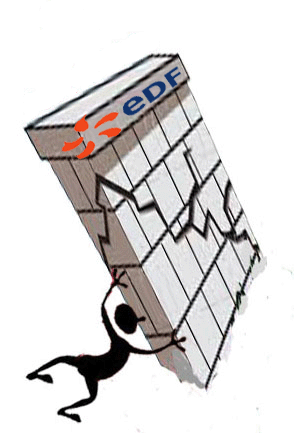
EDF quits Paris stock exchange after full nationalisation. French nuclear
power group EDF (EDF.PA) returns to full state ownership on Thursday with
its de-listing from the Paris stock exchange after it suffered a record
loss last year and saw nuclear output fall to a 34-year low.
The government launched a buyout for the 16% stake it did not already own in EDF in late
2022, stumping up around 10 billion euros ($10.9 billion) to take full
control of the debt-laden operator of Europe’s largest fleet of nuclear
power plants.
Reuters 8th June 2023
https://www.reuters.com/business/energy/french-utility-giant-edfs-history-2022-07-08
-
Archives
- February 2026 (228)
- January 2026 (308)
- December 2025 (358)
- November 2025 (359)
- October 2025 (376)
- September 2025 (258)
- August 2025 (319)
- July 2025 (230)
- June 2025 (348)
- May 2025 (261)
- April 2025 (305)
- March 2025 (319)
-
Categories
- 1
- 1 NUCLEAR ISSUES
- business and costs
- climate change
- culture and arts
- ENERGY
- environment
- health
- history
- indigenous issues
- Legal
- marketing of nuclear
- media
- opposition to nuclear
- PERSONAL STORIES
- politics
- politics international
- Religion and ethics
- safety
- secrets,lies and civil liberties
- spinbuster
- technology
- Uranium
- wastes
- weapons and war
- Women
- 2 WORLD
- ACTION
- AFRICA
- Atrocities
- AUSTRALIA
- Christina's notes
- Christina's themes
- culture and arts
- Events
- Fuk 2022
- Fuk 2023
- Fukushima 2017
- Fukushima 2018
- fukushima 2019
- Fukushima 2020
- Fukushima 2021
- general
- global warming
- Humour (God we need it)
- Nuclear
- RARE EARTHS
- Reference
- resources – print
- Resources -audiovicual
- Weekly Newsletter
- World
- World Nuclear
- YouTube
-
RSS
Entries RSS
Comments RSS
 nuclear-news