Consent-based or bribery?
June 11, 2023 https://beyondnuclear.org/consent-based-or-bribery/
The US Department of Energy on June 9 announced it will direct $26 million to “groups of university, nonprofit, and private-sector partners” who will help communities decide that they want to be the recipients of the country’s irradiated reactor fuel.
Having abjectly failed to find any safe, long-term radioactive waste management “solution” — possibly because there is none — while also failing to halt the production of nuclear waste, the DOE has now moved to what it calls “consent-based siting”.
The DOE’s interpretation of this term is that the recipients of the $26 million will “work with communities interested in DOE’s community-centered approach to storing and disposing of spent nuclear fuel.” In addition they would “ensure transparency and local support.”
But if past examples are any indicator, the “consenting” communities are likely to be those most deprived of resources, especially Indigenous communities and communities of color, who may feel pressured to accept the DOE largesse along with the fatal outcomes of living alongside high-level radioactive waste.
While U.S. Secretary of Energy Jennifer M. Granholm, insists that “it is vital” that “DOE works to be good stewards of the nation’s spent nuclear fuel,” the end result is more likely to be dumping radioactive waste on communities whose “consent” and willingness is driven by economic hardship.
UN concerned by ‘discrepancy’ in Ukraine nuclear plant water levels after dam collapse
. IAEA head Rafael Grossi, who will visit Zaporizhzhia
nuclear plant, says there is a difference of about 2 metres from the
reservoir that cools the plant.
Guardian 12th June 2023
Zelensky Confirms Ukrainian Counteroffensive Has Started
by EDITORJune 12, 2023, https://scheerpost.com/2023/06/12/zelensky-confirms-ukrainian-counteroffensive-has-started/
Russia said Sunday that it had destroyed German-made Leopard tanks and US-made Bradley fighting Vehicles.
By Dave DeCamp / Antiwar.com
Ukrainian President Volodymyr Zelensky has confirmed that Ukrainian forces have started their long-awaited counteroffensive.
Throughout last week, Russia reported large Ukrainian attacks in the eastern Donbas region and in the southern Zaporizhzhia Oblast, but Ukrainian officials stayed quiet about the assaults. On Saturday, Zelensky said that “relevant counteroffensive defensive actions are taking place in Ukraine.”
Zelensky didn’t offer any details about the operations, which are being carried out with NATO equipment by NATO-trained troops. On Sunday, Russia said that it destroyed several German-made Leopard tanks and US-made Bradley Fighting Vehicles over the past 48 hours.
The Russian Defense Ministry claimed it has continued to repel Ukrainian attacks. “During the past day, the armed forces of Ukraine continued unsuccessful attempts of offensive actions in the Donetsk, southern Donetsk, and Zaporizhzhia directions,” the ministry said.
Ukrainian officials on Sunday claimed that their forces made gains in Donetsk. Neither the Russian or Ukrainian claims have been confirmed, but it’s clear there has been steady fighting both in the Donbas and in Zaporizhzhia, and US officials have acknowledged to CNN that Ukraine is taking heavy casualties.
The US has been pushing for a counteroffensive instead of peace talks as the Biden administration is against the idea of a ceasefire in Ukraine. US officials told POLITICO that they believe President Biden’s reputation and continued US support for Ukraine hinges on the success of the counteroffensive.
As Japan prepares to release Fukushima nuclear waste water – a reminder that countries can ban goods with radiation contamination risks
Banning goods with radiation contamination risks can pressure Tokyo, say analysts, as Japan prepares to start nuclear-contaminated wastewater dumping trials
By Wan HengyiPublished: Jun 11, 2023
2
Japan’s unilateral decision to discharge nuclear-contaminated wastewater into the sea disregards international law and public opinion, said analysts on Sunday, one day before Tokyo Electric Power Company (TEPCO), the operator of the crippled Fukushima Daiichi nuclear power plant, starts trial operations of equipment for dumping nuclear-contaminated wastewater into the Pacific Ocean.
Some analysts believe that resisting goods with potential nuclear radiation contamination risks can be extended to other regions apart from Fukushima in Japan and products beyond seafood in accordance with the relevant import regulations, which would exert greater pressure on the Japanese government by consumers.
Fukushima media reported that the trial operation will be carried out on Monday by mixing fresh water and seawater, and will take 10 days to two weeks to check whether the specified amount of water can flow to the sea and whether the shutoff device can shut off water in the event of an emergency.
Japan’s unilateral discharge of nuclear nuclear-contaminated wastewater is not in line with the spirit of the UN Convention on the Law of the Sea, said Tse Chin-wan, secretary for the Environment and Ecology of China’s Hong Kong Special Administrative Region, on Thursday, adding that imports of seafood from Fukushima and nearby high-risk areas will be banned in Hong Kong at once if Japan starts to dump nuclear-contaminated water into the Pacific Ocean.
Seafood from outside high-risk areas in Japan would also need to provide radiation test reports before it can be sold in local markets in Hong Kong, he added.
According to a report issued by the plant’s operator Tokyo Electric Power Company (TEPCO) on June 5, the radioactive elements in marine fish caught in the harbor of the Fukushima Daiichi Nuclear Power Plant far exceeded safety levels for human consumption, with the content of Cs-137 reaching 180 times that of the standard maximum stipulated in Japan’s food safety law.
South Korea also announced it would maintain a ban on imports of seafood from Japan’s Fukushima Prefecture, according to reports from Nikkei Asia on April 30. The country has for the past decade banned imports of food from the area due to concerns over food safety and fears of radiation contamination following the 2011 nuclear disaster.
In 2019, South Korea won the bulk of its appeal in a dispute at the World Trade Organization over import bans and testing requirements it had imposed on Japanese seafood in the wake of the Fukushima nuclear disaster.
The case of South Korea serves as a valuable reference for China and other countries, as it demonstrates that a resistance against potentially radiation-contaminated products is not limited to seafood from Fukushima alone, Chang Yen-chiang, director of the Yellow Sea and Bohai Sea Research Institute of Dalian Maritime University, told the Global Times on Sunday………………………………………… more https://www.globaltimes.cn/page/202306/1292369.shtml
Trudeau visits Kiev to bolster US-NATO war on Russia
Roger Jordan. WSWS, 12June 23
In a surprise visit to Kiev on Saturday, Canadian Prime Minister Justin Trudeau committed another C$500 million in military assistance to the far-right Ukrainian regime, and pledged Ottawa would continue supplying weapons and funds to Kiev to wage war on Russia for “as long as it takes.” Coming as the major imperialist powers are carrying out a dramatic escalation of the US-NATO war with Russia, Trudeau’s visit also saw Ottawa advocate for Ukraine’s membership in NATO, which would result in a direct military clash between nuclear-armed powers.
Trudeau was accompanied on his trip by Deputy Prime Minister Chrystia Freeland, a bellicose Ukrainian nationalist whose grandfather served as the editor of the only Ukrainian-language newspaper permitted in Nazi-occupied Europe. The pair held private talks with the Ukrainian President, Volodymyr Zelensky, before Trudeau unveiled the new military support package at a joint press conference with Zelensky. Although the Prime Minister refused to specify how the funds would be spent, his remarks made clear that the military aid will contribute to the major escalation of NATO’s participation in the conflict that is already under way.
Canada committed to extending Operation Unifier, the training program for the Ukrainian army launched in 2015, until 2026. Canada will now train Ukrainian pilots to fly F-16 fighter jets, which are one of the main types of combat aircraft that NATO members are planning to provide Kiev. According to a press release by the far-right Ukrainian Canadian Congress, the aid package also includes additional supplies of 105mm ammunition, air-to-surface missiles, and a tank maintenance centre in Poland.
Trudeau used his press conference with Zelensky to make provocative denunciations of Russia. This included accusing Moscow, without providing a shred of evidence, of being responsible for the destruction of the Nova Kakhovka dam, and vowing it “will be held accountable.” The implications of Trudeau’s statement are that Russia, by deliberately destroying civilian infrastructure, is guilty of war crimes—the very type of claim that the NATO powers, Canada included, have used to justify directly intervening in conflicts (as in the 1999 NATO war against Yugoslavia)……………………………………
Zelensky’s declaration at his joint press conference with Trudeau that Ukraine’s long-promised counter-offensive has begun underscores that the war in Ukraine is entering a new, even more explosive stage. Leading officials from the United States and other imperialist powers have repeatedly declared their commitment to the military defeat of Russia, while their governments significantly expand military activity throughout Europe.
…………………………………………………….. Canada’s latest round of military assistance was announced less than two weeks after Ukraine’s Defence Minister, Oleksii Reznikov, delivered a long list of requests for weapons in a video statement to the Canadian Association of Defence and Security Industries, Canada’s top arms manufacturers’ body. Noting the unusual character of the address, the CBC reported that Reznikov had “bypassed the [Canadian] government” to speak directly to the assembled executives. In reality, he was given the opportunity to do so by the Trudeau government, whose Defence Minister Anita Anand delivered the opening address but was conveniently absent when Reznikov spoke. ………………………………………………………………………… https://www.wsws.org/en/articles/2023/06/12/scev-j12.html
Lawmakers seek clearer picture of nuclear command and control costs
By Colin Demarest C4ISR Net 12 June 23
WASHINGTON — U.S. lawmakers are pushing for a clearer catalog of spending on nuclear command, control and communications, the means through which the devastating arsenal is readied, coordinated and potentially used.
Members of the House strategic forces panel included in a draft of fiscal 2024 defense legislation a provision to establish a major force program for NC3, a highly guarded topic. The proposal was shared June 12, alongside additional National Defense Authorization Act input from other subcommittees.
……………………………… The Biden administration’s Nuclear Posture Review, published last year, pledged to strengthen nuclear command and control, including further insulation from cyber, space-based and electromagnetic attack. Different nuclear weapon types face different risks, as well, in part because of their age and lack of ingrained information technologies. Newer nuclear weaponry is expected to enter the stockpile after 2030 — and with it, the potential for more-modern systems. https://www.c4isrnet.com/battlefield-tech/c2-comms/2023/06/12/lawmakers-seek-clearer-picture-of-nuclear-command-and-control-costs/
Nuclear Weapons Cybersecurity
Monday, June 12, 2023 m https://www.gao.gov/podcast/nuclear-weapons-cybersecurity
Nuclear weapons, along with other military weapon systems, are increasingly relying on software and other information technology to operate. But this increased reliance may make nuclear weapons and the systems they rely on more vulnerable to cyberattacks. We learn more from GAO’s Allison Bawden, an expert on nuclear security.
Cancer patients can possibly avoid radiation
https://www.news.com.au/world/cancer-patients-can-possibly-avoid-radiation/video/0ec4a79ddc8001d666531d2105fc8bbb 12 June 23 Researchers performed a study in which several cancer patients without radiation did just as well as those who were undergoing radiation. Emory University’s Dr. Winawer shares how removing radiation would allow patients to avoid serious side effects. (Video)
This week in nuclear news

Some bits of good news – The planet’s economist: has Kate Raworth found a model for sustainable living?A watchdog acted on fossil fuel ‘greenwashing’
Climate. Is peaceful protest enough to make a difference to the climate crisis. or do we need a “tornado of change”?
AI is the new big worry – Why make a world that nobody wants?
Nuclear. The drums of war are beating ever more severely. The break in Ukraine’s Nova Kakhovka dam increases the danger to Zaporizhzhia nuclear power station – all rather doom and gloom this wek.
Christina notes. What is Zelensky’s “peace formula”, and why on Earth are we backing it?
TOP STORIES
Is nuclear fusion energy salvation?
Ralph Nader: Reverse the Accelerating Warfare State Before It’s Too Late!
The War in Ukraine Was Provoked—and Why That Matters to Achieve Peace.
Kiev’s Long Term Plans To Blow Up The Kakhovka Dam. Ukrainian dam is destroyed; nuclear plant lives in a ‘grace period’.
Detailed evidence exposes Japan’s lies, loopholes in nuclear-contaminated wastewater dumping plan.2
Rosatom says nuclear cleanup in Arctic done – Far from the case, says Bellona.
CLIMATE. Europe’s Nuclear Power Puzzle.
CULTURE and ARTS. A-bombed artist to distribute ‘war brooms’ in Hiroshima as he calls for nuclear abolition.
ECONOMICS.
- Cost of building Hinkley nuclear station soars from £18bn to £32.7bn. Increasing costs and delays in building Hinkley nuclear station.
- France fully nationalises debt-laden nuclear power group EDF, after its record loss last year.
- Marketing. China and Russia building most nuclear power plants, – the main goal is to market them to developing countries.
EDUCATION. Lockheed Martin CEO James Taiclet super ecstatic over USA govt’s budget deal.
EMPLOYMENT. The ABCs of a nuclear education.
ENERGY. Wind and solar overtake fossil fuel generation in the European Union. European Union to try again for renewable energy deal after nuclear row.
ENVIRONMENT. Content of radioactive element in fish at Fukushima‘s Nuclear Power Plant 180 times of safe limit. World Ocean Day appeal to international bodies over Fukushima dump plan. Hong Kong to ban seafood from high-risk regions near Fukushima if Japan dumps nuclear-contaminated water into ocean. Despite scientific evidence and public opposition, Japan to test ocean nuclear wastewater discharge on June 12
ETHICS and RELIGION. U.S. leaders must take responsibility for past nuclear atrocities..
HEALTH. Energy Northwest nuclear plant failed to properly measure workers’ radioactive exposure, report says.
LEGAL. Judge orders the Crown Prosecution Service to come clean about the destruction of key documents on Julian Assange. UK: Julian Assange Dangerously Close to Extradition Following High Court Rejection of Appeal. ASSANGE JUDGE IS 40-YEAR ‘GOOD FRIEND’ OF MINISTER WHO ORCHESTRATED HIS ARREST.
MEDIA. Journalists Are Asking Ukrainian Soldiers To Hide Their Nazi Patches, New York Times Admits. War propaganda machine silencing voices of truth.
NUCLEAR TECHNOLOGY. Robotic “dogs” to help clean up Dounreay nuclear site. Small nuclear reactors for the moon. Nuclear-Powered Cargo Ships Are Trying to Stage a Comeback. A.I. or Nuclear Weapons: Can You Tell These Quotes Apart?
OPPOSITION to NUCLEAR. Mayors call for action against nuclear war.
PERSONAL STORIES. My nuclear family. A reader’s scathing rebuke on this site’s use of Tucker Carlson article [on nuclear-news.net]
POLITICS.
- Citizens Advisory Panel to host meetings on recycling spent nuclear fuel, Vermont.
- Britain’s taxpayers, slugged with uneconomic Hinkley nuclear plant ‘s costs, now to be slugged again with Sizewell.
- In Taiwan, DPP, Hou You-yi clash over nuclear power. US presidential candidate
- Nikki Haley says that arming UKraine is “preventing war”.
- AUKUS coming to dinner.
- Letter. Nuclear plan raises suspicions.
- Anxiety and disagreement in South Korea about Fukushima radioactive wastewater.
POLITICS INTERNATIONAL and DIPLOMACY.
- Major Progress Made in Nuclear Talks Between U.S. and Iran in Preparation for a New Agreement. UN nuclear chief, facing Israeli criticism on Iran, says his agency ‘very fair but firm’.
- Amid Blinken visit, top Saudi diplomat says kingdom seeks U.S. nuclear aid. Israel undecided on Saudi Arabia’s demand for civil nuclear technology Israeli Minister says US should deny Saudi Arabia nuclear reactor.
- OpenAI’s Sam Altman calls for an international agency like the UN’s nuclear watchdog to oversee AI.
- Washington banned Kiev from signing truce with Moscow – Russian security chief.
- German TV Shows Nazi Symbols on Helmets of Ukraine Soldiers.
- France says nuclear power is ‘non-negotiable’. France’s EDF and the global nuclear lobby sulking because Europe won’t accept their lie that nuclear power is “renewable”.
- Are We Back to Nuclear Brinkmanship for Good?
- Universalization of Nuclear Weapon Ban Treaty Is Essential – now more than ever.
RADIATION. As Japan prepares to release Fukushima nuclear waste water – a reminder that countries can ban goods with radiation contamination risks.
SAFETY.
- Kakhovka dam breach raises risk for Zaporizhzhia nuclear plant – receding waters narrow options for cooling. Ukrainian dam collapse ‘no immediate risk’ to Zaporizhzhia nuclear plant. Water levels at Zaporizhzhia nuclear plant ‘critical’ after dam collapses in Ukraine. The Zaporizhzhia nuclear plant used water from the destroyed Nova Kakhovka dam. What happens now? Last reactor at Ukraine’s biggest nuclear power plant shut down for safety
- Ukraine: Nuclear threat shows danger of small modular reactors .
- Japan passes law to allow nuclear power stations to operate beyond 60 years.
- Canadian Federal Court Upholds Alcohol and Drug Testing at Nuclear Facilities.
- Non Government Organisations Tell Biden that US Nuclear Plants Aren’t Safe from Attack.
- Minor’ leak at nuclear submarine dock.
SECRETS and LIES. Washington Post reported Ukraine conducted a test strike with HIMARS on the Kahovka dam last year. Trump-era officials under fire as nuclear fund for Bikini islanders is squandered. Leaks reveal FBI helps Ukraine censor Twitter users and obtain their info. Snowden Warns Today’s Surveillance Technology Makes 2013 Look Like ‘Child’s Play’ . Trump held secret nuclear documents. https://www.youtube.com/watch?v=DErGSfKuXcg
SPACE. EXPLORATION, WEAPONS.Stealth actions by SpaceX, as 36 space launches approved by California Coastal Commission without a vote, public hearing, or public notice.[ on nuclear-news.net]
SPINBUSTER. Tucker Carlson steamrolls Ukraine propaganda in new show. Patrick Lawrence: Neo-Nazis in Ukraine? No, Yes, No–Yes.
WASTES. Amid opposition, Japan takes 1st step to release nuclear waste water into ocean. Problems ahead for the nuclear industry in the closing and disposal of dead nuclear reactors. Chalk River: Radioactive Wastes and the Honour of the Crown. (from the archives – Canada’s controversial nuclear waste disposal design for Chalk River) Timeline: The history of radioactive contamination in St. Louis County. Consent-based or bribery?
WAR and CONFLICT. The Ukrainian “counter-offensive”: A new stage in the US-NATO war against Russia. Suicide Day Four, all so that NATO can Expand. Ukraine rebuffs Vatican peace attempt. BLINKEN’S BATTLE HYMN. Four nuclear myths. Israel simulates Iran war after Tehran cleared of nuclear allegations.
WEAPONS and WEAPONS SALES. Russia says U.S.-built F-16s could ‘accommodate’ nuclear weapons if sent to Ukraine. Russia warns that supplying nuclear weapons to Ukraine would lead to ‘global, irrevocable collapse’. Starve the Poor; Feed the Pentagon. US “Doomsday” Plane, Capable Of Surviving Nuclear War, Just Got A Big Revamp.
Stealth actions by SpaceX, as 36 space launches approved by California Coastal Commission without a vote, public hearing, or public notice
Nina Beety, 11 June 23
June 7, the California Coastal Commission approved 36 SpaceX launches at
Vandenberg AFB per year without a vote, public hearing, or public notice
in the agenda. SpaceX presently launches 6 rockets per year.
The proposal was hidden in a staff report which the Commission merely
concurred with. The public did not know it was proposed. Fortunately, a
commissioner commented on it during the meeting, and a member of the
public caught it and investigated. She and another person then spoke
during public comments the following day June 8 against this possibly
unlawful action, and hearing about it for the first time, I joined them.
If this attendee had not caught it, the action would not have come to
light.
Stealth actions are being repeated by agency after agency, exempting
projects from review, environmental evaluation, hearings, public notice,
and laws, and this must be exposed and contested very publicly whenever they
occur.
Below is the link to the agenda. Item #10 “Energy, Ocean Resources and
Federal Consistency” report.
Also, U.S. Department of the Air Force propose a new space complex at
Vandenberg Air Force Base
for private company Phantom Space Company for up to 48 launches per year
and 48 rocket tests per year. This was scheduled on the June 7 agenda
but was postponed until probably the July meeting. The staff report for
it is linked in the June agenda.
10 Energy, Ocean Resources & Federal Consistency
https://www.coastal.ca.gov/meetings/agenda/#/2023/6
Report by the Deputy Director on permit waivers, emergency permits,
immaterial amendments & extensions, negative determinations, matters not
requiring public hearings, and status report on offshore oil & gas
exploration & development. For specific information contact the
Commission’s Energy, Ocean Resources, and Federal Consistency Division
office at (415) 904-5240.
Judge orders the Crown Prosecution Service to come clean about the destruction of key documents on Julian Assange

WIKILEAKS – After years of running up against a brick wall, the first crack has appeared with the latest ruling on our FOIA case issued by Judge O’Connor. In addition to the ruling, British Labour MP John McDonnell has just obtained new information from the Crown Prosecution Service. McDonnell is calling for an independent inquiry into the CPS’s role in the Assange case.
DI STEFANIA MAURIZI, 31 MAGGIO 2023, https://www.ilfattoquotidiano.it/in-edicola/articoli/2023/06/01/judge-orders-the-crown-prosecution-service-to-come-clean-about-the-destruction-of-key-documents-on-julian-assange/7179642/
For the last six years, they have rejected all of our attempts to shed light on the destruction of key documents in the Julian Assange case, even though the emails were deleted when the high-profile, controversial case was still ongoing.
But now the British authorities at the Crown Prosecution Service have to come clean: they must declare whether they hold any information as to when, how and why that documentation was deleted, and if they do hold it, they must either release it to us or clarify the grounds for their refusal.
This order was just issued by the London First-tier Tribunal, chaired by Judge O’Connor, in response to our litigation based on the UK Freedom of Information Act (FOIA), in which we are represented by top-notch FOIA specialist Estelle Dehon, of Cornerstone Barristers in London.
READ THE RULING ISSUED BY JUDGE O’CONNOR
The Crown Prosecution Service must comply with this judicial order by June 23, and any failure on their part to do so could lead to contempt proceedings.
Ever since 2017, when we first discovered that documents had been destroyed, we have consistently run up against a brick wall: the Crown Prosecution Service (CPS) has always maintained that deletion of those documents was in conformity with their standard operating procedure. A previous ruling issued in 2017 by the London First-tier Tribunal – chaired by a different judge, Andrew Bartlett – averred that there was “nothing untoward” about their deletion, and the British body instituted to uphold information rights, the Information Commissioner (ICO), has always been pleased with the decision that there was “nothing untoward” about it.
This new ruling by judge O’Connor is the first crack in the brick wall.
Judge O’Connor has also confirmed that “WikiLeaks is a media organization”, though he rejected all of our requests to access the full correspondence between the Crown Prosecution Service and the U.S. State Department, the U.S. Department of Justice, the Swedish Prosecution Authority and the Ecuadorian authorities on the Julian Assange case from 2010 to 2019.
Relative to the correspondence between the CPS and Ecuador, the judge ruled in favour of the Crown Prosecution Service, maintaining an exemption to “neither confirm nor deny” that the British and the Ecuadorian authorities exchanged emails on the case.
As for the case of all other correspondence between the CPS and the Swedish authorities, between the CPS and the U.S. Department of Justice, and between the CPS and the U.S. State Department, Judge O’Connor ruled that if released, the documentation would risk damaging the relationship of trust and confidence that underlies information sharing between prosecuting authorities, and that it would be likely to have a chilling effect on the relationship with both the Swedish and US authorities, as well as with other foreign authorities.
The ruling was issued in two forms: a decision available to the public, and a separate closed decision which can be accessed only by the UK authorities at the Crown Prosecution Service and by ICO.
The documentation on which the closed ruling is based includes, among other documents, over 552 pages of correspondence between the CPS and the U.S. Department of Justice and between the CPS and the State Department between 2010 and 2019, including “the provision of legal advice and queries on wider strategic matters relating to Mr. Assange’s extradition to that country”.
This correspondence is part of the documentation which we have been requesting under FOIA for years, and which has always been denied to us. And yet accessing it would be crucial, as the British authorities are assisting the U.S. government in extraditing a journalist for revealing war crimes and torture, as if he was a mafia boss or drug dealer. From Amnesty International to the International Federation of Journalists (IFJ), all major organizations for the defense of human rights and freedom of the press have called for the extradition case to be dropped and Assange freed.
Assange remains in prison, however, waiting for British justice to decide on his appeal against extradition to the United States, where he risks 175 years in prison for obtaining and publishing classified U.S. government files.
All requests to drop the charges and free Julian Assange have been ignored by the British and U.S. governments. And all decisions and opinions of highly respected UN bodies like the UN Working Group on Arbitrary Detention (UNWGAD) or the UN Special Rapporteur on Torture from 2016 to 2022, Nils Melzer, have been completely ignored by the British government, if not ridiculed, as occurred with the UNWGAD decision.
Now that Judge O’Connor has rejected our request to access those documents, in particular the correspondence between the U.S. and the U.K., the oversight role that the Fourth Estate should play also risks being severely undermined. And yet we are not alone in our call for public scrutiny.
In addition to the authoritative report by Nils Melzer and our FOIA battle, recently a British Labour member of Parliament, John McDonnell, has also submitted a FOIA request to the CPS, full of detailed questions which were just answered by the Crown Prosecution Service.
Speaking to Il Fatto Quotidiano, John McDonnell told us: “It’s become clear that there must now be an independent inquiry into the role of the CPS in relation to the case of Julian Assange. We need full openness and transparency”.
The role of the Crown Prosecution Service in the Assange case
Continue readingThe ABCs of a nuclear education
Then she remembered the words of her grandmother, a field nurse from Ohkay Owingeh Pueblo, who once tended to Navajo Nation tribal members affected by uranium mining and saw the health impacts of radiation exposure firsthand.
“She used to tell me, ‘Don’t ever, ever work at Los Alamos National Labs.’”
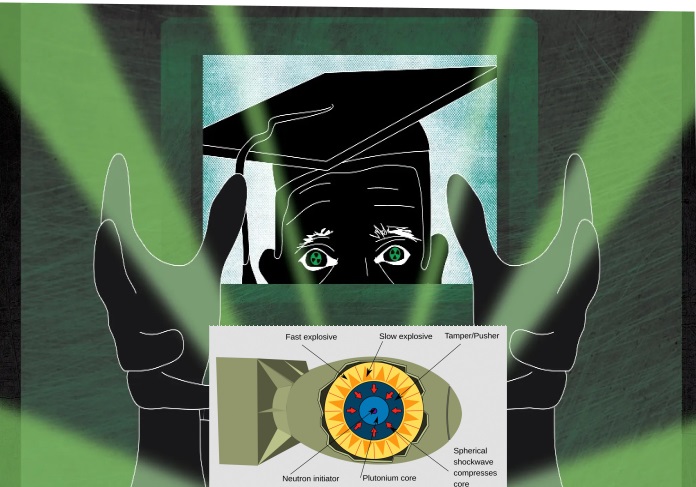
New Mexico’s local colleges are training students to work in a plutonium pit factory. What does this mean for their future — and the world’s?
Searchlight NewMexico, by Alicia Inez Guzmán, June 7, 2023
Every day, thousands of people from all parts of El Norte make the vertiginous drive up to Los Alamos National Laboratory. It’s a trek that generations of New Mexicans have been making, like worker ants to the queen, from the eastern edge of the great Tewa Basin to the craggy Pajarito Plateau.
All in the pursuit of “good jobs.”
Some, inevitably, are bound for that most secretive and fortified place, Technical Area 55, the very heart of the weapons complex — home to PF-4, the lab’s plutonium handling facility, with its armed guards, concrete walls, steel doors and sporadic sirens. To enter “the plant,” as it’s known, is to get as close as possible to the existential nature of the nuclear age.
For 40 years, some 250 workers were tasked, mostly, with research and design. But a multibillion-dollar mission to modernize the nation’s nuclear arsenal has brought about “a paradigm shift,” in the words of the Defense Nuclear Facilities Safety Board, a federal watchdog. Today, the plant is in the middle of a colossal expansion — growing from a single, aged building to what the safety board calls “a large-scale production facility for weapon components with the largest number of workers in its history.”
In short, the plant is slated to become a factory for making plutonium pits, the essential core of every nuclear warhead.
Four years ago, LANL began laying the groundwork for this expansion by searching out and shaping a highly trained labor pool of technicians to handle fissile materials, machine the parts for weapons, monitor radiation and remediate nuclear waste. The lab turned to the surrounding community, as it often had, tapping New Mexico’s small regional institutions — colleges that mostly serve minority and low-income students. The plan, as laid out in a senate subcommittee meeting, set forth a college-to-lab pipeline — a “workforce of the future.”
Taken altogether, Santa Fe Community College, Northern New Mexico College and the University of New Mexico’s Los Alamos campus are set to receive millions of federal dollars for their role in preparing and equipping that workforce. They’ve graduated 74 people to date, many of whom will end up at TA-55……………………………………
For many local families, the lab has been a gateway to the American dream. Its high wages have afforded generations of Norteños a chance at the good life — new houses, new cars, land ownership, higher education for their kids. Indeed, to work there is to become part of the region’s upper crust.
It carries a legacy of illness, death and environmental racism for countless others. History tells of a long practice of hiring local Hispano and Pueblo communities to staff some of the most dangerous positions, a practice that has its origins in the early years of the lab, as Myrriah Gómez described in her 2022 book “Nuclear Nuevo México.”

New Mexico’s academic institutions have for decades served as LANL’s willing partner, feeding students into the weapons complex with high school internships, undergraduate student programs; graduate and postdoc programs; and apprenticeships for craft trades and technicians. The lab heavily recruits at most local colleges with the assurance of opportunities not easily found in New Mexico.
Talavai Denipah-Cook can still remember LANL representatives plying her with promises of a high-paying job and good benefits at an American Indian Sciences and Engineering Society conference years ago. At the time, she was a student at a local high school, and the future that they painted looked bright.
“I was like, ‘Wow, that sounds really intriguing.’ We don’t get that around here, especially as people of color,” said Denipah-Cook, now a program manager in the Environmental Health and Justice Program at Tewa Women United, an Indigenous nonprofit based in Española.
Then she remembered the words of her grandmother, a field nurse from Ohkay Owingeh Pueblo, who once tended to Navajo Nation tribal members affected by uranium mining and saw the health impacts of radiation exposure firsthand.
“She used to tell me, ‘Don’t ever, ever work at Los Alamos National Labs.’” ……………………………………………………………………………………………………….
“The lab has never had to be accountable for their promises,” said Greg Mello, of the Los Alamos Study Group, an influential anti-nuclear nonprofit based in Albuquerque. “Could they be a factory? Could they produce pits reliably? No. Not at all.”
LANL, regardless, was tapped as one of two sites — the other being the Savannah River plutonium processing facility in South Carolina — to produce an annual quota of “no fewer than 80 such pits by 2030,” according to the Fiscal 2020 National Defense Authorization Act. With this, LANL has been authorized to produce 30 pits per year by 2026.
What’s being proposed is so huge it has no precedent, said Jay Coghlan, executive director of Nuclear Watch New Mexico, an anti-nuclear advocacy organization in Santa Fe.
“Here we have this arrogant agency that thinks it can just impose expanded bomb production on New Mexico,” said Coghlan, referring to the National Nuclear Security Administration, the lead agency for pit production. “They do not have credible cost estimates and they do not have a credible plan for production. But yet they expect New Mexicans to bear the consequences.”
The costs, according to the Los Alamos Study Group, will come to some $46 billion by 2036 — the earliest the NNSA says it can hit 80 pits per year at the two sites. It’s roughly the same amount of money it would take to rebuild every single failing bridge in America.
To support the pit mission at LANL, the NNSA estimates the lab will need 4,100 full-time employees, including scientists and engineers, security guards, maintenance and craft workers, and “hard-to-fill positions,” as LANL has dubbed the pipeline jobs.
More costly than the Manhattan Project in its day, the NNSA program is the most expensive in the agency’s history. It is also destined, Coghlan and others say, to collapse under its own weight. Both Los Alamos and Savannah River are, according to federal documents, billions of dollars over budget and years behind schedule.
Money, waste and risk
In the meantime, LANL’s budget has increased by 130 percent over the past five years, according to a June 2022 report by the Government Accountability Office. There’s no real way to determine how much money LANL will need to reach its quota.
…………………………………………………………. Radiation 101: Students get prepped for pit work
Last spring, assistant professor Scott Braley taught two back-to-back introductory courses to 13 future radiation control technicians at NNMC. His lectures covered a host of topics: the history of “industrial-scale” radiation accidents worldwide, algebraic formulas to determine the correlation between individual cancer and workplace exposure, and maximum permissible doses for future workers like themselves. The rates are higher than for the general public, Braley explained, because, for one, radiation workers “have accepted a higher risk.”
……………………………. Much of the college programs and their curricula center around minimizing risk. But because the possibility of serious harm at LANL is much higher than in most jobs, the programs present an ethical dilemma: Who are the people bearing the risk?
“What does it mean to assume that exposure is acceptable at all?” asked Eileen O’Shaughnessy, cofounder of Demand Nuclear Abolition. “Because the thing about radiation is it’s cumulative and any amount is unsafe.”
………………….. “You realize, yes, they are paying you well, but you’re being put in situations that you have no idea about,” said the retired machinist, a man with over two decades of experience working at the lab, much of it at the plant. He asked to remain anonymous for fear of retaliation. “It’s the mentality at the lab,” he said. “They don’t really think that people that are techs are even really worth much.”
A powerful neighbor
Dueling perspectives in El Norte reveal the chasms around the lab and, in particular, what some consider the Manhattan Project’s original sin: Its use of eminent domain to force Indigenous and Hispano people off their farms and sacred lands on the Pajarito Plateau. Its arrival, oral histories hold, spelled the end of land-based living.
……………………. As the single largest employer in northern New Mexico, LANL’s horizon of influence is vast. And with billions more dollars flooding in, its sway in almost every sphere — economics, politics, education — seems only to grow.
“It is hard for us at the Los Alamos Study Group to see how New Mexico can ever develop if LANL becomes a reliable, enduring pit factory,” said Greg Mello, the executive director. “We see it as a death sentence for economic and social development in Northern New Mexico.”
Despite the lab’s omnipresence, economic gains have been relatively limited. While Los Alamos County has one of the highest median household incomes in the nation, the surrounding communities — including Española — are among the poorest in the state.
The most damning indication of that disparity came in a draft report from the University of New Mexico’s Bureau of Business and Economic Research, which showed that the lab actually cost Rio Arriba County $2.6 million and Santa Fe County $2.2 million in fiscal year 2017.
According to the Rio Grande Sun, LANL suppressed that information in the report’s final version. And though LANL jobs are by far the most competitive in the region, the trickle-down hasn’t amounted to collective uplift.
“LANL has been a bad neighbor,” charged Warren. “If the economic benefits are so good for them to continue their work and expand, you would think the communities around here would be doing better. But we’re not.” https://searchlightnm.org/the-abcs-of-a-nuclear-education/
A-bombed artist to distribute ‘war brooms’ in Hiroshima as he calls for nuclear abolition
June 11, 2023 (Mainichi Japan)
SHIKAOI, Hokkaido — A Hiroshima A-bomb survivor ink artist seeking to amplify his nuclear abolition message will hand out miniature brooms signifying the renunciation of war in front of Hiroshima Peace Memorial Museum, coinciding with his art show opening in the city on June 24.
Miki Tsukishita, 82, a resident of the Hokkaido town of Shikaoi, was exposed to radiation from the atomic bombing in Hiroshima when he was 4 years old. He is upset that the recent Group of Seven (G7) summit held in the A-bombed city from May 19 to 21 recognized the deterrence of war through the possession of nuclear weapons.
The joint document, “G7 Leaders’ Hiroshima Vision on Nuclear Disarmament,” set forth the direction that the G7 would pursue to realize a world without nuclear weapons. At the same time, the document referred to nuclear deterrence. While it also pointed out the importance of nuclear nonproliferation, Tsukishita said emphatically, “What we are seeking is not nuclear nonproliferation, but nuclear abolition.”
After the summit, he wrote a letter of appeal to the participating leaders in his distinctive ink brush strokes, which was full of sarcasm, beginning with “Did the ‘okonomiyaki’ (savory pancakes that are a Hiroshima specialty) suit your palate?” It is lined with harsh phrases such as, “You left us with the continuation of nuclear nonproliferation,” “What was the purpose of your visit to Hiroshima?” “The tender ‘heart of Hiroshima’ has been trampled on by all of you.”
The feelings of the people of Hiroshima cannot be conveyed only by the appeal letter. So, in line with his already scheduled show in Hiroshima, Tsukishita decided to convey the wishes of A-bomb survivors for nuclear abolition by distributing miniature brooms, paper cranes and letters of appeal to foreign visitors to the Hiroshima museum……………………………………………..
The upcoming exhibition, titled “war brooms art exhibition,” will be held at Aster Plaza in the city of Hiroshima from June 24 to 29. In addition to Tsukishita’s ink artwork, pictures such as “The boy standing by the crematory” and a young A-bombed Chinese parasol tree will be on display. Seeds of the tree will also be handed out. https://mainichi.jp/english/articles/20230608/p2a/00m/0na/025000c
(Japanese original by Hitoshi Suzuki, Obihiro Bureau)
America’s Nuclear Rules Still Allow Another Hiroshima
The bombs could not discriminate between combatants and the innocent. As many as one in seven of those killed in Hiroshima were not Japanese but Korean, amounting to roughly 20,000 people, many of whom were forcibly transported from their homes and interred in labor camps. The bombs killed Javanese, Dutch, British, Australian, American, and other prisoners of war. The U.S. survey estimated that over 90 percent of the 200 doctors and 1,800 nurses in Hiroshima were dead or injured, as well as half the personnel and patients at the teaching hospital at Nagasaki. One of the few numbers we know with precision is that, at minimum, the United States killed 4,412 schoolchildren in Hiroshima (a figure we know because teachers kept precise data on their students who were assigned to work crews around the city).
U.S. leaders must take responsibility for past nuclear atrocities.
Foreign Policy, JUNE 10, 2023,
On May 18, U.S. President Joe Biden traveled to Hiroshima, Japan, planning to meet with G-7 leaders—as well as survivors of the nuclear bombs—to discuss, among other things, reducing the risk of nuclear war. He followed in the footsteps of former U.S. President Barack Obama, who visited Hiroshima in his final year as president. In a short speech, Obama mourned the dead—but he did not express regret and, his advisors insisted, he did not apologize. Instead, Obama looked forward to a future that would come to see Hiroshima and Nagasaki “as the start of our own moral awakening.”
Biden and his administration have proven to be uncommonly committed to atoning for past domestic acts of violence and racism that still weaken the moral foundations of the United States. Interior Secretary Deb Haaland has announced a major investigation into ethnic cleansing in federal boarding schools for Native Americans, and the president has reaffirmed the government’s apology for its racist internment of Japanese Americans during the second world war. “That’s what great nations do,” Biden said in a speech commemorating the Tulsa Race Massacre, “come to terms with their dark sides.”
The United States has never had a similar moral awakening on Hiroshima and Nagasaki. On the 75th anniversary of the atomic bombing of Hiroshima, Biden, then a candidate for president, wrote that “the scenes of death and destruction … still horrify us.” For too long, U.S. presidents have used passive language to refer to the bombings, evading responsibility for the act. White House spokesman John Kirby continued this tradition when he said that Biden would “pay his respects to the lives of the innocents who were killed in the atomic bomb that was dropped on Hiroshima.” The language helps Americans think of the bombings as something that happened to cities rather than as something their government did to people.
At Hiroshima, Biden said nothing about the bomb. He did not meet with bomb survivors as planned and did not deliver remarks when visiting the peace memorial. U.S. National Security Advisor Jake Sullivan stressed that Biden would be one of several leaders paying respects and it was not “a bilateral moment.”
After his trip, Biden—and the U.S. government—should begin to atone for the destruction of Hiroshima and Nagasaki, in word and in deed. A moral awakening on nuclear weapons requires that we confront not only the facts of the bombings that killed uncountable thousands of Japanese civilians, but also the policies and principles that still echo in U.S. nuclear weapons policy today.
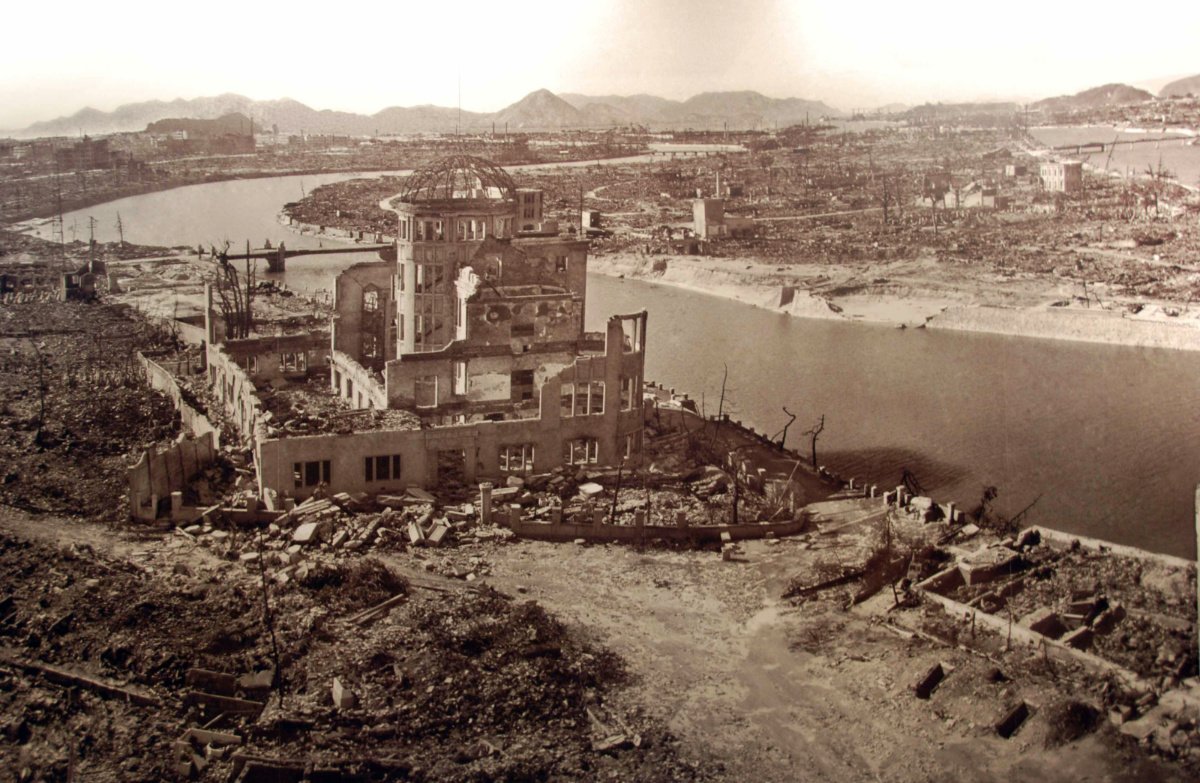
When Hiroshima was destroyed on Aug. 6, 1945, the city contained more than eight civilians for each soldier. Though a group of senior advisors had recommended that the bomb be aimed at “a military target surrounded by workers’ houses,” they did not issue orders to strike a specific target. The crew of the Enola Gay aimed the atomic bomb at Aioi Bridge, a visible landmark at the center of Hiroshima. The bomb detonated directly over nearby Shima Hospital. By November, the bomb had killed 90 percent of people who had been within one kilometer of its detonation. By the next year, more than one-third of the civilians who had been in the city during the bombing were dead. Nearly as many had been injured and would have to wait hours or days for care. More than 90 percent of the city’s doctors and nurses were killed and only three of 45 civilian hospitals were usable.
Survivors describe burned figures stumbling away from the city center, their skin hanging from their bodies, begging for water, some carrying blackened infants or their own body parts. Hospitals, churches, schools, firehouses, and public utilities all collapsed or succumbed to the flames. While two military headquarters near the center of the city were destroyed, the airfield, ordinance depots, heavy industry, and navy units clustered around the port received less damage. The fire did not reach them. If the bomb were to have been aimed at the city’s military targets, it would have been dropped two miles to the south.
The intended target of the second atomic bomb was Kokura, a city to the north that contained a military arsena………………
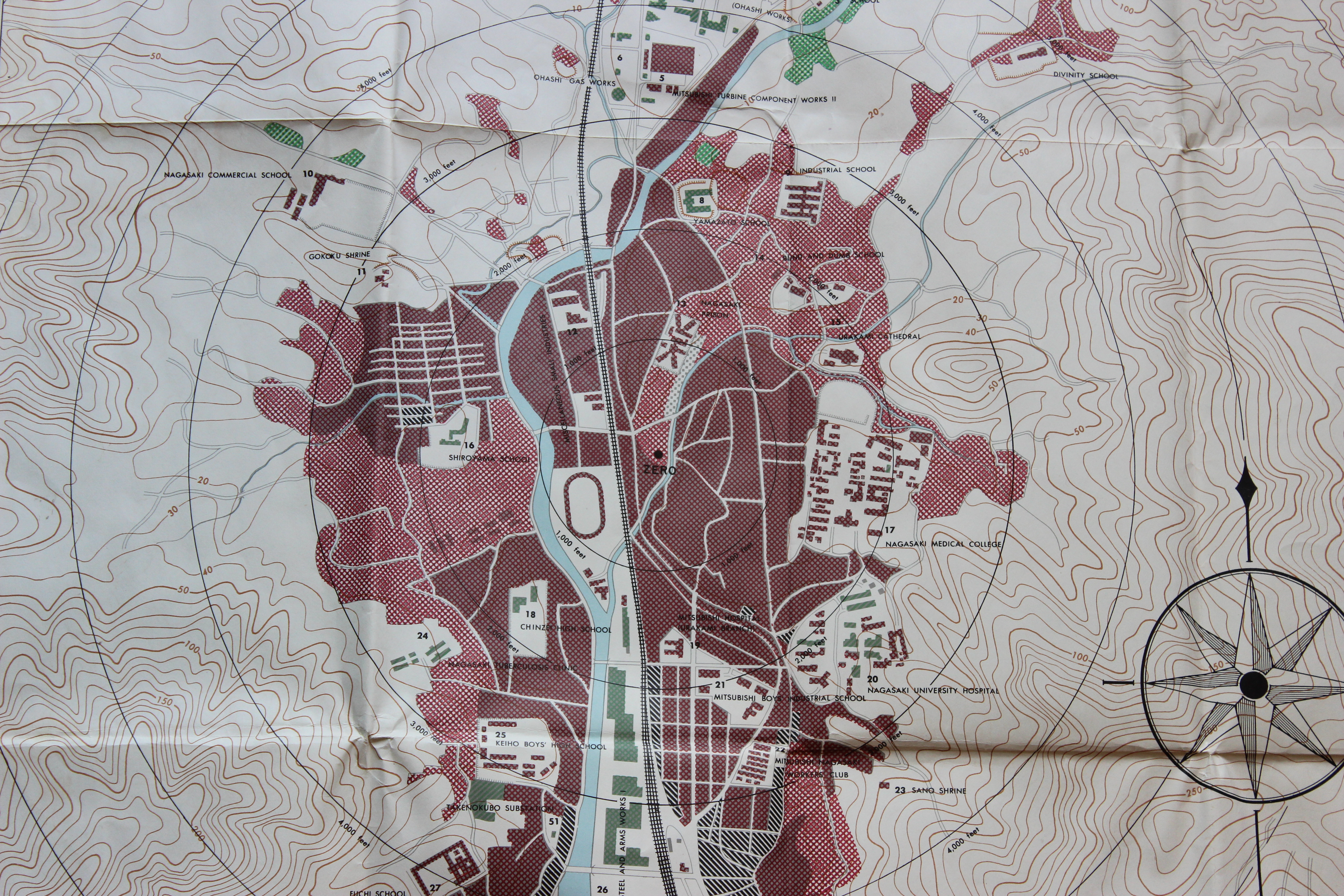
The bomb missed its intended target by three-quarters of a mile and detonated over the Urakami Valley, a residential area that included schools, a prison, a prisoner-of-war camp, a medical college, and a cathedral that served a large population of Catholics in the neighborhood. A half mile to the north and south, at the edges of the damage, there were two arms factories. Some of Nagasaki’s pregnant women and elderly residents had been moved to the valley precisely because it did not contain military factories.
……………. when the first plutonium bomb was ready in only three days, military personnel managing the operation on Tinian Island followed their orders to drop the bomb as soon as it was available. When he learned of Nagasaki, Truman ordered a halt to further use of nuclear weapons, saying, according to accounts of a cabinet meeting, he didn’t like the idea of killing “all those kids.”
………………………. We will never know precisely how many died in the two cities. In 1951, U.S. survey teams estimated that at least 104,000 died; in 1981, a detailed study led by Japanese researchers estimated that 210,000 civilians had died. Most other estimates fall between these figures. In most estimates, the wounded meet or exceed the dead. More than 90% of those seriously injured by the bomb had died by mid-September—but for all of those who survived, the effects of the bomb would continue. Thousands have suffered from injury, trauma, social stigma, and increased rates of miscarriage, birth defects, leukemia, and solid cancers for decades.
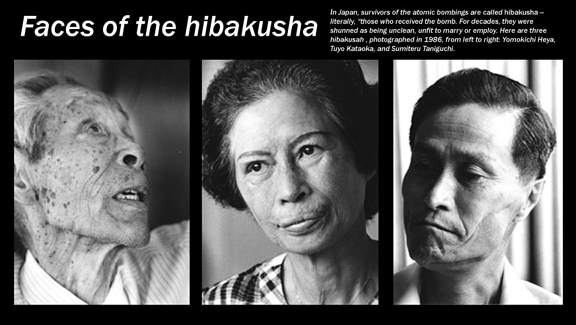
The bombs could not discriminate between combatants and the innocent. As many as one in seven of those killed in Hiroshima were not Japanese but Korean, amounting to roughly 20,000 people, many of whom were forcibly transported from their homes and interred in labor camps. The bombs killed Javanese, Dutch, British, Australian, American, and other prisoners of war. The U.S. survey estimated that over 90 percent of the 200 doctors and 1,800 nurses in Hiroshima were dead or injured, as well as half the personnel and patients at the teaching hospital at Nagasaki. One of the few numbers we know with precision is that, at minimum, the United States killed 4,412 schoolchildren in Hiroshima (a figure we know because teachers kept precise data on their students who were assigned to work crews around the city).
The United States’ bombs also killed American citizens in Hiroshima and Nagasaki. It is not known how many Americans died in the two cities, but before the war more U.S. immigrants had arrived from Hiroshima than any other Japanese prefecture and so were linked to the city by familial ties. After the war, as many as 3,000 Japanese-Americans returned home to the United States as victims of the atomic bombs. Furthermore, around 1,000 Japanese bomb victims would later move to the United States and become U.S. citizens. Many never identified themselves—but others organized to demand recognition and compensation from the U.S. government for medical expenses.
…………….Americans who were injured in Japan when their government dropped a nuclear bomb on them received neither recognition nor compensation.
The United States also did not provide medical care to Japanese atomic bomb victims. The Atomic Bomb Casualty Commission, established to research the effects of radiation on the human body to inform Cold War U.S. civil defense procedures, maintained a policy of not providing medical treatment to the victims. M. Susan Lindee writes, “The United States would not apologize atone for the use of atomic weapons in Japan, and it would therefore not provide medical treatment to the survivors of the bombings who were the subjects of American biomedical research.” Initially, the commission refused to share its data with Japanese physicians treating patients……..
https://foreignpolicy.com/2023/06/10/united-states-japan-hiroshima-nuclear-atomic-bomb/
China and Russia building most nuclear power plants, – the main goal is to market them to developing countries


China and Russia account for 70% of new nuclear plants
Exports used as diplomatic card while Western nations fall behind
NAOYUKI TOYAMA, Nikkei staff writerJune 11, 2023
TOKYO — Russia and China are building up an outsized presence in the field of nuclear power, with the countries accounting for nearly 70% of reactors under construction or in planning worldwide.
…………………Notably, 33 of the reactors are being constructed or planned outside each respective country. Russia has the largest number of overseas reactors with 19, and despite growing opposition from Europe and the U.S. following its invasion of Ukraine, it maintains a strong global influence in nuclear power.
In April, Russian President Vladimir Putin participated remotely in a ceremony to mark the arrival of the first fuel at the under-construction Akkuyu nuclear power plant in Turkey………
Russia’s nuclear power diplomacy is extending to other countries as well. In May, Rosatom began full-scale construction on Unit 3 of the Dabaa nuclear plant in Egypt, the country’s first.
Hungarian Prime Minister Viktor Orban met with Rosatom officials this month to discuss the company’s plans to build a new nuclear power plant in the country’s south. Hungary opposes sanctions the European Union has imposed on Rosatom.
“Many developing countries take a positive view of Russia,” Kacper Szulecki of the Norwegian Institute of International Affairs told British scientific journal Nature Energy. Russia’s acceptance of spent nuclear fuel is also attractive to emerging countries.
Meanwhile, China is deepening its engagement with Pakistan………………………………..
China also plans to build a nuclear plant in Argentina…………………………………
The U.S., Japan and Europe are hoping to catch up using small modular reactors (SMRs), considered fourth-generation technology………………………………………..
Another issue is nuclear fuel. Uranium enrichment has become the weak link for Western nations. Enrichment facilities are limited, and Russia is the global leader for that process. In April, the U.S., the U.K., France, Canada and Japan formed a nuclear fuel alliance. While the aim is to shut out Russian fuel from Western reactors, doing so will not be easy.
https://asia.nikkei.com/Business/Energy/China-and-Russia-account-for-70-of-new-nuclear-plants
-
Archives
- February 2026 (228)
- January 2026 (308)
- December 2025 (358)
- November 2025 (359)
- October 2025 (376)
- September 2025 (258)
- August 2025 (319)
- July 2025 (230)
- June 2025 (348)
- May 2025 (261)
- April 2025 (305)
- March 2025 (319)
-
Categories
- 1
- 1 NUCLEAR ISSUES
- business and costs
- climate change
- culture and arts
- ENERGY
- environment
- health
- history
- indigenous issues
- Legal
- marketing of nuclear
- media
- opposition to nuclear
- PERSONAL STORIES
- politics
- politics international
- Religion and ethics
- safety
- secrets,lies and civil liberties
- spinbuster
- technology
- Uranium
- wastes
- weapons and war
- Women
- 2 WORLD
- ACTION
- AFRICA
- Atrocities
- AUSTRALIA
- Christina's notes
- Christina's themes
- culture and arts
- Events
- Fuk 2022
- Fuk 2023
- Fukushima 2017
- Fukushima 2018
- fukushima 2019
- Fukushima 2020
- Fukushima 2021
- general
- global warming
- Humour (God we need it)
- Nuclear
- RARE EARTHS
- Reference
- resources – print
- Resources -audiovicual
- Weekly Newsletter
- World
- World Nuclear
- YouTube
-
RSS
Entries RSS
Comments RSS
 nuclear-news