Nuclear arsenals growing as chances for diplomacy shrink: report

China, Russia, India, Pakistan, and North Korea each deployed more nuclear weapons last year, according to SIPRI.
Connor Echols https://responsiblestatecraft.org/2023/06/12/nuclear-arsenals-growing-as-chances-for-diplomacy-shrink-report/ JUNE 12, 2023
Nuclear-armed states are expanding and modernizing their arsenals as tensions continue to rise between great powers, according to a new report from the Stockholm International Peace Research Institute. SIPRI estimates that militaries have deployed an additional 86 warheads over the past year, bringing the total number of active nuclear weapons to 9576.
China added 60 warheads since the start of 2022, giving it a total arsenal of 410 nuclear weapons, according to SIPRI. Russia deployed an additional 12 nukes, with India, Pakistan, and North Korea making up the rest of the increase.
“It is increasingly difficult to square this trend with China’s declared aim of having only the minimum nuclear forces needed to maintain its national security,” argued SIPRI senior fellow Hans M. Kristensen in a press release.
The new data comes from SIPRI’s Yearbook, the organization’s annual report on global trends in weapons stockpiles and disarmament.
Despite China’s notable increase, the United States and Russia continue to dominate all other states when it comes to nuclear stockpiles. Together, the two hold 85 percent of the world’s deployed nuclear weapons, and both plan to invest heavily in efforts to modernize their arsenals.
Chances for renewed disarmament talks have flagged following Russia’s invasion of Ukraine early last year. Washington and Moscow both took steps recently to reduce their compliance with the New START Treaty — the only agreement capping the number of warheads that each country deploys, which expires in 2026.
Notably, the United States announced earlier this month that it is ready to engage in new nuclear talks “without preconditions” with both Russia and China. But it remains unclear whether either state is interested in negotiating with Washington as geopolitical tensions continue to grow.
“This elevated nuclear competition has dramatically increased the risk that nuclear weapons might be used in anger for the first time since World War II,” SIPRI researcher Matt Korda said in a press release.
Meanwhile, some states have taken steps to reduce transparency around their nuclear stockpiles. The United States and United Kingdom “both declined to release information to the public concerning their nuclear forces in 2022, which they had done in previous years,” the report notes. The UK decision is particularly notable given its 2021 announcement that it will increase the limit on its arsenal from 225 to 260 warheads.
Data about the arsenals of other nuclear-armed states is also limited given the secrecy surrounding many countries’ nuclear programs. Israel has never admitted to possessing nuclear weapons, but SIPRI estimates that it currently has 90 warheads. North Korea, another secretive nuclear-armed state, has as many as 30 nuclear bombs, according to the report.
Iranian Supreme Leader Says ‘Nothing Wrong’ With A Nuclear Deal With West
https://www.rferl.org/a/iran-khamenei-nuclear-deal-approval/32454257.html 12 June 23
Iran’s supreme leader said on June 11 that a deal with the West over Tehran’s nuclear work was possible if the country’s atomic infrastructure remained intact, amid a stalemate between Tehran and Washington to revive a 2015 nuclear pact.
Months of indirect talks between Tehran and Washington to salvage the nuclear accord with six major powers have stalled since September, with each side accusing the other of making unreasonable demands. Ayatollah Ali Khamenei’s guarded approval comes days after both Tehran and Washington denied a report that they were nearing an interim deal. To read the original story by Reuters, click here.
Time to remove nuclear weapons from NATO countries, in return for Putin not putting them in Belarus?
Now is the time to call for all US nuclear weapons to be removed from five NATO countries, Italy, Turkey, Germany, Netherlands, Belgium, restore the ABM Treaty which Bush walked out of and close new missile bases in Romania and Poland in return for Putin not putting nuclear weapons in Belarus. https://apnews.com/article/putin-russia-belarus-nuclear-weapons-war-ukraine-a8b462cd8f30b85ec8f3be93e554e94b
Oil-rich nations dominate COP28 – now offering rich sponsorships, in the effort to silence critics

Emanuele Del Rosso Emanuele is an award-winning Italian political cartoonist. His work is published and distributed internationally.
16 January 2023
UN climate summit organisers wage public relations battle. Marketing drive
for multimillion-dollar sponsorships for UAE-hosted event as critics become
more vocal.
The UAE COP28 has offered sponsorship packages ranging up to
$8.2mn (Dh30mn) for a principal partner to enjoy privileged access in the
controlled “blue zone” where world leaders gather, according to
documents sent to prospective sponsors.
Space in the “green zone”, open
to civil society and small business, is less than $7,000 (Dh25,000).
Expressions of interest for pavilions close this week for the event
starting on November 30.
FT 11th June 2023
https://www.ft.com/content/7b17bc43-f303-4039-a8d5-7e9825604a46
45 nations pledge to double their rate of energy efficiency improvements

45 nations pledge to double rate of energy efficiency improvements. The
UK, the US and Ukraine are among the 45 nations endorsing a new global
commitment to accelerate the rate of energy efficiency improvements. The
declaration takes the form of a new ministerial statement, released to mark
the conclusion of the International Energy Agency’s (IEA) global
conference on energy efficiency in France. As the conference began earlier
this week, the IEA confirmed that global energy intensity decreased 2.2%
last year, twice the average of the previous five years, largely due to
policy responses to the energy price crisis. Yet annual decreases of 4% are
needed to give the world the best chance of achieving net-zero by
mid-century and averting the worst physical impacts of the climate crisis.
To that end, the 45 nations have pledged to develop and implement better
policies to improve energy efficiency domestically. These include both
government-led schemes and policies that help to unlock private investment.
Edie 9th June 2023 https://www.edie.net/45-nations-pledge-to-double-rate-of-energy-efficiency-improvements/
A.I. or Nuclear Weapons: Can You Tell These Quotes Apart?
Many experts on artificial intelligence are warning of its potential dangers and calling for regulation, just as others once did with the atomic bomb.
NYT.By Ian Prasad Philbrick and Tom Wright-Piersanti. June 10, 2023
The comparison seems to be everywhere these days. “It’s like nuclear weapons,” a pioneering artificial intelligence researcher has said. Top A.I. executives have likened their product to nuclear energy. And a group of industry leaders warned last week that A.I. technology could pose an existential threat to humanity, on par with nuclear war.
People have been analogizing A.I. advances to splitting the atom for years. But the comparison has become more stark amid the release of A.I. chatbots and A.I. creators’ calls for national and international regulation — much as scientists called for guardrails governing nuclear arms in the 1950s. Some experts worry that A.I. will eliminate jobs or spread disinformation in the short term; others fear hyper-intelligent systems could eventually learn to write their own computer code, slip the bonds of human control and, perhaps, decide to wipe us out. “The creators of this technology are telling us they are worried,” said Rachel Bronson, the president of the Bulletin of the Atomic Scientists, which tracks man-made threats to civilization. “The creators of this technology are asking for governance and regulation. The creators of this technology are telling us we need to pay attention.”…………………………………more https://www.nytimes.com/2023/06/10/upshot/artificial-intelligence-nuclear-weapons-quiz.html
The War in Ukraine Was Provoked—and Why That Matters to Achieve Peace

By recognizing that the question of NATO enlargement is at the center of this war, we understand why U.S. weaponry will not end this war. Only diplomatic efforts can do that.
Common Dreams, JEFFREY D. SACHS, May 23, 2023
George Orwell wrote in 1984 that “Who controls the past controls the future: who controls the present controls the past.” Governments work relentlessly to distort public perceptions of the past. Regarding the Ukraine War, the Biden administration has repeatedly and falsely claimed that the Ukraine War started with an unprovoked attack by Russia on Ukraine on February 24, 2022. In fact, the war was provoked by the U.S. in ways that leading U.S. diplomats anticipated for decades in the lead-up to the war, meaning that the war could have been avoided and should now be stopped through negotiations.
Recognizing that the war was provoked helps us to understand how to stop it. It doesn’t justify Russia’s invasion. A far better approach for Russia might have been to step up diplomacy with Europe and with the non-Western world to explain and oppose U.S. militarism and unilateralism. In fact, the relentless U.S. push to expand NATO is widely opposed throughout the world, so Russian diplomacy rather than war would likely have been effective.
The Biden team uses the word “unprovoked” incessantly, most recently in Biden’s major speech on the first-year anniversary of the war, in a recent NATO statement, and in the most recent G7 statement. Mainstream media friendly to Biden simply parrot the White House. The New York Times is the lead culprit, describing the invasion as “unprovoked” no fewer than 26 times, in five editorials, 14 opinion columns by NYT writers, and seven guest op-eds!
There were in fact two main U.S. provocations. The first was the U.S. intention to expand NATO to Ukraine and Georgia in order to surround Russia in the Black Sea region by NATO countries (Ukraine, Romania, Bulgaria, Turkey, and Georgia, in counterclockwise order). The second was the U.S. role in installing a Russophobic regime in Ukraine by the violent overthrow of Ukraine’s pro-Russian President, Viktor Yanukovych, in February 2014. The shooting war in Ukraine began with Yanukovych’s overthrow nine years ago, not in February 2022 as the U.S. government, NATO, and the G7 leaders would have us believe.
Biden and his foreign policy team refuse to discuss these roots of the war. To recognize them would undermine the administration in three ways. First, it would expose the fact that the war could have been avoided, or stopped early, sparing Ukraine its current devastation and the U.S. more than $100 billion in outlays to date. Second, it would expose President Biden’s personal role in the war as a participant in the overthrow of Yanukovych, and before that as a staunch backer of the military-industrial complex and very early advocate of NATO enlargement. Third, it would push Biden to the negotiating table, undermining the administration’s continued push for NATO expansion.
The archives show irrefutably that the U.S. and German governments repeatedly promised to Soviet President Mikhail Gorbachev that NATO would not move “one inch eastward” when the Soviet Union disbanded the Warsaw Pact military alliance. Nonetheless, U.S. planning for NATO expansion began early in the 1990s, well before Vladimir Putin was Russia’s president. In 1997, national security expert Zbigniew Brzezinski spelled out the NATO expansion timeline with remarkable precision.
U.S. diplomats and Ukraine’s own leaders knew well that NATO enlargement could lead to war…………………………………………………………………..
Ukraine’s leaders knew clearly that pressing for NATO enlargement to Ukraine would mean war. Former Zelensky advisor Oleksiy Arestovych declared in a 2019 interview “that our price for joining NATO is a big war with Russia.”
During 2010-2013, Yanukovych pushed neutrality, in line with Ukrainian public opinion. The U.S. worked covertly to overthrow Yanukovych, as captured vividly in the tape of then U.S. Assistant Secretary of State Victoria Nuland and U.S. Ambassador Geoffrey Pyatt planning the post-Yanukovych government weeks before the violent overthrow of Yanukovych. Nuland makes clear on the call that she was coordinating closely with then Vice President Biden and his national security advisor Jake Sullivan, the same Biden-Nuland-Sullivan team now at the center of U.S. policy vis-à-vis Ukraine.
…………………………………. Historian Geoffrey Roberts recently wrote: “Could war have been prevented by a Russian-Western deal that halted NATO expansion and neutralised Ukraine in return for solid guarantees of Ukrainian independence and sovereignty? Quite possibly.” In March 2022, Russia and Ukraine reported progress towards a quick negotiated end to the war based on Ukraine’s neutrality. According to Naftali Bennett, former Prime Minister of Israel, who was a mediator, an agreement was close to being reached before the U.S., U.K., and France blocked it.
While the Biden administration declares Russia’s invasion to be unprovoked, Russia pursued diplomatic options in 2021 to avoid war, while Biden rejected diplomacy, insisting that Russia had no say whatsoever on the question of NATO enlargement. And Russia pushed diplomacy in March 2022, while the Biden team again blocked a diplomatic end to the war.
By recognizing that the question of NATO enlargement is at the center of this war, we understand why U.S. weaponry will not end this war. Russia will escalate as necessary to prevent NATO enlargement to Ukraine. The key to peace in Ukraine is through negotiations based on Ukraine’s neutrality and NATO non-enlargement. The Biden administration’s insistence on NATO enlargement to Ukraine has made Ukraine a victim of misconceived and unachievable U.S. military aspirations. It’s time for the provocations to stop, and for negotiations to restore peace to Ukraine. https://www.commondreams.org/opinion/the-war-in-ukraine-was-provoked-and-why-that-matters-if-we-want-peace—
My nuclear family

“The locals know their local land and water supplies are contaminated from the nuclear material that was either buried in nearby canyons or on riverbanks,” Gómez writes in her book. “They know their presence on the Pajarito Plateau is being erased from national memory. They know they were placed in dangerous jobs because of their identities. They know the plutonium exploded into the atmosphere during the Trinity Test is making them sick. They know nuclear waste, if buried in their backyard, poses severe threats.”
Alicia Inez Guzmán, Searchlight New Mexico, 14 June 23, https://www.lcsun-news.com/story/news/2023/06/11/my-nuclear-family/70306994007/
My parents’ house sits at the foot of the Sangre de Cristos facing west toward the setting sun and the Jemez Mountains. I still remember nights looking out across the vast darkness at the twinkling lights of Los Alamos, the secret city, “a place,” as the late anti-nuclear activist and Ohkay Owingeh elder Herman Agoyo put it, “with no public memory.”
As the crow flies, Truchas is 30 miles from Los Alamos, separated by the great Tewa Basin and arid badlands checkerboarded by Hispano settlements and Indigenous Pueblos. For most of my young life, I took the Lab for granted. It was there in the background, omnipresent like a low-frequency hum.
But it didn’t always just exist. It was forced onto our homeland and into our consciousness, even if most origin stories about the Manhattan Project and the Lab’s continued presence in the region treat local people like extras in a movie.
“For the several hundred workers required to man these plants, there must also be several thousand service and supporting personnel,” a 1950 internal report read. Its writer was debating whether Los Alamos was the best place for the weapons Lab moving forward.
Scientists performed clandestine work here, yes, but that work required and continues to require the effort of so many others — “supporting personnel” — who can also be on the frontlines of exposure.
I am reminded, for instance, of an experiment that went horribly wrong just nine months after American forces decimated Hiroshima and Nagasaki with nuclear bombs. A Canadian physicist, Louis Slotin, was trying to gather data on nuclear chain reactions when the screwdriver he was holding as a wedge between a beryllium tamper and a plutonium core accidentally slipped. For a brief second, the beryllium and plutonium reached fission, sending out a blast of blue light and radioactivity.
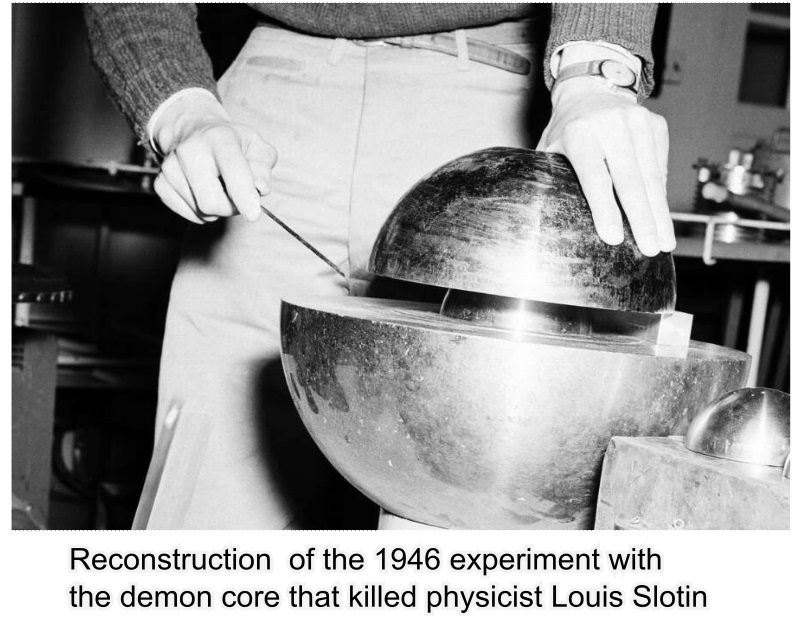
Slotin’s death in 1946 has been famously recorded in histories of the Lab. But there were several other people in the room that day, including several colleagues and a security guard whose fate has largely been eclipsed. All that was noted in records of the event was his fear. Apparently, it was said, the security guard ran out of the room and up a hill. And that’s where his part in the story ends.
But he was there, a witness — and one, I imagine, who was exposed to the same plutonium that within a matter of nine days killed Slotin. I’ve long wondered: Who was he? What was his story?
When I think of that man, I think of my Grandpa Gilbert. Many auxiliary staff were local people who got their start on “the hill” as security guards for the Atomic Energy Commission. That was his story — a career begun as a security guard in 1946 and ended some three decades later as a staff member of the Lab and the University of California, which managed it. The position was a distinction that not many Hispanos held at the time. My mom says he felt dignified by his work there — the only means he had to raise five kids after World War II. But there was a trade-off, including discreet trips to the doctor where he was screened for cancer on a more-than-routine basis.
Many family members would follow in his footsteps — my Uncle Jerry among them. Los Alamos was a place abounding in conspiracy theories and Uncle Jerry found himself at the center of one of them. He believed that racism had created a culture of retaliation, so toxic that it led to his being framed for intentionally dosing his supervisor with plutonium-239. After my uncle’s death two years ago, the Santa Fe New Mexican published a column narrating the sordid events — his boss ultimately recanted the allegations and my uncle and others won a settlement — but he was haunted by a lasting specter. The multiple cancers that consumed his body decades later were products of the Lab, in his opinion, like sleeper fires set within him.
I only recently came to know the fragments of my Uncle Pat’s story. During his three years at the Lab in the late 1970s, he was flown on two occasions to California with a locked box chained to his wrist. His destination was TRW, the predecessor of Northrop Grumman Space Technology, and his cargo, he told me, was top-secret technology that could detect nuclear weapons testing from outer space.
There’s a kind of mental acrobatics required to compartmentalize these different realities — the opportunity and the harm, the secrets and the consent. I know this compartmentalization well, this desire to draw a line in the sand between the good and the bad. When I was 19, I spent a summer working as an undergraduate intern in the Lab’s explosives division, a building perched behind a maze of fences and guards. I didn’t have a security clearance at the time, nor could I foresee getting one, so I spent most days marooned at my desk in the front office, filing papers and sending emails. I couldn’t even take a bathroom break without a chaperone accompanying me.
Nothing of that work rings more clearly than a memory of two scientists stumbling out into the hallway, covered in blood. An experiment had gone awry — nothing radiation related — but it was so shrouded in mystery that parsing what actually happened is like trying to put a puzzle together that’s missing half the pieces. I watched in horror from the doorframe.
After that, I transferred to the Bradbury Science Museum, also in Los Alamos, where I walked by replicas of Little Boy and Fat Man daily to get to my desk. I spent that summer, among other things, writing exhibition text about the Manhattan Project’s early architects — J. Robert Oppenheimer, Enrico Fermi, Richard Feynman. I wrote not the history of mi gente, but of those agents of immense creation and destruction, those who’d exacted what Myrriah Gómez in her book, “Nuclear Nuevo México,” calls nuclear colonization. The irony.
It was only when I left the state that I had the distance to understand the debt our communities pay for the good jobs. I began to unpack what it means for New Mexico to be what the writer D.H. Lawrence once called the moon of America. This place was distant enough in America’s consciousness to be foreign, exotic even. But as that “tierra incognita,” the unknown and unknowable blankness stretched across mental maps of the Southwest, our world became America’s wasteland. We continue to sit at the periphery of centers of power, yet we have been forced into the epicenter of this nation’s nuclear weapons complex.
Now, as I write about the role of nuclear weapons across New Mexico, the nation and the globe, Toni Morrison’s words come to mind: “The subject of the dream is the dreamer.” Her ideas about literature were deeply influenced by psychoanalysis. Indeed, to her mind, the act of dreaming was not unlike the act of writing. Or, to put it another way, the subject of the writing is the writer. Here, that is me.
My family and community’s own tangled history with the Lab sits in my subconscious like an inchoate thought. Only when I hold it up to scrutiny does that thought form into the imperative, allowing me to fully fathom what the Manhattan Project birthed in our backyard. Perhaps this is what Gómez refers to as an “innate knowing,” our local “sixth sense.”
“The locals know their local land and water supplies are contaminated from the nuclear material that was either buried in nearby canyons or on riverbanks,” Gómez writes in her book. “They know their presence on the Pajarito Plateau is being erased from national memory. They know they were placed in dangerous jobs because of their identities. They know the plutonium exploded into the atmosphere during the Trinity Test is making them sick. They know nuclear waste, if buried in their backyard, poses severe threats.”
I know all of this when I drive along Highway 84/285, an artery that connects Pojoaque Pueblo to Española and the Pueblos of Santa Clara and Ohkay Owingeh, below a billboard sprawled against sienna-hued bluffs. A woman with a complexion like my own holds radiation detection equipment and smiles down at me.
“Radiation Control Technicians are vital to operations at LANL,” the billboard proclaims. “Start your career as an RCT at Northern NM College now.”
My worldview will always shape my writing on a topic that hits so close to home, but the focus of this series — The Atomic Hereafter — is to highlight all the communities most impacted by 80 years of nuclear presence, from the most recent attempts to modernize the nation’s nuclear arsenal to the long, drawn-out ways radiation can transmit from mother to child. Nuclear issues in this state are generational. I will take them one story at a time.
Fukushima waste-water plan a nuclear threat to Asia-Pacific
By Shaun Burnie | chinadaily.com.cn 2023-06-13 https://www.chinadaily.com.cn/a/202306/13/WS6487d3e0a31033ad3f7bbf92.html
Japan has decided to start discharging radioactive wastewater from the Fukushima Daiichi nuclear power plant into the Pacific Ocean very soon. The operator of the wrecked plant began tests on Monday of newly constructed facilities for discharging treated radioactive wastewater into the sea. Many myths and untruths have been spread about the nuclear-contaminated water. For example, the Japanese government has said, that according to the International Atomic Energy Agency, the global nuclear industry and some scientists, there is nothing to worry about the effects of the radioactive wastewater.
The Japanese government also claims that nearly all the radioactive materials will be removed from the wastewater using the Advanced Liquid Processing System (ALPS) with only tritium remaining before it is released into the Pacific. It is constantly stated that tritium cannot be removed from the wastewater, but would emit very weak radiation and therefore it will have no impact on either the marine environment or human health in the Asia-Pacific region and beyond.
False claims to mislead the Japanese public
As for Tokyo Electric Power Company, the owner of the Fukushima nuclear plant, it claims discharging the wastewater is necessary due to insufficient space for more storage tanks and for it to be able to fully decommissioning the Fukushima plant between 2041 and 2051. TEPCO also says the discharges will meet regulatory standards and will be lawful.
In the real world, it is a lot worse and a lot more complicated than what TEPCO, the Japanese government and the IAEA claims. The ALPS has been a spectacular failure, with major doubts about its effectiveness. In addition to tritium, all the radioactive carbon (C-14) in the wastewater will be released into the ocean along with many other radionuclides (plutonium isotopes, iodine-129, strontium-90). But despite the Japanese government and TEPCO “planning” to keep them below the regulatory limit, they will still be significant.
There is no safety threshold for artificial radioactivity in the environment, and technology does exist to process tritium from the tanks’ water. However, TEPCO and the Japanese government do not want to spend huge amounts of money needed to do so. Tritium is indeed a low energy radioactive material but that does not mean its effect is weak; if ingested, it has the potential to damage plants, animals and humans.
Recent research published by a leading radiation biologist shows scientific literature of the past 60-plus years is clear — tritium, in particular organically bound tritium (OBT), is biologically harmful to all forms of life. The persistence, bioaccumulation and potential biomagnification and increased toxicity of OBT increases the potential impact on the environment if tritiated water is discharged on land or in the sea.
Tritium more dangerous than previously believed
None of the current regulations in Japan (or worldwide) takes into full account the nature of organic forms of tritium. That organic forms of tritium have been found to bioaccumulate in phytoplankton, the base of the marine food chain, is deeply worrying. The fact that there has been no comprehensive environmental impact assessment of these and many other issues is outrageous, and suggests there is a deliberate underestimation of the accumulation and potential toxic effect of tritium on the environment.
Equally important, the many other radioactive materials in the Fukushima wastewater have the potential to cause damage to the environment and human health. In fact, Japan has sufficient storage capacity, including in the areas around the Fukushima plant. And storing the toxic wastewater, TEPCO cannot fully decommission the reactors at Fukushima in the next 20-30 years — probably not in this century. Rather than being lawful, the release of the wastewater into the sea will violate international law, specifically the United Nations Convention on the Law of the Sea.
One reason why the untruths and myths continue to be spread is that there is a lot at stake for the Japanese government and the nuclear industry. Japan’s energy policy is dependent on restarting many nuclear reactors shut down after the 2011 Fukushima disaster. So far, nine have resumed operations — but according to government policy, Japan needs 30-plus reactors by 2030.
Public opinion in Japan has been influenced by the government’s claim that it is safe to operate these nuclear reactors and that it is possible to recover from a three-reactor meltdown without consequences for human health and the environment. Of course, it’s not.
Sweeping real issue under the carpet
TEPCO, the Japanese government or the IAEA refuses to accept that the wastewater crisis points to a deeper nuclear crisis at the Fukushima plant. And it is getting worse, because groundwater entering the plant continues to become highly contaminated, while the water in the tanks requiring ALPS processing increases.
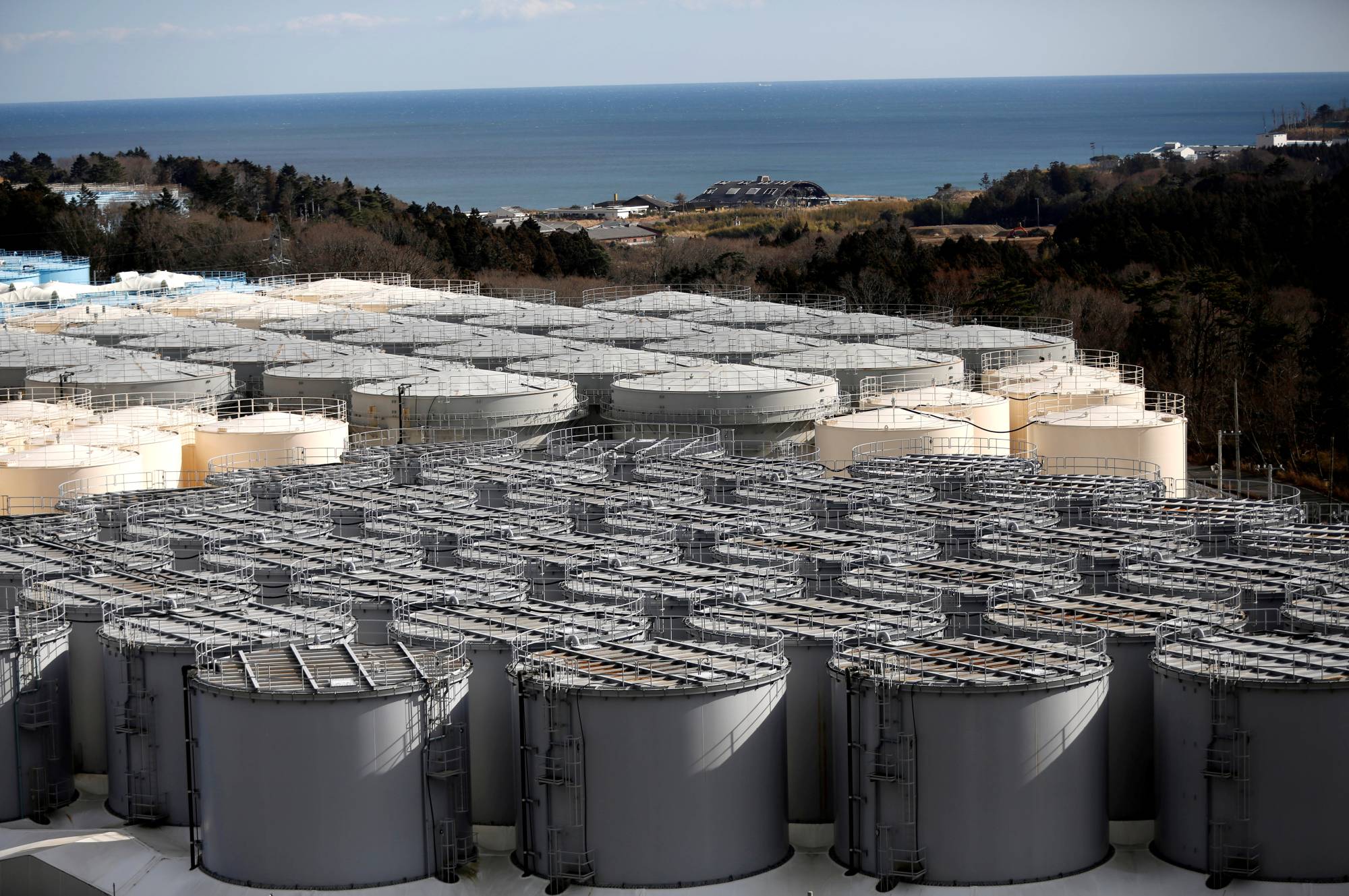
In November 2021, based on TEPCO data, there were 1,284,284 cubic meters of contaminated ALPS water in the storage tanks, of which 832,900 cu m needed further ALPS processing. As of April 20, 2023, the total volume of radioactive wastewater stored in the tanks was 1,330,944 cu m — a 3.6 percent increase in less than 2 years.
Worse, about 70 percent or 931,600 cu m of the wastewater needs to be processed again (and probably many times again) by the ALPS to bring the radioactive concentration levels below the regulatory limit for discharge. This is an increase of nearly 12 percent in less than 2 years.
TEPCO has succeeded in reducing the concentration levels of strontium, iodine and plutonium in only 0.2 percent of the total volume of the wastewater, and it still requires further processing. But no secondary processing has taken place in the past nearly three years. Neither TEPCO nor the Japanese government nor the IAEA wants to talk about this. They have not said how many times the wastewater needs to be processed, how long it will take to do so or whether the efforts will ever be successful.
Problems not new but none solved in 5 years
Greenpeace wrote about these problems and why the ALPS failed nearly five years ago; none of those issues has been resolved. Also, there is a high possibility of the ALPS failing in the future.
To proceed with their discharge plan, the Japanese government and TEPCO have been creating a false impression on the public that significant progress has been made in decommissioning the Fukushima plant. But fact is, the source of the problem — the highly radioactive fuel debris in reactor pressure vessels 1, 2 and 3 — continues to contaminate groundwater. Nearly 1000 cu m of water becomes highly contaminated every 10 days. So until the nuclear fuel is isolated from the environment, contaminated groundwater, potentially hundreds of thousands of cubic meters, will continue to accumulate.
While the Fukushima plant, after being destroyed by the earthquake-triggered tsunami in March 2011, released large amounts of radioactive particles into the environment, most of the radioactive inventory remains inside the melted fuel. As such, the damaged Fukushima plant on the edge of ocean is a long-term radioactive threat to the environment, including the marine environment. And this threat will be aggravated once Japan begins dumping the toxic water into the ocean.
TEPCO, the Japanese government and the IAEA refuse to acknowledge the fact that the decommissioning plan for the Fukushima plant is not attainable, and that they must embark on a comprehensive reassessment of the plan.
Crisis compounded by damage to reactor
The nuclear crisis in Fukushima is compounded by the damage to the reactors, in particular unit 1. The rapid meltdown of the nuclear fuel in March 2011 severely damaged the large concrete block the 440-ton reactor pressure vessel sits on. One of the agencies responsible for its decommissioning has recently demanded that TEPCO work out immediate countermeasures to prevent the possible collapse of the reactor. But with very high radiation levels inside the plant, it’s not clear whether any countermeasures are possible.
Building a very large containment structure covering the reactor buildings, like it was done at the Chernobyl plant in Ukraine after the nuclear disaster in 1986, is probably the only way to prevent highly radioactive dust entering the lower atmosphere in the event of a future collapse. But such a “solution” is not a currently an option for the Japanese government or the nuclear industry, as it would send the wrong message that the decommissioning process is not going according to plan.
There is no scientific, legal or moral justification for Japan to deliberately contaminate our shared and common marine environment. And concerned citizens, scientists, maritime lawyers, the fishing communities across the Asia-Pacific and the world’s leading oceanography universities and institutes have spread public awareness about the nuclear dangers, something that has rarely been done before.
There is a very strong legal case for challenging Japan’s decision to dump the wastewater into the sea but doing so is a major undertaking. For many reasons, no state or group of states may take up the challenge through UNCLOS this year. But since the environmental threat from the Fukushima plant will only intensify, future legal action should not be ruled out.
At a time when our oceans are under so many multiple threats, including from melting glaciers and related climate emergencies, overfishing and biodiversity loss and plastic pollution — there is no reason why Japan should be allowed to dump the radioactive water into the sea.
Greenpeace has been campaigning for protection for our oceans from radioactive contamination since the 1970s. And the most important thing I have learned in my 30 years with Greenpeace is that positive change is possible even if it does not often happen as early as it should but it can happen and people must never give up their efforts or hope.
The author is a senior nuclear specialist with Greenpeace East Asia and has worked in Japan and wider Asia for over 30 years.
USA Majority say taking nuclear, military secrets a national security threat
Former President Trump taking nuclear, military documents would be a national security risk, say 80 percent of respondents in a new CBS News/YouGov poll.
Number of nuclear weapons held by major powers rising, says thinktank
Daniel Boffey,Guardian, 12 June 23
The number of operational nuclear weapons in the arsenals of the major military powers is on the rise again according to a leading thinktank, whose analysts warn the world is “drifting into one of the most dangerous periods in human history”
There are now an estimated 12,512 warheads across the globe, with most of the new ones in military stockpiles said to be China’s
The other new weapons are attributed to Russia (12), Pakistan (five), North Korea (five) and India (four).
The increase in battle-fit warheads comes despite a statement in 2021 from the UN’s five permanent security council members – the US, Russia, China, the UK and France – that “nuclear war cannot be won and must never be fought”.
Russia and the US together possess almost 90% of all the nuclear weapons globally. In addition to their usable nuclear weapons, the two powers each hold more than 1,000 warheads previously retired from military service, which they are gradually dismantling.
Of the total of 12,512 warheads in the world, which includes those that are retired and awaiting dismantlement, Sipri estimates that 3,844 are deployed with missiles and aircraft.
At a time of both deteriorating international relations and the escalation of nuclear sabre-rattling, there are now said to be an estimated 12,512 warheads globally, of which 9,576 are in military stockpiles ready for potential use, up 86 on a year ago.
Around 2,000 of those – nearly all of which belong to Russia or the US – are kept in a state of high operational alert, meaning that they are fitted to missiles or held at airbases hosting nuclear bombers.
Sipri notes, however, that the full picture is difficult to judge as a number of countries, including Russia, the US and the UK, have reduced their level of transparency since Vladimir Putin launched his full-scale invasion of Ukraine.
China, the world’s third biggest nuclear power, is believed to have increased its number of warheads from 350 in January 2022 to 410 in January 2023. That arsenal is expected to keep growing but Sipri predicts it they will not surpass the arsenals of the US and Russia.
The rise brings to an end the period of gradual decline that followed the end of the cold war. The Stockholm International Peace Research Institute (Sipri) suggested 60 of the new warheads were held by China………………………………………………………………………………. more https://www.theguardian.com/world/2023/jun/12/number-of-nuclear-weapons-held-by-major-powers-rising-says-thinktank
Oman facilitating Iran-US talks to replace 2015 nuclear accord
MUSCAT DAILY, 12 JUN 2023
Tehran, Iran – Iran on Monday said it has continued indirect negotiations with the Unites States through the Sultanate of Oman over its nuclear deal and a possible prisoner swap.
Iran’s nuclear programme has long been the subject of scrutiny from Western powers, resulting in sanctions that have crippled the country’s economy.
A 2015 deal granted Tehran much-needed relief from sanctions in exchange for curbs on its nuclear programme before it was torpedoed by the United States’ unilateral pullout in 2018.
In recent days, the two capitals have denied media reports that they were close to reaching an interim deal to replace the 2015 accord.
“We welcome the efforts of Omani officials and we exchanged messages with the other party through this mediator” over the lifting of US sanctions, Iran’s Foreign Ministry spokesman Nasser Kanaani said on Monday.
“We have never stopped the diplomatic processes,” he added during his weekly press conference, emphasising that the talks “were not secret”.
Diplomatic ties between Tehran and Washington soured following the 1979 revolution led by Iran’s first supreme leader Ayatollah Ruhollah Khomeini.
Efforts to revive the 2015 nuclear deal have so far failed to yield results.
Iran’s Supreme Leader Ayatollah Ali Khamenei on Sunday reiterated the denial of moves towards acquiring a nuclear weapon. He also said deals could be reached, provided they do not change “the existing infrastructure of the nuclear industry”……………………………………………..more https://www.muscatdaily.com/2023/06/12/oman-facilitating-iran-us-talks-to-replace-2015-nuclear-accord/
Fukushima nuclear plant begins tests of wastewater release plan; fishing officials remain opposed
The operator of the wrecked Fukushima nuclear plant has begun tests of newly constructed facilities for discharging treated radioactive wastewater into sea, a plan strongly opposed by local fishing communities and neighboring countries
By MARI YAMAGUCHI Associated Press. abc news, June 12, 2023,
TOKYO — The operator of the wrecked Fukushima nuclear plant began tests on Monday of newly constructed facilities for discharging treated radioactive wastewater into the sea, a plan strongly opposed by local fishing communities and neighboring countries.
The tests at the Fukushima Daiichi nuclear power plant use fresh water instead of the treated water, operator Tokyo Electric Power Company Holdings said……………………………….
The plan has faced fierce protests from local fishing communities concerned about safety and reputational damage. Nearby countries, including South Korea, China and Pacific Island nations, have also raised safety concerns. Japan’s government has set up a fund to promote Fukushima seafood and provide compensation in case sales fall due to safety concerns.
Fishing officials said they remain opposed to the plan when they met Industry Minister Yasutoshi Nishimura on Saturday when he visited Fukushima and the neighboring prefectures of Ibaraki and Miyagi.
“We stand by our opposition,” Tetsu Nozaki, head of the Fukushima prefectural fisheries association, told Nishimura. Nozaki, however, said the association supports progress in the plant’s decommissioning and hopes to continue the dialogue. “At the moment, our positions remain wide apart.”
………….. In South Korea, fishermen staged a rally in front of the National Assembly in Seoul on Monday against the plan to release treated radioactive water. https://abcnews.go.com/Technology/wireStory/fukushima-nuclear-plant-begins-tests-wastewater-release-plan-100006333
Ontario Government Response on Nuclear Proximity Principle Expected by Mid-October.

www.nuclearwastewatch.ca 12 June 23
| Toronto – Groups that travelled to Queen’s Park last week for the reading of their petition asking the Provincial government to adopt a Proximity Principle requiring that high-level radioactive waste be managed close to where it is generated may wait until mid-October to hear to back from the Provincial government. The government has 24 sitting days to respond to petitions presented in the Provincial legislature. The groups say they won’t be idle during that waiting period. Members of We the Nuclear Free North, in Northern Ontario, and Protect Our Waterways – No Nuclear Waste, in Southwestern Ontario, attended the May 30 session of Ontario’s Legislative Assembly to witness their petition being presented by Lise Vaugeois (NDP – Thunder Bay-Superior North), Sol Mamakwa (NDP – Kiiwetinoong) and Mike Schreiner (GPO Leader – Guelph). The petition calls for the adoption of the proximity principle with respect to the management of (nuclear waste) and for the government to direct Ontario Power Generation (OPG) to further their development of robust extended storage systems at the reactor locations. In conjunction with attending the Legislature to witness the reading of the Petition, the dozen representatives of the two groups were present at Queen’s Park for a related media conference and for meetings with members of the Provincial parliament. |
“We had an excellent day at Queen’s Park, and are ready for more,” commented Anja van der Vlies, President of Protect Our Waterways – No Nuclear Waste, which is based in South Bruce, one of the areas under investigation by the Nuclear Waste Management Organization (NWMO) for a deep geological repository for nuclear fuel waste.
The groups plan to continue meeting with MPPs as well as with municipal and First Nation leaders, seeking their support and learning what additional concerns or questions they have, either about the Proximity Principle or about the NWMO’s nuclear waste burial plan which would include 2-3 transport trucks of nuclear waste per day for 50 years, travelling an average of 1,600 kilometres one-way.
The petitions bearing 1,141 signatures were presented in the Legislature. An additional 977 signatures had been collected but were not included in the packages presented at Queen’s Park due to a formatting issue.
“Each of those 2,200 signatures represents a conversation,” explained Dodie LeGassick, member of We the Nuclear Free North and Nuclear Lead for Environment North.
| Toronto – Groups that travelled to Queen’s Park last week for the reading of their petition asking the Provincial government to adopt a Proximity Principle requiring that high-level radioactive waste be managed close to where it is generated may wait until mid-October to hear to back from the Provincial government. The government has 24 sitting days to respond to petitions presented in the Provincial legislature. The groups say they won’t be idle during that waiting period.Members of We the Nuclear Free North, in Northern Ontario, and Protect Our Waterways – No Nuclear Waste, in Southwestern Ontario, attended the May 30 session of Ontario’s Legislative Assembly to witness their petition being presented by Lise Vaugeois (NDP – Thunder Bay-Superior North), Sol Mamakwa (NDP – Kiiwetinoong) and Mike Schreiner (GPO Leader – Guelph). The petition calls for the adoption of the proximity principle with respect to the management of (nuclear waste) and for the government to direct Ontario Power Generation (OPG) to further their development of robust extended storage systems at the reactor locations.In conjunction with attending the Legislature to witness the reading of the Petition, the dozen representatives of the two groups were present at Queen’s Park for a related media conference and for meetings with members of the Provincial parliament.“We had an excellent day at Queen’s Park, and are ready for more,” commented Anja van der Vlies, President of Protect Our Waterways – No Nuclear Waste, which is based in South Bruce, one of the areas under investigation by the Nuclear Waste Management Organization (NWMO) for a deep geological repository for nuclear fuel waste.The groups plan to continue meeting with MPPs as well as with municipal and First Nation leaders, seeking their support and learning what additional concerns or questions they have, either about the Proximity Principle or about the NWMO’s nuclear waste burial plan which would include 2-3 transport trucks of nuclear waste per day for 50 years, travelling an average of 1,600 kilometres one-way.The petitions bearing 1,141 signatures were presented in the Legislature. An additional 977 signatures had been collected but were not included in the packages presented at Queen’s Park due to a formatting issue.“Each of those 2,200 signatures represents a conversation,” explained Dodie LeGassick, member of We the Nuclear Free North and Nuclear Lead for Environment North.“We are hearing it repeatedly from public – the nuclear industry has to do better than their 1970s plan to ship and bury all of Canada’s high-level waste in a single location and then abandon it. When people learn about the Proximity Principle they say, ‘What can I sign to support that?’” Additional petitions are active among groups opposing the NWMO’s proposed deep geological repository. Environment North has collected over 12,000 signatures on an online petition that opposes NWMO’s nine-step siting plan, and Protect Our Waterways – No Nuclear Waste is circulating a petition informing the Ontario government that Ontario is not a willing host for a deep geological repository, and demanding programs that prioritize the investigation of technology alternatives. Ontario Power Generation (OPG) owns over 90% of the nuclear fuel waste in Canada, and is a major shareholder in the NWMO, which is seeking a site for a deep geological repository for all of Canada’s nuclear fuel waste. Two sites are now short-listed: the Revell Site between Ignace and Dryden, and the South Bruce-Teeswater Site near Teeswater. The Provincial government can issue directives to OPG, which is a Provincial crown corporation. A Backgrounder on the Proximity Principle and High Level Nuclear Waste is HERE. |
3
Japanese government making “all-out” efforts to convince fishermen that Fukushima waste-water release is OK
Government seeks fishing industry’s understanding over nuclear plant water
release. Industry minister Yasutoshi Nishimura met with local fisheries
industry representatives Saturday to seek their understanding for the
planned release into the sea of treated water from the Fukushima No. 1
nuclear power plant. The government will “make all-out efforts to prevent
reputational damage” to the fisheries industry from the water release,
Nishimura told representatives of a federation of fisheries cooperatives in
a meeting in Mito, Ibaraki Prefecture.
Japan Times 11th June 2023
https://www.japantimes.co.jp/news/2023/06/11/national/fukushima-contaminated-water/
-
Archives
- February 2026 (228)
- January 2026 (308)
- December 2025 (358)
- November 2025 (359)
- October 2025 (376)
- September 2025 (258)
- August 2025 (319)
- July 2025 (230)
- June 2025 (348)
- May 2025 (261)
- April 2025 (305)
- March 2025 (319)
-
Categories
- 1
- 1 NUCLEAR ISSUES
- business and costs
- climate change
- culture and arts
- ENERGY
- environment
- health
- history
- indigenous issues
- Legal
- marketing of nuclear
- media
- opposition to nuclear
- PERSONAL STORIES
- politics
- politics international
- Religion and ethics
- safety
- secrets,lies and civil liberties
- spinbuster
- technology
- Uranium
- wastes
- weapons and war
- Women
- 2 WORLD
- ACTION
- AFRICA
- Atrocities
- AUSTRALIA
- Christina's notes
- Christina's themes
- culture and arts
- Events
- Fuk 2022
- Fuk 2023
- Fukushima 2017
- Fukushima 2018
- fukushima 2019
- Fukushima 2020
- Fukushima 2021
- general
- global warming
- Humour (God we need it)
- Nuclear
- RARE EARTHS
- Reference
- resources – print
- Resources -audiovicual
- Weekly Newsletter
- World
- World Nuclear
- YouTube
-
RSS
Entries RSS
Comments RSS
 nuclear-news