Key moments of aborted Wagner revolt in Russia
https://www.rt.com/russia/578650-recap-failed-coup-wagner/ 25 June 23
RT breaks down how the private military company’s attempted rebellion unfolded
The Wagner private military company led by Evgeny Prigozhin launched an insurrection in Russia that began on Friday evening and lasted through Saturday.
The armed contractors managed to seize an army headquarters in the southern part of the country.
However, they failed to rally other units and eventually aborted their advance towards Moscow after a deal was reached with the authorities.
The agreement, which includes an amnesty for Prigozhin, was brokered by Belarusian leader, Aleksandr Lukashenko.
Simmering Wagner-MOD tensions
The private military company Wagner Group was founded by restaurateur and catering tycoon Evgeny Prigozhin. The group’s members fought alongside regular Russian troops and distinguished themselves in the bloody battle for the Donbass city of Artyomovsk, known to Ukrainians as Bakhmut.
Prigozhin is a vocal critic of the country’s top military brass. He has publicly accused Defense Minister Sergey Shoigu and General Valery Gerasimov, the Chief of the General Staff, of mishandling the military operation in Ukraine. Prigozhin has also refused to sign an official contract with the Russian Defense Ministry.
Prigozhin begins ‘march on Moscow’
Late on Friday, Prigozhin accused the Russian military of striking Wagner’s field camps. The MOD quickly rejected his claim as “informational provocation.” Nevertheless, Prigozhin announced that his forces were beginning a “march for justice” with a plan to reach Moscow.
In the early hours of Saturday, an armored Wagner convoy, which included tanks, rolled into the southern city of Rostov-on-Don. In the city, Wagner members took control of the headquarters of the Southern Military District without a fight. Several gunshots were heard in Rostov later during the day, but no casualties were reported.
Putin condemns revolt
Shortly after Prigozhin declared his “march,” the Federal Security Service accused the Wagner boss of inciting an armed rebellion and opened a criminal case against him. In a video address on Saturday morning, President Vladimir Putin said Wagner’s actions were tantamount to treason, describing them as the “backstabbing of our country and our people.” He called for unity and stated that all necessary steps were being taken to restore order.
Meanwhile, counter-terrorism measures were enacted in Moscow and the surrounding Moscow Region. All public events were canceled in several cities, and traffic along major highways leading to Moscow was suspended.
Meanwhile, Prigozhin’s endeavor failed to attract support from other military units. On the contrary, several high-profile commanders and officials called on Wagner to lay down their arms.
Mutinous unit turns back after deal reached
On Saturday evening, Belarusian President Aleksandr Lukashenko, who had spoken to Prigozhin on Putin’s behalf, said the Wagner boss agreed to end his attempted insurrection in exchange for security guarantees. Prigozhin stated hours later that the Wagner convoys were halting their advance towards Moscow and returning to their bases. After some time, the regional authorities confirmed that Wagner fighters had left Rostov-on-Don.
The Kremlin said that, in order to avoid bloodshed, the case against Prigozhin would be dropped, and that he would “leave for Belarus.” Putin’s spokesman Dmitry Peskov added that Wagner members would not be prosecuted due to “their achievements on the frontline” in Ukraine.
By excluding Russia from markets in Europe, USA ‘s nuclear industry plans to sell its small and large nuclear reactors to Poland,Romania, Slovakia, Estonia, the Czech Republic and Ukraine

in April, the U.S. announced financing of up to $4bn to deploy U.S. small modular reactors (SMRs) in Poland.
the Export–Import Bank of the United States and the Development Finance Corporation) should take on more financial risk
Domestic market stagnation requires US nuclear companies to explore the growing export market.
1 Can the U.S. export its Nuclear plants to Europe, starting with Poland?
June 23, 2023 by Matt Bowen and Sagatom Saha
The exclusion of Russia from Europe’s energy future opens a door for the U.S. to export its nuclear plants, explain Matt Bowen and Sagatom Saha at the Center on Global Energy Policy. That’s why, in April, the U.S. announced financing of up to $4bn to deploy U.S. small modular reactors (SMRs) in Poland. A successful deployment there could lead to the same in Romania, Slovakia, Estonia, the Czech Republic and Ukraine,..
, the U.S. needs to create the “one stop shop” that Russia has always offered. Financing is a priority, and the authors point at what’s missing right now. In particular, the overseas investment arms (like the Export–Import Bank of the United States and the Development Finance Corporation) should take on more financial risk than they’ve needed to in the past. Coordination, too, between the knowledge bases and expert staff in the various arms will avoid duplication of effort and accelerate project assessments. And it would help if the U.S. deployed more nuclear at home: only two new reactors have connected to the U.S. power grid this century.

United States civil nuclear diplomacy is back on the move. In April, the Export–Import Bank of the United States (EXIM) and the Development Finance Corporation (DFC) announced financing of up to $3 billion and $1 billion, respectively, to deploy US small modular reactors (SMRs) in Poland.[1] SMRs — smaller, more uniform designs intended to be factory-manufactured to lower nuclear energy costs — have benefited from congressional support and interagency interest in the Biden administration. This follows the Trump administration’s reversal of a legacy prohibition on DFC funding of US nuclear energy exports.
The US is exploring the growing export market
Domestic market stagnation (only two new reactors have connected to the US power grid this century) requires US nuclear companies to explore the growing export market.
Russia has dominated the nuclear energy marketplace, but its invasion of Ukraine has damaged its diplomatic standing and widened the opportunity for US companies. However, the window will not remain open indefinitely, and progress will hinge upon US agencies arranging financing packages that turn diplomatic handshakes into cement in the ground in Poland and elsewhere.
The Polish opportunity
With EXIM Bank and DFC having just signed letters of intent to support the deployment of the GE-Hitachi BWRX-300 SMR with Orlen Synthos Green Energy as the most recent example,[3] Poland has been the epicentre of the revival of US commercial nuclear diplomacy.
The 2020 US-Poland Intergovernmental Agreement (IGA) on nuclear energy cooperation[4] was a political commitment, and in 2021 the US Trade and Development Agency funded a front-end engineering (FEED) study for potential deployment of a AP1000 nuclear power plant.[5] These developments likely facilitated Poland’s selection of the Westinghouse AP1000 for large reactor builds in 2022.[6]
Separately, Poland-headquartered mining company KGHM announced a plan in 2023 to deploy modular reactors designed by the US company NuScale Power, and in April submitted an application to the Polish Ministry of Climate and Environment to build NuScale SMRs in Poland.[7]
Successfully deploying both large-scale reactors and SMRs in Poland could accelerate progress throughout a region (Romania, Slovakia, Estonia, Czech Republic, and Ukraine)………Poland’s neighbours have, in some cases, handshake agreements to adopt US nuclear technologies. For example, at the 2021 United Nations Climate Change Conference in Glasgow, US special presidential envoy for climate John Kerry and Romanian president Klaus Iohannis jointly announced Romania’s intention to build NuScale SMRs. A May 2023 announcement at the G7 Leaders’ Summit included support for the Romanian SMR project of up to $275 million from the United States, Japan, Republic of Korea, and United Arab Emirates, as well as Letters of Interest issued by EXIM and DFC for potential support of up to $3 billion and $1 billion for project deployment – similar to the potential package for Poland.[8] US diplomatic efforts also contributed to the Czech Republic at least excluding Russian and Chinese companies from a tender to build a new reactor that will entail roughly $6.6 billion of investment into the country.[9]
Financing the deal
For all of the announcements, there are no done deals just yet. Part of Russia’s competitive edge in the past has stemmed from the ability of Rosatom, its state-owned enterprise, to offer a “one-stop shop” including favourable financing terms that private sector companies cannot match alone.[10] The United States will ultimately have to grapple with this challenge if it expects to be competitive in international markets.
…needs a “one stop shop” like the Russians have
To date, the US playbook in Poland has consisted of an IGA demonstrating US political commitment and an intent to finance; funding for FEED work from USTDA; and now, letters of intent from EXIM Bank and DFC. The process has been improvised and tactical, but it could be replicated elsewhere as part of a long-term, sustainable approach. The missing piece at the end — US government financing agencies’ ability to quickly finalise deals — could make the difference, especially as the United States competes with Russia and China for reactor supply deals.
The US may be able to improve the efficiency and terms of its reactor export financing offers to other countries through measures such as:
Considering improvements in staffing and interagency coordination at the DFC.………………..
- Exploring DFC equity scoring. Potential customer countries are eager for DFC equity investment in nuclear deals, but according to federal budget rules, the DFC must score its equity investments entirely as a loss with no expectation of returns — essentially as a grant.[11] This may be discouraging the DFC from exercising its ability to make equity investments, especially in capital-intensive nuclear projects.
- Evaluating EXIM Bank’s processes. EXIM Bank is subject to a statutory 2 percent default rate cap, which requires the bank to virtually freeze lending if exceeded.[12] Senior EXIM Bank officials have identified the cap as an impediment to pursuing slightly riskier projects — specifically to compete with China…………………
- Enlisting the DOE Loan Programs Office (LPO). The DOE LPO, with new funding and leadership under the Biden administration, has become an influential player in government energy financing.[14]……………………. https://energypost.eu/can-the-u-s-export-its-nuclear-plants-to-europe-starting-with-poland/
Watchdog group has concerns over nuclear micro-reactor plans
Monday, June 26th 2023, By Nestor Licanto, https://www.kuam.com/story/49121972/watchdog-group-has-concerns-over-nuclear-microreactor-plans
U.S. defense department proposal to use a nuclear micro-reactor as a power backup for the planned missile defense system on Guam is now being considered by Congress.
But a local watchdog group is sounding the alarm over the danger of the largely untested technology.
Leland Bettis of the local think tank and research group, pacific center for island security has been tracking the missile defense system plans for Guam and the potential for a nuclear micro-reactor.
“That’s not been disclosed by the MDA yet but we’ve sorta been tracking this. I think what really drew our attention was over the weekend the Senate Armed Services Committee’s executive summary, their NDAA language includes this piece which asks for a briefing for the Senate about the possibility of placing microreactors in Guam. 109
Bettis acknowledges that nuclear power has proven to be safe, and can provide huge cost savings even for private commercial use. [??]
But he believes a red line is crossed if they become targets in a combat situation.
“Just imagine if these reactors are a principal source of power for some of the measures, and counter-measures that the military is operating they’re certainly gonna be a target,” Bettis said. “That means that the environmental impact is not just about how does the nuclear reactor perform in producing power but how might a micro nuclear reactor perform if it’s targeted and hit.”
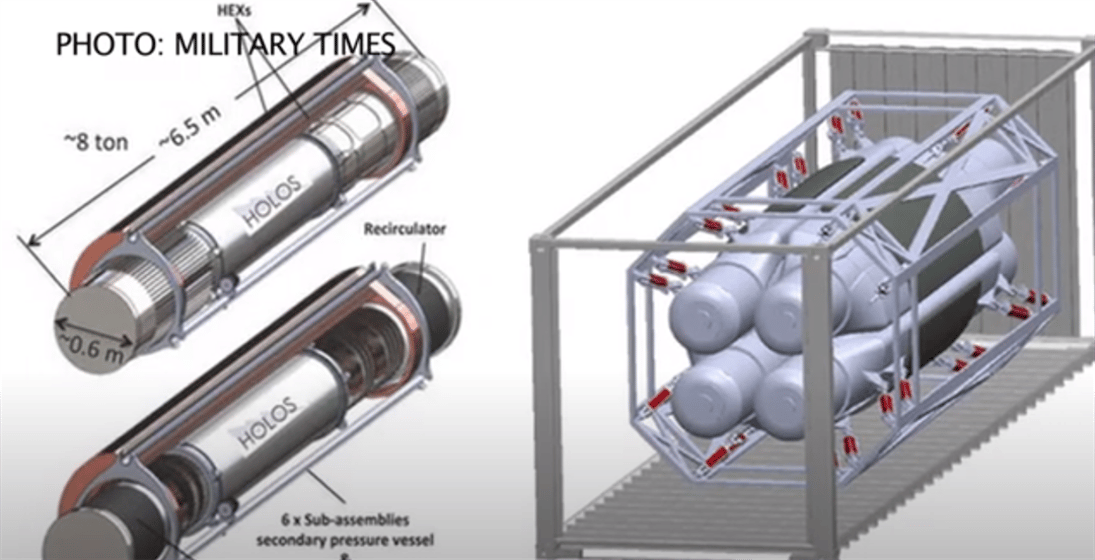
An article last year in the “Military Times” mentions Guam as a potential site for the mobile nuclear equipment.
It describes a 40-ton reactor that can fit into three to four 20-foot containers and can provide up to 5 megawatts of power.
The army has been considering the use of mobile nuclear power for years in a program called project pele, ironically named after the Hawaiian goddess of fire and volcanoes.
The benefits as a power source in remote, austere locations is clear, but there are drawbacks in battle situations.
If however that reactor is struck during conflict all the troops that are around that will be affected. So I think the concerns that they had about the use of these particular power devices for military people is magnified ten-fold when you think about the possibility that these might be placed in proximity to a civilian community.
And the military has confirmed that the planned 360-degree missile defense system could have as many as twenty different sites scatttered across the island.
Bettis says we need to know now more than ever, what’s going into each of these sites.
The people that I’ve talked to talk about a micro nuclear reactor and say if it hits you need a set-aside that’s at least a mile. That’s gonna be a very different sort of thing then if you had command and control module in your neighborhood, so I think as a community we need better transparency about what is being planned at all these locations.
US navy accused of cover-up over radioactive shipyard waste

The US navy is covering up dangerous levels of radioactive waste on a
40-acre former shipyard parcel in San Francisco’s waterside Hunters Point
neighborhood, public health advocates charge.
The land is slated to be
turned over to the city as early as next year, and could be used for
residential redevelopment. The accusations stem from 2021 navy testing that
found 23 samples from the property showed high levels of strontium-90, a
radioactive isotope that replaces calcium in bones and causes cancer.
The Environmental Protection Agency raised alarm over the levels, but the navy
in 2022 said its testing was inaccurate and produced a new set of data that
showed levels of strontium-90 lower than zero, which was dismissed by
environmental health experts as impossible.
Guardian 25th June 2023
https://www.theguardian.com/us-news/2023/jun/25/us-navy-accused-radiocative-shipyard-waste
What is the new ‘returning zone’ to be created in disaster-hit Fukushima?
June 24, 2023 (Mainichi Japan)
The Mainichi Shimbun answers some common questions readers may have about the new residence zones that will be created in parts of Fukushima Prefecture that have become uninhabitable as a result of the 2011 nuclear power plant accident.
Question: I heard that people who were unable to return to their hometowns due to the March 2011 Fukushima nuclear disaster will be able to do so. Is it true?
Answer: Due to the accident at the Fukushima Daiichi Nuclear Power Station, parts of seven municipalities in Fukushima Prefecture have been designated as so-called “difficult-to-return zones” where residence is restricted due to high radiation levels. Within these zones, new “specified returning residence zones” will be established to allow those who wish to return to do so.
Q: How will this work?
A: This system is based on the revised Act on Special Measures for the Reconstruction and Revitalization of Fukushima enacted by the Diet on June 2. The new returning residence zones are set to includes homes, roads and meeting places deemed necessary for the daily lives of those who wish to return to the “difficult-to-return” zones. Decontamination will be carried out to reduce radiation levels in these areas, and then the evacuation order over the areas will be lifted………………………………………..
When the Great East Japan Earthquake hit, there were about 16,000 people living in the areas. However, only about 200 people reside there now — an apparent result of many past residents already having shifted their base of livelihood to other locations due to their prolonged displacement.
Q: How far will the scope of the new returning residence zones extend?
A: Reconstruction bases were set up in clusters of private homes and around train stations, but in the case of the new returning residence zones, the setting is likely to be limited to areas around the homes of those who wish to return. Since it remains difficult to live in an area when an evacuation order has only partially been lifted, there is strong demand for unconditional decontamination throughout the entire area.
(Japanese original by Shuji Ozaki, Minamisoma Local Bureau) https://mainichi.jp/english/articles/20230623/p2a/00m/0op/028000c
Japan urged to face up to legitimate international concerns on dumping nuclear-contaminated water into ocean

By Global Times Jun 23, 2023
Japan was urged to face up to the legitimate concerns of the international community on dumping nuclear-contaminated water into ocean at the 53rd session of the United Nations Human Rights Council on Thursday. Japan’s moves are passing on the risk of nuclear pollution to all mankind that are seriously endangering the right to health of people of all countries, the Chinese representative to the council said.
The Chinese representative said that Japan’s dumping of nuclear-contaminated water into the sea violated its obligations under the United Nations Convention on the Law of the Sea and Japan has so far failed to prove that the dumping of nuclear-contaminated water into the sea is safe and sound. The data released by Japan itself also shows that nearly 70 percent of the treated nuclear-contaminated water still fail to meet the standards.
The dumping plan is not the only way to deal with the Fukushima nuclear-contaminated water, nor is it the safest and most optimal means of disposal. However, the Japanese side chose to discharge the nuclear-contaminated water into the ocean based on economic cost, and in doing so is passing on the risk of nuclear pollution to all mankind, and is seriously endangering the right to health of people of all countries.
The Chinese representative pointed out that Japan has not followed the principle of consultation on the dumping plan of nuclear-contaminated water, and has repeatedly tried to mislead the international community, trying to cover up the uncertain risks of nuclear-contaminated water dumped into the sea under the disguise of “treated water.”………………………………….
This is not a matter for Japan alone. The Japanese side must face up to the strong opposition voices at home and abroad and the reasonable concerns of the international community, honestly fulfill its international obligations, and dispose of the nuclear-contaminated water in an open, transparent, and safest way, so as not to cause irreversible consequence, the representative noted. https://www.globaltimes.cn/page/202306/1293022.shtml
Nuclear Waste Transportation Draws Opposition in West

Concerns are growing in the west about nuclear waste transportation.
On Tuesday, the Snake River Alliance is holding a webinar on these concerns, heightened by the potential of a temporary waste facility opening in New Mexico.
Kevin Kamps is the radioactive waste specialist for Beyond Nuclear. He said these fears are combined with the recent train derailment of toxic waste in Ohio.
He said the federal government and nuclear power industry are rushing to create the New Mexico temporary waste facility.
“These dumps that are proposed are called consolidated interim storage facilities, which means it’s only temporary and the waste will have to move again,” said Kamps. “So it’s really wrongheaded. It’s going to automatically double transportation risks.”
In May, the U.S. Nuclear Regulatory Commission issued a license for the temporary waste site in New Mexico.
The Biden administration says nuclear power is a key component for the country’s clean energy future. However, state officials in New Mexico have voiced their opposition to the facility.
Nuclear waste also is a concern in Idaho. Experiments are starting on new nuclear reactor designs such as small modular reactors at the Idaho National Laboratory.
However, Kamps pointed out that recent research found these SMRs generate two to 30 times the amount of radioactive waste as traditional nuclear reactors.
“So another downside of all this SMR talk,” said Kamps, “which unfortunately Idaho is on the cutting edge of.”
Kamps said he believes the country is living on borrowed time when it comes to the potential for disaster from nuclear power.
“We really should be transitioning into a renewable energy economy in this country,” said Kamps, “which is much safer, much more secure and actually much more cost effective than nuclear power.”
Keep nuclear threats off the table
https://wordpress.com/post/nuclear-news.net/235150 24 June 23
The developing events in Russia have not yet featured explicit nuclear threats of any kind. We must hope that no such threats materialise. Yet it would be wrong to completely ignore the implicit nuclear risks embedded in what is happening.
Russia spends the third largest amount on nuclear weapons of any of the nuclear-armed states ($9.6 billion in 2022) and retains the largest declared stockpile of nuclear warheads (close to 6,000) of any such state. Russia’s ‘nuclear doctrine’ is clear that nuclear weapons may be used if there is a threat to the integrity of the state.
Like many other nations Russia has a large number of nuclear power plants: each of these is a potential nuclear disaster in the ‘best of times’ and even more so in conflict situations. Such potential risks are illustrated by ongoing concern over the status of the Zaporizhzhia nuclear power plant in Ukraine, which is currently occupied by Russian forces.
There are no ‘right hands’ for nuclear weapons and nuclear technology. Events such as those in Russia demonstrate the stark risks and illustrate one of the reasons why the Campaign for Nuclear Disarmament calls for the abolition of nuclear weapons and an end to nuclear power.
What goes for Russia also goes for the rest of the world. For too long, actual nuclear blackmail and the prospect of such blackmail has distorted political relations within and between states. The prospect of nuclear escalation and the threat of nuclear use must end.
Whatever else transpires, CND calls on all sides to keep nuclear threats and nuclear blackmail off the table.
Suffolk campaigners vow to continue fighting Sizewell C
Campaigners have vowed to continue their fight against the “monstrous”
Sizewell C nuclear power station on the Suffolk coast despite losing a
legal challenge against the plans. The High Court announced on Thursday
that the judicial review brought by Together Against Sizewell C (TASC) had
been rejected as being ‘totally without merit’. TASC had launched the
review over the environmental impact of the project, particularly the
disposal of nuclear waste and the provision of a water supply to the
station.
East Anglian Daily Times 23rd June 2023
https://www.eadt.co.uk/news/23608074.suffolk-campaigners-vow-continue-fighting-sizewell-c/
“Brink of catastrophe” should Wagner Group “bandits” get their hands on nuclear weapons.
An ally of Russian President Vladimir Putin has warned the world would
find itself on the “brink of catostrophe” should Wagner Group “bandits” get
their hands on nuclear weapons. Dmitry Medvedev, Russia’s Security Council
Deputy Chairman issued the warning as Yevgeny Prigozhin and his mercenaries
marched towards Moscow, prior to their dramatic U-turn in order to “avoid
bloodshed”.
Mirror 25th June 2023
https://www.mirror.co.uk/news/world-news/world-brink-catastrophe-wagner-gets-30316109
Chinese Boycott Over Fukushima Nuclear Plant Water Release Sinks Japanese Cosmetics
A consumer boycott in China over a planned release of water from the Fukushima Dai-Ichi nuclear plant is threatening to hurt Japanese cosmetics makers.
The viral campaign began earlier this month when largely unproven allegations that water discharges from the plant are hazardous to ……………………………..(subscribers only) https://www.bloomberg.com/news/articles/2023-06-23/china-boycott-over-fukushima-nuclear-plant-water-release-sinks-japan-cosmetics#xj4y7vzkg
Amid China Tensions, US Nuclear-Powered Aircraft Carrier, USS Ronald Reagan, To Make A Rare Vietnam Port Call
By Ashish Dangwal. Eurasian Times, June 24, 2023
Amid heightened tensions with Beijing in the South China Sea, the US nuclear-powered aircraft carrier Ronald Reagan is scheduled to make a rare visit to Danang, the port city in Central Vietnam, on June 25.
This visit by the USS Ronald Reagan marks only the third time a US aircraft carrier has made such a stop since the end of the Vietnam War.
According to an announcement by Vietnam’s Foreign Ministry, the USS Ronald Reagan, a Nimitz-class aircraft carrier, was scheduled to reach Da Nang on June 25 and remain there until June 30………….
Additionally, Vietnam recently hosted Japan’s largest destroyer, the Izumo, after joint exercises with the USS Ronald Reagan and other American vessels in the South China Sea.
………. The United States aims to enhance its bilateral relationship with Vietnam, especially considering Hanoi’s ongoing disputes with Beijing over territorial boundaries in the South China Sea. …………………………………………….. more https://eurasiantimes.com/amid-china-tensions-us-nuclear-powered-aircraft-carrier-uss-ronald-reagan-to-make-a-rare-vietnam-port-call/
The Biden administration is pouring billions into the nuclear industry. The payoff isn’t certain
America aims for nuclear-power renaissance, The Economist 25 June 23
After the second world war, America’s newly created Atomic Energy Commission was on the hunt for a remote site where engineers could work out how to turn the raw, world-altering power contained in a nuclear bomb into electricity. They settled on the desert shrubland of south-eastern Idaho. Towns in the area fell over themselves to compete for the headquarters of the reactor test site, viewing it as a catalyst for growth. Idaho Falls, then a city of 19,000, launched what it called “the party plan”. Locals wooed officials at lunches, cocktail parties and tours of the city. The guest lists always included women who were “as winsome as possible” to make the town seem attractive to the (male) engineer in charge of choosing.
The party plan worked. Nearly 75 years later, Idaho Falls (with a population of 67,000) remains home to the test site’s successor and the centre of nuclear-power research in the United States: the Idaho National Laboratory (inl)…………………… (Subscribers only)
https://www.economist.com/united-states/2023/06/25/america-aims-for-nuclear-power-renaissance
1 This Month
Chernobyl: The Lost Tapes – A good documentary on Chernobyl on SBS available On Demand for the next 3 weeks– https://www.sbs.com.au/ondemand/tv-program/chernobyl-the-lost-tapes/2352741955560

of the week–London Campaign for Nuclear Disarmament

Tell the Ukrainian Government to Drop Prosecution of Peace Activist Yurii Sheliazhenko
To see nuclear-related stories in greater depth and intensity – go to https://nuclearinformation.wordpress.com
-
Archives
- April 2026 (139)
- March 2026 (251)
- February 2026 (268)
- January 2026 (308)
- December 2025 (358)
- November 2025 (359)
- October 2025 (376)
- September 2025 (257)
- August 2025 (319)
- July 2025 (230)
- June 2025 (348)
- May 2025 (261)
-
Categories
- 1
- 1 NUCLEAR ISSUES
- business and costs
- climate change
- culture and arts
- ENERGY
- environment
- health
- history
- indigenous issues
- Legal
- marketing of nuclear
- media
- opposition to nuclear
- PERSONAL STORIES
- politics
- politics international
- Religion and ethics
- safety
- secrets,lies and civil liberties
- spinbuster
- technology
- Uranium
- wastes
- weapons and war
- Women
- 2 WORLD
- ACTION
- AFRICA
- Atrocities
- AUSTRALIA
- Christina's notes
- Christina's themes
- culture and arts
- Events
- Fuk 2022
- Fuk 2023
- Fukushima 2017
- Fukushima 2018
- fukushima 2019
- Fukushima 2020
- Fukushima 2021
- general
- global warming
- Humour (God we need it)
- Nuclear
- RARE EARTHS
- Reference
- resources – print
- Resources -audiovicual
- Weekly Newsletter
- World
- World Nuclear
- YouTube
-
RSS
Entries RSS
Comments RSS
 nuclear-news