Is Fukushima wastewater release safe? What the science says
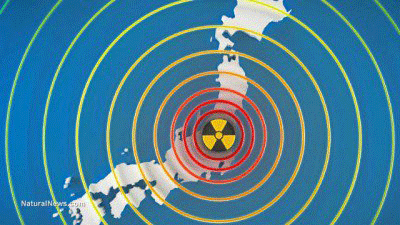
Radiation in the water will be diluted to almost-background levels, but some researchers are not sure this will be sufficient to mitigate the risks.
Bianca Nogrady Nature, 22 June 23
Despite concerns from several nations and international groups, Japan is pressing ahead with plans to release water contaminated by the 2011 meltdown of the Fukushima Daiichi nuclear power plant into the Pacific Ocean. Starting sometime this year and continuing for the next 30 years, Japan will slowly release treated water stored in tanks at the site into the ocean through a pipeline extending one kilometre from the coast. But just how safe is the water to the marine environment and humans across the Pacific region?
How is the water contaminated?
The power station exploded after a devastating earthquake and subsequent tsunami crippled the coastal plant, overheating the reactor cores. Since then, more than 1.3 million cubic metres of seawater have been sprayed onto the damaged cores to keep them from overheating, contaminating the water with 64 radioactive elements, known as radionuclides. Of greatest concern are those that could pose a threat to human health: carbon-14, iodine-131, caesium-137, strontium-90, cobalt-60 and hydrogen-3, also known as tritium.
Some of these radionuclides have a relatively short half-life and would already have decayed in the 12 years since the disaster. But others take longer to decay; carbon-14, for example, has a half-life of more than 5,000 years.
How are they treating the water?
The contaminated water has been collected, treated to reduce the radioactive content and stored in more than 1,000 stainless steel tanks at the site. …………………………
Will radioactivity concentrate in fish?
Nations such as South Korea have expressed concern that the treated water could have unexplored impacts on the ocean environment, and a delegation from the country visited the Fukushima site in May. Last year, the US National Association of Marine Laboratories in Herndon, Virginia, also voiced its opposition to the planned release, saying that there was “a lack of adequate and accurate scientific data supporting Japan’s assertion of safety”. The Philippine government has also called for Japan to reconsider releasing the water into the Pacific.
“Have the people promoting this going forward — ALPS treatment of the water and then release into the ocean — demonstrated to our satisfaction that it will be safe for ocean health and human health?” asks Robert Richmond, marine biologist at the University of Hawaii at Manoa. “The answer is ‘no’.”
Richmond is one of five scientists on a panel advising the Pacific Islands Forum, an intergovernmental organization made up of 18 Pacific nations including Australia, Fiji, Papua New Guinea and French Polynesia. The panel was convened to advise on whether the release of the treated water from Fukushima was safe both for the ocean and for those who depend on it. Richmond says they have reviewed all the data provided by TEPCO and the Japanese government, and visited the Fukushima site, but there are still some unanswered questions about tritium and carbon-14………………………………….
TEPCO says fishing is not routinely conducted in an area within 3 kilometres of where the pipeline will discharge the water. But Richmond is concerned the tritium could concentrate in the food web as larger organisms eat smaller contaminated ones. “The concept of dilution as the solution to pollution has demonstrably been shown to be false,” Richmond says. “The very chemistry of dilution is undercut by the biology of the ocean.”
Shigeyoshi Otosaka, an oceanographer and marine chemist at the Atmospheric and Ocean Research Institute of the University of Tokyo says that the organically bound form of tritium could accumulate in fish and marine organisms. He says international research is investigating the potential for such bioaccumulation of the radionuclides in marine life, and what has already happened in the waters around Fukushima after the accidental release of contaminated water during the tsunami. “I think it is important to evaluate the long-term environmental impact of these radionuclides,” Otosaka says………………………………. https://www.nature.com/articles/d41586-
No comments yet.
1 This Month
Chernobyl: The Lost Tapes – A good documentary on Chernobyl on SBS available On Demand for the next 3 weeks– https://www.sbs.com.au/ondemand/tv-program/chernobyl-the-lost-tapes/2352741955560

of the week–London Campaign for Nuclear Disarmament

Tell the Ukrainian Government to Drop Prosecution of Peace Activist Yurii Sheliazhenko
To see nuclear-related stories in greater depth and intensity – go to https://nuclearinformation.wordpress.com
-
Archives
- April 2026 (139)
- March 2026 (251)
- February 2026 (268)
- January 2026 (308)
- December 2025 (358)
- November 2025 (359)
- October 2025 (376)
- September 2025 (257)
- August 2025 (319)
- July 2025 (230)
- June 2025 (348)
- May 2025 (261)
-
Categories
- 1
- 1 NUCLEAR ISSUES
- business and costs
- climate change
- culture and arts
- ENERGY
- environment
- health
- history
- indigenous issues
- Legal
- marketing of nuclear
- media
- opposition to nuclear
- PERSONAL STORIES
- politics
- politics international
- Religion and ethics
- safety
- secrets,lies and civil liberties
- spinbuster
- technology
- Uranium
- wastes
- weapons and war
- Women
- 2 WORLD
- ACTION
- AFRICA
- Atrocities
- AUSTRALIA
- Christina's notes
- Christina's themes
- culture and arts
- Events
- Fuk 2022
- Fuk 2023
- Fukushima 2017
- Fukushima 2018
- fukushima 2019
- Fukushima 2020
- Fukushima 2021
- general
- global warming
- Humour (God we need it)
- Nuclear
- RARE EARTHS
- Reference
- resources – print
- Resources -audiovicual
- Weekly Newsletter
- World
- World Nuclear
- YouTube
-
RSS
Entries RSS
Comments RSS
 nuclear-news
Leave a comment