TODAY. Cool thinking is needed on the Ukraine situation. Would Russia really blow up a nuclear plant that it controls?

A leader may popular, brave, hard-working, charismatic, and zealously against the evils of communism, – and a brilliant media performer.
But that does not necessarily mean that we should blindly believe everything that he says, or dutifully act on his advice.
Cool thinking is needed now, more than ever. Is Ukraine really winning this war?
Is it really wise to plan to pretty much encircle Russia with weaponry, with NATO at the nuclear-attack ready?
Russians still remember, and still endure, the effects of the 1986 Chernobyl nuclear disaster – which President Gorbachev blamed for starting the collapse of the Soviet Union.
We are expected now to believe that Putin is stupid enough to blow up the Zaporizhzhia nuclear plant, because Russia is supposedly losing the war in Ukraine?
Really?
Consider the possibility that Putin is not stupid. Consider the possibility that Ukraine’s much-vaunted “counter-offensive” is not bringing about the complete rout of Russia, which is Zelensky’s stated aim. Even consider the possibility that Zelensky and his supporters are zealous enough to do this blowing up themselves, as a last-ditch effort to get NATO to attack Russia.
You do realise that a NATO attack on Russia will bring about World War 3?
p.s. What nobody is telling us about – how many Ukrainian soldiers being killed each day? the total Ukrainian military casualties?.
European Parliamentary Assembly rapporteurs warn against extradition to the United States of Julian Assange

20/06/2023Legal Affairs and Human Rights, https://pace.coe.int/en/news/9145/pace-rapporteurs-warn-against-extradition-to-the-united-states-of-julian-assange?fbclid=IwAR17jfNw-hOFAyBnLaAdYy-4ZurMA8qGK9TdNyYSAILwoezU1K4EmqukTv4
The General Rapporteurs on Human Rights Defenders and Whistleblowers, and on Political Prisoners, of the Parliamentary Assembly of the Council of Europe (PACE), Emanuelis Zingeris (Lithuania, EPP/CD) and Sunna Ævarsdóttir (Iceland, SOC), have warned against the extradition to the United States of Julian Assange.
“The harsh treatment of Julian Assange to date, and the lengthy prison term which he faces in the US if extradited, have a chilling effect on freedom of information, freedom of speech and whistleblowing in general. Daniel Ellsberg, who leaked the ‘Pentagon Papers’, is rightly celebrated as a hero for his contribution to bringing the Vietnam war to an end. Julian Assange, who published accurate information on egregious human rights violations by state agents in Iraq and elsewhere, also deserves recognition, not punishment,” said Mr Zingeris.
“Julian Assange has made powerful enemies in the United States. If extradited, he would risk serious human rights violations, including ill-treatment in detention, and a disproportionate prison sentence. It is therefore with great concern that we learned of the decision issued on 6 June by the High Court in London, denying Julian Assange permission to appeal the decisions authorising his extradition,” said Ms Ævarsdóttir.
“We also call on the international community to take any action likely to put an end to Julian Assange’s extradition proceedings in order to prevent human rights violations, which appear more imminent now than ever before,” the rapporteurs said. Both rapporteurs note that the Assembly has already supported the release of Julian Assange and recall statements by the Council of Europe Commissioner for Human Rights calling on the UK to end the arbitrary detention of Julian Assange and to prevent his extradition.
Nuclear Fusion: A Clean Energy Revolution Or A Radioactive Nightmare?

By Kurt Cobb – Jun 20, 2023, Oil Price
Fusion reactors, while producing energy, also produce neutron streams that can cause radiation damage, produce radioactive waste, necessitate biological shielding, and even create the potential for weapons-grade plutonium production.
Apart from the aforementioned problems, fusion reactors face issues such as tritium release, intensive coolant demands, and high operating costs, which would require the power plant to have at least a one-gigawatt capacity to balance costs.
Given the time and resources required for fusion power plant construction, the technology might not be feasible for timely carbon emission reduction, and the prospect of fusion energy might be distracting society from immediate solutions to energy scarcity and climate change.
……………………
The reality of fusion power, however, is one of huge scale and vast obstacles according to Daniel Jassby, a former research physicist at the Princeton Plasma Physics Lab. (All of what follows assumes that the remaining obstacles to producing net energy from fusion will be overcome. Addressing that issue would require a seperate and lengthy essay.)
Perhaps the most unexpected revelation Jassby offers runs entirely contrary to the clean image that fusion energy has in the public mind. It turns out that the most feasible designs for fusion reactors will generate large amounts of radioactivity and radioactive waste.
[here much detail on the operation of nuclear fusion]………………………………………………………………………..
To power the enormously energy-intensive process of fusion, a fusion plant will use a lot of energy just to run itself. That means scale will matter. In order to accommodate this so-called parasitic power drain AND produce enough excess electricity to sell to pay for the costs of constructing the plant and for its ongoing operation, fusion plants will have to have a capacity of at least one gigawatt (one billion watts). One gigawatt can supply electricity to 300,000 to 750,000 homes depending on how the calculation is done. And, even much larger capacity per plant will be desirable because it will decrease the percentage of power production devoted to sustaining the fusion reaction and servicing the plant infrastructure. In short, making fusion plants big will be the only way to make them economical. So much for my friend’s fantasy of handheld fusion power units!
In a second article, Jassby addresses the International Thermonuclear Experimental Reactor (ITER) located in France. The project is a cooperative research venture designed to study and perfect fusion. It will not produce any electricity itself, but rather set the stage for so-called demonstration plants which could be built in the second half of this century.
……………………..
just to operate its experiments, ITER will require 600 megawatts of power, a window into the parasitic power requirements of fusion reactors.
The fantasy of cheap, unlimited fusion power arriving soon with no serious side-effects prevents us as a society from grappling with near-term energy depletion and our ongoing dependence on fossil fuels in the accelerated manner required to prevent a major energy crisis. Hope that fusion energy will somehow solve our energy and climate problems is not a real plan. It is just another illusory and far-in-the-future technical fix offered to convince us that we don’t need to alter our way of life in any substantial way to address the serious problems we face. https://oilprice.com/Alternative-Energy/Nuclear-Power/Nuclear-Fusion-A-Clean-Energy-Revolution-Or-A-Radioactive-Nightmare.html
Khren Im – To the USA and Biden ….if this continues, it is lights out for humanity

Khren Im.
Sullivan (above) made it clear to his audience [at the “Arms Control Association,” sic] that the nuclear strategy that the Biden administration approved in October 2022 would remain intact through 2026, when the last remaining U.S.-Russian arms control agreement, the 2010 New START treaty, was set to expire.
Once the New START treaty expires, and barring any agreement replacing it with a new agreement, Sullivan said that, given the state of play between the U.S. and Russia when it came to arms control, the U.S. would have no choice but to develop and deploy newer, more dangerous nuclear weapons [to be made for the foreseeable future using plutonium cores (“pits”) produced by Los Alamos National Laboratory].
Sullivan then laid out the Biden administration’s case against Russia, starting with the Russian suspension of the New START treaty itself. Left unsaid was Russia’s stated reason for this suspension, namely the impossibility from the Russian point of view of engaging in strategic nuclear arms reductions at a time when the United States was pursuing a policy in Ukraine of waging a proxy conflict designed to cause the strategic defeat of Russia.
From the Russian perspective, pursuing the cooperative reduction with the U.S. of the very strategic capability which is, by design, intended to prevent Russia’s strategic defeat at a time when the U.S. was pursuing the strategic defeat of Russia was a non-starter.
If this insanity is allowed to continue unabated, it is lights out for all of humanity.
Chew on that the next time you cheer on the Ukrainian counteroffensive or applaud the use of U.S. taxpayer dollars to fund the Ukrainian military.
It is high time for the American public to recognize that our only hope for a survivable future is one where arms control and nuclear disarmament once again serve as the cornerstone of a U.S.-Russian relationship, and that the shortest possible path toward achieving that objective is for Russia to win its war against Ukraine [which would occur at any time the U.S. said it would not support the war further, thus also saving tens of thousands of lives]
And for those politicians in the U.S. and Europe who have invested their political futures on the suicidal mission of feeding Ukraine’s anti-Russian fantasies? Khren Im.
| https://consortiumnews.com/2023/06/21/scott-ritter-on-horse-radishes-nuclear-war/SCOTT RITTER: On Horseradish & Nuclear War. June 21, 2023 |
When Vladimir Putin was recently asked about the potential use of nuclear weapons in the context of Ukraine, an understanding of back-alley Russian slang was needed to understand his response.
……………………………….During the June 16 discussion period of the plenary session of the 2023 St. Petersburg International Economic Forum, the Russian leader was asked about his views on the potential use of nuclear weapons in the context of the ongoing Ukrainian conflict.“This use of nuclear weapons is certainly theoretically possible,” Putin bluntly answered.
Putin paused, before shrugging and, with a half-smile, saying “Khren Im”.Khren Im is a Russian slang term derived from the word “horseradish” (khren), thus a literal translation of the phrase used by Putin would be “horseradish them.” But khren closely resembles a more salty term …….. khren Im is understood to mean “F*ck them.”“F*ck them, you know?” Putin said, to the obvious mirth of the audience……………….
The “them” in the horseradish reference made by the Russian president is the United States. Two weeks prior to Putin’s man-in-the-street reaction, on June 2, U.S. President Joe Biden’s national security adviser, Jake Sullivan, addressed a conference hosted by the Arms Control Association, in Washington, D.C. The topic, not surprisingly, was the administration’s approach to U.S.-Russian arms control.
Biden’s Nuclear Strategy ……………………………………………………….
Likewise left unspoken was Russia’s contention that the U.S. was in violation of the New START Treaty by keeping some 101 strategic delivery systems from being inspected, despite being required to do so by the provisions of the New START Treaty.Khren Im.
Sullivan called out Russia’s decision to station tactical nuclear weapons in Belarus, without elaborating on either the threats made to Belarus by several NATO members, including Poland and the Baltic states. Nor did he acknowledge that the Russian action parallels a similar U.S. policy in stationing some 100 nuclear B-61 gravity bombs on the territories of five NATO nations. Khren Im.
Sullivan strongly criticized Russia for its total disregard for international law, including arms control treaties such as the Treaty on Conventional Forces in Europe (CFE) from which Russia recently withdrew, without putting the Russian decision in proper historical perspective. This perspective involves the ongoing disregard by the U.S. and NATO of deliberate inequities in the CFE structure that were brought on by the ongoing expansion of NATO.
Nor did the U.S. national security adviser acknowledge that it was the U.S., not Russia, which had withdrawn from the Anti-Ballistic Missile Treaty and the Intermediate Forces Treaty, both of which are considered foundational for all arms control treaties going forward.[Related: U.S. Establishment: Nixing Arms Control]Khren Im.
Sullivan’s presentation ignored such salient matters as the purpose behind NATO’s certification of the F-35 fighter as a nuclear-capable delivery system, and what the deployment of nuclear-capable F-35s to NATO nations not included in the existing shared nuclear defense scheme meant to the scope and scale of the NATO nuclear deterrence model considering the continued NATO Baltic Air Policing and South European Air Policing operations.
Sullivan also failed to address the current “launch-on-warning” posture employed by the Biden administration, which positions the U.S. to carry out a first nuclear strike against Russia, and the role that the continued patrols in Europe and Asia by American nuclear-capable B-52H strategic bombers, including aggressive flight profiles appearing to simulate the launch of nuclear-armed cruise missiles against Saint Petersburg.
Sullivan also ignored the impact of the Biden administration’s ongoing plans to bring back medium- and intermediate-range nuclear-capable missiles to the European theater will be on the overall nuclear balance of power between the U.S.-NATO and Russia.Khren Im.
A day before Putin addressed the St. Petersburg International Economic Forum, Russian Deputy Foreign Minister Sergey Ryabkov spoke to the media about the “opposing, irreconcilable positions” of Russia and the U.S. concerning the resumption of discussions regarding the New START treaty. “[T]he suspension of New START remains in effect,” Ryabkov said, “and this decision may be revoked or reconsidered only if the U.S. demonstrates a willingness to abandon its fundamentally hostile policy toward the Russian Federation.”Khren Im……………………………………………………………………
While people are right to be concerned about the policy recommendations made by prominent Russians such as Karaganov, they must also address the root cause of such pronouncements, namely the policies of the Biden administration to achieve the strategic defeat of Russia in Ukraine, seemingly at whatever cost (especially when the cost is paid in the blood of Ukrainian soldiers)
Russia will not use nuclear weapons to fulfil the tasks set forth in its Special Military Operation. It will use nuclear weapons to preserve Russian territorial integrity. The reality today is that the irresponsible policies of the U.S. and its NATO allies have sought the expansion of NATO up to the Russian borders . As they abandoned every opportunity to prevent a conflict with Russia over Ukraine, there is a war between Russia and Ukraine that has resulted in Ukraine irrevocably losing 20 percent of its territory (the oblasts of Kherson, Zaparizhia, Donetsk and Lugansk, along with the Crimea).
All of that territory has been absorbed into the Russian Federation and makes any effort to strip them away from Russia by definition an existential conflict where, if Russia were to lose, would necessarily trigger the use of nuclear weapons.
And yet Biden and his NATO allies continue to feed a Ukrainian fantasy where the reacquisition of these territories by Ukraine is a desirable outcome.
Has either Biden, his advisers, or the American public considered the potential consequences of this action? Are they willing to trade Boston for Poznan, or sacrifice humanity for the sake of appeasing Ukrainian sensibilities? The answer appears to be “no.”
As for Russia, one is guided by the words of Vladimir Putin: “Khren Im”F*ck them. But in reality, F*ck us. All of us. If this insanity is allowed to continue unabated, it is lights out for all of humanity.
Assessing investability of new nuclear projects like Sizewell C
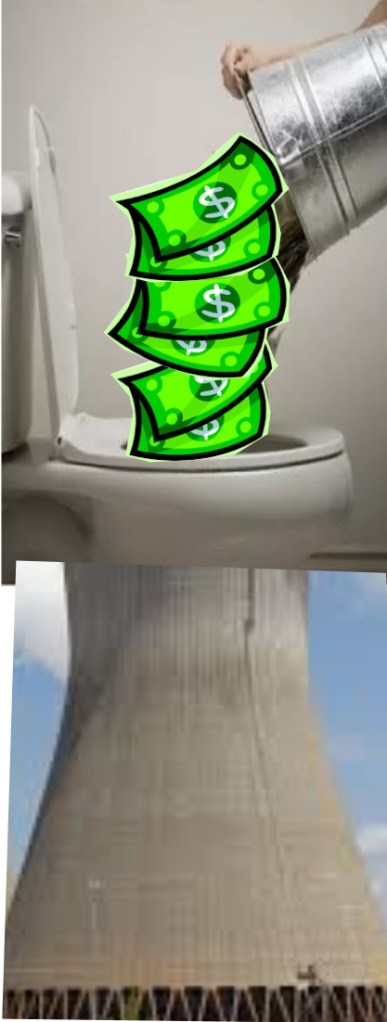
The crucial issue here is that the regulated company is permitted to start charging customers immediately after the project begins, and can continue to do so throughout the construction phase.
The downside for customers or ratepayers is that they end up bearing most of the risk, whether that is delays, cost increases, or even complete cancellations.
it is transferring a lot of the risk straight onto the customer and the customer can end up paying through the nose for nothing if you have serious problems in terms of timescales.”
NS Energy, By James Varley 19 Jun 2023
The UK is grappling with the problem of inviting the private sector to invest in new nuclear without interest driving up the price. Its solution cuts costs – but transfers the risk to consumers
UK Chancellor Jeremy Hunt confirmed recently that the UK would back the proposed Sizewell C nuclear power plant with an investment of £679m. The funding had initially been announced by then Prime Minister Boris Johnson. It is a mark of the large investment involved in a new nuclear unit that, despite UK plans to see one new nuclear plant reach Final Investment Decision (FID) in this parliament (ie before the end of 2024) and two achieve FID in the next (before 2029), two incoming Prime Ministers (Teresa May and Rishi Sunak) have announced reviews of Sizewell C. But Sunak’s chancellor Jeremy Hunt reaffirmed both the project and the funding, saying: “Our £700m investment is the first state backing for a nuclear project in over 30 years and represents the biggest step in our journey to energy independence.”
Of perhaps more interest to investors is the UK government’s decision to take a 50% stake in Sizewell C, with co-investor EDF. But neither of the two envisages holding those large stakes for very long. Once the project – which now has planning permission – reaches FID, both hope that it will attract new investors, so that the UK and EDF can reduce their stake to around the 20% level.
It is hoped that the project can bring in private capital because investors will gain confidence in the continued presence in the project of the UK and EDF but also because it will be built under a different financing model.
It is hoped Sizewell C will look less like a state-owned plant where funding comes from the government and it (in effect taxpayers) bears the risk of cost and schedule overruns. Instead, the government hopes it will resemble other types of power plant development cycles, in which different investors buy and dispose of stakes as the project moves from development, to permitted and ‘shovel-ready’, to construction and operation. With each step the project rises in value while the risk falls, so eventually it becomes investable for groups like pension funds which will accept low returns in exchange for long-term stability, while early investors will take their profit and reinvest in other projects where returns are higher.
At £20bn (in 2015 money) even 60% of the project will be too large for any single bank or other investors, which are more likely to join at the £1bn level. But the UK hopes that post-FID (aimed to be at the end of 2024) the project will attract enough investors that they will be in competition on the initial return on investment required. In the future, the level of allowed return will be set by the UK’s energy regulatory authority, Ofgem
Moving to a RAB model
Co-investing with the government is not currently enough to make Sizewell C an attractive investment though. The key to that, the UK government believes, is the Regulated Asset Base model (RAB).
The Department for Business, Energy and International Strategy (BEIS) set out its view on the RAB model and compared it with other funding models in an Impact Assessment in 2021 – required because the RAB model required primary legislation (which has now been passed).
Comparing RAB with relying on existing funding models, such as Contracts for Difference (CfD) BEIS said it “believes there are few, if any, strategic investors in the market with the risk appetite to finance a new nuclear power plant using a CfD mechanism.” In fact, BEIS also considered that the RAB on its own “would not achieve the goal of delivering new projects at a lower cost”. It added new Funded Decommissioning Programme (FDP) legislation and the new Special Administration Regime.
What is the Regulated Asset Base model? It aims to manage nuclear’s biggest problem: huge capital costs and the long gap (as much as 15 years) between investing and starting to earn a return when power is produced.
The UK’s RAB approach aims to address this. It has commonalities with US models that add nuclear to a utility’s ‘rate base’, but the UK version would ring-fence the project activities in a special purpose vehicle (SPV). The SPV is awarded a licence to own and operate the project for a defined period. It is permitted to recover the costs of construction and operation, and also to make an ‘allowed return’ on the asset for the lifetime of the licence.
The crucial issue here is that the regulated company is permitted to start charging customers immediately after the project begins, and can continue to do so throughout the construction phase.
……………………..The downside for customers or ratepayers is that they end up bearing most of the risk, whether that is delays, cost increases, or even complete cancellations.
……………………….There is no shortage of experience in the energy sector of different financing models. Some have salutary lessons………………………………
The burden lies less heavily on wind and solar projects because they can be built relatively quickly and the project can be built in phases. As a result, income from part of the project starts early, while construction lessons can be learned from in early phases so delivery risk in the later phases is lower. Nuclear does not have that opportunity.
Prices set in advance look very different in the rearview mirror. Once the plant is operating the risks accepted by the developer before and during construction are forgotten…………………..
With the RAB model, a nuclear plant will still face price and volume risk once operating, as its power will have to be sold into a volatile market where nuclear can be pushed out of the merit order by cheap renewables and prices can fall to zero at times (a contrast to TTT, whose customer Thames Water has no choice but to use the service and no alternative supplier).
Despite the fact that it may reduce costs, consumer advocates are very wary of the RAB model. Alan Whitehead, Labour’s shadow energy minister and a longstanding observer of the industry, has previously complained that the RAB model “effectively puts costs on the consumer well before you have any idea when a particular plant will come onstream. If there is any slippage in the process the consumer just continues to pay out. …it is transferring a lot of the risk straight onto the customer and the customer can end up paying through the nose for nothing if you have serious problems in terms of timescales.”
He referred to consumers in the USA who were left paying the cost for decades when nuclear projects were cancelled……………….. https://www.nsenergybusiness.com/features/assessing-investability-of-new-nuclear-projects-like-sizewell-c/
‘We need to wake up’: Algonquin leaders sound alarm over planned nuclear waste facility near Ottawa River
By Matteo Cimellaro | News, Urban Indigenous Communities in Ottawa | June 20th 2023
Four Algonquin chiefs spoke out on Tuesday, calling out the government and its private-sector contractor over what they say are inadequate consultations over a planned nuclear waste storage facility.
Last year, the Canadian Nuclear Safety Commission (CNSC) paused its decision to move ahead with the planned waste facility, located at the Canadian Nuclear Laboratories in Chalk River, Ont. The site is 180 kilometres north of Ottawa and sits within a kilometre of the Ottawa River, otherwise known as the Kichi Sibi in Algonquin.
The pause was intended to give more time for consultations with Kebaowek First Nation and Kitigan Zibi Anishinabeg, whose traditional territories circle the Ottawa River on both sides of Quebec and Ontario.
“It’s a huge victory for us,” Coun. Justin Roy of Kebaowek First Nation told Canada’s National Observer at the time.
But now, Algonquin leaders are slamming the CNSC for failing to give adequate time for meaningful consultation. The process only lasted six months, which the leaders argued is a short time frame given the challenges of negotiating funding agreements for Indigenous-led environmental assessments.
Still, the Algonquin-led assessment found the proximity to the Ottawa River, which supplies water to millions, including Algonquins, a major red flag. The river was given status of a Canadian Heritage River by Ontario and Quebec and it holds the utmost spiritual and historical importance for the Algonquin nation.
The assessment also pointed to potential risks to Indigenous harvesting rights and the environment, including contamination concerns to local moose, migratory birds and fish.
There are also concerns about tritium, a radioactive form of hydrogen, leaching from the nuclear waste into the Ottawa River, Chief Lance Haymond of Kebaowek First Nation said.
“We need to wake up and recognize what a danger Chalk River poses not only to the Algonquin people but to all Canadians, especially those living in the Ottawa-Gatineau area,” he added.
At the press conference, Haymond was flanked by Dylan Whiteduck, chief of Kitigan Zibi, and grand chiefs Savanna McGregor and Lisa Robinson, who are leaders of the Algonquin Anishinabeg Nation Tribal Council and Algonquin Nation Secretariat, respectively.
Elizabeth May, co-leader of the federal Green Party, sponsored the press conference. In brief comments, she pointed to the primary shareholder of the company that manages Canadian Nuclear Laboratories, criticizing the decision to build the facility so close to the Ottawa River.
Canadian Nuclear Laboratories is a subsidiary of the Crown corporation Atomic Energy Limited Corporation, but it is operated under contract by the Canadian National Energy Alliance, a private-sector consortium led primarily by SNC-Lavalin. The Canadian National Energy Alliance is responsible for the daily operations of the nuclear laboratories, as well as the decommissioning and management of nuclear waste from the facilities, according to the SNC-Lavalin website.
“I don’t think we had in mind that SNC-Lavalin would once again get its way,” she said, alluding to the company’s role in a scandal that rocked the federal government four years ago.
The Algonquin leaders are also calling foul on the consultation process for a divide-and-conquer strategy of picking which Algonquin nations to consult with, which Haymond calls a “continuation of colonialism.” Pikwakanagan First Nation signed a long-term relationship agreement with Canadian Nuclear Laboratories on June 9.
“It’s a First Nation who seemed to have forgotten their responsibilities and priorities as protectors of the land, protectors of the water,” he said.
Haymond notes Pikwakanagan was given years of consultation through the controversial organization Algonquins of Ontario, which local Algonquins have accused of dividing the nation and giving free passes to false Indigenous identity claims. The organization even named a building in Algonquin at the Canadian Nuclear Laboratories site.
An official hearing for the near-surface nuclear waste facility is scheduled for Aug. 10.
“We’ve been here for millennia, the Algonquin nation and our people,” Chief Whiteduck said.
“We’re still here, and we’re gonna be here for another 1,000 years. We’re hoping to deal with these contaminants that will be poured into our river.”
— With files from Natasha Bulowski
Plan to discharge water into Hudson River from closed nuclear plant sparks uproar

Michael Hill, Independent 21 June 23
The Indian Point nuclear plant along the Hudson River is at the
center of a controversy two years after it was shut down. The latest
flashpoint revolves around plans to release 1.3 million gallons of water
with traces of radioactive tritium into the river as part of the plant’s
decommissioning…………..
opponents along the river question the health and safety claims. They say the releases of radioactive water could be a step back for a once notoriously polluted river that is now a popular summer attraction for sailors, kayakers and swimmers.
Communities along the river have already passed resolutions opposing the discharges, and an online petition has gathered more than 440,000 signatures. Now a bill being considered in state Legislature on Tuesday sponsored by two Hudson Valley Democrats would ban those radiological discharges into the river.
“It leaves a bad taste in your mouth … the idea that we would be polluting our beautiful Hudson River with waste when we’ve spent so many years trying to clean it up. This shouldn’t be a dumping ground,” Assembly member Dana Levenberg said at a state Capitol rally for her bill.
The bill, approved by the state Senate earlier this month, was opposed by some union officials, who say it could interrupt the decommissioning and cause layoffs…………….. https://www.independent.co.uk/news/world/americas/hudson-river-ap-new-york-city-kathy-hochul-communities-b2361202.html
The false counter-offensive and the refusal of good offices
Morale among Ukrainian troops is at an all-time low. The Ministry of Defense assures us that there are plenty of men left in the rear. However, the Ivano-Frankivsk oblast has decreed the mobilization of all men aged 18 to 60. Exemptions are rare. The reality therefore seems to be that there are no combatants left ready for action.
by Thierry Meyssan VOLTAIRE NETWORK | PARIS (FRANCE) | 20 JUNE 2023, Translation
Roger Lagassé
It’s a fool’s game. Kiev’s communication asserts that its army launched a counter-offensive two weeks ago. But this does not correspond to what can be seen on the battlefield. It also claims to welcome with hope the two missions of good offices from China and the African Union. But Volodymyr Zelensky has interrupted the negotiations he was conducting with Moscow and enacted a law prohibiting their resumption.
ccording to the authorities in Kiev, the Ukrainian army launched “a vast counter-offensive against the Russian aggressor” on June 8.
THERE’S NO SUCH THING AS A COUNTER-OFFENSIVE
Military literature prefers to speak of a counter-attack rather than a counter-offensive. A counter-attack consists in taking advantage of the enemy’s momentary weaknesses to launch an assault. We think of Napoleon at Austerlitz, who had some of his troops beaten back in order to trap his adversaries, from which he emerged victorious.
Choosing the term “counter-offensive” is not neutral. It’s a communication device suggesting that the Russians have launched an “offensive” to seize Ukraine. In fact, they fought at the capital’s northern airport before withdrawing.
In reality, the Russians have never attempted to take Kiev and have no intention of invading Ukraine. That’s what their president, Vladimir Putin, said in the first week of his “special operation”. Taking a military airport, even one north of Kiev, is just a battle to give the Russians air superiority. It does not indicate that they intended to take the capital.
The term “special operation” is not neutral either. Moscow is stressing that it is not waging a war of invasion, but is implementing its “responsibility to protect” the populations of the Donetsk and Lugansk oblates, who had officially been the targets of a punitive operation by Kiev, since 2014. To question the validity of the Russian special operation would be like questioning the French army’s operation to put an end to the massacres in Rwanda. Both special operations were authorized by resolutions of the United Nations Security Council (resolutions 929 of June 22, 1994 and 2202 of February 17, 2015). Except that the resolution on which Moscow is relying was not taken in a hurry. It is the one that endorses the Minsk agreements and gives Germany, France and Russia the ability to intervene to enforce them.
From a communications point of view, the term “counter-offensive” has the advantage of making us forget that for eight years, Kiev waged a war against its own citizens, killing between 14,000 and 22,000 people, depending on the count.
For months, Kiev begged for and obtained a large quantity of Western weapons. It also trained its soldiers to handle them. Meanwhile, Moscow fell back on the lines it had accepted during the peace negotiations, conducted in Belarus and then Turkey, before being denounced by the Verkhovna Rada (the Kiev parliament in which Washington has installed an office of permanent advisors from the State Department and USAID). Moscow went further, abandoning the right bank of Kherson (but not the left), making the Dnieper River the natural border between Ukraine and Novorossia. The inhabitants of this region having joined the Russian Federation by referendum, Moscow built two defense lines, stretching from the mouth of the Dnieper to the Donbass (Lugansk and Donetsk). These are two lines of dragons’ teeth (fortifications preventing the passage of armoured vehicles) and trenches.
The Atlantic Alliance, which is providing the weapons and strategies, has given the order to launch the counter-offensive at a time when Kiev has no control over the air and little ammunition. During the previous year, the Ukrainian army was able to use drones to monitor its adversary’s movements. Today, it can no longer do so, as the latter jams all communications on “its” territory and a little beyond. In theory, Kiev has an impressive array of land-based weaponry, the likes of which no country has ever had. In practice, however, many of the weapons delivered have disappeared, bound for other climes, with or without the agreement of the generous donors. As for ammunition, it cannot be stored in Ukraine without being destroyed by Russian hypersonic missiles. They are also warehoused in Poland and Moldavia, crossing the border only to reach the front line.
For two weeks, Ukrainian forces have been trying to break through Russian defensive lines, but without success. The troops are amassing in front of these lines and are being fired on by Russian artillery. When they decide to withdraw, the Russians send drones scattering mines on their way home.
The only thing Kiev’s forces can do is take the villages that lie a few kilometers in front of the defense lines. Meanwhile, enemy aircraft are bombing their arsenals, sometimes deep inside Ukraine. The most effective anti-aircraft protection systems, the Patriots, were destroyed as soon as they were installed. There’s not much left, just enough to reach old missiles. The Ukrainian General Staff claims to have destroyed six Kinzhal missiles, which, given their speed (10 mach), is impossible. The mayor of Kiev, Vitali Klitschko, released a photograph of himself posing in front of a Kinzhal wreckage. Unfortunately, the wreckage does not correspond at all to this weapon.
Morale among Ukrainian troops is at an all-time low. The Ministry of Defense assures us that there are plenty of men left in the rear. However, the Ivano-Frankivsk oblast has decreed the mobilization of all men aged 18 to 60. Exemptions are rare. The reality therefore seems to be that there are no combatants left ready for action.
The Atlantic Alliance has deployed all its AWACS to remotely monitor the battlefield. It cannot ignore the scale of the defeat. Strangely, it continues to push the Ukrainians into battle, or rather, into death.
KIEV DOESN’T WANT A GOOD OFFICES MISSION
Washington still hopes that Kiev will win, giving President Joe Biden a resounding re-election. It could, however, back down and rely on the two good offices missions of China and the African Union. However, at Washington’s urging, the Verkhovna Rada has forbidden anyone to negotiate with the “invader”.
China has published 12 principles which it believes should underpin any peace agreement. Beijing’s special envoy, Li Hui, refuses to discuss their implementation until they have been approved by both parties. This has now been done. But Westerners are not fooled. We can only pretend to share these principles by continuing the lies we have been developing for three decades. Otherwise, they will lead us to recognize the validity of Russia’s position, and thus to wish for Kiev’s defeat.
The African Union and Fondation Brazaville have sent four heads of state. Azali Assoumani (Comoros and current President of the African Union), Macky Sall (Senegal), Cyril Ramaphosa (South Africa) and Hakainde Hichilema (Zambia). All the others failed to show up. Egypt’s President sent his Prime Minister, Mostafa Madbouly. Uganda’s Yoweri Museveni, suffering from Covid, sent his former Minister of Foreign Affairs, Ruhakana Rugunda. Congo’s Denis Sassou-Nguesso was represented by Florent Ntsiba, Minister of State at the Presidency.
On arrival, the entire delegation was invited to visit Boutcha, where their hosts explained that the Russian occupiers had committed atrocities. The Africans did not meet the international investigators who established, on the contrary, that the massacres had been perpetrated with darts; (ammunition widely used during the First World War). Above all, the Russians left Boutcha on March 30, 2022. The local mayor saw nothing unusual. Then, the following day, the full nationalists of the Azov battalion entered the town but the bodies weren’t found till April 4. Clearly, then, this was a scene of civil war, in which the Integral Nationalists executed fellow citizens they believed to have collaborated with the Russians. In any case, Africans know all about such situations and are not easily fooled.
When they arrived in Kiev, the sirens went off. But these leaders were not impressed. They saw that the capital had not been bombed, but only a few military targets.
During the final press conference, Comorian President Azali Assoumani declared: “The path to peace must involve respect for the United Nations Charter, and Africa is ready to continue working with you in the search for lasting peace (…) Even if the road to peace may be long, there is hope that talks are possible”. To which Ukrainian President Volodymyr Zelensky replied: “Today I made it clear during our meeting that allowing any negotiations with Russia now, when the occupier is on our land, means freezing the war, freezing the pain and suffering.
After this rejection, the Africans travelled to Saint Petersburg to meet Russian President Vladimir Putin. Of course, Putin was far more forthcoming. Not only did he have nothing to lose, he also had a massive argument in his favor. He presented the delegation with the text of the peace treaty and addendum negotiated by the Ukrainians in March 2022, and signed by the head of their delegation. He even explained that, in application of this project, Russian troops had left the oblasts of Kiev and Chernihiv, and that the Ukrainians had not only refused to ratify these texts, but had adopted a law prohibiting the continuation or resumption of peace negotiations.
It remains to be seen, at the Africa-Russia summit scheduled for July 26-29, which of the two heads of state will have appeared more sincere in the eyes of the African Union delegation. Kiev’s interest in missions of good offices is as false as its counter-offensive.
Starmer must drop support for flagship £20bn nuclear power station, says former Gordon Brown adviser.

Nick Butler urged the Labour leader to instead back the use of British-designed nuclear tech. A former adviser to Gordon Brown has urged Labour to drop its support for the £20bn Sizewell C nuclear power station because of concerns the French design is unreliable.
Nick Butler, who advised Mr Brown when he was prime minister and was an
executive at BP, pointed to delays building the Hinkley Point C power
station, in Somerset, and warned that using the same technology at Sizewell
C, in Suffolk, was “a mistake”.
Both projects are being developed by
EDF, the state-owned French giant, which has opted to use its own European
pressurised reactor (EPR) design for each. EPR reactors in various
countries have suffered delays and cost overruns.
Hinkley Point C was originally set to cost £18bn and come online by 2025 but is now expected to cost up to £32bn and may not enter service until 2028. Mr Butler urged Sir
Keir Starmer and Ed Miliband, Labour’s shadow energy secretary, to withdraw
their support for Sizewell C and back the type of small modular reactors
being developed by Rolls-Royce and others instead.
Speaking at a panel
event alongside Mr Miliband at King’s College London, Mr Butler, who is a
visiting professor at the college, said: “On Sizewell, I hate to disagree
with Ed but I think that the choice of the EPR French nuclear reactor is a
mistake.
“It was a mistake at Hinkley – still not built, supposed to be
on stream by 2027, probably now 2030. “And to sink so much money, £20
billion, into one project where you can’t trust the technology is really a
mistake. “We should be looking much more positively at the small nuclear
reactors that Rolls Royce are developing, because that could be a British
technology which could sell around the world.”
Telegraph 20th June 2023
1 This Month

of the week – Shut Down Drone Warfare!


Tell the Ukrainian Government to Drop Prosecution of Peace Activist Yurii Sheliazhenko

Petition to revoke the licensing of the Near Surface Nuclear Disposal Facility (NSDF) at Chalk River. https://www.ourcommons.ca/petitions/en/Petition/Details?Petition=e-7247
To see nuclear-related stories in greater depth and intensity – go to https://nuclearinformation.wordpress.com
-
Archives
- April 2026 (103)
- March 2026 (251)
- February 2026 (268)
- January 2026 (308)
- December 2025 (358)
- November 2025 (359)
- October 2025 (376)
- September 2025 (257)
- August 2025 (319)
- July 2025 (230)
- June 2025 (348)
- May 2025 (261)
-
Categories
- 1
- 1 NUCLEAR ISSUES
- business and costs
- climate change
- culture and arts
- ENERGY
- environment
- health
- history
- indigenous issues
- Legal
- marketing of nuclear
- media
- opposition to nuclear
- PERSONAL STORIES
- politics
- politics international
- Religion and ethics
- safety
- secrets,lies and civil liberties
- spinbuster
- technology
- Uranium
- wastes
- weapons and war
- Women
- 2 WORLD
- ACTION
- AFRICA
- Atrocities
- AUSTRALIA
- Christina's notes
- Christina's themes
- culture and arts
- Events
- Fuk 2022
- Fuk 2023
- Fukushima 2017
- Fukushima 2018
- fukushima 2019
- Fukushima 2020
- Fukushima 2021
- general
- global warming
- Humour (God we need it)
- Nuclear
- RARE EARTHS
- Reference
- resources – print
- Resources -audiovicual
- Weekly Newsletter
- World
- World Nuclear
- YouTube
-
RSS
Entries RSS
Comments RSS
 nuclear-news