TODAY Council of Polluting Corporations COP28 – in charge of the November-December global climate talks

Leaders gathered for nine days of climate talks. It took them eight to agree on an agenda.
“I see a lack of ambition, a lack of trust, a lack of support, a lack of co-operation and an abundance of problems around clarity and credibility,” – United Nations’ Secretary-General Antonio Guterres
Compounding that sense of despondency was the role played at the talks by the host of the upcoming COP talks in the UAE, Dr Sultan Al Jaber, who is both a government minister and chief executive of the Abu Dhabi National Oil Company.
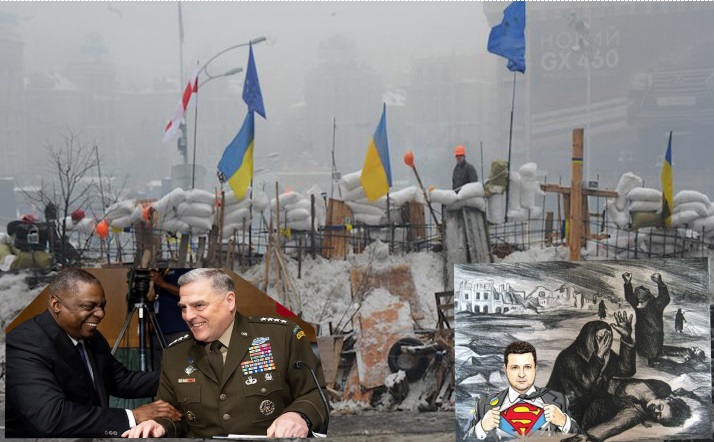
Milley Predicts Long, ‘Very Violent’ Ukrainian Counteroffensive
by EDITORJune 16, 2023
Milley and Austin led a meeting of military officials in Brussels on Thursday.
By Dave DeCamp / Antiwar.com https://scheerpost.com/2023/06/16/milley-predicts-long-very-violent-ukrainian-counteroffensive/
Chairman of the Joint Chiefs of Staff Gen. Mark Milley predicted Thursday that Ukraine’s counteroffensive will be long and “very violent” following a meeting of military officials in Brussels.
Milley made the comments when asked how long he expects the counteroffensive to last, saying it was “premature” to put a timeline on the battle. “This is a very difficult fight. It’s a very violent fight, and it will likely take a considerable amount of time and at high cost,” Milley said.
The Biden administration has been pushing for the violent counteroffensive as it’s explicitly opposed to a ceasefire and peace talks, a position Secretary of State Antony Blinken outlined earlier this month.
Milley claimed Ukraine has been making “steady progress,” but the battle lines have not changed much since Ukraine launched the assault early last week. According to The New York Times, it’s been three days since Ukraine claimed any gains, and Ukraine’s deputy defense acknowledged it was “very difficult to advance” in the southeast.
Asia Times reported on June 10 that American and European military observers in Ukraine described Ukraine’s attempted counteroffensive as a “suicide mission” because of the way they were attacking Russia’s positions.
“If you want to conduct an offensive and you have a dozen brigades and a few dozen tanks, you concentrate them and try to break through. The Ukrainians have been running around in five different directions,” a senior European officer told Asia Times.
“We tried to tell them to stop these piecemeal tactics, define a main thrust with proper infantry support and then do what they can,” the officer added. The report said Ukraine lost 38 tanks, including numerous German-made Leopard 2 tanks, on June 8 by sending them into minefields without deploying mine-clearing vehicles first.
The US has already announced a new weapons package to replace Bradley and Stryker armored vehicles that Ukraine has lost in the offensive, and Ukraine has been asking for more tanks, including the Leopard 2.
Speaking alongside Milley on Thursday, Secretary of Defense Lloyd Austin downplayed Ukraine’s losses, claiming that Russia was showing different pictures of the same damaged vehicles. “This is a war, so we know that there will be battle damage on both sides … I think the Russians have shown us that same five vehicles about a thousand times from 10 different angles. But quite frankly, the Ukrainians have — still have a lot of combat capability — combat power,” he said.
At the conference in Brussels of military officials from more than 50 countries, known as the Ukraine Defense Contact Group, Austin stressed the need to support Ukraine for the long-term. He said the Netherlands and Denmark shared the progress they’ve made on training Ukrainians on F-16s, but it’s still unclear how many of the US-made fighter jets Ukraine will receive.
USSR Sprinkled More Than 2,500 Nuclear Generators Across The Countryside
Hundreds of these tiny atomic terrors are still unaccounted for in the rugged landscape of the former Soviet Union.
By Erin Marquis, 16 June 23, https://jalopnik.com/ussr-sprinkled-more-than-2-500-nuclear-generators-acros-1850501190
Ah, the USSR. It was a strange place with strange ideas. Ideas such as planting unprotected mini nuclear power sources into inhospitable and hard-to-reach areas. I mean, nothing should go wrong as long as the government always exists to maintain them, right?
Welcome to the world of Radioisotope Thermoelectric Generators or RTGs. It’s a piece of nuclear history I only recently learned about and thought I should bring this whole new horror to your attention as well. These things are just kind of rolling around famously stable Russia, and it seems like it should be a cause for concern.
RTGs are not nuclear reactors, nor are they “nuclear batteries.” Rather they work by converting the heat caused by radioactive decay into electricity. Due to the dangerous nature of the materials used however, countries like America only use RTGs in applications such as space exploration. Voyager, Cassini and New Horizons uses RTGs for power, as do the Mars rovers Perseverance and Curiosity. These probes however, use expensive plutonium-238 as their power sources and we launch them far the hell away from us.
The USSR though? Nah. It’s going to use super cheap, super radioactive Strontium-90 instead, though later, smaller RTGs used equally cheap Caesium-137 or Cerium-144. These three isotopes all have one thing in common; they’re all the products of spent nuclear fission. In other words, waste. The terrestrial Beta-M RTG is about 1.5 meters wide and 1.5 meters tall and weight about one metric ton, according to the International Atomic Energy Agency. The entire unit put out about between 1 and 1000 watts (quite the spread) and had a working life of 10 to 20 years.
Originally built by the USSR’s Navy to power lighthouses and radio navigation beacons along Russia’s expansive arctic coastline, the RTGs provided power hundreds or even thousands of miles from civilization, occasionally completely unprotected and always unsupervised. They were occasionally secured by metal frames or sheds, but sometimes these lighthouses and radio beacons were set up on little more than rough structures hastily constructed out of nearby timber with the RTG stuck outside to face the harsh arctic elements. While the USSR provided regular rolling patrols to maintain the RTGs, that came to a screeching halt in 1991 when the Soviet Union fell. After that, there was no money to maintain the hard-to-reach RTGs, and they became victims of neglect and metal thieves.
After it proved useful for the Navy, the Soviets put the RTGs into service in other rough terrains. That’s how several ended up in the mountains of the former Soviet state of Georgia. Three residents from the village of Lia, Georgia, found a canister high up in the mountains. Since this strange material gave off heat, the three used it to stay warm overnight, but they woke up vomiting and dizzy. A week later, a military hospital diagnosed the three with radiation sickness. Two of the men would make it out with the help of dozens of skin grafts and months in the hospital. But the man who slept closest to the radioisotope source and handled it the most could not be saved.
Their arrival at the hospital launched a mad scramble from the international atomic community to find the orphan source of radiation. Footage of the clean-up crew both training for retrieval and actually snaring the Strontium-90 core shows just how dangerous RTGs are:
That wasn’t the only incident involving RTGs however. In 2001, scrappers broke into a lighthouse on Kandalashka Bay and stole three radioisotope sources (all three were recovered and sent to Moscow). Three men in the mountains of Georgia were also exposed in 2002 after stumbling upon cores left out in the woods. In 2003, scrappers hurled a core into the Baltic Sea, where a team of experts retrieved it.
Silent Danger: Hidden Link Discovered Between Low-Dose Radiation and Heart Disease
By COLUMBIA UNIVERSITY IRVING MEDICAL CENTER JUNE 16, 2023
According to a new study by a global team of researchers, individuals exposed to small amounts of ionizing radiation may experience a slight increase in their lifetime risk of developing heart disease.
“The study suggests that radiation exposure, across a range of doses, may be related to an increased risk of not just cancer, as has been previously appreciated, but also of cardiovascular diseases,” says Andrew Einstein, MD, Ph.D., professor of medicine at Columbia University Vagelos College of Physicians and Surgeons and one of the study’s senior authors.
“It should not steer people away from receiving radiation if necessary—in fact many medical uses of radiation are lifesaving—but it underscores the importance of ensuring that radiation is used appropriately and kept as low as reasonably achievable.”
It’s well known that exposure to high doses of radiation, from cancer therapy for example, can damage the heart. But firm evidence linking heart disease with low-dose radiation—encountered by workers in the nuclear industry or from diagnostic medical imaging—is less clear.
The researchers used data from 93 studies covering all ranges of radiation exposures to find a relationship between dose and heart disease……………………….
“The effect of lower doses of radiation on the heart and blood vessels may have been underestimated in the past,” Einstein says. “Our new study suggests that guidelines and standards for the protection of workers exposed to radiation should be reconsidered, and efforts to ensure optimal radiation protection of patients should be redoubled.”
Reference: “Ionising radiation and cardiovascular disease: systematic review and meta-analysis” by Mark P Little, Tamara V Azizova, David B Richardson, Soile Tapio, Marie-Odile Bernier, Michaela Kreuzer, Francis A Cucinotta, Dimitry Bazyka, Vadim Chumak, Victor K Ivanov, Lene H S Veiga, Alicia Livinski, Kossi Abalo, Lydia B Zablotska, Andrew J Einstein and Nobuyuki Hamada, 8 March 2023, The BMJ.
DOI: 10.1136/bmj-2022-072924
The study was funded by the National Cancer Institute. https://scitechdaily.com/silent-danger-hidden-link-discovered-between-low-dose-radiation-and-heart-disease/
Zelensky’s Swiss parliament speech boycotted by right-wing Swiss People’s Party
Rightwing members of the Swiss parliament boycotted an address by Ukraine President Volodymyr Zelensky that called for war materiel export restrictions to be eased.
swissinfo.ch June 15, 2023June 15, 2023
Members of the Swiss People’s Party were absent from the parliamentary chamber in protest against perceived interference of Swiss affairs.
Zelensky has in the past urged Switzerland to beef up sanctions against Russian oligarchs and now wants Swiss-manufactured weapons to be sent to Ukraine.
“I know there is a discussion in Switzerland about the exportation of war materiel to protect and defend Ukraine. That would be vital,” Zelensky said during his video-link address on Thursday. “We need weapons so we can restore peace in Ukraine.”……………………………
Switzerland has resisted calls from Germany, Denmark, the Netherlands and Spain to allow them to re-export Swiss-made ammunitions and weapons to support Ukraine in the fight against Russia.
Earlier this year, the Swiss parliament voted against a softening of war materiel export restrictions as it would violate Switzerland’s position of neutrality.
The People’s Party refused to listen to Zelensky’s address that was interpreted as an attempt to weaken the Swiss tradition of neutrality.
“………..we must not allow ourselves to be put under pressure on the issue of sanctions or arms deliveries,” said People’s Party parliamentarian Alfred Heer.
“I oppose the Ukrainian President making a video address in the House of Representatives,” tweeted Thomas Aeschi, parliamentary leader of the People’s Party, last month when Zelensky’s address was announced.
“Ukraine is trying to directly influence parliament to take a decision on weapons/ammunition deliveries. Our neutrality would be violated!”………….. https://www.swissinfo.ch/eng/zelensky-s-swiss-parliament-speech-boycotted-by-right-wingers/48592932
‘Nuclear not allowed’: Papua New Guinea’s Marape backtracks on comments about Japan’s plan to dump nuclear wastewater.
16 June 2023 , Scott Waide, RNZ Pacific PNG correspondent, Christina Persico, Bulletin Editor
Papua New Guinea’s Prime Minister James Marape has backtracked on his position regarding Japan’s proposed dumping of treated nuclear wastewater into the Pacific Ocean.
Marape indicated support for the controversial proposal this week, which received major backlash from Papua New Guineans and Pacific climate and nuclear free campaigners.
But when questioned in Parliament on his support for the move by government MP Belden Namah on Thursday, Marape said the statement from his office was “misconceived”.
Namah asked the PM to address whether PNG’s official position relating nuclear issues had changed as the country is a party to the region’s principal nuclear non-proliferation agreement, the Treaty of Rarotonga since 1986.
“My statement was misconceived or misplaced in the sense was there’s no unilateral clearance for [Japan] to discharge any nuclear waste,” Marape said.
He said PNG’s position remains unchanged.
“We subscribe to the entire Rarotonga treaty; we subscribe to all elements of the treaty.”
The discharge of untested, unsafe nuclear waste into our waters, is not something we want in PNG waters or Pacific waters.
Untested, unsafe nuclear waste into our waters is not something we want in PNG or the Pacific waters, he said.
“My statement does not qualify Japan to discharge unsafe [nuclear waste] water.”
But he said from a PNG perspective, Japan could only go ahead with its plans if the “test is compliant upon all the global standards and requirements.”
“Nuclear is not allowed in our waters. Nuclear is not allowed in the waters of Pacific.”
- Search
- Listen Live
live stream
live stream
live stream
- PlaylistYour playlist Launch player Close
16 Jun 2023
‘Nuclear not allowed’: PNG’s Marape backtracks on comments
2:47 pm on 16 June 2023 Share this
Scott Waide, RNZ Pacific PNG correspondent
Christina Persico, Bulletin Editor

James Marape has clarified his position on the wastewater dump, saying his support was only for treated and safe discharge. Photo: PNG PM Media
Papua New Guinea’s Prime Minister James Marape has backtracked on his position regarding Japan’s proposed dumping of treated nuclear wastewater into the Pacific Ocean.
Marape indicated support for the controversial proposal this week, which received major backlash from Papua New Guineans and Pacific climate and nuclear free campaigners.
But when questioned in Parliament on his support for the move by government MP Belden Namah on Thursday, Marape said the statement from his office was “misconceived”.
Namah asked the PM to address whether PNG’s official position relating nuclear issues had changed as the country is a party to the region’s principal nuclear non-proliferation agreement, the Treaty of Rarotonga since 1986.
“My statement was misconceived or misplaced in the sense was there’s no unilateral clearance for [Japan] to discharge any nuclear waste,” Marape said.
He said PNG’s position remains unchanged.
“We subscribe to the entire Rarotonga treaty; we subscribe to all elements of the treaty.”
“The discharge of untested, unsafe nuclear waste into our waters, is not something we want in PNG waters or Pacific waters.
Untested, unsafe nuclear waste into our waters is not something we want in PNG or the Pacific waters, he said.
“My statement does not qualify Japan to discharge unsafe [nuclear waste] water.”
But he said from a PNG perspective, Japan could only go ahead with its plans if the “test is compliant upon all the global standards and requirements.”
“Nuclear is not allowed in our waters. Nuclear is not allowed in the waters of Pacific.”
Call for transparency
This week, Palau’s President Surangel Whipps Jr called on Japan to raise the transparency of the decommissioning process.
According to Japan’s state broadcaster NHK, Whipps made the statement on Tuesday in a meeting with Fukushima governor Uchibori Masao, after visiting the Fukushima site……….. https://www.rnz.co.nz/international/pacific-news/492109/nuclear-not-allowed-png-s-marape-backtracks-on-comments
U.N. nuclear chief visits Ukraine nuke plant after dam explosion, to “help prevent a nuclear accident”

BY PAMELA FALK, JUNE 16, 2023 CBS NEWS
United Nations — The head of the United Nations’ nuclear watchdog agency made his third trip to Ukraine’s Zaporizhzhia Nuclear Power Plant, Europe’s largest atomic power station, this week in a bid to “prevent a nuclear accident.” Ukraine accused Russia of blowing up the Kakhovka Dam, which Russian forces had occupied for months, a week and a half ago, threatening the vital cooling water supply to the sprawling nuclear plant………………
International Atomic Energy Agency (IAEA) Director General Rafael Mariano Grossi completed his latest visit to Zaporizhzhia Thursday and was expected to issue a full report on the safety of the facility in the coming days.
“We believe that we have gathered a good amount of information for an assessment of the situation and we will continue permanently monitoring the situation there in order to help prevent a nuclear accident,” Grossi said in one of several videos he posted from the plant.
Russia’s TASS news agency said Grossi was shown fragments of Ukrainian shells allegedly found on the grounds of the plant. Ukraine and Russia have accused each other of endangering the plant with artillery fire for months.
Grossi’s long-standing appeal to the 15-nation U.N. Security Council to establish a safety zone around the nuclear plant has gone unheeded, and he said this week that he did not expect Moscow and Kyiv to sign a document on the site’s security. ……..
He recently presented a new plan of “five principles” to beef up the IAEA presence at the Russian-occupied facility, and a new team of international inspectors was rotated into the mission during his visit this week.
“My visit to Zaporizhzhia nuclear power plant is the first after I established the IAEA 5 principles for protecting the plant and avoiding a nuclear accident, which reinforce the essential role of the IAEA Support and Assistance Mission at Zaporizhzhia,” Grossi said.
He said the situation around the plant was “serious” but being “stabilized” after the blast at the dam. ………… https://www.cbsnews.com/news/ukraine-zaporizhzhia-nuclear-power-plant-grossi-iaea-visit-after-kakhovka-dam-explosion/
Macao SAR to suspend Japanese food import after nuclear-contaminated wastewater discharge
An official at the Municipal Affairs Bureau (IAM) of the Government of Macao Special Administrative Region (SAR) said on Tuesday that it will immediately suspend food import applications from Japan’s nine prefectures, if the country releases nuclear-contaminated wastewater into the sea.
O Lam, acting chairman of the IAM, said in an interview that import suspension will be expanded to the country’s nine “highest-risk prefectures,” including Tokyo Metropolis and Chiba prefectures.
Products to be suspended will include aquatic products, vegetables and fruits.
Fresh and live food imported from other prefectures may be asked to attach a certificate on radiation monitoring and pass inspection before entering Macao SAR, she added…………………………more https://news.cgtn.com/news/2023-06-13/Macao-to-suspend-Japanese-food-import-after-nuclear-wastewater-release-1kBLwicliP6/index.html
2
US nuclear-powered submarine arrives in South Korea
By Hyunsu Yim, June 16 2023 https://www.canberratimes.com.au/story/8237042/us-nuclear-powered-submarine-arrives-in-south-korea/
A US nuclear-powered submarine has arrived at a port in the South Korean city of Busan, the South Korean military says.
It is the first time a submarine classified as “SSGN” by the US Navy, or a cruise-missile submarine, has stopped off in South Korea in almost six years.
The USS Michigan’s arrival on Friday comes after North Korea fired two short-range missiles off its east coast on Thursday and follows a failed attempt by Pyongyang to launch a spy satellite last month.
In April, South Korean President Yoon Suk Yeol and US President Joe Biden agreed in Washington to “further enhance the regular visibility of strategic assets” on the Korean Peninsula.
The leaders also agreed a US Navy nuclear-armed ballistic missile submarine (SSBN) would visit South Korea for the first time since the 1980s to help demonstrate Washington’s resolve to protect the country from a North Korean attack.
There was no timetable given for such a visit.
Norman Solomon: Bipartisan Obsession With War
June 16, 2023.
https://scheerpost.com/2023/06/16/norman-solomon-bipartisan-obsession-with-war/
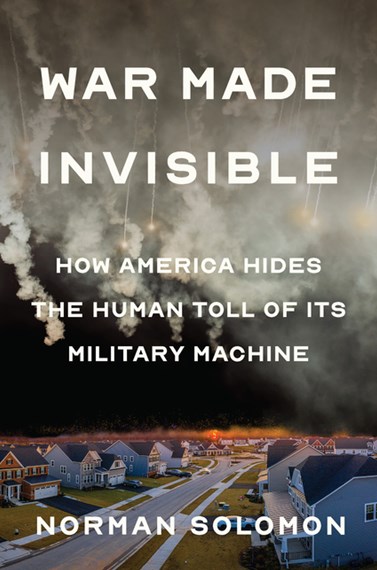
In War Made Invisible, journalist Norman Solomon explains that Biden is as guilty as Trump in ushering a potential nuclear holocaust.
There is no rationality, logic or hope left in the U.S. government’s obsession with war. There is no complexity, awareness or nuance left in the U.S. media and its pundits’ perception of other nations as the enemy. There is only greed, jingoism, hypocrisy and belligerency left to define the current state of affairs, as the proxy war in Ukraine draws nearer to a dreaded nuclear confrontation. Norman Solomon joins host Robert Scheer for this episode of Scheer Intelligence to discuss his new book, War Made Invisible: How America Hides the Human Toll of Its Military Machine, and explain the bipartisan cheerleading for war that goes largely unnoticed.
| .As Scheer points out numerous times in previous episodes of SI, there has always been a precedent for the other side: a peace movement, rational politicians acting against nuclear escalation and simply a recognition of profiteering from war. “Even during World War II, when Harry Truman chaired a committee, they talked about in the Senate war profiteering. You can’t even get that phrase anymore. So it’s lucrative, but hardly mentioned in mass media that the billions and billions of dollars going to Ukraine are making extremely wealthy CEOs and major stockholders even more extremely wealthy,” Solomon explains. |
Diplomacy, Solomon says, has now become a dirty word. Anything other than the complete commitment to funding and continuing the war effort is seen as a threat to the country and status quo. The loss of the ability to even talk about it, has infected both sides of the aisle. But it is the Democrats, as Scheer mentions, who have become the perpetrators of this new jingoism and xenophobia towards Russia. “What we’ve lost now is any sense of complexity and the Democrats are leading the charge of simplification. They did Russiagate. They are the ones who say you can’t negotiate with Putin,” Scheer says.
Transcript
Robert Scheer: Hi, this is Robert Scheer with another edition of Scheer Intelligence, which would be an arrogant title for a show but the intelligence comes from my guests and in this case it’s Norman Solomon…………………………………………….
Norman Solomon: Hey, thanks a lot, Bob. Well, the title is War Made Invisible, and the subtitle is How America Hides the Human Toll of Its Military Machine.
Fossil fuel lobbyists will have to identify themselves as such in registering for the UN Cop28 climate summit

Fossil fuel lobbyists will have to identify themselves as such in
registering for the UN Cop28 climate summit, making polluting and
carbon-intensive industries more accountable at the annual talks.
The move by the UN to require anyone registering for the summit to declare their
affiliation was heralded as a victory for transparency by campaigners who
have been increasingly concerned at the growing presence of oil and gas
lobbyists at climate talks.
Guardian 15th June 2023
Nuclear Free Local Authorities – visiting community owned project in the UK, at the start of Community Energy Fortnight,
At the start of Community Energy Fortnight (10 June), NFLA Secretary
Richard Outram travelled to picturesque Dovestones Reservoir to visit his
nearest community owned hydro project. Saddleworth Community Hydro was
holding a public open day to mark the start of this annual event promoted
by Community Energy England, which is held to showcase projects, share
knowledge in the sector, and celebrate success.
Community Energy England
was founded in 2014 by community energy practitioners as the ‘voice’ of
the sector and to help put people at the heart of the energy system. Now
with over 275 community energy organisations as members, its mission is to
‘to help active community energy organisations implement new projects,
innovate, improve and grow.’ Saddleworth Community Hydro also started in
2014, commencing operations in September of that year. It was the first
high head project in England to generate power from the waters of a
reservoir.
At a cost of £500,000, it was financed almost equally by grants
from the Department for Environment, Food and Rural Affairs and the
European Agricultural Fund for Rural Development and by the sale of shares
to around 200 members, and subsequent upgrades have been funded by local
supporters.
NFLA 16th June 2023
Why Saudi Arabia wants a ‘nuclear Aramco’.

Monash University, Ran Porat 16 June 23
US Secretary of State Antony Blinken visited Riyadh at the beginning of June to bargain with the Saudis over a package of concessions to be granted to the kingdom in exchange for normalisation of relations with Israel.
Under the leadership of Crown Prince Mohammed bin Salman (MBS), the Saudis reportedly asked the US to jointly create a “nuclear Aramco”, modelled after the kingdom’s oil and gas giant that has played such a large role in building the country’s substantial wealth
The idea is to rebrand Saudi Arabia as a civilian nuclear energy powerhouse, and worldwide exporter of nuclear products and technology, given the expected reduction in the usage of fossil fuel in coming decades as part of efforts to control climate change.
Yet there’s another aspect to the Saudi request. As part of this proposed nuclear project, the Saudis invited the Americans to jointly manufacture and monitor uranium enrichment capabilities – a must for the production of nuclear fuel used in power generating reactors.
Yet, the capacity to enrich uranium is also a crucial part of any nuclear weapons project. From that perspective, it seems that the Sunni kingdom likely aspires to create deterrence against its archrival, Shi’ite Iran, which is fast-approaching the status of a nuclear threshold country……………………………………………………..
The “nuclear Aramco” idea suggests a seismic shift in the Saudi nuclear policy, pushing towards the development of in-house independent atomic deterrence.
Saudi civil, and possibly also military, nuclear capabilities are still years away. Yet, the dangerous scenario of a nuclear-weapon zone stretching across Asia from North Korea, through China, via Pakistan and India, then Iran and finally Saudi Arabia (and on to Israel), suddenly looks closer than ever………………………
This scenario could be avoided if the Saudis could be made to feel safer against the Iranian threat, and could trust the international community to defuse Tehran’s nuclear ambitions.
One path to achieving this is by increasing the pressures on Tehran in a true attempt to stop, and hopefully even reverse, Iran’s frantic and dangerous drive to acquire nuclear weapons capabilities……………………………. https://lens.monash.edu/@politics-society/2023/06/16/1385882/explainer-why-does-saudi-arabia-want-a-nuclear-aramco
1 This Month

of the week – Shut Down Drone Warfare!


Tell the Ukrainian Government to Drop Prosecution of Peace Activist Yurii Sheliazhenko

Petition to revoke the licensing of the Near Surface Nuclear Disposal Facility (NSDF) at Chalk River. https://www.ourcommons.ca/petitions/en/Petition/Details?Petition=e-7247
To see nuclear-related stories in greater depth and intensity – go to https://nuclearinformation.wordpress.com
-
Archives
- April 2026 (103)
- March 2026 (251)
- February 2026 (268)
- January 2026 (308)
- December 2025 (358)
- November 2025 (359)
- October 2025 (376)
- September 2025 (257)
- August 2025 (319)
- July 2025 (230)
- June 2025 (348)
- May 2025 (261)
-
Categories
- 1
- 1 NUCLEAR ISSUES
- business and costs
- climate change
- culture and arts
- ENERGY
- environment
- health
- history
- indigenous issues
- Legal
- marketing of nuclear
- media
- opposition to nuclear
- PERSONAL STORIES
- politics
- politics international
- Religion and ethics
- safety
- secrets,lies and civil liberties
- spinbuster
- technology
- Uranium
- wastes
- weapons and war
- Women
- 2 WORLD
- ACTION
- AFRICA
- Atrocities
- AUSTRALIA
- Christina's notes
- Christina's themes
- culture and arts
- Events
- Fuk 2022
- Fuk 2023
- Fukushima 2017
- Fukushima 2018
- fukushima 2019
- Fukushima 2020
- Fukushima 2021
- general
- global warming
- Humour (God we need it)
- Nuclear
- RARE EARTHS
- Reference
- resources – print
- Resources -audiovicual
- Weekly Newsletter
- World
- World Nuclear
- YouTube
-
RSS
Entries RSS
Comments RSS
 nuclear-news