Nuclear weapons on rise in a world where ‘peace through deterrence’ is a myth
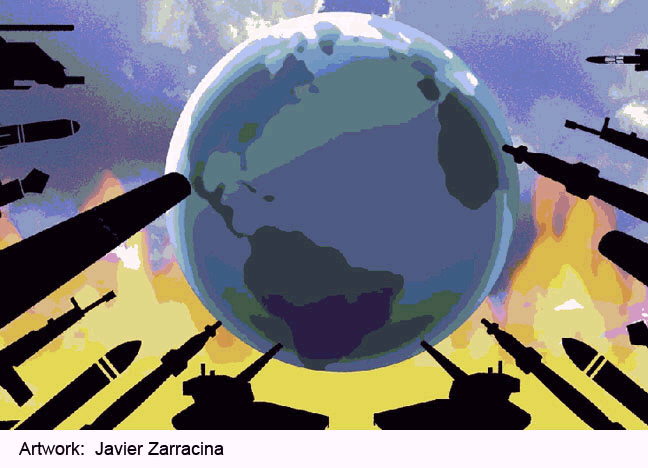
many nuclear-armed states are prepared to use nuclear weapons first, and even use them against states that do not have their own nuclear weapons.
Powerful nations are prepared to use nuclear weapons first. This is why their proliferation is worrying analysts
Paul Rogers, 16 June 2023, open Democracy,
The world is “drifting into one of the most dangerous periods in human history”, according to a leading security research centre, the Stockholm International Peace Research Institute (SIPRI). At the root of its concern is that, though the number of nuclear warheads is still far lower than during the Cold War years, nuclear modernisation and development programmes in the nine nuclear-armed states are leading to an expansion in the number of warheads held………………………
The great majority are held by Russia (4,489 warheads) and the United States (3,708), followed by three middle-ranking states: China (410), France (290) and the UK (225). These countries are the five permanent members of the UN Security Council and also signatories of the Non-Proliferation Treaty (NPT). They were allowed in as members back in 1968 on the condition that they worked towards nuclear disarmament – but there’s fat chance of that.
As well as these five, there are four more states with nuclear weapons: Pakistan (170 warheads), India (164), Israel (90) – though it has never acknowledged having them – and, most recently, North Korea, assessed by SIPRI as now having 30 warheads. Out of SIPRI’s estimated global total of 12,512 warheads, it believes 9,576 are in military stockpiles ready for use, meaning that they are either fitted to missiles or available as bombs to be delivered by aircraft.
Given that it would only take a dozen or so nuclear warheads to wreck a country, it seems nonsense to talk about the ‘need’ for more than 10,000 weapons.
United States was reckoned to have 23,500 warheads and the Soviet Union 39,200. This was during the Cold War days of ludicrously massive ‘overkill’.
Many of the superpowers’ weapons at that time were later withdrawn, with most of them now dismantled, and there was the added hope at the end of the Cold War that the cutbacks would continue, and the pace of warhead development would slow. But the opposite is happening now.
More recently, the UN’s Treaty on the Prohibitions or Nuclear Weapons (TPNW) gave some hope. Voted in by the majority of all UN member states in 2017 and requiring 50 states to ratify it, this was achieved, with the treaty entering into force just over two years ago. Already, 92 member states, almost half the UN membership, have signed it and 68 have ratified it after approving it within their domestic legal systems. In view of this, why do SIPRI analysts, along with many other peace researchers, still have concerns?
There are several reasons.
The TPNW is a strong treaty in that signatory states must not design, develop or manufacture nuclear weapons of any sort, nor must they allow nuclear-armed states to base their own weapons on their territory. But none of the nine nuclear states have signed up to it, or shown any sign of doing so. Neither have those states that allow foreign nuclear weapons to be based on the territories, including the half dozen European states that host US nuclear weapons, or Belarus, with Russian nuclear weapons.
Most of the states that have signed or ratified the treaty are not so-called ‘big powers’, even if some have leaders who speak out readily against nuclear weapons, while all of them demonstrate an opposition to a nuclearised world – in marked contrast to the postures of the actual nuclear-armed states and many of their close allies.
If anything, the attitude among nuclear-armed states has hardened, with the UK being an example. Just two years ago, the Johnson government declared that it would no longer be transparent about the size of the UK nuclear arsenal and its number of deployed warheads or missiles. Increased global tensions were cited as the reason, but it was a change in what had previously been an informal cross-party agreement to be more open.
More generally, despite what some may suggest, many nuclear-armed states are prepared to use nuclear weapons first, and even use them against states that do not have their own nuclear weapons. NATO has maintained a clear first-use policy since 1968; the UK even deployed two types of nuclear weapon to the South Atlantic during the 1982 Falklands/Malvinas War; and Putin, of course, has implied that there are circumstances where Russia would threaten nuclear use in the current war in Ukraine…………………….. https://www.opendemocracy.net/en/nuclear-weapons-proliferation-sipri-analysts-concerns-first-use-defence-strategy/
No comments yet.
1 This Month

Petition to revoke the licensing of the Near Surface Nuclear Disposal Facility (NSDF) at Chalk River. https://www.ourcommons.ca/petitions/en/Petition/Details?Petition=e-7247


of the week – STOP SMALL MODULAR REACTORS IN CANADA
To see nuclear-related stories in greater depth and intensity – go to https://nuclearinformation.wordpress.com
-
Archives
- March 2026 (153)
- February 2026 (268)
- January 2026 (308)
- December 2025 (358)
- November 2025 (359)
- October 2025 (376)
- September 2025 (258)
- August 2025 (319)
- July 2025 (230)
- June 2025 (348)
- May 2025 (261)
- April 2025 (305)
-
Categories
- 1
- 1 NUCLEAR ISSUES
- business and costs
- climate change
- culture and arts
- ENERGY
- environment
- health
- history
- indigenous issues
- Legal
- marketing of nuclear
- media
- opposition to nuclear
- PERSONAL STORIES
- politics
- politics international
- Religion and ethics
- safety
- secrets,lies and civil liberties
- spinbuster
- technology
- Uranium
- wastes
- weapons and war
- Women
- 2 WORLD
- ACTION
- AFRICA
- Atrocities
- AUSTRALIA
- Christina's notes
- Christina's themes
- culture and arts
- Events
- Fuk 2022
- Fuk 2023
- Fukushima 2017
- Fukushima 2018
- fukushima 2019
- Fukushima 2020
- Fukushima 2021
- general
- global warming
- Humour (God we need it)
- Nuclear
- RARE EARTHS
- Reference
- resources – print
- Resources -audiovicual
- Weekly Newsletter
- World
- World Nuclear
- YouTube
-
RSS
Entries RSS
Comments RSS
 nuclear-news
Leave a comment