TODAY. Nuclear industry puppet France is bullying Europe into environmental destruction.
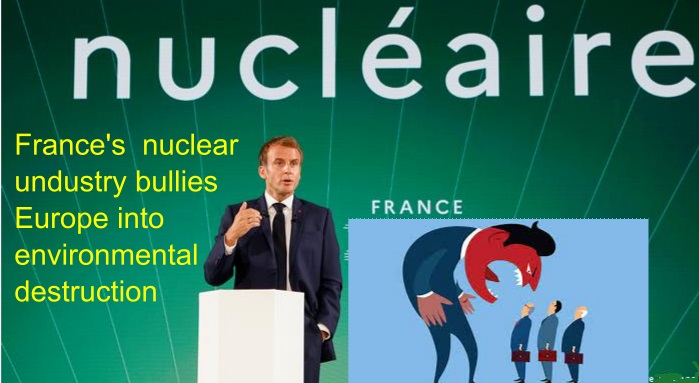
The children, the grandchildren, the great grandchildren don’t get to vote. Let alone the animals, the birds, the insects, -the total environment on which we all depend.
The European Union is poised to throw away all pretence of protecting the environment. The parliamentary committee will finish voting on June 27, when they will dutifully kow-tow to the polluting industries of the Netherlands, and other industrial countries, and pretty much destroy the much vaunted European “taxonomy”, originally designed to address climate change, and save the planet’s environment.
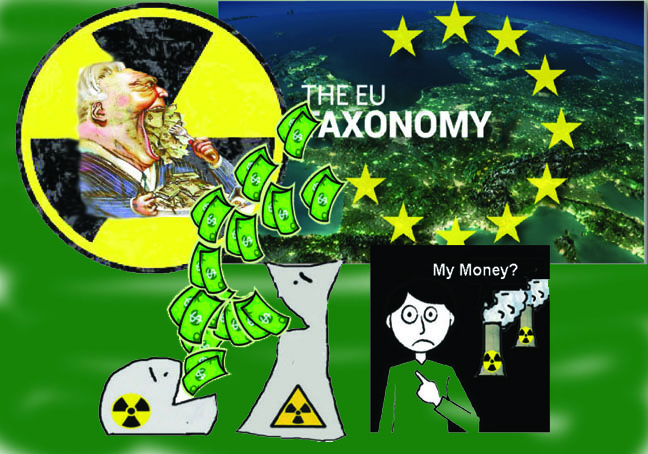
Above all, these cringing, useless politicians, (obsessed as ever with keeping their own lucrative jobs), are now caving in to France’s nuclear industry, which controls Emmanuel Macron and his delusions of nuclear grandeur.

Why Biden Wants Assange in Jail: Case at the Tipping Point
15 Jun 2023 A London High Court judge rejected Wikileaks editor Julian Assange’s appeal against his extradition to the United States. He now faces up to 175 years in prison — despite public opinion around the world and in his home country, Australia. The UN has declared his detention “arbitrary,” which usually results in the release of the detainee, but not so far. The fate of the man who revealed so many of the hidden crimes of the US empire hangs in the balance. Brian Becker is joined by Joe Lauria, editor in chief of Consortium News
U.S. Congress caves in to nuclear industry pressure for the Nuclear Regulatory Commission to dumb down standards, and shift fees to tax-payers.

“they want the NRC to dumb down its own standards and just rubber-stamp anything that they put before the agency, no matter how flimsy.”
The industry has long argued that NRC fees are an impediment to innovation……the 2023 Appropriations Act…. allows the NRC to shift certain fees from the applicant to the taxpayer.
US Nuclear Push Brings Regulatory Growing Pains, Energy Intelligence Group ,Jun 16, 2023, Jessica Sondgeroth,
Congressional pressure on the US Nuclear Regulatory Commission (NRC) has intensified in recent years, with pro-nuclear lawmakers pressuring the independent government regulator to further reduce regulatory review times, update its regulatory philosophy and minimize fees for developers of next-generation reactor vendors and small modular reactors (SMRs). Lawmakers have already passed new laws to this effect, and proposed legislation would increase the agency’s role in nuclear technology exports. All the while, the NRC is struggling to hire new staff with morale low and older staff members retiring.
“We have seen major shifts in NRC’s workload, budget, staff size, hiring, and overall outlook for the future,” Jeff Baran, NRC’s longest-serving commissioner said last month at his third renomination hearing on Capitol Hill. When Baran was first appointed to the NRC’s five-member board in 2014, “there was little talk of new construction beyond Vogtle. There was some interest in small modular reactors, but almost no real discussion of advanced, non-light-water reactors. Today, we are in a very different situation.”
Indeed, Congress is pushing the NRC to lean away from its traditional, more deterministic regulatory model and shift toward an increasingly risk-informed approach to rulemaking that supports applications for advanced reactors, SMRs and new fuel designs. Meanwhile, a suite of new reactor designs are in early pre-application talks with the agency. And thanks to new policies supporting nuclear in the energy transition, owners of existing reactors are incentivized to extend operating lives from 60 to 80 years rather than retire. All of this means that the NRC’s “overall workload is increasing,” Baran said.
But so too is the pressure on the agency to further minimize the regulatory burden on new reactor vendors and developers, and not all of these changes are being welcomed. “I think it is outrageous that the nuclear industry continues to scapegoat the NRC for its own failures and incompetence,” Union of Concerned Scientists Director of Nuclear Power Safety Ed Lyman told Energy Intelligence. “Instead of improving its applications and doing the hard and time-consuming work to provide sufficient technical justification for the safety of experimental, paper reactor designs, they want the NRC to dumb down its own standards and just rubber-stamp anything that they put before the agency, no matter how flimsy.”
Below are only some of the challenges the agency now faces:
- Advanced Reactor Rulemaking The NRC is in the middle of developing a two-part regulatory framework for advanced reactor designs…………. Advanced reactor and SMR vendors are pushing for more flexibility in the rules, citing advancements in computational modeling, but that is still a challenge given the lack of operational data and staff. ……….
- Review Times
- There are now new generic review milestones in place as mandated by the 2019 Nuclear Energy Innovation and Modernization Act. The NRC has shortened review schedules from approximately five years for conventional LWR designs to 30-42 months, depending on the application and design. With pre-application engagement, those timeframes can be shortened even further…………………………….But the industry is pushing for more. Nuclear Energy Institute Senior Policy Director John Kotek told Energy Intelligence last month that another way to trim regulatory reviews is through less rigorous environmental reviews and fewer hearings.
- Fees The industry has long argued that NRC fees are an impediment to innovation. Congress has already alleviated some of this burden on new reactor applicants with $5 million from the 2023 Appropriations Act for the Advanced Nuclear Energy Cost-Share Grant Program. ………….. This allows the NRC to, on a case-by-case basis, shift certain fees from the applicant to the taxpayer………………………………..
- Staffing
- The agency’s 9.6% attrition rate “is well above the average for federal agencies,” with one-third of the NRC’s workforce eligible for retirement,……………………………….
All of this means that the regulator remains under constant pressure to further streamline and minimize review times and limit environmental and safety reviews. Such pressure will only increase with the proposed Advance Act, introduced by a bipartisan group of senators. The bill cleared the Senate Environment & Public Works Committee in a May 31 business meeting by a vote of 16-3, but must still be passed by both the full Senate and the House of Representatives before becoming law. https://www.energyintel.com/00000188-c325-d38d-a58b-df3509750000
EU states back nuclear energy while diluting biodiversity reforms.
Concessions follow a heated political fightback by France against Brussels’ green agenda
Ft.com Alice Hancock in Brussels 16 June 23
EU countries have backed more allowances for nuclear energy and the weakening of a law to protect biodiversity amid an increasingly heated fightback against Brussels’ green agenda. Following months of French pressure to gain more recognition for its nuclear industry, EU ambassadors on Friday approved a declaration that puts “other non-fossil” energy sources on a par with renewables in efforts to decarbonise.
Germany, Austria and Luxembourg were among member states who had opposed recognising “low carbon” energy sources such as nuclear in the EU’s rules on renewable energy, fearing that it could detract investment away from other options such as wind and solar power. But France’s threat to block approval of the EU’s renewable energy targets forced the European Commission to put forward an additional declaration that acknowledges the role of nuclear, which Germany finally back
The document said that the commission “acknowledges that other sources of fossil-free energy than renewable energy contribute to reaching climate neutrality by 2050 for member states who decide to rely on such sources of energy”. France and Germany were also among a majority that supported heavy revisions to Brussels’ flagship law to restore damaged ecosystems, allowing national governments far more leeway in applying the reforms.
The Nature Restoration Law was initially envisaged by the commission as a way to protect and restore landscapes in Europe that had been degraded through years of pollution or heavy agricultural use. It should also ensure that the bloc meets its international commitments, agreed at the COP15 biodiversity conference last year, to restore and conserve 30 per cent of the world’s ecosystems.
The commission’s original proposal that countries should restore 30 per cent each of six different kinds of habitat including wetlands and forests that were in poor condition by 2030 has been reduced to a target of 30 per cent across all ecosystems. To placate densely populated countries such as the Netherlands, countries would no longer need to prevent healthy habitats from deteriorating but rather to “endeavour to put in place, where possible” the necessary measures.
The proposal has also been controversial in the European parliament where lawmakers were forced to delay a highly charged vote on the law on Thursday after running out of time to go through more than 2,000 proposed amendments.
Conservative politicians have made a concerted campaign to squash the regulation claiming that it would lead to higher food prices and increased costs for farmers and fishermen, as political groups begin to jostle for attention ahead of European elections next year.
The topic became so heated in the run-up to Thursday’s vote that the European People’s party, the largest group in the parliament and political family of the former German chancellor Angela Merkel, accused the commission of blackmailing MEPs to support the law…………………………
The parliamentary committee will finish voting on June 27. Ministers are expected to endorse EU member states position on Tuesday though several diplomats said that it could be a tight vote. https://www.ft.com/content/ee8cfeb4-4c33-4f83-ad64-6b009ab5083a—
The profligate use of our stressed freshwater resource by the nuclear industry.
Stressed Freshwater in our Lakes and Rivers Cooling the Heels of the Nuclear Industry – while the Industry wants More and Hotter Waste.
BY MARIANNEWILDART, https://mariannewildart.wordpress.com/2023/06/15/stressed-freshwater-in-our-lakes-and-rivers-are-cooling-the-heels-of-the-nuclear-industry-and-the-industry-wants-more-and-hotter-waste/
There is a deeply worrying unspoken aspect of this heatwave and that is the profligate use of our stressed freshwater resource by the nuclear industry. The hotter the weather the more freshwater is required for processes including the one absolutely essential to protect all life on planet earth from humanity’s greatest hubris – and that is the cooling of high level radioactive wastes. The industry requires top quality water not the rubbish that was given to folk in West Cumbria from the boreholes near Sellafield – nope the industry requires the coolest freshest waster including from Britain’s most iconic lake.
For Fifteen years now Radiation Free Lakeland have been flagging up the nuclear industry’s eyewatering use of our most precious resource, freshwater. For fifteen years the main stream media have shied away from the issue preferring to flag up the freshwater use of fracking which is big and very nasty but on a different scale both in time and quantity of freshwater involved .
Despite the nuclear industry insisting that the public should not have access to information on fresh water use for reasons of ‘national security’ we now have a body of documentation from (largely blacked out) Freedom of Information requests and research which shows that the nuclear industry’s freshwater use is on a scale second to none. The nuclear industry’s abuse of fresh water continues long after other industrys’ fracking, fossil fuel etc will have come and gone.
We have been told by diligent fracking activists that the figure from the hydraulic fracture plan for Cuadrilla was up to 31,000 cubic metres of water to frack the first well. This was based on up to 765 cubic metres per stage. The number of stages in the fracture plan was 41. That is a lot, it is too much and thanks to diligence of fracking campaigners (nuclear campaigners also fought fracking) this was stopped in its tracks. The ALREADY monstrous freshwater use by the nuclear industry in the Preston area was flagged up by nuclear campaigners.
Springfields Nuclear Fuels just off Preston New Road discharges at least 2400 cubic metres A DAY into the River Ribble. The fresh water discharge contains chemical and radioactive contamination – but the industry say this is fine as the super large quantities of fresh water used “dilute and disperse” the nasties.
Springfields Nuclear Fuels which is slap bang in the middle of Cuadrilla’s fracking plans on the Fylde has recieved no, nada, zilch attention over its fresh water use.
The video illustrates information painstakingly gleaned about Springfields freshwater use along with Sellafield’s. The front and the back end of the nuclear industry which are neatly tucked away under a cloak of invisibility in the NW. Sellafield’s abusive use of the Lake District’s freshwater is detailed in the video taken from a talk at New Horizons, St Annes. Lets hope the rain falls soon to replenish our Lakes and Rivers which have been flushing cool water over hot nuclear wastes since the 1940s. The new build plan would mean more and ever hotter wastes to cool into infinity . Our Lakes and rivers are finite.
This abuse of our fresh water has been going on now since the 1940s. Who knew? and Who Cares?
Vienna Summit: Anti-War Activists From 32 Countries Call For Diplomacy to End Ukraine War
By Medea Benjamin / MintPress News, 14 June 23
During the weekend of June 10-11 in Vienna, Austria, over 300 people representing peace organizations from 32 countries came together for the first time since the Russian invasion of Ukraine to demand an end to the fighting. In a formal conference declaration, participants declared, “We are a broad and politically diverse coalition that represents peace movements and civil society. We are firmly united in our belief that war is a crime against humanity and there is no military solution to the current crisis.”
To amplify their call for a ceasefire, Summit participants committed themselves to organizing Global Weeks of Action—protests, street vigils and political lobbying—during the days of September 30-October 8.
Summit organizers chose Austria as the location of the peace conference because Austria is one of only a few neutral non-NATO states left in Europe. Ireland, Switzerland and Malta are a mere handful of neutral European states, now that previously neutral states Finland has joined NATO and Sweden is next in line.
Austria’s capital, Vienna, is known as “UN City,” and is also home to the Secretariat of the OSCE (the Organization for Security and Cooperation in Europe), which monitored the ceasefire in the Donbas from the signing of the Minsk II agreement in 2015 until the Russian invasion of Ukraine in 2022.
“We are firmly united in our belief that war is a crime against humanity and there is no military solution to the current crisis.”
Campaign for Peace, Disarmament, and Common Security
Surprisingly, neutral Austria turned out to be quite hostile to the Peace Summit. The union federation caved in to pressure from the Ukrainian Ambassador to Austria and other detractors, who smeared the events as a fifth column for the Russian invaders. The ambassador had objected to some of the speakers, including world-renowned economist Jeffrey Sachs and European Union Parliament member Clare Daly.
Even the press club, where the final press conference was scheduled, was canceled at the last minute. The Austrian liberal/left newspaper Der Standard piled on, panning the conference both beforehand, during and afterwards, alleging that the speakers were too pro-Russian. Undaunted, local organizers quickly found other locations. The conference took place in a lovely concert center, and the press conference in a local cafe.
The most moving panel of the conference was the one with representatives from Ukraine, Russia, and Belarus, who risked their lives to participate in the Summit………………….
……………………The eight-person U.S. delegation included representatives from CODEPINK, Peace in Ukraine, the Fellowship of Reconciliation and Veterans for Peace. U.S. retired colonel and diplomat Ann Wright was a featured speaker, along with former Congressman Dennis Kucinich, who joined remotely……………………..more https://www.mintpressnews.com/vienna-summit-anti-war-activists-from-32-countries-call-for-diplomacy-to-end-ukraine-war/284999/
UN nuclear chief Rafael Grossi continues to have a bet each way on nuclear power “safety”

UN nuclear chief says situation at Zaporizhzhia plant is ‘serious’ but it can operate safely for ‘some time’
Guardian, 16 June 23
Rafael Grossi visited the Russian-controlled plant amid concerns for water levels in cooling pools after dam breach
The head of the UN atomic energy agency has said the situation at the Russian-controlled Zaporizhzhia nuclear plant in Ukraine is “serious” and that ensuring water for cooling was a priority of his visit, adding that the station could operate safely for “some time”.
Rafael Grossi, of the International Atomic Energy Agency (IAEA), was inspecting the state of Europe’s largest nuclear plant following last week’s breach in the Kakhovka dam downstream on the Dnipro River. He said IAEA inspectors would remain at the site.
“What is essential for the safety of this plant is that the water that you see behind me stays at that level,” Grossi said in two tweets issued from near the station, including next to a pond that supplies water for cooling.
With the water that is here the plant can be kept safe for some time. The plant is going to be working to replenish the water so that safety functions can continue normally.”
Grossi said the visit, his third to the plant in southern Ukraine since Russian forces occupied it in the first days of their February 2022 invasion, had gathered “a good amount of information for an assessment”.
Russia and Ukraine have repeatedly accused each other of shelling near the plant, endangering its safe operation. The station’s six reactors are now in shutdown……………
Grossi was earlier quoted by Russian news agencies as saying the situation at the site was “serious”.
“On the one hand, we can see that the situation is serious, the consequences [of the dam’s destruction] are there, and they are real,” he said.
“At the same time, there are measures that are being taken to stabilise the situation.”
Grossi’s trip was delayed by a day for security reasons amid heavy fighting……………………… https://www.theguardian.com/world/2023/jun/16/un-nuclear-chief-says-situation-at-zaporizhzhia-plant-is-serious-but-it-can-operate-safely-for-some-time
Cyberattack Hits US National Lab, Nuclear Waste Site
A contractor at a US national lab and a radioactive waste storage site
managed by the Department of Energy were among the victims of wide-ranging
cyberattack that saw several federal agencies hacked, according to a person
familiar with the matter.
A department spokesperson confirmed Thursday that
records from two of the agency’s “entities were compromised,” though
further details on the extent of the breach couldn’t immediately be
determined. Multiple US agencies were compromised by a hacking campaign in
which attackers exploited flaws in a popular software tool to gather
information from a range of victims.
Bloomberg 15th June 2023
Why Russia must not take the Western bait, to use nuclear weapons in the Ukraine war

Western commentators ………… actively urging Moscow to break the taboo of proactive nuclear use. ………to put Russia in a position of moral equality with the US, which was the first and only country in the world to use atomic weapons on the battlefield.
One should not think about turning Poland into a nuclear wasteland (i.e. akin to beheading an irrational child for occasionally breaking your front window), but rather about creating a world order in which the very idea of using military force and politico-military pressure to impose a so-called “rules-based order” becomes impossible and universally condemned.
Ilya Fabrichnikov: Why I disagree with the call for Russia to use its nuclear weapons against the West.
Sergey Karaganov’s call for a preemptive strike has unleashed a major debate, but I don’t agree that we should take NATO’s bait
By Ilya Fabrichnikov, member of the Council on Foreign and Defense Policy and a communications advisor, https://www.rt.com/russia/578165-russia-shouldnt-use-nuclear-weapon/ 16 June 23,
This is a response to Sergey Karaganov’s article ‘By using its nuclear weapons, Russia could save humanity from a global catastrophe.’
The respected Sergey Karaganov, in his widely discussed article, suggests that we should stop haggling with the collective West, which is pumping modern weapons into the Ukrainian armed forces, and start moving quickly up the ladder of atomic escalation. All the while, he believes we must demonstrate our readiness to launch a “pre-emptive defensive nuclear strike” on the territory of one of the Western European countries, who are the sponsors of the Kiev leadership.
We seem to be talking about Poland. If such an escalation would not force European leaders to come to their senses then it would be necessary to strike at a “group of countries.”
The Russian nuclear doctrine is enshrined in the ‘Foundations of State Policy of the Russian Federation in the Area of Nuclear Deterrence’ as of June 2, 2020. It states very clearly: “The Russian Federation views nuclear weapons exclusively as a means of deterrence, the use of which is an extreme and compelled measure, and is making all the necessary efforts to reduce the nuclear threat and not allow an aggravation in interstate relations which could provoke military conflicts, including nuclear ones. The Russian Federation is prepared to use nuclear weapons in four scenarios (or a combination of them):
a) [if it has] credible information about the launch of ballistic missiles to attack the territory of the Russian Federation and/or its allies;
b) an enemy’s use of nuclear weapons or other weapons of mass destruction on the territory of the Russian Federation and/or its allies;
c) an enemy strike on critical state or military facilities of the Russian Federation, the deactivation of which would disrupt the response actions of the nuclear forces;
d) aggression against the Russian Federation using conventional weapons, where the very existence of the state is threatened.”
At this point, none of the scenarios under which the Russian president could order the use of nuclear weapons are even in the early stages of becoming possible. Nevertheless, there are clear contours of a verbal escalation from the West that has not yet been matched by a symmetrical response from Russian officials. So far, this verbal escalation has been an informational confrontation aimed at probing a purely psychological reaction from the main decision-maker on the use of nuclear weapons – President Vladimir Putin. There are no other individuals in the country with responsibility for the use of strategic weapons – they are not provided for in the Constitution, relevant regulations or presidential decrees.
It should be stressed that Russia’s “nuclear doctrine” was developed under conditions where Western countries had been making constant attacks on our core national interests and was about indicating our readiness and ability to defend ourselves. In this sense, it is unambiguous and not open to broad interpretations, but calibrated and practical.
Speaking of verbal escalation, we are not even referring to a recent proposal from a former American official of comparatively low rank, Michael Rubin (now of the American Enterprise Institute) in which he proposed handing over tactical nuclear weapons to Ukraine. We are also not talking about a hypothetical US willingness to transfer F-16 Block 40/42 aircraft to the Ukrainian armed forces, some of which can be adapted to use B-61 freefall nuclear bombs.
In reality, this is all part of an information campaign in the Western European and – to some extent – American media that had gained considerable momentum by the middle of last year. Western commentators actively and imperatively speculated about when, not if, Russia would finally use its tactical nuclear capability against Kiev. In doing so, they were actively urging Moscow to break the taboo of proactive nuclear use.
The goal of this information campaign is clear: to provoke a public backlash, not only from the Russian media or expert community, but also to put psychological pressure on Russia’s foreign policy decision makers to lower the threshold of susceptibility to such decisions. In other words, to put Russia in a position of moral equality with the US, which was the first and only country in the world to use atomic weapons on the battlefield.
So far, this task has not been achieved and the Russian leadership’s approach to the use of our national nuclear capabilities has remained reliably constrained by doctrinal frameworks, a pragmatic view of the issue from the president, and a responsible attitude to questions of military escalation.
It is not simply that, but according to some estimates – including those of senior Russian diplomats and other practitioners of international relations – a limited and preventive nuclear strike by Russia (e.g. against Poland) wouldn’t provoke a similar response from the US and its satellites. Rather, it’s about the fact that lowering the threshold for the use of atomic weapons and their use against non-nuclear states, however vehemently anti-Russian their policies and agendas may be, will not lead to the appeasement of the Western world. Rather it would lead to an increased possibility of the use of nuclear weapons by countries outside the big nuclear club such as Pakistan, India, Israel and North Korea. Simply because it could irreversibly become the norm in politico-military confrontation.
Moreover, by arguing in practical terms for a proactive, preventive nuclear strike in self-defense “for all the evil they have done to us, for all the good we can achieve,” we would be playing by the rules that have been imposed on us. Instead, we should be consistently, through pragmatic politico-military actions, demonstrating the flawed nature of those very rules and, in the not too distant future, dismantling them altogether – together with other responsible actors in the international community.
One should not think about turning Poland into a nuclear wasteland (i.e. akin to beheading an irrational child for occasionally breaking your front window), but rather about creating a world order in which the very idea of using military force and politico-military pressure to impose a so-called “rules-based order” becomes impossible and universally condemned.
On the other hand, Russia has made it clear to its Western European and American interlocutors that if conventional Western forces are used directly against Russian troops on the ground (e.g. if Polish soldiers openly come into contact with our combat ranks in the event of Polish units occupying territory in western Ukraine, attempting to invade Kaliningrad, or carrying out military actions against Belarus), the national doctrine of nuclear deterrence will be enacted in full compliance with the spirit and letter of Russian law. Reading it carefully is a good and necessary exercise for the relevant NATO politico-military planning authorities. And in this case, no one will think twice as it is clear and well-defined.
Paradoxical as it may seem, the NATO states are now demonstrably proactive in the delicate and error-prone business of escalation. And Russia’s foreign policy leadership seems to have reacted belatedly to these initiatives. In fact, the Western bloc’s demonstrative restlessness only confirms the loss of initiative, and haste always leads to dramatic miscalculations.
We should not deprive our foreign “partners” of the privilege of making all the mistakes they are trying to program us to make. Instead, we should be conducting sophisticated and multidimensional moral-psychological operations, including through the English-language media space they control, aimed at undermining their reserve and willingness to keep going for the long haul.
Democracy out the window in USA – as teachers and others punished for making pro-Russian comments

Tammy, 17 June 23
Three St. Louis residents indicted on charges of illegally pushing pro-Russian propaganda
First of all Russia is not a socialist country and being a socialist in the usa is not a crime. Bernie sanders is a democratic socialist. The biden administration, is behind these prosecutions.
https://news.yahoo.com/substitute-teacher-suspended-remarks-supporting-004938324.html
Substitute teacher suspended for remarks supporting Putin’s invasion of Ukraine
Other teachers in Florida, Utah, and Idaho have been suspended or fired for similar views.
Not democratic. Semi totalitarian.
People from across the usa, have complained about FBI interrogations about, their views on Russia and the Ukraine. Some taken from social media. This is totalitarian at many levels.
Nuclear weapons on rise in a world where ‘peace through deterrence’ is a myth

many nuclear-armed states are prepared to use nuclear weapons first, and even use them against states that do not have their own nuclear weapons.
Powerful nations are prepared to use nuclear weapons first. This is why their proliferation is worrying analysts
Paul Rogers, 16 June 2023, open Democracy,
The world is “drifting into one of the most dangerous periods in human history”, according to a leading security research centre, the Stockholm International Peace Research Institute (SIPRI). At the root of its concern is that, though the number of nuclear warheads is still far lower than during the Cold War years, nuclear modernisation and development programmes in the nine nuclear-armed states are leading to an expansion in the number of warheads held………………………
The great majority are held by Russia (4,489 warheads) and the United States (3,708), followed by three middle-ranking states: China (410), France (290) and the UK (225). These countries are the five permanent members of the UN Security Council and also signatories of the Non-Proliferation Treaty (NPT). They were allowed in as members back in 1968 on the condition that they worked towards nuclear disarmament – but there’s fat chance of that.
As well as these five, there are four more states with nuclear weapons: Pakistan (170 warheads), India (164), Israel (90) – though it has never acknowledged having them – and, most recently, North Korea, assessed by SIPRI as now having 30 warheads. Out of SIPRI’s estimated global total of 12,512 warheads, it believes 9,576 are in military stockpiles ready for use, meaning that they are either fitted to missiles or available as bombs to be delivered by aircraft.
Given that it would only take a dozen or so nuclear warheads to wreck a country, it seems nonsense to talk about the ‘need’ for more than 10,000 weapons.
United States was reckoned to have 23,500 warheads and the Soviet Union 39,200. This was during the Cold War days of ludicrously massive ‘overkill’.
Many of the superpowers’ weapons at that time were later withdrawn, with most of them now dismantled, and there was the added hope at the end of the Cold War that the cutbacks would continue, and the pace of warhead development would slow. But the opposite is happening now.
More recently, the UN’s Treaty on the Prohibitions or Nuclear Weapons (TPNW) gave some hope. Voted in by the majority of all UN member states in 2017 and requiring 50 states to ratify it, this was achieved, with the treaty entering into force just over two years ago. Already, 92 member states, almost half the UN membership, have signed it and 68 have ratified it after approving it within their domestic legal systems. In view of this, why do SIPRI analysts, along with many other peace researchers, still have concerns?
There are several reasons.
The TPNW is a strong treaty in that signatory states must not design, develop or manufacture nuclear weapons of any sort, nor must they allow nuclear-armed states to base their own weapons on their territory. But none of the nine nuclear states have signed up to it, or shown any sign of doing so. Neither have those states that allow foreign nuclear weapons to be based on the territories, including the half dozen European states that host US nuclear weapons, or Belarus, with Russian nuclear weapons.
Most of the states that have signed or ratified the treaty are not so-called ‘big powers’, even if some have leaders who speak out readily against nuclear weapons, while all of them demonstrate an opposition to a nuclearised world – in marked contrast to the postures of the actual nuclear-armed states and many of their close allies.
If anything, the attitude among nuclear-armed states has hardened, with the UK being an example. Just two years ago, the Johnson government declared that it would no longer be transparent about the size of the UK nuclear arsenal and its number of deployed warheads or missiles. Increased global tensions were cited as the reason, but it was a change in what had previously been an informal cross-party agreement to be more open.
More generally, despite what some may suggest, many nuclear-armed states are prepared to use nuclear weapons first, and even use them against states that do not have their own nuclear weapons. NATO has maintained a clear first-use policy since 1968; the UK even deployed two types of nuclear weapon to the South Atlantic during the 1982 Falklands/Malvinas War; and Putin, of course, has implied that there are circumstances where Russia would threaten nuclear use in the current war in Ukraine…………………….. https://www.opendemocracy.net/en/nuclear-weapons-proliferation-sipri-analysts-concerns-first-use-defence-strategy/
Lawmakers propose shoring up nuclear cyber standards ahead of National Defense Authorization Act markup

NextGov, By Edward Graham, JUNE 16, 2023
The bipartisan proposal, which could be added to the FY2024 defense policy bill, would establish a federal working group to help address gaps in the cyber practices securing the nation’s nuclear weapons stockpile.
A bipartisan trio of lawmakers on the House Armed Services Committee unveiled a measure on Thursday that would address security risks to the nation’s nuclear weapons systems by creating a federal working group to help mitigate previously identified cybersecurity gaps.
The proposal — from Reps. Salud Carbajal, D-Calif., Don Bacon, R-Neb. and Mike Gallagher, R-Wis. — would establish a Cybersecurity, Risk Inventory, Assessment and Mitigation Working Group within the Department of Defense that is tasked with creating “a comprehensive strategy for inventorying the range of National Nuclear Security Administration systems that are potentially at risk in the operational technology and nuclear weapons information technology environments, assessing the systems at risk and implementing risk mitigation actions.”
The lawmakers are looking to include the measure in the 2024 National Defense Authorization Act. The committee’s markup of the must-pass defense policy bill is taking place June 21.
A September 2022 report issued by the Government Accountability Office found that the National Nuclear Security Administration — the federal agency tasked with safeguarding the nation’s nuclear weapons stockpile — failed to fully implement “foundational cybersecurity risk practices” across its systems, including in its “operational technology and nuclear weapons IT environments.”………………………….. https://www.nextgov.com/cybersecurity/2023/06/lawmakers-propose-shoring-nuclear-cyber-standards-ahead-ndaa-markup/387632/—
Moscow estimates Ukraine’s counteroffensive losses
https://www.rt.com/russia/578010-moscow-estimates-ukraine-losses/ 15 June 23
Some 7,500 troops have been killed or injured in failed attacks since June 4, the Russian Defense Ministry has said
Ukraine has lost several thousand service members since launching its much-anticipated counteroffensive earlier this month, Russia’s Defense Ministry claimed on Wednesday.
In a statement, the ministry said that Kiev’s forces have suffered some 7,500 killed or wounded, with the tally only including service members on the front line, and not those struck by Russian high-precision missiles and airstrikes deeper into Ukrainian territory.
The estimated losses encompass the period from June 4, when the Russian Defense Ministry reported it had repelled a large-scale Ukrainian offensive along five sections of the front line in Donbass. Since then, Kiev’s troops have attempted to storm Russian positions on numerous occasions, failing to gain any ground, according to Moscow.
The ministry added that in the last 24 hours, Russian troops had repelled two Ukrainian attacks near the settlement of Makarovka in the southern sector of the front. The assaults involved two Ukrainian motorized infantry companies, four tanks and 11 armored vehicles, according to the ministry. It added that each of the tanks had been destroyed, along with seven vehicles.
Another Ukrainian assault in the neighboring settlement of Prechistovka also failed, with Kiev’s troops losing five tanks and five armored vehicles, the ministry said.
According to Russian defense officials, Ukraine’s total losses in the southern part of Donetsk and Zaporozhye Regions over the past 24 hours amounted to more than 800 service members, 20 tanks, 15 armored vehicles, four armored personnel carriers and other military hardware.
In addition, Russian forces conducted massive high-precision, long-range strikes on assembly areas for Ukrainian reserves and foreign mercenaries, as well as on military warehouses storing foreign-supplied equipment, the statement read. “All designated targets have been hit,” it added.
Speaking to war correspondents at the Kremlin on Tuesday, Russian President Vladimir Putin said Ukrainian troops were “taking heavy casualties,” which he claimed were greater than Russia’s by a factor of ten. The Russian leader also said Ukraine had lost up to 30% of the military equipment it had been sent by the West.
Kiev intends to kill as many Russians as possible – top Zelensky aide
https://www.rt.com/russia/578070-zelensky-aid-kill-russians/— 15 June 23
Mikhail Podoliak says Ukraine’s only plan is to launch a brutal offensive to reach its 1991 borders
Ukraine currently has only one plan, which is a campaign to kill the maximum number of Russians, Mikhail Podoliak, an advisor to the chief of President Vladimir Zelensky’s office, said on the air during a telemarathon on Thursday.
“There is only one plan: the most brutal advance with the maximum killing of Russians on this route,” he said, noting that Kiev “can’t just stop somewhere and say ‘alright, let’s think and talk about something now.’“
“The only possible scenario for Ukraine is to reach its 1991 borders,” he said.
Back in May, Podoliak also proclaimed that his country hates Russia and those who represent it and vowed to “persecute” Russians “always and everywhere.” That followed comments by Kirill Budanov, the head of Ukraine’s military intelligence agency, who boasted that his agents had murdered Russian public figures and pledged that Kiev will “keep killing Russians anywhere on the face of this world.”
Earlier this week, Ukraine’s Defense Minister Aleksey Reznikov revealed that Kiev had been instructed by its Western backers in the early days of the conflict to “kill as many Russians” as it could before surrendering.
We asked, ‘can we have stingers?’” Reznikov told Foreign Policy magazine in an interview published on Tuesday. “We were told, ‘No, dig trenches and kill as many Russians as you can before it’s over.’”
The minister boasted that since then Ukraine’s forces have received a large number of Western weapons and heavy arms and stated that Kiev will also soon be equipped with F-16 fighter jets.
The West has continued to provide billions of dollars worth of military aid to Kiev, with the stated intention of helping Ukrainian forces score as many battlefield successes as possible before the conflict is eventually settled at the negotiating table.
Last month, however, US Senator Lindsey Graham hinted at Washington’s true intentions in continuing to fuel the conflict. During a meeting with Zelensky in Kiev, Graham expressed glee at the fact that “the Russians are dying” and said later in the meeting that the billions of dollars that the US has poured into Ukraine was “the best money we’ve ever spent.”
USA marketing nuclear power to Bulgaria

Westinghouse has signed a front-end engineering and design (FEED) contract
with Kozloduy NPP-Newbuild for the construction of an AP1000 reactor at the
Kozloduy nuclear power plant site in Bulgaria.
World Nuclear News 15th June 2023
https://www.world-nuclear-news.org/Articles/FEED-contract-signed-for-Bulgarian-AP1000
1 This Month

of the week – Shut Down Drone Warfare!


Tell the Ukrainian Government to Drop Prosecution of Peace Activist Yurii Sheliazhenko

Petition to revoke the licensing of the Near Surface Nuclear Disposal Facility (NSDF) at Chalk River. https://www.ourcommons.ca/petitions/en/Petition/Details?Petition=e-7247
To see nuclear-related stories in greater depth and intensity – go to https://nuclearinformation.wordpress.com
-
Archives
- April 2026 (103)
- March 2026 (251)
- February 2026 (268)
- January 2026 (308)
- December 2025 (358)
- November 2025 (359)
- October 2025 (376)
- September 2025 (257)
- August 2025 (319)
- July 2025 (230)
- June 2025 (348)
- May 2025 (261)
-
Categories
- 1
- 1 NUCLEAR ISSUES
- business and costs
- climate change
- culture and arts
- ENERGY
- environment
- health
- history
- indigenous issues
- Legal
- marketing of nuclear
- media
- opposition to nuclear
- PERSONAL STORIES
- politics
- politics international
- Religion and ethics
- safety
- secrets,lies and civil liberties
- spinbuster
- technology
- Uranium
- wastes
- weapons and war
- Women
- 2 WORLD
- ACTION
- AFRICA
- Atrocities
- AUSTRALIA
- Christina's notes
- Christina's themes
- culture and arts
- Events
- Fuk 2022
- Fuk 2023
- Fukushima 2017
- Fukushima 2018
- fukushima 2019
- Fukushima 2020
- Fukushima 2021
- general
- global warming
- Humour (God we need it)
- Nuclear
- RARE EARTHS
- Reference
- resources – print
- Resources -audiovicual
- Weekly Newsletter
- World
- World Nuclear
- YouTube
-
RSS
Entries RSS
Comments RSS
 nuclear-news