Jacques Baud on the legitimacy and legality of Russia’s Special Military Operation in Ukraine

Introduction. Jacques Baud is a former colonel of Swiss Strategic Intelligence, former colonel of the General Staff, specialist in Eastern countries, and former chief of doctrine of United Nations Peacekeeping Operations. He is author of several books published by Max Milo, including Ukraine Between War and Peace, Operation Z, and Governing by Fake News.
Jacques Baud on the legitimacy and legality of Russia’s SMO in Ukraine Dennis Riches, Lit by Imagination 13 June 23
Dialogue Franco-Russe, 2023/05/31 (partial transcript,)_ translated by Dennis Riches
Jacques Baud is a former colonel of Swiss Strategic Intelligence, former colonel of the General Staff, specialist in Eastern countries, and former chief of doctrine of United Nations Peacekeeping Operations. He is author of several books published by Max Milo, including Ukraine Between War and Peace, Operation Z, and Governing by Fake News.
Interview

Irina Dubois: You were a member of Strategic Intelligence Switzerland, a specialist in Eastern European countries at the United Nations where you participated in programs in Ukraine in 2014 and 2017. We organized a major conference at the Dialogue Franco-Russe in February of this year, and we dealt with many topics but perhaps not everything.
Today I want to come back to these questions, some sensitive questions perhaps, but certainly questions about the issues that interest our audience. And you are in Paris because your latest book Ukraine Between War and Peace was published by Max Milo yesterday.
First of all, is the Russian special operation, as it has been defined by Russia, or the war in Ukraine, as they say in the West, legal from the point of view of international law?
Jacques Baud: Obviously, there are many views, and naturally it depends on what you understand as the objective of this operation. Westerners tend to explain this special operation as Russia’s desire to occupy and seize Ukraine. Others say it’s because of NATO’s advance etc. These motives would not make an operation legal because you cannot go to war simply because your neighbor wants to join NATO. But that’s not what the Russians claim, either. It is Westerners who give this explanation.
The explanation given by Russia is an explanation that is, in my opinion, the only valid one. The idea was to protect the Russian-speaking populations of Donbass from the actions of the Ukrainian government. These abuses against the people of Donbass began… It’s really been a very long time, actually, but they really started to show a certain aspect from 2014, starting because of the new authorities, when the new unelected authorities in Kiev came to power and started what triggered, in reality, the revolt of the whole south of Ukraine.
It was the abolition of the Official Languages Act that made Russian an official language on a par with Ukrainian. The abolition of this law meant that Russian-speaking citizens could no longer interact with the authorities in Russian and had to do so in Ukrainian. And that’s what sparked massive revolts throughout southern Ukraine, not just in Donbass, but throughout southern Ukraine.
Westerners did not talk about this because they wanted to legitimize the coup d’état in Kiev— Maidan as it was called—but in reality, the whole south of the country ignited from Odessa to Kharkov. To restore order, so to speak, the Kiev government couldn’t use the Ukrainian army because it was also made up of Russian speakers, and the Russian-speaking Ukrainian soldiers didn’t want to shoot other Russian-speaking Ukrainians. This is why it was necessary to create these famous ultra-nationalist paramilitary units such as the Azov Regiment, the Pravi Sector, and all these paramilitary units, some of which are neo-Nazi—we will come back to this—and which have since 2014 committed violence against the populations of Donbass.
What happened in 2015—it is important to remember this—in order to stop this violence under the auspices of the OSCE and with the participation of France, Germany and Russia, France and Germany on the Ukrainian side, Russia on the side of the Donbass forces, which was not separatist—I repeat, which was not separatist—signed the Minsk Accords, which were supposed to bring a political solution to the conflict. But the Westerners did not respect their signatures. The Ukrainian government did not respect its signature, neither under President Petro Poroshenko nor President Volodymyr Zelenskiy.
So we arrived in a situation where in March 2021, Ukrainian President Volodymyr Zelensky issued a decree for the reconquest of Crimea and the south of the country, and from that moment, on March 24th, 2021, there was a concentration of Ukrainian forces on the borders of Donbass preparing an offensive against Donbass. That’s when the Russians started thinking about what was going to happen, and they saw that an intervention might be needed. They applied a principle that is a United Nations principle, which is the principle of the Responsibility to Protect [R2P]. This is the same principle that Russia invoked in 2008 to protect the populations of South Ossetia in Georgia. This Responsibility to Protect is a United Nations principle that was adopted in 2004-2005, and I can speak to it because I was responsible for the doctrine of peacekeeping operations at the United Nations in New York. I was responsible for the protection of civilians. So this is a subject that I know well.
The Responsibility to Protect consists of three pillars. The first is that every state is responsible for protecting its own population. So there Ukraine was obligated to protect its population in Donbass. However, we know that between 2014 and 2022, there were about 10,000 deaths in the Donbass and that in February 2022, the Ukrainian army was preparing to attack the Donbass. Therefore, the first pillar of Responsibility to Protect was not respected.
The second pillar of Responsibility to Protect is the role of friendly countries or allied countries, if you will, or surrounding countries in this case of Ukraine. These countries should have helped Ukraine to solve these internal problems. In this case it is very simple since for the Minsk Accords we had the German and French signatories. Yet we know, because Angela Merkel said it in November last year and François Hollande said it in December of last year, then Zelenski confirmed it in January of this year, that they never intended to put the agreements in place. Therefore, the political solution that constituted the second pillar of Responsibility to Protect was not respected, either, neither by Ukraine, nor by Western countries, nor even by the countries of the Security Council. The Minsk Accords had become a Security Council resolution.
There remains the third pillar of Responsibility to Protect, which is the possibility of a neighboring country intervening to help civilian populations. It is this third pillar that Russia is currently working on with its special operation. The term special operation is legitimate because the war, in fact, began in 2014. It had at first a political solution in February 2015 with the Minsk Accords, and these agreements were not respected. Thus we are in the same war that began in 2014, an internal war that initially extended until 2022. Therefore, the Russian intervention is indeed a special operation within a war that already existed, and it is important to say so.
So they are still within Responsibility to Protect, which is a principle. So what about legality? We have in principle the legitimacy of the Russian action. Legitimacy is the moral right, the political right to do so. Legality is the legal right to do so, but we will come back to that.
All the conditions that existed in Donbass at that time gave legitimacy to the Russian action in Donbass. So next is the problem of legality.
The Russians understood that very well. First of all, the Russians are a people who are very legalistic. We know that this is a subject that the authorities uphold. It was even the same with the Soviets long ago. It’s surprising, but that’s the way it is. Then the following thing happened. In order to intervene under the principle of the responsibility to protect, Russia invoked Article 51 of the Charter of the United Nations, which authorizes intervention for the benefit of a population. However, to do so it had to be done within the framework of a coalition. This legality involved a bit of hairsplitting, but it is nonetheless legal. To create this coalition, Russia had to recognize the independence of the two self-proclaimed republics of Donbass, the Luhansk Republic and the Donetsk Republic, which Russia had always refused to do before. This is important to say because the Russian authorities, Vladimir Putin in particular, had in mind a political solution to the problem. That is, the implementation of the Minsk Accords. But at the beginning of February 2022, with the Ukrainian forces preparing to attack Donbass, the Russians found that the political solution was now dead and that it was necessary to move to a military solution, if you will, and Vladimir Putin agreed to recognize the independence of the two republics so that he could ally with the two now recognized independent republics, signing treaties of friendship and assistance in case of danger. This is what was done on February 21st, 2022: the recognition of the two republics. Then there was a parliamentary process in the Moscow, in the Duma [legislature], in the Russian Federation, and then in the parliaments of the two republics. On this basis there was the signing of friendship treaties. On February 23rd both republics requested military assistance from Russia. At that time, in coalition with the two republics, Russia intervened under Article 51 of the Charter of the United Nations.
Thus, in reality, we have de facto legitimacy through Responsibility to Protect and legality through the application of Article 51 of the UN Charter. It is very important to stress that this legitimacy and legality is only valid to the extent that, in my opinion, Russia was seeking to protect populations. Russia’s calculation, I think, is that they intervened to help these populations, and that in order to conclude the conflict, Russia would integrate other political objectives such as the question of NATO, such as the question of neutralizing the presence of foreign troops in Ukraine etc. This is another problem, but that can be added in a later phase of negotiation. This is what happened, in fact, when Volodymyr Zelenskiy, at the end of March 2022, made proposals to Russia that took into consideration precisely the neutralization of Ukraine, the status of the Donbass republics etc. In reality, the policy of Russia is legitimate, and it is legal. I think that strategically it was much less false than what the Westerners always say………………………………………………………………………..
The issue of the Indigenous Peoples Act is also important. I mention it in my book, and I quote a parliamentarian of the Kiev Rada [parliament]. The law was passed on July 1st, 2021. For those who don’t know, it’s a law that gives different rights to Ukrainians based on their ethnicity. In history you must know that the Germans had done the same thing in 1935 with what was called the Nuremberg Laws, which gave different rights to German citizens and Jewish [German] citizens. So the principle of this type of law is that it gives different rights, not according to what one does but according to who one is……………………………………… in short, that from now on Russians will no longer have the same rights as others Ukrainian citizens. They will no longer even have the same rights, the same benefits, the same human rights, and will no longer enjoy constitutional rights like other Ukrainian citizens. So a very clear distinction was made between Ukrainian citizens and Russian-speaking citizens of Ukraine.
………. For me, this law expresses very well the ultra-nationalist character of the government……….. ultra-nationalist, most certainly neo-Nazi in the sense that they take elements of ideology that make distinctions between ethnicities. This is the element that goes beyond ultra-nationalism and could be called neo-Nazi………………
Irina Dubois: But why exactly is the neo-Nazi presence minimized by the press in the West? And why is this term almost never taken seriously?
Jacques Baud: It is never taken seriously because in the West they wanted to create a black-white perception. They wanted to avoid all shades of grey, and since 2014, in fact, we know that the Maidan Revolution was possible thanks to the intervention of ultra-nationalist, neo-Nazi extremists………………….. governments …….had to work with those who helped them carry out the coup. This is why we have this permanent presence of neo-Nazis in the security apparatus and the political apparatus of the country………………………
I have also put in my book—you have the excerpts—the writings or doctrines of these different movements. They are indeed talking about racial purity. It is the same as the Germany of the 1930s that wanted purity, blondes with blue eyes etc., the same thing.
In the West, of course, if we talk about this, we delegitimize the Ukrainians and we would have to recognize that Russia is correct. This is what is avoided in all our media but also among politicians. It’s in all Western media, particularly in Switzerland and France, where you are never told about the victims of Donbass. We never talk about them. And above all, you are never told about it as the possible reasons for the Russian intervention. Never……………………………….
…………… This difference in the treatment of minorities is something that Westerners don’t want to show because it would explain and justify Russian intervention. As I said, the invocation of Responsibility to Protect is legitimate.
Irina Dubois: They are not talking about neo-Nazis, but on the other hand, they are talking about war crimes by Russia such as acts of torture, and lately the deportation of children. Do we have evidence today of all these acts relayed by the press since the beginning, the very beginning of the conflict, especially in Bucha?
Jacques Baud: I start from the idea that in a conflict where you have thousands of men fighting each other, there are certainly war crimes on one side and on the other, perhaps more by one than by the other, but there are most certainly some. The problem is that they wanted to focus on only some of them. Bucha is one example, and the example of the children being another. ………………….. I may say it is a crime, but first there must be an impartial, objective, and international investigation.
Moreover, with regard to the children, we know that the decision of the International Criminal Court was made on the basis of a report made by an NGO and that American journalists tried to investigate this document. They found something very different from what was being told. They first found that the children who had been deported (so-called “deported” with quotation marks) had in fact simply been removed from the battlefield because in Donetsk, where these children came from, they were periodically bombed by Ukrainians. Therefore, these children were removed to safety with the agreement of their parents. There was no deportation but rather it was the parents who sent their children, in fact, to Russia, and journalists have even found that the concentration camps do not exist. Where were these children? In fact, they are at very good hotels. And the children have music lessons, play the cello, do cultural activities………………………………………………….
There are also many parents who did not dare to admit that they sent their children to Russia because they were afraid of reprisals from the Ukrainians. The work of these American journalists I know is very serious work. They are truly American people, so they are not Kremlin delegates. They are American, and I know from experience with them that they are people who do serious work. I have seen what they have done, and I can say that it is serious work. I have the impression, based on that, that the International Criminal Court went beyond what it was supposed to do. That is my feeling. They have deliberately—and I mean deliberately—because the report on which it is based—its judgments, finally—show that there was no desire on the part of Russia to abduct children, to separate them from their families. There was no evil intent in this case, so I question, personally, the moral, intellectual, and professional integrity of the people in charge of the International Criminal Court.
– End of interview excerpt – more https://wordpress.com/read/feeds/34145837/posts/4755356855
USA’s Inflation reduction act expands tax-payer funding for nuclear power plants
Bryan Cave Leighton Paisner
The Inflation Reduction Act (“IRA”) created new incentives for the generation of electricity from nuclear power plants, supplementing incentive provisions that are currently in place. The primary changes are (i) the adoption of a new 8-year production tax credit (“PTC”) for certain existing nuclear power plants, and (ii) enabling nuclear facilities to qualify under the new technology-neutral zero-emission PTC and investment tax credit (“ITC”) regime that will apply beginning in 2025. Some of the other incentives adopted by the IRA may also support the nuclear industry.
Existing Incentives Prior to IRA
The advanced nuclear production tax credit (“Advanced Nuclear PTC”) under Code Section 45J of the Internal Revenue Code (the “Code”)………………………………..
Inflation Reduction Act Incentives……………. enabling new nuclear power plants placed in service after December 31, 2024 to participate in the PTC and ITC incentives available for the production of electricity from renewable and other low-carbon sources.
Zero-Emission Nuclear Power Production Tax Credit
The IRA creates a new zero-emission nuclear power production tax credit (“Zero Emission PTC”) for certain existing nuclear power plants under Section 45U of the Code. ………………………
Clean Electricity Production Tax Credit
For facilities placed in service after December 31, 2024, the IRA replaces the existing PTC under Section 45 of the Code with a technology-neutral “zero emissions” clean electricity production tax credit (“Clean Electricity PTC”) under Section 45Y of the Code……………………………
Clean Electricity Investment Tax Credit
For facilities placed in service after December 31, 2024, the IRA also replaces the existing ITC under Section 48 of the Code with a technology-neutral “zero emissions” clean electricity investment tax credit (“Clean Electricity ITC”) under Section 48E of the Code. The credit is available for any “qualified facility” and certain energy storage technology…………………………….
Other Tax Credit Incentives
The IRA provides some additional tax credit incentives that could benefit the development of future nuclear power plants…………………………………
High-Assay Low-Enriched Uranium Funding
The IRA also earmarks $700 million for the development of a domestic market and production of high-assay low-enriched uranium (“HALEU”)…………………………. https://www.jdsupra.com/legalnews/inflation-reduction-act-expands-support-4367428/—
Connecticut Governor Lamont should veto SB 7 that would advance dangerous nuclear power

Gov. Lamont, veto bill to ‘advance’ dangerous nuclear power. CT Mirror, by Stanley Heller, June 12, 2023
What folly! Just as a dam necessary for cooling nuclear waste at Europe’s biggest nuclear power complex is blown up, members of the Connecticut legislature pass a bill that includes promotion of dangerous outmoded nuclear power.
Senate Bill 7 creates a “Council for Advancing Nuclear Energy Development” specifically packed with six positions for people who work in the nuclear energy industry. Their mission will be to discuss “advancements that are occurring in nuclear energy development.” They’ll study “small modular reactors, advanced nuclear reactors, [and] fusion energy facilities.”
Rather than seek “advancement,” we should be figuring out how to phase out this technology. We see by the Ukraine example that parties at war do not respect what one would think would be totally obvious, the need to do nothing to harm the safety of nuclear power plants. Not that we expect warfare to break out in the U.S., but this country should lead in best practices so that countries where war is a lot more likely won’t go down the nuclear path and risk huge releases of nuclear contamination that spread world-wide.
Realize that the Chernobyl disaster of 1986 led to thousands of fatalities. In Ukraine alone 35,000 women have received compensation for spouses who died because of the disaster. And that’s only the numbers from Ukraine. High levels of radiation covered southern Belarus too, but the government there has never released its statistics.
Another section of the Connecticut bill would classify nuclear power as a “Class 1 renewable energy source.” That would allow the owner of a new nuclear facility to sell renewable “energy credits,” another dubious idea. Rather than limit the use of polluting fuels, the idea is for “the market” to take care of things. Grand, let’s rely on the same market whose mindless profit seeking got us hooked on fossil fuels in the first place.
The new council will study ways to “promote nuclear energy development, expansion and research” in Connecticut. What won’t be studied is the problem of importation of Russian uranium that is used to generate nuclear power. Every year hundreds of millions of dollars are spent by U.S. companies to buy raw and enriched uranium from Russia. Presumably Connecticut nuclear power companies are no different. Reuters reports that the U.S. power industry relies on Russia and its allies Kazakhstan and Uzbekistan for roughly half of the uranium powering its nuclear power plants. Why not respond to a petition about this and study how to stop relying on a fuel that enriches the Russian dictator?
……………………………………….. Governor Lamont should veto SB 7. Then call a special session to pass a revised SB 7 clean of plans for more nuclear power. After doing that stay in session and spend time passing blockbuster legislation that will provide leadership for a country teetering on a climate precipice.
EU to vote on renewables bill again after being stalled on nuclear row
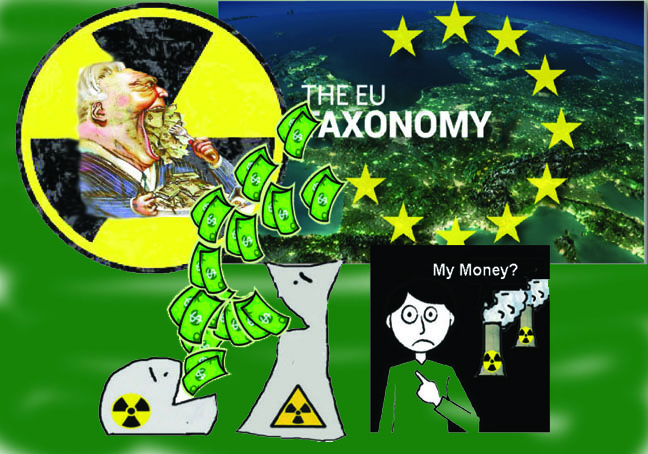
France wants the law to recognise low-carbon nuclear energy as a component of renewable targets, while Bulgaria, Romania and Poland call the targets overambitious.
By Ashima Sharma, https://www.power-technology.com/news/eu-to-vote-on-renewables-bill-after-nuclear-row/ 12 June 23
U diplomats will vote on the bloc’s new renewable energy bill on Wednesday after a group of countries, including France, registered last-minute opposition in May.
The bill proposes a binding goal for all EU countries to generate 42.5% of their energy from renewable sources by 2030. While France wanted the law to recognise low-carbon nuclear energy as a component of renewable targets, Bulgaria, Romania, and Poland say the targets are overambitious.
The EU’s current share of renewables in the energy mix is 22%. However, the share of the energy mix is unevenly distributed among the countries. Sweden’s share of renewable energy is 63%, while Ireland, Luxembourg, Malta and the Netherlands comprise less than 13% of the total energy share.
The revised directive on renewables doubles the current targets with an ambition to accelerate the bloc’s plan to fight climate change and end dependence on Russian fuel. Meeting the new goals requires scaling up wind and solar farms, increasing the production of renewable gases and integrating Europe’s power grids to accommodate cleaner energy.
While nuclear energy is low-carbon, it is not renewable. France is, however, pushing for more favourable treatment of nuclear energy. The country maintains that the new bill puts countries like France, with a huge nuclear share, at a disadvantage. In May this year, the French Parliament passed a law to accelerate the construction of new nuclear reactors.
The revised directive on renewables doubles the current targets with an ambition to accelerate the bloc’s plan to fight climate change and end dependence on Russian fuel. Meeting the new goals requires scaling up wind and solar farms, increasing the production of renewable gases and integrating Europe’s power grids to accommodate cleaner energy.
While nuclear energy is low-carbon, it is not renewable. France is, however, pushing for more favourable treatment of nuclear energy. The country maintains that the new bill puts countries like France, with a huge nuclear share, at a disadvantage. In May this year, the French Parliament passed a law to accelerate the construction of new nuclear reactors.
Nuclear weapons spending increases while global security decreases
https://www.icanw.org/2022_global_nuclear_spending_article 12 June 23
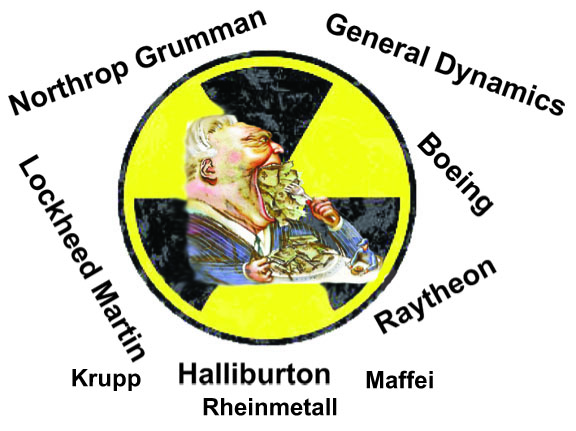
ICAN’s new report “Wasted: 2022 Global Nuclear Weapons Spending” shows nine countries spent $82.9 billion on nuclear weapons, of which the private sector earned at least $29 billion in 2022. The United States spent more than all of the other nuclear armed states combined, $43.7 billion. Russia spent 22% of what the U.S. did, at $9.6 billion, and China spent just over a quarter of the U.S. total, at $11.7 billion.
This is the fourth annual report on global nuclear weapons spending published by ICAN. The report shows that global spending on nuclear weapons has increased for the third year in a row as the nine nuclear-armed states continued to modernise and expand their arsenals.
The report illustrates how private contractors continue to benefit from nuclear weapons spending and lobby to maintain nuclear weapons. It details the $278.6 billion in ongoing nuclear weapons contracts, some of which don’t expire for decades. In 2022, at least $15.9 billion in new nuclear weapon contracts were awarded. The companies that received these contracts invested in lobbying governments, spending $113 million on those efforts in the US and France alone.
Think tanks also benefited from these corporate interests. Together, nuclear weapon producing companies, nuclear-armed governments and those in nuclear alliances spent $21-36 million funding the ten most prominent think tanks researching and writing about nuclear weapons in nuclear-armed states.

Russia’s invasion of Ukraine publicly demonstrated how unacceptably dangerous nine countries’ reliance on nuclear weapons is. Those whose incomes depend on the existence of nuclear weapons fiercely defended the right of these countries to indiscriminately murder civilians with weapons of mass destruction through falsehoods of deterrence.
The Treaty on the Prohibition of Nuclear Weapons is the multilateral response to the irresponsible behaviour of all nuclear-armed states to pour money down their nuclear weapons drains. It is the normative barricade against threats to use nuclear weapons. All countries should join this landmark international instrument to prohibit the development and maintenance of nuclear weapons and prevent their eventual use by ensuring their elimination.
European Union to try again for renewable energy deal after nuclear row
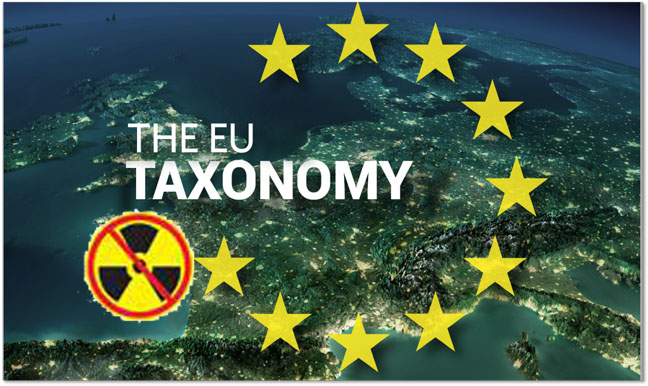
By Kate AbnettJune 10, 2023
BRUSSELS, June 10 (Reuters) – European Union countries will try again next week to pass a deal on new renewable energy targets, which have been stalled by concerns from France and other states that the law sidelines nuclear energy.
A group of countries including France lodged last-minute opposition to the EU’s law on more ambitious renewable energy goals last month, putting on hold a main pillar of the bloc’s plans to tackle climate change.
EU country diplomats will attempt to approve the law on Wednesday, according to an agenda for the meeting published late on Friday.
Paris has sought changes to the law to offer more favourable treatment of nuclear energy, and said the final deal puts at a disadvantage countries like France with large shares of nuclear power. Nuclear energy is low-carbon, but not renewable.
The EU law is designed to drive a rapid expansion of renewable energy sources like wind and solar. The deal negotiated this year offered some compromises, including lower renewable fuel targets for industry, in countries that have already used nuclear power to slash their use of fossil fuels…………………
France’s energy ministry did not immediately respond to a request for comment.
French Finance Minister Bruno Le Maire said on Thursday France will not give up the competitive advantages linked to nuclear power, noting that EU countries have the right to choose their own energy mix.
Other pro-nuclear EU members including Bulgaria, Poland, Hungary and the Czech Republic had also signalled they would not support the renewable law – citing concerns including, for some, that the targets are simply too high.
Together, they have enough votes to block the law.
It is unusual for countries to reject pre-agreed deals on EU laws, which follow months of negotiations.
Meanwhile, states including Germany and Luxembourg – both anti-nuclear countries – plus Denmark and Ireland have urged the EU to resolve the spat quickly, warning the delay endangers investments in renewable energy.
Reporting by Kate Abnett Additional reporting by Dominique Vidalon Editing by Frances Kerry https://www.reuters.com/world/europe/eu-try-again-renewable-energy-deal-after-nuclear-row-2023-06-10/
France’s EDF and the global nuclear lobby sulking because Europe won’t accept their lie that nuclear power is “renewable”.

‘Not there yet’: France’s EDF frustrated with nuclear power’s status in EU’s Net-Zero Industry Act, By Frédéric Simon | EURACTIV.com 11 June 23,
Supporters of nuclear power in France have welcomed plans to scrap the two-tier approach to low-carbon technologies in the EU’s draft Net-Zero Industry Act (NZIA) but they also condemn the lower status granted to atomic energy as “incoherent” with the bloc’s wider decarbonisation goals.
Tabled by the European Commission in March, the NZIA aims to ensure Europe is capable of producing domestically at least 40% of the technologies it deems “strategic” to achieve its goal of reducing emissions to net zero by 2050.
But while nuclear energy was catalogued among the EU’s net-zero industries, it did not make it into the list of “strategic” technologies – such as wind, solar, batteries and electrolysers – that are eligible for the 40% domestic manufacturing benchmark, as well as quicker permitting procedures and looser EU state aid oversight.
Under the Commission’s proposal, only Small Modular Reactors (SMRs) and “advanced technologies” producing energy from nuclear processes “with minimal waste from the fuel cycle” would be eligible for the ‘strategic’ label.
“The cutting-edge nuclear is in for specific fields, but not for all,” European Commission President Ursula von der Leyen explained after an EU summit in March, causing uproar among nuclear energy fans on social media.
Technological neutrality
Legislators are now examining the proposed NZIA regulation, with the European Parliament and EU member states aiming to reach an agreement on a joint text before the end of the year.
And for nuclear power advocates, the Parliament’s draft position on the regulation means more frustration, even though some see encouraging signs as well…………………………………..
EDF, the French state-owned electric utility, appears even more bitter, denouncing the “incoherence” of ignoring a mature technology like nuclear power, which emits almost no carbon dioxide, in a legislative text meant to promote zero-emission technologies.
“The only nuclear power included in the NZIA is the one which does not yet exist – Small Modular Reactors (SMRs),” said Erkki Maillard, senior vice president for EU affairs at EDF, which returned under full state ownership this week……………………………………..
Nuclear alliance
France is not alone in its quest to win recognition for nuclear power as a strategic net-zero technology.
Last month, a group of 16 European countries taking part in the French-led “nuclear alliance” signed a joint declaration in which they encouraged the European Commission “to recognise nuclear energy in the EU’s energy strategy” and promote “better conditions for the development and deployment of new nuclear energy capacity in the EU”.
………………………………………. Parliament lawmakers have until 19 June to table amendments to the NZIA regulation.
The Parliament’s industry committee, which has the lead on the matter, is scheduled to vote on the proposal on 12 October, before a plenary vote expected the following month. This will open the way for decisive talks with EU member states and the European Commission to finalise the law’s adoption.
Ukraine’s propaganda machine is vital for Zelensky: Here is how it works
Rt.com 12 June 23
Kiev is waging an extensive information war against Russia and it began long before the military conflict
The Russia-Ukraine conflict isn’t just about the clash of armed forces on the battlefield. It has also been marked by unprecedented levels of confrontation in the fields of information and psychology, cognition and semantics.
Kiev has arguably achieved more success on the information front, than on the ground. There the “fighters” aren’t just journalists and information and psychological warfare specialists, but content makers and PR experts. Influencing the psyche, mindset, and emotions of ordinary people has become a big deal, as shaping Western public opinion is vital for President Vladimir Zelensky’s regime.
The symbols of war
Anyone familiar with advertising and PR knows that tying a product to a colorful, memorable symbol, or slogan, will boost its popularity, especially in this era of short attention spans. During wartime, the same strategy works just as well with the news as with advertising and election campaigns.
In the current conflict, Ukraine has become very good at creating symbols. Media outlets instantly take up any popular symbol and make use of it in order to influence the mindset of ordinary Ukrainians.
Here’s a recent example. In May, despite the very difficult situation for the Armed Forces of Ukraine (AFU) in Artemovsk (Bakhmut) and statements from several commentators – particularly the former Zelensky adviser Alexey Arestovich – that the army could soon retreat (as it eventually did), Ukrainian society wasn’t at all worried and had complete faith in the AFU’s ability to retain control over the city.
In fact, public attitudes towards the battle were largely shaped by the media. For example, at the beginning of the year the rock band “Antytila” (“Antibodies”) released a video for the song ‘Bakhmut Fortress.’ A few months later, it became viral. Ukrainians have since posted countless self-made versions of the video on social networks, affirming the myth of the impenetrable fortress of Bakhmut.
Such symbols are created not only during ongoing battles, but also in the aftermath of the AFU’s obvious failures. For example, at the end of February, the Artemsol salt production enterprise announced that before the start of active battles for Soledar (which ended in January with the victory of the Russian Army), it collected 20 tons of salt from the mines. The salt was packed into 100,000 packages bearing the symbolic inscription “Ukrainian Rock-Solid Strength.” Each package was sold for 500 hryvnia (about $13.50). According to the organizers of the fundraiser, most proceeds were spent on kamikaze drones for the AFU.
Symbolic campaigns like these occur regularly in Ukraine and are designed to encourage the population. In November of last year, when Russian troops withdrew from the west bank of the Kherson region and the AFU entered the eponymous regional capital, a national social media campaign urged users to place images of watermelons (the area grows them) on their profile pictures. ………………………………………………………………
The triumph of these symbols, which have endured long after being confirmed as fake, is a result of the information bubble in which Ukrainian society and much of the West has found itself. In the past year and a half since opposition media was blocked, government-controlled outlets are often the only source of information for Ukrainians.
The invisible front
“Today, information warfare is the core structure of any war. It is very important to have influence over a society that is involved in combat. Moreover, it is essential to convince the world community of the rightness of our actions in order to receive further support. Not only authorized persons can take part in this information war, but also regular citizens who ‘fight’ at their own discretion,” Ukraine’s Deputy Defense Minister Anna Maliar said in February.
Information and Psychological Operations (IPsO) are intended to brainwash people and shape public opinion, and they are among Kiev’s most important strategies in the conflict with Russia. In combat conditions, these operations are primarily aimed at demoralizing and disorganizing the enemy’s front and rear and inspiring a hopeless, doomed atmosphere. Usually, their main task is to discredit the military and political command and highlight defeat and failure…………………………………………………………………………………….
As part of Ukraine’s integration into NATO structures, special unit instructors from the United States and other Western countries are involved in the training of IPsO center personnel. In particular, these are specialists from the US Army’s 4th Psychological Operations Group (formerly called the 4th Military Information Support Group) and the UK’s 77th Brigade – a special unit of information, psychological, and cyber operations of the Armed Forces of Great Britain. IPsO specialists also undergo regular training at US military bases.
Disinformation and propaganda
In addition to official media outlets, Ukraine’s Information and Psychological Operations Centers rely on several thousand internet resources including information and news sites, social networks, and coordinated social media groups.
Even before the start of Russia’s military campaign, certain Ukrainian volunteer internet information resources were controlled by IPsO centers. This included the volunteer communities InformNapalm, (informnapalm.org ), Peacemaker (psb4ukr.org ), Information Resistance (sprotyv.info ), as well as commercial sites (seebreeze.org.ua, petrimazepa.com, podvodka.info, metelyk.org, mfaua.org, burkonews.info, euromaidanpress.com , peopleproject.com and others) used for information campaigns and testing “social engineering” technologies. In particular, it was noted that IPsO officers often operated under the guise of “volunteers” and pseudo-bloggers……………………………………
Ukraine uses various tools – including websites, social networks, and bots – to spread disinformation. In April, hackers from RaHDit and other groups revealed Ukrainian Telegram channels presumably supervised by the SBU, which posed as pro-Russian. An entire network of such channels, with an audience of 5-6 million people, was discovered during the investigation. The list includes channels Operation Z, Novorossiya 2.0, and many others……………… more https://www.rt.com/russia/577774-kievs-propaganda-machine-how-it-works/—
The Fukushima Wastewater ‘Discharge’: What’s in a Name? – technostrategic language.
Japan is very carefully shaping the narrative around its release of radioactive water into the Pacific Ocean.
The Diplomat By Maxime Polleri, June 12, 2023
Japan is planning to soon release a million tons of radioactive water from the Fukushima power plant. Since the 2011 Fukushima nuclear disaster, water used to cool the crippled power plant has become contaminated, while being kept in huge storage tanks. Advanced techniques of water treatment have removed many of the radioactive substances from this stored water, but one pollutant, radioactive tritium, remains especially tricky to get rid of. Since tritium is a radioactive isotope of hydrogen – a key component of water – it cannot be removed by purification and remains in the treated water.
Currently, tritium-contaminated water is filling Japan’s tanks to the brink and the government has no choice but to release this water in the sea. This decision is fueling numerous controversies surrounding the potential danger of releasing nuclear wastewater in the ocean. It is notably facing stark opposition from Japan’s fishing industry, which has been scrambling to recover ever since the 2011 nuclear meltdowns.
As a social anthropologist working on this disaster, I am less concerned about the scientific debates over the safety vs. danger, and more interested in another type of battle that surrounds this decision: a linguistic one. For instance, when fishermen discuss their concerns, they at times use a specific narrative that accuses the authorities of treating the sea as a garbage dump. On the other hand, state authorities and nuclear organizations like The International Atomic Energy Agency (IAEA), rarely talk about “dumping” wastewater in the sea. Instead, they use words like “release,” “disposal,” or even “dilution.” Words like “garbage,” “pollutants,” “contaminants,” or “waste” are also utterly absent from these expert organizations’ vocabulary. In talking about tritium-contaminated water, for example, IAEA prefers resorting to highly technical terms like Advanced Liquid Processing System-treated water.
These words are not random choices. They reflect highly peculiar ways of governing environmental risks in the aftermath of nuclear disasters. In particular, they echo what scholar Carol Cohn famously called “technostrategic language,” that is, terminologies that disregard particular realities in the face of risks, while preventing the expression of specific values. Cohn first talked about technostrategic languages in the context of nuclear defense intellectuals, arguing that their specific language allowed a rejection of the idea that they too could become victims of the wrath of nuclear weapons.
Similarly, words like “discharge,” “dilution,” or “treated water” are part of governance techniques that have powerful symbolic functions. This language imbues post-disaster narratives with specific values, while shutting out alternatives. Let us examine some of the consequences of this technostrategic language.
First, technical words provide an aura of expertise, legitimacy, and control toward the things that cannot be governed, such as the slow accumulation of tons of contaminated water………………………..
Second, much like the phenomenon of radioactive decay – a process where unstable atomic elements gradually transform themselves into wholly different elements – bringing discussions of contamination into the technical sphere literally transmutes the narrative of “waste dumping” into what appears to be a sound policy of “treated-water management.”………………….
Third, the use of scientific jargon also creates powerful hierarchical divisions between people and experts. For instance, Japanese fishermen are worried that the release of radioactive water will affect their livelihood. Yet they can rarely compete against the technical lingo of reified expertise. https://thediplomat.com/2023/06/the-fukushima-wastewater-discharge-whats-in-a-name/
Nuclear arsenals growing as chances for diplomacy shrink: report

China, Russia, India, Pakistan, and North Korea each deployed more nuclear weapons last year, according to SIPRI.
Connor Echols https://responsiblestatecraft.org/2023/06/12/nuclear-arsenals-growing-as-chances-for-diplomacy-shrink-report/ JUNE 12, 2023
Nuclear-armed states are expanding and modernizing their arsenals as tensions continue to rise between great powers, according to a new report from the Stockholm International Peace Research Institute. SIPRI estimates that militaries have deployed an additional 86 warheads over the past year, bringing the total number of active nuclear weapons to 9576.
China added 60 warheads since the start of 2022, giving it a total arsenal of 410 nuclear weapons, according to SIPRI. Russia deployed an additional 12 nukes, with India, Pakistan, and North Korea making up the rest of the increase.
“It is increasingly difficult to square this trend with China’s declared aim of having only the minimum nuclear forces needed to maintain its national security,” argued SIPRI senior fellow Hans M. Kristensen in a press release.
The new data comes from SIPRI’s Yearbook, the organization’s annual report on global trends in weapons stockpiles and disarmament.
Despite China’s notable increase, the United States and Russia continue to dominate all other states when it comes to nuclear stockpiles. Together, the two hold 85 percent of the world’s deployed nuclear weapons, and both plan to invest heavily in efforts to modernize their arsenals.
Chances for renewed disarmament talks have flagged following Russia’s invasion of Ukraine early last year. Washington and Moscow both took steps recently to reduce their compliance with the New START Treaty — the only agreement capping the number of warheads that each country deploys, which expires in 2026.
Notably, the United States announced earlier this month that it is ready to engage in new nuclear talks “without preconditions” with both Russia and China. But it remains unclear whether either state is interested in negotiating with Washington as geopolitical tensions continue to grow.
“This elevated nuclear competition has dramatically increased the risk that nuclear weapons might be used in anger for the first time since World War II,” SIPRI researcher Matt Korda said in a press release.
Meanwhile, some states have taken steps to reduce transparency around their nuclear stockpiles. The United States and United Kingdom “both declined to release information to the public concerning their nuclear forces in 2022, which they had done in previous years,” the report notes. The UK decision is particularly notable given its 2021 announcement that it will increase the limit on its arsenal from 225 to 260 warheads.
Data about the arsenals of other nuclear-armed states is also limited given the secrecy surrounding many countries’ nuclear programs. Israel has never admitted to possessing nuclear weapons, but SIPRI estimates that it currently has 90 warheads. North Korea, another secretive nuclear-armed state, has as many as 30 nuclear bombs, according to the report.
Iranian Supreme Leader Says ‘Nothing Wrong’ With A Nuclear Deal With West
https://www.rferl.org/a/iran-khamenei-nuclear-deal-approval/32454257.html 12 June 23
Iran’s supreme leader said on June 11 that a deal with the West over Tehran’s nuclear work was possible if the country’s atomic infrastructure remained intact, amid a stalemate between Tehran and Washington to revive a 2015 nuclear pact.
Months of indirect talks between Tehran and Washington to salvage the nuclear accord with six major powers have stalled since September, with each side accusing the other of making unreasonable demands. Ayatollah Ali Khamenei’s guarded approval comes days after both Tehran and Washington denied a report that they were nearing an interim deal. To read the original story by Reuters, click here.
Time to remove nuclear weapons from NATO countries, in return for Putin not putting them in Belarus?
Now is the time to call for all US nuclear weapons to be removed from five NATO countries, Italy, Turkey, Germany, Netherlands, Belgium, restore the ABM Treaty which Bush walked out of and close new missile bases in Romania and Poland in return for Putin not putting nuclear weapons in Belarus. https://apnews.com/article/putin-russia-belarus-nuclear-weapons-war-ukraine-a8b462cd8f30b85ec8f3be93e554e94b
Oil-rich nations dominate COP28 – now offering rich sponsorships, in the effort to silence critics

Emanuele Del Rosso Emanuele is an award-winning Italian political cartoonist. His work is published and distributed internationally.
16 January 2023
UN climate summit organisers wage public relations battle. Marketing drive
for multimillion-dollar sponsorships for UAE-hosted event as critics become
more vocal.
The UAE COP28 has offered sponsorship packages ranging up to
$8.2mn (Dh30mn) for a principal partner to enjoy privileged access in the
controlled “blue zone” where world leaders gather, according to
documents sent to prospective sponsors.
Space in the “green zone”, open
to civil society and small business, is less than $7,000 (Dh25,000).
Expressions of interest for pavilions close this week for the event
starting on November 30.
FT 11th June 2023
https://www.ft.com/content/7b17bc43-f303-4039-a8d5-7e9825604a46
45 nations pledge to double their rate of energy efficiency improvements

45 nations pledge to double rate of energy efficiency improvements. The
UK, the US and Ukraine are among the 45 nations endorsing a new global
commitment to accelerate the rate of energy efficiency improvements. The
declaration takes the form of a new ministerial statement, released to mark
the conclusion of the International Energy Agency’s (IEA) global
conference on energy efficiency in France. As the conference began earlier
this week, the IEA confirmed that global energy intensity decreased 2.2%
last year, twice the average of the previous five years, largely due to
policy responses to the energy price crisis. Yet annual decreases of 4% are
needed to give the world the best chance of achieving net-zero by
mid-century and averting the worst physical impacts of the climate crisis.
To that end, the 45 nations have pledged to develop and implement better
policies to improve energy efficiency domestically. These include both
government-led schemes and policies that help to unlock private investment.
Edie 9th June 2023 https://www.edie.net/45-nations-pledge-to-double-rate-of-energy-efficiency-improvements/
A.I. or Nuclear Weapons: Can You Tell These Quotes Apart?
Many experts on artificial intelligence are warning of its potential dangers and calling for regulation, just as others once did with the atomic bomb.
NYT.By Ian Prasad Philbrick and Tom Wright-Piersanti. June 10, 2023
The comparison seems to be everywhere these days. “It’s like nuclear weapons,” a pioneering artificial intelligence researcher has said. Top A.I. executives have likened their product to nuclear energy. And a group of industry leaders warned last week that A.I. technology could pose an existential threat to humanity, on par with nuclear war.
People have been analogizing A.I. advances to splitting the atom for years. But the comparison has become more stark amid the release of A.I. chatbots and A.I. creators’ calls for national and international regulation — much as scientists called for guardrails governing nuclear arms in the 1950s. Some experts worry that A.I. will eliminate jobs or spread disinformation in the short term; others fear hyper-intelligent systems could eventually learn to write their own computer code, slip the bonds of human control and, perhaps, decide to wipe us out. “The creators of this technology are telling us they are worried,” said Rachel Bronson, the president of the Bulletin of the Atomic Scientists, which tracks man-made threats to civilization. “The creators of this technology are asking for governance and regulation. The creators of this technology are telling us we need to pay attention.”…………………………………more https://www.nytimes.com/2023/06/10/upshot/artificial-intelligence-nuclear-weapons-quiz.html
1 This Month

of the week – Shut Down Drone Warfare!


Tell the Ukrainian Government to Drop Prosecution of Peace Activist Yurii Sheliazhenko

Petition to revoke the licensing of the Near Surface Nuclear Disposal Facility (NSDF) at Chalk River. https://www.ourcommons.ca/petitions/en/Petition/Details?Petition=e-7247
To see nuclear-related stories in greater depth and intensity – go to https://nuclearinformation.wordpress.com
-
Archives
- April 2026 (114)
- March 2026 (251)
- February 2026 (268)
- January 2026 (308)
- December 2025 (358)
- November 2025 (359)
- October 2025 (376)
- September 2025 (257)
- August 2025 (319)
- July 2025 (230)
- June 2025 (348)
- May 2025 (261)
-
Categories
- 1
- 1 NUCLEAR ISSUES
- business and costs
- climate change
- culture and arts
- ENERGY
- environment
- health
- history
- indigenous issues
- Legal
- marketing of nuclear
- media
- opposition to nuclear
- PERSONAL STORIES
- politics
- politics international
- Religion and ethics
- safety
- secrets,lies and civil liberties
- spinbuster
- technology
- Uranium
- wastes
- weapons and war
- Women
- 2 WORLD
- ACTION
- AFRICA
- Atrocities
- AUSTRALIA
- Christina's notes
- Christina's themes
- culture and arts
- Events
- Fuk 2022
- Fuk 2023
- Fukushima 2017
- Fukushima 2018
- fukushima 2019
- Fukushima 2020
- Fukushima 2021
- general
- global warming
- Humour (God we need it)
- Nuclear
- RARE EARTHS
- Reference
- resources – print
- Resources -audiovicual
- Weekly Newsletter
- World
- World Nuclear
- YouTube
-
RSS
Entries RSS
Comments RSS
 nuclear-news