Is nuclear fusion energy salvation?
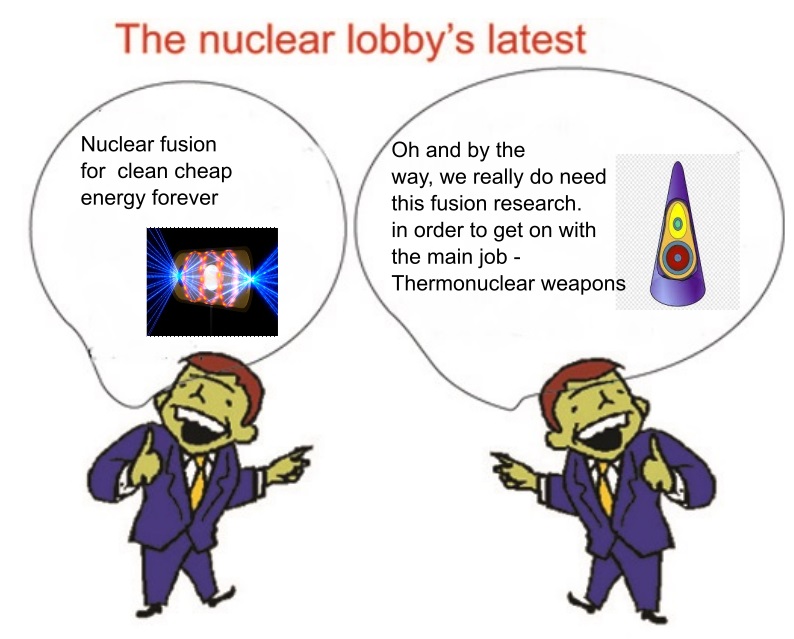
the real reason for the race to fusion is actually to allow the stockpiling of nuclear weapons that are even more dreadful than present ones. Currently, a major difficulty in manufacturing nuclear bombs is “the need for highly enriched uranium or plutonium” to initiate the reaction. Research with nuclear fusion could provide an alternative path to accomplish the ignition.

Few know that “100 significant accidents happened in world’s nuclear power plants from mid-1950s to 2010.” The world’s press has given scant attention to how people were used as guinea pigs in testing sites such as the Marshall Islands.
mronline, By Don Fitz, Stan Cox ( Jun 07, 2023) Originally published: Dissident Voice on June 3, 2023
Like a third rate zombie movie on Netflix, delusions of nuclear fusion repeatedly rise from the dead. The cover story in the June 2023 issue of Scientific American by Philip Ball, “Star Power: Does Fusion Have a Future After All?” recycles the corporate line which was broadcast on December 13, 2022. The U.S. Department of Energy (DOE) announced that the National Ignition Facility (NIF) at the Lawrence Livermore National Laboratory had reached a “breakthrough” in developing an alternative to fission.
As Joshua Frank described the hype over nuclear fusion …
“there’s no toxic mining involved, nor do thousands of gallons of cold water have to be pumped in to cool overheated reactors, nor will there be radioactive waste byproducts lasting hundreds of thousands of years. And not a risk of a nuclear meltdown in sight! Fusion, so the cheery news went, is safe, effective, and efficient!“
After six months of the announcement’s being debunked, the Scientific American article admitted some of the inherent faults with fusion, repeated some of the original misstatements, and went on with detailed descriptions of technical tweaks necessary to make the technology viable in the second half of the century. Unfortunately, most of those who criticized fusion missed one of its most serious dangers—that discovering a source of limitless cheap energy would doom humanity’s future rather than enhance it.
The Terror
In order to interpret the spin of the military-industrial-pseudo-scientific (MIPS) complex, we need to appreciate the primary obstacle to expanding nuclear power. MIPS must overcome the intense terror of nukes.
The terror began with images of Hiroshima and Nagasaki in August 1945. Photos of burnt bodies are burned into the minds of their viewers. MIPS seeks to discount the images with the myth that Japan had to be nuked, even though it was ready to surrender. The mythology continued with the “Atoms for Peace” false pretense that there could be a disconnect between nuclear power and nuclear bombs.
A few decades went by and on March 28, 1979 Three-Mile Island melted down. A good part of its infamy stemmed from repeated government lies that the event was not so serious and would have few long-lasting effects. Americans would never be convinced that nukes would only be dangerous if the Soviets or Japanese built them.
Then there was Chernobyl on April 26, 1986. In 2009 the New York Academy of Science published a detailed analysis estimating the total death count to be around 900,000 and the MIPS spewed forth venomous claims that it was not actually so bad, but was merely the worst human-caused catastrophe in history.
This was followed on March 11, 2011 with the Fukushima Daiichi apocalypse when 3 of 6 nuclear reactors melted down, spreading radioactivity into the neighboring Pacific Ocean and poisoning unknown quantities of aquatic life. So, each generation from World War II through today, has memories of horrendous nuclear events which MIPS has been totally unsuccessful at erasing.
But credit should be given where it is due, and there is an area where MIPS has done quite well in its plugola efforts. Those efforts have been to keep everyday leakage of nuclear material and “smaller” catastrophes either out of or reduced to short paragraphs in the corporate press. Few know that “100 significant accidents happened in world’s nuclear power plants from mid-1950s to 2010.” The world’s press has given scant attention to how people were used as guinea pigs in testing sites such as the Marshall Islands. Souma Dutta notes such events:
… in the Soviet nuclear test sites of Semipalatinsk in Kazakhstan, Novaya Zemlya and others, the French nuclear test sites of Reggane & Akker in Algeria and the Mururoa Atoll in the Pacific, the British test sites in the Australian territories of Monte Bello, Maralinga, Emu Field, and the Chinese test site of Lop Nur.
Denial Non-Stop
The Scientific American article lets us know which dangers of nuclear fusion that MIPS continues to deny six months after the NIF “breakthrough.” Despite a good amount of evidence to contrary, the article claims that nuclear fusion would (a) produce “near zero carbon emissions” but (b) “without creating the dangerous radioactive waste.”
……………………………Please remember that the goal of corporations is profit. That requires expanding production by increasing the amount of energy used to the maximum. If fusion were added to the energy mix, there would continue be little to no decrease in fossil fuel use.
Equally fallacious is the claim that nuclear fusion would not result in deadly waste. Essential for the fusion process is tritium, a radioactive form of hydrogen. Its isotopes can permeate metals and pass through the tiniest spaces in enclosures. Since tritium can enter virtually any part of the human body, it can lead to a variety of cancers.
Nuclear fusion would be even more inefficient at water use than would fission reactors. Though not exactly a “waste product,” this wastage would seriously drain water supplies at a time when they are increasingly being exhausted.
Dirty Little Secrets Creep into the Open
Philip Ball’s article slyly admits the accuracy of several of the most frequent criticisms of the December 2022 “breakthrough” announcement. They appear as a hint to the MIPS complex that, in order to manufacture consent on the grandeur of nuclear fusion, its acolytes should modify some of their more outlandish claims if they are to be taken seriously.
First, nuclear fusion is far, far too expensive to provide energy “too cheap to meter” during upcoming decades. Not only is tritium (costing $30,000 per gram) necessary to start the initial reaction, reactors must be lined with expensive lithium. Equipment to make the tiny event happen is enormous, requiring space equal to three football fields. The complexity of the system requires twice as many employees—1000 for fusion vs. 500 for a fission reactor. This helps explain why original cost projections of $6.3 billion mushroomed to DOE’s current estimate of $65 billion.
Second, closely linked to cost is the contrast between the minuscule amount of electricity squeezed out with the use of 192 lasers in December 2022 and the gargantuan amount that would be needed to feed the grid. According to Brian Tokar, the Livermore blast lasted for one ten-billionth of a second. Nowhere close to powering a major city for a year, or a month or even an hour.
Third, the cost for such a frivolous amount of energy means that no one seriously suggests that fusion reactors will power homes in the foreseeable future. Many proponents now openly admit that claiming that the technology will be used to improve people’s lives is a hoax. Ball quotes an industry spokesperson bluntly stating that “There is not today a single project underway to build a fusion power plant that will produce energy.”
Fourth, the real reason for the race to fusion is actually to allow the stockpiling of nuclear weapons that are even more dreadful than present ones. Currently, a major difficulty in manufacturing nuclear bombs is “the need for highly enriched uranium or plutonium” to initiate the reaction. Research with nuclear fusion could provide an alternative path to accomplish the ignition.
Dr. M.V Ramana explains the search for “neutrons with the very short pulse widths characteristic of low-yield nuclear intercepts that can be used to establish lethal criteria for chemical/biological agents and nuclear warhead targets.” Thus, if experimentation with nuclear fusion were to be successful, it could further shorten the Doomsday Clock, increasing the probability of human annihilation.
To Dream the Impossible Dream
………………………………………….. quest for limitless energy is a journey into oblivion. To dream the impossible energy dream is to hallucinate the most hideous nightmare. Richard Heinberg warns of the dangers of ignoring limits, noting that if nuke fusion were to remove limits on energy production, corporations would expand production to endlessly deplete soil and destroy species habitat.
Searching for infinite energy other than fossil fuels would present dangers as ominous as nuclear war.
Christopher Ketcham summarizes:
mainstream environmentalists have siloed climate change as a phenomenon apart from the broad human ecological footprint, separate from deforestation, overgrazing of livestock, megafauna kill-off, collapsing fisheries, desertification, depleted freshwater, soil degradation, oceanic garbage gyres, toxification of rainfall with microplastics, and on and on–the myriad biospheric effects of breakneck growth.
The attitude that “nothing is as threatening as climate change” has lured many into the abyss of ignoring (or minimizing) the humongous dangers of “alternative” energy (AltE). Stan explains how AltE contributes to ongoing threats, writing that the total quantity of “human-made mass”—which is everything made by people—has now exceeded the “the total weight of all living plant, animal, and microbial biomass on Earth.” This material mass is doubling every 20 years, it contributing to the “breakdown of of entire ecosystems” as well as climate change………………………….
The good news is that it does not have to be like this. We now have the knowledge and ability to provide good lives for people throughout the world if we have the sense to distinguish what humanity needs vs. what corporations are greedy for.
Do we really need to build rocket ships to Mars? Is the quality of our lives improved by having products that fall apart sooner and sooner? Must there be a car for every adult on Earth instead of having communities where people get 80% of what they use by walking or cycling?
Are Americans really safer by having over 700 military bases and the ability to exterminate every human many times over. Don’s book on Cuban Health Care documents how that country’s medical system produces less infant mortality and a longer life expectancy than the U.S. while spending less than 10% of what the U.S. spends per person annually.
Contrary to widespread propaganda, humanity does not desperately need more energy. We desperately need to live better with less energy. https://mronline.org/2023/06/07/is-nuclear-fusion-energy-salvation/
No comments yet.
1 This Month

of the week – Shut Down Drone Warfare!


Tell the Ukrainian Government to Drop Prosecution of Peace Activist Yurii Sheliazhenko

Petition to revoke the licensing of the Near Surface Nuclear Disposal Facility (NSDF) at Chalk River. https://www.ourcommons.ca/petitions/en/Petition/Details?Petition=e-7247
To see nuclear-related stories in greater depth and intensity – go to https://nuclearinformation.wordpress.com
-
Archives
- April 2026 (103)
- March 2026 (251)
- February 2026 (268)
- January 2026 (308)
- December 2025 (358)
- November 2025 (359)
- October 2025 (376)
- September 2025 (257)
- August 2025 (319)
- July 2025 (230)
- June 2025 (348)
- May 2025 (261)
-
Categories
- 1
- 1 NUCLEAR ISSUES
- business and costs
- climate change
- culture and arts
- ENERGY
- environment
- health
- history
- indigenous issues
- Legal
- marketing of nuclear
- media
- opposition to nuclear
- PERSONAL STORIES
- politics
- politics international
- Religion and ethics
- safety
- secrets,lies and civil liberties
- spinbuster
- technology
- Uranium
- wastes
- weapons and war
- Women
- 2 WORLD
- ACTION
- AFRICA
- Atrocities
- AUSTRALIA
- Christina's notes
- Christina's themes
- culture and arts
- Events
- Fuk 2022
- Fuk 2023
- Fukushima 2017
- Fukushima 2018
- fukushima 2019
- Fukushima 2020
- Fukushima 2021
- general
- global warming
- Humour (God we need it)
- Nuclear
- RARE EARTHS
- Reference
- resources – print
- Resources -audiovicual
- Weekly Newsletter
- World
- World Nuclear
- YouTube
-
RSS
Entries RSS
Comments RSS
 nuclear-news
Leave a comment