Nuclear energy just helped Finland slash electric costs by a staggering 75% — so why doesn’t the US follow suit? 3 reasons we are cool on the power source
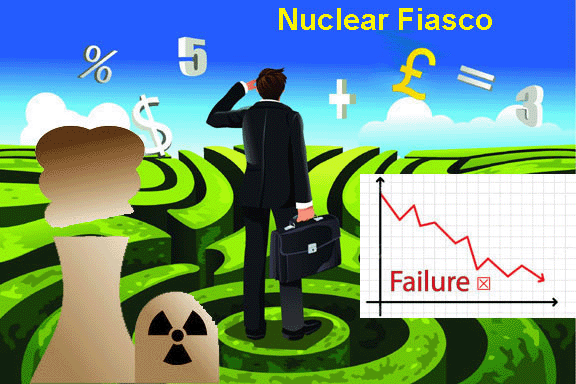
Of course all bets on stability are off in the event of a meltdown — and in terms of catastrophes compared to anything possible with solar or wind, you might also say it’s not even close.
But in the end, nuclear is complicated — and it only takes a tsunami, fat finger on the control panel or mechanical breakdown to once again become reacquainted with the fallout.
Vishesh Raisinghani, Sun, June 4, 2023 https://finance.yahoo.com/news/nuclear-energy-just-helped-finland-110000152.html
The first new European nuclear plant in 16 years has already slashed Finland’s energy bill by three-fourths.
Olkiluoto 3, or OL3, joins two existing reactor units that have powered Finland’s grid for decades. This latest unit adds 1,600 megawatts to the plant’s production capacity — which means 30% of the nation’s electricity will soon come from just one plant on a tiny island in Western Finland.
When the new OL3 unit was fully activated in April, average spot electricity prices fell to €60.55 ($65.69) per megawatt hour. That’s 75.38% lower than the average spot price in December 2022 (€245.98 per megawatt hour).
While its operating company TVO called it “the greatest single climate act in Finland,” others argue that the benefits are hardly worth the risks.
Here’s why most countries are cool on this technology.
Fear
High-profile incidents like at Three Mile Island, Chernobyl and Fukushima have severely impacted the reputation of nuclear energy. Even if an overwhelming number of plants are safe, it only takes one accident to render the land around a plant uninhabitable.
In the U.S., “nukes” (as protesting musicians nicknamed them in the 1980s) continue to be unpopular. The number in the U.S. has dropped from a peak of 107 in 1990 to 93 as of 2022, according to the Pew Research Center.
Roughly 1-in-4 Americans say their government should actively discourage nuclear energy production, which could explain why so few plants have been built over the last 10 years. Yet fear is only part of the equation, as the financial bottom line also plays a crucial role in the lack of any nuclear energy embrace.
Cost
New nuclear power plants are mostly being built in countries where all infrastructure is cheaper to build. China is currently developing 24 new plants — the most in the world. Meanwhile, India is building eight new reactors. It’s simply cheaper to build plants in these regions.
According to the World Nuclear Association, the overnight cost of building a new plant in China, which assumes no interest payments, is $2500/kWe, while the cost in the U.S. is $6041/kWe (short for kilowatt-electric or one thousand watts of electric capacity). This price disparity is another reason why nuclear power isn’t favored in the developed world — though the causes go far beyond this.
Time
Nuclear power takes several years to deploy — and that’s on the conservative end. A plant can typically be constructed over a period of five years. However, regulatory and financial hurdles could delay these projects along the way. Meanwhile, a typical wind farm can be fully deployed in as little as six months, according to EDF Energy.
The classic example of how mismanaged a nuclear project can get is as close as Georgia. There, the third reactor at Plant Vogtle went online at full capacity in late May but was supposed to start generating power in 2016. It was approved for construction in 2009, and overruns pushed the cost to more than $17 million; combined with a fourth reactor still in the testing phase, the total price comes to a staggering $35 billion.
‘The most reliable source’
Indeed, time and cost ultimately represent the biggest barrier to adoption. Even Finland’s energy experts understand the commercial challenges. “[Nuclear] it seems is not very attractive for the investors,” Jukka Ruusunen, chief executive of Finland’s national grid operator Fingrid, told The National.
However, nuclear power has several non-commercial advantages. Unlike wind and solar, nuclear energy output is stable regardless of weather and sunshine hours. The U.S. Energy Department once called it “the most reliable energy source and it’s not even close.”
Of course all bets on stability are off in the event of a meltdown — and in terms of catastrophes compared to anything possible with solar or wind, you might also say it’s not even close.
Russia’s invasion of Ukraine has also highlighted nuclear’s potential to deliver national security and energy independence. Yet the near catastrophes at the Chernobyl plant during the war almost seem to counteract that fact.
On the upside, Finland’s new nuclear plant has helped it avoid blackouts despite sanctions on Russian energy and could help explain why several other European countries are also now pushing for more nuclear power.
But in the end, nuclear is complicated — and it only takes a tsunami, fat finger on the control panel or mechanical breakdown to once again become reacquainted with the fallout.
No comments yet.
1 This Month


Tell the Ukrainian Government to Drop Prosecution of Peace Activist Yurii Sheliazhenko

Petition to revoke the licensing of the Near Surface Nuclear Disposal Facility (NSDF) at Chalk River. https://www.ourcommons.ca/petitions/en/Petition/Details?Petition=e-7247


of the week – STOP SMALL MODULAR REACTORS IN CANADA
To see nuclear-related stories in greater depth and intensity – go to https://nuclearinformation.wordpress.com
-
Archives
- March 2026 (204)
- February 2026 (268)
- January 2026 (308)
- December 2025 (358)
- November 2025 (359)
- October 2025 (376)
- September 2025 (258)
- August 2025 (319)
- July 2025 (230)
- June 2025 (348)
- May 2025 (261)
- April 2025 (305)
-
Categories
- 1
- 1 NUCLEAR ISSUES
- business and costs
- climate change
- culture and arts
- ENERGY
- environment
- health
- history
- indigenous issues
- Legal
- marketing of nuclear
- media
- opposition to nuclear
- PERSONAL STORIES
- politics
- politics international
- Religion and ethics
- safety
- secrets,lies and civil liberties
- spinbuster
- technology
- Uranium
- wastes
- weapons and war
- Women
- 2 WORLD
- ACTION
- AFRICA
- Atrocities
- AUSTRALIA
- Christina's notes
- Christina's themes
- culture and arts
- Events
- Fuk 2022
- Fuk 2023
- Fukushima 2017
- Fukushima 2018
- fukushima 2019
- Fukushima 2020
- Fukushima 2021
- general
- global warming
- Humour (God we need it)
- Nuclear
- RARE EARTHS
- Reference
- resources – print
- Resources -audiovicual
- Weekly Newsletter
- World
- World Nuclear
- YouTube
-
RSS
Entries RSS
Comments RSS
 nuclear-news
Leave a comment