France’s triple dependence on nuclear fuel .
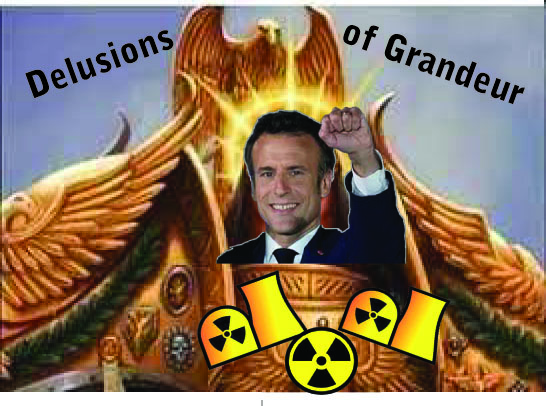
the main argument of this policy is “national energy independence”, moreover making a misleading shortcut from energy to electricity and from it nuclear power, an imaginary symbol of supposed independence.
Tuesday, May 30, 2023, by Bernard Laponche , Jean-Claude Zerbib, m https://www.global-chance.org/IMG/pdf/gc_la_triple_de_pendance_mai_2023_v2.pdf
Introduction
With 56 reactors spread over 18 EDF nuclear power plants, approximately 70% of electricity production in France is ensured by the use of nuclear energy, thanks to the production of heat by the combination of fission and chain reaction in reactors.
This situation makes France the most “nuclearized” country in the world in proportion to its population and the third in level of production after the United States and China, which are much more populous.
The program of reactors currently in operation (including the two Fessenheim reactors being dismantled) was launched in the early 1970s and reinforced by the “Messmer Program” of 1974, on the occasion of the first “oil shock”, inaugurating the “all-electric-all-nuclear” policy which continued until the construction of the Flamanville EPR in 2007, which has still not started.
The current government places itself in this line by advocating the extension of the duration of operation of the current reactors and the construction of a certain number of reactors of the EPR2 sector, heir to the EPR.
As at the time, and although times have changed, the main argument of this policy is “national energy independence”, moreover making a misleading shortcut from energy to electricity and from it nuclear power, an imaginary symbol of supposed independence. Let us admit, however, that the design and construction of the reactors are “national”, although much equipment is imported, the fact remains that the design is essentially that of the enriched uranium and pressurized water reactors of Westinghouse origin, and that the “francization” carried out at the beginning of the 1980s now raises a lot of questions, in particular with the discovery of cracks caused by corrosion under stress or thermal fatigue, which plague a certain number of reactors, including the most recent ones.
On the other hand, independence is far from being acquired on the side of the “nuclear fuel” which “boils the pot”. Indeed, natural uranium, the raw material for fission, has been completely imported for several decades. The suppliers are numerous but, among the main ones, Kazakhstan, Niger, Uzbekistan, Australia, Canada, three present geopolitical risks. But, we are told, since France has an enrichment plant, a reprocessing plant and fuel fabrication plants, we could rest easy.
The reality is much more complex.
On the other hand, independence is far from being acquired on the side of the “nuclear fuel” which “boils the pot”. Indeed, natural uranium, the raw material for fission, has been completely imported for several decades. The suppliers are numerous but, among the main ones, Kazakhstan, Niger, Uzbekistan, Australia, Canada, three present geopolitical risks. But, we are told, since France has an enrichment plant, a reprocessing plant and fuel fabrication plants, we could rest easy.
The reality is much more complex.
The purpose of this article is to assess:
- The tonnages of uranium which are delivered directly to France by the producing country, in the form of yellow cake and then undergo all the transformations, up to being put into the form of assemblies;
- The tonnages of natural uranium transiting through a third country, to arrive in France in the form of enriched uranium, gaseous or solid, or even fuel assemblies produced abroad;
- EDF’s depleted uranium enrichment operations in Russia;
- EDF and Orano’s reprocessing uranium enrichment operations in Russia.
- Manufacture of fuel assemblies, partly carried out abroad.
Thus will be established the triple dependence, total or partial, in the supply of natural uranium, in the enrichment of natural uranium, depleted uranium and reprocessed uranium and, in the manufacture of fuel assemblies.
This article is dedicated to the memory of André Guillemette, member of Global Chance and ACRO, expert in issues related to the reprocessing of irradiated fuels and the plutonium industry, author of several articles on these subjects, in particular in collaboration with Jean-Claude Zerbib, published on the Global Chance website ( www.global-chance.org ).
To read the full text https://www.global-chance.org/IMG/pdf/gc_la_triple_de_pendance_mai_2023_v2.pdf—
No comments yet.
1 This Month
Chernobyl: The Lost Tapes – A good documentary on Chernobyl on SBS available On Demand for the next 3 weeks– https://www.sbs.com.au/ondemand/tv-program/chernobyl-the-lost-tapes/2352741955560

of the week–London Campaign for Nuclear Disarmament

Tell the Ukrainian Government to Drop Prosecution of Peace Activist Yurii Sheliazhenko
To see nuclear-related stories in greater depth and intensity – go to https://nuclearinformation.wordpress.com
-
Archives
- April 2026 (139)
- March 2026 (251)
- February 2026 (268)
- January 2026 (308)
- December 2025 (358)
- November 2025 (359)
- October 2025 (376)
- September 2025 (257)
- August 2025 (319)
- July 2025 (230)
- June 2025 (348)
- May 2025 (261)
-
Categories
- 1
- 1 NUCLEAR ISSUES
- business and costs
- climate change
- culture and arts
- ENERGY
- environment
- health
- history
- indigenous issues
- Legal
- marketing of nuclear
- media
- opposition to nuclear
- PERSONAL STORIES
- politics
- politics international
- Religion and ethics
- safety
- secrets,lies and civil liberties
- spinbuster
- technology
- Uranium
- wastes
- weapons and war
- Women
- 2 WORLD
- ACTION
- AFRICA
- Atrocities
- AUSTRALIA
- Christina's notes
- Christina's themes
- culture and arts
- Events
- Fuk 2022
- Fuk 2023
- Fukushima 2017
- Fukushima 2018
- fukushima 2019
- Fukushima 2020
- Fukushima 2021
- general
- global warming
- Humour (God we need it)
- Nuclear
- RARE EARTHS
- Reference
- resources – print
- Resources -audiovicual
- Weekly Newsletter
- World
- World Nuclear
- YouTube
-
RSS
Entries RSS
Comments RSS
 nuclear-news
Leave a comment