The age of small modular nuclear?

the CEO of Rolls Royce described it as “a Lego kit of parts” for building a nuclear reactor. So it’s not actually an Small Modular Reactor , but why not call it one if you can tap government funding by pretending it is?
BY AGREENERLIFEAGREENERWORLD ON By Jeremy Williams
There was something of a non-sequitur from Britain’s Chancellor Jeremy Hunt recently. “We don’t want to see high bills like this again,” he said of the country’s current energy costs. “It’s time for a clean energy reset. That is why we are fully committing to nuclear power in the UK, backing a new generation of small modular reactors.”
If I was hoping to bring down energy bills, then nuclear isn’t the first place I’d look. The cost of Hinkley Point C, Britain’s first new nuclear power plant in decades, was originally priced at £16 billion. That made it the most expensive building in the world, and that was before costs began to spiral upwards. The latest estimate is that it will cost £32 billion. So it really doesn’t make much sense for Jeremy Hunt to be promising lower bills with nuclear power.
But maybe it’s not about megaprojects like Hinkley. Maybe, as Hunt suggests, the future lies in the much-vaunted Small Modular Reactors (SMRs). A number of agencies are looking for smaller reactors that can be standardised and therefore built quickly and cheaply – cheap being relative in the world of nuclear. It ought to be cheaper to install a chain of SMRs than to build one massive and bespoke power station.
The theory is that if they are small and they are modular, then SMRs would be closer to a manufactured product than a construction project. That would mean economies of scale, and potentially prompt the kind of decline in costs that we’ve seen in solar or in battery technologies.
But SMRs have been discussed for years. How close are we to seeing them as part of a low-carbon electricity grid?
Let’s start with who is working on the idea. A recent overview of the sector from the OECD includes this map of various projects. It’s not exhaustive, but it shows the major players.

Most of the action is in the US, with other projects in China, Britain, France, Russia and a handful of others. Some of these are private enterprises, particularly the American ones. Elsewhere a lot of the work is coming from state-owned nuclear companies such as EDF in France, or Argentina’s CNEA. Anyone who has invested in nuclear power and research in the past is likely to have an SMR project on a drawing board somewhere.
Is anyone actually building them? Sort of, but only China and Russia have working SMRs so far – a demonstration plant in China, and Russia’s pioneering floating nuclear power station, the Akademik Lomonosov. I wouldn’t consider either of those to be good examples of what SMRs are supposed to be, but they’re the ones that get mentioned. Construction on further plants is underway in both countries, along with Argentina. As the OECD notes, “there are currently no SMRs licensed to operate outside of China or Russia.” Everywhere else, SMRs are in various phases of research, design and planning.
This doesn’t tell us much about how long it’s going to take to bring SMRs into the energy mix. That’s because the big obstacle in nuclear power isn’t technology, but regulation. It’s incredibly difficult and slow to bring a new nuclear technology to market, and rightly so, given its dangers. Licensing a new nuclear design in the US takes five years and costs a billion dollars – and that’s before you even apply to build anything. That’s just to confirm that the design is safe.
Things move incredibly slowly in the nuclear world. The concepts for the European Pressurised Reactor that’s being built at Hinkley Point – and which is considered a new design, were being done in the mid-nineties. So of the long list of companies with concepts for SMRs, how many of those will ever get built, and in how many decades? From a climate change perspective, speed matters. We don’t want to accelerate nuclear power at the expense of safety, but at the moment it is going to take too long to bring any of these new reactors online.

Here in the UK, there is one firm that is synonymous with SMRs, and that’s Rolls Royce. Any article on the subject in the UK will mention Rolls Royce and often illustrate the article with a glossy picture of their proposed design – as I’ve done above. What’s odd about this is that Rolls Royce’s design isn’t a small modular reactor. It’s being called that because it’s a buzzword, but it’s 470Mw in capacity. That’s smaller than Hinkley Point C at 3,300Mw, but it’s a whole lot larger than what is generally called an SMR.
Neither does it use modular reactors to achieve its larger power output. What Rolls Royce is doing is using modular construction techniques to build a traditional reactor a bit quicker. On Michael Liebriech’s Cleaning Up podcast, the CEO of Rolls Royce described it as “a Lego kit of parts” for building a nuclear reactor. So it’s not actually an SMR, but why not call it one if you can tap government funding by pretending it is?
Looking at where we are at the moment, I expect there will be a new generation of smaller nuclear power stations at some point in the future. I expect China will do it first, and that the economies of scale will happen there. If it ever reaches the UK, it will be a few years away.
A more urgent question is whether or not a new generation of nuclear power will happen in time to make a difference to climate change. That looks far less certain.
First published in The Earthbound Report.
Preparing for War: The Global Military Budget

2022 proved to be a boon for militarists the world over
May 1, 2023: Dr Binoy Kampmark https://theaimn.com/preparing-for-war-the-global-military-budget/—
US$2.24 trillion is a mighty amount. It’s also a sickening figure when considering the object of this exercise. The flickering tease of war, the promise of bloodshed and an increasingly large butcher’s bill, are inevitable suggestions from such a figure. The scenes are also clear: well-paid suits dazed by theories of the next war; policy wonks jabbering over mock war games. A huge amount of money is being pushed into the venture, and the sceptics are being held at bay.
Much of this news comes from the Stockholm International Peace Research Institute’s latest findings that countries are spending 2.2% of the world’s gross domestic product on armaments. Of that amount, the United States, China and Russia accounted for 56% of the total. Global military spending, the SIPRI report also notes, grew by 19% over 2013-2022, rising every year since 2015.
The amount is slightly more than the previous year, when SIPRI announced that total military expenditure had risen by 0.7% in real terms in 2021 “to reach $2113 billion.” The largest contributors to the binge on that occasion were the United States, China, India, the United Kingdom and Russia. In sum, the five countries accounted for 62% of expenditure.
This reads differently from the more optimistic International Monetary Institute’s assessment from 2021: “Worldwide military spending, when estimated on the basis of unweighted country averages, has declined by nearly half, from 3.6 percent GDP during the Cold War period (1970-90) to 1.9 percent of GDP in the years following the global financial crisis.” When it comes to variations on the figures in this field, best stick with SIPRA.
2022 proved to be a boon for militarists the world over, though there were particular regions that saw more growth than others. In Europe, levels of spending had reached levels unseen since the Cold War, up from 13% from the previous twelve months. The reason commonly given: Russia’s invasion of Ukraine. In East Asia, the justification is the increasingly hostile US-Chinese rivalry, though those in Washington’s corner are ever pointing the finger to the Yellow Horde’s ambitions in Beijing.
The picture in Europe is an ugly one, with concerns being expressed in certain strategic circles that not enough is being done to move away from dependency on the US imperium. The European Council on Foreign Relations (ECFR) has even posited that Europe is the victim of US “vassalisation”, notably in light of the Ukraine War. Visions of strategic autonomy are more distant than ever.
Such sentiments, however, do little to discourage the militarists: whether Europe chooses to throw in its lot with Washington or not, the arms dealers and manufacturers will do a merry jig. To prove that point, the ECFR advocates the deployment of “western European forces to the east in greater numbers, offering to replace US forces in some cases.” The only difference here is the burden shared, rather than the amount spent.
In terms of individual countries, Finland’s military expenditure rose by 36% in 2022 to reach $4.8 billion, the largest in the country’s year-on-year increase since 1962. Polish military expenditure grew by 11%, reaching $16.6 billion over the course in 2022. The passage of the Homeland Defence Act, designed to reorganise the military and raise defence spending, promises to eventually push the levels to 4% of GDP. Warsaw has made no secret of the fact that it wishes to have the continent’s largest army, a daft and distinctly draining exercise.
The figures are also significant given the increasingly proxy nature of the Ukraine War’s balance sheet. Ukraine, for its part, rose from its position at 36 on the league of arms spenders to 11 in 2022, with a figure of $44 billion. But SIPRI has a modest confession to make: it is unable to furnish us “an accurate assessment of the total amount of financial military aid to Ukraine.” This is largely because the donor countries have, for the most part, not released disaggregated data. A rough estimate of $30 billion is provided, which “includes financial contributions, training and operational costs, replacement costs of the military equipment stocks donated to Ukraine and payments to procure additional military equipment for the Ukrainian armed forces.”
Some of this must be factored into the increased budgets of the UK (top European spender at 3.1%), with Germany and France coming in at 2.5% and 2.4% respectively. Of the three, the UK has given the most military aid to Ukraine, and is second only behind the United States, which allocated $19.9 billion.
As for the US itself, the Biden administration has already mooted the idea that it will increase the number of troops deployed to Europe by 20,000 personnel to 100,000. The measure is part of the European Deterrence Initiative (EDI), an effort to, according to the US Department of Defense, “enhance the US deterrence posture, increase the readiness and responsiveness of US forces in Europe, support the collective defense and security of NATO allies, and bolster the security and capacity of US allies and partners.”
While China, with a bill of $292 billion, is leant upon as an excuse for increased military expenditure by other powers, the United States remains the undisputed premier spender, making up a staggering 39% of the global total at $877 billion. Hardly the sort of figure to be sported by a peacemaker.
The Single Dumbest Thing The Empire Asks Us To Believe

Caitlin Johnstone https://caitlinjohnstone.substack.com/p/the-single-dumbest-thing-the-empire?utm_source=post-email-title&publication_id=82124&post_id=118488383&isFreemail=true&utm 1 May 23
The single dumbest thing the US-centralized empire asks us to believe is that the military encirclement of its top two geopolitical rivals is a defensive action, rather than an act of extreme aggression.
We’re asked to believe many extremely stupid narratives by the manipulators who rule over us, but I really think this one might take the cake. The idea that the US militarily encircling Russia and China is an act of defense rather than aggression is so in-your-face transparently idiotic that anyone who thinks critically enough about it will immediately dismiss it for the foam-brained nonsense that it is, yet it’s the mainstream narrative in the western world, and millions of people accept it as true. Because that’s the power of US propaganda.
It gets more and more absurd the more you think about it. Their argument is basically, “No no you don’t understand, the US has been hurriedly surrounding its primary geopolitical competitors with war machinery because it wants to prevent them from doing something aggressive.” They’re like, “We can’t just have nations exerting military aggression willy nilly, that’s why we needed to move all this war machinery to the other side of the planet onto the borders of our primary strategic rivals.”
Can you think of anything more insane than that? Than all of the most powerful and influential figures in politics, government and media simultaneously claiming that a nation amassing heavily-armed proxy forces on the borders of their enemies is something that should be regarded as an action designed to prevent aggression, rather than an incendiary act of extreme aggression in and of itself?
I recently had someone tell me that the US has every right to expand its immense military presence near China, and to illustrate their point they said that if China set up a base in Mexico the US would have no business telling them not to. But that argument actually illustrates my point, not theirs: only the most propaganda-addled of minds would believe that the US would allow China to set up a military base in Mexico for even one second. There’d be kinetic warfare long before the foundations were even poured.
What this undeniably means is that the US is the aggressor in these conflicts. It was the aggressor when it expanded NATO and began turning Ukraine into a de facto NATO member, and it is the aggressor as it accelerates its encirclement of China and prepares to open the floodgates of weapons into Taiwan. If it is doing things on the borders of its geopolitical rivals that it would never permit those rivals to do to it, then it is the aggressor, and anything its rivals do is a defensive response to those aggressions.
This is how the US-centralized empire always acts. It continually attacks, starves and menaces nations which disobey the decrees it issues in its self-appointed role as the leader of the so-called “rules-based international order”, then as soon as its aggressions receive the slightest bit of pushback its spinmeisters feign Bambi-eyed innocence and pretend they’re just passive witnesses to unprovoked aggression by the disobedient nations.
But the empire is not passive, it is not innocent, and it is primarily responsible for the extremely dangerous current and emerging conflicts we are seeing on the world stage. The US empire is imperiling us all with its last-ditch frantic scramble to secure unipolar planetary hegemony before multipolarity takes over, engaging in freakishly aggressive actions on the borders of the nuclear-armed nations who challenge its power.
And I just think that’s worth reiterating from time to time. If we don’t keep reminding ourselves what’s true, these bastards will drive us all nuts.
UK courts Bahrain and the United Arab Emirates for investments to salvage the nuclear dream
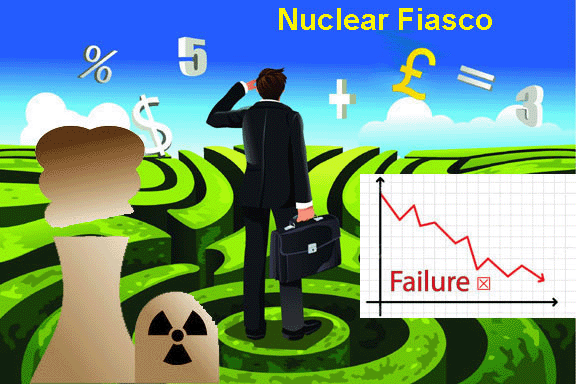
Gulf states poised to bail Britain out of energy crisis
Bahrain and the UAE courted by energy secretary Grant Shapps for fresh nuclear investment
By Rachel Millard, 30 April 2023
Gulf states are poised to help bankroll Britain’s efforts to build new
nuclear power stations to keep the lights on, the energy security secretary
has indicated. Grant Shapps visited the region in January and said he
remains “in constant contact” with investors in the region who are
“very interested” in the nuclear sector. Countries such as the UAE and
Bahrain have built up vast sovereign wealth funds which are now pushing
into clean energy amid global efforts to cut fossil fuel use.
Jeremy Hunt, the chancellor, met with the UAE’s Mubadala, a sovereign investment firm,
in February, and has abandoned plans to toughen tax rules for sovereign
wealth funds. Mr Shapps said: “I was in the Gulf states [this year] and
I’m in constant contact with our friends and colleagues over there. “They
have already been investing massive amounts in renewable energy – and
they’re very interested in nuclear power as well. The scale of their
ambitions are pretty big – watch this space.”
Ministers are trying to drum up investment for EDF’s planned £20bn power plant in Suffolk as well as other nuclear projects as part of a push on the carbon-free [?] power
source. Legal & General, Britain’s biggest money manager with £1.3 trillion
of assets, has said it is focused on supporting other “viable, and
cost-effective” {?] clean [?] energy solutions.
French state energy giant EDF
owns Britain’s nuclear fleet but will need outside investors to build its
planned Sizewell C project in Suffolk. The Government and EDF have pushed
China’s CGN out of the project amid concern about China’s involvement in
critical national infrastructure.
Telegraph 30th April 2023
Zaporizhzhya Nuclear Power Plant: a Catastrophe Waiting to Happen
BY CAROL WOLMAN CounterPunch 1 May 23
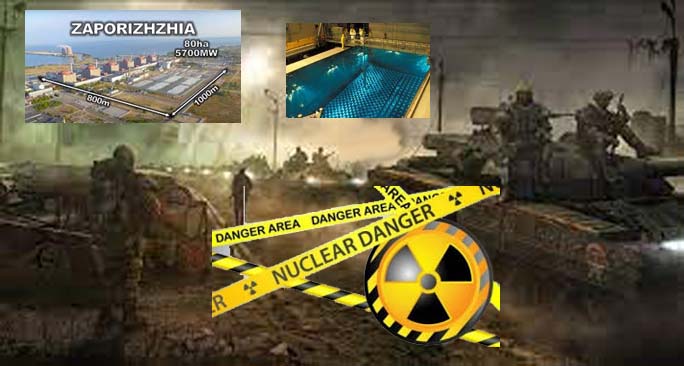
A meltdown at Zaporizhzhya Nuclear Power Plant grows more likely with every passing day. With a meltdown, radioactive water from the plant would flow into the Dnieper River, which empties into the Black Sea, and thence to the Mediterranean. See below for map. The consequences would be catastrophic for Europe, North Africa, and the Middle East. Clearly this is an international problem. It calls out for an international solution.
Perhaps it is time to send in UN Peacekeeping Forces.
ZNPP has been at risk for a Fukushima-type meltdown since the Russians occupied the plant in March 2022. It sits on the front line of the war, the south side of the Dnieper River. The Russians quickly occupied the south side early in their invasion; the Ukrainians still occupy the north side.
The International Atomic Energy Agency was able to establish a presence at ZNPP after months of lobbying by its Director- General Mariano Grossi. He has personally visited twice and gets daily updates from the IAEA personnel on site. His latest report can be found here.
Grossi has been trying for almost a year to negotiate a safety zone around ZNPP. After his visit to the plant on 3/29/23, Grossi stressed that the increasing combat makes it urgent to find a way to prevent a potentially catastrophic nuclear accident.
He complains that he is not getting support from the UN, and even from his own agency. The EU issued a statement a few months ago but is not keeping the pressure on. Given the potential for catastrophe, it is astounding that more attention is not being given to the need to support Grossi’s efforts.
Instead, the media publishes reassuring articles about how many safety features ZNPP has.
Safety features are useless if the cooling water stops circulating around the nuclear material. The reactors have been shut down, so the pumps need an external power source.
The main power lines cross the Dnieper to the Ukraine energy grid on the north side of the river. The back up lines connect to conventionally fired plants in Ukrainian territory. They are right on the front line, and mortar fire from either side can cut them.
Since the invasion, all the external power lines to the plant- 4 major lines and 2-4 backup lines- have been cut simultaneously at least SIX times, forcing the pumps to rely on emergency diesel generators. As Grossi says ““Each time we are rolling a dice…And if we allow this to continue time after time, then one day our luck will run out.”
Without the constant circulation of cooling water, the nuclear fuel would overheat, resulting in a chain reaction and meltdown. This is what happened at Fukushima Daiichi 1:
; the earthquake and tsunami cut off the power and the pumps stopped working. A huge discharge of radioactive water into the vast Pacific Ocean continued for several years, until an ice wall was built around the damaged reactors.
Within three years after the Fukushima disaster, there were massive die-offs throughout the Pacific. Mollusks in particular suffered, and the result went up the food chain, so that sea mammals were starving and mutated. The sea bird population was decimated.
A meltdown at ZNPP would release large amounts of radioactive water into a much smaller body of water than the Pacific Ocean. The Dnieper River empties into the Black Sea and eventually into the Mediterranean. All the countries which border the Mediterranean would be affected. The consequences are unthinkable.
The circulation of cooling water could fail for another reason. It cycles through a holding pond nearby. Because of the constant influx of warm water from the reactors, still hot even in shutdown mode, the pond is prone to algae growth, which could clog the intake valves and stop the water flow. It is stocked with tropical fish, which eat the algae and keep the water clear.
The cooling pond is at risk. Global warming may cause the pond to overheat this summer, killing the scavenging fish…………………………………………………
Clearly this is an international problem. The danger of a meltdown at ZNPP is real; the consequences would be catastrophic for Europe, North Africa, and the Middle East…………………………………………………………….. https://www.counterpunch.org/2023/05/01/znpp-a-catastrophe-waiting-to-happen/
Is nuclear power attractive or risky? In Minnesota, it’s both.
Christian Science Monitor, By Colette Davidson Special correspondent @kolet_ink May 1, 2023|MONTICELLO, MINN.
At a clearing in the brush, a clunky wooden dock is still pulled onshore for the season amid piles of dirty snow. Usually, this boat landing at the Montissippi Regional Park is a popular spot for amateurs to fish bass and walleye from the Mississippi River.
But after the Xcel Energy nuclear plant – just half a mile away – announced in March that radioactive material had leaked twice from a faulty pipe since November, some locals say they’re worried about what’s in the water. ……………………….
The Minnesota Pollution Control Agency and Minnesota Department of Health say the risks to the public from the leaks of water contaminated with tritium – totaling a little more than 400,000 gallons – are minimal and have not affected public drinking water. Xcel Energy powered down its Monticello plant in mid-March for maintenance, once the second leak had been discovered.
That has done little to assuage the fears of local residents, however, who say the utility company should have notified the public earlier about the leak.
…………………………….. a renewed push for nuclear energy, even among former skeptics. Yet building public trust remains a key challenge, in Minnesota and across the nation – particularly in the wake of incidents like the one in Monticello.
………………………………………………..
Reliance, but also restrictions
The U.S. gets approximately 19% of its electricity from nuclear power, according to the Energy Information Administration. While states need to go through the federal Nuclear Regulatory Commission (NRC) for licensing approval, much of the challenge of building nuclear energy plants or considering new nuclear technologies is getting past state legislation.
Minnesota – which gets 24% of its electricity from two nuclear power plants – is one of 12 states that currently have a moratorium on the construction of new nuclear power facilities. That has led proponents here to focus their efforts instead on the latest technologies, like small modular reactors………..
…………… in the past five years, more Minnesota Democrats have come around to the idea of nuclear energy – an issue that once split along party lines.
This mirrors a wider national trend. In 2023 alone, there have been close to 100 bills across 20 states to repeal moratoriums or study nuclear energy, according to the Nuclear Innovation Alliance, based in Washington, D.C. The U.S. Department of Energy recently invested nearly $2 billion in TerraPower’s construction of a nuclear reactor in Kemmerer, Wyoming, to replace a retiring coal plant. And John Kerry, the special presidential envoy for climate, has openly supported nuclear energy….
Evolving concerns on safety
That’s not to say there aren’t concerns about nuclear from within the climate advocacy community. With the exception of the Vogtle plant in Burke County, Georgia – which boasts next-generation technology – the U.S. reactor fleet is of the same or similar generation as the one involved in Japan’s Fukushima disaster in 2011.
“Whether they’re identical in design or not, they all have the same level of vulnerability,” says Edwin Lyman, a physicist and the director of nuclear power safety at the Union of Concerned Scientists, a national watchdog. …………………………..
Dr. Lyman says the Biden administration, in its enthusiasm to tackle carbon emissions and roll out new nuclear plants, must be careful not to forgo needed safety rules. That becomes even more essential as climate change brings higher winds and flooding, the biggest risks for a reactor short-circuit. Nuclear operators have also struggled with how to store waste long term. New waste is stored in pools before being transferred to dry casks, which can take up land space indefinitely.
Mixed feelings by the Mississippi
The public seems to be on board with putting more time and research into nuclear energy. According to an April Gallup poll, 55% of Americans support nuclear energy, the highest level in a decade.
But for those living near nuclear plants, there are still concerns about safety and security – from the quality of groundwater to the threat of domestic terrorism. Out on the trail at Montissippi Regional Park in Monticello, locals joke that their tomatoes are extra large thanks to their proximity to the Xcel plant. Others say they’ve been drinking bottled water since the leak.
“When those Chinese surveillance balloons flew overhead [in February], I did wonder, would the nuclear plant be a target?” says Betty, out for a walk with her husband Jack. Betty used to work for the city of Monticello and did not want to identify herself by her full name.
While the immediate risks may be small, she says she and her husband “live in the shadow of the nuclear plant,” which is a half mile from their house. Every year, Xcel Energy distributes a free calendar, which includes evacuation information in the event of disaster. …………………………… https://www.csmonitor.com/Environment/2023/0501/Is-nuclear-power-attractive-or-risky-In-Minnesota-it-s-both
Kim Jong Un’s influential sister says North Korea determined to develop nuclear arsenal following US-South Korea summit
ABC News 1 May 23
The powerful sister of North Korea’s leader says her country will stage more provocative displays of its military might in response to a new US-South Korean agreement to intensify nuclear deterrence on the Korean Peninsula.
Key points:
- Kim Yo Jong, sister of Kim Jong Un, is a top foreign policy official for the regime
- She says the new US-South Korea agreement only strengthens the North’s resolve to develop nuclear arsenal
- North Korea’s nuclear deterrence doctrine emphasise pre-emptive strike capabilities
According to Kim Yo Jong, the new agreement between Washington and Seoul to counter North Korea’s nuclear threat shows their “extreme” hostility toward Pyongyang………………………………………………………………………..
North Korean leader Kim Jong Un is widely expected to up the ante in coming weeks or months as he continues to accelerate a campaign aimed at cementing the North’s status as a nuclear power and eventually negotiating US economic and security concessions from a position of strength. https://www.abc.net.au/news/2023-05-01/north-korea-rebukes-us-south-korea-summit-/102285574
Libya lost, then found, 2.5 tonnes of uranium – a red flag for nuclear safety

The Conversation Olamide Samuel.Track II Diplomat and Expert in Nuclear Politics, University of Leicester 1 May 23
Earlier this year the International Atomic Energy Agency Director General Rafael Grossi reported that about 2.5 tonnes of uranium ore concentrate had gone missing from a site in Libya. This was arguably one of the largest quantity of uranium ore concentrate that had ever been misplaced.
Barely a day after the IAEA’s announcement, General Khaled Mahjoub of the self-styled Libyan National Army said the uranium ore had been found about 5km from the warehouse where it had been stored. A week later, the IAEA, which had been monitoring the stockpile occasionally, confirmed that most of the uranium ore concentrate had been found.
Uranium ore concentrate, popularly known as ‘yellowcake’, is a type of uranium concentrate powder obtained after uranium ore has been milled and chemically processed. Yellowcake has very low radioactivity, equivalent to the radioactivity of uranium ore found in nature, and it is produced by all countries where uranium ore is mined.
Yellow cake is further processed to become enriched uranium, which is used to manufacture the fuel for nuclear reactors. However, enriched uranium can also be used to manufacture nuclear weapons. If the technology were available, the 2.5 tons of missing yellowcake would have been half the amount required for a nuclear bomb.
Nuclear material experts had said the Libyan uranium ore concentrate in case posed “no significant security risk” as it required prohibitively sophisticated processing capabilities before it can be suitable for civil or weapons use.
Nevertheless, the news of missing Libyan uranium ore concentrate did highlight serious problems with the national and global governance structures for managing uranium.
Based on my experience in nuclear non-proliferation and politics, I believe that the missing Libyan uranium debacle illustrates two things.
Firstly, it illustrates the dangers of a IAEA that doesn’t have enough resources to monitor uranium ore stockpiles, especially in countries with unstable regimes. And faced with more pressing issues such as the safety and security of nuclear power plants in Ukraine, the IAEA won’t prioritise yellowcake storage.
Secondly, many African countries still struggle to implement nuclear safety and security governance provisions.
A regional destabiliser
Libya has been unstable since the fall of Muammar Gaddafi’s regime in 2011. This plunged the country into a civil war that has destabilised the North African and the Sahel regions, as Libya lost control of the largest and most diverse military arsenals in the region.
Much of this arsenal eventually fell into the hands of various non-state actors. Among them were Boko-Haram which mounted a reign of terror in northern Nigeria, and Ansar Al-Sharia in Tunisia.
Gaddafi had amassed stockpiles of nuclear material and technology as he sought to develop nuclear weapons. He had help from Abdul Qadeer Khan, who had been identified as a key facilitator for the global smuggling of nuclear material and technology.
Gaddafi eventually abandoned the weapons program in 2003, after months of secret disarmament negotiations with the US and British.
Following this deal, the US airlifted about 25 metric tonnes of Libya’s nuclear weapon programme components and documents. The last of Libya’s enriched uranium was removed in 2009. But there remained in Sabha, the southern Libyan city, about 6400 barrels of uranium ore concentrate. It’s this material that was under the control of an army battalion.
Olli Heinonen, a former Deputy Director of the IAEA, has since explained that it would have been very costly to airlift the remaining concentrate. He also said there were incentives for Libyans to holding onto the concentrate until the spot price of uranium was high enough for profitable export.
More questions than answers
Though the missing 2.5 tonnes of uranium have been recovered, questions remain: Why did 2.5 tonnes go missing in the first place? Who would have wanted to acquire it?
…………………………….. more https://theconversation.com/libya-lost-then-found-2-5-tonnes-of-uranium-a-red-flag-for-nuclear-safety-203775
ACTION ALERT: False NYT Spy Claim on Iran Nukes Needs Correction
JIM NAURECKAS, https://fair.org/home/action-alert-false-nyt-spy-claim-on-iran-nukes-needs-correction/ 1 May 23
The New York Times (5/1/23), reporting on Iran’s execution of British spy Alireza Akbari, reported:
The spy had provided valuable information — and would continue to do so for years — intelligence that would prove critical in eliminating any doubt in Western capitals that Iran was pursuing nuclear weapons.
This is not correct; as FAIR has often pointed out (FAIR.org, 10/17/17, 9/9/15, 9/24/13; 1/31/13; Extra!, 3–4/08), the position of US intelligence is that it has no proof Iran has decided to build a nuclear weapon. As the US State Department reiterated in April 2022:
The United States continues to assess that Iran is not currently undertaking the key nuclear weapons–development activities it judge necessary to produce a nuclear device.
This is a serious error that deserves prompt correction.
ACTION:
Please tell the New York Times to correct its false claim that there is no doubt that Iran is pursuing nuclear weapons.
CONTACT:
Letters: letters@nytimes.com
REGAN Vest: Inside Denmark’s secret nuclear bunker
BBC 1 May 23,
A top-secret atomic bunker has opened to the public in Denmark. Built to withstand a nuclear attack, it’s now an astonishing subterranean museum that sheds light on Cold War paranoia.
Hidden in northern Jutland’s Rold Forest, some 400km north-west of Copenhagen, is the sprawling bunker complex of Koldrigsmuseet REGAN Vest (The Cold War Museum REGAN West). Secretly built in the 1960s at the height of Cold War tensions, this is where the Danish government and even the queen would have been evacuated if nuclear war broke out.
The plan was to run the country from inside this shelter, 60m below ground, and its very existence was kept hushed for decades until it was finally revealed in 2012. After years of preparations, it opened to the public for the first time in February 2023 as a museum. Only 50,000 visitors are permitted annually, and access has been limited to small groups of 10 on 90-minute guided tours that explore 2km of the labyrinthine bunker system. It’s an eye-opening journey into the heart of a Cold War-era time capsule…………………………………………………………………………………………………………………..
The resulting nuclear-proof bunker was a staggering 5,500sq m behemoth, shaped like two large, connected rings, each with an upper and lower floor, and more than 230 rooms that would house around 350 personnel. Mostly these would be ministers and civil servants, part of a slimmed down administration tasked with running the nation’s affairs during the darkest of times, plus a few medical staff, several journalists and a priest……………………………………………. more https://www.bbc.com/travel/article/20230501-regan-vest-inside-denmarks-secret-nuclear-bunker
May 1 Energy News — geoharvey

Opinion: ¶ “BYD Seagull And The Promise Of The EV Revolution” • Up until now, almost all electric cars were either luxury models or minuscule. The BYD Seagull is a 4-passenger hatchback that is slightly larger than a Fiat 500 and a little shorter than a MINI Cooper. But the most astonishing news is that […]
May 1 Energy News — geoharvey
UK underlines commitment to NATO nuclear capability and a £3 billion funding uplift for the nuclear enterprise
UKDJ, By Tom Dunlop 1 May 23
Defence Minister Baroness Goldie recently hosted members of the North Atlantic Council and NATO Military Committee at His Majesty’s Naval Base (HMNB) Clyde, emphasising the UK’s commitment to NATO’s nuclear deterrence.
This comes as the UK government announced a £3 billion funding uplift for the nuclear enterprise in the Spring Budget.
………………………….. Defence Secretary Ben Wallace commented, “We have declared our nuclear deterrent to the defence of NATO for over 60 years, and our commitment to the security of the NATO Alliance is absolute. The UK’s round-the-clock nuclear deterrent is more crucial than ever, as the ultimate guarantee of our collective security.” https://ukdefencejournal.org.uk/uk-underlines-commitment-to-nato-nuclear-capability/
Ukraine signs new contracts with Turkish drone manufacturer for “new-generation weapons” — Anti-bellum
AzertagApril 30, 2023 Ukraine signed new contracts with “Baykar” company New cooperation agreements have been signed between Ukraine and Turkey’s famous “Baykar” drone company “Baykar”. [T]he Minister of Strategic Industries of Ukraine, Alexander Kamishin, announced this on his Telegram page. “I had many meetings at the international aviation equipment exhibition TEKNOFEST 2023 in Turkey. These […]
Ukraine signs new contracts with Turkish drone manufacturer for “new-generation weapons” — Anti-bellum
G-7 Expected to Focus on Nuclear Dangers in Hiroshima
Arms Control Association, May 2023, By Daryl G. Kimball
The leaders of the Group of Seven (G-7) industrialized nations, who will convene this month in Hiroshima, the city destroyed in 1945 by the world’s first nuclear attack, are expected to emphasize measures to address rising nuclear dangers.
Japanese Prime Minister Fumio Kishida, who will preside over the summit, chose Hiroshima as the venue “to deepen discussions so that we can release a strong message toward realizing a world free of nuclear weapons.” In response to concerns that Russia might use nuclear weapons in its war in Ukraine, Kishida also said on Jan. 9 that the G-7 needs to “demonstrate a firm commitment to absolutely reject the threat or use of nuclear weapons.”
………………………. According to The Japan Times, the Japanese government is arranging for a meeting between the G-7 leaders and some of the remaining hibakusha, the survivors of the atomic bomb attacks, during a visit to the peace museum on May 19.
………………… Kishida also met representatives from the “Civil 7” group of nongovernmental organizations from 72 countries on April 13 to hear their recommendations on how the G-7 leaders could advance progress on nuclear risk reduction and nuclear disarmament. Among other measures, the civil society group recommended that G-7 leaders meet atomic bombing survivors, unequivocally condemn threats to use nuclear weapons, and endorse urgent negotiations to achieve the complete elimination of nuclear weapons before 2045……………….
https://www.armscontrol.org/act/2023-05/news/g-7-expected-focus-nuclear-dangers-hiroshima
—
Another nuclear war-mongering week in the news

A bit of good news. The Golden Rule, the first boat to protest nuclear weapons is back to inspire a new generation.
Events. 17 May Online Seminar – Beyond Nuclear “Tritium and the U.S. Nuclear Power Sector”. 18 – 28 May .12TH INTERNATIONAL URANIUM FILM FESTIVAL RIO DE JANEIRO .
Climate. The most at-risk regions in the world for high-impact heatwaves.
Nuclear. What can I say? The longest section below “Weapons and Weapons Sales” says it all. It’s the war-mongering economy, stupid.
Christina notes. Australia’s Defence Minister Richard Marles – a puppet of the American war industry – leading us on to WW3.
CLIMATE. Despite the dangers of climate change, UK nuclear power stations still sited on the coastline!
ECONOMICS. Preparing for War: The Global Military Budget. Nuclear vs Solar: The Race For Renewable Dominance. Marketing. UK courts Bahrain and the United Arab Emirates for investments to salvage the nuclear dream
ENERGY. EDF Q1 revenues rise but nuclear output declines.
ENVIRONMENT. Remembering Chornobyl — Beyond Nuclear. Why did Russians dig trenches in radioactive Chernobyl woods? Marine deaths prompt calls for investigation and halt into any new nuclear dump tests. Hinkley fish deterrent farce makes mockery of Environment Agency and Minister.
HEALTH. Russian troops ‘went FISHING in the nuclear reactor cooling channel at Chernobyl’ and are now suffering from radiation sickness. ‘New Zealand should say sorry’ – sailors posted to watch nuclear tests.
HISTORY. REGAN Vest: Inside Denmark’s secret nuclear bunker.
MEDIA. BBC launches 7 part series on Fukushima nuclear disaster. Fukushima nuclear disaster – new Netflix series https://www.youtube.com/watch?v=EtB8P59xWjw Survivors of Britain’s Cold War radiation experiments to have their stories recorded.
NUCLEAR TECHNOLOGY. The age of small modular nuclear? Amid maintenance delays and strikes in nuclear industry, France restarts one reactor.
OPPOSITION to NUCLEAR. MPs and activists push back as Ottawa pitches expansion of nuclear energy -“a dirty dangerous distraction”. Citizen opposition blocks discharge of radioactive water from Indian Point nuke into Hudson River, for now. Anti nuclear campaign groups in Wales (Dwyfor and Meirionnydd) urge government to invest in energy conservation, NOT dirty nuclear power.
PERSONAL STORIES. The mind of Oppenheimer, inventor of nuclear bomb who turned pacifist. Chernobyl: Survivors reflect on nuclear accident, Russian occupation.
POLITICS.
- . New Defence Review Further Enslaves Australia To US War Agendas. Australia pays former US defence chiefs $7000 a day for advice. Australia being seduced into war again by the US, this time over Taiwan.
- Biden’s team fears the aftermath of a failed Ukrainian counteroffensive. Scott Ritter: ‘Ukraine Victory Resolution’ Act – a Delusional Suicide Pact.
- US Senators and Congress Members introduce Bill to stop A1 from power to launch a nuclear weapon. Lawmakers propose banning AI from singlehandedly launching nuclear weapons.
- Canada’s push for small nuclear reactors will be costly, ineffective, some MPs warn. New nuclear tech not the answer to Canada’s climate woes, MPs say.
POLITICS INTERNATIONAL and DIPLOMACY.
- Biden and South Korea’s Yoon sign new agreement on nuclear weapons.
- France to participate in Russian Rosatom’s Hungary nuclear power plant project. Will The EU Sanction Russia’s Nuclear Industry? (I don’t think France will agree to this)
- Pentagon-EU-NATO merger proceeds apace. New pact mandates EU honor NATO’s Article 5 collective war clause .
- Statement by the G7 Parliamentarian Forum for the Elimination of Nuclear Weapons. G-7 Expected to Focus on Nuclear Dangers in Hiroshima.
PROTESTS.“We won’t be scapegoats!” — French opposition to nuclear waste dumping.
PUBLIC OPINION. Is nuclear power attractive or risky? In Minnesota, it’s both.
SAFETY Remembering Chernobyl as nuclear danger grows with attacks in the Zaporizhzhia region. Zaporizhzhya Nuclear Power Plant: a Catastrophe Waiting to Happen, Ukraine’s nuclear power plants are still a source of nightmares years after the Chornobyl disaster. Chernobyl anniversary offers a bleak look at what may await other Ukrainian nuclear plants. Russia fixing power line from Zaporizhzhia nuclear plant to land it controls, IAEA says.
Japanese authorities doubtful of removal process of Fukushima radioactive sandbags. Libya lost, then found, 2.5 tonnes of uranium – a red flag for nuclear safety. No change to nuclear transport rules following accident down under, says regulator.
SECRETS and LIES.
- Foiled Escape: UC Global, the CIA and Julian Assange.
- ‘Crazy’ that Russia and Ukraine still trade – Seymour Hersh.https://www.youtube.com/watch?v=M_2kfZKtSRg
- Once Shocking, U.S. Spying on Its Allies Draws a Global Shrug.
- How The FBI Helps Ukrainian Intelligence Hunt ‘Disinformation’ On Social Media.
- Sensitive files on nuclear submarine found in English pub restroom.
- ACTION ALERT: False NYT Spy Claim on Iran Nukes Needs Correction.
- Australia Pays “retired U.S. military figure” Clapper to advance USA’s Military Aims
SPACE. EXPLORATION, WEAPONS. India needs ‘space-based’ weapons – top generals. Stop SpaceX from crashing rockets in the Pacific. The wrong stuff – Musk and the 4/20 rocket drill .
SPINBUSTER. Caitlin Johnstone – The Single Dumbest Thing The Empire Asks Us To Believe.
WASTES. Nuclear waste from small modular reactors – Simon Daigle comments on recent article. A means to dispose of nuclear waste remains elusive and Canada continues to store the most per capita. The long and dirty legacy of nuclear power. Plans to release nuclear wastewater into Hudson River delayed following outcry.
WAR and CONFLICT.
- Daniel Ellsberg Warns Risk of Nuclear War Is Rising as Tension Mounts over Ukraine & Taiwan. https://www.youtube.com/watch?v=0RAxEnqZt3w
- US deployed Nuclear Disablement Teams to S. Korea in March.
- Russia is preparing to defend Zaporizhzhia nuclear power plant.
- NATO drills fifth-generation warplanes for all-domain “immediate response under Article 5”.
- Germany trains Ukrainian special forces, tank crews for attacks on Russian forces.
- Estonia: NATO absorbs national forces on Russia’s northwest border .
- Sardinia: NATO strike force practices war with Russia .
- Mombasa Appeal for peace and prevention of Nuclear War – International Physicians for the Prevention of Nuclear War.
WEAPONS and WEAPONS SALES.
- UK replacing its Nuclear Warhead Programme – at what cost? UK underlines commitment to NATO nuclear capability and a £3 billion funding uplift for the nuclear enterprise. UK Gave Ukraine Thousands of Shells, Including Depleted Uranium Rounds.
- Will the West turn Ukraine into a nuclear battlefield?
- US nuclear weapons modernization plan spurs cost questions. Dealing with a debacle: A better plan for US plutonium pit production.
- US to send nuclear-armed submarines to South Korea. Kim Jong Un’s influential sister says North Korea determined to develop nuclear arsenal following US-South Korea summit.
- Pentagon: Poland leader among NATO nations, “wonderful host” to U.S. combat forces .
- Largest short-range missile acquisition in NATO: UK to deliver more missile batteries to Poland .
- NATO conference pushes arms procurements for Ukraine, future wars .
- NATO allies, partners provide Ukraine with 1,550 armored vehicles, 230 tanks .
- Ukraine signs new contracts with Turkish drone manufacturer for “new-generation weapons” .
- France: NATO’s rehearsal for war with Russia includes cyber, space, electromagnetic components .
- Nuclear weapons: a big threat to Africa, too — IPPNW peace and health blog.
1 This Month
23-25 October – on Zoom – World BEYOND War’s annual global conferenc


Shut down the radiation-damaged Heysham nuclear reactors now
To see nuclear-related stories in greater depth and intensity – go to https://nuclearinformation.wordpress.com

Say No to NASA’s Reckless Nuclear Reactor on the Moon
Say No to NASA’s Reckless Nuclear Reactor on the Moon

-
Archives
- October 2026 (199)
- September 2026 (339)
- August 2026 (330)
- July 2026 (355)
- June 2026 (287)
- May 2026 (306)
- April 2026 (356)
- March 2026 (251)
- February 2026 (267)
- January 2026 (308)
- December 2025 (358)
- November 2025 (359)
-
Categories
- 1
- 1 NUCLEAR ISSUES
- business and costs
- climate change
- culture and arts
- ENERGY
- environment
- health
- history
- indigenous issues
- Legal
- marketing of nuclear
- media
- opposition to nuclear
- PERSONAL STORIES
- politics
- politics international
- Religion and ethics
- safety
- secrets,lies and civil liberties
- spinbuster
- technology
- Uranium
- wastes
- weapons and war
- Women
- 2 WORLD
- ACTION
- AFRICA
- Atrocities
- AUSTRALIA
- Christina's notes
- Christina's themes
- culture and arts
- Events
- Fuk 2022
- Fuk 2023
- Fukushima 2017
- Fukushima 2018
- fukushima 2019
- Fukushima 2020
- Fukushima 2021
- general
- global warming
- Humour (God we need it)
- Nuclear
- RARE EARTHS
- Reference
- resources – print
- Resources -audiovicual
- Weekly Newsletter
- World
- World Nuclear
- YouTube
-
RSS
Entries RSS
Comments RSS

