UK government to take 50% stake in Sizewell C nuclear project, amid legal challenge, soaring costs, and pension funds pulling out.
No2 Nuclear Power SAFE ENERGY E-JOURNAL No.97, April 2023
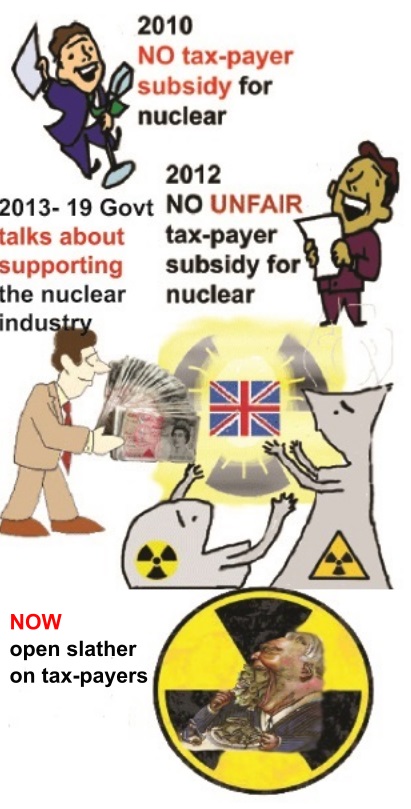
In December, the Government announced, yet again, that Sizewell C will go ahead, and that it would invest nearly £700m to end China’s controversial involvement. Ministers said the move would mean the UK Government taking a 50% stake in the project’s development. (1) However, the announcement was no more than the long-anticipated buying out of China General Nuclear from the project and funds to allow the development of the project to the point of a Final Investment Decision (FID). (2) Business Secretary Grant Shapps has refused to provide a figure for the cost of buying out China’s stake.
It reaffirmed its commitment again at the launch of the ‘Powering Up Britain’ strategy. It says it will bring Sizewell C to the point of a final investment decision this year. In his spring budget announced earlier this month, chancellor Jeremy Hunt confirmed the Government would be investing £700million in Sizewell C. (3)
Campaigners launched a legal challenge against Sizewell C in the High Court on Wednesday 22nd and Thursday 23rd March. (4) Together Against Sizewell C argues that the environmental impacts of securing a permanent water supply of two million litres per day were never assessed. As a result, the government cannot guarantee the date the nuclear plant will open, which means it has no way of knowing for sure that the plant’s contribution to climate change is enough to override the environmental harm it will cause. TASC also says no alternatives to nuclear power, including renewables, were considered when the Secretary of State for Energy, then Kwasi Kwarteng, gave the go ahead. He rejected the recommendation of the Examining Authority which ruled in February 2022 that unless the outstanding water supply strategy could be resolved and sufficient information provided to enable the Secretary of State to carry out his obligations under the Habitats Regulations, there was no case for a development consent order. The result of the hearing should be known between the 23rd April and the 7th May.
Sizewell Funding Efforts to attract investment into Sizewell C have taken a setback after two of the UK’s biggest pension funds turned their backs on the project. The BT Pension Scheme and NatWest – have told campaign group Stop Sizewell C and the Daily Mail they do not intend to back the project. (5) However, the UAE’s wealth fund – Mubadala – may invest. (6)
With Hinkley Point C now forecast to cost £33 billion and Sizewell C as much as £30 billion, Grant Shapps insists “private sector capital and investment” will ride to the rescue. He points to the Middle East. “I was recently in the Gulf states and was really struck by the money available for investment,” he says. “What they want to know is that we’ve got a platform, Great British Nuclear, and that we’re up for it — we’ve got the technology.” (7)
The Flamanville EPR is another six months late and 500 million euros more expensive. (8) Regular electricity production at Finland’s new Olkiluoto 3 nuclear reactor has been postponed again to 29th March. (9) Nuclear Engineering International summarises where the world’s EPRs have got to. (10) https://www.no2nuclearpower.org.uk/wp/wp-content/uploads/2023/04/SafeEnergy_No97.pdf
UK government’s proposals on radioactive substances : -all of its 7 “consultation questions” should be vigourously opposed.

Nuclear Waste Consultation, No2 Nuclear Power SAFE ENERGY E-JOURNAL No.97, April 2023
The UK and devolved governments have launched a consultation on proposals to update and consolidate policies on managing radioactive substances and nuclear decommissioning into a single UK-wide policy framework. (1) The new document will basically replace existing policy which dates back to a 1995 document commonly known as Command 2919. The proposals focus on 3 areas: managing solid radioactive waste; updating the policy for nuclear decommissioning; managing nuclear materials and spent nuclear fuel. Proposals include leaving lower-level waste behind on decommissioned sites; disposing intermediate level waste in near surface facilities and, most shockingly, reintroducing reprocessing.
In a draft response, I argue that the consultation has its priorities the wrong way round. In Part 1 there is far more emphasis placed on cost-effectiveness and removing burdens from industry, whereas protecting public health appears to be relegated to a second-class objective. Even here the emphasis is on meeting safety and environmental regulations rather than maximising public health protection, with no recognition of the uncertainties involved in radiation protection.
There needs to be a new emphasis on openness, transparency and public consultation as plans for decommissioning and waste management are developed, so that the public is fully aware of the intended destination of each waste stream, radioactive discharges expected from each proposed method of waste management and the dose implications of each proposed action. The public should also be given access to independent advice.
The document says: Government “must strive to keep the creation of radioactive waste to a minimum,” which given that the latest UK Energy Security Strategy proposes increasing the target for new nuclear power stations from 16GW to 24GW is nothing short of misleading.
The proposals would embed the so-called Nuclear Waste Hierarchy into Government Policy. In our view the Hierarchy promotes methods of radioactive waste management which are basically ways of diluting and dispersing radioactive waste around the environment, ultimately discharging radioactive substances into our estuaries, seas and atmosphere whilst masquerading as the environmentally friendly sounding ‘waste hierarchy’. Diverting increasing quantities of radioactive waste to landfill, metal recycling and incineration plants is a policy of dilute and disperse rather than one of concentrate and contain. This is ‘waste management on the cheap’. Waste management techniques should be based on environmental principles, particularly the principle that hazardous waste should be concentrated and contained in isolation from the environment.
The document also proposes a new policy framework for near surface disposal facilities for some types of intermediate level waste in England and Wales. It should be noted that while these near surface facilities might resemble Scottish near surface facilities, in Scotland waste could be retrieved if something went wrong, but in England and Wales retrieval is not planned for.
The new policy also proposes the promotion of on-site disposal on nuclear and former nuclear sites with the rider “where it is safe to do so”. This is to “help drive earlier and more cost-effective nuclear decommissioning and management of radioactive waste without compromising safety and security.”
Finally, the consultation says “New and advanced reprocessing technologies, with integrated waste management, may be developed in the future which support advanced nuclear reactor systems. The UK Government is continuing to support the advanced nuclear sector through investments in research facilities and programmes.”
The Consultation Document asks 7 “Do you agree” questions. The answer to all seven should be “No”. https://www.no2nuclearpower.org.uk/wp/wp-content/uploads/2023/04/SafeEnergy_No97.pdf
Reply to UK government’s nuclear dump consultation – STOP Undersea Nuclear Dump NOW!
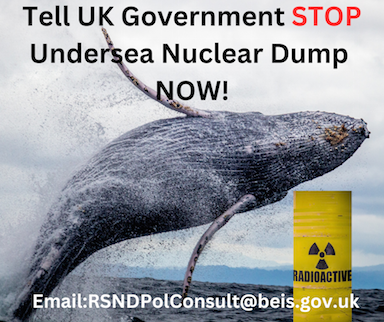
Radiation Free Lakeland have just put together a reply to the Government’s consultation on the nuclear dump plans. You don’t have to write a long reply to all their (loaded) questions. The main thing is to say that the GDF and Near Surface plans are too dangerous and that the Government should think again. Please do use the below for inspiration for your own replies to the consultation which can be found here https://www.gov.uk/government/consultations/managing-radioactive-substances-and-nuclear-decommissioning
Your reply does not need to be long – even a sentence or two explaining why the Government should halt GDF plans would be good – Email your reply to the consultation here: RSNDPolConsult@beis.gov.uk
Managing radioactive substances and nuclear decommissioning
Consultation by: Department for Energy Security and Net Zero
1 March 2023 Notes from Radiation Free Lakeland sent by email to:RSNDPolConsult@beis.gov.uk 3rd May 2023
Radiation Free Lakeland are a volunteer civil society group who formed in 2008 as a response to the Managing Radioactive Waste Safely’s (now RWM/NWS) ‘steps to Geological Disposal’ which were halted by Cumbria County Council in 2013.. RaFL’s focus is nuclear safety.
Introduction: RaFL do not recognise the validity of this consultation for the following reasons:
a) TIMING – It is taking place at a time when the most expedient ( proximity to Sellafield ) target area for nuclear waste disposal is undergoing the upheaval of Local Government Organisation.
b) CRONYISM – The NDA and Nuclear Waste Services are being advised on “Investigation Techniques,” “Construction” and “Costings for Scenarios” including “co-location” of a GDF and NSD by the CEO of West Cumbria Mining. Mark Kirkbride’s coal mine, now approved by Government, lies directly between the target areas of Mid Copeland and Allerdale.
c) SAFE ENOUGH – The public are being misled over escalating radiation risks by the use of ALARP (As Low As Reasonably Practicable), the Waste Hierarchy and Best Available Techniques to recycle, incinerate and dispose of radioactive wastes by increasingly novel routes from recycling radioactive scrap metal to burial of high level wastes in sub-sea geology.
Consultation: Part I UK policy proposals for managing radioactive substances and nuclear decommissioning
- 1. Do you agree with the proposal to require the application of a risk-informed approach as a decision-making framework for the management of all solid radioactive waste?
NO. The public are being misled into answering Yes to this question – who would disagree with a “risk informed approach?” But what the consultation fails to reveal (or even refer to as far as we can see) is that the industry uses a device called ALARP which was instigated following a court case in 1949. A coal mine employee had been killed by a rock fall that might have been prevented if the tunnel roof had been shored up by the operator the UK National Coal Board (NCB). The appeal court’s decision was that the NCB did not have to take every possible physical measure to eliminate risk; it only had to provide protection where it was required.
This judgement enabled business owners to defend themselves from successful legal action by showing that they had taken all “reasonably practicable” measures to ensure safe operation, and that therefore risks were “As Low As Reasonably Practicable” or ALARP. The nuclear industry has taken this principle and used it to apply to radiation protection for the public – the consultation does not make any mention of ALARP but does mention its facilitator “Best Available Technique” which aims to provide “value for money” ie the cheapest option measured against human life.
If risk is either impossible or hugely expensive to reduce the industry chooses to do what is “reasonably practicable” to manage it and label the process “ALARP”. The obvious alternative is that the process would have to shut down. The ALARP principle for fatality risk is effectively set at 1 in 10,000 per annum for members of the public and 1 in 1000 per annum for nuclear workplace risks. Even by this optimistic industry standard the public risk from radioactive emissions is twice that of a fatality by car accident (one in approx 20,000 according to some statistics) and in a reverse lottery many times greater than that of winning the National Lottery – the difference being that the public can choose to avoid the fatal traffic accident or winning lottery ticket. This equates to thousands of ALARP deaths every year due to radioactive emissions even by the industry’s own optimistic standard.
An example of this is the decommissioning of Sellafield’s Pile 1 and 2. A new landfill area called Calder Landfill Extension Segregated Area Disposals (CLESA) for nuclear waste dumping was created to dispose of wastes from the demolition. “This Best Available Techniques (BAT) justification demonstrates that the environmental permit for CLESA should be varied to allow it to accept radioactive waste material with higher levels of tritium..” Despite the Environment Agency previously pointing out in 2014 “ it is doubtful whether the location of the LLWR site (at nearby Drigg) would be chosen for a new facility for near-surface radioactive waste disposal if the choice were being made now. It would not be in accordance with current national and international siting practice for new facilities.” Despite knowing that radioactive wastes that will still be dangerous to the public in many decades to come will sooner or later end up scattered along the beach and in the sea the Environment Agency have acquiesced to Sellafield’s ‘necessity’ for a newly enlarged landfill just metres from the Irish Sea containing radioactive rubble using ALARP and BAT to justify the industry’s ‘need’. Coinciding with ALARP and BAT is the fact that in recent years the Environment Agency once fully autonomous from Government (and the nuclear industry) have been systematically declawed with massively reduced funding over recent years to become less of a watch dog than a lap dog.
Image the Calder Landfill is Expanding next to the Irish Sea in order to dump decommissioning wastes from Piles 1and 2 along with radioactively contaminated animal carcasses etc https://consult.environment-agency.gov.uk/cumbria-and-lancashire/sellafield-rsa-major-permit-review/supporting_documents/10.%20MARP003_CLESA%20PCRSA%20Updated%20Report%206.12.17.pdf-1
- 2. Do you agree that application of the waste hierarchy should be an explicit policy requirement for the management of all solid radioactive waste where practicable?
NO. Radiation Free Lakeland have previously warned that the application of the “waste hierarchy” has opened up novel routes to the environment with increasing radioactive risks to the public. Examples:…………………………………………………………………………………………..
- 3. Do you agree with the proposed amendment to current policies on geological disposal to allow disposal of Intermediate Level Waste in near surface facilities?
No. The NIREX inquiry of 1997 rejected the deep disposal of Intermediate Level Wastes. Nirex’s aim was “to prevent radioactive material from coming into contact with groundwater in which it could dissolve, because this is the principal route by which radioactive material could be transported from a repository through the overlying rock to the surface where it could affect humans.” The Nirex inquiry concluded that this aim could not be achieved with deep disposal of ILW. Roll on 20 years and this fact is airbrushed out with the plan for Near Surface Disposal which would mean that Intermediate Level radioactive wastes would reach groundwater and the surface far sooner than the rejected NIREX plan for deep disposal………………………………………………………………
- 4. Do you agree with the proposed policy framework for the development of near surface disposal facilities by the NDA for the disposal of less hazardous ILW?
No. See answer above. “less hazardous” does not mean safe to “dispose” by shallow grave.
- 5. Do you agree that the policy of the UK Government and devolved administrations should promote the use of on-site disposal of radioactively contaminated waste from the decommissioning of nuclear sites, subject to environmental permits?
No. See 3. and 4. Waste cannot be “disposed” unless radioactivity has reduced to background levels. Radioactive waste should be retrievable, monitorable and able to be repackaged/shielded giving future generations the ability to protect themselves.
- 6. Are there any further improvements that we might consider in relation to the proposed update of the nuclear decommissioning and clean-up policy?
Yes – see 3. 4. And 5. In addition the first step is to stop the process of generating more nuclear wastes.
- 7. Do you agree with our proposed updates to the policy statement on the management of spent fuel?
No. See 6. Reprocessing spent fuel should be banned completely. Reprocessing generates ever more waste streams to be discharged to the environment and increases the volume of nuclear wastes dangerous to all life forms by at least 160 times. Sellafield’s reprocessing wastes are found in the Arctic but much of the waste has settled on the Irish Sea bed to be resuspended with the tides and activities such as borehole drilling and subsidence from sub-sea mining.
- 8. Do you agree with our proposed policy statement on the management of uranium?
No. Uranium should not be ‘re-used.’ Uses of uranium include military use which should be banned as it is effectively a chemical weapon. Depleted uranium is used for tank armour, armour, armour piercing bullets and aircraft weights. Depleted uranium is both a toxic chemical and radiation health hazard when inside the body.
- 8. Do you agree with our proposed policy statement on the management of uranium?
No. Uranium should not be ‘re-used.’ Uses of uranium include military use which should be banned as it is effectively a chemical weapon. Depleted uranium is used for tank armour, armour, armour piercing bullets and aircraft weights. Depleted uranium is both a toxic chemical and radiation health hazard when inside the body
……………………………………………………………………………. https://mariannewildart.wordpress.com/2023/05/03/tell-uk-government-stop-undersea-nuclear-dump-now/
Canada and Ontario are turning to nuclear energy as a green solution. Here’s the problem with that.
As more than $1 billion in public money is being committed to a new generation of reactors, critics are calling for a pause and a rethink, saying nuclear power’s cost overruns, construction delays and safety concerns outweigh its benefits as a provider of clean electricity.
By Marco Chown Oved, Climate Change Reporter, Thu., May 4, 2023
After a pause of more than 30 years, Ontario is poised to start building nuclear reactors again in an effort to provide the carbon-free electricity needed to avoid the worst effects of climate change.
Both Premier Doug Ford and Prime Minister Justin Trudeau have lauded nuclear power as a climate change solution, one that will help reduce emissions, attract green businesses and provide abundant electricity to enable society to stop burning fossil fuels.
But as more than $1 billion in public money is being committed to a new generation of reactors, critics are calling for a pause and a rethink, saying nuclear power’s cost overruns, construction delays and safety concerns outweigh its benefits as a provider of clean electricity — especially when renewables such as wind and solar are cheaper, quicker to build and have no long-term radioactive legacy.
The last nuclear plant Ontario built was so expensive that it caused the bankruptcy of Ontario Hydro, said Mark Winfield, a professor of environmental and urban change at York University.
“People don’t remember that,” he said. “Now, we’re sleepwalking back down a nuclear path and nobody’s asking the big questions about the costs, viability, risks and alternatives.”
Winfield, who is also co-chair of the Sustainable Energy Initiative at York, said the climate crisis has opened up a window of opportunity for nuclear power, aided by the public’s short memory.
“The nuclear industry is engaged in a full-court press, trying to take advantage of the decarbonization push to rehabilitate its reputation,” he said, an assertion supported by records in the lobbyist registry in Ontario.
Building nuclear to reduce emissions is a false solution, he said, because it will burden future generations with waste that will remain radioactive for thousands of years.
“It’s climate change for nuclear waste. Are we trading one giant intergenerational problem for another.
…………………….. Winfield and other critics point to nuclear power’s record of taking longer to build and costing more than anticipated — often by large margins — as the reason why the spread of the technology stalled decades ago.
……………………………. Nuclear power was never meant to be commercially viable, said Benjamin Sovacool, a professor of earth and environment at Boston University. It was developed in the United States as a way to convince the public that the power of the atom — which had demonstrated its catastrophic destructive potential during the Second World War — could be used for good, he said.
“There was this euphoria around what nuclear power could do,” he said. The only problem? “It was never cost effective.”
Sovacool published an academic paper that analyzed the construction timelines and budgets of more than 400 large-scale electricity projects around the world over the past 80 years. He found, on average, nuclear plants cost more than double their original budgets and took 64 per cent longer to build than projected. Wind and solar, by contrast, had average cost overruns of 7.7 per cent and 1.3 per cent, respectively.
“That’s why the market has not really embraced nuclear power at all. It just can’t compete with modern renewables,” said Sovacool. “Nuclear is stagnating and declining.”
……………………………………………………………. One of the only places where enthusiasm exists for new nuclear is China.
Over the past two decades, China has commissioned 50 new reactors, more than half of all new reactors built. In the rest of the world, twice as many reactors have been decommissioned (105) as were built (48). But even China’s passion for nuclear is eclipsed by its penchant for building solar.
Since 2001, China has added 47.5 GW of nuclear power generation to its grid, according to the World Nuclear Industry Report. But in the last decade — half that time — it has also built 13 times more wind and solar (630 GW), according to the International Energy Agency.
…………………………….. The cost increases associated with these undercut the case that nuclear power is reliable and inexpensive, Ramana said, prompting the nuclear industry to lowball cost estimates and provide unrealistic construction schedules.
“If politicians and the public were given accurate estimates, they’d say: ‘No thank you,’ ” he said. “There is an incentive to lie about this. If you look into the history, you should be very skeptical about promises.”
Canada was an early proponent of nuclear power, with the first experimental nuclear reactor outside the U.S. operating at Chalk River in the 1940s. Canada then developed its own civilian power technology — called CANDU — with prototypes built at Douglas Point, Ont., and Gentilly, Que., in the 1960s. The first large-scale reactor was built in Pickering in 1971, followed by Bruce in 1977, Point Lepreau, N.B., in 1983 and Darlington in 1990.
In Ontario, all three plants — Pickering, Bruce and Darlington — took longer and cost more to build than expected. Darlington, the last one to be completed, ended up costing $14.4 billion — triple the original budget.
Built to meet projections of soaring demand for electricity that didn’t materialize after the recession of the early ’90s, Darlington nuclear power plant bankrupted Ontario Hydro and led to the once-profitable public utility being broken into three.
The promised electricity price reductions also failed to materialize.
Now, three decades later, Ontario gets 53 per cent of its electricity from nuclear, but faces growing demand for noncarbon emitting electricity as industry returns to the province and cars and home heating electrify.
So Queen’s Park is turning to nuclear again.
Midway through $26 billion in refurbishments to extend the production lives of Darlington and Bruce, Ontario Power Generation (OPG) asked the Canadian Nuclear Safety Commission to prolong its operating licence for Pickering, Canada’s oldest operating reactor.
But that won’t be enough. The Independent Electricity System Operator said new nuclear reactors will be needed to get the province’s electricity supply to net-zero emissions. So, OPG has started the licensing process to build a first-of-its-kind small modular reactor (SMR)……………………………………
SMRs are supposed to solve the cost overruns and construction delays that plagued larger nuclear projects. They are to be assembled mostly in a factory, where costs can be better controlled, and their smaller size means they will be quicker to construct.
The SMR proposed for Darlington will have a 300 MW capacity. By contrast, each of the four existing reactors at Darlington have a capacity of nearly 900 MW.
But the very logic of going small undercuts the economies of scale that large nuclear reactors relied on, said Lyman. While they may cost a lot, full-scale reactors produce incredible amounts of electricity. Lyman doubts the smaller reactors will end up being much cheaper, but they’ll definitely produce less electricity — and he has concerns they could be less safe.
“In the drive to show these things are going to be cheaper, they’re cutting too many corners,” he said. “There may be a way to make it safe enough, but that’s not the way we’re going.”
The hypothetical consequences of a nuclear accident would be far worse in Ontario, where Darlington and Pickering are located very close to millions of homes, than most other nuclear plants around the world, said Theresa McClenaghan, a lawyer with the Canadian Environmental Law Association.
“We have been numbed to the danger,” she said. “The emergency planning zone extends well into Toronto.”………………. https://www.thestar.com/news/canada/analysis/2023/05/04/the-problemswith-canada-and-ontarios-new-push-for-nuclear-energy.html?rf
As US-China Tensions Mount, We Must Resist the Push Toward Interimperialist War
What would it look like to build international solidarity against imperial rivalry from below?By Ashley Smith , TRUTHOUT, May 4, 2023
The daily news is filled with stories about the spiraling conflict between the U.S. and China over everything from trade to geopolitical squabbles and dueling military exercises. All of these converge over Taiwan — a small nation claimed by China as a renegade province, backed by the U.S., and home to the most advanced microchip manufacturing plants in the world.
These plants produce chips that power everything from iPhones to Washington’s F-35 fighter bomber, and other high-tech weaponry. That fact raises the stakes of a long-simmering dispute punctuated with periodic “Taiwan Strait Crises,” turning it into a volatile diplomatic, economic and military confrontation.
On Capitol Hill and in boardrooms, as Edward Luce notes, “the old Washington Consensus” of integrating of China has been replaced with a new one of “dis-integrating China.” Joe Biden has continued Donald Trump’s grand strategy of great power rivalry with Beijing………………………………………………………………………………………………………..
the relative decline of U.S. imperialism and the rise of today’s asymmetric multipolar world order. The U.S. remains, of course, the most dominant imperialist state, but it now faces China as a rising rival, a revitalized Russia as an outsize regional power and a host of sub-imperialist states from Saudi Arabia to Israel and Brazil, which variously challenge and cooperate with the U.S.
The Rise of Chinese Imperialism
Washington views China as its biggest rival. Beijing has transformed itself from an autarchic, underdeveloped economy into a capitalist superpower. It is now the world’s second-largest economy, the number one manufacturer, the largest exporter, main trade partner with most of the world’s major economies, a leading exporter of capital, largest creditor and a top recipient of foreign direct investment……………………………………………………
Biden’s Imperialist Keynesianism
Of course, the U.S. remains the world’s largest economy, controls the dollar as the international reserve currency, boasts the largest network of military allies, spends nearly three times as much as China on defense and possesses over 750 bases around the world. To enforce its supremacy, it has taken an increasingly aggressive turn to contain Beijing……………………………………………………………………………….
“Democracies” Versus Autocracies
To complement this imperialist industrial policy, Biden has launched a geopolitical campaign to forge a front of democracies against autocracies. A lot of this is ideological posturing, as U.S. democracy is, to say the least, ridden with crisis (remember January 6?) and the allies it invited to its two “Democracy Summits” included states that Freedom House categorized as “partly free,” “not free at all” and “electoral autocracies.”……………………………………………………………………………………………….
Taiwan: Strategic Flashpoint of Imperial Rivalry
The conflict between the U.S. and China is coming to a head over Taiwan, with American Gen. Mike Minihan going so far as to predict war in 2025. Beijing claims the island as a renegade province it aims to reintegrate, while the U.S. holds a position of “strategic ambiguity,” upholding a One China policy that only officially recognizes Beijing, while remaining unclear whether it would militarily defend Taiwan in order to deter China from invading and Taiwan from declaring independence.
………………………………………………………………………….. The Taiwanese people are caught between China and the U.S., their right to self-determination threatened by Beijing and cynically supported by the U.S. for imperial motives.
Neither Washington, Nor Beijing
War between the U.S. and China is, however, unlikely at this point. Their economies remain deeply integrated, both possess enormous stockpiles of nuclear weapons, and they are embedded in elaborate international geopolitical and economic institutions, all factors that mitigate the chances of war.
But, amid global capitalism’s multiple crises, both powers are whipping up nationalist hostility and implementing increasingly antagonistic geopolitical and economic policies. In such volatile conditions, it is essential for the international left to agitate against the drive toward imperialist war.
In the U.S., the left’s top priority must be to oppose Washington’s attempt to enforce its hegemony against China’s challenge. Washington remains, as Martin Luther King Jr. said decades ago, “the greatest purveyor of violence in the world today,” a fact most recently confirmed by its destruction of Afghanistan and Iraq.
At the same time, we should not fall for the politics of “my enemy’s enemy is my friend” and support Washington’s main imperial rival, China, nor lesser ones like Russia. They are no less predatory and avaricious imperialist states, as Beijing’s record in Xinjiang and Hong Kong attests, as does Moscow’s similarly brutal one in Syria and Ukraine.
Building International Solidarity From Below
Instead, the left must build international solidarity from below between oppressed nations like Palestine, Ukraine and Taiwan, as well as exploited workers in both countries and throughout the world. This project is not an abstraction, but a necessity and possibility…………………………………………
Finally, the U.S. left must collaborate with the Chinese left (and the Asian left more broadly), which despite repression and difficult conditions, have developed extensive networks and publications like Hong Kong’s Lausan, Taiwan’s New Bloom, and Chinese groups and publications like Gongchao, Chuang and Made in China Journal. Now is the time to build internationalist anti-imperialism that rejects the false choice between Washington and Beijing and organizes across borders in a fight for international socialism that puts people and the planet first. https://truthout.org/articles/as-us-china-tensions-mount-we-must-resist-the-push-toward-interimperialist-war/?utm_source=Truthout&utm_campaign=43fadf3893-EMAIL_CAMPAIGN_3_20_2023_13_41_COPY_04&utm_medium=email&utm_term=0_bbb541a1db-43fadf3893-650192793&mc_cid=43fadf3893&mc_eid=73e1cd43d0
US Sells Taiwan 400 Harpoon Anti-Ship Missiles – Profits and Provocations, Not Protection
There are no clear solutions for Taiwan if it continues down the path of US-sponsored separatism and antagonism toward the rest of China, so much so that the only logical solution to “defeat” a Chinese blockade of the island is to not provoke one in the first place.
US Sells Taiwan 400 Harpoon Anti-Ship Missiles as US-Chinese Tensions Rise
03.05.2023 Author: Brian Berletic
As the US continues its proxy war against Russia in Ukraine, it also continues preparations for a similar conflict with China using the island province of Taiwan as its proxy of choice in Asia.
Toward this end, the US continues flooding the island province with billions of dollars worth of weapons.
One of the more recent announced weapon sales was 400 Harpoon anti-ship missiles.
Washington’s Flawed “Porcupine Strategy” for Taiwan
The anti-ship missiles manufactured by Boeing would presumably be part of developing much wider anti-access area denial (A2AD) capabilities for the administration’s armed forces on the island.
A Taiwan-based analyst, Pei-Shiue Hsieh, in an article for The Diplomat titled, “Building Taiwan’s Own Area Denial Capabilities,” would claim:
While some assert that Taiwan cannot counter a Chinese invasion on its own, the results of my analytical wargames show the opposite. The drills by the Chinese People’s Liberation Army (PLA) last month likely demonstrated Beijing’s intentions to impose a naval blockade on the island in the event of a military confrontation. Taiwan’s military needs to prevent Chinese fleets from moving into their tactical positions or, if unable to prevent the blockade’s establishment, to disrupt ongoing PLA Navy (PLAN) operations.
In order to do so, the author suggests:
Taiwan must develop its own anti-access/area denial (A2/AD) strategy, which incorporates guided weapons and reconnaissance systems. Currently, Taiwan’s military possesses two possible options for guided anti-ship weapons: the ground-launched Hsiung Feng II/III and the ground- or air-launched AGM-84 Harpoon. With the reconnaissance information gathered by naval surveillance radars and MQ-9B SeaGuardian unmanned aerial vehicles, these legacy anti-ship missiles remain potent defenders of the island. However, as the PLAN is rapidly growing, Taiwan needs more than short- and medium-range options to cope with the PLA threat.
The Hsiung Feng III and Harpoon anti-ship missiles have ranges of 400 km and 139 km respectively. While these ranges may seem like more than enough to target and destroy Chinese warships imposing a sea blockade on the island of Taiwan, the problem is that while the missiles themselves have active radar homing, finding Chinese ships to home in on in the first place will be very difficult for Taiwan’s armed forces…………………………………………..
In a scenario where China is attempting to blockade Taiwan and China feels its surface vessels are at risk from anti-ship missiles, it can also employ submarines while using its formidable missile force to strike at and destroy not only military capabilities based on Taiwan, but also ports receiving military aid from abroad as well as ships attempting to deliver it. A blockade by any other name is still a blockade.
The other problem Taiwan’s administration faces is the time frame purchased weapons would actually reach the island. The 400 purchased Harpoon anti-ship missiles will take years at the earliest to arrive……………………
According to most estimates, the gap in military capabilities between China and the United States is set to close somewhere around 2025. By 2029, the gap would be in the process of widening, but this time in China’s favor.
Contracts for munitions like the LRASM are not even being publicly discussed, but should such contracts be signed, it’s likely Taiwan will be waiting as long or longer for the missiles to arrive, and that is assuming the missiles are developed into ground-launched systems to adapt to the reality Taiwan’s air force will not play a role in any hostilities with the rest of China.
Profits and Provocations, Not Protection
While Boeing is certainly profiting from the sale of 400 Harpoon anti-ship missiles to Taiwan, the move hardly enhances Taiwan’s military capabilities relative to the rest of China, nor does it do so within the window of opportunity the US seeks to provoke an armed conflict with China over Taiwan. If any blockade imposed by China around the island province of Taiwan is to be broken, it will have to be by the US military using a combination of anti-ship missiles and anti-submarine warfare.
US policymakers having wargamed an armed conflict between the US and China noted that the US would likely exhaust its arsenal of long-range anti-ship missiles of all kinds, a result of America’s limited military industrial capacity, a shortfall on demonstration amid its proxy war with Russia in Ukraine at the moment.
But even if the US didn’t run out of missiles and if the US was successful in thwarting China’s use of naval vessels to impose a blockade, a de facto blockade can still be imposed through the use of China’s long-range missiles fired from the mainland at Taiwan’s ports and any ships attempting to utilize them.
There are no clear solutions for Taiwan if it continues down the path of US-sponsored separatism and antagonism toward the rest of China, so much so that the only logical solution to “defeat” a Chinese blockade of the island is to not provoke one in the first place.
Brian Berletic is a Bangkok-based geopolitical researcher and writer, especially for the online magazine “New Eastern Outlook”. https://journal-neo.org/2023/05/03/us-sells-taiwan-400-harpoon-anti-ship-missiles-as-us-chinese-tensions-rise/
Former Nuclear Leaders: Say ‘No’ to New Reactors
The former heads of nuclear power regulation in the U.S., Germany, and France, along with the former secretary to the UK’s government radiation protection committee, have issued a joint statement that in part says, “Nuclear is just not part of any feasible strategy that could counter climate change.”
The statement issued Jan. 25 notes the importance of global action to combat climate issues, but the four leaders say nuclear power is too costly, and too risky an investment, to be a viable strategy against climate change.
The four leaders issuing the joint statement include:
- Dr. Greg Jaczko, former Chairman of the U.S. Nuclear Regulatory Commission, and founder of Maxean, an energy company.
- Prof. Wolfgang Renneberg, a university professor and former Head of the Reactor Safety, Radiation Protection and Nuclear Waste, Federal Environment Ministry, Germany.
- Dr. Bernard Laponche, a French engineer and author, and former Director General, French Agency for Energy Management, former Advisor to French Minister of Environment, Energy and Nuclear Safety.
- Dr. Paul Dorfman, an associate fellow and researcher at the University of Sussex, and former Secretary UK Govt. Committee Examining Radiation Risk from Internal Emitters.
Here’s the text of the statement:
“The climate is running hot. Evolving knowledge of climate sensitivity and polar ice melt-rate makes clear that sea-level rise is ramping, along with destructive storm, storm surge, severe precipitation and flooding, not forgetting wildfire. With mounting concern and recognition over the speed and pace of the low carbon energy transition that’s needed, nuclear has been reframed as a partial response to the threat of global heating. But at the heart of this are questions about whether nuclear could help with the climate crisis, whether nuclear is economically viable, what are the consequences of nuclear accidents, what to do with the waste, and whether there’s a place for nuclear within the swiftly expanding renewable energy evolution.
“As key experts who have worked on the front-line of the nuclear issue, we’ve all involved at the highest governmental nuclear regulatory and radiation protection levels in the US, Germany, France and UK. In this context, we consider it our collective responsibility to comment on the main issue: Whether nuclear could play a significant role as a strategy against climate change.
“The central message, repeated again and again, that a new generation of nuclear will be clean, safe, smart and cheap, is fiction. The reality is nuclear is neither clean, safe or smart; but a very complex technology with the potential to cause significant harm. Nuclear isn’t cheap, but extremely costly. Perhaps most importantly nuclear is just not part of any feasible strategy that could counter climate change. To make a relevant contribution to global power generation, up to more than ten thousand new reactors would be required, depending on reactor design.”
The statement includes a list of items (below) the leaders see as making an argument against nuclear power.
In short, nuclear as strategy against climate change is:
- Too costly in absolute terms to make a relevant contribution to global power production
- More expensive than renewable energy in terms of energy production and CO2 mitigation, even taking into account costs of grid management tools like energy storage associated with renewables rollout.
- Too costly and risky for financial market investment, and therefore dependent on very large public subsidies and loan guarantees.
- Unsustainable due to the unresolved problem of very long-lived radioactive waste.
- Financially unsustainable as no economic institution is prepared to insure against the full potential cost, environmental and human impacts of accidental radiation release – with the majority of those very significant costs being borne by the public.
- Militarily hazardous since newly promoted reactor designs increase the risk of nuclear weapons proliferation.
- Inherently risky due to unavoidable cascading accidents from human error, internal faults, and external impacts; vulnerability to climate-driven sea-level rise, storm, storm surge, inundation and flooding hazard, resulting in international economic impacts.
- Subject to too many unresolved technical and safety problems associated with newer unproven concepts, including ‘Advanced’ and Small Modular Reactors (SMRs).
- Too unwieldy and complex to create an efficient industrial regime for reactor construction and operation processes within the intended build-time and scope needed for climate change mitigation.
- Unlikely to make a relevant contribution to necessary climate change mitigation
- needed by the 2030’s due to nuclear’s impracticably lengthy development and construction time-lines, and the overwhelming construction costs of the very great volume of reactors that would be needed to make a difference.
Former CIA Officer Says Decision to Drone Attack Kremlin Was Made by the United States
Deadly escalation an effort to provoke major Russian response.
Summit News, 5 May, 2023, Paul Joseph Watson
Former CIA intelligence officer Larry Johnson says the decision to launch a drone attack on the Kremlin was made by the United States.
The Wednesday attack, which was likely to have been targeting Russian President Vladimir Putin, was stopped by electronic warfare systems which disabled the drones before they could reach their target.
According to Johnson, the attack must have been spearheaded by the Biden administration and the US military-industrial complex because “decisions on such attacks are made not in Kiev, but in Washington.”
“Washington should understand clearly that we know this,” Johnson told reporters.
Although the attack, which Ukraine denied it was involved in, failed to accomplish its tactical goal, it was still highly “symbolic,” according to Johnson……………………………………….
Democratic presidential candidate Robert F. Kennedy Jr. denounced the attempted drone attack as a dangerous escalation. https://summit.news/2023/05/05/former-cia-officer-says-decision-to-drone-attack-kremlin-was-made-by-the-united-states/
Record low Antarctic sea ice is another alarming sign the ocean’s role as climate regulator is changing
Craig Stevens
A changing climate is upon us, with more frequent land and marine heatwaves, forest fires, atmospheric rivers and floods. For some, it is the backdrop to day-to-day life, but for a growing number of people it is a life-changing reality.
Sweden leads large-scale NATO air combat exercise over the Baltic — Anti-bellum

NATOAllied Air CommandMay 4, 2023 Swedish and Allied fighters undertake large-scale training in the Baltic Sea region Allied and Partner aircraft integrate over the Baltic Sea area during high intensity Swedish led large-scale Exercise Aurora, March 28. Exercise Aurora is a Swedish national exercise with international participants, including NATO members. The exercise is an important […]
Sweden leads large-scale NATO air combat exercise over the Baltic — Anti-bellum
May 5 Energy News — geoharvey

Science and Technology: ¶ “The People Living Ultra Low-Carbon Lifestyles” • Surveys show that many people want to participate in climate actions, but putting a very low-carbon life into practice can mean be tricky: it can mean changing several aspects of daily life, particularly for the richer parts of society. What do truly low-carbon lifestyles […]
May 5 Energy News — geoharvey
The Antidote to Oliver Stone is Philippe Carillo’s Film “Fukushima Disaster: The Hidden Side of the Story”
This Week’s Featured Interview:
Libbe HaLevy, Host of Nuclear Hotseat, 3 May 23 https://nuclearhotseat.com/podcast/antidote-oliver-stone-fukushima-disaster/
- Philippe Carillo has made a 52-minute film that busts the myths of nuclear reactor safety that is clear, easily understood, and devastatingly powerful. Philippe is a French citizen currently living in the Vanuatu archipelago. While living in Paris, he worked on several major documentary projects for the BBC, 20th Century Fox, French National TV, and independent film productions. He moved to Hollywood in 2003 and made his first feature documentary in Hollywood in 2013, Inside the Garbage of the World. The film won 3 awards, was distributed worldwide, and inspired a wave of change regarding plastic pollution.
Philippe moved to Vanuatu in 2017 and has since made more than100 short films in that country. In 2022, he decided to finish his feature documentary about Fukushima which was started in 2016. That film, FUKUSHIMA Disaster – The Hidden Side of the Story, was the topic of our conversation.
I spoke with Philippe Carillo on Friday, April 14, 2023.
The rise of fascism, Ukraine, America at war with the world – journalists must speak up.

JOHN PILGER: Danger of war exists if we don’t speak up now
Independent Australia, By John Pilger | 2 May 2023
“………………………………………………………………………………… The rise of fascism in Europe is uncontroversial. Or “neo-Nazism” or “extreme nationalism”, as you prefer. Ukraine as modern Europe’s fascist beehive has seen the re-emergence of the cult of Stepan Bandera, the passionate anti-Semite and mass murderer who lauded Hitler’s “Jewish policy” which left 1.5 million Ukrainian Jews slaughtered. ‘We will lay your heads at Hitler’s feet,’ a Banderist pamphlet proclaimed to Ukrainian Jews.
Today, Bandera is hero-worshipped in western Ukraine and scores of statues of him and his fellow fascists have been paid for by the EU and the U.S., replacing those of Russian cultural giants and others who liberated Ukraine from the original Nazis.
In 2014, neo-Nazis played a key role in an American-bankrolled coup against the elected President, Viktor Yanukovych, who was accused of being “pro-Moscow”. The coup regime included prominent “extreme nationalists” — Nazis in all but name.
At first, this was reported at length by the BBC and the European and American media. In 2019, Time magazine featured the “White supremacist militias” active in Ukraine. NBC News reported, ‘Ukraine’s Nazi problem is real’. The immolation of trade unionists in Odessa was filmed and documented.
Spearheaded by the Azov regiment, whose insignia, the “Wolfsangel”, was made infamous by the German SS, Ukraine’s military invaded the eastern, Russian-speaking Donbas region. According to the United Nations, 14,000 in the east were killed. Seven years later, with the Minsk peace conferences sabotaged by the West, as Angela Merkel confessed, the Red Army invaded.
This version of events was not reported in the West. To even utter it is to bring down abuse about being a “Putin apologist”, regardless of whether the writer (such as myself) has condemned the Russian invasion. Understanding the extreme provocation that a NATO-armed borderland, Ukraine, the same borderland through which Hitler invaded, presented to Moscow, is anathema.
Journalists who travelled to the Donbas were silenced or even hounded in their own country. German journalist Patrik Baab lost his job and a young German freelance reporter, Alina Lipp, had her bank account sequestered.
In Britain, the silence of the liberal intelligentsia is the silence of intimidation. State-sponsored issues like Ukraine and Israel are to be avoided if you want to keep a campus job or a teaching tenure. What happened to Jeremy Corbyn in 2019 is repeated on campuses where opponents of apartheid Israel are casually smeared as anti-Semitic.
Professor David Miller, ironically the country’s leading authority on modern propaganda, was sacked by Bristol University for suggesting publicly that Israel’s “assets” in Britain and its political lobbying exerted a disproportionate influence worldwide — a fact for which the evidence is voluminous.
The university hired a leading KC to investigate the case independently. His report exonerated Miller on the ‘important issue of academic freedom of expression’ and found ‘Professor Miller’s comments did not constitute unlawful speech’. Yet Bristol sacked him. The message is clear: no matter what outrage it perpetrates, Israel has immunity and its critics are to be punished………………………………………
When 9/11 happened, the fabrication of new “threats” on “America’s frontier” (as the Project for the New American Century called the world) completed the political disorientation of those who, 20 years earlier, would have formed a vehement opposition.
In the years since, America has gone to war with the world. According to a largely ignored report by the Physicians for Social Responsibility, Physicians for Global Survival and the Nobel Prize-winning International Physicians for the Prevention of Nuclear War, the number killed in America’s “war on terror” was at least 1.3 million in Afghanistan, Iraq and Pakistan.
This figure does not include the dead of U.S.-led and fuelled wars in Yemen, Libya, Syria, Somalia and beyond. The true figure, said the report, ‘could well be in excess of 2 million [or] approximately 10 times greater than that of which the public, experts and decision-makers are aware and [is] propagated by the media and major NGOs.’
At least one million were killed in Iraq, say the physicians, or five per cent of the population.
The enormity of this violence and suffering seems to have no place in the Western consciousness. No one knows how many is the media refrain. Blair and George W Bush – and Straw and Cheney and Powell and Rumsfeld et al – were never in danger of prosecution. Blair’s propaganda maestro, Alistair Campbell, is celebrated as a “media personality”.
……………………………………Had journalists done their job, had they questioned and investigated the propaganda instead of amplifying it, a million Iraqi men, women and children might be alive today; millions might not have fled their homes; the sectarian war between Sunni and Shia might not have ignited; and Islamic State might not have existed.
Cast that truth across the rapacious wars since 1945 ignited by the United States and its “allies” and the conclusion is breathtaking. Is this ever raised in journalism schools?
Today, war by media is a key task of so-called mainstream journalism, reminiscent of that described by a Nuremberg prosecutor in 1945:
‘Before each major aggression, with some few exceptions based on expediency, they initiated a press campaign calculated to weaken their victims and to prepare the German people psychologically… In the propaganda system…it was the daily press and the radio that were the most important weapons.’
…………………………………………………………. On 14 September 2016, the House of Commons Foreign Affairs Committee in London reported the conclusion of a year-long study into the NATO attack on Libya which it described as an ‘array of lies’ — including the Benghazi massacre story:
‘The NATO bombing plunged Libya into a humanitarian disaster, killing thousands of people and displacing hundreds of thousands more, transforming Libya from the African country with the highest standard of living into a war-torn failed state.’
……………………………….Reminiscent of the Scramble for Africa in the 19th Century, the U.S. African Command (Africom) has since built a network of supplicants among collaborative African regimes eager for American bribes and armaments. Africom’s “soldier to soldier” doctrine embeds U.S. officers at every level of command from general to warrant officer. Only pith helmets are missing.
……………………… In the year NATO invaded Libya, 2011, Obama announced what became known as the “pivot to Asia”. Almost two-thirds of U.S. naval forces would be transferred to the Asia-Pacific to “confront the threat from China,” in the words of his Defence Secretary.
There was no threat from China; there was a threat to China from the United States; some 400 American military bases formed an arc along the rim of China’s industrial heartlands, which a Pentagon official described approvingly as a “noose”.
At the same time, Obama placed missiles in Eastern Europe aimed at Russia. It was the beatified recipient of the Nobel Peace Prize who increased spending on nuclear warheads to a level higher than that of any U.S. administration since the Cold War — having promised, in an emotional speech in the centre of Prague in 2009, to help “rid the world of nuclear weapons”.
Obama and his administration knew full well that the coup his assistant secretary of state, Victoria Nuland, was sent to oversee against the government of Ukraine in 2014 would provoke a Russian response and probably lead to war. And so it has.
…………………………………………………….. Ho Chi Minh’s Vietnam was victorious and none of the above happened. Instead, Vietnamese civilisation blossomed, remarkably, in spite of the price they paid — three million dead. The maimed, the deformed, the addicted, the poisoned, the lost.
If the current propagandists get their war with China, this will be a fraction of what is to come. Speak up. https://independentaustralia.net/politics/politics-display/john-pilger-danger-of-war-exists-if-we-dont-speak-up-now,17470—
Impending NATO inductee Finland welcomes “significant military infrastructure” from Pentagon — Anti-bellum

NewsweekMay 3, 2023 U.S. Troops May Deploy to Finland Bases Amid Russia Threat American soldiers may soon be deploying to bases near Russia’s border with Finland if ongoing talks on a new defense cooperation agreement (DCA) between Helsinki and Washington prove successful. Finnish newspaper Helsinki Sanomat reported Monday, citing Finnish Foreign Ministry official Mikael Antell, […]
Impending NATO inductee Finland welcomes “significant military infrastructure” from Pentagon — Anti-bellum
France’s government postpones its nuclear safety reform indefinitely.
The merger of ASN and IRSN will not be examined by a joint committee during the
examination of the nuclear acceleration law on May 4th. The OPECST is
invited to discuss the future of this controversial merger. Game over for
the nuclear safety reform project. Announced by the government at the
beginning of February, the merger of the Nuclear Safety Authority, in
charge of civil nuclear safety, and the Institute for Radiation Protection
and Nuclear Safety (IRSN), in charge of nuclear safety expertise “is
withdrawn,” said the office of Energy Minister Agnès Pannier Runacher on
Friday.
Les Echos 28th April 2023
1 This Month
23-25 October – on Zoom – World BEYOND War’s annual global conferenc


Shut down the radiation-damaged Heysham nuclear reactors now
To see nuclear-related stories in greater depth and intensity – go to https://nuclearinformation.wordpress.com

Say No to NASA’s Reckless Nuclear Reactor on the Moon
Say No to NASA’s Reckless Nuclear Reactor on the Moon

-
Archives
- October 2026 (199)
- September 2026 (339)
- August 2026 (330)
- July 2026 (355)
- June 2026 (287)
- May 2026 (306)
- April 2026 (356)
- March 2026 (251)
- February 2026 (267)
- January 2026 (308)
- December 2025 (358)
- November 2025 (359)
-
Categories
- 1
- 1 NUCLEAR ISSUES
- business and costs
- climate change
- culture and arts
- ENERGY
- environment
- health
- history
- indigenous issues
- Legal
- marketing of nuclear
- media
- opposition to nuclear
- PERSONAL STORIES
- politics
- politics international
- Religion and ethics
- safety
- secrets,lies and civil liberties
- spinbuster
- technology
- Uranium
- wastes
- weapons and war
- Women
- 2 WORLD
- ACTION
- AFRICA
- Atrocities
- AUSTRALIA
- Christina's notes
- Christina's themes
- culture and arts
- Events
- Fuk 2022
- Fuk 2023
- Fukushima 2017
- Fukushima 2018
- fukushima 2019
- Fukushima 2020
- Fukushima 2021
- general
- global warming
- Humour (God we need it)
- Nuclear
- RARE EARTHS
- Reference
- resources – print
- Resources -audiovicual
- Weekly Newsletter
- World
- World Nuclear
- YouTube
-
RSS
Entries RSS
Comments RSS

