Understanding The Highly Complex World Of Western China Analysis

CAITLIN JOHNSTONE, MAY 15, 2023 https://caitlinjohnstone.substack.com/p/understanding-the-highly-complex?utm_source=post-email-title&publication_id=82124&post_id=121463595&isFreemail=true&utm_medium=email
—
Former Pentagon official Elbridge Colby was interviewed on The National Review’s Charles CW Cooke Podcast, where he provided some very high-level analysis on the tensions around China, Taiwan, and the United States.
I will here attempt to explain some of Colby’s comments for the benefit of the average reader, because Colby has been studying these things for many years and his commentary can be a bit advanced and esoteric for the casual punditry consumer.
“The analogy I use is… Taiwan is like a man with a cut in the ocean, and China is like a great white shark, and America is like a man in a boat,” Colby said in the interview.
“The problem is once that great white shark starts moving, you got no time,” added Colby. “You’re done. You know, if you’re not already by the side of the boat, right? Because it’s a great white shark.”
Now bear with me if Colby’s incisive observations went a bit over your head here, but if we break it down I’m confident that we can all catch up to this man’s towering intellect enough to catch a glimpse of his understanding on the matter.
What Colby appears to be saying — and please correct me of you think I’m reading this wrong — is that China is like a Great White Shark, which as we all know is an extremely dangerous aquatic predator with a voracious appetite, capable of gulping down a human being in a few swift bites.
Now, try to imagine being in a situation where you’re out there in the ocean, and there’s a Great White Shark right there with you in the water. And to make matters worse, you’re bleeding — a problem not only due to the wound from whence the blood is emanating, but also because sharks can smell blood in the water! That would be pretty bad, right?
Okay, so are you with me so far? Remember, this is very advanced stuff, so feel free to read back and review as much as you need.
Now, imagine you’re in that situation with the cut and the shark, and there’s a boat that you can go to to get away from the shark. You’d want to hop aboard that vessel as swiftly as possible, don’t you think? I know I would!
So to put it all together, what the esteemed Elbridge Colby is telling us is that China is analogous to the Great White Shark which is eyeing the bleeding man in the water, and the man can be compared to Taiwan, and the United States of America is comparable to the boat that is coming to the rescue of the man.
Make sense? If you’re still struggling to comprehend Colby’s scalpel-like geopolitical analysis, don’t worry, because I’ve obtained this helpful infographic above, to further illuminate your understanding:
Interestingly enough, this is not the first time China has been compared to a Great White Shark in recent western punditry. The Hoover Institution’s Matt Pottinger, a former advisor to President Donald Trump, made a similar comparison in an interview with Nikkei Asia earlier this month:
“We saw a baby shark and thought that we could transform it into a dolphin over time, to become a friendly sort of system,” Pottinger said. “Instead, what we did was we kept feeding the shark and the shark got bigger and bigger and bigger and bigger. And now we’re dealing with a formidable, great white.”
“With a shark you put up a shark cage,” added Pottinger. “The shark doesn’t take it personally. It bumps into the cage. It respects those barriers.”
Again, this is very complicated for the uninitiated layperson, but what Pottinger appears to be saying is that China is not at all comparable to a dolphin, which is an oceanic mammal known to be friendly toward people and easily trained to do tricks in aquatic theme parks. Rather, in Pottinger’s understanding, China is more comparable to a Great White Shark, which as you’ll recall from our discussion earlier in this essay is actually known to be rather dangerous.
If you’re still struggling to make sense of Pottinger’s luminous understanding, here’s another illustration to help make things a bit clearer:
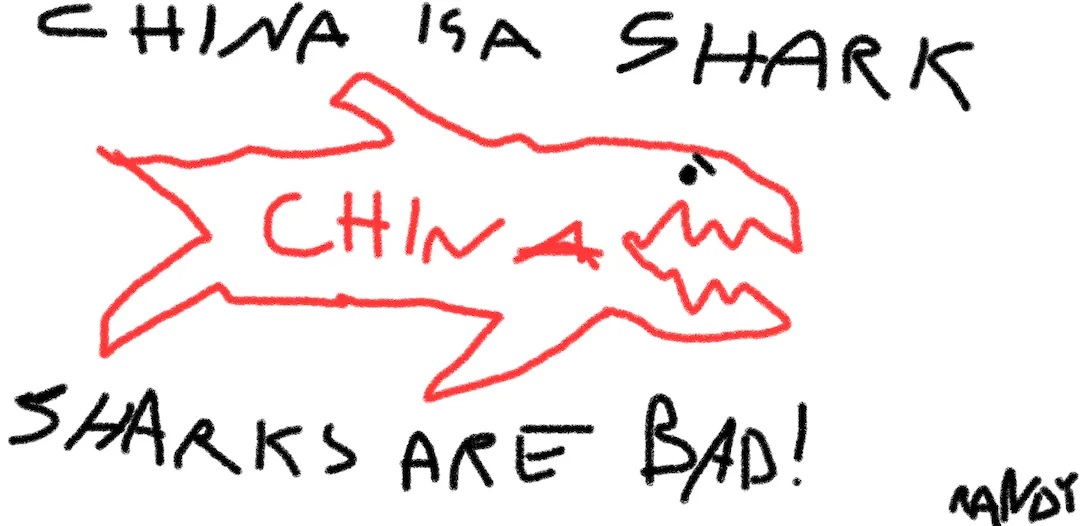
If you need it simplified even further, another way to put it might be, CHINA BAD. SHARK BAD. CHINA LIKE SHARK. CHINA VERY, VERY BAD. BAD CHINA. BAD.
Again, don’t be hard on yourself if you can’t quite wrap your head around the high-level analysis of intellectual giants like Matt Pottinger and Elbridge Colby. If we could understand these things as well as they do, we’d be the ones earning big bucks from Washington think tanks, not them!
Well I think that’s enough work for your gray matter today. Have a rest and a nice sleep and come back fresh tomorrow, where we’ll be discussing some mind-blowing comparisons western analysts have been drawing between Vladimir Putin and Adolf Hitler.
UK government’s own workplace pension scheme won’t back nuclear projects.
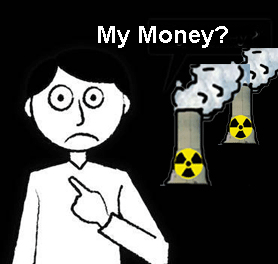
The government’s own workplace pension scheme has ruled out investing in
nuclear projects such as Sizewell C, dealing a blow to ministers’ hopes of
getting new plants off the ground.
The National Employment Savings Trust (Nest) said it would not revise its policy on nuclear infrastructure investments despite an overhaul of energy policy last year.
The government has set a high target of 24 gigawatts of new nuclear capacity by 2050,
supplied by big power plants and small modular reactors. It is courting investors such as pension funds to back Sizewell C in Suffolk, the next big nuclear plant in the pipeline.
Nest, which was set up by the government to manage auto-enrolment pensions, said it had no direct investments in nuclear infrastructure and “no current plans to review this any time soon”. “Our fund managers … would need to be confident it offers a good investment opportunity,” a spokesman added.
Big City investors like Aviva and Legal & General have previously ruled out funding projects such as Sizewell. The Department for Energy Security and Net Zero said: “We
are confident that investors will take assurance from the government’s clear commitment to [nuclear].” Alison Downes, executive director at Stop Sizewell C, said:
“Nest’s refusal to bring its 11+ million members into line with ministers’ misguided energy policy is protecting the savings of millions of hard-pressed workers and pensioners from risky, slow, expensive Sizewell C.”
Times 14th May 2023
https://www.thetimes.co.uk/article/state-pension-scheme-nest-wont-back-nuclear-plans-h22q5qnzr
Luck is not a safety plan
“We must act now,” said International Atomic Energy Agency director general, Rafael Grossi. But what is his plan? IAEA efforts at creating a “safe zone” around the Zaporizhzhia reactors, where no fighting could then occur, have collapsed. On the geopolitical stage, both Russia and Ukraine appear to harbor the conviction that their side can win the war. NATO and its allies show no signs of insisting on a diplomatic solution, given the benefit to those countries of a Russian defeat.
War devastation is bad enough without adding a nuclear disaster
Luck is not a safety plan — Beyond Nuclear International
How much more perilous can the situation at Zaporizhzhia nuclear power plant become?
By Linda Pentz Gunter, 14 May 23
Luck is not a sound basis on which to rely when we are dealing with nuclear risks. But luck is again what me must depend on as we watch and wait for the worst to happen — or not — at the six-reactor Zaporizhzhia nuclear power plant in Ukraine.
The plant, located in the southwestern region of the country — the area most directly embroiled in some of the most intense fighting, and with parts of it already “annexed” by Russia — has already experienced some frightening near-misses. These include shelling and missile attacks and frequent losses of offsite power that, if not restored promptly, could lead to a meltdown.
The plant has been occupied by Russian forces since March 4, 2022. Rumors abound that a severely depleted workforce is laboring under stressful and even violent conditions, while other staff have fled or have disappeared.
Now we learn that mass evacuations are underway from communities close to the nuclear plant. These include residents of Enerhodar, the city that houses most of the plant workers and their families……………………….
Fears of a Ukrainian offensive designed to recapture some or all of the Russian-held territory appear to have prompted the sudden evacuation. But are people evacuating away from the conflict or from the prospect of a catastrophic outcome at the nuclear power plant, should it become fully engulfed by the fighting? And if that does happen, what might the consequences be?
As a precaution, all six Zaporizhzhia reactors are currently shut down — officially their status is called “cold shutdown”, which is not as final as it sounds and does not mean they are out of danger.
The fuel in the reactor core still requires electricity to power cooling, as do the pumps that supply cooling water to the fuel pools. This means a meltdown is still possible. Cold shutdown just buys workers more time to restore power should it become lost, but a reliable supply of electricity to the site is still essential to avoid disaster…………
The consequences of such an outcome would be drastic not only for the people of Ukraine and neighboring Russia, but for all of Europe, should any or all of these reactors melt down or suffer a fuel pool fire. We only have to look at the fallout map from the 1986 Chornobyl disaster, a single unit with a far smaller radioactive inventory, to understand the potential scale of such a tragedy.
Chornobyl contaminated 40% of the European landmass with long-lived radioactive fallout and created an effectively permanent 1,000 square mile Exclusion Zone around the stricken nuclear site.
Beyond electrical power, water supply is also essential to keep nuclear power plants out of danger. The thermally and radioactively “hot” irradiated fuel rods sitting in cooling pools, must stay submerged. Electrically powered pumps can maintain a steady water supply. But access to water is critical.
In late March, alarms were raised about a dramatic drop in water levels at the reservoir that supplies cooling water to the plant. Ukrainian officials said the Russians had drained the reservoir, increasing the risk of a meltdown at Zaporizhzhia.
But this month, headlines warned that record high water levels could threaten a dam that, if breached, would send floodwaters pouring onto the nuclear site, inundating the plant’s pumping systems.
War, flooding, and human error are all potential disasters waiting in the wings that could trigger a nuclear catastrophe. But what can prevent it?
“We must act now,” said International Atomic Energy Agency director general, Rafael Grossi. But what is his plan? IAEA efforts at creating a “safe zone” around the Zaporizhzhia reactors, where no fighting could then occur, have collapsed. On the geopolitical stage, both Russia and Ukraine appear to harbor the conviction that their side can win the war. NATO and its allies show no signs of insisting on a diplomatic solution, given the benefit to those countries of a Russian defeat.
All of this brutality already comes at immense cost to the population of Ukraine, but also to Russia, where mothers, too, are losing sons to an unnecessary war. A major strike on Europe’s largest nuclear power plant would extend that tragedy across thousands of miles, affecting hundreds of millions of lives. All we’ve got between us and that disaster is luck, which, like the deadly uranium that fuels nuclear power plants, will eventually run out.
UK’s Nuclear Waste Services ignore overwhelming local council opposition to siting plan for waste dump.
Candidates opposed to the siting of a Nuclear Waste facility on the border
of Mablethorpe and Theddlethorpe not only took control of all the parish
councils in the search area but also took all of the allocated seats on the
dissstrict council, plus two seats in Sutton on Sea.
Turnout was high for a local election. In Theddlethorpe and Withern 39.6% of those eligible to
vote did so and more than seventy per cent of the voted for Travis Hesketh
(pictured) In Sutton on Sea, Where one Green and one independent anti dump
candidates overturned a Conservative majority, the turnout topped forty per
cent.
With such an overwhelming result we wrote to the leaders of both
Lincolnshire County Council and East Lyndsey District Council demanding
that they honour the people’s decision and withdraw from the so-called,
Community Partnership.
We await their decision. However, NWS has spoken to
the press and intend to ignore the result. That makes the second “Test Of
Public Support ” they have chosen to ignore. The first, a survey carried
out by Theddlethorpe Residents Association, showed 85% against with a
turnout of 56%.
Guardians of the East Coast 13th May 2023
https://preview.mailerlite.io/emails/webview/385711/88100923539195491
New Mexico shouldn’t be the nation’s nuclear dump.

The New Mexican, May 13, 2023 https://www.santafenewmexican.com/opinion/editorials/new-mexico-shouldnt-be-the-nations-nuclear-dump/article_e3ab7340-f0fa-11ed-b7a1-4325f0b82388.html
The federal government’s longstanding failure to build a repository for nuclear waste should not be left for New Mexico to solve.
Yet a decision last week by the Nuclear Regulatory Commission to issue a license to “temporarily” store tons of spent nuclear fuel in New Mexico could mean waste from commercial power plants across the nation will end up buried in the state. It’s bad news for us, of course, but it’s catastrophic for a nation that has never fully come to grips with the reality of nuclear power.
To recap: The commission said it will allow Holtec International to build and operate a nuclear waste storage facility near the Lea and Eddy County line in far southeast New Mexico.
This, despite the clear message from New Mexico’s congressional delegation, governor and statewide elected officials that the state is not interested in being the one-size-fits-all nuclear storage solution for the country. New Mexico already hosts the Waste Isolation Pilot Plant. It stores transuranic waste, a byproduct of the country’s nuclear defense program.
Opening the Holtec facility would up the ante, bringing highly radioactive spent fuel to our state. The spent fuel consists of uranium pellets inside metal rods and can be handled only by machines. It’s so radioactive people who work near it are protected by steel or concrete.
The consolidated interim storage facility planned for New Mexico would have the capacity to store up to 8,680 metric tons of used uranium fuel, with possible future expansions to make room for as many as 10,000 canisters over six decades.
Material would arrive in New Mexico via rail. While that seems a smidge safer than high-speed truck traffic over crowded interstates and well-traveled New Mexico roads, recent derailments make the thought of rail travel worrisome.
And temporary has a way of becoming permanent, considering the federal government has no solution for the growing piles of waste at commercial nuclear reactors all over the country.
With New Mexico’s nuclear history — home of the atomic bomb, site of nuclear bomb testing and today’s expanded plutonium pit construction — surely the state has contributed its share. Besides, who is the NRC trying to kid? A storage facility cannot be “interim” without a final, designated location. Such a site does not exist. And when it comes to anything nuclear, there’s no such thing as interim or temporary.
The decision by federal regulators to license the plant ignores the will of the state Legislature — lawmakers passed legislation during the 2023 session aimed at stopping the project. Next up: a court battle over the license.
Holtec officials, evidently unconcerned about the will of New Mexico’s elected representatives and many of its citizens, point to federal law, which they say preempts state action. The company already has invested $80 million to seek the 40-year license to build and operate the facility. Officials are promising an economic boom to go along with becoming the nation’s nuclear waste dump.
Unsurprisingly, perhaps, local officials in southeastern New Mexico — some of them, anyway — are welcoming the jobs the plant will bring. We’re not sure they have thought out the potential long-term consequences, considering the federal government’s reluctance to confront the problem of nuclear waste. A storage site was going to be built at Yucca Mountain in Nevada, but state and federal politics blocked the project.
As a result, the United States lacks the infrastructure to dispose of radioactive nuclear waste. And that’s where the state’s congressional delegation comes in. They must push harder, fanatically if need be, to break the legislative logjam on Yucca Mountain, which has become an accepted impasse. This state’s future depends on their success.
Meanwhile, New Mexico is poised to become the interim — cue eye roll — solution. That’s not the future New Mexico wants or deserves.
NATO Weapons Go Boom, British Missiles Strike Russia – Ukraine War Escalates
The NATO vs Russia proxy war in Ukraine recently escalated a notch or two, with simultaneous ‘Ukrainian’ airstrikes downing two modern Russian fighter jets and two helicopters… well inside ‘Russia proper’. This came the day after British-supplied, longer-range, cruise missiles struck the city of Lugansk, and hours after Russian airstrikes obliterated another huge store of NATO supplies for Ukraine’s much-vaunted ‘counter-offensive’.
This week on NewsReal, Joe & Niall discuss the latest deceptions in ‘the Ukraine war…. more https://www.sott.net/article/480219-NewsReal-NATO-Weapons-Go-Boom-British-Missiles-Strike-Russia-Ukraine-War-Escalates#
Missteps deliver Alexandria Ocasio-Cortez into the hands of the pro-nuclear propagandists – REPROCESSING IS NOT RECYCLING.
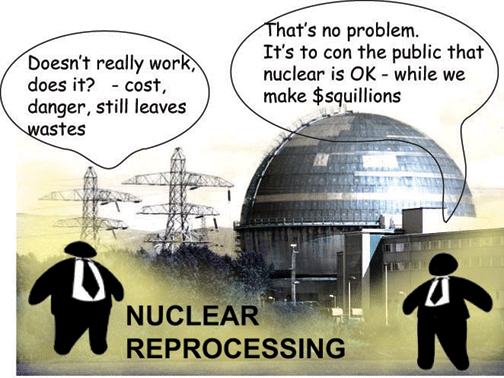
In fact, reprocessing irradiated fuel increases the volume of radioactive waste, while reducing only the level of radioactivity. This results in enormous discharges of so-called low- and intermediate-level but still highly radioactive wastes in the form of gases and liquids into the air and the English Channel. It is this that makes reprocessing arguably the dirtiest and most carcinogenic phase of the entire nuclear industry
.
Congresswoman talked nuclear nonsense, but does that mean she supports it?
Dear AOC, reprocessing is not recycling — Beyond Nuclear International
“………..the nuclear power propagandists, heralding her as the latest defector from the “Left” to the pro-nuclear power cause…………. But her errors are costly — to her credibility, as well as to the climate cause.
By Linda Pentz Gunter – from Ralph Nader’s new newspaper, the Capitol Hill Citizen, April 23
The progressive Democratic congresswoman, Alexandria Ocasio-Cortez, has 8.6 million followers on her Instagram account, a number identical to the online readership of the New York Times.
With her rock star-like AOC moniker and plenty of adoring fans, what the U.S. representative from Queens, New York writes or says has an impact. And it needs to be accurate. Presumably that is why Members of Congress deploy a slew of aides, tasked with delivering the details on a likely sometimes overwhelming array of topics.
When it comes to nuclear power, however, the Congresswoman from New York appears to be flying solo. Either that, or her aides are failing to do their homework. AOC’s stance on nuclear power was as confusing — and arguably as confused — during the introduction of the short-lived Green New Deal four years ago as her latest venture on Instagram after her February 2023 trip to Japan.
In 2019, after a February 7 joint press conference to roll out the blueprint for a Green New Deal alongside fellow Democrat, Senator Ed Markey, AOC’s office published details of the plan with nuclear power explicitly excluded. There was an immediate backlash, after which the reference to nuclear power’s exclusion was abruptly deleted. Asked to explain the switch, AOC told reporters that the Green New Deal “leaves the door open on nuclear so we can have that conversation” and that she herself did not “take a strong anti- or pro-position on it.”
From Japan earlier this year, AOC delivered a series of bubbly Instagram updates, mostly expressing her delight with Japan’s bullet trains. After her visit to the stricken Fukushima Daiichi nuclear power plant, site of the devastating March 2011 explosions and triple meltdowns, she put up a series of informational posts, then stumbled badly on the final question, which asked: “France uses nuclear power. How do they manage it differently? They don’t have earthquakes….”
For reasons that remain unclear, other than the French connection, AOC used this opportunity to launch what sounded unmistakably like praise for the end phase of nuclear power production — reprocessing. Only she called it “recycling”, a deliberately misleading industry term that masks the highly polluting operations involved in reprocessing, which takes irradiated reactor fuel and separates the plutonium from uranium in a chemical bath.
She then made a series of points, all of which were either factually or scientifically inaccurate, or both. We reached out to AOC’s press office for a response, but as of press time there was none.
These missteps begged the question as to the source of the Congresswoman’s information. Her use of the term “recycling” suggests that she, like most of her colleagues on the Hill, defers to the nuclear industry itself to sell her a highly sanitized version of its activities.
This is particularly frustrating coming from an elected official whose raison d’être is to serve as the people’s champion. Had her staff instead opened the door to eminently qualified academics on the subject, such as Princeton physicist, Frank von Hippel, never mind independent experts from the NGO world, they could have saved their boss considerable embarrassment.
Instead, AOC posted that “France recycles their nuclear waste,” even embedding the recycling logo in her text. But reprocessing does nothing of the kind.
Of that irradiated reactor fuel reprocessed at the La Hague nuclear center on France’s Normandy coast, 95% of it contains uranium products too contaminated for further use. This is trucked south for conversion and storage at the Pierrelatte/Tricastin enrichment facility, although for a time, some was shipped to Siberia. Of the remaining 5%, 4% of it is vitrified into glass logs and stored at La Hague. So is almost all of the separated plutonium, 1% of what’s left, now amounting to more than 80 tonnes.
A tiny fraction of that plutonium is “recycled” into something called Mixed-Oxide Fuel (MOX), used in 24 French reactors licensed to carry a 30% MOX fuel load. After fissioning, during which plutonium is once again produced, that waste is again shipped back to La Hague for storage.
AOC went on to explain that France’s “recycling” of nuclear waste had increased “the efficiency of their system.” It is not clear what this vague allusion means, but there is no debate about the extra costs incurred by France in choosing the reprocessing route. As a May 2007 analysis prepared for Public Citizen concluded: “The cumulative cost difference between full reprocessing and no reprocessing amounts to about $25 billion.”
AOC then wrote that French nuclear waste “recycling” was responsible for “reducing the overall amount of radioactive waste to deal with.” In fact, reprocessing irradiated fuel increases the volume of radioactive waste, while reducing only the level of radioactivity. This results in enormous discharges of so-called low- and intermediate-level but still highly radioactive wastes in the form of gases and liquids into the air and the English Channel. It is this that makes reprocessing arguably the dirtiest and most carcinogenic phase of the entire nuclear industry.
AOC also noted that “Japan sends its waste to France and the UK for recycling”. This practice was suspended some years ago, but when it was happening, it comprised more than 160 ship transports of at least 7,000 tons of lethal radioactive cargo, including plutonium, the trigger component for nuclear bombs, an inviting target for terrorists. Most of the reprocessed fuel was then returned to Japan, either in vitrified form or as MOX.
Surely none of this qualifies as recycling?
Needless to say, the pro-nuclear lobby seized on these pronouncements, turning AOC into the latest enviro-convert to the pro-nuclear side. She even garnered headlines in the French press, including in the conservative daily, Le Figaro, where a columnist exhorted French environmentalists to take inspiration from AOC’s epiphany and “abandon their anti-nuclear ideology”.
Newsweek characterized AOC’s Instagram posts as indicative of “The Left’s Changing Position on Nuclear Energy,” in its headline and suggested that “her appraisal of the fuel that provides 19 percent of Americans’ electricity seemed almost warm.”
All of this attention, whether invited or unwanted, prompted yet another ambiguous statement from AOC’s communications director, Lauren Hitt, who told Newsweek “We don’t have any changes in the Congresswoman’s policy posture re[garding] nuclear to announce as of now.”
But what exactly is Rep. Acasio-Cortez’s policy posture on nuclear power? That remains exasperatingly unclear.
Philippines unprepared for nuclear-related dangers

“Companies and the pro-nuclear lobby are not being forthright on the pitfalls of small modular reactors (SMR),”
“If constructed, the Philippines will be one of the guinea pigs in a costly experiment “
BYJONATHAN L. MAYUGA, MAY 15, 2023, Business Mirror
THE Philippines is not prepared for the risks posed by nuclear energy and should instead pursue the development of renewable energy. This was emphasized by Greenpeace Campaigner Khevin Yu during an online news briefing dubbed “The Economic Implications of a Philippine Nuclear Program: What the Pro-Nuclear Camp Won’t Tell Us” held last Friday.
Greenpeace held the briefing to issue its reaction to the House Committee on Appropriations’ approval of a House bill that seeks to establish a nuclear regulatory framework.
Citing a Philippine Institute for Development Studies (PIDS) report on the feasibility of nuclear energy in the Philippines, Yu said it would take at least a hundred years for the Philippines to be ready for the construction, operation and management of nuclear waste.
He said that similarly, the Philippines is not equipped with the technology nor the capacity to ensure the safe operation of nuclear energy, arguing that it will be too risky to operate such a facility in a country that is exposed to various natural disasters such as earthquakes, typhoons, landslides and flooding.
According to Yu, at least 14 sites are being eyed for the development of a nuclear facility in various locations, including Bataan, near the Bataan Nuclear Power Plant, which was abandoned by the government in the 1970s.
A lot better
GOING for renewable energy like solar energy is a lot better, Yu said because once it fails, solar energy can be quickly switched off without the risk of a nuclear disaster. He added that nuclear energy requires a lifetime to construct, operate and manage and is worse than fossil fuel, which can be shut down in 25 years. He said that disposing of wastes in nuclear will be problematic, citing the case of even advanced countries like Japan.
According to Greenpeace, the proposed Philippine National Nuclear Energy Act is a gruesome bill that, if enacted, will potentially bankrupt the country.
The group believes that the most that benefit from the proposed measure are the nuclear industry and nuclear companies.
“Posing a severe drain to the country’s financial resources, the bill will make the national government, local government units, using Filipino taxpayer money, shoulder most, if not all the liabilities—costs of short-and long-term waste storage, decommissioning and nuclear accidents— associated with nuclear energy,” it says.
During the briefing, Yu said nuclear energy is a costly source of power.
“It does not fit in a world beset by a global financial crisis, as countries like ours struggle from keeping the economy afloat while dealing with climate change impacts,” he said.
Yu said the nuclear bill in Congress will waste billions of taxpayer money even while it fails to propose any viable financial solutions to address the necessary gargantuan costs for short- and long-term radioactive waste storage, decommissioning and nuclear accidents.
“Companies and the pro-nuclear lobby are not being forthright on the pitfalls of small modular reactors (SMR),” he added.
Costs much higher
YU said there is no commercial SMR currently in operation in the world. If constructed, the Philippines will be one of the guinea pigs in a costly experiment, he said.
Moreover, he said the projected costs are much higher than our country can afford, putting the burden on our government and the people.
“Companies proposing SMRs, in reality, do not have sufficient capital to fund billions needed for nuclear accidents, early decommissioning and waste storage. Meanwhile, the Philippine government’s track record of making those responsible for environmental accidents like mine and oil spills is dismal,” he said.
In conclusion, Greenpeace said the Philippines government should drop Rep. Mark O. Cojuangco’s nuclear bill, arguing that it has “faulty provisions” and “neglects to tackle the true costs of nuclear energy”—both on the financial aspects of construction and operation, as well as, short and long term waste storage, decommissioning and nuclear accidents, all of which concern the safety of Filipino people.
Yu said the government should, in fact, drop plans to develop nuclear energy in the Philippines, altogether saying “it uses technologies and resources that are not readily available in the country and indigenous renewable sources are locally available and abundant, much faster to deploy, much less costly and does not carry inherent risks.
Instead, he said the Philippine government should prioritize a just transition to renewable energy.
The Nuclear Industry Thinks It Can Get Away With Dumping Far Hotter Wastes Because Cumbria Has a Short Memory?
Poster Against the 1990s NIREX plan for a Rock Laboratory to test the geology for deep dumping of low to intermediate level radioactive waste – now in a vicious mission creep the plan is Much Worse and Government and Nuclear Industry are ALREADY on with the rock characterisation over the heads of the public. It […]
A Quarter of a Century Ago NIREX was Refused Its “Rock Characterisation Facility” For Low to Intermediate Level Radioactive Wastes on the Lake District Coast – Now the Nuclear Industry Thinks It Can Get Away With Dumping Far Hotter Wastes Because Cumbria Has a Short Memory? — RADIATION FREE LAKELAND
Chris Hedges: Julian Assange – A Fight We Must Not Lose

BY TYLER DURDEN, FRIDAY, MAY 12, 2023,
https://www.zerohedge.com/geopolitical/chris-hedges-julian-assange-fight-we-must-not-lose—
Authored by Chris Hedges via ScheerPost.com, (emphasis ours)
This is a talk Chris Hedges gave in New York City at rally calling for the immediate release of Julian Assange on World Press Freedom Day.
The detention and persecution of Julian Assange eviscerates all pretense of the rule of law and the rights of a free press. The illegalities, embraced by the Ecuadorian, British, Swedish and U.S. governments are ominous. They presage a world where the internal workings, abuses, corruption, lies and crimes, especially war crimes, carried out by corporate states and the global ruling elite, will be masked from the public. They presage a world where those with the courage and integrity to expose the misuse of power will be hunted down, tortured, subjected to sham trials and given lifetime prison terms in solitary confinement. They presage an Orwellian dystopia where news is replaced with propaganda, trivia and entertainment. The legal lynching of Julian, I fear, marks the official beginning of the corporate totalitarianism that will define our lives.
Under what law did Ecuadorian President Lenin Moreno capriciously terminate Julian’s rights of asylum as a political refugee? Under what law did Moreno authorize British police to enter the Ecuadorian Embassy — diplomatically sanctioned sovereign territory — to arrest a naturalized citizen of Ecuador? Under what law did Donald Trump criminalize journalism and demand the extradition of Julian, who is not a U.S. citizen and whose news organization is not based in the United States? Under what law did the CIA violate attorney-client privilege, surveil and record all of Julian’s conversations both digital and verbal with his lawyers and plot to kidnap him from the Embassy and assassinate him?
The corporate state eviscerates enshrined rights by judicial fiat. This is how we have the right to privacy, with no privacy. This is how we have “free” elections funded by corporate money, covered by a compliant corporate media and under iron corporate control. This is how we have a legislative process in which corporate lobbyists write the legislation and corporate-indentured politicians vote it into law. This is how we have the right to due process with no due process. . This is how we have a government — whose fundamental responsibility is to protect citizens — that orders and carries out the assassination of its own citizens, such as the Muslim cleric Anwar al-Awlaki and his 16-year-old son. This is how we have a press which is legally permitted to publish classified information and our generation’s most important publisher sitting in solitary confinement in a high security prison awaiting extradition to the United States.
The psychological torture of Julian — documented by the United Nations special rapporteur on torture, Nils Melzer — mirrors the breaking of the dissident Winston Smith in George Orwell’s novel “1984.” The Gestapo broke bones. The East German Stasi broke souls. We, too, have refined the cruder forms of torture to destroy souls as well as bodies. It is more effective. This is what they are doing to Julian, steadily degrading his physical and psychological health. It is a slow-motion execution. This is by design. Julian has spent much of his time in isolation, is often heavily sedated and has been denied medical treatment for a variety of physical ailments. He is routinely denied access to his lawyers. He has lost a lot of weight, suffered a minor stroke, spent time in the prison hospital wing — which prisoners call the hell wing — because he is suicidal, been placed in prolonged solitary confinement, observed banging his head against the wall and hallucinating. Our version of Orwell’s dreaded Room 101.
The psychological torture of Julian — documented by the United Nations special rapporteur on torture, Nils Melzer — mirrors the breaking of the dissident Winston Smith in George Orwell’s novel “1984.” The Gestapo broke bones. The East German Stasi broke souls. We, too, have refined the cruder forms of torture to destroy souls as well as bodies. It is more effective. This is what they are doing to Julian, steadily degrading his physical and psychological health. It is a slow-motion execution. This is by design. Julian has spent much of his time in isolation, is often heavily sedated and has been denied medical treatment for a variety of physical ailments. He is routinely denied access to his lawyers. He has lost a lot of weight, suffered a minor stroke, spent time in the prison hospital wing — which prisoners call the hell wing — because he is suicidal, been placed in prolonged solitary confinement, observed banging his head against the wall and hallucinating. Our version of Orwell’s dreaded Room 101.
All these crimes, especially after the attacks of 9/11, have returned with a vengeance. The CIA has its own armed units and drone program, death squads and a vast archipelago of global black sites where kidnapped victims are tortured and disappeared.
The U.S. allocates a secret black budget of about $50 billion a year to hide multiple types of clandestine projects carried out by the National Security Agency, the CIA and other intelligence agencies, usually beyond the scrutiny of Congress. The CIA has a well-oiled apparatus, which is why, since it had already set up a system of 24-hour video surveillance of Julian in the Ecuadorian embassy in London, it quite naturally discussed kidnapping and assassinating Julian. That is its business. Sen. Frank Church — after examining the heavily redacted CIA documents released to his committee — defined the CIA’s “covert activity” as “a semantic disguise for murder, coercion, blackmail, bribery, the spreading of lies and consorting with known torturers and international terrorists.”
Fear the puppet masters, not the puppets. They are the enemy within.
This is a fight for Julian, who I know and admire. It is a fight for his family, who are working tirelessly for his release. It is a fight for the rule of law. It is a fight for the freedom of the press. It is a fight to save what is left of our diminishing democracy. And it is a fight we must not lose.
As Donetsk civilians live in constant fear of Ukrainian shelling, from on the ground, I detail the terror
May 11, 2023, -Eva Karene Bartlett https://www.patreon.com/posts/as-donetsk-live-82857680?utm_medium=post_notification_email&utm_campaign=patron_engagement&utm_source=post_link
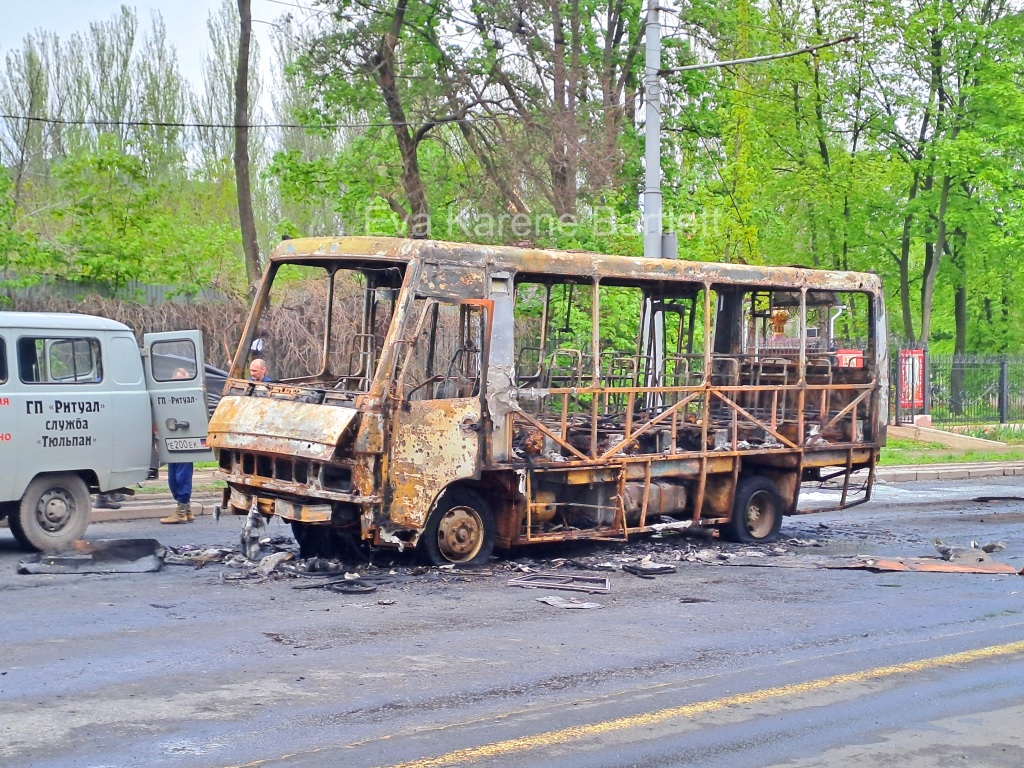
Heavy Ukrainian shelling of central Donetsk on April 28 killed nine civilians – including an eight-year-old girl and her grandmother – and injured at least 16 more. The victims were burned alive when the minibus they were in was hit by a shell.
The attack also targeted a major hospital, apartment buildings, houses, parks, streets, and sidewalks. All civilian areas – not military targets.
According to the Donetsk People’s Republic’s (DPR) Representative Office in the JCCC (Joint Monitoring and Co-ordination Center on Ukraine’s War Crimes), Kiev’s forces fired high-explosive fragmentation missiles “produced in Slovakia and transferred to Ukraine by NATO countries.” Regarding an earlier shelling on the same day, the JCCC noted that US-made HIMARS systems were used, targeting “exclusively in the residential, central quarter of the city.”
I was outside of Donetsk interviewing refugees from Artyomovsk (also known as Bakhmut) when both rounds of intense shelling occurred, the first starting just after 11am. I returned to see a catastrophic scene, with a burnt-out bus – still smoking – and some of its passengers’ charred bodies melted onto the frame. This tragic picture was sadly not a one-off event.
Elsewhere, city workers were already removing debris and had begun repaving damaged sections of the roads. I’ve seen this following Ukrainian shelling many times, including on January 1 this year, when Ukraine fired 25 Grads into the city centre. Similarly, in July 2022, Ukrainian shelling downtown killed four civilians, including two in a vehicle likewise gutted by flames. When I arrived at the scene about an hour later, workers were repaving the affected section of the street.
The damage to the Republican Trauma Center hospital was quickly cleaned up, but videos shared on Telegram immediately after the shelling show a gaping hole in one of the walls. The room concerned contained what was, apparently, Donetsk’s sole MRI machine.
Along Artyoma street, the central Donetsk boulevard targeted countless times by Ukrainian attacks, the destruction was evident: Two cars caught up in the bombing, residents of an apartment building boarding up shattered windows and doors, the all-too-familiar sound of glass and debris being swept away. In the residential area, the first to be targeted that day, in a massive crater behind one house, the walls and roof of another home were intermixed with rocket fragments.
Another year of Ukrainian war crimes
In April 2022, following strikes on a large market area in Kirovsky district, in western Donetsk, which killed five civilians and injured 23, I went there to document the aftermath, not expecting to see two of the five dead still lying in nearby lanes. This shelling was just before noon, a busy time of day in the area. Bombing at such periods is an insidious tactic to ensure more civilians are maimed or killed.
Double and triple striking the same areas is another method used by Ukrainian forces. In an interview last year, the director of the Department of Fire and Rescue Forces of the DPR Ministry of Emergency Situations, Sergey Neka, told me, “Our units arrive at the scene and Ukraine begins to shell it. A lot of equipment has been damaged and destroyed.”
Andrey Levchenko, chief of the emergency department for the Kievsky district of Donetsk, also hit by Ukrainian attacks, said: “They wait for 30 minutes for us to arrive. We arrive there, start assisting people, and the shelling resumes. They wait again, our guys hide in the shelters, as soon as we go out, put out the fire, help people, then shelling resumes.”
I was here in Donetsk in mid-June, during a day of particularly intense Ukrainian shelling of the very centre of the city, which killed at least five civilians. The DPR authorities reported that “within two hours, almost 300 MLRS rockets and artillery shells were fired.” One Grad rocket hit a maternity hospital, tearing through the roof.
The following month, Ukraine fired rockets containing internationally-banned ‘petal’ mines. The streets of central Donetsk, as well as the western and northern districts and other cities, were littered with the hard-to-spot mines designed to grotesquely maim, but not necessarily kill, anyone stepping on them. These mines keep claiming new victims to this day – when I last wrote about them here, 104 civilians had been maimed, including this 14-year-old boy. Three had died of their injuries. Since then, the number of victims has risen to 112.
In August, heavy Ukrainian shelling of the centre of Donetsk hit directly next to the hotel I was staying in, along with dozens of other journalists and cameramen. Six civilians were killed that day, including one woman outside the hotel, as well as a child. She been a talented ballerina due to leave to study in Russia soon, and along with her grandmother, her ballet teacher was also killed that day, herself a world-famous former ballerina.
Three bouts of Ukrainian shelling of the city centre in a span of just five days in September killed 26 civilians. Four were killed on September 17, among them two people burned alive inside a vehicle on the same central Artyoma Street. Two days later, 16 civilians were killed, the remains of their bodies strewn along the street or in unrecognizable piles of flesh. Three days later, Ukraine struck next to the central market, killing six civilians, two in a minibus, the rest on the street.
In my subsequent visits to Donetsk and surrounding cities in November and December, I filmed the aftermath of more Ukrainian shelling (using HIMARS) of civilian areas of Donetsk and the settlement of Gorlovka to the north. The November 7 shelling of central Donetsk could have killed the toddler of the young mother I interviewed. Fortunately, after hearing the first rockets hit, she ran with her son to the bathroom. When calm returned, she found shrapnel on his bed.
The November 12 shelling of Gorlovka damaged a beautiful historic cultural building, destroying parts of the roof and the theatre hall within. According to the centre’s director, it was one of the best movie theatres in Donetsk Region, one of the oldest, most beautiful, and most beloved buildings in the city. He noted that the HIMARS system is a very precise weapon, so the attack was not accidental.
The shelling goes on
Early morning during Easter Mass on April 16, the Ukrainian army fired 20 rockets near the Cathedral of the Holy Transfiguration in the centre of Donetsk, French journalist Christelle Neant reported, noting that one civilian was killed and seven injured. The shelling extended to the central market just behind the cathedral. Just over a week prior, on April 7, another shelling of that market killed one civilian and injured 13, also considerably damaging the market itself.
Ukraine continues to shell the western and northern districts of Donetsk, also pounding Gorlovka, as well as Yasinovatya just north of Donetsk (killing two civilians some days ago).
On April 23, shelling in Petrovsky, a hard-hit western Donetsk district, killed one man and injured five more. The same day, in a village northeast of Donetsk, a rocket killed two women in their 30s. Security camera footage shows the moment when the women attempted to take cover. The munition that killed them hit directly next to where they huddled.
A few days later, on my way to interview refugees from Artyomovsk sheltering in another city, I passed along the tiny village where those women were killed. It’s a road I’ve driven a dozen times or more, a quiet, calm, scenic region of rolling hills, a lovely river, a beautiful church. It’s far from any front line. The murder of these two women was another Ukrainian war crime.
The people here are constantly terrorized by Ukrainian shelling or the threat of it, and have been since Kiev started its war on the Donbass in 2014.
Risks too high at Zaporizhzhia
May 10, 2023 https://beyondnuclear.org/risks-too-high-at-zaporizhzhia/
Beyond Nuclear has put out a press statement warning that the risks of a nuclear catastrophe at Ukraine’s six-reactor Zaporizhzhia nuclear power plant are too high, with rumors of a Ukrainian offensive reportedly prompting mass evacuations of civilians living near the plant. Only an immediate ceasefire — or, better still, a negotiated end to a likely unwinnable war — can protect us from a potentially catastrophic nuclear incident at the plant, which has already endured shelling, missile attacks, and frequent loss of connection to the electrical grid.
The press release begins:
Fears of an imminent Ukrainian offensive that could put the country’s six-reactor Zaporizhzhia nuclear power plant in even greater danger, should prompt immediate efforts to negotiate a ceasefire, if not an end to the Russian war against Ukraine, urged safe energy group, Beyond Nuclear today.
News reports that civilians around the Zaporizhzhia nuclear power plant are being evacuated suggest that the conflict already consuming the southwestern region of Ukraine could be about to escalate, potentially engulfing the nuclear plant.
The Zaporizhzhia nuclear power plant has already escaped close calls, the target of shelling and missile attacks on at least one occasion and with frequent losses of offsite power that, if not restored promptly, could lead to a meltdown.
The plant has been occupied by Russian forces since March 4, 2022. Rumors abound that a severely depleted workforce is laboring under stressful and even violent conditions, while other staff have fled or have disappeared.
As a precaution, all six Zaporizhzhia reactors are currently shut down, but that does not mean they are out of danger.
“The fuel in the reactor core still requires electricity to power cooling, as do the pumps that supply cooling water to the fuel pools,” warned Beyond Nuclear international specialist, Linda Pentz Gunter. “A meltdown is still possible. Putting the reactors in what is termed ‘cold shutdown’ just buys workers more time to restore power, but a reliable supply of electricity to the site is still essential to avoid disaster.
“The consequences not only for the people of Ukraine and neighboring Russia, but for all of Europe, should any or all of these reactors melt down or suffer a fuel pool fire are unimaginably dire,” Pentz Gunter said.
Biden is selling weapons to the majority of the world’s autocracies

Despite the White House’s rhetoric about supporting global democracy, the U.S. sold weapons in 2022 to 57 percent of the world’s authoritarian regimes.
Stephen Semler, May 11 2023, The Intercept
SINCE PRESIDENT JOE BIDEN came into office in 2021, he hasdescribed a “battle between democracies and autocracies” in which the U.S. and other democracies strive to create a peaceful world. The reality, however, is that the Biden administration has helped increase the military power of a large number of authoritarian countries. According to an Intercept review of recently released government data, the U.S. sold weapons to at least 57 percent of the world’s autocratic countries in 2022.
Since the end of the Cold War, the United States has been the world’s biggest weapons dealer, accounting for about 40 percent of all arms exports in a given year. In general, these exports are funded through grants or sales. There are two pathways for the latter category: foreign military sales and direct commercial sales.
The U.S. government acts as an intermediary for FMS acquisitions: It buys the materiel from a company first and then delivers the goods to the foreign recipient. DCS acquisitions are more straightforward: They’re the result of an agreement between a U.S. company and a foreign government. Both categories of sales require the government’s approval.
Country-level data for last year’s DCS authorizations was released in late April through the State Department’s Directorate of Defense Trade Controls. FMS figures for fiscal year 2022 were released earlier this year through the Pentagon’s Defense Security Cooperation Agency. According to their data, a total of 142 countries and territories bought weapons from the U.S. in 2022, for a total of $85 billion in bilateral sales.
How many of those countries were democracies, and how many were autocracies? That question can be answered by comparing the new U.S. arms sales data to political regime data from the Varieties of Democracy project at the University of Gothenburg in Sweden, which uses a classification system that’s called Regimes of the World.
The system classifies regimes into four categories: closed autocracy, electoral autocracy, electoral democracy, and liberal democracy. For a country to be classified as a democracy, it must have multiparty elections and political freedoms that make those elections meaningful. According to this methodology, the dividing line between democracies and autocracies is whether a country’s leaders are accountable to their citizens through free and fair elections.
Of the 84 countries codified as autocracies under the Regimes of the World system in 2022, the United States sold weapons to at least 48, or 57 percent, of them. The “at least” qualifier is necessary because several factors frustrate the accurate tracking of U.S. weapons sales. The State Department’s report of commercial arms sales during the fiscal year makes prodigious use of “various” in its recipients category; as a result, the specific recipients for nearly $11 billion in weapons sales are not disclosed………………………… https://theintercept.com/2023/05/11/united-states-foreign-weapons-sales/
Experts urge G7 leaders to discuss nuclear security
NNK News, , May 12, 23
Amid Russia’s invasion of Ukraine, the threat of nuclear weapons use continues to grow but nuclear security is also endangered in the region. Experts from the US and Japan called for the G7 leaders to address these issues at next week’s summit in Hiroshima.
Rafael Grossi, head of the International Atomic Energy Agency, warned on Saturday that the situation around Russian-held Zaporizhzhia nuclear power plant is unpredictable and potentially dangerous.
He also expressed concern about the stressful conditions for people working there as military activity increases in the region.
Experts gathered in Tokyo on Thursday to discuss how countries can protect their nuclear facilities from being targeted by other nations. They condemned Russia’s actions, saying they could result in a devastating situation.
Nuclear Threat Initiative’s Scott Roecker said, “The most significant risk we’re worried about is not a nuclear detonation — it’s not a nuclear explosion with a mushroom cloud. It is the risk of significant radiation release associated with an attack on Zaporizhzhia nuclear power plant.”
The nuclear issue is one of the important topics that will be discussed at the G7 Summit. Ukrainian President Volodymyr Zelenskyy is scheduled to attend online. He is expected to call for discussions on nuclear security.
Roecker said, “The G7 leaders have a unique opportunity in Hiroshima to talk about what’s happening from a nuclear standpoint in Ukraine. There needs to be more done to strengthen the international legal framework and the international norms around nuclear facilities in times of conflict that need to be better protected. And they should not be a target during military conflict.”….. https://www3.nhk.or.jp/nhkworld/en/news/20230512_05/
Counting the rising costs of Scotland’s nuclear testing facility

Alan Laird, 12 May 23
https://www.thenational.scot/community/23516945.counting-rising-costs-scotlands-nuclear-testing-facility/
HOW magnanimous of Andrew Bowie, Westminster’s Nuclear Minister, not to “impose nuclear power on Scotland” (The National, May 4), although he’s a bit late with that assurance. But never mind democracy, let’s look at the cost.
Dounreay was commissioned as a test facility in 1955 on our north coast – in other words, “let’s put it waaaay up there in case something goes wrong”.
The initial research reactor “went critical” – a not very reassuring term for “started working” – in 1958.
The Dounreay Fast Reactor started up in 1959 and shut down in 1977 after 15 years of operation. Its maximum output of 14MW was negligible.
A Fast-Breeder Reactor, now an abandoned technology, began supplying 250MW from 1975 till 1995, enough for about 48,000 homes. Its cooling was by liquid sodium – 1500 tons of the stuff – which explodes instantly in contact with air. Cool.
Then there is the military site, HMS Vulcan, for development and testing the reactors of nuclear-powered submarines. From 1963 to 2015, five generations of small reactors have been tested here, routinely run at greater than operational stress to find out any faults before installation in the subs. How reassuring. As with MoD sites on the Clyde, full disclosure of breaches of health and safety are not disclosed. The site is due for decommissioning next year. Estimates of the costs are not available.
In 1998, following safety and pollution concerns, Norway, Sweden and the Irish Republic demanded the immediate closure of the site. PM Tony Blair was advised it would take £1 billion and 100 years to complete the work. By 2006, 25 years and £2.7bn was the estimate, then in 2007 it was 17 years and £2.6bn. In 2019 contracts worth £400m were awarded to continue the clean-up, with a new estimate of £4.3bn and 60 years. I guess no-one actually knows.
The site also took in foreign spent nuclear fuel for reprocessing. Unsurprisingly, many foreign customers refused to take their nuclear waste back. It’s mostly still there, along with Dounreay’s own.
The expected date of the return of the site to brownfield use is 2330. Yes, that’s more than 300 years from now. Uncountable billions of pounds and nearly 400 years of an unusable bit of Scotland is an astounding price to pay for powering 48,000 homes.
The arguments for nuclear power put forward by the industry and their UK Government lackeys are contradictory, disingenuous and downright dishonest.
Dounreay’s installation is a mere toy compared to Hunterston (both reactors now decommissioned) and Torness (the nuclear regulator thinks it should close by 2024). First estimates for decommissioning these sites is £132 billion and 120 years. I wonder when that estimate will be revised upward?
Just as a footnote, all of the UK’s uranium has to be imported. Much of it from Russia. The real reason the UK Government wants to continue with this outrageous waste of money is for the steady supply of enriched uranium for making atomic bombs. That’s worth it to them at any cost.
1 This Month
23-25 October – on Zoom – World BEYOND War’s annual global conferenc


Shut down the radiation-damaged Heysham nuclear reactors now
To see nuclear-related stories in greater depth and intensity – go to https://nuclearinformation.wordpress.com

Say No to NASA’s Reckless Nuclear Reactor on the Moon
Say No to NASA’s Reckless Nuclear Reactor on the Moon

-
Archives
- October 2026 (199)
- September 2026 (339)
- August 2026 (330)
- July 2026 (355)
- June 2026 (287)
- May 2026 (306)
- April 2026 (356)
- March 2026 (251)
- February 2026 (267)
- January 2026 (308)
- December 2025 (358)
- November 2025 (359)
-
Categories
- 1
- 1 NUCLEAR ISSUES
- business and costs
- climate change
- culture and arts
- ENERGY
- environment
- health
- history
- indigenous issues
- Legal
- marketing of nuclear
- media
- opposition to nuclear
- PERSONAL STORIES
- politics
- politics international
- Religion and ethics
- safety
- secrets,lies and civil liberties
- spinbuster
- technology
- Uranium
- wastes
- weapons and war
- Women
- 2 WORLD
- ACTION
- AFRICA
- Atrocities
- AUSTRALIA
- Christina's notes
- Christina's themes
- culture and arts
- Events
- Fuk 2022
- Fuk 2023
- Fukushima 2017
- Fukushima 2018
- fukushima 2019
- Fukushima 2020
- Fukushima 2021
- general
- global warming
- Humour (God we need it)
- Nuclear
- RARE EARTHS
- Reference
- resources – print
- Resources -audiovicual
- Weekly Newsletter
- World
- World Nuclear
- YouTube
-
RSS
Entries RSS
Comments RSS

