Sowing Seeds of Plunder: A Lose-Lose Situation in Ukraine

President Zelenskyy put the land reform into law in 2020 against the will of the vast majority of the population who feared it would exacerbate corruption and reinforce control by powerful interests in the agricultural sector.
The largest landholders are a mix of Ukrainian oligarchs and foreign interests — mostly European and North American as well as the sovereign fund of Saudi Arabia.
Ed note: The irony of it! Ukrainians hold the hated memory of Soviet Russia starving Ukraine, as it sent their grain to Russia. Now we have the Western world helping themselves to Ukraine’s agriculture – with increasing farming for export, – pushing out the livelihood’s of Ukrainian small farmers. Zelensky – seen as a hero/saviour for now – – but how will this clown be remembered?
y Colin Todhunter, 10 May 23 https://www.globalresearch.ca/sowing-seeds-plunder-lose-lose-situation-ukraine/5818851
It’s a lose-lose situation for Ukrainians. While they are dying to defend their land, financial institutions are insidiously supporting the consolidation of farmland by oligarchs and Western financial interests.
So says Frédéric Mousseau, Policy Director of the Oakland Institute, an independent think tank.
Depending on which sources to believe, between 100,000 and 300,000 Ukrainian soldiers (possibly more) have died during the conflict with Russia. That figure, of course, does not include civilian casualties.
The mainstream narrative in the West is that Russia grabbed Crimea and then invaded Ukraine. Russia is portrayed as the outright aggressor which wants to restore its control over large swathes of Europe.
The expansion of NATO towards the east, the US-backed coup in 2014 – followed by eight years of the shelling of the ethnic Russian eastern parts of the country by the regime in Kyiv resulting in around 14,000 deaths – led up to the military intervention by Russia, which regards the expansionism and militarism as an existential threat.
It is not the purpose of this article to explore these issues. Much has already been written on this elsewhere. But billions of dollars’ worth of military hardware has been sent to Ukraine by the NATO countries and hundreds of thousands of young Ukrainians have died.
They died in the belief that they were protecting their nation – their land. A land that is among the most fertile in the world.
Professor Olena Borodina of the National Academy of Sciences of Ukraine says:
“Today, thousands of rural boys and girls, farmers, are fighting and dying in the war. They have lost everything. The processes of free land sale and purchase are increasingly liberalised and advertised. This really threatens the rights of Ukrainians to their land, for which they give their lives.”
Borodina is quoted in the February 2023 report by the Oakland Institute War and Theft: The Takeover of Ukraine’s Agricultural Land, which reveals how oligarchs and financial interests are expanding control over Ukraine’s agricultural land with help and financing from Western financial institutions.
Aid provided to Ukraine in recent years has been tied to a drastic structural adjustment programme requiring the creation of a land market through a law that leads to greater concentration of land in the hands of powerful interests. The programme also includes austerity measures, cuts in social safety nets and the privatisation of key sectors of the economy.
Frédéric Mousseau, co-author of the report, says:
“Despite being at the centre of news cycle and international policy, little attention has gone to the core of the conflict — who controls the agricultural land in the country known as the breadbasket of Europe. [The] Answer to this question is paramount to understanding the major stakes in the war.”
The report shows the total amount of land controlled by oligarchs, corrupt individuals and large agribusinesses is over nine million hectares — exceeding 28% of Ukraine’s arable land (the rest is used by over eight million Ukrainian farmers).
Amidst Chaos of War, a New Report Exposes the Stealth Take-over of Ukrainian Agricultural Land
The largest landholders are a mix of Ukrainian oligarchs and foreign interests — mostly European and North American as well as the sovereign fund of Saudi Arabia. A number of large US pension funds, foundations and university endowments are also invested in Ukrainian land through NCH Capital – a US-based private equity fund, which is the fifth largest landholder in the country.
President Zelenskyy put the land reform into law in 2020 against the will of the vast majority of the population who feared it would exacerbate corruption and reinforce control by powerful interests in the agricultural sector.
The Oakland Institute notes that, while large landholders are securing massive financing from Western financial institutions, Ukrainian farmers — essential for ensuring domestic food supply — receive virtually no support. With the land market in place, amid high economic stress and war, this difference of treatment will lead to more land consolidation by large agribusinesses.
All but one of the ten largest landholding firms are registered overseas, mainly in tax havens such as Cyprus or Luxembourg. The report identifies many prominent investors, including Vanguard Group, Kopernik Global Investors, BNP Asset Management Holding, Goldman Sachs-owned NN Investment Partners Holdings, and Norges Bank Investment Management, which manages Norway’s sovereign wealth fund.
Most of the agribusiness firms are substantially indebted to Western financial institutions, in particular the European Bank for Reconstruction and Development, the European Investment Bank, and the International Finance Corporation – the private sector arm of the World Bank.
Together, these institutions have been major lenders to Ukrainian agribusinesses, with close to US$1.7 billion lent to just six of Ukraine’s largest landholding firms in recent years. Other key lenders are a mix of mainly European and North American financial institutions, both public and private.
The report notes that this gives creditors financial stakes in the operation of the agribusinesses and confers significant leverage over them. Meanwhile, Ukrainian farmers have had to operate with limited amounts of land and financing, and many are now on the verge of poverty.
International financial institutions are in effect subsidising the concentration of land and a destructive industrial model of agriculture based on the intensive use of synthetic inputs, fossil fuels and large-scale monocropping.
Much of what is happening in Ukraine is part of a wider trend: private equity funds being injected into agriculture throughout the world and used to lease or buy up farms on the cheap and aggregate them into large-scale, industrial grain and soybean concerns. These funds use pension funds, sovereign wealth funds, endowment funds and investments from governments, banks, insurance companies and high net worth individuals (see the 2020 report ‘Barbarians at the Barn‘ by Grain.org).
Financialising agriculture this way shifts power to people with no connection to farming. In the words of BlackRock’s Larry Fink: “Go long agriculture and water and go to the beach.”
Funds tend to invest for between 10 and 15 years, resulting in good returns for investors but can leave a trail of long-term environmental and social devastation and serve to undermine local and regional food insecurity.
By contrast, according to the Oakland Institute, small-scale farmers in Ukraine demonstrate resilience and enormous potential for leading the expansion of a different production model based on agroecology and producing healthy food. Whereas large agribusinesses are geared towards export markets, it is Ukraine’s small and medium-sized farmers who guarantee the country’s food security.
This is underlined by the State Statistics Service of Ukraine in its report ‘Main agricultural characteristics of households in rural areas in 2011’, which showed that smallholder farmers in Ukraine operate 16% of agricultural land, but provide 55% of agricultural output, including 97% of potatoes, 97% of honey, 88% of vegetables, 83% of fruits and berries and 80% of milk.
In June 2020, the IMF approved an 18-month, strings-attached $5 billion loan programme with Ukraine. Also that year, the World Bank incorporated measures relating to the sale of public agricultural land as conditions in a $350 million Development Policy Loan (COVID ‘relief package’) to Ukraine. This included a required ‘prior action’ to “enable the sale of agricultural land and the use of land as collateral.”
According to the Oakland Institute:
“Ukraine is now the world’s third-largest debtor to the International Monetary Fund and its crippling debt burden will likely result in additional pressure from its creditors, bondholders and international financial institutions on how post-war reconstruction – estimated to cost US$750 billion – should happen.”
Financial institutions are leveraging Ukraine’s crippling debt to drive further privatisation and liberalisation – backing the country into a corner to make it an offer it can’t refuse.
Since the war began, the Ukrainian flag has been raised outside parliament buildings in the West and iconic landmarks have been lit up in its colours. An image bite used to conjure up feelings of solidarity and support for that nation while serving to distract from the harsh machinations of geopolitics and modern-day economic plunder that is unhindered by national borders and has scant regard for the plight of ordinary citizens.
Zaporizhzhia nuclear plant facing ‘catastrophic’ staff shortage amid Russian evacuation
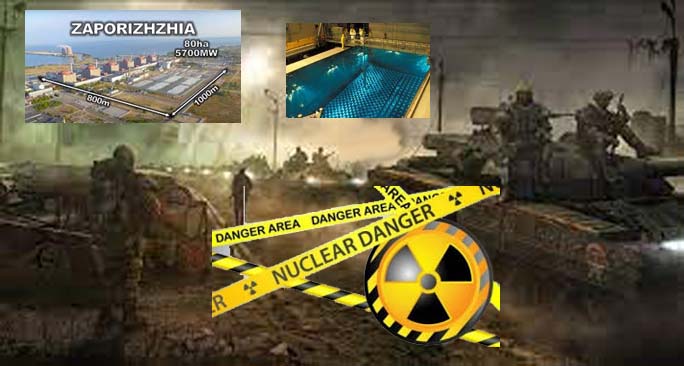
Russia plans to relocate thousands of staff from nuclear plant, atomic energy company claims, warning of ‘catastrophic lack of qualified personnel’
Associated Press, 11 May 23
Russia plans to relocate about 2,700 Ukrainian staff from Europe’s largest nuclear plant, Ukraine’s atomic energy company has claimed, warning of a potential “catastrophic lack of qualified personnel” at the Zaporizhzhia facility in Russian-occupied southern Ukraine.
Workers who signed employment contracts with Russia’s nuclear agency Rosatom following Moscow’s capture of the Zaporizhzhia plant early in the war are set to be taken to Russia along with their families, Energoatom said in a Telegram post on Wednesday.
The company did not specify whether the employees would be forcibly moved out of the plant, nor was it immediately possible to verify Energoatom’s claims about Moscow’s plan.
Removing staff would “exacerbate the already extremely urgent issue” of staff shortages, Energoatom said.
The Moscow-installed governor of the region ordered civilian evacuations from the area last Saturday, including from the nearby city of Enerhodar where most plant workers live. The full scope of the evacuation order was not clear.
Russian forces seized the Zaporizhzhia plant days after Russian president, Vladimir Putin, ordered the invasion of Ukraine in February 2022. Russian occupiers left the Ukrainian staff in place to keep the plant running but the exact number of workers currently at the plant is not known.
Fighting near the plant has fuelled fears of a potential catastrophic incident like the one at Chornobyl, in northern Ukraine, where a reactor exploded in 1986 and contaminated a vast area in the world’s worst nuclear accident.
Zaporizhzhia is one of the 10 biggest nuclear plants in the world. While its six reactors have been shut down for months, it still needs power and qualified staff to operate crucial cooling systems and other safety features…………………. more https://www.theguardian.com/world/2023/may/11/zaporizhzhia-nuclear-plant-facing-catastrophic-staff-shortage-amid-russian-evacuation
Regulator issues permit for New Mexico nuclear waste facility against wishes of local, state, and federal leaders
By Simon Druker, https://www.upi.com/Top_News/US/2023/05/09/3631683671382/
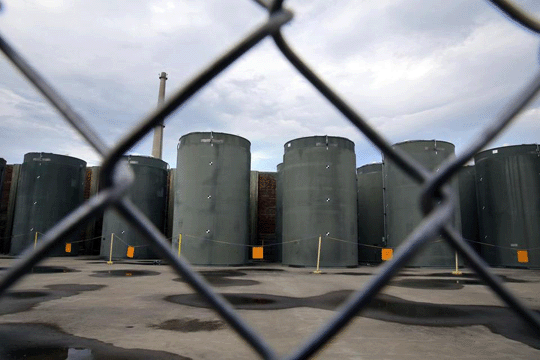
May 9 (UPI) — The agency that governs nuclear power in the United States issued a permit Tuesday to build a facility to store nuclear waste in New Mexico.
The Nuclear Regulatory Commission permit goes against the wishes of both state and federal elected officials.
“I have been strongly opposed to the interim storage of spent nuclear fuel and high-level waste in New Mexico, which would pose serious risks to our communities. But today’s announcement paves the way for New Mexico to be home for indefinite storage of spent nuclear fuel,” Sen. Ben Ray Lujan D-N.M., told The Hill in a statement.
“This approach — over the objections of many local, state, and federal leaders — is unacceptable,” he said.
Gov. Michelle Lujan Grisham, D-N.M., in March signed legislation prohibiting the facility from being built by Florida-based Holtec International.
It’s not clear what effect her law would have on the NRC’s federal permit.
Lujan Grisham called on President Joe Biden to intervene.
The NRC permit grants Holtec the right to build the consolidated interim storage facility for spent nuclear fuel in the state’s Lea County. The company can store 500 canisters, or approximately 8,680 metric tons, of spent nuclear fuel for 40 years.
Holtec said it plans to eventually apply for amended licenses in order to eventually store up to 10,000 canisters or approximately 173,600 metric tons over an additional 19 phases.
The company was founded in 1986 in New Jersey and specializes in manufacturing parts for nuclear reactors. It also offers existing nuclear waste storage services.
Despite having the permit, Holtec is not fully committed to moving ahead with the project.
“We’re still working with our partners and the key stakeholders to understand what our paths are … what our potential options are. Then we’re going to head forward from that,” the company’s director of government affairs and communications Patrick O’Brien told the Albuquerque Journal in an interview Tuesday.
Robert Kennedy Jr: America needs a revolution
The 2024 outsider on Biden, Ukraine and Covid misinformation, more https://unherd.com/thepost/robert-kennedy-jr-america-needs-a-revolution/ 4 May 23
For decades, as a scion of the Kennedy family and environmental litigator, Robert F. Kennedy Jr was considered an establishment hero. In recent years, however, his rhetoric against Covid lockdowns and vaccines sealed his reputation among most commentators as irresponsible and potentially dangerous. So, since he announced that he was running for president two weeks ago, challenging Joe Biden for the Democratic nomination, he has presented the establishment media with something of a conundrum. He is already polling at 20% — should he be ignored or interrogated?
UnHerd‘s Freddie Sayers invited RFK Jr. to the studio to discuss his campaign promises and get behind the controversies.
Canada’s radioactive waste and decommissioning policy is a failure
by Ole HendricksonMay 8, 2023 https://rabble.ca/columnists/canadas-radioactive-waste-and-decommissioning-policy-is-a-failure/
Ole Hendrickson argues Canada’s new radioactive waste and decommissioning policy ignores Indigenous rights, public input and international safety standards.
Natural Resources Canada (NRCan) issued a news release on March 27 headlined “Now Live: Government of Canada’s Modernized Policy for Radioactive Waste and Decommissioning for Canada.”
NRCan then waited five more days before making the policy available on its website.
Why the delay?
If a government agency knows that information will generate a negative reaction from the public, it posts it quietly on a Friday to minimize media attention.
The Canadian Environmental Law Association (CELA) gave the policy a failing grade, saying, “There is no provision for independent management of nuclear waste.”
Nor does the policy acknowledge Article 29(2) of the U.N. Declaration on the Rights of Indigenous Peoples.
“States shall take effective measures to ensure that no storage or disposal of hazardous materials shall take place in the lands or territories of indigenous peoples without their free, prior and informed consent,” the Article reads.
After NRCan released a draft of the policy a year earlier, the Council of Canadians sent out an action alert that triggered 7,400 emails demanding “an independent oversight body free from industry influence to regulate our radioactive waste.”
Nuclear Waste Watch submitted An Alternative Policy for Canada on Radioactive Waste Management and Decommissioning based on International Atomic Energy Agency safety standards and requirements for decommissioning, waste storage, and waste disposal.
Why does Canada’s new radioactive waste and decommissioning policy ignore Indigenous rights, public input and international safety standards? Is this a desperate attempt to revive a fading nuclear industry by allowing it to ignore its waste problem?
The new policy illustrates the conflict of interest facing NRCan Minister Jonathan Wilkinson, charged with promoting nuclear energy under the Nuclear Energy Act.
When Budget 2023 was tabled, John Gorman, president of the Canadian Nuclear Association, wrote in a LinkedIn post, “I am personally grateful to Minister Wilkinson in particular, and his team of dedicated staff at NRCan (including but not limited to Mollie Johnson, Claire Seaborn, John Hannaford, and Debbie Scharf), who have championed the role of nuclear in Canada.”
As NDP deputy leader Alexander Boulerice noted at a recent press conference, NRCan has been infiltrated by pro-nuclear proponents.
“They don’t have to knock on the door to get into the house because they own the house,” Boulerice said.
In other OECD countries, multiple competent regulatory authorities are involved in radioactive waste management and decommissioning. Nearly all have a national oversight body. France also has a national financial evaluation commission to assess the funding of costs of dismantling nuclear installations and of managing spent fuel and other radioactive waste.
In contrast, Canada suffers from a nuclear waste governance void. Canada’s benign nuclear regulator, the Canadian Nuclear Safety Commission (CNSC), allows the nuclear industry to propose its own waste disposal projects with limited technical oversight and no financial oversight. The Nuclear Waste Management Organization is a private organization run by the nuclear utilities that produce the waste.
Canada also now has a weak, hands-off, industry-friendly policy.
Nuclear non-proliferation experts have warned Canada that extracting plutonium from high-level fuel waste risks weapons proliferation. The policy shirks responsibility for the oversight of plutonium extraction (or “reprocessing”), even as the government has given $50.5 million to a start-up company, Moltex Energy, to develop this technology.
The new policy will allow current projects for abandonment of federal nuclear waste to continue. In 2015, Atomic Energy of Canada Limited contracted private companies to manage its $16 billion waste liability.
Without prior consultation with local First Nations, these companies (Texas-based Fluor and Jacobs, and SNC-Lavalin), through their Canadian Nuclear Laboratories subsidiary, quickly announced plans to create new permanent waste disposal facilities next to the Ottawa and Winnipeg Rivers.
Their hastily conceived projects are now dragging through licensing and environmental assessment processes, opposed by municipal governments and citizens’ groups.
Parliament is responsible for scrutinizing public spending and ensuring proper accountability of expenses. The lack of cost-benefit analysis of disposal projects for the federal government’s own waste is irresponsible. The private companies behind these projects would be happy to receive waste management funds in perpetuity.
The old policy stated clearly that waste owners are responsible for funding waste management facilities “in accordance with the ‘polluter pays’ principle”. The new policy merely calls upon the industry to develop “conceptual approaches” and to update on “funding plans.” This opens the door to federal subsidies for non-federal waste owners.
The new policy acknowledges for the first time ever that Canada’s nuclear industry is importing waste in the form of radioactive “sealed sources” not of Canadian origin. These waste imports and other industrial radioactive wastes eventually end up in Canada’s only licensed commercial waste storage facility at AECL’s Chalk River Laboratories, potentially increasing the federal nuclear liability.
The new policy is silent on small modular reactor (SMR) fuel waste. According to a 2022 study in the prestigious journal Proceedings of the National Academy of Sciences, SMRs would produce up to 30 times more waste per unit electricity generated, and novel SMR waste types would pose serious disposal challenges.
Rather than requiring transparency in the form of credible cost estimates and technical analyses of safety for disposal facilities in its new policy, the federal government is subsidizing new reactors that will create additional wastes, impose financial burdens on future Canadians, and create risks of nuclear weapons proliferation.
Canada’s new radioactive waste and decommissioning policy is a failure.
Ole Hendrickson is an ecologist, a former federal research scientist, and chair of the Sierra Club Canada Foundation’s national conservation committee.
Profitable industry in trying to clean up dead nuclear reactors
Magnox is ready to start a major decommissioning project to clean-up and
demolish four ‘blower house’ superstructures that surround Berkeley
site’s two reactor buildings. Altrad has bagged a £31m contract for the
design, asbestos removal, deplant, demolition and construction works in and
around the blower houses.
The firm will also be supported by Veolia KDC
Decommissioning Services, NSG Environmental, OBR Construction, Mammoet, and
Cavendish Nuclear. Ross McAllister, Magnox programme delivery director
said: “This is one of the largest decommissioning projects that Berkeley
site has seen for several years.
“It was originally planned for the
2070’s so it is fantastic to bring that forward by five decades in our aim
to deliver our mission better, faster and even safer. “The blower houses
circulated gas through the reactors to transfer heat into 310 tonne boilers
to create steam to turn the turbines and generate electricity. The last of
the 15 gigantic metal boilers was transported to Sweden for cleaning,
smelting and recycling in 2013. “The buildings will be emptied of the
residual metallic low-level waste and undergo a full asbestos clean before
being demolished.
Construction Enquirer 10th May 2023
1 This Month

of the week – Shut Down Drone Warfare!


Tell the Ukrainian Government to Drop Prosecution of Peace Activist Yurii Sheliazhenko

Petition to revoke the licensing of the Near Surface Nuclear Disposal Facility (NSDF) at Chalk River. https://www.ourcommons.ca/petitions/en/Petition/Details?Petition=e-7247
To see nuclear-related stories in greater depth and intensity – go to https://nuclearinformation.wordpress.com
-
Archives
- April 2026 (103)
- March 2026 (251)
- February 2026 (268)
- January 2026 (308)
- December 2025 (358)
- November 2025 (359)
- October 2025 (376)
- September 2025 (257)
- August 2025 (319)
- July 2025 (230)
- June 2025 (348)
- May 2025 (261)
-
Categories
- 1
- 1 NUCLEAR ISSUES
- business and costs
- climate change
- culture and arts
- ENERGY
- environment
- health
- history
- indigenous issues
- Legal
- marketing of nuclear
- media
- opposition to nuclear
- PERSONAL STORIES
- politics
- politics international
- Religion and ethics
- safety
- secrets,lies and civil liberties
- spinbuster
- technology
- Uranium
- wastes
- weapons and war
- Women
- 2 WORLD
- ACTION
- AFRICA
- Atrocities
- AUSTRALIA
- Christina's notes
- Christina's themes
- culture and arts
- Events
- Fuk 2022
- Fuk 2023
- Fukushima 2017
- Fukushima 2018
- fukushima 2019
- Fukushima 2020
- Fukushima 2021
- general
- global warming
- Humour (God we need it)
- Nuclear
- RARE EARTHS
- Reference
- resources – print
- Resources -audiovicual
- Weekly Newsletter
- World
- World Nuclear
- YouTube
-
RSS
Entries RSS
Comments RSS
 nuclear-news