What happens to the UK’s nuclear waste?
Elly Foster. 2nd May 2023 https://ecohustler.com/technology/what-happens-to-the-uks-nuclear-waste
What are the plans for disposing of the UK’s nuclear waste?
Let’s not talk about it!
Nuclear reactors have existed in the UK since 1956, 67 years. In all this time no single government nor the industry itself has come up with a decent plan for getting rid of the dangerous waste. I have been a science teacher for many years and in the curriculum on electricity generation, students are always taught the advantages and disadvantages of nuclear power. They are simply taught that it is expensive to dispose of the waste. What they are not taught is how it is being stockpiled in places like Sellafield and how open concrete ponds of water filled with dangerous waste exist right next to the Irish Sea.
We have all seen what happened in Japan when Fukushima was affected by an earthquake. But this is the UK and we don’t suffer earthquakes here, or do we? Listening to our Government, to the Labour Party, to the Liberal Democrats and to Plaid Cymru, nuclear power is the way to get us out of the climate emergency hole. Of course what they really want to promise voters is that they can carry on consuming electricity with abandon. They like to argue that nuclear power is clean. What they mean is that it produces no CO2 as a by-product of the reaction process, but they fail to tell you how much CO2 is emitted in the construction of the power station, the transport and the decommissioning. They like you to think that only nuclear power can provide a baseload so that we can ‘keep our lights on’. They don’t tell you that it is possible to generate enough electricity if we were to drastically cut our unnecessary consumption and use our grid in a smart way.
And they never talk about the waste issue
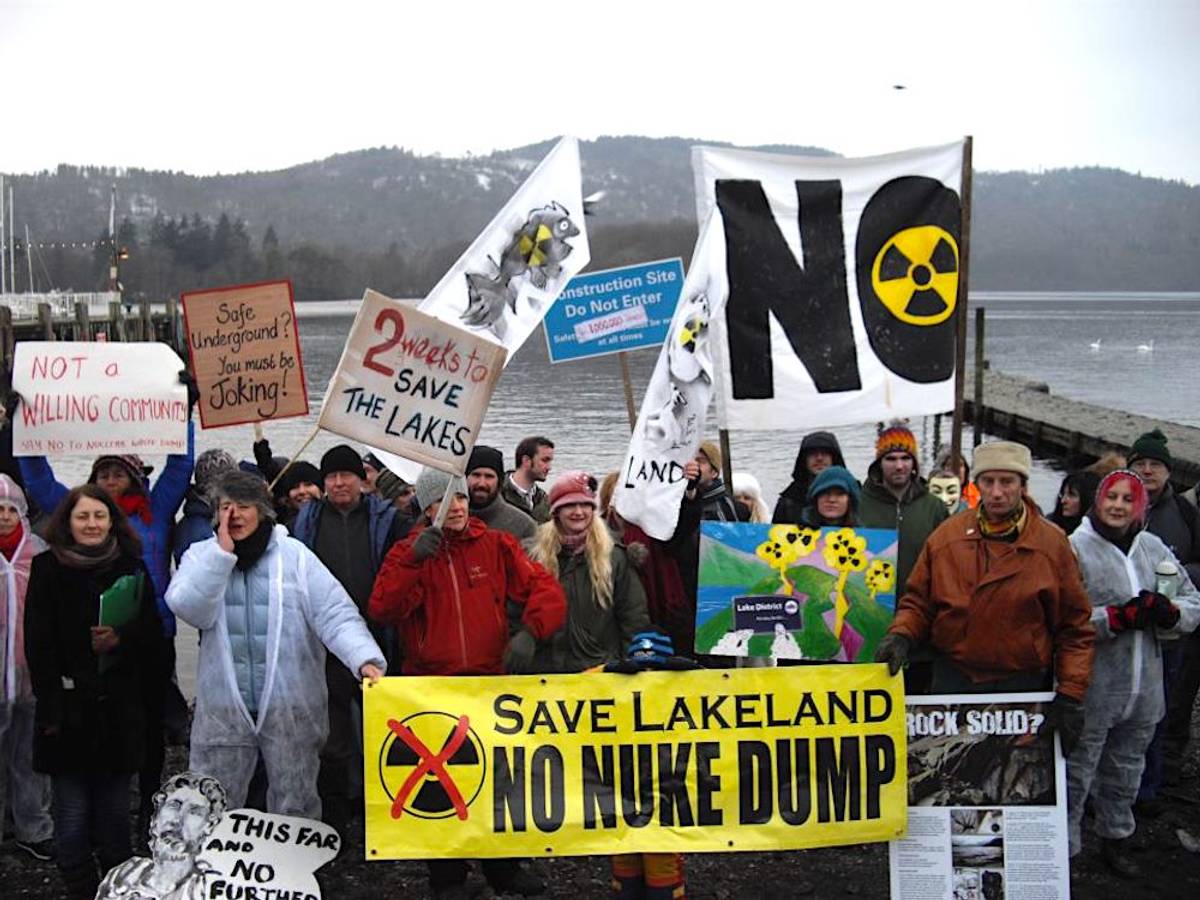
We need to have a close look at the plans for nuclear waste dumping. In the industry’s parlance this is called a Geological Disposal Facility. The name says it all. Find some geologically stable rocks and dispose of the waste for millennia. A previous government asked all communities politely who would be prepared to have such a facility on their doorstep. Naturally not many communities came forward willingly, one in Lincolnshire and one which is the subject of this article.
It’s not that the local people were shouting hoorah, no; it’s more that their local council chiefs shouted JOBS and COMMUNITY BENEFIT. And it is seen as a community with a nuclear ‘heritage’, hence it is the obvious choice. Certain local people immediately started campaigning against this idea as they understood the reality on the ground, or rather under the ground. They knew that in fact the geology in their area is not that stable at all.
Coal consipracy?
It gets worse. The community I am describing is in West Cumbria. Many of you will know of plans to open a new coal mine there. We have heard the arguments that it is for coking coal and that we need it for the steel industry or otherwise we’ll have to import it, stated to be the unsustainable option. The pro’s love to pull this sustainability argument out of the hat; they think they sound so green.
Now, did you know that the CEO of West Cumbria Mining is none other than the same guy the Government has appointed to be its chief advisor on dumping nuclear waste? Something stinks, doesn’t it? His name is Mark Kirkbride. The two areas in Cumbria assigned for the nuclear waste dump are absolutely adjacent to the proposed under the sea coal mine. And this is a deep coal mine, prone to worse earthquakes than fracking. I have checked major news outlets for linking the new coal mine approval with nuclear waste dumping but cannot find one item.
Harm to marine animals
It gets worse still. In 2006 an organisation I was involved with called Save Our Sea (SOS) was set up to stop drilling for oil and gas in Cardigan Bay. The companies involved couldn’t just start drilling, and they couldn’t just start carrying out seismic testing to see if there was any oil or gas. An environmental assessment had to be done. They needed to know if there are animals affected by this. In Cardigan Bay there is a resident population of bottlenose dolphins and there are harbour porpoises, common dolphins and other migratory cetaceans.
What makes Cardigan Bay so different from the Cumbrian Coast? Just recently a stretch of this Cumbrian coastline has been designated a Marine Conservation Zone. So there must be plenty to protect. And in any case, migrating species swim all over the Irish Sea. But for some unfathomable reason, no environmental assessment has been carried out and apparently is not needed. Says who? Answer: the Nuclear Waste Services, Radioactive Waste Management (this is the body with Mark Kirkbride as its key advisor) and the Nuclear Decommissioning Authority.
Local people didn’t get a say but they did find lots of dead harbour porpoises, seals and hundreds of jellyfish. The seismic testing itself delivered blasts every 5 seconds, 24 hours a day, for 20 days. The dump pit in the Irish Sea they hope to create would be 25km2. Last year the seismic testing was carried out near Copeland, centred on Seascale, this year they are planning to do the same at Allerdale.
It’s up to us all to stop this madness
Please read the following links and help stop these plans. Demand an answer from your MP if they are in favour of nuclear power as to how they think the waste should be disposed of, and demand that they find out why no environmental assessment or public consultation needs to be carried out before any seismic testing can take place. Also demand to know why a person like Mark Kirkbride can be both CEO of a coal mine and advise on nuclear dump sites next to his coal mine. Then sign the petition and share it with your friends. We must stand by the campaigners of West Cumbria who are a seriously good bunch of activists and defeat plans for nuclear dumping and for coal mining.
Useful links
The dangers of nuclear escalation have not receded
Putin would use a tactical weapon if pushed
1ai news, 3rd May, Keir A. Lieber Keir Lieber is the Director of the Center for Security Studies and Security Studies Program, and Professor in the School of Foreign Service and Department of Government at Georgetown University.
Since the Cuban missile crisis, the idea of all-out nuclear war in Europe has been almost unthinkable. And many Western commentators have dismissed Putin’s recent threats of nuclear blackmail as scare tactics. But we should not be so confident in our assessment argues nuclear expert Keir Lieber. If the West doesn’t tone down it’s rhetoric of a decisive military victory against Russia, we could be heading for catastrophe in Europe.
Many analysts believe that the danger of Russian nuclear weapons use against Ukraine or NATO has receded. Occasional escalatory threats by Russian President Vladimir Putin have been largely dismissed as scare tactics by Western officials, who remain confident that nuclear deterrence will hold under most plausible circumstances.
Such confidence is misguided. Both strategic logic and international history suggest that Putin is likely to use nuclear weapons if he faces the prospect of a devastating defeat in the Ukraine war or a future conflict with NATO. Specifically, if Putin perceives an existential threat to his regime, then he will be compelled to prevent that outcome – even if it requires taking risky escalatory steps, including the use of tactical nuclear weapons on the battlefield. Nuclear weapons are the ultimate tools of last resort; any rational leader would consider using them if his or her regime or life were on the line.
Of course, Russia’s poor military performance in Ukraine makes a future direct attack by Russia on a NATO country seem unlikely. But that same conventional military weakness explains the danger of Russian nuclear escalation in both the current war in Ukraine and any conflict with NATO, if one were to occur.
The brutal fate of leaders like Saddam Hussein and Muammar Gaddafi, who lost wars to superior adversaries without having a nuclear option, looms large…………………………………………………………………………………………………
Both strategic logic and international history suggest that Putin is likely to use nuclear weapons if he faces the prospect of a devastating defeat in the Ukraine war
The only wise response to Putin’s nuclear use in Ukraine would be to negotiate some kind of resolution in which all parties could declare Potemkin victories. If that is the path we are heading down, the United States and its allies should dial-down any rhetoric about achieving decisive victory and, instead, find a solution before nuclear weapons are used.……………. https://iai.tv/articles/the-dangers-of-nuclear-escalation-have-not-receded-keir-lieber-auid-2470
Antony Blinken, Jake Sullivan, and the ‘made men’ of the Biden administration

Antony Blinken and the ‘made men’ of the Biden administration
BY JONATHAN TURLEY, – 04/22/23 https://thehill.com/opinion/white-house/3963743-antony-blinken-and-the-made-men-of-the-biden-administration/
Secretary of State Antony Blinken would really, really prefer to talk about grain in Ukraine this week. But many people are less interested in what Blinken is doing as secretary of state than in what he did to become secretary of state.
This week, Blinken was implicated in a political coverup that could well have made the difference in the 2020 election. According to the sworn testimony of former acting CIA Director Michael Morrell, Blinken – then a high-ranking Biden campaign official – was “the impetus” of the false claim that the Hunter Biden laptop story was really Russian disinformation. Morrell then organized dozens of ex-national security officials to sign the letter claiming that the Hunter laptop story had “all the classic earmarks of a Russian information operation.”
Morrell further admitted that the Biden campaign “helped to strategize about the public release of the statement.”
Finally, he admitted that one of his goals was not just to warn about Russian influence but “to help then-Vice President Biden in the debate and to assist him in winning the election.”
Help it did. Biden claimed in a presidential debate that the laptop story was “garbage” and part of a “Russian plan.” Biden used the letter to say “nobody believes” that the laptop is real.
In reality, the letter was part of a political plan with the direct involvement of his campaign, but Biden never revealed their involvement. Indeed, over years of controversy surrounding this debunked letter, no one in the Biden campaign or White House (including Blinken) revealed their involvement.
Of course, the letter was all the media needed. Discussion of the laptop was blocked on social media, and virtually every major media outlet dismissed the story before the election.
That was also all Biden needed to win a close election. The allegations that the Biden family had cashed in millions through influence peddling could have made the difference. It never happened, in part because of Blinken’s work.
Once in power, Blinken was given one of the top Cabinet positions. He was now one of the “made” men of the administration.
He was not alone. The 2016 election was marred by false allegations of Russian collusion with the Trump campaign. Unlike the influence peddling allegations made against Biden, the media ran with those stories for years. It later turned out that the funding and distribution of the infamous Steele dossier originated with the Clinton campaign. The campaign, however, reportedly lied in denying any such funding until after the election. It was later sanctioned for hiding the funding as legal expenses.
Those involved in spreading this false story were rewarded handsomely. For example, the second collusion story planted in the media by the campaign concerned the Russian Alfa Bank.
The campaign used key Clinton aide Jake Sullivan, who went public with the entirely false claim of a secret back channel between Moscow and the Trump campaign.
Sullivan was also a “made” man who was later made Biden’s national security adviser. Others who were implicated in either the Steele dossier or Alfa Bank hoaxes also later found jobs in the administration. The Brookings Institution proved a virtual turnstile for these political operatives.
Many signatories on the Russian disinformation letter continue to flourish. MSNBC analyst Jeremy Bash signed the letter and was put on the president’s Intelligence Advisory Board. As with Sullivan, it did not seem to matter that Bash had gotten one of the most important intelligence stories of the election wrong.

Former CIA head James Clapper was referenced by Biden on the letter and was also a spreader of the Russian collusion claims. Despite those scandals and a claim of perjury, CNN gave him a media contract.
They are all “made” men in the Beltway, but they could not have succeeded without a “made” media.
These false stories planted by the Clinton and Biden campaigns succeeded only because the media played an active and eager role. In any other country, this pattern would fit the model of a state media and propaganda effort. However, there was no need for a central ministry when the media quickly reinforced these narratives. This is a state media by consent rather than coercion. The Biden campaign knew that reporters would have little interest or curiosity in how the letter came about or the involvement of campaign operatives.
If Republicans did not control the House of Representatives, the Morrell admission would never have occurred. The Democrats repeatedly blocked efforts to investigate this story and the influence peddling allegations. Even this week, some Democrats called it a “tabloid story.”
Given the career paths of figures such as Blinken and Sullivan, there is a concern that other officials may see the value in “earning their bones” as “made” men and women. There is now a senior IRS career official who is seeking to disclose what he claims was special treatment given to Hunter Biden in the criminal investigation.
While the 51 former intelligence figures were eager to raise Russian disinformation claims before the election, most have become silent. After all, the letter served its purpose, as Morrell indicated, “to assist [Biden] in winning the election.” After the false stories planted before the 2016 and 2020 elections, the question is what is in store for 2024?
Jonathan Turley is the Shapiro Professor of Public Interest Law at George Washington University. Follow him on Twitter @JonathanTurley.
DEPLETED URANIUM: COURTS ACCEPT CANCER RISK DENIED BY ARMY
400 Italian soldiers who were exposed to DU in the Balkans had since died from cancer, and another 8,000 were suffering from the disease. They interviewed the lawyer at the centre of the litigation, Angelo Tartaglia, who urged Britain to “think about the risks and the consequences” of supplying Ukraine with DU shells.
Tartaglia said: “There’s the possibility that both Ukrainian and Russian military officials might fall ill but most importantly pollution caused by military activities could cause irreversible damage to the environment which means that civilians too would be at risk”.
An Italian Parliamentary commission into the issue found “shocking” levels of exposure among Italian veterans and said it had “helped sow deaths and illnesses”.
Courts across Europe have ruled that depleted uranium can cause cancer among troops. Yet the British army insists it is safe to supply Ukraine with the toxic tank shells.
PHIL MILLER, 2 MAY 2023
More than 300 Italian veterans who developed cancer after being exposed to depleted uranium ammunition have won court cases against Italy’s military. Some of the cases were brought by their bereaved relatives.
The judgments have mounted in recent years, with Italian courts repeatedly finding a link between cancer and service in the Balkans where such weapons were fired.
Although Italy does not have depleted uranium weapons in its own arsenal, Italian police and soldiers were deployed to Bosnia and Kosovo where NATO allies fired the controversial ammunition in the 1990s.
Depleted uranium (DU) is a chemically toxic and radioactive heavy metal produced as waste from nuclear power plants. Britain uses it to make armour-piercing tank shells, which are now being supplied to Ukraine.
Scientific debate continues about DU’s long-term risks to human health and the environment in post-conflict zones. British ministers insist it is low risk, and that there is only “some potential heavy metal contamination localised around the impact zone.”
But in the Balkans and Iraq, many believe it has caused cancer. That view was shared in 2009 by a coroner in England, who held an inquest into the death of Stuart Dyson, a British army veteran.

Dyson cleaned tanks during the Gulf war in 1991 and later developed a rare cancer, passing away in 2008. An inquest jury found it was “more likely than not” that depleted uranium had caused his death.
The Ministry of Defence rejected the ruling and refused to pay his widow a pension for those who die from service. By contrast, the widow of Captain Henri Friconneau, a French gendarme who served in Kosovo, was granted a service pension when he later died from cancer.
An appeal court in Rennes ruled in 2019 that Friconneau’s death was due to his exposure to DU dust. France’s interior ministry accepted the judgment and added his name to a monument for those who died on operations in Kosovo.
When in Rome
But it is in Italy where the highest number of veterans have won compensation. One family received a 1.3m euros pay out in 2015 after the court of appeal in Rome found “with unequivocal certainty” a link between exposure to depleted uranium dust and cancer.
The Il Fatto newspaper said the judgement went further than previous rulings, as it recognised a causal link beyond just the balance of probabilities.
A more recent ruling in 2018 seen by Declassified found the court could not “rule out the possibility that a soldier who served” in the Balkans “would have been exposed to genotoxic pollutants, thus increasing the likelihood of illness.”
An Italian Parliamentary commission into the issue found “shocking” levels of exposure among Italian veterans and said it had “helped sow deaths and illnesses”.
Last month, Euronews reported that 400 Italian soldiers who were exposed to DU in the Balkans had since died from cancer, and another 8,000 were suffering from the disease. They interviewed the lawyer at the centre of the litigation, Angelo Tartaglia, who urged Britain to “think about the risks and the consequences” of supplying Ukraine with DU shells.
Tartaglia said: “There’s the possibility that both Ukrainian and Russian military officials might fall ill but most importantly pollution caused by military activities could cause irreversible damage to the environment which means that civilians too would be at risk”………………………………………………………………. more https://declassifieduk.org/depleted-uranium-courts-accept-cancer-risk-denied-by-army/
MPs, Scientists Raise Alarm Over Climate Hype for Small Modular Reactors
The Energy Mix, May 2, 2023. Primary Author: Christopher Bonasia @CBonasia_
Several Members of Parliament and activists are warning the Canadian government that its support for nuclear energy projects could prove costly and ineffective—even as Prime Minister Justin Trudeau maintains that nuclear is “on the table” for achieving the country’s climate goals.
The federal government considers nuclear energy—including small modular reactors (SMRs) that are touted as easier to build and run than traditional nuclear plants—as key to meeting energy needs while aiming for net-zero by 2050.
………………..But on April 25, anti-nuclear activists and a cross-partisan group of MPs held a media conference on Parliament Hill, urging Ottawa to rethink its stance on nuclear and calling the energy source a dangerous distraction from climate action, reported CBC News.
Speakers in the group said Trudeau and his cabinet are getting bad advice about nuclear energy.
“The nuclear industry, led by the United States and the United Kingdom, has been lobbying and advertising heavily in Canada, trying to convince us that new SMR designs will somehow address the climate crisis,” said Prof. Susan O’Donnell, a member of the Coalition for Responsible Energy Development in New Brunswick (CRED-NB). The reality, she added, is that SMRs will produce “toxic radioactive waste” and could lead to serious accidents while turning some communities into “nuclear waste dumps”.
Moreover, there is “no guarantee these nuclear experiments will ever generate electricity safely and affordably,” O’Donnell said, since SMRs are still relatively untested.
Green Party Leader Elizabeth May called government funding for nuclear projects a “fraud.”
“It has no part in fighting the climate emergency,” May said. “In fact, it takes valuable dollars away from things that we know work, that can be implemented immediately, in favour of untested and dangerous technologies that will not be able to generate a single kilowatt of electricity for a decade or more.”
Liberal MP Jenica Atwin, New Democrat Alexandre Boulerice, and Bloc Québecois MP Mario Simard also attended the media event, the National Post reports. Atwin, who was first elected as a Green in 2019 before crossing the floor, “is the only Liberal to publicly break ranks so far, but said she has had conversations with colleagues who appear to be ‘open-minded’ to learning more about her concerns,” the Post says.
Advocacy groups like the Canadian Environmental Law Association (CELA) have also pushed back against SMRs, arguing they “pose safety, accident, and proliferation risks” akin to traditional nuclear reactors. CELA urged[pdf] the federal government to “eliminate federal funding for SMRs, and instead reallocate those investments into cost-effective, socially responsible, renewable solutions.”
The International Energy Agency (IEA) says renewables will “lead the push to replace fossil fuels” but that nuclear can help in countries where it is accepted. As of 2022, there were only three SMR projects in operation—one each in Russia, China, and India, CBC News reported.
Canada’s First SMR Passes Pre-Licencing
In Ontario, which currently produces 60% of its electricity from conventional nuclear stations, plans for one such SMR passed a regulatory checkpoint in March. Slated to be Canada’s first new nuclear reactor since 1993, the BWRX-300 is being built by Ontario Power Generation (OPG) and North Carolina-based GE Hitachi.
…………………………………………………………………….The review is not binding on the commission and does not involve the issuance of a licence, but its completion does give OPG “a head start on licencing,” said GE Hitachi spokesperson Jonathan Allen.
However, the pre-licencing review also revealed “some technical areas that need further development,” CNSC said. The commission will require OPG to supply further details on severe accident analysis and the engineered features credited for mitigation. OPG must also demonstrate that the reactor’s design meets the requirement for two separate and diverse means of reactor shutdown (or an alternative approach) and provide further information “on the protective measures for workers in the event of an out-of-core criticality accident.”
“From the list of areas needed for further development, it looks like [GE Hitachi] has some work to do,” said Allison Macfarlane, director of the University of British Columbia’s public policy school, who chaired the U.S. Nuclear Regulatory Commission (NRC) between 2012 and 2014.
BWRX-300 Raises Safety Questions
The BWRX-300 is a leading concept that GE Hitachi says is its simplest boiling water design, and could deliver 60% lower capital costs per megawatt than other SMRs.
But Edwin Lyman, director of nuclear power safety for the Union of Concerned Scientists, told The Mix he has concerns about the design. He pointed to a joint CNSC-NRC review [pdf] that identified several issues associated with reactor containment, including a potential for “reverse flow” of steam from the containment back into the reactor vessel under certain accident conditions. The review also found that the reactor’s reliance on isolation condensers may not always be effective to remove heat from the reactor during loss-of-coolant accidents.
“The consequences of a failure of isolation condensers is apparent from the fate of Fukushima Daiichi Unit 1, which experienced a core melt only hours after the system was lost,” Lyman said, citing the 2011 nuclear disaster in Ōkuma, Japan.
He added he is “extremely skeptical” that the BWRX-300 design will mature quickly enough to allow CNSC to make a meaningful determination of its safety in time for the anticipated 2028 start date. SMR designs need to undergo further testing and analysis before they can be considered safe, and yet vendors are rushing to deploy new, untested reactor designs without going through the necessary stages of technology development, including testing of full-scale prototypes, Lyman said.
“History has shown that shortcuts in this process are an invitation to disaster,” he added.
SMRs fall under the same Class 1A Nuclear Facilities Regulations as traditional reactors, so they do receive the same level of CNSC scrutiny. With its mandate to ensure the safe conduct of nuclear activities in Canada, the commission “will only issue a licence if the applicant has demonstrated the reactor can be operated safely,” the spokesperson said.
Next steps for the DNNP include a CNSC assessment, already under way, to review OPG’s licence application. This will result in a Commission Member Document that offers results and recommendations to an independent commission. Then there will also be two public hearings. The first is slated [pdf] for January 2024 and will consider the applicability of the previous environmental assessment to the BWRX-300. A separate, future hearing will determine whether to issue a construction licence for the DNNP.
“It is the independent commission who will make the decision as to whether the licensee or applicant is qualified to carry on the proposed activities and in a safe manner that protects the public and the environment,” the CNSC spokesperson said. https://www.theenergymix.com/2023/05/02/canadian-mps-raise-alarm-over-nuclear-energy-drive-for-climate-goals/
The Philippines to be the South East Asian guinea pig for NuScam’s small nuclear reactors?

New in Marcos’ nuclear push: US firm seeks site in Philippines for costly small reactors Cristina Chi – Philstar.com, May 2, 2023 |
MANILA, Philippines (Corrected, May 3; 10:33 a.m.)— A top nuclear energy firm from the United States that has been developing a type of nuclear reactor flagged for being potentially financially risky as renewable energy becomes more affordable has expressed interest in putting up a site in the Philippines.
This comes as President Ferdinand “Bongbong” Marcos Jr. takes his aggressive nuclear energy push to talks with US officials during his visit there this week — an agenda backed by his cousin House Speaker Martin Romualdez but roundly criticized by environmental groups………………………
Too expensive, too risky’
NuScale Power was flagged by independent think-tank Institute for Energy Economics and Financial Analysis in 2022 for developing SMR technology that is “too expensive, too risky and too uncertain.”
The group also recommended that SMR “should be abandoned” given that the costs of available renewable sources are falling rapidly and that the SMR wouldn’t generate electricity before 2029.
Marcos is on a four-day trip to the United States that began last weekend, and he has so far met with US President Joe Biden and other business leaders, including executives of the energy firm.
…………. Clayton Scott, NuScale executive vice president for business, also expressed confidence that NuScale’s small modular reactor (SMR) technology “will perform as expected.” NuScale was also accompanied by local partner Enrique Razon, representing Prime Infrastructure Capital, Inc.
Marcos first met with NuScale executives in 2022 on the sidelines of the 77th United Nations General Assembly.
Among the deals clinched during Marcos’ meeting with US officials is the US Agency for International Development’s commitment to invest $5 million to support the Philippines’ exploration of the potential for nuclear energy to meet the country’s need for clean energy, “consistent with the highest standards of nuclear security, safety and nonproliferation.”
Environmental groups’ pushback
A financially unrewarding nuclear energy deal may not be the only risk posed by NuScale Power’s entry in the Philippines, according to environmental group Greenpeace.
Nuclear energy companies are “practically making the Philippines the guinea pig for untested risky technologies to promote their business” despite other local options for safer and cheaper renewable energy, Greenpeace campaigner Khevin Yu said.
Yu warned of the potential consequences of tapping nuclear energy for electricity in the Philippines given that Germany, like other developed countries, has weaned off nuclear power — an undertaking that it began in 2002 and was accelerated in 2011 after the Fukushima nuclear disaster in Japan.
Italy also permanently shut down all of its functioning nuclear plants in 2022.
Yu said that risks related to nuclear technology remain unresolved, and SMRs “are still untested and unproven.”
“(And) there is currently no way to safely store nuclear waste,” Yu said.
“Even if they actually succeed in putting up nuclear plants, it will take a long time before we are able to use it. Furthermore, we will be stuck with maintaining a ticking time-bomb, which will endanger the lives of nearby communities should an accident occur,” Yu added.
Yu, meanwhile, pointed out that the pivot to renewable energy became a topic of discussion between Marcos and Bide, which he said should now “be the focus of the current administration.” https://www.philstar.com/headlines/climate-and-environment/2023/05/02/2263238/new-marcos-nuclear-push-us-firm-seeks-site-philippines-costly-small-reactors
France and Russia have “a win-win partnership” on the nuclear industry

France to Work With Russia on Hungarian Nuclear Project Despite EU Criticism
France’s energy transition ministry has permitted Framatome, a nuclear energy subsidiary of Électricité de France (EDF), to contribute to the construction of two reactors at the Hungarian Paks-2 nuclear power plant alongside Russian state-run nuclear bigwig Rosatom, according to a report by French news outlet Le Monde on April 27.
………… The said project has been contentious among some EU members, owing to the bloc’s sanctions against Russia.
…………………………. Last month, Hungarian Foreign Minister Péter Szijjártó disclosed that Hungary might increase the contributions of Framatome in the project, after encountering roadblocks with Germany’s Siemens Energy, in the context of Ukraine-linked sanctions and Germany’s reduction of nuclear power as an energy source. Both companies had been contracted to provide control systems for new reactors at Paks-2 as part of a French-German consortium.
“Since the German government is blocking for political reasons the contractual participation of Siemens Energy, we wish to rely more on the French,” said Szijjártó ……………………………………..
Unveiled in 2014 under an agreement between Hungary and Russia, the Paks-2 project aimed to construct two new nuclear reactors by Rosatom and a Russian state loan to bankroll most of the project……..
In wake of the Russo-Ukraine conflict, anti-Russian observers and policymakers saw Framatome’s participation in the setting up of two nuclear reactors in Hungary led by the Russian state-owned group Rosatom as an ill-advised move.
……. , “to date, European sanctions [against Russia] do not target the nuclear industry,” the French ministry said.
………………………… The EU and Ukraine have been mounting pressure on France to fully sever relations with Russia’s atomic sector amid rounds of sanctions against Moscow, ramping up scrutiny of France’s links with Rosatom.
Collaboration with Rosatom has been a hot-button issue among France and other EU countries dependent on Russia for nuclear fuel. While 2022 saw the suspension of a great deal of commercial cooperation, some French state-controlled companies continue to maintain some ties with Rosatom.
…………………………………… Rosatom called the Franco-Russian alliance “a win-win partnership” that is “a driver of development both in the field of nuclear energy and scientific projects.”
……. French companies provide technology to Rosatom whenever the Russian behemoth constructs a nuclear plant abroad, with Rosatom usually spending up to €1 billion per project, encompassing command and control systems from Framatome, Faudon revealed.
……….. Apart from France, the United States also purchased $830 million of enriched uranium from Russia last year. Reactors in Bulgaria, the Czech Republic, Finland, Slovakia, and Hungary obtain fuel from Russia as well…………………………………….more https://thenewamerican.com/france-to-work-with-russia-on-hungarian-nuclear-project-despite-eu-criticism/
US ‘Dangerously Close’ To Another Nuclear Missile Crisis; After Russia, China Could Respond To Deployment Of Nuke Subs To S.Korea
The Eurasian Times, 4 May 23
South Korean President Yoon Suk-yeol was on a state visit to the US from April 25 for six days. The top agenda of the visit was ‘how to contain, control, and neutralize the North Korean nuclear threat.’
Since the beginning of 2023, North Korea has carried out about a dozen missile tests. Kim Jong Un, the North Korean dictator, has been categorical in condemning military exercises being carried out jointly by South Korean and US military and has threatened to retaliate.
South Korea and the US have regularly carried out military exercises. …………………………….
Proposed US Nuclear Submarine Deployment
To protect South Korea from the North Korean nuclear threat, the US has announced that it will deploy SSBN in South Korean waters. The event is yet to take place.
Proposed US Nuclear Submarine Deployment
To protect South Korea from the North Korean nuclear threat, the US has announced that it will deploy SSBN in South Korean waters. The event is yet to take place.
A look at the globe will indicate that US nuclear submarines, equipped with nuclear-warhead Submarine Launched Ballistic Missiles, will also be able to strike mainland China.
However, if the SSBN deployment indeed does take place, it might, and will, be different from the Cuban Missile Crisis due to the following reasons:
a. In 1962, only two nuclear powers, the US and the USSR, challenged each other with a nuclear strike.
b. China, then, was not a nuclear power. China exploded its first nuclear device on October 8, 1964.
c. In 2023, there are nearly a dozen nations in possession of nukes.
d. China is a formidable economic and nuclear power now.
e. In 1962, the USSR’s decision to deploy nuclear missiles in Cuba forced the US to retaliate. Then, the USSR was the initiator. The US was the affected party.
f. In 2023, China will be the affected party, and the USA will be the initiator if the US does not back off from its decision to deploy SSBNs near South Korea.
g. In the event of an escalation, the US will have to face nukes from China and North Korea but also (maybe) from Russia.
Key Issues
The key issue, which might rather lead to a similar situation as the Cuban Missile Crisis, is the US announcement to deploy nuclear weapons capable submarines near South Korea.
Such a deployment aims to protect South Korea from any North Korean military or nuclear misadventure. However, a closer look at the probable region of deployment of nuclear submarines will indicate that the US will be able to threaten the underbelly of China exactly in the same manner as the Soviet missiles threatened the US underbelly. China will almost certainly react or retaliate in the way deemed fit.
Should that happen, will diplomacy succeed yet again and prevent a nuclear holocaust? Global grouping in 2023 is vastly different from what prevailed in 1962………..
SSBNs are extremely difficult to track. China, Russia, or North Korea cannot track and confirm the presence of US Navy SSBNs. If deployed in the abovementioned areas, the SSBN will threaten North Korea, China, and Russia.
China’s Concerns
Beijing has already reacted by describing the planned deployment of SSBNs by the US as a bid to promote the latter’s selfish geopolitical interests.
The US expansion of the nuclear umbrella has been termed an irresponsible action and a threat to world peace. The Chinese spokesperson said, “The United States has put regional security at risk and intentionally used the (Korean) peninsula issue as an excuse to create tensions.
What the US does is full of Cold War thinking, provoking bloc confrontation, undermining the nuclear non-proliferation system, damaging the strategic interests of other countries, exacerbating tensions on the Korean peninsula, undermining regional peace and stability, and running counter to the goal of the de-nuclearisation of the peninsula.
………….. The recently concluded AUKUS treaty has already raised hostility between China and the US. The decision to deploy SSBNs capable of carrying up to 20 MIRVed ballistic missiles in close proximity has invited extremely adverse reactions from China………………………………………………………………………………………
Conclusion
The US decision to deploy SSBNs in South Korea would almost certainly invite adverse reaction and possible retaliation from China, which Russia and North Korea will support. ……………………………………………..https://eurasiantimes.com/us-dangerously-close-to-nuclear-crisis-after-russia/
Newbuild: How Much of Vogtle Nuclear Plant’s Capital Costs Can Southern Recover?

Energy Intelligence Group , Apr 28, 2023, Stephanie Cooke, Washington
As the first of two AP1000 newbuilds ramps up to commercial operation at Georgia Power’s Vogtle plant in the US state of Georgia, an “epic battle” is brewing over how much the operator can recover in capital cost overruns from ratepayers. Preparation for a possible standoff between the Southern Co. subsidiary and staff of the state Public Service Commission (PSC) is already under way against a toxic political backdrop.
Voter rights litigation challenging ossified Republican dominance on the commission is delaying a PSC election previously slated for November. Now the question is to what extent a delayed PSC election, and pressure from the two Democratic contenders, might influence the outcome of “prudency” hearings that will determine how much ratepayers will be on the hook for capital expenditures at the Vogtle-3 and -4 newbuilds.
Much is at stake for Georgia Power and its ratepayers. The latter have been charged for the financing portion — but not the actual capital costs — of Georgia Power’s construction bills since 2011, well before the first concrete was poured for Vogtle-3 on Mar. 2, 2013. By the end of the year, ratepayers will have on average paid approximately $913 per person for the project, according to PSC testimony earlier this year.
Once Unit 3 is in commercial operation, the utility is authorized to include $2.1 billion of capital costs in the rate base. And when fuel loading begins at Unit 4 the PSC will begin hearings to determine the “prudency” of billions more in capital expenditures as a basis for passing on the cost to ratepayers.
Earlier this year PSC staff said Georgia Power may ultimately seek to recover as much as $9.7 billion of its capital costs, translating into a potential rate hike of 15%, or $17.20 extra per month for each customer based on an average monthly bill of $131. This figure is 120% higher than the $4.4 billion in capital costs expected at certification, and both figures are only a fraction of total capital costs, as Georgia Power is only a 45.7% owner of the Vogtle newbuilds. Georgia Power provided no response to Energy Intelligence questions as to what Vogtle capital cost recovery it will seek.
For Southern, the key is getting both reactors into commercial operation, after which all capital expenditures become fair game for inclusion in the rate base…………………
…………. any additional technical glitches — Unit 3 was forced to shut down for a week earlier this month because of an electrical malfunction — could delay recovery of capital costs. And at some point Georgia Power might face a very different PSC. If one or both Democratic candidates succeed in ousting current PSC commissioners, they would likely not shift the majority vote in disputed rate cases, but they would be better positioned to draw media attention to any Georgia Power capital cost recovery requests.
“There’s never been any single financial decision this large in the state of Georgia,” said Patty Durand, a candidate running to unseat Commissioner Tim Echols, whose term technically expired in December. In Georgia, it’s “going to be the epic financial battle of the century.”
Even getting on the ballot has been a challenge for Durand and for Shelia Edwards, who is challenging Commissioner Fitz Johnson, and now both candidates must wait until a federal court case over the PSC electoral process is decided……………………………………………….
…………………………………… Sources close to the PSC suggest that the total Vogtle project cost, including financing costs and on a 100% basis, may ultimately surpass $35 billion. https://www.energyintel.com/00000187-b4f4-d9b3-afdf-f6f7d5780000—
US Secretary of State Antony Blinken embroiled in alleged attempt to influence US officials on Burisma

Hunter Biden joined the board of the allegedly corrupt Ukrainian company Burisma in April 2014, while the US authorities were working with British law enforcement on a financial investigation into its owner, Mykola Zlochevsky.
Secretary of State Blinken and his cabinet secretary wife were embroiled in an alleged attempt to influence US officials on behalf of Burisma – and may have known Hunter was on the board despite telling investigators otherwise.
- Emails show Tony Blinken and his wife Evan Ryan corresponding with a consultancy firm hired by Hunter’s Ukrainian gas company Burisma
- Blinken told Senate investigators under oath that he had ‘no knowledge’ of Hunter Biden’s service on the board of Burisma
- Hunter emailed Ryan to make sure her husband took a meeting with the consultancy firm to discuss ‘some troubling events we are seeing in Ukraine’
By JOSH BOSWELL FOR DAILYMAIL.COM, 2 May 2023
Secretary of State Tony Blinken and his wife, Joe Biden‘s cabinet secretary Evan Ryan, were both embroiled in an alleged attempt to influence US government officials on behalf of Ukrainian gas firm Burisma, emails show.
Blinken told Senate investigators under oath in 2020 that he had ‘no knowledge of Hunter Biden‘s service on the board’ of Burisma, and didn’t know about Blue Star Strategies, a Democrat consultancy hired by the firm in 2015 to improve its image in Washington DC.
But State Department emails show he spoke with Blue Star’s CEO Karen Tramontano at a political event around July 2016 while he was Deputy Secretary of State, and agreed to have a coffee with her to discuss ‘some troubling events we are seeing in Ukraine’.
And July 14, 2016 emails from Hunter’s laptop show the First Son checked in with Blinken’s wife to try to make sure he took a call from Tramontano and her chief operating officer Sally Painter – as well as meeting with Blinken himself at his State Department office in July 2015.
There is no evidence that Blinken or Ryan tried to change US policy on Burisma’s behalf.
But Senator Ron Johnson is now accusing the Secretary of State of having ‘lied bald-faced to Congress’ about his links to the murky influence campaign in 2020 sworn testimony.
Blinken has come under new scrutiny this month over his relationship with the Bidens, after the House Judiciary Committee received testimony that he helped orchestrate a letter by intelligence chiefs claiming Hunter’s laptop was a Russian disinformation campaign just weeks before the 2020 election.
The government and laptop emails obtained by DailyMail.com suggest Blinken, who was Joe’s senior campaign advisor, his Vice Presidential National Security Advisor in the Obama administration and now Secretary of State, may have been more aware of Hunter’s dealings than he has let on.
Blinken was grilled by Senate homeland security committee investigators in December 2020, as part of a probe into Hunter’s business dealings run by Senators Chuck Grassley and Ron Johnson.
Hunter joined the board of the allegedly corrupt Ukrainian company Burisma in April 2014, while the US authorities were working with British law enforcement on a financial investigation into its owner, Mykola Zlochevsky.
When Hunter’s appointment became public soon after, it caused a firestorm of controversy – including among State Department officials, who complained in emails that ‘the presence of Hunter Biden on the Burisma board was very awkward for all U.S. officials pushing an anti-corruption agenda in Ukraine.’
However, the furor apparently passed by Blinken, who told investigators in sworn testimony that he was not ‘aware of any association that Hunter Biden had with Burisma’ while Deputy Secretary of State from 2015 to 2017, had no emails or texts with the First Son, and never discussed Hunter’s financial or business arrangements with him.
Data on Hunter’s laptop shows 26 emails involving Blinken’s personal address and three with his Vice Presidential office address, between 2010 and 2018.
A further 47 emails include his wife Evan’s VP office email and 22 have her personal email address.
A contact book entry for Blinken on Hunter’s laptop includes three numbers labeled ‘mobile’, ‘car’ and ‘other’, as well as his office and personal email addresses.
Speaking to Fox New on Sunday, Senator Ron Johnson, who has been investigating the Biden’s business dealings for four years, accused Blinken of having ‘lied boldface to Congress about never emailing Hunter Biden.’
‘Antony Blinken finally did come in and sit down for a voluntary transcribed interview in December of 2020 because he wanted to be Secretary of State,’ Johnson told Maria Bartiromo.
‘And now, because of more information that’s come out, we know that he lied boldface to Congress about never emailing Hunter Biden. My guess is he told a bunch of other lies that hopefully we’ll be able to bring him and his wife back in. Tell them to preserve their records.’
On May 22, 2015, Hunter wrote to Blinken asking if he had ‘a few minutes next week to grab a cup of coffee? I know you are impossibly busy, but would like to get your advice on a couple of things.’
Blinken replied ‘absolutely’, and copied his secretary to ‘find a good time’. Hunter forwarded the exchange to his business partner and fellow Burisma board member, Devon Archer.
The meeting was postponed due to the death of Hunter’s brother Beau eight days later from brain cancer.
Hunter and Blinken eventually met for lunch at his State Department office on July 22, 2015, but Blinken told Senate investigators they only discussed ‘the loss the family had suffered and how they were coping’.
In November that year Burisma hired Blue Star Strategies to improve the firm’s image in DC.
Blue Star CEO Karen Tramontano played down her relationship with Hunter in her own 2020 testimony to the Senate committee, and claimed at first that she didn’t know Hunter was on its board.
In June 2021 DailyMail.com revealed emails from Hunter’s laptop showing in fact he was the point man for Burisma’s hiring of Blue Star, and that as far back as March 2014 Tramontano had discussed registering her investment banking license with Hunter’s firm Rosemont Seneca.
Tramontano and her COO Sally Painter set about arranging meetings and calls with top government officials, trying to convince them to take a softer approach towards Burisma owner Zlochevsky and refrain from calling his gas firm ‘corrupt’.
Blinken told investigators that although he knew Tramontano and Painter, he was unaware of their firm, Blue Star.
State Department emails obtained by the Homeland Security Committee show that on June 27, 2016 Painter wrote to Blinken’s assistant from her Blue Star email address about a meeting he agreed to when he bumped into them at an event three days earlier.
‘Per my conversation with Tony at the Truman event, Karen Tramontano and I would like to have a brief coffee with Tony at his earliest convenience regarding some troubling events we are seeing in Ukraine. (He said yes),’ Painter said in the email.
‘Karen was President Clinton’s Deputy Chief of Staff and we are just back from Kiev.’
A call appears to have been scheduled for the following month, but when it fell through Hunter got involved – contacting Blinken’s wife and then-assistant secretary of state for educational and cultural affairs Evan Ryan to chase up the contact.
‘Time for a very quick call?’ Hunter wrote to her AOL email address on July 14, 2016. ‘He said neither Karen or Sally called this afternoon,’ she responded.
‘I don’t know what happened. Talked to S and K and they said they called at 5:30 and left message w/ his Asst. Sorry,’ Hunter wrote. She replied: ‘He didn’t get the msg. He said if we can get him their numbers he can call them late afternoon DC time tmrw – let me know if that works.’
The next day Blinken wrote to his aide, ‘Please send me her [Tramontano’s] number. I may call.’
It is unclear if the call took place. Blinken told investigators ‘I don’t recall having a coffee with them.’
influence campaign with the DoJ.
Tramontano’s lawyer said the probe ended when the firm submitted a filing to the government admitting its lobbying activities for the Ukrainian gas firm – more than six years after the fact.
Blue Star’s filing, submitted in May 2022, finally declared its $60,000 of work for Zlochevsky in 2015 and 2016 including ‘to help schedule meetings with U.S. Government officials so counsel for Mr. Zlochevsky could present an explanation of certain adverse proceedings in the U.K. and Ukraine involving Mr. Zlochevsky.’
The filing listed a 2016 ’email and meeting’ with Obama’s energy envoy Amos Hochstein, and also with Under Secretary of State for Economic Growth, Energy, and the Environment Catherine Novelli.
It did not declare any meetings, emails or calls with Blinken.
The danger of artificial intelligence controlling nuclear codes
NEVER GIVE ARTIFICIAL INTELLIGENCE THE NUCLEAR CODES
The temptation to automate command and control will be great. The danger is greater.
The Atlantic, By Ross Andersen, MAY 2, 2023
No technology since the atomic bomb has inspired the apocalyptic imagination like artificial intelligence. Ever since ChatGPT began exhibiting glints of logical reasoning in November, the internet has been awash in doomsday scenarios. Many are self-consciously fanciful—they’re meant to jar us into envisioning how badly things could go wrong if an emerging intelligence comes to understand the world, and its own goals, even a little differently from how its human creators do.
One scenario, however, requires less imagination, because the first steps toward it are arguably already being taken—the gradual integration of AI into the most destructive technologies we possess
Jacquelyn Schneider, the director of the Wargaming and Crisis Simulation Initiative at Stanford’s Hoover Institution, recently told me about a game she devised in 2018. It models a fast-unfolding nuclear conflict and has been played 115 times by the kinds of people whose responses are of supreme interest: former heads of state, foreign ministers, senior NATO officers. Because nuclear brinkmanship has thankfully been historically rare, Schneider’s game gives us one of the clearest glimpses into the decisions that people might make in situations with the highest imaginable human stakes……………………. (Subscribers only) https://www.theatlantic.com/magazine/archive/2023/06/ai-warfare-nuclear-weapons-strike/673780/
Georgia: Pentagon conducts military exercises for war with Russia — Anti-bellum

Agenda.geMay 3, 2023 US-Georgia “continue to do more across broad range of cooperative military activities” in 2023 – US Embassy The United States Embassy in Georgia on Wednesday issued a statement on military cooperation between the two states in 2023 and stressed US-Georgia continued “to do more across a broad range of cooperative military activities”. […]
Georgia: Pentagon conducts military exercises for war with Russia — Anti-bellum
1 This Month

of the week – Shut Down Drone Warfare!


Tell the Ukrainian Government to Drop Prosecution of Peace Activist Yurii Sheliazhenko

Petition to revoke the licensing of the Near Surface Nuclear Disposal Facility (NSDF) at Chalk River. https://www.ourcommons.ca/petitions/en/Petition/Details?Petition=e-7247
To see nuclear-related stories in greater depth and intensity – go to https://nuclearinformation.wordpress.com
-
Archives
- April 2026 (68)
- March 2026 (251)
- February 2026 (268)
- January 2026 (308)
- December 2025 (358)
- November 2025 (359)
- October 2025 (376)
- September 2025 (257)
- August 2025 (319)
- July 2025 (230)
- June 2025 (348)
- May 2025 (261)
-
Categories
- 1
- 1 NUCLEAR ISSUES
- business and costs
- climate change
- culture and arts
- ENERGY
- environment
- health
- history
- indigenous issues
- Legal
- marketing of nuclear
- media
- opposition to nuclear
- PERSONAL STORIES
- politics
- politics international
- Religion and ethics
- safety
- secrets,lies and civil liberties
- spinbuster
- technology
- Uranium
- wastes
- weapons and war
- Women
- 2 WORLD
- ACTION
- AFRICA
- Atrocities
- AUSTRALIA
- Christina's notes
- Christina's themes
- culture and arts
- Events
- Fuk 2022
- Fuk 2023
- Fukushima 2017
- Fukushima 2018
- fukushima 2019
- Fukushima 2020
- Fukushima 2021
- general
- global warming
- Humour (God we need it)
- Nuclear
- RARE EARTHS
- Reference
- resources – print
- Resources -audiovicual
- Weekly Newsletter
- World
- World Nuclear
- YouTube
-
RSS
Entries RSS
Comments RSS
 nuclear-news