Anti nuclear campaign groups in Wales(Dwyfor and Meirionnydd) urge government to invest in energy conservation, NOT dirty nuclear power.
Here is the response on behalf of PAWB, Pobl Atal Wylfa B/People AgainstWylfa B (Ynys Môn and Arfon) and CADNO, Cymdeithas Atal Dinistr NiwclearOesol (Dwyfor and Meirionnydd) to the Welsh Government’s review of renewable energy targets..
Generally, there is much to welcome in the government’s discussion paper.
However, in response to Proposal 1, we would like to see the government
putting more emphasis on reducing the demand for electricity by investing
in a comprehensive insulation and energy conservation programme.
That is vitally important all over Cymru alongside the renewable energy programme.
However, we believe that Welsh Government’s investment in Cwmni Egino to
attempt to get a nuclear energy development at the Nuclear Decommissioning
Authority’a site at Trawsfynydd undermines this aim. Nuclear power is a
dirty, dangerous and extremely expensive technology that is in no way
renewable. Any nuclear development at Trawsfynydd would depend heavily on
carbon fuels in the building process thereby further undermining the aim of
proposal.
PAWB 24th April 2023
Canada’s push for small nuclear reactors will be costly, ineffective, some MPs warn
By David Fraser, The Canadian Press, Tue., April 25, 2023
Prime Minister Justin Trudeau has asserted that Canada is “very
serious” about developing nuclear technology across the country to meet
growing power needs, but some members of Parliament are warning the
technology could be costly and ineffective.
A Liberal MP is among the critics who say Ottawa is looking at an expensive investment into an unproven and potentially dangerous technology. The federal government
started actively exploring small modular reactor technology in 2018, and
released an action plan in 2020 that dubbed them a strategic Canadian asset
that could leverage significant economic, geopolitical, social and
environmental benefits.
But Green Party Leader Elizabeth May says other
renewable energy sources are getting cheaper, so there’s not much of a case
for Canada to expand its capacity on that technology, which she said is
being pushed by powerful lobbyists.
Liberal MP Jenica Atwin, who was first
elected under the Green banner, said she is used to being an outlier in her
caucus, but the party has allowed her to express her concerns about the
unknowns of emerging nuclear technologies. Four nuclear energy stations are
generating about 15 per cent of Canada’s electrical grid today, mostly in
Ontario and New Brunswick, and as the facilities age more attention is
being paid to the potential of smaller, more-portable reactors.
Toronto Star 25th April 2023
Amid maintenance delays and strikes in nuclear industry, France restarts one reactor
France’s EDF has restarted the 1.5-GW Civaux-2 reactor while delaying both
planned maintenance and returns elsewhere amid ongoing worker strikes,
transparency data showed April 24.
EDF further delayed planned return dates
for Gravelines 1 and Blayais 1, where strikes have been ongoing for over
five weeks. The start of maintenance at Cruas 4 was also delayed further,
with annual refueling pushed back another fortnight to May 6. Initial
planning set an April 20 return date for the reactor, now scheduled to
remain offline until June 16.
Civaux-2 has been awaiting a restart, having
been delayed by strikes after a failed attempt in early March. The reactor
has been offline since late 2021 for stress corrosion repairs that were
completed in February.
SP Global 24th April 2023
Once Shocking, U.S. Spying on Its Allies Draws a Global Shrug
April 13, 2023, New York Times https://www.nytimes.com/2023/04/13/us/politics/us-spying-allies.html
The last time a trove of leaked documents exposed U.S. spying operations around the world, the reaction from allied governments was swift and severe.
In Berlin, thousands of people protested in the streets, the C.I.A. station chief was expelled, and the German chancellor told the American president that “spying on friends is not acceptable.” In Paris, the American ambassador was summoned for a dressing-down.
That was a decade ago, after an enormous leak of classified documents detailing American surveillance programs by … Edward Snowden. The latest leak of classified documents that appeared online this year, the motive behind which remains unknown, has again illustrated the broad reach of U.S. spy agencies, including into the capitals of friendly countries such as Egypt, South Korea, Ukraine and the United Arab Emirates.
Though the documents mainly focus on the war in Ukraine, they include C.I.A. intelligence briefs describing conversations and plans at senior levels of government in those countries, in several cases attributed to “signals intelligence,” or electronic eavesdropping.
Unlike in 2013, however, U.S. allies appear to be mostly shrugging off the latest examples of apparent spying. So far, the only evident political fallout from the latest leaks has occurred in South Korea, where one classified U.S. document described a debate among senior national security officials about whether to send artillery shells abroad that might wind up in Ukraine, potentially angering Russia.
Despite the dangers of climate change, UK nuclear power stations still sited on the coastline!
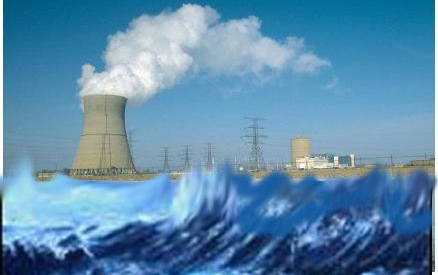
**Nuclear Siting**
Frozen in aspic — planning and pragmatism in the siting of nuclear power
stations in Britain. Despite efforts at strategic siting and the problems
posed by changing circumstances — especially the challenges arising out
of climate change — the geography of nuclear power infrastructure is
stubbornly inflexible, and has barely changed since it was first
established over half a century ago, as Andrew Blowers explains.
The geography of nuclear power in Britain was more or less settled by the 1970s
and has endured remarkably since then. Speed was of the essence in the
early years, a so-called age of ‘innocent expectation’ or, perhaps more
realistically, one of ‘trust in technology’. This was ‘nuclear’s
moment’, lasting less than three decades, during which time the
infrastructure of nuclear development was established around Britain,
predominantly at coastal sites.
But there is now a serious disjunction between a geography of nuclear power established more than half a century ago and the realities of site suitability in an age of climate change.
During the present century, a strategic siting process was adopted, with
individual sites identified through a National Policy Statement for Nuclear
Power Generation. In practice, siting remains a specific process, a matter
primarily of economic and historical determinism, with a few projects
seeking to attract investment to a handful of existing sites.
The last of the AGRs, at Torness on the east coast of Scotland, became the focus of the
first full-blown anti-nuclear protest in 1978 and 1979, attracting 5,000
people to the familiar features of fairs, symbols, stalls, camps, speeches,
leaflets, workshops, non-violent action, political and media attention,
stand-off s with police, and site occupations. The protest halted progress
but was eventually cleared. Its target was not just Torness power station
but the nuclear industry itself, and the connections between civil and
military nuclear power were clearly in evidence. With Torness, the
geography of nuclear power in Britain was complete.
Town & Country Planning Association Journal March April, 25th April 2023. ..https://www.tcpa.org.uk/journals/
US Senators and Congress Members introduce Bill to stop A1 from power to launch a nuclear weapon.

MARKEY, LIEU, BEYER, AND BUCK INTRODUCE BIPARTISAN LEGISLATION TO PREVENT AI FROM LAUNCHING A NUCLEAR WEAPON
Washington (April 26, 2023) – Senator Edward J. Markey (D-Mass.) and Representatives Ted W. Lieu (CA-36), Don Beyer (VA-08) and Ken Buck (CO-04) today introduced the bipartisan and bicameral Block Nuclear Launch by Autonomous Artificial Intelligence Act, legislation to safeguard the nuclear command and control process from any future change in policy that allows artificial intelligence (AI) to make nuclear launch decisions.
The Department of Defense’s 2022 Nuclear Posture Review states that current policy is to “maintain a human ‘in the loop’ for all actions critical to informing and executing decisions by the President to initiate and terminate nuclear weapon employment” in all cases. The Block Nuclear Launch by Autonomous AI Act would codify the Department’s existing policy by ensuring that no federal funds can be used for any launch of any nuclear weapon by an automated system without meaningful human control. Furthermore, the National Security Commission on Artificial Intelligence, established by Congress through the FY19 National Defense Authorization Act, recommended in their final report that the U.S. clearly and publicly affirm its policy that only human beings can authorize employment of nuclear weapons. This bill follows through on their recommendation.
“As we live in an increasingly digital age, we need to ensure that humans hold the power alone to command, control, and launch nuclear weapons – not robots,” said Senator Markey. “That is why I am proud to introduce the Block Nuclear Launch by Autonomous Artificial Intelligence Act. We need to keep humans in the loop on making life or death decisions to use deadly force, especially for our most dangerous weapons.”……………………………………………………………………………………………….
In April, Senator Markey and Representative Lieu reintroduced the Restricting First Use of Nuclear Weapons Act to prohibit any U.S. President from launching a nuclear strike without prior authorization from Congress. Last October, Senator Markey, then-member of Senate Foreign Relations Committee, filed eight amendments to the National Defense Authorization Act (NDAA) to reduce the risk of ‘nuclear Armageddon’ and stop the proliferation of nuclear weapons. Last January, co-chairs of the Nuclear Weapons and Arms Control Working Group, Senators Markey and Jeff Merkley (D-Ore.) and Representatives John Garamendi (CA-03) and Beyer led 51 of their colleagues in a letter to President Joe Biden urging the United States to take bold steps to reduce the nation’s reliance on nuclear weapons and to elevate arms control. https://www.markey.senate.gov/news/press-releases/markey-lieu-beyer-and-buck-introduce-bipartisan-legislation-to-prevent-ai-from-launching-a-nuclear-weapon
The most at-risk regions in the world for high-impact heatwaves

Heatwaves are becoming more frequent under climate change and can lead to
thousands of excess deaths. Adaptation to extreme weather events often
occurs in response to an event, with communities learning fast following
unexpectedly impactful events.
Using extreme value statistics, here we show
where regional temperature records are statistically likely to be exceeded,
and therefore communities might be more at-risk. In 31% of regions
examined, the observed daily maximum temperature record is exceptional.
Climate models suggest that similar behaviour can occur in any region.
In some regions, such as Afghanistan and parts of Central America, this is a
particular problem – not only have they the potential for far more extreme
heatwaves than experienced, but their population is growing and
increasingly exposed because of limited healthcare and energy resources. We
urge policy makers in vulnerable regions to consider if heat action plans
are sufficient for what might come.
Nature Communications 25th April 2023
No change to nuclear transport rules following accident down under, says regulator
in Western Australia.
The Office of Nuclear Regulation is responsible for oversight of operators transporting nuclear materials in the UK, and the Chief Nuclear Inspector’s report from October 2022 recorded 69 incidents related to nuclear transport in the reporting period. Two of these involved lost radioactive packages.
In response to the Western Australian accident, Richard Bramhall, of the Low-Level Radiation Campaign, told the NFLA: ‘The company is to be criticised for appalling practice since the gauge itself came apart and the packaging came apart and the vehicle was inadequate to contain the outcome of those failures.’
The NFLA and Dr Jill Sutcliffe, joint Chair of the NGA Forum of the Office of Nuclear Regulation, sent an FOI request to the ONR with their concerns. The ONR’s response is shown below as, whilst it contains no commitment to procedural changes, it has useful detailed guidance on the regulatory regime that applies to the transport of nuclear materials and links to reports.
The NFLA also wrote to senior executives at Rio Tinto PLC, the mining conglomerate that lost the caesium capsule, asking the company to issue a statement outlining how procedures would be tightened up to avoid another accident and whether Rio Tinto would fully reimburse the local authorities for the cost of recovering the capsule. Despite a reminder being sent urging the executives to respond, no reply has so far been received. 25 Apr 23
Return to Russia: Crimeans Tell the Real Story of the 2014 Referendum and Their Lives Since — RADIATION FREE LAKELAND

Originally posted on In Gaza: Crimeans gather with Russian national and Crimea flags in Sevastopol, Crimea, March 14, 2018. Alexander Zemlianichenko | AP Eva Bartlett traveled to Crimea to see firsthand out how Crimeans have fared since 2014 when their country reunited with Russia, and what the referendum was really like. October 9, 2019, Mint…
Return to Russia: Crimeans Tell the Real Story of the 2014 Referendum and Their Lives Since — RADIATION FREE LAKELAND
SIMFEROPOL, CRIMEA — In early August I traveled to Russia for the first time, partly out of interest in seeing some of the vast country with a tourist’s eyes, partly to do some journalism in the region. It also transpired that while in Moscow I was able to interview Maria Zakharova, spokeswoman of the Foreign Ministry.
High on my travel list, however, was to visit Crimea and Donetsk People’s Republic (DPR) — the former a part of Russia, the latter an autonomous republic in the east of Ukraine, neither accurately depicted in Western reporting. Or at least that was my sense looking at independent journalists’ reports and those in Russian media.
Both regions are native Russian-speaking areas; both opted out of Ukraine in 2014. In the case of Crimea, joining Russia (or actually rejoining, as most I spoke to in Crimea phrased it) was something people overwhelmingly supported. In the case of the Donbass region, the turmoil of Ukraine’s Maidan coup in 2014 set things in motion for the people in the region to declare independence and form the Donetsk and Lugansk People’s Republics.
In March 2014, Crimeans held a referendum during which 96 percent of voters chose to join Russia. This has been heavily disputed in Western media, with claims that Crimeans were forced to hold the referendum and claims of Russian troops on the streets “occupying” the peninsula.
Because Western media insisted the referendum was a sham held under duress, and because they bandy about the term “pro-Russian separatists” for the people of the DPR, I decided to go and speak to people in these areas to hear what they actually want and feel.
From the Russian mainland to the Crimean Peninsula………………………………………………………………
In the evening, we stay in the home of Vlad’s friend Tata, a Russian woman who moved to Crimea in 2012.
Since there was so much hype in Western media about a Russian takeover of the peninsula, I ask the burning questions: Were Crimeans forced to take part in the referendum? What was the mood like around that time? Tata replies:
“I never saw so many people in my life go out to vote, of their own free will. There was a period before the referendum, maybe about two months, during which there were two holidays: International Women’s Day, March 8, and Defender of the Fatherland Day, February 23.
……………………………………………………………I never saw tanks, I never saw Russian soldiers. I never saw any of that in the city.”
I ask Tata about how life had changed after the referendum:………………………………….
After the Soviet Union collapsed, it wasn’t the will of the Crimean people to join Ukraine. People were always Russian here; they always identified as Russian. Ukraine understood this well, and put nothing into Crimea, as punishment. Ukraine didn’t build any hospitals, kindergartens or roads.
In the past four years, the Crimean government has built 200 new kindergartens. This is the most obvious example of how things have improved. They also built the new Simferopol airport.
I worked in aviation. It took three years to build an airport of this standard in Yekaterinburg, Russia. It took half a year in Simferopol.”
International Jazz Festival……………………………………………………….
Construction everywhere……………………………………….
I remark on how kind and gentle people are here, as in Russia. Vlad replies:
“It shouldn’t be surprising — people are people anywhere. But Western media conditions us with stereotypes of Russians as cold and hard, vilifying an entire nation.”
The coastal city of Yalta lies further west along the peninsula. The drive there the following day is more beautiful still, the road flanked by mountains to one side, hills cascading down to the Black Sea on the other, endless wineries and, before Yalta itself, the stunning cliff-top castle known as “Swallow’s Nest.”
In the evening, we stay in the home of Vlad’s friend Tata, a Russian woman who moved to Crimea in 2012.
Since there was so much hype in Western media about a Russian takeover of the peninsula, I ask the burning questions: Were Crimeans forced to take part in the referendum? What was the mood like around that time? Tata replies:
“I never saw so many people in my life go out to vote, of their own free will. There was a period before the referendum, maybe about two months, during which there were two holidays: International Women’s Day, March 8, and Defender of the Fatherland Day, February 23.
Normally, people would go away on vacation during these holidays. But that year, Crimeans didn’t go anywhere; they wanted to be sure they were here during the referendum. We felt the sense of a miracle about to happen. People were anxiously awaiting the referendum.
There were military tents in the city, but they were not erected by the military, but by local men. They would stand there every day, and people could come and sign a document calling for a referendum.
I went one day and asked if I could add my name but I couldn’t, because I have a Russian passport. Only Crimean citizens could sign it. This was the fair way to do it.
At that time, my husband was in America. One day, he was watching CNN and got scared and called me because he saw reports of soldiers in the streets, an ‘invasion’ by Russia.
The local navy came from Sevastopol to Yalta and anchored their ships off the coast, made a blockade to ensure no larger Ukrainian or other ships could come and attack.
But I never saw tanks, I never saw Russian soldiers. I never saw any of that in the city.”
I ask Tata about how life had changed after the referendum:
When I came here in December 2012, everything was dilapidated and run down. The nice roads you were driving on, they didn’t exist when we were a part of Ukraine. I didn’t understand why Crimea was still a part of Ukraine. It was Russian land ever since the Tsars, the imperial time of Russia. This is where the Russian soul is, and the soul of the Russian navy.
After the Soviet Union collapsed, it wasn’t the will of the Crimean people to join Ukraine. People were always Russian here; they always identified as Russian. Ukraine understood this well, and put nothing into Crimea, as punishment. Ukraine didn’t build any hospitals, kindergartens or roads.
In the past four years, the Crimean government has built 200 new kindergartens. This is the most obvious example of how things have improved. They also built the new Simferopol airport.
I worked in aviation. It took three years to build an airport of this standard in Yekaterinburg, Russia. It took half a year in Simferopol.”
Finally, after night falls, we drive into the city of Koktebel, where an annual Jazz Festival is starting.
During all these hours of driving, the roads are smooth and well-trafficked, and I don’t see a single Russian military vehicle.
The next day, I walk through Koktebel, taking in the local markets brimming with produce, cheeses, and other goods, and every so often come across a streetside stand laden with fresh fruits. In the late afternoon, I walk along the sea, past packed beaches, and meet with a Crimean woman, Yaroslava, who lives in Austria but every summer returns to her beloved Crimea. She is ardently supportive of the decision to have joined Russia and spends much of her time back in Austria trying to educate people on why Crimeans wanted to be a part of Russia.
These are reasons I hear throughout my travels in Crimea: We wanted to be able to speak our native language [Russian] and be educated in that language; we wanted to be able to practice our cultural traditions; we have always been a part of Russia and we wanted to return.
Yaroslava is busy helping out with the Jazz Festival and wants to use the rest of our short time talking to help me arrange future meetings with people in Crimea. We decided to do a proper interview via Skype in the future when time allows.
I drift on to the Jazz Festival, where a talented pianist and band play beach-side to an enthusiastic crowd. Some songs later, I drift back along the beach, passing numerous musicians busking, and a pulsing nightlife that isn’t going to bed any time soon.
…………………………………As I stand to orient the map route and zoom in to look for any signs of cafes, a woman walks by me and says with a smile something with the word “shto,” which I think means “what.” When I reply in English, she laughs and flags down another woman, Yana, who speaks English well and insists she and her husband drive me.
As we drive, we chat. I ask her about the referendum, mentioning that many in the West have the notion that it was done under duress, with a heavy military presence to influence the vote. She laughs, saying: “There were no troops, no military, around us during the referendum.” She speaks of the joy of Crimeans to vote, says that maybe 98 percent of Sevastopol voters had voted in favor [it was apparently 96 percent, but close enough], and adds, “We are now under the wing of Russia.”
I ask about developments since then. She mentions the improvements in roads, also the modern trolley-buses and regular buses, the opening of kindergartens and schools, and free courses (like music) for children……………………………………..
Ukrainians in Crimea
In Simferopol anew, I meet Anastasiya Gridchina, the Chair of the Ukrainian Community of Crimea, an organization formed in 2015 whose main goals, she tells me, “are to have friendly relations between two great peoples: Ukrainians and Russians — not the politicians but the people. The second goal is to preserve inter-ethnic peace in the Republic between different nationalities.”
Gridchina explains that in Crimea there are more than 175 nationalities, just 20 less than in all of Russia, but in a very small territory. Hence the importance of preserving inter-ethnic peace. After Russians, Ukrainians comprise the second largest population in Crimea.
I ask Anastasiya whether she supported, much less participated in the referendum.
“I worked very hard in order that we could have a referendum. I live in Perevalne, the last settlement in the mountains above Alushta. There was a Ukrainian military detachment which did surrender. In February 2014, I was among a line of people standing between the Ukrainian and Russian military detachments, to prevent any bloodshed. The fear that prevailed at that time was that nationalists from Ukraine would come here and we would have massacres.
In February, there was a confrontation outside the Parliament here in Simferopol. It was organized by leaders of the Mejlis — the Crimeans Tatars. On the other side, there were some pro-Russia organizations who were protecting the Parliament. They were far less [numerous] than the Mejlis. The Mejlis were armed with sticks and knives. There were clashes and two people were killed, but thankfully it didn’t escalate beyond that.
When the news came that there would be a referendum, people relaxed. They had a chance to express their point of view and 96 percent of the population of Crimea voted for Crimea to return to Russia.”
Since she is Ukrainian, I ask Anastasiya why she wanted Crimea to join Russia:
“I’ve lived in Crimea all my life, and my language is Russian. And I know the history of Crimea, which has always been Russian territory, which has a history beginning with the Russian Empire and then the Soviet Union. So, it is Russian-speaking territory, first of all. That’s why I believe it should be in the Russian Federation, not in Ukraine.”
I ask about the claims that Russian soldiers invaded Crimea:
“Whatever they might have said about Russian soldiers forcing people to participate in the referendum, it was all lies, pure lies. We did not see any soldiers on the streets, especially on the day of the referendum.
I gave an interview to foreign journalists before the referendum. But when they published it, they changed my words. I said we were very thankful to the Russian troops that were here, that protected us from the attacks of Ukrainian nationalists prior to the referendum. But they translated it that I said ‘Please, we want Ukrainian soldiers to defend us from those Russian soldiers.’
The Russian troops that were here were not on the streets on the day of the referendum but, at the time in general, they were there to protect civilians from an attack by Ukrainians.
On the day of the referendum, there were no soldiers, no military. The only security were there to prevent any illegal actions. No military people were there, no arms, no armored personnel carriers, no military equipment, nothing. Only members of the election commission and the people voting.”
I ask whether many Ukrainian Crimeans left following the referendum:
“There were those who immediately after the referendum left Crimea for Ukraine because it was their personal wish. Nobody prevented them from going. Even the soldiers had an option: to stay and continue military service here, or to leave……………
Finally, Anastasiya gives me a message for the people outside of Crimea:
“I’d like to tell people around the world, welcome to Crimea, come here yourselves and see and hear with your own eyes and ears, to understand that all the lies you hear about Crimea, that we are oppressed or under pressure from the military…this is all lies, this is all not true.
Also, that we are not allowed to speak Ukrainian is a lie. One of the state languages is Ukrainian. Russian and Tatar are also state languages.”……………………
Next, I speak to Yuri Gempel, a member of Parliament, and the chairman of the Standard Commission on Inter-Ethnic Relations of the Parliament of Crimea.
“Crimea, under Ukraine, was robbed,” Gempel says. He continues:
“Everything was taken by the government and representatives of the ruling elite of Ukraine. For the 23 years Crimea was a part of Ukraine, they robbed Crimea. Not a single kindergarten was built in Crimea during those years. Kindergartens built during Soviet times stopped functioning.
But the main issue is that during that time, the people still felt themselves to be in Russian territory, not Ukrainian, in language, culture and in spirit. Under Ukrainian rule, Crimeans were made to speak Ukrainian, although Crimeans’ native language is Russian. People were deprived of the right to be in state service if they did not speak Ukrainian.”…………………………………………………………………………………………………………………………………
As for the claims that Russia invaded Crimea and of Russian forces intimidating voters, I believe the many people I met who denounced those claims and articulated very clearly why they wanted to join Russia, or as they say, “return to Russia.” https://ingaza.wordpress.com/2019/10/10/return-to-russia-crimeans-tell-the-real-story-of-the-2014-referendum-and-their-lives-since/
Questions about S.Korea-USA ‘ironclad’ commitment lead to impossible nuke solution
Korea Joong Ang Daily, BY MICHAEL LEE [lee.junhyuk@joongang.co.kr] 23Apr 23
“………… The Korea-U.S. alliance now stands at a crossroads as it marks its 70th anniversary………
South Korean politicians have made headlines in recent months by calling for an independent nuclear deterrent in a shift that experts say is driven by questions about the reliability of Washington’s “ironclad” commitment to defend Seoul.
These politicians include President Yoon Suk Yeol and Seoul Mayor Oh Se-hoon, who have publicly mused in recent months about the need for South Korea to bolster its security by means of developing an independent nuclear deterrent or persuading the United States to re-deploy tactical nuclear weapons on the peninsula that were withdrawn in 1991…………………….
To signal its commitment to defending Seoul, Washington has upped the frequency of U.S. strategic assets on rotation around the peninsula, especially as the North conducted a record 95 missile launches last year and announced the frontline deployment of tactical nuclear weapons and a new preemptive nuclear strike doctrine in April and September.
Seoul’s lack of say in how nuclear weapons would be used
But the United States has thus far ruled out re-deploying tactical nuclear weapons to the peninsula or setting up a nuclear sharing framework with South Korea similar to the one in place in some NATO states, such as Germany and Turkey, which participate in storing and planning the use of U.S. nuclear weapons in the absence of their own deterrent.
U.S. President Joe Biden in January shot down suggestions by Yoon that the two countries are planning joint nuclear weapons exercises, leaving South Korea without a codified say in the key question of how U.S. nuclear weapons could be employed in its defense.
It remains to be seen if decision-making on the use of nuclear weapons in a potential inter-Korean conflict will stay entirely in the hands of Washington.
According to a South Korean government official who spoke on condition of anonymity to the JoongAng Ilbo on March 27, “joint planning on how the U.S. extended deterrence and the nuclear umbrella will be maintained in potential scenarios involving an armed conflict” is on the agenda of Yoon’s summit with Biden later this month.
South Koreans worry about future U.S. administrations……………………………….
Failure of diplomacy with Pyongyang…………………………………………
International deadlock…………………………………….
Differing views of the role of the alliance regarding China
But all the experts agreed that the real test of Seoul’s alliance with Washington would come in the event of an armed conflict between the United States and China.
…………..Kim agreed that the prospect of a U.S.-China conflict over Taiwan was looming, if less publicly discussed, source of insecurity in Seoul’s alliance with Washington……… more https://koreajoongangdaily.joins.com/2023/04/24/national/defense/Korea-KoreaUS-alliance-nuclear-deterrence/20230424173040597.html
What now for Germany’s remaining nuclear waste?
Jens Thurau, 24 Apr 23 https://www.dw.com/en/what-now-for-germanys-remaining-nuclear-waste/a-65420338
Germany has shut down its last nuclear power stations. But the issue isn’t going anywhere, as the country faces the question of what to do with its remaining nuclear waste.
Nuclear energy in Germany has been history since mid-April. At one time, up to 20 nuclear power plants fed electricity into the German grid. But all that is over now. The last three nuclear power plants ended their operations on April 15.
To Germany’s environment minister Steffi Lemke of the Green Party, the date marks a new dawn: “I think we should now put all our energy into pushing forward photovoltaics, wind power storage, energy saving, and energy efficiency, and stop these backward-looking debates,” she said in a recent radio interview.
April 15 also effectively ended a decades-long political dispute in Germany. In light of the tense situation on the energy market due to Russia’s war in Ukraine, there are still voices demanding that nuclear power be extended
The waste issue
And yet, the issue of nuclear energy will linger for Germany for some time yet, as the reactors still have to be dismantled, and the final disposal of the radioactive nuclear waste has not yet been clarified.
Like almost all other countries that have operated, or continue to operate nuclear power plants, Germany has yet to find a place to safely store the spent fuel. Currently, Germany’s nuclear waste is in interim storage at the sites of abandoned power plants, but the law requires that nuclear waste be safely stored in underground repositories for several millennia.
“The interim storage facilities are designed to last for quite some time,” Wolfram König, president of the Federal Office for the Safety of Nuclear Waste Disposal (BASE), told DW. “They are supposed to bridge the time until a final repository is available. … What we are looking for is geological depth, a suitable layer of salt, in granite or in clay rock, which will ensure that no radioactive substances reach the surface again for an indefinitely long period of time.”
Location, location, location
That’s a principle that Germany shares with all of the 30 or so countries that still operate, or have operated nuclear power plants in the past: Radioactive waste is to be disposed of underground. But where exactly? For a long time, Gorleben, located in the Wendland region of Lower Saxony, northeastern Germany, was the site most favored by politicians looking for an underground repository for nuclear waste.
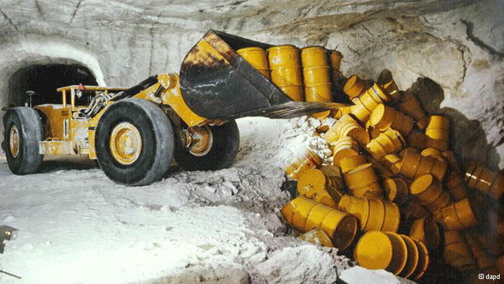
But Gorleben became the location of fierce protests against nuclear energy, so politicians decided a few years ago to abandon the site. Now, the search is on throughout Germany, with more than 90 possible sites under consideration. “We can and must assume that the search process in Germany, with the construction of a final repository, will take approximately as long as we have used nuclear energy, namely 60 years,” König said.
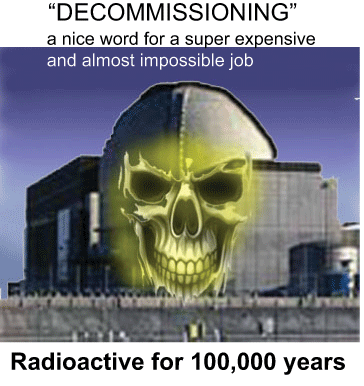
Meanwhile, the dismantling of Germany’s 20 or so nuclear power plants that have been built will also take time. That, according to König, is the responsibility of their operators, who estimate it could take between 10 and 15 years.
A worldwide headache
So far, reactors have been shut down in Italy, Kazakhstan, and Lithuania, while other countries, including the United Arab Emirates and Belarus, are building new nuclear plants.
But the permanent, safe storage of radioactive waste is an unresolved issue everywhere.
Finland is furthest along in its planning. In a report by German public broadcaster ARD, Vesa Lakaniemi, administrative head in the municipality of Eurajoki, southern Finland, talked about the construction of the final storage facility for nuclear waste in his town: “Whoever profits from electricity must also take responsibility for the waste. And that’s how it is in Finland.” The estimated construction costs for the Eurajoki repository is €3.5 billion ($3.8 billion).
According to the International Atomic Energy Agency (IAEA), there are currently 422 nuclear reactors in operation worldwide, with an average age of about 31 years. The recent “World Nuclear Industry Status Report” said that, despite a few countries building new nuclear power stations, there was no evidence of a “nuclear renaissance.” In 1996, some 17.5% of the world’s energy was produced in nuclear reactors — in 2021 it was below 10%. Nevertheless, the radioactive legacy will keep Germany preoccupied for many years to come.
In Indiana, small nuclear reactors don’t need to be “small” any more.

ED. – the picture above is of a NuScale smr design, not Rolls Royce, but the principle is the same. It’s not really small, and they know that truly small reactors are not economically viable.
New law boosts maximum size of nuclear reactors permitted in Indiana
nwi.com Dan Carden, Apr 24, 2023
Gov. Eric Holcomb approved a new state law Thursday increasing the maximum size of the small modular nuclear reactors that someday may be used by utility companies to generate electricity in Indiana.
Senate Enrolled Act 176, which took effect immediately, redefines a small modular reactor (SMR) as a nuclear reactor capable of generating up to 470 megawatts of energy — a 34% increase from the state’s former 350 MW generating cap.
Rep. Ed Soliday, R-Valparaiso, the sponsor of the legislation, said the higher generating capacity encompasses more of the nascent SMR market, including a 450 MW reactor designed by Rolls-Royce, an aircraft engine manufacturer based in Indianapolis…………………………………………..
State lawmakers directed the Indiana Utility Regulatory Commission last year to adopt rules by July 1, 2023, that would permit nuclear SMRs to be used to generate electricity in the Hoosier State……….
Critics of the plans have said there’s no need for Indiana to lead the way with nuclear SMRs, especially through rules that give utilities built-in profits, other incentives and the opportunity to recoup potentially billions of dollars in construction costs from ratepayers before a nuclear reactor actually generates any electricity. https://nwitimes.com/business/technology/new-law-boosts-maximum-size-of-nuclear-reactors-permitted-in-indiana/article_3962a672-8e8c-5168-bc88-31cc6891a88b.html
Why the disbandment of NATO is long overdue
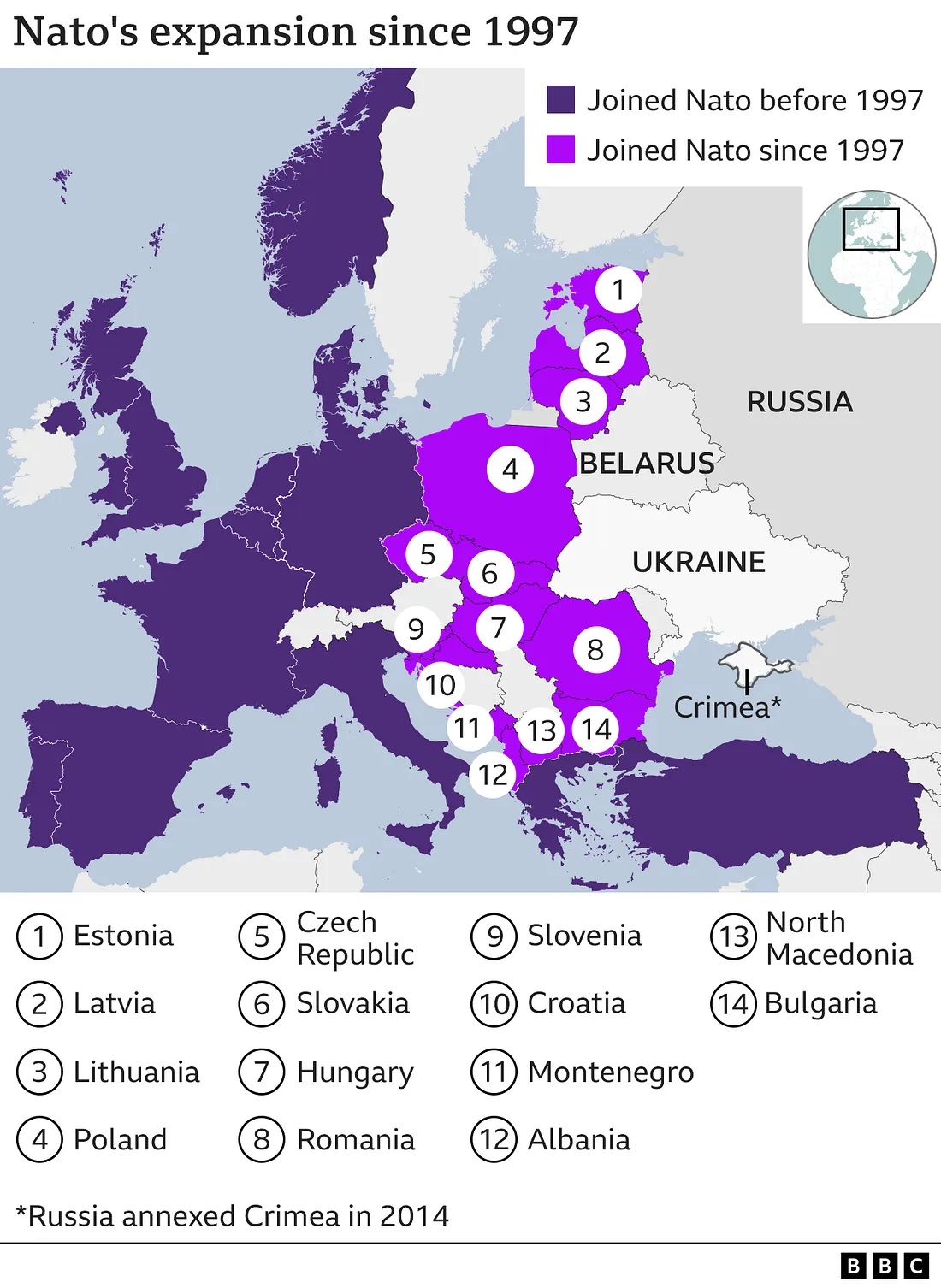
it is no longer feasible or possible to harbour any lingering belief that NATO is anything other than a tool of US hard power, deployed not to protect and defend, but instead to destroy and dominate.
John Wight, Medium, 27 Jan 23 https://johnwight1.medium.com/why-the-disbandment-of-nato-is-long-overdue-aaebff253cd0
The fundamental root cause of the ongoing brutal and tragic conflict in Ukraine is not Russian aggression, it is NATO aggression, reminding us that the latter’s disbandment is a non-negotiable condition of a world in which the triumph of peace and stability over chaos and conflict is at long last achieved.
Indeed the very existence of NATO seventy-four years on from its creation stands as an insult to the millions who died in WWII so that the UN Charter could be born. Produced as the foundational document of the United Nations upon its birth in October 1945, enshrined within the Charter’s articles was a solemn promise that henceforth justice, international law and tolerance would reign in place of brute power, force and intolerance.
Consider for a moment the first section of the Charter’s preamble:
WE THE PEOPLES OF THE UNITED NATIONS DETERMINED
- to save succeeding generations from the scourge of war, which twice in our lifetime has brought untold sorrow to mankind, and
- to reaffirm faith in fundamental human rights, in the dignity and worth of the human person, in the equal rights of men and women and of nations large and small, and
- to establish conditions under which justice and respect for the obligations arising from treaties and other sources of international law can be maintained, and
- to promote social progress and better standards of life in larger freedom
It is impossible to read those words and not lament the gaping disjuncture between the noble ideals and vision they describe and the grim reality that arrived in their wake. For rather than mankind being saved from the ‘scourge of war’, and rather than ‘respect for the obligations arising from treaties and other sources of international law’, the scourge of war and violation of treaties and international law have grown to become a near-everyday occurrence across the globe.
The pressing question we are required to grapple with today is, why? What lies at the root and what is the common denominator responsible for mankind’s abject failure to achieve the vision set out in the UN Charter?
Upon due consideration, we are left in no doubt that fundamentally the series of conflicts that have come to define our existence are a consequence of the drive by one ideological bloc to dominate and impose a particular political, economic and value system onto a world defined by its diversity of languages, cultures, histories and traditions.
The result is the normalization of war and the apotheosis of hard power, rather than war and hard power being regarded as grotesque perversions and an impediment to human progress.
Seventy- four years ago, NATO, a military alliance whose entire existence and ethos is predicated on might is right, emerged from the womb of the Cold War objectives devised by a Truman administration of fanatical hawks, consumed with the goal of full-spectrum dominance at the close of WWII.
In his 1997 essay, ‘The Last Empire,’ Gore Vidal savages the official history proffered by Western ideologues when it comes to the sudden shift that took place from Moscow being viewed as an indispensable ally in the war against Nazi Germany in the eyes of the Roosevelt administration, to implacable foe when Truman entered the White House upon Roosevelt’s death in April 1945.
Vidal:
The National Security State, the NATO alliance, the forty-year Cold War were all created without the consent, much less advice, of the American people… The impetus behind NATO was the United States… We were now hell bent on the permanent division of Germany between our western zone (plus the British and French zones) and the Soviet zone to the east. Serenely, we broke every agreement that we had made with our former ally, now horrendous Communist enemy.
Moving things forward, it is by now no secret that US Secretary of State James Baker assured Soviet premier Mikhail Gorbachev in a meeting on February 9, 1990, that NATO would not expand “one inch eastward” upon the reunification of Germany. According to declassified documents, Baker’s pledge was made as part of a “cascade of assurances” over Soviet security given by Western leaders at that time and on into 1991, when the Soviet Union came to an end. It is the breaking of those assurances that lies at the heart of the deterioration in relations between East and West that has taken place since, and which informs the current conflict in Ukraine.
Flush with triumphalism over the demise of the Soviet Union in the early 1990s, NATO was loosed upon the world not in name of democracy but in the cause of imperialism. Neocon scribe Thomas Friedman wrote openly of the driving ethos of Western foreign policy after the Soviet Union’s demise:
Continue readingGlobal military spending increase: Militarism will cost us the earth
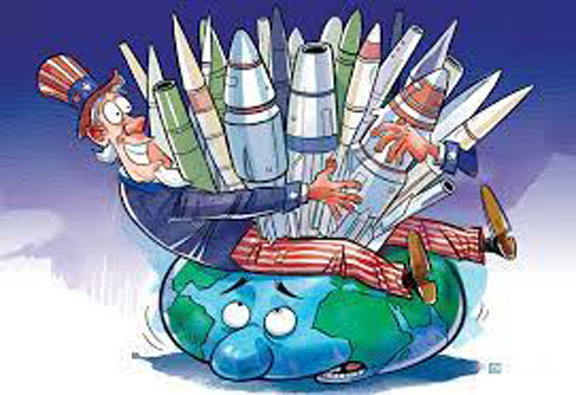
The five largest military spenders in 2022 were the US (39% of the global total), China (13%), Russia (3.9%), India (3.6%) and Saudi Arabia (3.3%),
Aotearoa New Zealand Campaign on Military Spending
24 April 2023
Links to share: Facebook, https://www.facebook.com/PeaceMovementAotearoa/posts/6107093852671266 Twitter, https://twitter.com/PeaceMovementA/status/1650264027988365312
Despite the rapidly escalating climate emergency and humanitarian crises around the world, global military spending increased to its highest ever recorded level last year according to new figures released by the Stockholm International Peace Research Institute (SIPRI) today – the Global Day of Action on Military Spending.SIPRI has estimated global military expenditure last year was at least $2,240 billion (US) – a spending increase of 3.7% in real terms in 2022 (a 6.5% nominal increase in current prices without adjusting for inflation) – which averages out to more than $6.1 billion (US) spent every day. [1]
By way of contrast, on average more than 13,600 children under the age of five died every day last year from mainly preventable causes – lack of access to adequate food, clean water and basic medicines – a figure UNICEF describes as an “immense, intolerable” loss of life. [2] This is one of the prices paid, the collateral damage that is seldom talked about, for maintaining armed forces in a state of combat readiness around the world.
It is inexcusable that many states – including New Zealand – continue to prioritise spending on combat-ready armed forces over human health and wellbeing, and care for the planet…………………………………..
Every dollar of military expenditure is a dollar taken away from socially useful spending – a dollar that could be used to take real action on climate change, to ensure a decent standard of living for all, and to ensure health and social welfare systems can function well in national, regional or global emergencies: it is a dollar that could be used to save lives, to promote climate justice, flourishing communities and care for the planet, rather than being spent on endless preparations for war.
Now more than ever, with the future of life on earth at stake, states must work together to find sustainable solutions, instead of continuing to pour public money into wasteful destructive military activity – the ultimate in unsustainability, with military emissions estimated to be at least 5.5% of the global total.
The five largest military spenders in 2022 were the US (39% of the global total), China (13%), Russia (3.9%), India (3.6%) and Saudi Arabia (3.3%), which together accounted for 63% of world military spending. [1] Military expenditure decreased in Africa (-5.3%) last year, but increased in four of the five geographical regions, with the highest increase in Europe (+13%), followed by the Middle East (+3.2%), then Asia and Oceania (+2.7%) and the Americas (+0.3). Overall in 2022, the military burden (military spending as a share of gross domestic product) globally was 2.2%. [1]New Zealand’s military spendingWhile New Zealand does not feature in the SIPRI table ranking the highest increases in military spending around the world this year as it did in 2020 [3], that is simply because other states increased their spending by more, not because there has been any reduction in New Zealand’s military spending.
With visit of Algerian President France must face up to its nuclear fallout
Next month the Algerian president, Abdelmadjid Tebboune, is set to visit
Emmanuel Macron in Paris. The two countries have a difficult past, with war
giving way to hostility, giving way to a very curious form of
interdependence. The agenda for the visit looks crowded, with irregular
migration through Algeria dominating the list of the Elysee’s priorities.
However, unlike previous meetings between the two leaders, Tebboune arrives
in France on the crest of a diplomatic wave fuelled by Algeria’s
hydrocarbon reserves at a time when European supplies are at a premium.
Moreover, he arrives with a long list of Algeria’s own grievances, not
least the tonnes of radioactive waste France has buried in the Sahara and
for which it still won’t provide details.
New European 22nd April 2023
https://www.theneweuropean.co.uk/france-faces-up-to-its-nuclear-fallout/
-
Archives
- February 2026 (220)
- January 2026 (308)
- December 2025 (358)
- November 2025 (359)
- October 2025 (376)
- September 2025 (258)
- August 2025 (319)
- July 2025 (230)
- June 2025 (348)
- May 2025 (261)
- April 2025 (305)
- March 2025 (319)
-
Categories
- 1
- 1 NUCLEAR ISSUES
- business and costs
- climate change
- culture and arts
- ENERGY
- environment
- health
- history
- indigenous issues
- Legal
- marketing of nuclear
- media
- opposition to nuclear
- PERSONAL STORIES
- politics
- politics international
- Religion and ethics
- safety
- secrets,lies and civil liberties
- spinbuster
- technology
- Uranium
- wastes
- weapons and war
- Women
- 2 WORLD
- ACTION
- AFRICA
- Atrocities
- AUSTRALIA
- Christina's notes
- Christina's themes
- culture and arts
- Events
- Fuk 2022
- Fuk 2023
- Fukushima 2017
- Fukushima 2018
- fukushima 2019
- Fukushima 2020
- Fukushima 2021
- general
- global warming
- Humour (God we need it)
- Nuclear
- RARE EARTHS
- Reference
- resources – print
- Resources -audiovicual
- Weekly Newsletter
- World
- World Nuclear
- YouTube
-
RSS
Entries RSS
Comments RSS
 nuclear-news