Nuclear Tug of War Intensifies in Brussels
With money and regulations on the table for renewable energy, the EU has become entrenched into two solid blocs with different stances on nuclear power.
Bridget Ryder — April 3, 2023 The European Conservative
With both a package of incentives for green technology and revisions to the Renewable Energy Directive on the table, the fight in Brussels over the place of nuclear power in the ‘green,’ ‘sustainable,’ ‘clean’ energy landscape—and its corresponding regulation—has intensified.
The bloc’s energy ministers met last week to prepare their negotiating points with the EU Parliament over changes to the Renewable Energy Directive. Prior to the March 28th Council meeting, energy ministers pow-wowed in competing breakfast gatherings—one for the French-led nuclear alliance and the other for the Austrian-organised Friends of Renewables group, Euractiv reports.
Nuclear alliance
At the end of their meetings, the nuclear alliance sent out a press release to notify the media—and presumably, both the Commission and their rivals on the EU Council—that they had agreed that nuclear energy was indeed “strategic” in achieving the EU Commission’s environmental goals. This is the opposite position to the one the Commission has taken in the recently proposed Net Zero Industry Act (NZIA), a set of incentives meant to counter U.S. green tech subsidies.
Under French leadership, the nuclear alliance (consisting of Bulgaria, Croatia, the Czech Republic, Finland, Hungary, the Netherlands, Poland, Romania, Slovakia, and Slovenia) first met in February while the Commission was still preparing the NZIA. Its goal was to promote nuclear power as a low-carbon source of electricity and work on “common industrial projects.”
In mid-March, the Commission presented the NZIA draft, but with nuclear power excluded from the list of “strategic” technologies that would qualify for incentives. The one exception was “cutting-edge nuclear” technology, such as small modular reactors (SMRs) which could qualify for some investment incentives. The alliance then met again in March, just before the meeting of energy ministers on March 28th, and announced that they had “fully recognised that nuclear is a strategic technology for achieving climate neutrality.”
The pro-nuclear breakfasts were attended by Italy and Belgium, though only as observers. The two countries made it clear they had not signed on to any agreed position with the group, though they have reasons for desiring a favourable status for nuclear energy.
Belgium, for its part, has had to retract plans to start shutting down the country’s six nuclear reactors. After announcing the closure of a set of nuclear power plants by 2025, the public outcry forced the energy ministry to instead grant them a ten-year extension. ………………..
Friends of renewables
The Friends of Renewables—Estonia, Spain, Germany, Denmark, Ireland, Luxembourg, Portugal, Latvia, and Lithuania, with Austria as leader—are a clear counterweight to the nuclear alliance.
The compromise
After the breakfast gatherings, the two groups had to come together with the rest of the bloc’s member states for the official EU Council Meeting to settle on a negotiating position for the updates to the Renewable Energy Directive (RED).
The nuclear sticking point was whether hydrogen produced using nuclear power should be included in renewable fuel targets. After hours of back and forth, they agreed to label nuclear-produced hydrogen as “low carbon,” in other words, dirtier than ‘green’ hydrogen but better than the ‘brown’ hydrogen linked to fossil fuels.
Nuclear power enters into the debate about renewables in the question of hydrogen gas. Making the gas ‘green,’ a process of separating the hydrogen from water molecules, requires an energy source. When that source is considered ‘green,’ such as solar or wind power, the hydrogen is considered ‘green.’
Negotiators for the EU Parliament then also made room for nuclear power in the Renewable Energy Directive (RED), admitting that it has a “role” to play in reducing carbon emissions and is in a category of its own in the spectrum of environmental friendliness.
The RED now recognizes “the specific role of nuclear power, which is neither green nor fossil,” French MEP Pascal Canfin, chair of the Parliament’s Environment Committee, who participated in the negotiations, tweeted…….
The political agreement reached by the Council and Parliament calls for doubling renewable energy output by 2030.
“The agreement raises the EU’s binding renewable target for 2030 to a minimum of 42.5%, up from the current 32% target and almost doubling the existing share of renewable energy in the EU. Negotiators also agreed that the EU would aim to reach 45% of renewables by 2030,” the Commission said in a statement about the political agreement on the RED.
‘Renewable’ energy currently makes up just over 20% of the bloc’s energy mix.
Further room was made for nuclear by provisions in the agreement by giving member states two options to calculate achieving certain targets: either emission reductions or renewable energy output. This is an advantage for countries like France that have substantial nuclear capacity, as carbon dioxide is not the major by-product of nuclear power production. https://europeanconservative.com/articles/news/nuclear-tug-of-war-intensifies-in-brussels/
Opponents pack Pilgrim Nuclear meeting as potential discharge of radioactive water looms
CAI | By Jennette Barnes, March 28, 2023
Opponents of the proposed discharge of radioactive water from the Pilgrim Nuclear Power Station packed a meeting on the future of the station last night.
Ryan Collins of Bourne received a standing ovation from the audience when he presented a thick binder of signatures from his Change.org petition. The petition calls for a stop to the discharge plan. It garnered more than 200,000 signatures.
The state’s Nuclear Decommissioning Citizens Advisory Panel hosted the meeting at Plymouth Town Hall as part of its regular calendar.
…………………………………… opponents argue that the terms of a state settlement with Holtec would make a release of contaminated water illegal, with or without a permit.
Many members of the audience held orange signs that read, “Protect our bays! No permit!” in reference to the proposed modification of Holtec’s permit under the National Pollutant Discharge Elimination System.
Jo-Anne Wilson-Keenan, of East Dennis, said she’s concerned about contamination. Speaking from the podium, she raised her arm to show the shape of Cape Cod and the location of Dennis.
“We live right here in the elbow, and when the radioactive water comes down from Plymouth, it’s going to land right on our beaches,” she said.
Jim Cantwell, state director for U.S. Sen. Ed Markey, discussed Markey’s March 17 letter to Holtec asking the company to use the ratepayer-funded decommissioning trust fund to pay for an independent scientific study of the risks of discharging the radioactive water stored at Pilgrim.
Last May, at a field hearing hosted by Markey in Plymouth, Singh agreed to allow independent testing.
Meanwhile, state-supervised testing of the Pilgrim water is set to begin with a collection of samples on April 5. Senior staff from the Massachusetts Department of Environmental Protection and Department of Public Health are scheduled to observe, along with a representative of the town of Plymouth.
But Seth Pickering, a deputy regional director with DEP, said the state no longer plans to use the previously identified Colorado lab, Eurofins, to test for non-radioactive pollutants.
The agency will instead rely on Gel Laboratories of South Carolina, which Pickering disclosed is a lab Holtec uses as well.
Members of the audience objected to the idea of using the same lab as Holtec……………. https://www.capeandislands.org/local-news/2023-03-28/opponents-pack-pilgrim-nuclear-meeting-as-potential-discharge-of-radioactive-water-looms
Inside Saudi Arabia’s Global Push for Nuclear Power
Despite qualms in Washington, Saudi officials have pressed the United States to help them develop nuclear power. But they are also exploring other options, including China.
NY Times, By Edward Wong, Vivian Nereim and Kate Kelly, This article was reported from Washington and Riyadh, Saudi Arabia. April 1, 2023
For years, Saudi Arabia has pressed the United States to help it develop a nuclear energy program, as Saudi leaders look beyond oil to power their country.
But talks about a nuclear partnership have dragged on, largely because the Saudi government refuses to agree to conditions that are intended to prevent it from developing nuclear weapons or helping other nations do so, according to officials with knowledge of the discussions.
Frustrated Saudi officials are now exploring options to work with other countries, including China, Russia or a U.S. ally.
At the same time, they are renewing a push with the United States — their preferred partner — by offering to try to normalize relations with Israel in exchange for U.S. cooperation on building nuclear reactors and other guarantees.
New details of the Saudi efforts provide a window into the recent difficulties and distrust between Washington and Riyadh, and into the foreign policy that Crown Prince Mohammed bin Salman is pursuing: greater independence from the United States as he expands partnerships with other world powers, including China……………
The Saudi nuclear efforts raise a specter of proliferation that makes some American officials nervous: Prince Mohammed, the kingdom’s de facto ruler, has said that Saudi Arabia will develop nuclear weapons if Iran does. Any civilian nuclear program has dual-use elements that could aid a country in producing weapons-grade material.
…………………………………………………………….. Saudi officials have refused to commit to the restrictions, which would undermine their goal of enriching and selling uranium. The United Arab Emirates, a Saudi neighbor, and Taiwan have agreements with the United States that include bans on enrichment and fuel reprocessing.
Even if Saudi officials express willingness to sign a 123 agreement, any deal would face significant political obstacles in Washington. President Biden distrusts Prince Mohammed and denounced Saudi Arabia during a blowup over Riyadh’s oil policy in October. And many Democratic lawmakers and some Republican ones say Saudi Arabia has been a destabilizing force…………………………………………………………………………………………………
Flirting With China
As the Biden administration insists on certain safeguards, Saudi officials have continued looking at non-American companies.
An attractive one is the Korea Electric Power Corporation, or Kepco, based in South Korea. A company spokesperson said Kepco is talking to U.S. officials about the nuclear program and is interested in working with Saudi Arabia but declined to go into details, citing a confidentiality agreement with the Saudis.
But the South Korean government, a U.S. ally, would likely bar the company from the project if Saudi Arabia does not enter into a strict nonproliferation agreement with a government or the International Atomic Energy Agency. The company said it hoped “the conditions for participation in the project will be created.” And a complicating factor is a legal dispute between Kepco and Westinghouse over reactor designs.
…………………………… China has built up Saudi Arabia’s ballistic missile arsenal over decades and sends military officers to work on the program, current and former U.S. officials said. And with Chinese technology, Saudi Arabia is now able to build its own missiles, they said. New satellite imagery showing bulldozer activity at previous missile sites indicates Saudi Arabia could be housing a new type of missile underground, said Jeffrey Lewis, a nuclear nonproliferation expert at the Middlebury Institute of International Studies.
………………………………… Chinese nuclear companies have also offered to help explore and develop the country’s uranium resources. In 2017, the China National Nuclear Corporation and the Saudi Geological Survey signed a memorandum of understanding on surveying uranium deposits. In 2021, the Saudi Geological Survey issued a “certificate of appreciation” to the Beijing Research Institute of Uranium Geology for help in exploring uranium and thorium resources……. more https://www.nytimes.com/2023/04/01/us/politics/saudi-arabia-nuclear-biden-administration.html
The cost of being wrong — Beyond Nuclear International

The price of nuclear deterrence failure is too great a gamble
The cost of being wrong — Beyond Nuclear International
Deterrence cannot fail and is therefore not a foundation for peace
By Linda Pentz Gunter
Arguments around nuclear deterrence can become quickly convoluted. But the basic premise, according to those who advocate it, is that we are safer with nuclear weapons than without them. The possession of nuclear weapons by the world’s major powers, they say, has kept the peace. The lethality of nuclear weapons is such that they will inevitably never be used, thus preventing nuclear war, the argument goes.
To the rational ear this sounds breathtakingly illogical. But try tangling with the deterrence crowd and both sides will quickly find themselves tied up in a semantic knot of double and triple negatives.
However, it’s all really quite simple, or it seems so when listening to Austrian diplomat Alexander Kmentt explain it. Kmentt, one of the chief architects of the UN Treaty on the Prohibition of Nuclear Weapons (TPNW), just has a knack for framing the argument against deterrence both clearly and compellingly. Here is how he puts it:
“I can’t prove that deterrence doesn’t work. And I can’t prove that it does. But the price of being wrong if it doesn’t work is too high. It cannot fail.”
Kmentt was addressing an audience of European representatives of International Physicians for the Prevention of Nuclear War at their January 2023 conference in Hamburg, Germany. (I was also a presenter there so enjoyed the privilege of hearing Kmentt’s talk, which was delivered live streamed.)
This rationale makes sense. For deterrence to work, it must be 100% foolproof all the time. But anything governed by human beings — and technology invented by them — can guarantee no such thing. And given the price of failure, the choice is obvious: deterrence isn’t worth the risk.
There is a solution to all this and it is contained in the TPNW, of which Kmentt, and many others, can be so rightfully proud. You can indeed guarantee zero chance of a nuclear war if there are zero nuclear weapons in the world. “With the TPNW, deterrence was rejected,” Kmentt said. A first. In another first, “it is the first treaty that recognizes the injustices done.”
Those injustices are invariably meted out to smaller nations, and it was they who lined up in significant enough numbers to both sign and then ratify the TPNW. “If deterrence fails, small states are the collateral damage,” Kmentt pointed out.
In fact, the TPNW is so innovatory — Kmentt referred to it as “an avant-garde treaty”— that it departed from all earlier treaty scripts by encouraging full inclusion and participation. Framing it was “open to outside voices, to civil society and to academia,” Kmentt told the Hamburg audience. “There were observers.” This set it apart from the halls-of-power treaties that preceded it.
And it remains an open process. “We are clear that we are welcoming to whoever wants to engage with us on arguments around the treaty,” said Kmentt. “If countries didn’t show up, it was not a reaction to something we did.”
There has been —and remains — as Kmnett noted, considerable opposition toward the TPNW, particularly from the nuclear weapon countries. The U.S. Ambassador to the UN at the time, Nikki Haley, now apparently running for president on the Republican ticket, was so frightened by the Treaty that, as ICAN reported, “on the first day of treaty negotiations, she hosted a press conference outside the room where negotiations were to take place, criticizing the pursuit of a prohibition treaty.”………………………………… more https://beyondnuclearinternational.org/2023/04/02/the-cost-of-being-wrong/
Poland, Slovakia deliver first MiG warplanes to Ukraine — Anti-bellum
Polish RadioApril 3, 2023 Poland supplied first MiG-29 jets to Ukraine: official A senior aide to the Polish president has said that Poland has already transferred the first batch of MiG-29 fighter jets to Ukraine to help Kyiv fight the Russian invasion. Marcin Przydacz made the statement in a radio interview on Monday… *** He […]
Poland, Slovakia deliver first MiG warplanes to Ukraine — Anti-bellum
North Korea May Be Close to Completing New Nuclear Reactor: 38 North
Satellite images indicate North Korea may be close to completing a new
reactor in its major nuclear complex in Yongbyon, according to 38 North, a
Washington-based website that tracks events in the country. Construction
crews are working on a support building at the site’s Experimental Light
Water Reactor (ELWR) development and water discharges have been spotted
near the ELWR’s pump house that could be associated with testing of the
reactor’s cooling system, the website said.
North Korean leader Kim Jong Un
visited a facility producing nuclear bombs earlier this week and reiterated
his order to massively expand the North’s nuclear arsenal. Kim said North
Korea is ready to use nuclear weapons “anytime and anywhere,” the
official Korean Central News Agency reported. His visit to the facility
came as the nation carried out series of weapon tests including ballistic
missiles designed to deliver a nuclear warhead. The Yongbyon site’s
existing 5 MWe reactor has been running since July 2021 and commercial
satellite images from March show there’s new construction for the reactor’s
spent fuel storage building, according to 38 North.
Bloomberg 2nd April 2023
April 2 Energy News — geoharvey

World: ¶ “The Oceans Just Reached Their Hottest Temperature On Record As El Niño Looms” • Ocean temperatures have steadily risen over the past several years – despite a lengthy cooling La Niña. The oceans have been record-warm for the past four years, scientists reported in January, temperatures are still rising, and an El Niño […]
April 2 Energy News — geoharvey
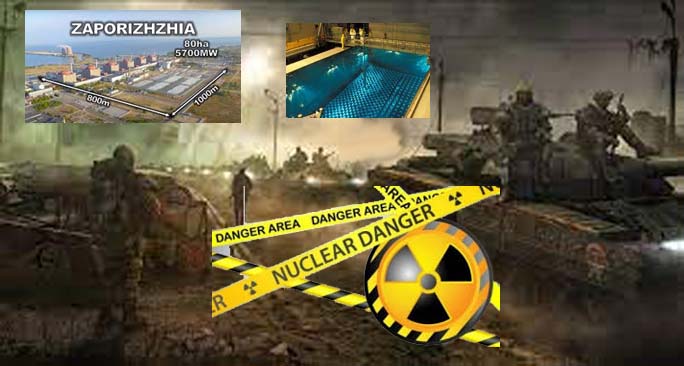
Ukraine’s Zaporizhzhia power plant: How prepared is Europe for a future nuclear disaster?
It raises the question, too, of whether we should rely on nuclear power at all.
It raises the question, too, of whether we should rely on nuclear power at all.
euro news.next, By Camille Bello 31/03/2023
Russia’s invasion has repeatedly knocked out Ukraine’s electricity grid, causing blackouts at the Zaporizhzhia nuclear plant – Europe’s largest – where a constant power supply is needed to prevent the reactors from overheating.
On March 9, the plant blacked out for the sixth time since the occupation, forcing nuclear engineers to switch to emergency diesel generators to power its essential cooling equipment running.
“Each time we are rolling a dice,” Rafael Mariano Grossi, the director general of the United Nations’ International Atomic Energy Agency (IAEA), warned at the time. “And if we allow this to continue time after time, then one day, our luck will run out”.
On Monday, during a meeting with Ukraine’s president Volodymyr Zelensky, Grossi reiterated the situation “isn’t getting any better” as relentless fighting in the area keeps the facility at risk of a disaster.
The IAEA watchdog has called for a “protection zone” around the plant but has failed to devise terms that would satisfy both Ukraine and Russia.
Grossi told the AP on Tuesday he believed a deal was “close”. However, Zelenskyy, who opposes any plan that would legitimise Russia’s control over the facility, said he was less optimistic a deal was near. “I don’t feel it today,” he said.
Is Zaporizhzhia really at risk?
Nuclear power plants are designed to withstand a wide range of risks, but no operating nuclear power plant has ever been caught up in modern warfare.
Because of the repeated crossfire, Zaporizhzhia’s last reactor was shut down in September as a precautionary measure. But external power is still essential to run critical cooling and other safety systems.
Fears about Zaporizhzhia have exacerbated existing concerns around our lack of preparedness for any nuclear-related incident, laying bare anxieties not necessarily around war-related incidents but about climate change and Europe’s old reactors, for instance.
It raises the question, too, of whether we should rely on nuclear power at all.
March 11 marked the 12-year anniversary of the massive earthquake and tsunami that caused the second-worst nuclear accident in history at the Fukushima Daiichi Nuclear Power Plant in Japan.
The anniversary of the catastrophic meltdown that left 160,000 people displaced and cost the Japanese government over €176 billion, was another reminder of the potential threat of a nuclear spill, but a number of other recent events have also raised the alarm in Europe, not least the war in Ukraine.
‘We are not properly prepared’
Europe’s nuclear power reactors are ageing – they were built on average 36.6 years ago – and recent checkups in France have found cracks in several facilities.
Some energy experts have warned that the extreme weather events brought on by climate change could pose a serious threat to the EU’s 103 nuclear reactors, which account for about one-quarter of the electricity generated in the bloc.
Jan Haverkamp, a senior nuclear energy and energy policy expert for Greenpeace, said the chances of Europe seeing a large accident like Fukushima were now “realistic” and “we should take them into consideration”.
“We are not properly prepared,” he told Euronews Next…………………………………………………….
The maintenance of a nuclear plant depends on a number of factors, such as its design and its supervision history. But there are other factors that come into play, such as error-prone humans, earthquakes, tsunamis, fires, flooding, tornadoes or even in the case of Zaporizhzhia, acts of war…………………………………………………………………………………… more https://www.euronews.com/next/2023/03/31/chernobyl-fukushima-europe-prepared-nuclear-disaster-ukraine-earthquake-meltdown-radiation
Nuclear winter webinar.

March 31, 2023
more https://beyondnuclear.org/nuclear-winter-webinar/ The Samuel Lawrence Foundation is hosting its “First Friday” Zoom Event at 11:30 AM PST (2:30 PM EST), Friday, April 7, 2023 featuring Brian Toon, Department of Atmospheric and Oceanic Sciences, Laboratory for Atmospheric and Space Physics, University of Colorado at Boulder on “Nuclear Winter: The Environmental Consequences of a Nuclear Exchange.” The event is moderated by Professor Paul Dorfman, Chair of Nuclear Consulting Group, University of Sussex, UK. Professor Toon is a world renowned researcher on the environmental and climate consequences of nuclear war. Even a limited conflict between nuclear-armed India and Pakistan, an exchange of 100 nuclear weapons, would have global climate changing consequences. Click here to register for the April 7th webinar.
THE LAST THING THE UKRAINIAN PEOPLE NEED IS DEPLETED URANIUM

27 Mar 2023 • by Kate Hudson, Stop the War Coalition
KATE HUDSON: THE USE OF DU RUNS COUNTER TO THE BASIC RULES AND PRINCIPLES OF INTERNATIONAL HUMANITARIAN LAW
In a shocking development, the government has announced it will be sending depleted uranium (DU) rounds to Ukraine along with Challenger 2 tanks. As we know from several wars in the past few decades, the health consequences for Ukrainian civilians will be high. DU is a chemically toxic and radioactive heavy metal and it’s a by-product of the enrichment process used to make reactor-grade uranium. Its chemical and physical properties have made it popular for a range of military and commercial uses: its density and its ability to self-sharpen attracted the attention of the US Department of Defense (DoD) in the late 1950s. The military was looking to increase the armour piercing capacity of munitions and to strengthen the armour of tanks. DU seemed to fit the bill. But its use has had a devastating impact on the populations caught up in numerous conflicts, with the terrible type of health consequences that we associate with radiation impacts.
………………………. The risk is not that DU munitions will cause a nuclear explosion. It’s that the impact of their use causes toxic or radioactive dust to be released and if this is subsequently inhaled or ingested in other ways, it has very significant negative health consequences. After the first Gulf War the DoD Office of the Special Assistant for Gulf War Illnesses (OSAGWI) identified a number of DU exposure scenarios including through wounds caused by DU fragments, inhalation of airborne DU particles, ingestion of DU residues, or wound contamination by DU residues.
DU munitions were used on a large scale by the US and UK in the Gulf War in 1991 and in Iraq in 2003. Their use has caused a sharp increase in the incidence rates of some cancers, such as breast cancer and lymphoma, in the areas where it has been used. It has also been implicated in a rise in birth defects from areas adjacent to the main Gulf War battlefields. Other health problems associated with DU include kidney failure, nervous system disorders, lung disease and reproductive problems.
A report funded by the Norwegian Ministry of Foreign Affairs in 2013 showed that more than 400 tonnes of DU ammunition were estimated to have been used in 1991 and 2003, the vast majority by US forces. The report showed that the Iraqi government’s Radiation Protection Centre had identified between 300 and 365 contaminated sites by 2006, mostly in the Basra region in southern Iraq. As well as warning of contamination being spread by poorly regulated scrap metal dealers, including children, it also shared evidence that DU munitions were fired at light vehicles, buildings and other civilian infrastructure including the Iraqi Ministry of Planning in Baghdad – in spite of official assurances of military-only armoured targets.
Its use in the former Yugoslavia by NATO forces in 1995 and 1999 led to the same type of consequences. It was also used by the US in Syria in 2015. The impacts have not been confined to local populations – they have also affected the troops involved in or close to their use, and also military clean-up teams sent to deal with the impact of the DU. The severe health consequences have led to the terms ‘Gulf War syndrome’ and ‘Balkan syndrome’ entering our vocabulary. The Ministry of Defence disputes the risks of DU, yet it recommends ‘ongoing surveillance’ for veterans with embedded DU fragments.
No treaty explicitly banning the use of DU is yet in force, but it is clear that its use runs counter to the basic rules and principles of International Humanitarian Law. In 2006, the European Parliament strengthened its previous calls for a moratorium by calling for an introduction of a total ban, classifying the use of DU, along with white phosphorus, as inhumane. Since 2007, repeated UN General Assembly resolutions have highlighted serious concerns over the use of DU weapons. The UK, together with the US, France and Israel are the only states that have consistently voted against the resolutions.
The British government must put an immediate end to its use of DU – inflicting it on the people of Ukraine is the last thing they need. https://www.stopwar.org.uk/article/the-last-thing-the-ukrainian-people-need-is-depleted-uranium/?link_id=14&can_id=6af7fc84f5bc6c4d25d736c71bd0eab7&source=email-europe-for-peace-stop-the-war-in-ukraine-3&email_referrer=email_1865172&email_subject=uniting-european-anti-war-forces
IAEA head warns on danger of intensified fighting near Zaporizhzhia nuclear power plant
The head of the United Nations atomic energy commission said on Wednesday
that intensified fighting near Europe’s largest nuclear power plant poses
a threat to the facility’s safety. The increasing combat makes it urgent
to find a way to prevent a catastrophic nuclear accident at the
Zaporizhzhia nuclear power plant, said International Atomic Energy Agency
director general Rafael Mariano Grossi. “It is obvious that this area is
facing perhaps a more dangerous phase,” he said of the facility, which is
in a partially Russian-occupied part of Ukraine. “We have to step up our
efforts to get to some agreement over the protection of the plant.”
Morning Star 30th March 2023
https://morningstaronline.co.uk/article/w/un-agency-warns-rising-combat-near-ukraine-nuclear-plant
Inglorious inertia: The Australian Albanese Government and Julian Assange
Australian Independent Media, April 1, 2023, Dr Binoy Kampmark
The sham that is the Assange affair, a scandal of monumental proportions connived in by the AUKUS powers, shows no signs of abating. Prior to Prime Minister Anthony Albanese assuming office in Australia, he insisted that the matter dealing with the WikiLeaks publisher would be finally resolved. It had, he asserted, been going on for too long.
Since then, it is very clear, as with all matters regarding US policy, that Australia will, if not agree outright with Washington, adopt a constipated, non-committal position. “Quiet diplomacy” is the official line taken by Albanese and Australian Foreign Minister Penny Wong, a mealy-mouthed formulation deserving of contempt. As Greens Senator David Shoebridge remarks, “‘quiet diplomacy’ to bring Julian Assange home by the Albanese Government is a policy of nothing. Not one meeting, phone call or letter sent.”
Kellie Tranter, a tireless advocate for Assange, has done sterling work uncovering the nature of that position through Freedom of Information requests over the years. “They tell the story – not the whole story – of institutionalised prejudgment, ‘perceived’ rather than ‘actual’ risks, and complicity through silence.”
The story is a resoundingly ugly one. It features, for instance, stubbornness on the part of US authorities to even disclose the existence of a process seeking Assange’s extradition from the UK, to the lack of interest on the part of the Australian government to pursue direct diplomatic and political interventions
Former Australian Foreign Minister Julie Bishop exemplified that position in signing off on a Ministerial Submission in February 2016 recommending that the Assange case not be resolved; those in Canberra were “unable to intervene in the due process of another’s country’s court proceedings or legal matters, and we have full confidence in UK and Swedish judicial systems.” Given the nakedly political nature of the blatant persecution of the WikiLeaks founder, this was a confidence both misplaced and disingenuous.
The same position was adopted by the Australian government to the United Nations Working Group on Arbitrary Detention (WGAD), which found that same month that Assange had been subject to “different forms of deprivation of liberty: initial detention in Wandsworth prison which was followed by house arrest and his confinement at the Ecuadorean embassy.” The Working Group further argued that Assange’s “safety and physical integrity” be guaranteed, that “his right to freedom of movement” be respected, and that he enjoy the full slew of “rights guaranteed by the international norms on detention.”………………………….
At the time, such press outlets as The Guardian covered themselves in gangrenous glory in insisting that Assange was not being detained arbitrarily and was merely ducking the authorities in favour of a “publicity stunt”………………………………
The new Australian High Commissioner to the United Kingdom, Stephen Smith, has kept up that undistinguished, even disgraceful tradition: he has offered unconvincing, lukewarm support for one of Belmarsh Prison’s most notable detainees. ……………………………………
As with his predecessors, Smith is making his own sordid contribution to assuring that the WikiLeaks founder perishes in prison, a victim of ghastly process.
As for what he would be doing to impress the UK to reverse the decision of former Home Secretary Priti Patel to extradite the publisher to the US, Smith was painfully predictable. “It’s not a matter of us lobbying for a particular outcome. It’s a matter of me as the High Commissioner representing to the UK government as I do, that the view of the Australian government is twofold. It is: these matters have transpired for too long and need to be brought to a conclusion, and secondly, we want to, and there is no difficulty so far as UK authorities are concerned, we want to discharge our consular obligations.”……………………… https://theaimn.com/inglorious-inertia-the-albanese-government-and-julian-assange/
;
An obnoxious clause in Canada’s draft Act for Implementing the United Nations Declaration on the Rights of Indigenous Peoples (UNDRIP)

First -let’s see what the Assembly of First Nations of Canada (AFN) say about Small Modular Nuclear Reactors
The AFN resolution from 2018 against SMRs, available HERE says:
THEREFORE BE IT RESOLVED that the Chiefs-in-Assembly:
1. Demand that free, prior and informed consent is required to ensure that no storage or disposal of hazardous
materials shall take place in First Nations lands and territories.
2. Demand that the Nuclear Industry abandon its plans to operate Small Modular Nuclear Reactors in Ontario and
elsewhere in Canada.
3. Demand that the Government of Canada cease funding and support of the Small Modular Nuclear Reactors
program.
4. Direct that the National Chief and appropriate staff work to ensure that the Nuclear Industry and the Canadian Government abandon this program.
Now see what the Government includes in this draft Act
In the Environment section of Canada’s draft Act for Implementing the United Nations Declaration on the Rights of Indigenous Peoples (UNDRIP)- the specific SMRs text is found, in Chapter 1, Shared priorities. https://www.justice.gc.ca/eng/declaration/ap-pa/ah/p3.html
The Government of Canada will take the following actions……………
44. Increase capacity for Indigenous peoples to meaningfully engage, make informed decisions, and participate financially in clean energy alternatives like Small Modular Reactors (SMRs). SMRs in Canada are developing along three parallel streams including near-term on-grid, next generation and micro/off-grid, and there is potential for multiple benefits including use in remote Indigenous communities for abating emissions of heavy industry and increasing energy security. (Natural Resources Canada)
Julian Assange – when “quiet diplomacy” means diddly squat

How could a conversation between President Biden, PM Albanese and PM Sunak, which he was in just two weeks ago, not be the most important kind of quiet diplomacy to use to free Julian Assange? And why wasn’t it used?
by Rex Patrick | Mar 31, 2023 | What’s the scam? https://michaelwest.com.au/julian-assange-when-quiet-diplomacy-means-diddly-squat/
Foreign Affairs Minister Penny Wong has all but confirmed in Parliament the government is doing nothing to bring the world’s foremost political prisoner home. What’s the scam with “quiet diplomacy”?
Despite claiming the government is deploying “quiet diplomacy” to urge the US to free Julian Assange, and despite the government committing to a $368b spend on submarines – the biggest transfer of public money in Australia’s history – to US and UK weapons makers, there is no evidence whatsoever that our elected representatives have even muttered one word on the matter.
Thursday at 2:14 pm, Senator Shoebridge stood up in question time and asked Senator Wong a question about Julian Assange. He asked whether Prime Minster Anthony Albanese had used the opportunity created by the March 14, AUKUS ‘Kabuki Show’ to lobby for the release of Assange.
Senator Wong did all things possible to avoid having to say “no.”
Shoebridge acknowledged the implied “no” when he asked further:
How could a conversation between President Biden, PM Albanese and PM Sunak, which he was in just two weeks ago, not be the most important kind of quiet diplomacy to use to free Julian Assange? And why wasn’t it used?
Wong again ducked and weaved and then said, “We are doing what we can between government and government, but there are limits to what that diplomacy can achieve.”
wo and half hours later, in the last working minute of the day that Parliament was set to rise until May, the Department of Foreign Affairs sent me the response to an FOI request for “all cablegrams sent between the Department of Foreign Affairs and Trade and the Embassy of Australia, Washington DC, since 24 November 2022 that relate to Julian Paul Assange”. They advised:
“Thorough searches conducted by the Consular Operations Branch and the United States, United Kingdom & Canada Branch found no documents.”
The scam is, that while the government purports to be working quietly in background on the release of Julian Assange, the reality is that they are doing nothing.
It’s disgraceful deceit.
China’s new warning to Australia over nuclear submarine deal
China has fired off another dire warning to Australia, amid growing tension over the nuclear submarine deal with the US and Britain.
Carla Mascarenhas, 1 Apr 23
Global superpowers unite against US
‘Anytime, anywhere’: Kim’s nuke threat
Dan appears on Chinese TV
China has fired off a frightening warning to Australia over its nuclear submarines deal with the US and the UK, declaring it may trigger an unpredictable global arms race.
The Chinese foreign ministry said on Thursday that once a Pandora’s box is opened, the “regional strategic balance will be disrupted and regional security will be seriously threatened”.
The United States, Australia and UK this month unveiled details of a plan to provide Australia with nuclear-powered attack submarines from the early 2030s to counter China’s ambitions in the Indo-Pacific.
“China firmly opposes the establishment of the so-called ‘trilateral security partnership’ between the United States, the United Kingdom and Australia,” said Tan Kefei, a spokesman at the Chinese defence ministry, during a regular press briefing.
“This small circle dominated by Cold War mentality is useless and extremely harmful.”
Mr Tan added such co-operation was an extension of the nuclear deterrence policy of individual countries, a game tool for building an “Asia-Pacific version of NATO” and seriously affected peace and stability in the Asia-Pacific region………………………………………………………….
Richard Dunley, a naval and diplomatic historian, said the deal “looks best from Washington – they get major wins in terms of basing, maintenance support and recapitalisation in their yards”.
He noted the Australian perspective was “less clear”.
“The cost is astronomical,” he wrote on Twitter.
Huge but still unknown amounts will be paid to the US in subsidies and then to buy the Virginias. This capability will only realise materialise mid-next decade, and is only a stopgap.”
carla.mascarenhas@news.com.au https://www.news.com.au/world/asia/chinas-new-warning-to-australia-over-nuclear-submarine-deal/news-story/16904f97d0a534af20dd69815f9c1986
1 This Month
23 April – WEBINAR – Why new nuclear reactors are the wrong tools for decarbonization Thursday, April 23 • 1 AM – 2 AM AEST
World Nuclear Power. Reactors 1951-2026, 75 Years of Nuclear Power.
Interactive Map– https://dv.worldnuclearreport.org/

Chernobyl: The Lost Tapes – A good documentary on Chernobyl on SBS available On Demand for the next 3 weeks– https://www.sbs.com.au/ondemand/tv-program/chernobyl-the-lost-tapes/2352741955560

of the week–London Campaign for Nuclear Disarmament


Tell the Ukrainian Government to Drop Prosecution of Peace Activist Yurii Sheliazhenko
To see nuclear-related stories in greater depth and intensity – go to https://nuclearinformation.wordpress.com
-
Archives
- April 2026 (231)
- March 2026 (251)
- February 2026 (268)
- January 2026 (308)
- December 2025 (358)
- November 2025 (359)
- October 2025 (376)
- September 2025 (257)
- August 2025 (319)
- July 2025 (230)
- June 2025 (348)
- May 2025 (261)
-
Categories
- 1
- 1 NUCLEAR ISSUES
- business and costs
- climate change
- culture and arts
- ENERGY
- environment
- health
- history
- indigenous issues
- Legal
- marketing of nuclear
- media
- opposition to nuclear
- PERSONAL STORIES
- politics
- politics international
- Religion and ethics
- safety
- secrets,lies and civil liberties
- spinbuster
- technology
- Uranium
- wastes
- weapons and war
- Women
- 2 WORLD
- ACTION
- AFRICA
- Atrocities
- AUSTRALIA
- Christina's notes
- Christina's themes
- culture and arts
- Events
- Fuk 2022
- Fuk 2023
- Fukushima 2017
- Fukushima 2018
- fukushima 2019
- Fukushima 2020
- Fukushima 2021
- general
- global warming
- Humour (God we need it)
- Nuclear
- RARE EARTHS
- Reference
- resources – print
- Resources -audiovicual
- Weekly Newsletter
- World
- World Nuclear
- YouTube
-
RSS
Entries RSS
Comments RSS
 nuclear-news