‘It Is Skynet’: Pentagon Envisions Robot Armies in a Decade

Blitzkrieg 2040
Nazi Germany, overran Europe in a very, very short period of time … because they were able to take those technologies and put them together in a doctrine which we now know as Blitzkrieg,” he said.

Milley, and the Pentagon with him, hopes to do the same now by bringing together emergent capabilities like robotics, AI, cyber and space platforms, and precision munitions into a cohesive doctrine of war.
By being the first to integrate these technologies into a new concept, Milley says, the United States can rule the future battlefield.
The Pentagon’s quest for an AI-dominated battlefield is becoming a reality
Epoch Times, By Andrew Thornebrooke, April 20, 2023
WASHINGTON—Robotic killing machines prowl the land, the skies, and the seas. They are fully automated, seeking out and engaging with adversarial robots across every domain of war. Their human handlers are relegated to the rearguard, overseeing the action at a distance while conflicts are fought and won by machines.
Far from science fiction, this is the vision of Joint Chiefs of Staff Chairman Gen. Mark Milley.
The United States, according to Milley, is in the throes of one of the myriad revolutions in military affairs that have spanned history.
Such revolutions have spanned from the invention of the stirrup to the adoption of the firearm to the deployment of mechanized maneuver warfare and, now, to the mass fielding of robotics and artificial intelligence (AI).
It is a shift in the character of war, Milley believes, greater than any to have come before.
“Today we are in … probably the biggest change in military history,” Milley said during a March 31 discussion with Defense One.
“We’re at a pivotal moment in history from a military standpoint. We’re at what amounts to a fundamental change in the very character of war.”
Robotic Armies in 10 Years
Many would no doubt be more comfortable with the idea of robots battling for the control of Earth if it were in a science-fiction novel or on a movie screen rather than on the list of priorities of the military’s highest-ranking officer.
Milley believes, however, that the world’s most powerful armies will be predominantly robotic within the next decade, and he means for the United States to be the first across that cybernetic Rubicon.
“Over the next ten to fifteen years, you’ll see large portions of advanced countries’ militaries become robotic,” Milley said. “If you add robotics with artificial intelligence and precision munitions and the ability to see at range, you’ve got the mix of a real fundamental change.”
“That’s coming. Those changes, that technology … we are looking at inside of 10 years.”
That means that the United States has “five to seven years to make some fundamental modifications to our military,” Milley says, because the nation’s adversaries are seeking to deploy robotics and AI in the same manner, but with Americans in their sights.
The nation that gets there first, that deploys robotics and AI together in a cohesive way, he says, will dominate the next war.
“I would submit that the country, the nation-state, that takes those technologies and adapts them most effectively and optimizes them for military operations, that country is probably going to have a decisive advantage at the beginning of the next conflict,” Milley said.
The global consequences of such a shift in the character of war are difficult to overstate.
Milley compared the ongoing struggle to form a new way of war to the competition that occurred between the world wars
In that era, Milley says, all the nations of Europe had access to new technologies ranging from mechanized vehicles to radio to chemical weapons. All of them could have developed the unified concept of maneuver warfare that replaced the attrition warfare which had defined World War I.
But only one, he said, first integrated their use into a bona fide new way of war.
“That country, Nazi Germany, overran Europe in a very, very short period of time … because they were able to take those technologies and put them together in a doctrine which we now know as Blitzkrieg,” he said.
Blitzkrieg 2040
Milley, and the Pentagon with him, hopes to do the same now by bringing together emergent capabilities like robotics, AI, cyber and space platforms, and precision munitions into a cohesive doctrine of war.
By being the first to integrate these technologies into a new concept, Milley says, the United States can rule the future battlefield.
To that end, the Pentagon is experimenting with new unmanned aerial, ground, and undersea vehicles, as well as seeking to exploit the pervasiveness of non-military smart technologies from watches to fitness trackers.
Though the effort is just gaining traction, Milley has in fact claimed since 2016 that the U.S. military would field substantial robotic ground forces and AI capabilities by 2030.
Just weeks from now, that idea will begin to truly culminate, when invitations from the Defense Department (DoD) go out to leaders across the defense, tech, and academic spheres for the Pentagon’s first-ever conference on building “trusted AI and autonomy” for future wars.
The Pentagon is on a correlating hiring spree, seeking to pay six figures annually for experts willing and able to develop and integrate technologies including “augmented reality, artificial intelligence, human state monitoring, and autonomous unmanned systems.”
Likewise, the U.S. Army Futures Command, created in 2018, maintains as a critical goal the designing of what it calls “Army 2040.” In other words, the AI-dependent, robotic military of the future.
Though slightly further out than Milley’s assumption of 10 to 15 years, Futures Command deputy commanding general Lt. Gen. Ross Coffman believes that 2040 will mark the United States’ true entry into an age characterized by artificially intelligent killing machines.
…………………….. Everything Spins Out of Control’
Remaking the American military and forming a new, cohesive way of war is a tall order. It is nevertheless one that the Pentagon appears prepared to pay for.
The DoD is requesting a record $1.8 billion in funding for AI projects for the next year alone. That amount will exceed the estimated $1.6 billion in AI investments being made by China’s military.
……………….. John Mills, former director of cybersecurity policy, strategy, and international affairs at the Office of the U.S. Secretary of Defense, believes that this path is rife with the potential for unintended consequences.
“It is Skynet,” Mills told the Epoch Times, referencing the fictional AI that conquers the world in “The Terminator” movie franchise. “It is the realization of a Skynet-like environment.”
“The question is, what could possibly go wrong with this situation? Well, a lot.”
…………… “The integration of AI with autonomous vehicles, and letting them action independently without human decision-making, that’s where everything spins out of control.”
To that end, Mills expressed concern about what a future conflict might look like between the United States and its allies, and China in the Indo-Pacific.
Imagine, he said, an undersea battlespace in which autonomous submarines and other weapons systems littered the seas.
Fielded by Chinese, American, Korean, Australian, Indian, and Japanese forces, the resulting chaos would likely end with autonomous systems engaging in war throughout the region, while manned vessels held back and sought to best launch the next group of robotic war machines. Anything else would risk putting real lives in the way of the automated killers.
“How do you plan for engagement scenarios with autonomous undersea vehicles?” Mills said
“This is going to be absolute chaos in subsurface warfare.”
……………………… There is just one caveat to that ethical, trustworthy, governable, deployment of lethal AI systems: The Pentagon does not have any hard and fast rules to prohibit autonomous systems from killing…………………………………………………………….
more https://www.theepochtimes.com/in-depth-it-is-skynet-pentagon-envisions-robot-armies-in-a-decade_5207504.html?utm_source=China&src_src=China&utm_campaign=uschina-2023-04-20&src_cmp=uschina-2023-04-20&utm_medium=email&est=vibelq5SAFOai0xZ2IdvvJe4uwKWVBE7hfxTKp%2FcR9S0a9BSSEoQCAfiSObFUg%3D%3D
Three nuclear superpowers, rather than two, usher in a new strategic era

Beijing and Moscow point to the overhaul as a motivating factor for their own upgrades. Arms controllers see a spiral of moves and countermoves that threatens to raise the risk of miscalculation and war.
BY DAVID E. SANGER, WILLIAM J. BROAD AND CHRIS BUCKLEY, THE NEW YORK TIMES Apr 23, 2023
WASHINGTON – On the Chinese coast, just 215 kilometers (135 miles) from Taiwan, Beijing is preparing to start a new reactor the Pentagon sees as delivering fuel for a vast expansion of China’s nuclear arsenal, potentially making it an atomic peer of the United States and Russia. The reactor, known as a fast breeder, excels at making plutonium, a top fuel of atom bombs.
The nuclear material for the reactor is being supplied by Russia, whose Rosatom nuclear giant has in the past few months completed the delivery of 25 tons of highly enriched uranium to get production started. That deal means that Russia and China are now cooperating on a project that will aid their own nuclear modernizations and, by the Pentagon’s estimates, produce arsenals whose combined size could dwarf that of the United States.
………………………………………………………………“By the 2030s the United States will, for the first time in its history, face two major nuclear powers as strategic competitors and potential adversaries,” the Pentagon said last fall in a policy document. “This will create new stresses on stability and new challenges for deterrence, assurance, arms control, and risk reduction.”
………………………………………………… The dynamic is, indeed, more complicated now — the Cold War involved only two major players, the United States and the Soviet Union; China was an afterthought. Its force of 200 or so nuclear weapons was so small that it barely figured into the discussion, and Beijing never participated in the major arms control treaties.
…………………………….Deepening tensions between Beijing and Washington appear to have hardened Xi’s judgment that China must counter “all-around containment,” including with a more robust nuclear deterrent……………………………………………………………
In Russia and the U.S., rolling out new weapons
…………………………… The Pentagon sees at least one of the emerging weapons as potentially threatening, in part because it could, if perfected, outwit the United States’ anti-missile defenses. The weapon is a long-range nuclear-powered undersea torpedo that, once unleashed, could move autonomously toward one of the nation’s coasts. Its warhead, as described by Russia, would create “areas of wide radioactive contamination that would be unsuitable for military, economic, or other activity for long periods of time.” Kristensen said the torpedo was close to operational.
For its part, the Biden administration has announced plans to make the first new warhead for the nation’s nuclear arsenal since the Cold War — an update that the White House says is long overdue for safety reasons. The weapon, for submarine missiles, is a small part of a gargantuan overhaul of the nation’s complex of atomic bases, plants, bombers, submarines and land-based missiles. Its 30-year cost could reach $2 trillion.
Beijing and Moscow point to the overhaul as a motivating factor for their own upgrades. Arms controllers see a spiral of moves and countermoves that threatens to raise the risk of miscalculation and war.
Like all top nuclear arms, the new warhead, known as the W93, is thermonuclear. That means a small atom bomb at its core acts as a match to ignite the weapon’s hydrogen fuel, which can produce blasts a thousand times stronger than the Hiroshima bomb. The atomic triggers are usually made of plutonium. Experts say that is true of Beijing’s arsenal and explains its building of breeder reactors.
The United States has about 40 tons of plutonium left over from the Cold War that is available for weapons and needs no more. It is, however, building two new plants that can fashion the old plutonium into triggers for refurbished and new thermonuclear arms, such as the W93. Recently, the agency that does investigations for Congress estimated the new plants could cost up to $24 billion.
Many arms-controllers decry the new facilities. They say Washington has in storage at least 20,000 plutonium triggers from retired hydrogen bombs and that some of them, if needed, could be recycled.

Despite such criticism, the Biden administration is pushing ahead, insisting that trigger recycling is risky. Jennifer M. Granholm, the energy secretary, has declared the new plants essential for “a safe, secure and effective nuclear deterrent.”
………………………….. “We don’t know what to do,” said Henry D. Sokolski, a former Pentagon official who now leads the Nonproliferation Policy Education Center. “What’s the response to this — do we just build more, and are we going to be able to build many more than they are?” https://www.japantimes.co.jp/news/2023/04/23/world/china-russia-us-nuclear-arsenal-buildup/
Daniel Ellsberg is still fighting — Beyond Nuclear International

For Ellsberg there was “no greater cause” than confronting the evils of nuclear weapons
Daniel Ellsberg is still fighting — Beyond Nuclear International
Legendary whistleblower keeps giving in his final months
By Linda Pentz Gunter
Most of us who have been around long enough in this movement probably have their own Daniel Ellsberg story. With the 91-year old famous whistleblower’s recent announcement that he has terminal pancreatic cancer, with just months to live, many were re-telling theirs. It was an apt outpouring of admiration, respect and love. So much so, that April 24-30 is now Daniel Ellsberg Week.
……………………………………….Thus I came to learn that one of the great heroes of our time, who was prepared to sacrifice a lifetime of freedom for a just cause, was indeed a man of quiet humility and one who has filled that lifetime that he views as some sort of unexpected bonus, with endlessly generous gifts of writing, insight, analysis and conviction.
His recent book — The Doomsday Machine, confessions of a nuclear war planner — is essential and definitive and nightmare-inducing. In other words, desperately important.
“In public, he has been a beacon of integrity and truth, willing to say and do what the warmakers and nuclear-holocaust planners find completely unacceptable,” RootsAction co-founder and director Norman Solomon told Common Dreams columnist, Brett Wilkins. ”In private, his thoughtful kindness and daily commitment to humanity are central to his being. And I want to emphasize right now that nothing in the world is more important to read and heed than Dan’s monumental book The Doomsday Machine.”
……………………………………………………………………….When I copied the Pentagon Papers in 1969, I had every reason to think I would be spending the rest of my life behind bars…………………………
………………………………………………….I was able to devote those years to doing everything I could think of to alert the world to the perils of nuclear war and wrongful interventions: lobbying, lecturing, writing and joining with others in acts of protest and non-violent resistance.
…………………………………………………..China and India are alone in declaring no-first-use policies. Leadership in the US, Russia, other nuclear weapons states, NATO and other US allies have yet to recognize that such threats of initiating nuclear war–let alone the plans, deployments and exercises meant to make them credible and more ready to be carried out–are and always have been immoral and insane: under any circumstances, for any reasons, by anyone or anywhere…………………………………………………….. more https://beyondnuclearinternational.org/2023/04/23/daniel-ellsberg-is-still-fighting/
Dogs of war — Chornobyl

Chornobyl dogs are distinct group, researchers find
Dogs of war — Beyond Nuclear International By Linda Pentz Gunter 23 Apr 23,
DNA research among Chornobyl’s dogs could provide answers about the effects of living in a radioactive environment
Pity the poor dogs (and cats) of Chornobyl. Abandoned in 1986 by owners fleeing the nuclear disaster, their descendants live on in the Chornobyl Exclusion Zone, an area deemed too radioactive for human habitation and in a country now at war.
…………………………………..The presence today of at least several hundred semi-feral domestic dogs living around the Chornobyl plant and beyond, indicates that the 1986 cull was not, of course, entirely successful. The Dogs of Chornobyl — and their more furtive feline friends — continue to survive down the generations in a highly radioactive environment. There are other threats too, including exposure to rabies and wolf packs that prey on the dogs and their puppies.
…………..So how are these animals surviving? And how well?
A new study, — The dogs of Chernobyl: Demographic insights into populations inhabiting the nuclear exclusion zone — published in the journal, Science Advances, has not yet answered this fundamental question. But the researchers have been able to gather important data to enable that next step.
The group studied the DNA of three sets of dog populations: those living at the Chornobyl power plant itself; those around nine miles away in Chornobyl City and another group around 28 miles away in Slavutych.
Their task was made easier by a surprising discovery: the dogs were not living in the traditional manner of wild dogs, or their closest ancestor, the Grey Wolf, but in distinct family units.
…………..These distinct family groups and lack of intermingling meant the researchers could easily identify different dogs through their DNA and thus distinguish those living at the nuclear plant from those living further away.
Co-author Tim Mousseau, professor of biological sciences at the University of South Carolina, has been visiting the Chornobyl site and studying the fate of its wildlife there since the late 1990s. At the same time, he began collecting blood samples from the Chornobyl dogs, curious to know how their bodies were handling such a significant radioactive load. Those samples are now being used in the current study to examine the dogs’ DNA. Wrote the authors in their paper:
“Hence, the dogs of Chernobyl are of immense scientific relevance for understanding the impact of harsh environmental conditions on wildlife and humans alike, particularly the genetic health effects of exposure to long-term, low-dose ionizing radiation and other contaminants, i.e., their adaptation to harsh living conditions makes them an ideal system in which to identify mutational signatures resulting from historical and ongoing radiation exposures.”
Mousseau’s wildlife studies have revealed shortened lifespans among birds and small mammals as well as the prevalence of tumors, sterility and cataracts among other phenomena considered related to exposure to radiation.
How or if the DNA of the Chornobyl-affected dogs has altered can now be examined……………………..
This in turn may lead to enlightenment on whether or not radiation damage is accumulating in their genomes and how this may affect their health and longevity — and that of other mammals similarly exposed — now and into the future https://beyondnuclearinternational.org/2023/04/23/dogs-of-war/
Pension funds shun Sizewell C in major blow to Britain’s nuclear ambitions

Asset managers ‘extremely sceptical’ about nuclear push despite project’s ‘sustainable’ status
By Matt Oliver and Szu Ping Chan, 22 April 2023 •
The Government’s push to find investors for the £20bn Sizewell C nuclear
power station has suffered a significant blow as Britain’s biggest fund
managers have snubbed the scheme.
Jeremy Hunt, the Chancellor, sought to
make the project more attractive to green-focused asset managers in his
Spring Budget by proposing to give it “sustainable” status under UK
financing rules. Ministers have also reformed the funding model for nuclear
plants to hand investors more up-front rewards.
But senior sources in the
asset management industry and two of the country’s biggest fund managers
have dismissed the changes as irrelevant and insisted it would not persuade
them to back Sizewell C.
Nuclear power is seen as vital to Britain’s energy
security in the wake of the Ukraine war, with ministers calling for it togenerate 25pc of the country’s electricity needs by 2050. But despite
introducing new funding models and classifying it as “green” to attract
investors, the Government has struggled to persuade sceptical pension funds
and asset managers to get behind Sizewell C.
Legal & General – Britain’s
biggest money manager with £1.3 trillion of assets – said Mr Hunt’s
announcement will have no bearing on its opposition to large nuclear energy
schemes, as it is focused on supporting alternatives such as wind and
solar. A spokesman for Legal & General Capital told The Telegraph: “Our
stance hasn’t changed: we are focused on investing in and supporting other
innovative, viable, and cost-effective clean energy solutions that are
already delivering results.” Barclays has been brought in to run the financing process but this has not yet begun, prompting concerns it could
be held up by a potential general election next year.
Telegraph 22nd April 2023
https://www.telegraph.co.uk/business/2023/04/22/uk-nuclear-ambitions-pension-funds-shun-sizewell-c/
Campaigners’ concerns about safety of Sizewell as Russian ‘spy’ ship seen nearby
Campaigners have expressed concerns about the risks posed to Suffolk’s
Sizewell nuclear plants after a Russian ‘spy’ ship stopped at sites off the
coast. The Admiral Vladimirsky ship is believed to have stopped at wind
farms off the East Anglian coast to map undersea power cables as part of
plans to sabotage the UK’s key energy infrastructure.
Alison Downes, from campaign group Stop Sizewell C, said she wanted to know what measures UK regulators were proposing to protect UK power plants, including Sizewell B,
from attack.
East Anglian Daily Times 22nd April 2023
https://www.eadt.co.uk/news/23473262.concerns-sizewell-safety-russian-spy-ship-seen/
Nuclear life extension plans tested by obsolete components
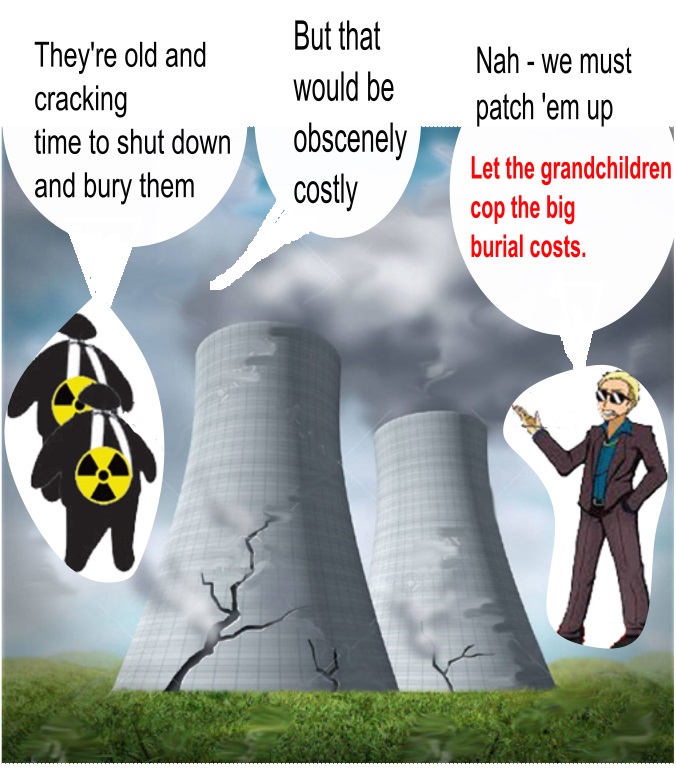
Reuters, By Paul Day, April 5 – Nuclear operators must be able to swap out old parts for new to keep a reactor running, but when like-for-like is unavailable, original equipment manufacturers (OEMs) are faced with the challenge of finding an alternative while avoiding making any major changes.
There’s a rule of thumb that if a plant has to do a design change, it’ll cost anywhere from $300,000-$500,000 just in engineering, licensing changes, drawing changes, and that doesn’t include the cost of the required equipment … so we try, wherever possible, to keep our clients from doing a design change,” says Vice President of Westinghouse Parts Business in its Operating Plant Services unit Craig Irish………………………….
Life extensions
Many of the world’s nuclear power plants were built several decades ago and applications for long-term operations (LTOs) beyond initial lifespans are becoming increasingly common.
…………………………………………………………..In the United States………….the average age of the fleet is 41 years including three reactors that started operation 52 years ago, according to the Department of Energy (DOE)
Nine U.S. reactors have active applications with the Nuclear Regulatory Commission (NRC) to extend their lives and 10 reactors have publicly announced plans to extend their licenses to 80 years.
“Under current license basis 92% of operating reactors would shut down by 2050 and 74 percent would shut down by 2050 with anticipated license renewals. However, if 54 reactors extended operation to 80 years, only 20% of operating reactors would shut down by 2050,” the DOE said in its 2022 report on nuclear energy supply chains.
Obsolescence challenge
The challenge, say OEMs, is keeping a supply chain running and up to date for complex, always-on machines that were built with Reagan-era (or earlier) technology.
………………with construction times for some plants approaching ten years, many of the parts can be obsolete before the plant has even started generating power, according to Westinghouse’s Irish.
……………………………………………Internationally, part of the challenge is many of the parts produced for the nuclear industry face varying specifications depending on the regulator they are working under, restricting an already tight market to national boundaries.
Such differences will become even more pronounced with the introduction of a new generation of reactors expected to begin commercial operations within the next decade, with more than 70 SMR designs under development in 18 countries.
…………………………………………………………………………… “The biggest problem is a lot of these discrete components, resistors, diodes, transistors, capacitors, etc are either substantially changed from the 70s and 80s when we built these instruments or they’re not available or they got bought and sold by another company,” he says. https://www.reuters.com/business/energy/nuclear-life-extension-plans-tested-by-obsolete-components-2023-04-05/
Rolls Royce shares OK for civil aviation, but investment in small nuclear reactors is risky

Will going nuclear send Rolls-Royce shares into meltdown?
Dr James Fox takes a closer look at Rolls-Royce shares. What’s next for the British engineering giant after the recent rally came to an end in March?
The Motley Fool, Dr. James Fox 23 Apr 23
Rolls-Royce (LSE:RR) shares have been red-hot in recent months, going from strength to strength. But the FTSE 100 stock has plateaued since March.
So what could drive the share price forward in the coming years? Could it be Rolls-Royce’s entry into the nuclear space?
Rolls-Royce (LSE:RR) shares have been red-hot in recent months, going from strength to strength. But the FTSE 100 stock has plateaued since March.
So what could drive the share price forward in the coming years? Could it be Rolls-Royce’s entry into the nuclear space?
For some, the jury is out on the future profitability of the modular nuclear reactor programme — the plan was given government approval and funding last year.
………. In theory, Rolls would ‘mass produce’ these small reactors, with a capacity of 470MW, and sell them for around £2bn.
………..there are challenges. First among them are reports that the UK government is preparing to invite international bids for next-generation nuclear power projects, thus removing its backing for Rolls-Royce’s product in development.
With billions of forecast development costs, it would be disastrous if the government started to favour other companies — the share price would really suffer.
What matters more?
The nuclear programme is interesting but, in reality, other sectors are more important — for now at least. In the near term, I’m hoping to see more signs of the recovery in civil aviation. This is Rolls’ biggest sector and a post-pandemic recovery will propel the company forward.
…………………..Despite the risks in the SMR space, I’m not fearing a share price meltdown. https://www.fool.co.uk/2023/04/23/will-going-nuclear-send-rolls-royce-shares-into-meltdown/
—
G7’s statement on nuclear issue hypocritical and pale
By Da Zhigang
As a diplomatic barometer for the upcoming Group of Seven (G7) summit to be held in Hiroshima next month, the G7 Foreign Ministers’ Meeting concluded recently. It is worth noting that the tone of this G7 Foreign Ministers’ Meeting was filled with an increasingly strong tone, and the subtext of the agenda was also permeated with a nervy atmosphere.
……………………………………………………..finding new excuses to demonize China has become a consensus among the G7 countries. Against the backdrop of the ongoing conflict between Russia and Ukraine, the increasing new sanctions imposed by the U.S. and Europe on Russia, and the increasingly complex and changing international situation, it is easy to find fault with China. Therefore, the new excuse targeting China’s nuclear weapons has emerged. In fact, the U.S. possesses the largest and most advanced nuclear arsenal in the world, and it has deployed nuclear weapons in many of its allies. In recent years, the U.S. has been engaged in strategic nuclear deterrence and the expansion of nuclear sharing while withdrawing from and violating multiple international arms control agreements in the global military control field.
Secondly, the emphasis on the so-called Chinese nuclear weapons issue highlights the hypocrisy of the G7’s advocacy of nuclear disarmament. The joint statement of the G7 foreign ministers repeatedly emphasized that member countries have reached consensus on nuclear disarmament and non-proliferation and confirmed that the G7 will promote corresponding measures. As the rotating chair of this G7 foreign ministers’ meeting and next month’s Hiroshima Summit, Japan has once again promoted the initiative to build a World without Nuclear Weapons based on the Hiroshima Action Plan and the historical experience of Hiroshima and Nagasaki being bombed with atomic bombs. This move has been welcomed by other G7 members.
However, when we peel off the clamor of nuclear disarmament and a World without Nuclear Weapons, we seem to see more clearly the hypocritical intentions outlined in the joint statement of the G7 Foreign Ministers’ Meeting. This can be seen from the establishment of the AUKUS security alliance by the U.S., Australia, and the UK. The open transfer of nuclear submarine power reactors and weapons-grade highly enriched uranium to Australia clearly violates the Treaty on the Non-Proliferation of Nuclear Weapons.
……………………………………..There is no doubt that China has always firmly followed the nuclear strategy of self-defense, adhered to the policy of no first use of nuclear weapons, and kept its nuclear force at the minimum level required to maintain national security. China is the only country among the five nuclear-weapon states to have made this pledge. The G7 selectively ignores China’s solemn commitment, tramples on China’s image of peaceful development, as well as the concept of international peace and development.
…………………………………………… Pointing fingers at other countries’ strategic security while downplaying their own military control obligations, the joint statement of the G7 foreign ministers’ meeting pointed at the so-called “China’s nuclear weapons issue” and made irresponsible remarks. The international community disagrees with this today, and so will it in the future.
(The author is a researcher at the Institute of Northeast Asian Studies at Heilongjiang Provincial Academy of Social Sciences and the chief expert of the Northeast Asia Strategic Research Institute.) http://eng.chinamil.com.cn/OPINIONS_209196/Opinions_209197/16219295.html
UK seeks a nuclear energy renaissance – but experts question whether it’s value for money

The most powerful argument against nuclear could be economic as most plants take at least ten years to commission, design and build
inews, By Leo Cendrowicz, Brussels Correspondent, 21 Apr 23,
BRUSSELS – As Europe scrambles for new energy sources, Britain has joined the countries seeking a nuclear renaissance.

Chancellor Jeremy Hunt announced last month the creation of Great British Nuclear, a body to oversee the roll-out of a fleet of nuclear power stations.
However, there are concerns about the environmental impact of nuclear, with campaign groups saying that the risks of nuclear reactions and the difficulties in disposing of nuclear waste mean it cannot be considered green.
And the most powerful argument against nuclear could be economic. Most plants take at least ten years to commission, design and build. Delays are frequent: Europe’s largest nuclear reactor, the Olkiluoto 3 plant in Finland, came online last week a full 14 years after its scheduled date, beset by technological problems that led to lawsuits – while its final price tag ballooned to around €11bn (£9.74bn), almost three times the initial estimate.
The steep upfront building costs for nuclear power plants, along with the long construction times, have raised questions about whether nuclear energy represents value for money.
Now that renewable costs are going down – especially in solar, wind and batteries – renewable is likely to be cheaper in the longer term, making nuclear commissions look less worthwhile.
The fact that Europe has built few nuclear plants since the boom wave of the 60s also means there is little expertise available across the value chain. The EU Internal Market Commissioner Thierry Breton has said a “colossal” investment in nuclear energy will be needed over the next 30 years to meet the EU’s emissions-reduction targets and electricity demand.
“The big question on nuclear is the economics of building new nuclear plants,” says Ben McWilliams, an energy research analyst at Bruegel – a Brussels-based think tank. “When you compare it to something like solar or wind, which are also modular technologies, so you can have much larger economies of scale – you have to ask if it is sensible to start building new nuclear plants that will come online in 15 or 20 years when they’re going to compete in a grid that should be largely renewable dominated?”
……………………………… France, Europe’s champion, has not been the best advertisement recently: last November, almost half of the country’s reactors were offline, thanks to maintenance issues in its ageing nuclear fleet.
The UK’s strategy is to focus on small modular reactors (SMRs) to ensure faster build times. These mini reactors would generate between 50 and 500 megawatts of power, compared with the 3.2-gigawatt Hinkley Point C in Somerset, the UK’s only large nuclear plant under construction, which is plagued by delays and cost overruns.
………………………….. . In February, 11 EU energy ministers signed a declaration committing to “cooperate more closely” across the entire nuclear supply chain and promote “common industrial projects” in new generation capacity as well as new technologies like small reactors.
While energy policy is mostly set at national level within the European Union, the long-term push is for green, renewable energy. The European Commission has attempted to nudge governments to wean themselves off fossil fuels, adopting a controversial measure that labels nuclear investments as sustainable “transitional” sources, if they replace dirtier fuels. Last Tuesday, Greenpeace and other campaign groups announced plans to take the Commission to the EU Court of Justice of the EU. https://inews.co.uk/news/world/uk-nuclear-energy-renaissance-expert-money-2289161
Earth Day 2023: A Newly Post-Nuclear Germany vs. California’s Reactor Relapse

Germany’s initiative calls out California’s backpedaling.
BY HARVEY WASSERMAN , APRIL 22, 2023
This year’s Earth Day marks a massive green energy triumph in Germany that stands in stark contrast to a bitter nuclear challenge in California.
A wide range of estimates put the two regions at a virtual tie for the world’s fourth and fifth-largest economies.
They also share a leading growth industry—renewable energy, with unprecedented investments in wind, solar, batteries, and efficiency.
But when it comes to atomic power, they are headed in very different directions.
On April 15, Germany claimed a huge global landmark by becoming one of the world’s wealthiest nations to renounce atomic power.
The decision dates back to 2011, when Germany’s powerful Green movement led a national demonstration aiming to shut the seventeen atomic reactors that, at the time, provided around a quarter of the nation’s electricity.
Before the rally took place, four reactors blew up in Fukushima, Japan, sending huge clouds of radioactive fallout into the air and ocean.
Germany’s then-Chancellor Angela Merkel—who has a Ph.D. in quantum chemistry—ordered eight reactors immediately shut, and soon announced a plan to shut the remaining nine by December 31, 2022.
This energiewende, or “energy transition,” substitutes wind, solar, battery storage, and increased efficiency for nuclear power reactors, moving Germany toward full reliance on renewables. Germany, since then, has invested billions in the renewables sector, transitioning whole towns to locally-owned rooftop solar and corporate wind power pumped in from large turbines in the North Sea.
The shutdown of the final three reactors was delayed by nearly four months due to natural gas shortages caused by the Russian war in Ukraine.
It was also complicated by a major atomic breakdown in neighboring France. Heavily reliant on nuclear power, France’s more than fifty standard-design reactors succumbed to a wide range of problems, including generic structural flaws and warming rivers too hot to cool their super-heated radioactive cores. In 2022, with more than half its fleet of reactors under repair, France made up for the energy shortfall by importing power from Germany, much of it fired by the burning of coal.
This prompted the nuclear industry to criticize Germany’s plan by pointing to a rise in the country’s CO2 emissions from burning increased quantities of coal, failing to note that much of that power was being exported to France to compensate for its own shuttered reactors.
California, whose economy may now be slightly larger than Germany’s, has taken an opposite route.
Two of its last four reactors—at San Onofre, between Los Angeles and San Diego—were shuttered in 2012 and closed permanently in 2013 after flaws were found in the turbines and other components.
In 2016, a deal was reached to shut the Golden State’s last two reactors, located at Diablo Canyon, nine miles west of San Luis Obispo. In the 1970s and 1980s, thousands of protestors were arrested at Diablo Canyon, more than at any other American nuclear plant.
The 2016 shutdown deal involved another energiewende, based on blueprints to replace Diablo’s power with a huge influx of new wind, solar, battery, and efficiency installations. The agreement was approved by the California state legislature, Pacific Gas & Electric (PG&E), the federal Nuclear Regulatory Commission (NRC) and the state Public Utilities Commission. It was signed by then-Governor Jerry Brown, then-Lieutenant-Governor Gavin Newsom, and a wide range of local governments, unions, and environmental groups, all of whom assumed the state would thus be nuke-free once Unit Two was shut in 2025—the date its original forty-year license would expire.
But along the way, the state experienced two close calls with partial blackouts. During both incidents, Newsom, now the governor, asked consumers to dial back their energy use. Ironically, independent battery capacity—mostly controlled by individual owners—helped the state stay lit.
But Newsom reversed course and now argues that California must keep Diablo open. Infuriating the national safe energy movement, Newsom rammed through the legislature a $1.4 billion midnight bailout for PG&E, to be funded by all of the state’s consumers, including many who live hundreds of miles from the plant, and receive no energy from it at all.
The Biden Administration also kicked in $1.1 billion, money that safe energy advocates angrily argue would be far better spent on renewables.
In 2019 a statewide petition signed by Hollywood’s Jane Fonda, Martin Sheen, Lily Tomlin, Eric Roberts, and some 2,500 other Californians demanded that Newsom facilitate an independent inspection. Nearing forty years of age, both Diablo reactors suffer a wide range of structural and age-related defects.
They are also surrounded by at least a dozen known earthquake faults, sitting just forty-five miles from the infamous San Andreas fault. Former NRC site inspector Michael Peck, who was stationed at Diablo for five years, has warned it might not survive a major earthquake, for which its owner, PG&E, has little or no private insurance. The state has never made public any plans to evacuate Los Angeles or other heavily populated areas in the event of an accident.
Newsom has also supported moves by state regulators to severely slash compensation paid by utilities to solar panel owners who feed their excess energy into the grid. While 1,500 workers are stationed at Diablo, some 70,000 work in the state’s solar industry, which angrily charges that Newsom’s pro-nuclear, anti-green positions are crippling the state’s top job creator.
Indeed, the irony of these twin economies heading in opposite energy directions is hard to ignore. In the 1970s, much of America’s early anti-nuclear movement was inspired by mass demonstrations led by German Greens (with the slogan “Atomkraft? Nein, danke!”). Both movements succeeded in massively moving their communities toward a renewable future.
But at this critical moment, Germany appears to be moving beyond nuclear power, while California clings to a hugely controversial technology it had once planned to transcend.
Germany’s Energy Revolution (‘Energiewende’) is working
When the Energiewende was legislated in 2000, the renewable share of the German power consumption market was just 6 %. In 2022, wind, solar and other renewables covered 54% of Germany’s power consumption. Meanwhile, electricity sector emissions have been cut by half since 1990. The plan is 80% renewables by 2030. The nuclear phaseout cleared the way for the renewable boom.
NATO conducts large-scale submarine warfare exercise in Norwegian Sea — Anti-bellum

NATOAllied Maritime CommandApril 20, 2023 NATO boosts capability on Northern Flank with major Anti-Submarine Warfare exercise Twelve Allied nations are set to take a part in a large-scale Anti-Submarine Warfare (ASW) exercise in the North Atlantic starting April 24. NATO-led Exercise Dynamic Mongoose is a live exercise (LIVEX) held annually in the High North. This […]
NATO conducts large-scale submarine warfare exercise in Norwegian Sea — Anti-bellum
April 23 Energy News — geoharvey

Opinion: ¶ “Single-Use Plastic Is Wreaking Havoc On The Planet. Here’s What You Can Do To Minimize Your Impact” • The life cycle of plastic begins with oil and gas are extraction. The fossil fuels are refined in facilities that use extreme temperatures and significant amount of water and energy. The plastic is used once. […]
April 23 Energy News — geoharvey
1 This Month

of the week – Shut Down Drone Warfare!


Tell the Ukrainian Government to Drop Prosecution of Peace Activist Yurii Sheliazhenko

Petition to revoke the licensing of the Near Surface Nuclear Disposal Facility (NSDF) at Chalk River. https://www.ourcommons.ca/petitions/en/Petition/Details?Petition=e-7247
To see nuclear-related stories in greater depth and intensity – go to https://nuclearinformation.wordpress.com
-
Archives
- April 2026 (103)
- March 2026 (251)
- February 2026 (268)
- January 2026 (308)
- December 2025 (358)
- November 2025 (359)
- October 2025 (376)
- September 2025 (257)
- August 2025 (319)
- July 2025 (230)
- June 2025 (348)
- May 2025 (261)
-
Categories
- 1
- 1 NUCLEAR ISSUES
- business and costs
- climate change
- culture and arts
- ENERGY
- environment
- health
- history
- indigenous issues
- Legal
- marketing of nuclear
- media
- opposition to nuclear
- PERSONAL STORIES
- politics
- politics international
- Religion and ethics
- safety
- secrets,lies and civil liberties
- spinbuster
- technology
- Uranium
- wastes
- weapons and war
- Women
- 2 WORLD
- ACTION
- AFRICA
- Atrocities
- AUSTRALIA
- Christina's notes
- Christina's themes
- culture and arts
- Events
- Fuk 2022
- Fuk 2023
- Fukushima 2017
- Fukushima 2018
- fukushima 2019
- Fukushima 2020
- Fukushima 2021
- general
- global warming
- Humour (God we need it)
- Nuclear
- RARE EARTHS
- Reference
- resources – print
- Resources -audiovicual
- Weekly Newsletter
- World
- World Nuclear
- YouTube
-
RSS
Entries RSS
Comments RSS
 nuclear-news