TODAY. Space X rocket – “A successful failure” – George Orwell would love it!
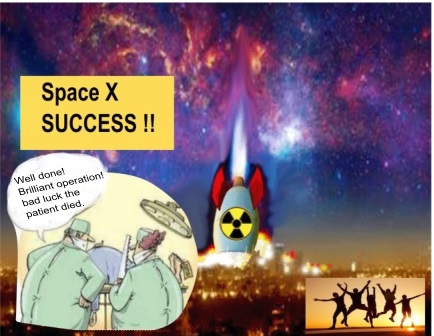
If only George Orwell were alive today! He would love it – Orwell, who wrote:
“It’s a beautiful thing, the destruction of words.”
George Orwell tried to show us the danger of accepting sloppy, dishonest language, and how this erodes democracy.
Already we have the mantra on Ukraine and Taiwan, spreading one of Orwell’s favourites “War is Peace“, and the corporate media news happy with “Ignorance is strength.”
“Failure is Success” – this beautiful Orwellian-style phrase is right now being pushed across the media, as we learn of the obscenely expensive, tax-payer funded Star X space rocket launch. So successful that it lasted a full 3 minutes before it exploded!
Wake up people – we are all being taken for a ride by the space-nuclear-weapons establishment – for a pointless aim of USA ruling space and colonising Mars
Meanwhile people are homeless, children go hungry, and global heating rampages on.
And we’re supposed to rejoice at this disgusting rocket “success” !
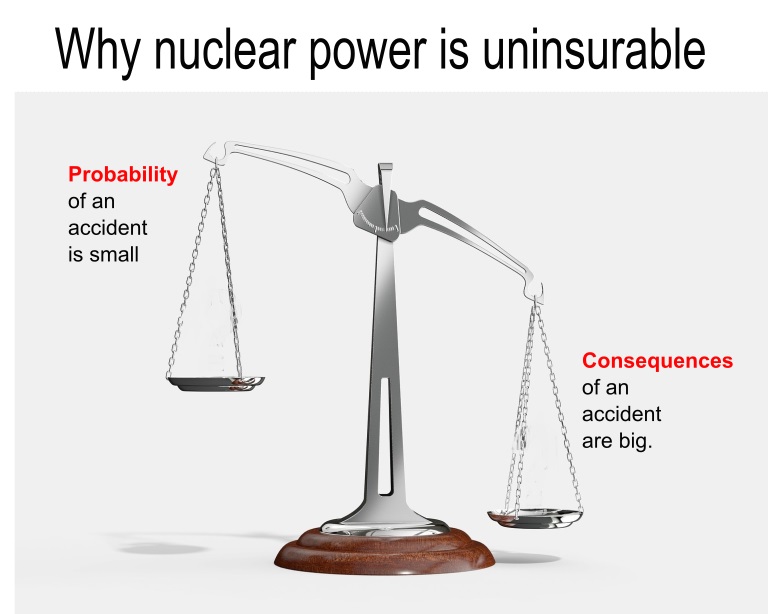
Globally, taxpayers are on the hook for nuclear accidents. Nuclear is uninsurable and unacceptable.
Simon Daigle – 21 Apr 23,
Simon J Daigle, B.Sc., M.Sc., M.Sc.(A) Concerned Canadian Citizen. Occupational / Industrial Hygienist, Epidemiologist. Climatologist / Air quality expert (Topospheric Ozone).
Any NPP plant globally has no guarantees from insurers, or governments, or have adequate accident liabilities to cover for just one NPP accident and any country host NPP taxpayers are always on the hook for damages
When will governments globally understand that taxpayers should not be collateral damage (tokens) financially for potential human suffering and/or irreversible biosphere damage as « willing » participants for the nuclear industry ? The answer should be none. Yet we see a different reality and narrative. It’s all Shameful.
In India, a US company paid a fraction of the true cost of one chemical disaster: Bhopal (less than 500 million US dollars) for one chemical accident. And worse, they were never found guilty in a court of law in the US. Imagine when nuclear accident happens in India ? Who will be responsible? We know today that the true cost are billions (USD) because of Chernobyl and Fukushima tragedies for examples.
Now, in 2023, and for past decades, any nuclear accident in India, or elsewhere, citizens and taxpayers, had and will continue to absorb the true public burden in the global insurance pool for all nuclear energy countries that are contributing in for covering any NPP risks or accident liabilities.
Current insurance policy are clearly inadequate to repair and compensate for any human suffering, death, disease, and biosphere irreversible damages for any potential NPP accident, nuclear waste and compensation.
Unacceptable.
French Winter Power Twice as Pricey as Germany’s on Nuclear Woes

Bloomberg By Todd Gillespie, April 19, 2023
France’s weakened nuclear power output means the cost of its electricity for next winter is more than twice as expensive as Germany’s, as concerns over the health of the country’s reactors persist.
The “massive” gap of nearly €250 ($273) per megawatt-hour between French and German prices is because traders are pricing in more risk as they await updates on Electricite de France SA’s struggles with its aging atomic fleet, according to analysts at Engie SA’s EnergyScan. “No participants want to risk being short next winter,” they wrote.
French power for the first quarter of 2024 is trading at €416 per megawatt-hour, more than double Germany’s rate of €169. Normally a power exporter, France’s atomic generation has been gradually returning to service but still remains below historical averages.
The price discrepancy is a sign of France’s lingering energy woes even as its European neighbors benefit from a prolonged drop in prices. EDF’s nuclear reactors have faced recurring corrosion issues as the government takes greater hold over the state-backed utility………………… https://www.bloomberg.com/news/articles/2023-04-19/french-winter-power-twice-as-pricey-as-germany-s-on-nuclear-woes?leadSource=uverify%20wall—
Six war mongering think tanks and the military contractors that fund them.

Center for Strategic and International Studies
Center for a New American Security
Hudson Institute
Atlantic Council
International Institute for Strategic Studies
Australian Strategic Policy Institute
Amanda Yee, March 7, 2023 https://www.liberationnews.org/six-war-mongering-think-tanks-and-the-military-contractors-that-fund-them/
From producing reports and analysis for U.S. policy-makers, to enlisting representatives to write op-eds in corporate media, to providing talking heads for corporate media to interview and give quotes, think tanks play a fundamental role in shaping both U.S. foreign policy and public perception around that foreign policy. Leaders at top think tanks like the Atlantic Council and Hudson Institute have even been called upon to set focus priorities for the House Intelligence Committee. However, one look at the funding sources of the most influential think tanks reveals whose interests they really serve: that of the U.S. military and its defense contractors.
This ecosystem of overlapping networks of government institutions, think tanks, and defense contractors is where U.S. foreign policy is derived, and a revolving door exists among these three sectors. For example, before Biden-appointed head of the Pentagon Lloyd Austin took his current position, he sat on the Board of Directors at Raytheon. Before Austin’s appointment, current defense policy advisor Michèle Flournoy was also in the running for the position. Flournoy sat on the board of Booz Allen Hamilton, another major Pentagon defense contractor. These same defense contractors also work together with think tanks like the Center for Strategic and International Studies to organize conferences attended by national security officials. On top of all this, since the end of the Cold War, intelligence analysis by the CIA and NSA has increasingly been contracted out to these same defense companies like BAE Systems and Lockheed Martin, among others — a major conflict of interest. In other words, these corporations are in the position to produce intelligence reports which raise the alarm on U.S. “enemy” nations so they can sell more military equipment!
And of course these are the same defense companies that donate hundreds of thousands of dollars each year to think tanks. Given all this, is it any wonder the U.S. government is simultaneously flooding billions of dollars of weaponry into an unwinnable proxy war in Ukraine while escalating a Cold War into a potential military confrontation with China?
The funding to these policy institutes steers the U.S. foreign policy agenda. To give you a scope of how these contributions determine national security priorities, listed below are six of some of the most influential foreign policy think tanks, along with how much in contributions they’ve received from “defense” companies in the last year.
All funding information for these policy institutes was gathered from the most recent annual report that was available online. Also note that this list is compiled from those that make this information publicly available — many think tanks, such as the hawkish American Enterprise Institute, do not release donation sources publicly.
1 – Center for Strategic and International Studies
According to their 2020 annual report
$500,000+: Northrop Grumman Corporation
$200,000-$499,999: General Atomics (energy and defense corporation that manufactures Predator drones for the CIA), Lockheed Martin, SAIC (provides information technology services to U.S. military)
$100,000-$199,999: Bechtel, Boeing, Cummins (provides engines and generators for military equipment), General Dynamics, Hitachi (provides defense technology), Hanwha Group (South Korean aerospace and defense company), Huntington Ingalls Industries, Inc. (largest military shipbuilding company in the United States), Mitsubishi Corporation, Nippon Telegraph and Telephone Corporation (provides intelligence and information technology services to U.S. military), Qualcomm, Inc. (semiconductor company that produces microchips for the U.S. military), Raytheon, Samsung (provides security technology to the U.S. military), SK Group (defense technology company)
$65,000-$99,999: Hyundai Motor (produces weapons systems), Oracle
$35,000-$64,999: BAE Systems
2 – Center for a New American Security
$500,000+: Northrop Grumman Corporation
$250,000-$499,999: Lockheed Martin
$100,000-$249,000: Huntington Ingalls Industries, Neal Blue (Chairman and CEO of General Atomics), Qualcomm, Inc., Raytheon, Boeing
$50,000-$99,000: BAE Systems, Booz Allen Hamilton, Intel Corporation (provides aerospace and defense technology), Elbit Systems of America (aerospace and defense company), General Dynamics, Palantir Technologies
3 – Hudson Institute
According to their 2021 annual report
$100,000+: General Atomics, Linden Blue (co-owner and Vice Chairman of General Atomics), Neal Blue, Lockheed Martin, Northrop Grumman
$50,000-$99,000: BAE Systems, Boeing, Mitsubishi Heavy Industries
4 – Atlantic Council
According to their 2021 annual report
$250,000-$499,000: Airbus, Neal Blue, SAAB (provides defense equipment)
$100,000-$249,000: Lockheed Martin, Raytheon
$50,000-$99,000: SAIC
5 – International Institute for Strategic Studies
Based in London. From fiscal year 2021-2022
£100,000+: Airbus, BAE Systems, Boeing, General Atomics, Lockheed Martin, Raytheon, Rolls Royce (provides military airplane engines)
£25,000-£99,999: Northrop Grumman Aerospace Systems, Northrop Grumman Corporation
6 – Australian Strategic Policy Institute
Note: ASPI has been one of the primary purveyors of the “Uyghur genocide” narrative
From their 2021-2022 annual report
$186,800: Thales Australia (aerospace and defense corporation)
$100,181: Boeing Australia
$75,927: Lockheed Martin
$20,000: Omni Executive (aerospace and defense corporation)
$27,272: SAAB Australia
This is why Youth, MPs and ICAN are going to Hiroshima next week

| Daniel Högsta, ICAN <admin@icanw.org> |
In May, the heads of the G7 states will meet in Hiroshima for their annual summit. Given the location, all eyes will be on these seven leaders – who represent states that either have, host or rely on nuclear weapons- to see if they can commit to real action to eliminate the weapons that once flattened Hiroshima, or whether it will all be empty rhetoric. So in the coming month we’ll be ramping up the pressure on them to do the right thing!
The signs aren’t looking great so far. Earlier this week, the G7 foreign ministers met in Japan, and their statement neglected to acknowledge how their own nuclear weapons policies including foreign stationing, modernising their arsenals and the implicit threat to use these weapons in their nuclear doctrines undermine global security. They also failed to present any new or concrete ideas for moving towards the elimination of nuclear weapons.
In May, the G7 leaders will have to do better. Reports indicate the leaders have committed to meet with atomic bomb survivors, hibakusha, during their visit. The call of the hibakusha is loud and clear – we need to prohibit and eliminate nuclear weapons. The UN Treaty on the Prohibition of Nuclear Weapons (TPNW) is the clearest path to doing so.

That is why we’re spending this month making these leaders feel the pressure:
That is why we’re spending this month making these leaders feel the pressure:
• Last week, ICAN coordinated with hundreds of civil society organisations around the world to present a set of joint demands to the G7 from the official civil society engagement group, the C7.
• Next week, on 25-27 April, the G7 Hiroshima Youth Summit will bring together over 50 participants to meet with survivors, visit Hiroshima, connect with others in advance of the G7 summit and announce the recommendations they’ve developed together for G7 leaders.
Immediately afterwards, the G7 Parliamentarian Forum for the Elimination of Nuclear Weapons – held in Tokyo and Hiroshima on April 28th to 30th – will bring together elected officials from all 7 states to discuss and recognise the catastrophic humanitarian consequences of nuclear weapons, condemn threats to use them, and discuss ways to eliminate them altogether through the TPNW.
We hope these events will inspire and empower the participants to go back to their countries and demand action from their governments, so that the leaders feel the pressure even before they arrive. And in the coming weeks, we will keep you posted on ways you can get involved, particularly if you are also in a G7 state.
And of course, we will be sharing a lot of our activities on social media next week, so make sure you are following us (we’re on Twitter, Facebook, Instagram, Tiktok and LinkedIn) and tune in to the livestream from the Youth Summit’s public event on April 26th here.
SpaceX launches most powerful rocket in history in explosive debut – like many first liftoffs, Starship’s test was a successful failure
The Conversation, Wendy Whitman Cobb 21 Apr 23
Professor of Strategy and Security Studies, Air University
Starship is almost 400 feet (120 meters) tall and weighs 11 million pounds (4.9 million kilograms). An out-of-control rocket full of highly flammable fuel is a very dangerous object, so to prevent any harm, SpaceX engineers triggered the self-destruct mechanism and blew up the entire rocket over the Gulf of Mexico.
On April 20, 2023, a new SpaceX rocket called Starship exploded over the Gulf of Mexico three minutes into its first flight ever. SpaceX is calling the test launch a success, despite the fiery end result. As a space policy expert, I agree that the “rapid unscheduled disassembly” – the term SpaceX uses when its rockets explode – was a very successful failure.
The most powerful rocket ever built
This launch was the first fully integrated test of SpaceX’s new Starship. Starship is the most powerful rocket ever developed and is designed to be fully reusable. It is made of two different stages, or sections. The first stage, called Super Heavy, is a collection of 33 individual engines and provides more than twice the thrust of a Saturn V, the rocket that sent astronauts to the Moon in the 1960s and 1970s.
The first stage is designed to get the rocket to about 40 miles (65 kilometers) above Earth. Once Super Heavy’s job is done, it is supposed to separate from the rest of the craft and land safely back on the surface to be used again. At that point the second stage, called the Starship spacecraft, is supposed to ignite its own engines to carry the payload – whether people, satellites or anything else – into orbit.
An explosive first flight
While parts of Starship have been tested previously, the launch on April 20, 2023, was the first fully integrated test with the Starship spacecraft stacked on top of the Super Heavy rocket. If it had been successful, once the first stage was spent, it would have separated from the upper stage and crashed into the Gulf of Mexico. Starship would then have continued on, eventually crashing 155 miles (250 kilometers) off of Hawaii.
During the SpaceX livestream, the team stated that the primary goal of this mission was to get the rocket off the launch pad. It accomplished that goal and more. Starship flew for more than three minutes, passing through what engineers call “max Q” – the moment at which a rocket experiences the most physical stress from acceleration and air resistance.
According to SpaceX, a few things went wrong with the launch. First, multiple engines went out sometime before the point at which the Starship spacecraft and the Super Heavy rocket were supposed to separate from each other. The two stages were also unable to separate at the predetermined moment, and with the two stages stuck together, the rocket began to tumble end over end. It is still unclear what specifically caused this failure.
Starship is almost 400 feet (120 meters) tall and weighs 11 million pounds (4.9 million kilograms). An out-of-control rocket full of highly flammable fuel is a very dangerous object, so to prevent any harm, SpaceX engineers triggered the self-destruct mechanism and blew up the entire rocket over the Gulf of Mexico…………………………………… https://theconversation.com/spacex-launches-most-powerful-rocket-in-history-in-explosive-debut-like-many-first-liftoffs-starships-test-was-a-successful-failure-204248
Terrestrial Energy’s molten-salt reactor gets over one hurdle – but many more to come. Will it be a lemon?

Terrestrial Energy’s molten-salt reactor clears prelicensing review, Globe and Mail, MATTHEW MCCLEARN, APRIL 19, 2023
Nuclear-reactor developer Terrestrial Energy has completed a prelicensing review by the Canadian Nuclear Safety Commission, an early milestone along the road to commercialization of its next-generation product.
The Integral Molten Salt Reactor (IMSR) is the first of its kind to finish the CNSC process known as a vendor design review. Whereas conventional reactors use solid fuel, this novel variety features liquid fuel dissolved in molten salt that’s heated to temperatures above 600 degrees.
The review, which began in 2016, is intended to provide feedback to reactor vendors in the early stages of development, but does not confer a licence to build one. CNSC staff found “no fundamental barriers to licensing,” signalling their willingness to entertain next-generation designs radically different from Canada’s aging fleet of Candu reactors………..
the CNSC’s high-level findings, published Tuesday, highlight the challenges ahead. It called on Terrestrial to provide more information to confirm that the IMSR meets safety requirements. Sensors, monitoring equipment, instrumentation and control systems all need to be further developed……………
” you see a lot of engineering questions that have to be followed up on.” -Akira Tokuhiro, a professor at Ontario Tech’s energy and nuclear engineering department.
Prof. Tokuhiro said answering those questions means Terrestrial (which currently employs about 100 people) will need to grow its engineering staff. NuScale Power, an early developer of small modular reactors (SMR) founded in 2007, stands alone in achieving certification from the U.S. Nuclear Regulatory Commission. It needed 500 staff and US$1-billion to accomplish that, said Prof. Tokuhiro, who previously served as an engineer at NuScale.
“There have been SMR startups – I won’t name names – where the company and investors quit when they got to the point of going from 50 engineers to 500 engineers on payroll,” he said.
Prof. Tokuhiro estimated that fewer than 20 people throughout North America possess deep experience with molten salt technologies, making it difficult to find qualified workers. Moreover, Terrestrial will likely need to build a demonstration unit – another expensive undertaking.
“It has to be a facility that’s quality assured and quality controlled,” he said. “And it has to be able to produce data that the regulator accepts.”……..
nitially developed in the 1950s and 60s, molten salt reactors never operated commercially but have lately enjoyed renewed interest. The U.S. Department of Energy funded two small demonstration projects, and the Canadian government provided tens of millions of dollars to each of Terrestrial and Moltex Energy, another startup, based in New Brunswick, that’s marketing a model known as the Stable Salt Reactor – Wasteburner (SSR-W).
According to a 2021 report about advanced nuclear reactors by the Union of Concerned Scientists, molten salt reactors are “even less mature” than other novel designs such as sodium-cooled and gas-cooled reactors.
That report – entitled Advanced Isn’t Always Better– concluded they were “significantly worse” than traditional light-water reactors in terms of safety and the risk of nuclear proliferation and terrorism, but acknowledged that some molten salt reactors would generate less hazardous waste than conventional models.
“MSR fuels pose unique safety issues,” the report concluded. “Not only is the hot liquid fuel highly corrosive, but it is also difficult to model its complex behaviour as its flows through a reactor system. If cooling is interrupted, the fuel can heat up and destroy an MSR in a matter of minutes.
“Perhaps the most serious safety flaw is that, in contrast to solid-fuelled reactors, MSRs routinely release large quantities of gaseous fission products, which must be trapped and stored.”
The nuclear industry has precious few small modular reactors available for sale today, but is under intense pressure to bring new ones to market quickly to capitalize on an anticipated surge in demand for low-carbon electricity. Yet recent reactors based on conventional technologies took longer than 30 years to develop, license and build, and some ran disastrously overbudget……………………………………. https://www.theglobeandmail.com/business/article-terrestrial-energys-molten-salt-reactor-clears-prelicensing-review/
Searing heatwave hitting Southern and South Eastern Asia.

Much of southern and southeastern Asia is enduring a deadly,
record-smashing heat wave, one that’s being called the continent’s worst
ever recorded in April. Several all-time record high temperatures have been
broken, including a torrid 113.7 degrees in Tak, Thailand, the nation’s
hottest reading on record. Laos also recorded its highest reliable
temperature in its history earlier this week, with 108.9 degrees at Luang
Prabang, reported climatologist and weather historian Maximiliano Herrera.
As the searing heat spread from India to China to Thailand to Japan,
Herrera called it a “monster Asian heat wave like none before.”
USA Today 19th April 2023
One in three people on the planet hit by ‘monster Asian heatwave’. The
searing heat has spread across large parts of south and southeast Asia in
recent weeks, and impacted more than a dozen countries including India,
China, Thailand, Laos, Bangladesh, Turkmenistan, Japan and Korea. The
temperature hit a scorching 44.6 degrees Celsius in the western province of
Tak, Thailand this week, the hottest temperature ever recorded in the
country. Thailand’s Meteorological Department warned that the baking
weather would continue into next week.
Independent 20th April 2023
https://www.independent.co.uk/climate-change/news/asia-heatwave-india-china-thailand-b2323666.html
It’s High Time the US Signed a Peace Treaty with North Korea

Halt the Endless and Futile Condemnation of the DPRK
by Alice Slater* 21 Apr 23, https://www.indepthnews.net/index.php/armaments/nuclear-weapons/6110-it-s-high-time-the-us-signed-a-peace-treaty-with-north-korea
NEW YORK, 21 April 2023 (IDN) — It is far beyond hypocrisy for the US and its allies to condemn North Korea for testing a long-range missile when the US boasts about its Air Force Global Strike Command of more than 33,700 Airmen and civilians responsible for the nation’s three intercontinental ballistic missile wings capable of delivering nuclear weapons.
Indeed, a US Minute Man Intercontinental Ballistic Missile (IBM) was tested this past February, with another scheduled for this August.
The 1950-1953 Korean War is the longest-standing US conflict. It has never actually ended. It was only suspended by a truce and armistice between North Korea, representing the Korean People’s Army and the Chinese People’s Volunteers and the United States, representing the multinational UN Command.
During this endless armistice, we have had US troops stationed in South Korea, amassed on North Korea’s border, organizing “war games” and manoeuvres with South Korean troops in a continuous series of threats over the years against a heavily armed North Korea.
Various peace initiatives were contemplated, but the US withdrew from them or didn’t follow through. During those years, North Korea persisted in requesting a peace treaty, offering to stop enriching “peaceful” reactor material to bomb-grade in return for a lifting of punishing sanctions that were causing great stress and poverty to the people of North Korea.
It froze its nuclear program after an agreement with the Clinton administration but started it up again when President Bush in 2002 stopped honouring the Clinton agreements and characterized North Korea as part of the “axis of evil”.
In 2017, South Korea elected a new President, Moon Jae-in, who campaigned for a “Sunshine Policy” and for peaceful Korean reunification.
Ironically, at a United Nations First Committee Meeting for Disarmament in 2017, when the amazing International Campaign for the Abolition of Nuclear Weapons (ICAN) succeeded in its ten-year campaign to bring a vote to the UN floor for negotiations on a treaty to ban the bomb, five western nuclear powers, the US, UK, France, Russia, and Israel voted NO.
China, Pakistan, and India abstained, and North Korea was the only nuclear weapon state to vote YES for negotiations on the new Treaty for the Prohibition of Nuclear Weapons (TPNW), which was adopted later that year at a special UN negotiating session!
It was clear that North Korea was sending a signal to the world as the only nuclear weapon state to approve the talks to negotiate a ban treaty. But just as the Western reporting about North Korea today fails to acknowledge the extraordinary provocations North Korea suffers at the hand of the Western colonial powers and their allies, not a word about North Korea’s startling vote was reported in the mainstream media.
During the Trump Presidency, some progress was made in negotiations between the US and North Korea, with a supportive new peace president in South Korea, but Congress refused to honour Trump’s promise to Kim Jong Un that the US would remove some of our troops from South Korea as part of a peace deal for North Korea to forego the development of nuclear weapons.
In the United States, there is a growing movement of people inspired by the Women Cross DMZ, which in 2015 organized an unprecedented crossing of the De-Militarized Zone that separates North and South Korea, where 30 women, including Nobel Peace laureates and feminist leaders, joined with 10,000 Korean women on both sides of the DMZ.
Through their efforts, and on behalf of an estimated 100,000 people who cannot visit their families in the Koreas—two nations which continue to live in a perpetual state of war—there is legislation pending in the US House of Representatives, H.R. 1369, Peace on the Korean Peninsula Act, calling for a peace treaty to formally end the Korean War. It also calls for a review of the travel restrictions to North Korea and the establishment of liaison offices in both countries.
It is time to reevaluate our perception of North Korea, and treat it, not as a country planning to attack us with nuclear bombs but as a country that wants relief from the harsh sanctions and isolation it has endured these long 76 years.
The sooner we understand how the Empire has contributed to the “evil doings” of North Korea, the more true security we will gain. In the memorable words of Pogo Possum, the Walt Kelly comic character who entertained us during the red scare of the 1950s, “We have met the enemy and he is us!”
* Alice Slater serves on the boards of World Beyond War and the Global Network Against Weapons and Nuclear Power in Space and is an NGO representative to the UN for the Nuclear Age Peace Foundation. [IDN-InDepthNews]
NATO to surge troops to Russian border
As the deteriorating military situation for the Ukrainian armed forces becomes increasingly apparent, NATO is making open plans to massively intensify its conflict with Russia.
Andre Damon@Andre__Damon, 17 April 2023 m\ https://www.wsws.org/en/articles/2023/04/18/tzhv-a18.html
NATO plans to surge troops to Russia’s border as part of an effort to become a “war-fighting alliance,” the New York Times reported Monday.
The Times wrote that “NATO now has deployed a battalion of multinational troops to eight countries along the eastern border with Russia. It is detailing how to enlarge those forces to brigade strength in those frontline states.”
A battalion can include up to 1,000 troops, while a brigade can include up to 5,000 troops, meaning that NATO could potentially plan to increase the number of troops on Russia’s borders fivefold, to up to 40,000 troops.
The Times reports that NATO “is also tasking thousands more forces, in case of war, to move quickly in support, with newly detailed plans for mobility and logistics and stiffer requirements for readiness.”
Politico, meanwhile, has cited even larger numbers. On March 18, it reported, “In the coming months, the alliance will accelerate efforts to stockpile equipment along the alliance’s eastern edge and designate tens of thousands of forces that can rush to allies’ aid on short notice… The numbers will be large, with officials floating the idea of up to 300,000 NATO forces.”
“The North Atlantic Treaty Organization,” wrote the Times, has launched “a full-throttled effort” to prepare for military operations all along its eastern flank.
As the Times put it, this “means a revolution in practical terms: more troops based permanently along the Russian border,” It also means “more integration of American and allied war plans, more military spending and more detailed requirements for allies to have specific kinds of forces and equipment to fight, if necessary, in pre-assigned places.”
The alliance has “shed remaining inhibitions about increased numbers of Western troops all along NATO’s border with Russia,” the Times stated. The aim is “to make NATO’s forces not only more robust and more capable but also more visible to Russia.”
Additional troops will be placed under the direct authority of Gen. Christopher G. Cavoli, NATO’s Supreme Allied Commander Europe, who also commands American forces in Europe, as part of the NATO alliance’s decision.
The Times reports that General Cavoli is integrating American and allied war-fighting plans for the first time since the Cold War. Citing a NATO official, the newspaper wrote, “Americans are back at the heart of Europe’s defense … deciding with NATO precisely how America will defend Europe.”
This will entail a massive military buildup, involving enormous increases in military spending. “Now the demands will be tougher and more rigorous to bring the alliance back to a war-fighting capacity in Europe and make deterrence credible—to ensure that NATO can fight a high-intensity war against a rival, Russia, from the first day of conflict,” the Times wrote.
Instead of meeting the previous goal of 2 percent of gross domestic product devoted to the military, NATO members will be expected to spend between 2.5 and 3 percent, the Times reported.
In perhaps the most ominous passage in the article, the Times wrote, “Previously, the annual exercises of NATO’s nuclear forces, known as Steadfast Noon, were kept quiet. But last year, after Russia’s invasion, the exercise went ahead openly. It was important, a NATO official said, to show Moscow that the alliance wasn’t deterred by nuclear threats.”
NATO’s headquarters is likewise “being transformed into a major strategic and war-fighting command, charged with drawing up the alliance’s plans to integrate and deploy allied troops.”
The accession of Finland to NATO, which doubled the length of NATO’s land border with Russia, will be a key component of these plans, with Russia’s entire border with NATO becoming a militarized zone.
Just weeks after its accession to NATO, Finland has begun building a fence on the Russian border, with the initial section to be completed in June.
In June of last year, NATO published a strategy document declaring that the alliance must prepare for “high-intensity, multi-domain warfighting against nuclear-armed peer-competitors.” The document declared that “the Euro-Atlantic area is not at peace”—all but declaring that the alliance is at war.
In January, Rob Bauer, NATO’s top military spokesperson, declared that the US-led NATO alliance is prepared for a “direct clash with Russia.” Asked by Portugal’s RTP News, “You don’t believe that it’s only about Ukraine?” Bauer replied, “No, it’s about turning back to the old Soviet Union.”
The interviewer continued, “So the entire Eastern Flank is at risk somehow?” Bauer replied, “Yeah.” The interviewer asked, “We are ready to [sic] a direct confrontation with Russia?” To this Bauer replied, “We are.”
In this supercharged environment, NATO will begin Defender 23, the alliance’s annual war game, on April 22.
The exercise will involve 9,000 US troops and 17,000 soldiers from other NATO members. The “nearly two-month-long exercise is focused on the strategic deployment of U.S.-based forces, employment of Army pre-positioned stocks and interoperability with European allies and partners,” a Pentagon spokesperson said April 5.
A key goal of the exercise will be to “increase lethality of the NATO Alliance through long-distance fires” according to U.S. Army’s Europe and Africa commands.
This will be followed by Air Defender 2023, the largest NATO air exercise since its founding. A US Air National Guard official told the War Zone that Russian officials can “take away whatever message they want” from the drill.
Against this background, a group of former top officials from France, Germany, the United States and Spain have written an op-ed in the Guardian Sunday encouraging more direct NATO military intervention against Russia, declaring “We have to go ‘all in’ in our support for Ukraine.” They declare that “Ukraine needs the combined force of tanks, longer-range missiles and aircraft to conduct a successful counterattack, paving the way to Ukrainian victory.”
The press is full of such declarations. David Ignatius, writing in the Washington Post, argued, “President Biden doesn’t want to start World War III, but he will look back with regret if the United States and its allies leave any weapons or ammunition on the sidelines that could responsibly be used in this conflict. Whatever Biden might wish later he had done if things go badly, he should do now.”
As the deteriorating military situation for the Ukrainian armed forces becomes increasingly apparent, NATO is making open plans to massively intensify its conflict with Russia.
The nuclear lobby continues to buy universities- University of Wyoming well and truly bought.

University of Wyoming Receives Faculty Advancement Grant From Nuclear Regulatory Commission
UW, April 21, 2023
The U.S. Nuclear Regulatory Commission’s (NRC) Office of Nuclear Regulatory Research recently announced the University of Wyoming has been selected for a Faculty Development Advancement Award as part of the NRC’s University Nuclear Leadership Program.
The award was announced in person by Commissioner Annie Caputo and Raymond Furstenau, director of the Office of Nuclear Regulatory Research from the NRC, at UW’s Research Explorations for Nuclear Energy in Wyoming (RENEW) event April 14.
“We are pleased to welcome the University of Wyoming as a NRC University Nuclear Leadership Program grant recipient,” Furstenau says. “The university’s proposal is exactly the type of activity we were aiming for with this grant program.”
The $600,000 award is intended to support new faculty in the nuclear-related fields of nuclear engineering, health physics and radiochemistry, and it advances the NRC’s goal of focusing on university-led projects that complement current and future research needs.
UW’s School of Energy Resources (SER) will augment the funding with an additional $100,000……………………… https://www.uwyo.edu/uw/news/2023/04/uw-receives-faculty-advancement-grant-from-nuclear-regulatory-commission.html
Hungary to Prolong Nuclear Plant’s Lifetime as Expansion Stalls
By Marton Kasnyik, April 21, 2023 https://www.bloomberg.com/news/articles/2023-04-21/hungary-to-prolong-nuclear-plant-s-lifetime-as-expansion-stalls?leadSource=uverify%20wall
Hungary aims to extend the lifetime of its sole nuclear power plant by 20 years to bridge major delays to its Russian-managed expansion, according to a senior official.
Extending the operation of the Paks plant in southern Hungary will maintain the source of about 40% of the country’s electricity consumption. The government is currently assessing safety issues after previous 20-year extensions to the four existing reactors in the last decade.
“Our plan is to get a further 20 years of life-extension,” Energy Minister Csaba Lantos said at a conference on Friday.
Prime Minister Viktor Orban’s administration handed a €10 billion ($11 billion) contract to Russia’s Rosatom Corp. in 2014 to expand the Paks plant. The project has been marred by delays, including due to initial European Union opposition to the investment and the quality of Rosatom’s plans, which Hungary’s own regulator has said fell short of stringent requirements.
Last week, Hungary and Russia said they agreed to an amendment of their original contract following media reports of a potentially reduced role for Rosatom amid EU sanctions against Russia for its invasion of Ukraine.
The changes are “technical” in nature and don’t affect the project’s cost, Cabinet Minister Gergely Gulyas told reporters on Thursday, without elaborating.
Scrapping could be next for Russia’s nuclear-powered battle cruiser
It is likely not cost-efficient to do the highly needed upgrade of the Northern Fleet’s 25-year old flagship “Pyotr Velikiy”.
Read in Russian | Читать по-русски
By Thomas Nilsen, 20 Apr 23 https://thebarentsobserver.com/en/security/2023/04/scrapping-could-be-next-russias-nuclear-powered-battle-cruiser
“Currently, the question about withdrawing “Pyotr Velikiy” from the Navy is under consideration. Based on the experience of repairing and modernizing the “Admiral Nakhimov” of the same class has shown that this is very costly,” a navy source said to state-owned news agency TASS.
Like in many speculations on the fate of older navy vessels, Russian state media send mixed information. Shortly after the TASS report came on Thursday, RIA Novosti quoted an unnamed source saying there are no plans to retire the huge warship.
The “Pyotr Velikiy” and “Admiral Nakhimov” are of sister ships, both of the Kirov-class, the only nuclear-powered surface warships in the Russian Navy.
The “Admiral Nakhimov” has not been in operation since the early 1990ties, and has since 1999 been at the yard in Severodvinsk undergoing repair, change of uranium fuel elements in the reactors and a refit to receive new weaponry, including modern cruise-missiles.
However, as repeatedly reported by the Barents Observer over the last decade, the re-commissioning of the warship has seen one postponement following the other. Current plans to set sail in 2024 today seem unlikely.
The “Pyotr Velikiy” was supposed to be docked in Severodvinsk as soon as “Admiral Nakhimov” joins the Northern Fleet.
The warship is armed with several types of cruise missiles, surface-to-air missiles, rocket launchers, torpedos and artillery. The hangar can house three helicopters.
April 18 marked the 25-years anniversary since “Pyotr Velikye” was commissioned. The ship has a crew of more than 700.
Biden willing to damage US economy to counter China – US Treasury
21 Apr 23, https://www.rt.com/news/575100-china-sanctions-impact-us-economy-yellen/
Janet Yellen has conceded that protecting national security may come at an economic cost
President Joe Biden will stop at nothing to protect America against security threats posed by China, even if it means damaging the US economy, Treasury Secretary Janet Yellen has claimed.
“National security is of paramount importance in our relationship with China,” Yellen said during a speech in Washington in Wednesday. She gave the example of blocking China from obtaining certain technologies, adding, “We will not compromise on these concerns, even when they force trade-offs with our economic interests.”
Yellen accused China of “unfair” economic practices and of “taking a more confrontational posture” toward the US and its allies in recent years. Washington has a “broad set of tools” to deal with security threats from China, she added, such as export controls and sanctions against entities that provide support to the People’s Liberation Army (PLA).
The Treasury Department has sanctions authorities to address threats related to cybersecurity and China’s military-civil fusion,” Yellen said. “We also carefully review foreign investments in the United States for national security risks and take necessary actions to address any such risks. And we are considering a program to restrict certain US outbound investments in specific sensitive technologies with significant national security implications.”
The Biden administration has already taken steps to block Chinese companies from securing advanced semiconductor technologies, such as restricting exports of chip-making equipment. Yellen insisted that Washington doesn’t take such actions to gain an economic advantage or to stifle China’s growth and modernization.
Yellen also scolded China for alleged human rights abuses and alleged “no limits” support for Russia amid the Ukraine crisis. She warned that consequences would be severe if China provided material support or helped Russia evade sanctions, and she added that the US would use its “tools” to deter human rights abuses.
“Like national security, we will not compromise on the protection of human rights,” Yellen said. “This principle is foundational to how we engage with the world.”
Beijing has balked at US accusations, suggesting that Washington should “make more effort in solving its own human rights problems.” Chinese leaders also have faulted Washington for a “Cold War mentality” in which Beijing is demonized as a security threat as Biden’s administration tries to contain its economic progress.
“Containment and suppression will not make America great again, nor will it stop China from moving towards national rejuvenation,” Chinese Foreign Minister Qin Gang told reporters last month.
Yellen admitted earlier this week that Washington’s use of its leverage over the global financial system to sanction other countries could diminish the role of the US dollar as the world’s reserve currency. Asked about “weaponization” of the US currency, she told CNN that such tactics “could undermine the hegemony of the dollar.”
Does India have enough insurance coverage for a nuclear disaster?
India has barely half the insurance amount required by law for its current nuclear plants, and has many more plants in the works.
Aljazeera, By Urvashi Sarkar 21 Apr 2023
India has barely half the insurance amount it needs in the event of a nuclear disaster, raising concerns among experts about the lack of oversight on the nuclear sector.
The India Nuclear Insurance Pool (INIP) has collected around 7 billion to 8 billion rupees ($84.5m to $96.6m) of the 15 billion rupees ($182.9m) required under the Civil Liability for Nuclear Damage Act, 2010 (CLND), indicating a critical shortfall in funds that will be needed to compensate victims and pay for cleanup in case of a nuclear disaster………………………………………………………..
“The fact that the nuclear insurance pool has not even met what is required by law is concerning — it shows that the Parliament is not overseeing how the nuclear sector is operating,” said MV Ramana, professor at the School of Public Policy and Global Affairs, University of British Columbia and author of The Power of Promise: Examining Nuclear Energy in India. “My greater concern is the approach of NPCIL and other parties involved, which seem to think of liability requirements as a box to check off, rather than something they need to prudently plan for.”
“They seem to be victims of the same ‘safety myth’ that was at the root of the inadequate preparations for nuclear accidents revealed in the aftermath of the multiple reactor accidents at the Fukushima Daiichi nuclear plant in Japan [in March 2011],” Ramana said…………………………………….
India currently has 22 reactors, all of which are operated by the NPCIL. The INIP provides insurance to all of them. Apart from this, it has 10 reactors that are at various stages of construction (one of which has been connected to the grid) and New Delhi has sanctioned another 10 — all of which are expected to start functioning by 2031. But how these plants will be insured is unknown………………………………………………………… more https://www.aljazeera.com/economy/2023/4/21/does-india-have-enough-insurance-coverage-for-a-nuclear-disaster
1 This Month

of the week – Shut Down Drone Warfare!


Tell the Ukrainian Government to Drop Prosecution of Peace Activist Yurii Sheliazhenko

Petition to revoke the licensing of the Near Surface Nuclear Disposal Facility (NSDF) at Chalk River. https://www.ourcommons.ca/petitions/en/Petition/Details?Petition=e-7247
To see nuclear-related stories in greater depth and intensity – go to https://nuclearinformation.wordpress.com
-
Archives
- April 2026 (103)
- March 2026 (251)
- February 2026 (268)
- January 2026 (308)
- December 2025 (358)
- November 2025 (359)
- October 2025 (376)
- September 2025 (257)
- August 2025 (319)
- July 2025 (230)
- June 2025 (348)
- May 2025 (261)
-
Categories
- 1
- 1 NUCLEAR ISSUES
- business and costs
- climate change
- culture and arts
- ENERGY
- environment
- health
- history
- indigenous issues
- Legal
- marketing of nuclear
- media
- opposition to nuclear
- PERSONAL STORIES
- politics
- politics international
- Religion and ethics
- safety
- secrets,lies and civil liberties
- spinbuster
- technology
- Uranium
- wastes
- weapons and war
- Women
- 2 WORLD
- ACTION
- AFRICA
- Atrocities
- AUSTRALIA
- Christina's notes
- Christina's themes
- culture and arts
- Events
- Fuk 2022
- Fuk 2023
- Fukushima 2017
- Fukushima 2018
- fukushima 2019
- Fukushima 2020
- Fukushima 2021
- general
- global warming
- Humour (God we need it)
- Nuclear
- RARE EARTHS
- Reference
- resources – print
- Resources -audiovicual
- Weekly Newsletter
- World
- World Nuclear
- YouTube
-
RSS
Entries RSS
Comments RSS
 nuclear-news